In Defense of “Xmas”
Last Friday night I went to a sizeable seeker-sensitive church which was hosting an elaborate “Journey to Bethlehem.” It was a really impressive set up. Groups of a couple dozen each would be lead on a journey from Nazareth to Bethlehem by a fictitious Jewish man and his wife and daughter. Along the way were intimidating Roman soldiers (some on horseback), lots of sheep, goats, ponies and even camels on hand. We were even held up by bandits on the road before we reached our destination: the stable offered by the keeper of the already booked “Bethlehem Inn.”
So many people turned out this year to go on the journey, that before we began, we spent a good 30-45 minutes being entertained in the sanctuary of the church–which I suppose they prefer to call the worship center. We enjoyed a Christmas version of “Don’t Forget the Lyrics,” a couple of puppet shows, and a few videos. One of the videos was a kind of spoof of a football player who wanted to make sure everyone around him kept Christ in Christmas–if they didn’t, he’d tackle them! It was a funny video. However, as usual, one of the football players’ poor victims was sporting the widely misunderstood holiday abbreviation, “Xmas.” She got tackled. How many times per Christmas season do you hear Christians around you complain whenever they see or hear someone use the word “Xmas”? I’ve personally lost count.
Noah Webster’s 1828 American Dictionary of the English Language has this short and helpful explanation. Among other uses of the the letter x, it reads, “As an abbreviation, X. stands for Christ, as in Xn. Christian; Xm. Christmas.” Why, you ask, does x stand for Christ? The letter x is not only the third from the last letter of the English alphabet, it is also the Greek letter, chi (pronounced “key”), which corresponds to the English “ch.” Chi is the first letter of the Greek name for Christ. Yes, Virginia, it is that simple. Here’s a simple Greek alphabet for your orientation.
If you’ve ever gotten nervous or felt someone was demeaning Christ by using the abbreviation “Xmas,” may I be the first to reassure you that such is not the case. Wikipedia has a very informative entry about the history of the use of Xmas, as well as the How Stuff Works website. Learn it, love it, live it.
Merry Xmas!!!
Mega-Churches Respond to Reveal Study
This week on the White Horse Inn, the topic is the response of American mega-churches to the survey conducted by Willow Creek’s leadership (REVEAL) which concluded that the solution to dissatisfaction among faithful church members is less dependence on the organized church’s ministries, focusing on making individual Christians self-feeders.
For the record, here and here were my responses back when the survey originally made the headlines.
Listen to The White Horse Inn: learn what you believe and why you believe it.
Baptists & them “Whiskeypalians”
Sorry, Anglicans. Just a little Baptist humor, there. Just wanted to bring to the attention of my readers a couple of interesting psots: one by R. Scott Clark on the fallout from the SBC’s recent “John 3:16 Conference,” and another from Christianity Today with an update on the continuing drama in the schism of the Anglican Communion over the ordination of openly unrepentant “homosexuals.”
Bob Memed Me
Bob memed me. Apparently, this is some blogging game. Guess I’ll play along. But first, of course, I had to check out Wikipedia on “meme.” Did you know it’s roots lie in evolutionary theory, ala Richard Dawkins (you know, the famous atheist?–boy, this stuff is begging for the right uptight Christian blogger to step up on the nearest soapbox!) 😉 This recent theory got applied to the internet to create the phenomenon of the “internet meme.”
Okay, Bob says the rules are find the nearest book; open to page 123; count the first five full sentences; post the following three sentences; tag five other bloggers. Okay, here goes. The book I found is called Theodosia Ernest Or, The Heroine of Faith (you can read it online here), by nineteenth century Baptist Successionist A. C. Dayton at the suggestion of J. R. Graves (the father of modern Baptist Successionism in America). The story of Theodosia Ernest is a fictitious debate sparked by the discovery of a young Presbyterian lady that the Bible seemed to her to better support “Baptist baptism” than it does the Presbyterian infant baptism which she’d received herself. A debate ensues between her pastor and a Baptist preacher (I think one or two others, but I forget) about what the Bible and church history (read the Baptist Successionist theory of church history) reveal about baptism. Anyway, here’s the quote:
“It is embapto, bapto, or baptizo, young gentlemen. Why did you not refer to your English and Greek Lexicon? That would have enabled you to answer the question for yourselves.”
So, there you have it. Hope that was worthwhile. Now, Alan, Matthew, Kyle, Christian, Sean–tag! You’ve been memed!
Did I do it right, Bob?
FBC Dallas Gets “Politically Incorrect”
Dr. Robert Jeffress is the pastor of the historic First Bapitst Church of Dallas. He has made the news this  week for beginning a sermon series called “Politically Incorrect.” At least the first two sermons will touch on the issue of homosexuality. Last Sunday, Dr. Jeffress corrected some commonly promoted myths that undermine Scripture’s teaching about the subject. Here’s the outline. About 100 protestors gathered outside the building during the three worship services. You can read the report here.
Thank God for the leadership and courage of a local prominent minister in this time when such a controversial topic would be easier to ignore. He provides an example of how believers will begin having to count the cost of faithfulness to Christ in the very forseeable future.
Are you a populist, or cosmopolitan?
Those are the categories utilized by Michael Lindsay, assistant professor of sociology at Rice University,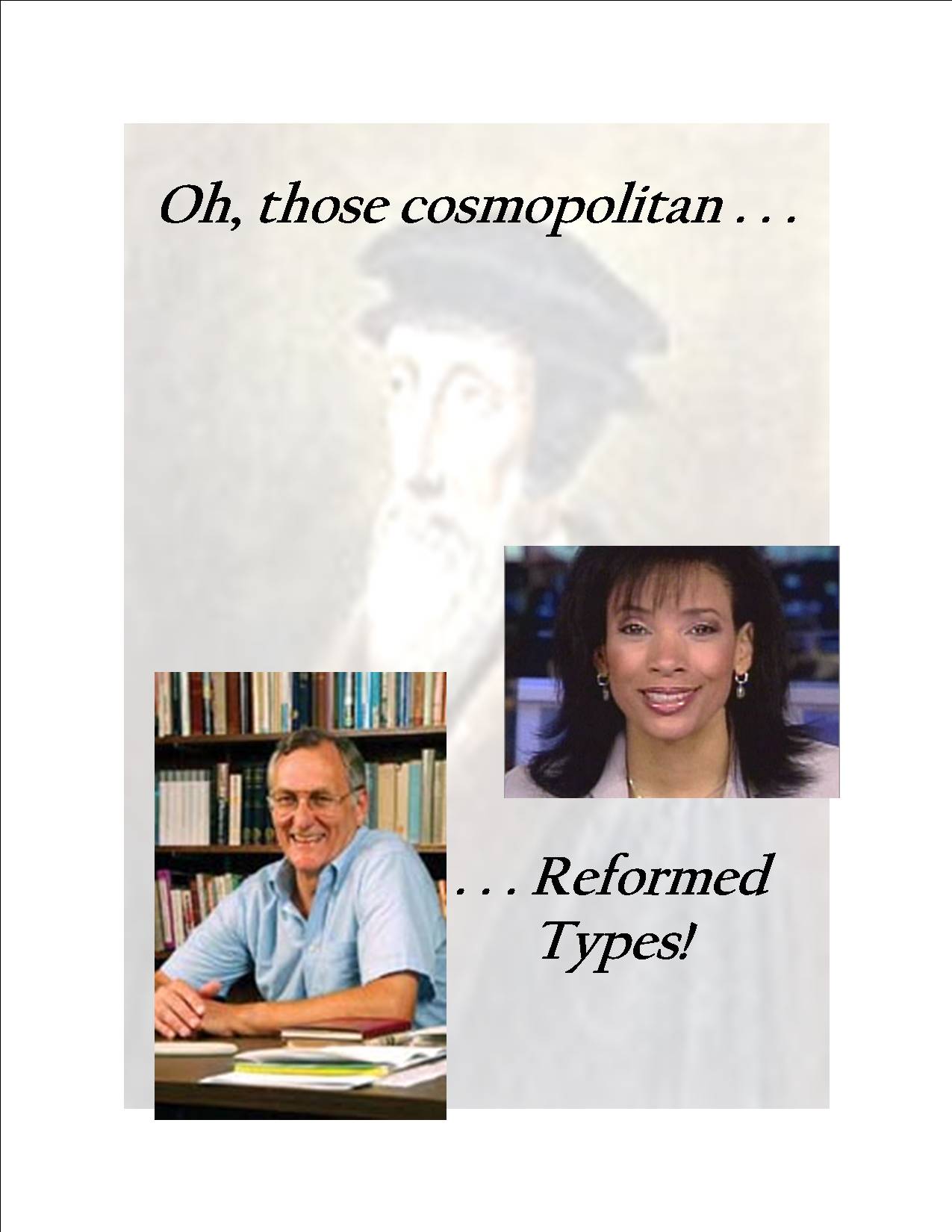 and author of Faith in the Halls of Power: How Evangelicals Joined the American Elite. When Lindsay spoke recently at the Pew Forum’s semi-annual Faith Angle Conference on religion, politics and public life, he used these categories to describe the division in the ranks of politically active American evangelicals.
Lindsay on Populists: “You see, populist evangelicals are what we oftentimes think about evangelicals. These are the folks who are culture warriors, who say that they want to take back the country for their faith. They see themselves as embattled against secular society. They are very much concerned that they are in a minority position, and they’ve got to somehow use very strong-arm tactics to win the day.”
Lindsay on Cosmopolitans: “They are less interested in taking back the country for their faith. They really are more interested in their faith being seen as authentic, reasonable, and winsome. So they still have an evangelistic impulse, but their whole modus operandi looks quite different. Because of that they have different ultimate goals of what they are actually trying to achieve. They want to have a seat at the table. They want to be seen as legitimate. They are concerned about what The New York Times or TIME magazine thinks about evangelicals because they [the cosmopolitan evangelicals] are concerned about cultural elites. They want legitimacy. Legitimacy is actually more important to them than necessarily taking back the country.”
Notable among the cosmopolitan group were Reformed Christians. Here’s what he said about them.
“There are some theologically literate cosmopolitan evangelicals, people who are able to articulate how their faith matters and drives them to particular positions, but the interesting thing about that is that almost all of them come from the Reformed tradition. The rise of Presbyterian kind of theology has been very interesting to observe. Abraham Kuyper has been one of the figures that is oftentimes cited among the people I interviewed.”
Then Lindsay mentions one significant Reformed theologian who is partly to be credited with the emergence of Reformed theology in the American evangelical community. David Wells. “I got in touch with a theologian named David Wells who has just written a book. I’ll promote his book since I don’t have one of my own. His book is The Courage to be Protestant: Truth Lovers, Marketers, and Emergents in the Postmodern World. And he has a different dichotomy of the outlook of the evangelical landscape.” So Lindsay explains Wells’ breakdown. But I don’t want to spoil it for you. I want you to go read the whole transcript. It will give you a good idea of what is going on among us voting evangelicals.
Normally, I don’t post on politics, but politics is only one factor. I’m interested in this also for the historical and theological associations. If you want my views on politics, you’ll have to email me or send me a message at my Facebook page.
Finally, there was another Reformed individual, who, in her vocation, is associated with all of this. The chief religion correspondent from FOXNews Channel, Lauren Green, happened to be in attendance at the conference and piped up with some questions when she heard her church referenced. That church would be Redeemer Presbyterian in New York City. I found that interesting. It’s nice to learn about the faith of the talking heads you listen to. So now Lauren is “outed” if you will as Reformed!
Live Chat with Michael Horton on “Christless Christianity”
 Back on Reformation Day, aka Halloween, aka October 31st, the Washington Post hosted a Live Web Chat with Michael Horton (White Horse Inn, Modern Reformation) helping to promote the release of his new book, Christless Christianity. The title of this book was also the focus of the programs during the past year on the White Horse Inn radio show. Horton attained a bit of media attention because of his recent statements critical of Joel Osteen’s theology, who serves as a good poster boy for what Horton calls “Christless Christianity,” but his book and the topic is far more extensive than a mere attempt to pull Osteen off of his pedastal. According to Horton, we all have the natural bent toward some form of Christless Christianity. We all tend to some degree to focus on ourselves and what we do at the expense of God and what he does for us in Christ. But to paraphrase the emphasis of Horton both on the radio and in his book(s), the grace and faith and love to serve Christ comes from the same source as the grace and faith and love that moved us to receive Christ in the first place: the good news of the sinless life, sacrifical death, glorious resurrection of the Lord Jesus Christ.
Our problem is, we keep falling back on focusing on the Law of God or the various commands of Scripture, to such a degree that we forget it’s primary use is to expose our sin while its secondary use is to only guide believing obedience. It doesn’t impart the grace and faith and love to obey, it merely charts out for the believer what obedience ought to look like. The grace and faith and love to obey, again, comes from the gospel. So any exposition of Scripture that never gets around to the Person and Work of Christ, won’t convey to us the power to live the Christian life by the Spirit.
The Morning After Reformation Day
R. Scott Clark, Professor of Church History and Historical Theology at Westminster Seminary California, and Associate Pastor at Oceanside United Reformed Church, splashes a little water in the faces of those of us who get excited about the Reformation on Halloween. If you want your Reformation myths challenged (if they are myths), then read his post at the Heidelblog entitled, “What Reformation Day Really Is.” But be of good cheer, true believer–the doctor not only invalidates the legends, he bestows a sharper knowledge of the true Reformation! Read, and rejoice in the truth!
Does Lack of Perseverance Imply Limited Atonement?
21 And you, who once were alienated and hostile in mind, doing evil  deeds, 22 he has now reconciled in his body of flesh by his death, in order to present you holy and blameless and above reproach before him, 23 if indeed you continue in the faith, stable and steadfast, not shifting from the hope of the gospel that you heard, which has been proclaimed in all creation [1] under heaven, and of which I, Paul, became a minister. (Colossians 1:21-23)
This passage clearly implies the doctrine of the Perseverance of the Saints, or as I renamed it, Persevering Grace for the Saints. It basically says that Jesus actually reconciled a professing believer if he continues, or perseveres, in the faith. Simple enough, those who persevere are the ones who were truly reconciled to the Father in Christ’s death on the cross.
But look what happens when you read its opposite:
if you shift from the hope of the gospel that you heard, are unstable, waver and do not continue in the faith, then Christ has not reconciled you in his body of flesh by his death in order to present you holy and blameless and above reproach before him.
Do you read what I read? When I think of it in this way, my logic tells me that lack of perseverance may be evidence for limited atonement. In other words, if you don’t persevere in the faith, then Jesus didn’t die for you.
What say you? Am I reading limited atonement into this passage, or am I properly drawing limited atonement out of the text? Eisegesis or exegesis? You be the judge (That means post your opinion!).
You Just Gotta Check Out The ESV Study Bible!
You just gotta see this! If you don’t own a study Bible yet, don’t bother shopping around. The ultimate study Bible is going to be released on October 15, 2008. Many of my Reformed blogging buddies are already aware of this monumental achievement, and most are undoubtedly awaiting it’s arrival as eagerly as I am, even though we’ve already got a shelf full of various study Bibles. But for those of you who are shy of solid resources that can help you understand the meaning of Scripture, the backgrounds of the places in the Bible, even instruction on Christian living, ethics and material that can clue you in on what many of the major world religions believe as compared with what the Bible teaches (and who knows what else?), your search need go no further. The ESV Study Bible will provide all of this for you, and then some, with full color maps and illustrations all over the place!
I just watched some of the promotional videos describing the project, the vision behind it and the contents of the product, and it is intended to be the equivalent of a miniature version of a multi-volume library on a broad cross-section of information vital to not only learning the Word of God, but also to personal growth in grace, and even to aid in the work of gospel ministry. The ESV Study Bible promises to be useful to layman, teacher and pastor alike.
Take a look at the following videos, hosted by PCA pastor and grandson to Billy Graham, Tullian Tchividjian , in which he will introduce the purpose of the ESV Study Bible and then take you on a guided tour of the contents. Seeing is believing . . .
If you’d like to see more of the videos, they are available at the Video Resources page of the ESV Study Bible website, which you can access by clicking on the colorful button near the top of the sidebar, just under the portrait of our blog mascot and namesake.
Even though the ESV Study Bible will come in a variety of bindings including the traditional leather, it’s so chock full of amazing resources that it may prove a bit cumbersome, were one wanting to carry it to church. In my opinion, this isn’t that kind of Bible. It’s a study resource, not a tag along Sunday-go-to-meetin’ Bible. For that reason, I’m getting the hardback edition, which comes with the additional feature of being the least expensive of all the varieties. But I must confess, that when, Lord willing, I obtain my copy, I may not be able to part with it for a few weeks, so it may in fact tag along with me to church now and then. But I’ll try to pay attention to the sermon, anyway. 😉
Why Your Next Pastor Should Be A Calvinist
Click to buy from WTS Books
I found an interesting article that I strongly recommend my Southern Baptist readers should carefully consider. Here’s an excerpt–the link to the article will follow:
If pulpit committees and churches would look below the facade of scare-tactic accusations and warnings being rolled out like taffy at the Mississippi State Fair, they would discover something healthy and very desirable in the men and the message preached of those against whom they are warned. The twentieth-century slide into liberalism rode on the back of a growing indifference to the doctrines of grace, because the doctrines of grace are tied vitally to more biblical doctrines than just perseverance of the saints. The recovery of a fully salubrious evangelical preaching ministry depends largely on the degree to which the doctrines of grace are recovered and become the consciously propagated foundation of all gospel truth.
If a church, therefore, gets a Calvinist preacher, she will get a good thing. Several issues will be settled forever and the church will not have to wonder about the soundness of her preacher on these items of biblical truth and their soul-nurturing power. Calvinists have stood for more than just their distinguishing doctrines, but have held steadfastly to other doctrines that are essential for the health of Baptist churches in our day.
Read the entire article here.
Here are some online resources for Reforming a Baptist Church
The Baptist Confession of Faith
Trinity Hymnal (Baptist Edition)
Association of Reformed Bapitst Churches of America
Salvation Full and Free
A couple of years ago, I tried to put Ephesians 1:3-14 to music. But nothing ever came that enabled me to carry the ESV translation of this great passage on the joint sovereign work of God the Father, Son and Holy Spirit over into a singable tune. But I did come up with the following little ditty that is more inspired by the passage than it is based on it’s text. I don’t have a recording of this song, even though I did sing it at church once.
I don’t know how it reads without knowing the tune, but, believe me, it may not read well as a simple poem, but it does work as a song. It’s short enough, and the tune is lively enough, that I actually kind of consider this my one praise chorus. Hope it doesn’t ruin it for you, but it’s kind of got that feel when you sing it, only it’s a little more raw and doesn’t sound quite like a commercial jingle like so much “P & W music.”
Salvation Full and Free
Slaves to sin/no good within/to merit our Father’s electing love
Redeemed in Christ/our sin debt paid/forgiven freely by God’s grace
Called to new life (by grace)/By the Spirit’s power (through faith)/Sealed to guarantee our inheritance in Christ
Salvation full and free!
If I ever get a recording of it, I’ll post it. Tomorrow I’ll post another song which I’ve never sung in worship yet, and as of yet have no prospects of doing so.
Calvinism, Coming to a Young Christian Near You!

Click image to purchase at WTS Books
There’s a book out chronicling the resurgence of Calvinism among the, pardon the expression (keep in mind, I’m using it correctly), emerging generation of teens, twenty-, and thirty-somethings (including myself) who are disillusioned with the shallow theology and over-emphasis on you name it, revivalism, pietism, experientialism, commercialism of the twentieth century. As you know, the list of misguided varieties could go on.
So many of us who’ve grown up as a either a fundamentalist or evangelical Christian have come to the conclusion that what is needed is for the church to get back to the basics of what it means to be a Christian. The basics of Christianity as understood in a broader way than just re-examining my Bible and reconstructing my own version of what I think is the clear teaching of Scripture regarding faith and practice (which is what most of the previous generation think it means to get back to the basics).
Such a tactic is part of the problem–it’s too self-centered and individualistic and often far too reductionistic. It’s not a matter of just throwing out current traditions and starting over with a clean slate. It’s not about reinventing the wheel–those are the kinds that never turn out round. What I’m talking about is getting on the right track–yes, the most biblical track, the most Christian track, the most Protestant track, the most truly evangelical track–a track I didn’t lay myself, but was laid by the faithful followers of Christ who genuinely changed the world in their generation as did the first century apostolic generation.
What generation am I talking about? I’m talking about the generation that laid the tracks of conservative evangelical, confessionally Reformed, Christ-centered Protestant theology. The generation identified in the history books as the Reformers.
I read once that Socrates is known for saying, “Sometimes regress is progress.” The bill of goods that we were sold in the 20th century told us that what’s happening now is better than what happened back then. The present is always preferable to the past. The new is more relevant than the old. Well, some of us have learned that sticking “new and improved” on something doesn’t mean a thing. Some of us have learned that if conservative evangelical, or fundamentalist Christianity is going to make any progress, we’re going to have to regress back to a time when things were genuinely being done right and learn from both their successes and mistakes, receiving the faith in tact as handed down by them and not as re-imagined by modern philosophical influences, be they pragmatism, modernism or post-modernism. Progress will only come through this kind of regress.
Second Timothy 2:2 puts it best: “and what you have heard from me in the presence of many witnesses entrust to faithful men who will be able to teach others also.” But lots of people are entrusting lots of things to lots of “faithful men.” Which version of Christianity is best? There’s a number of us in this new generation who are firmly convinced that what the apostolic churches passed on to faithful men who led the post-apostolic generation, got deformed in the medieval era and was reformed in the sixteenth and seventeenth centuries is the “basics” to which the 21st Century generation of Christians needs to get back to. So much that has transpired since the Reformation era leaves so much to be desired that we don’t trust much of it at all. That’s why we’re turning to Calvinism, also known as Reformed theology.
Journalist Collin Hansen has written Young, Restless, Reformed: A Journalist’s Journey with the New Calvinists. It tells our story. Martin Downes has reviewed the book over at Reformation21.org. Read all about it, then find your place in the 21st Century Reformation.
“Reforming” the TULIP?

This one Calvinized me once and for all!
One thing that has always puzzled me since I began reading and listening to Reformed theologians and writers deal with the TULIP, is that they almost unanimously seem to lament the fact that there is a “Five Points of Calvinism” in the first place. They complain that it raises more questions and seems to cause more confusion and more problems than it solves, but they just keep on referring to it and using it anyway. But when they use it they often rename the points in the acronym.
For those who may not know, the letters in TULIP are the first letters to a list of doctrines which reveal how God in his sovereignty saves sinners by his grace. These doctrines are:
T-Total Depravity
U-Unconditional Election
L-Limited Atonement
I-Irresistable Grace
P-Perseverance of the Saints
These doctrines are a summary of the five part document from the seventeenth century called the Canons of Dort, which were published upon the completion of the Synod of Dort, a council consisting of many Reformed churches throughout Europe at the time which had to convene in order to respond to the theological challenges within the Dutch Reformed Church by a formerly Reformed minister by the name of Jacob Arminius. He had originally published a five-point list of his own which denied certain teachings of Scripture which too clearly evidence the sovereignty of God in showing mercy to, and hardening, whomever he wills (Romans 9:18).
Arminius’ modified doctrines tended to limit God’s sovereignty in favor of the unlimited freedom of man’s will. Mimicking the TULIP acronym, I’ve noticed that some modern writers similarly outline the five points of Arminius with another flower acronym, DAISY. The titles consist of Diminished Depravity, Abrogated Election, Impersonal Atonement, Sedentary Grace, Yielding Eternal Uncertainty.
For some reason, the complaints Reformed writers make usually leave me wondering if they’re making a mountain out of a mole hill. Perhaps too many Reformed writers distrust homiletical mnemonic devices more than I thought? There’s no telling. However, when Seth McBee updated his Facebook status, registering his complaints against J. I. Packer’s views on Limited Atonement in his famous introduction to John Owen’s masterpiece, The Death of Death in the Death of Christ, for his supposed arrogance in condemning the Arminian general atonement view in no uncertain terms, I was intrigued. What? Someone claiming to be Reformed, yet disagreeing with Packer’s view of the atonement? That’s when we began the discussion over at his blog to which I directed you a couple of days ago (see the previous post).
So, anyway, I printed out the online copy of Packer’s intro, to read up on his “objectionable” views on Limited Atonement. It wasn’t far into the essay that he began to list the deficiencies in the TULIP, just like all the lower lights in Reformed theology. For the first time, I finally got it. Or at least I finally found a claimed deficiency in the TULIP that actually made sense and didn’t leave me wondering. Here’s what he wrote:
There is a fifth way in which the five-point formula is deficient. Its very form (a series of denials of Arminian assertions) lends color to the impression that Calvinism is a modification of Arminianism; that Arminianism has a certain primacy in order of nature, and developed Calvinism is an offshoot from it. Even when one shows this to be false as a matter of history, the suspicion remains in many minds that it is a true account of the relation of the two views themselves. For it is widely supposed that Arminianism (which, as we now see, corresponds pretty closely to the new gospel of our own day) is the result of reading the Scriptures in a ‘natural’, unbiased, unsophisticated way, and that Calvinism is an unnatural growth, the product less of the texts themselves than of unhallowed logic working on the texts, wresting their plain sense and upsetting their balance by forcing them into a systematic framework which they do not themselves provide.
An epiphany! The TULIP can tend to encourage people to assume that the answer to “which came first?” is Arminianism, when in reality, the reverse is the case. The five points of Calvinism are mostly stated in a negative form because they are denying claims the Arminians made when they were trying to modify Calvinism, the doctrine that arises the more legitimately from the text of Scripture.
Okay, now I’ll play ball. Like I said, one of the funny things about all the Calvinist critics of the five points is that they like to try to rewrite the points. Again, I was always left dissatisfied. For example, R. C. Sproul likes to retitle Total Depravity as “Radical Corruption” (as if that clears anything up). Some others recast Limited Atonement as “Definite Atonement.” Again, another loser in my book. Recalling these misadventures in homiletics, I decided I’d enter the realm of “Reforming” the TULIP with my own list of titles that, in my estimation, do not state things in the form of denials of someone else’s view, but positively presents the doctrines of grace. Here’s what I came up with. I hope you find them enlightening:
The Spiritual Death of the Sinner(formerly, Total Depravity)
The Electing Grace of the Father(formerly, Unconditional Election)
The Redeeming Grace of the Son(formerly, Limited Atonement)
The Saving Grace of the Spirit(formerly, Irresistable Grace)
Persevering Grace for the Saint(formerly, Perseverance of the Saints).
Earnest Contention for Limited Atonement

A Tulip
This morning I logged into Facebook and was intrigued by Seth McBee’s status that he is frustrated with J. I. Packer’s view of the atonement. I just had to track this down on his blog and discovered that he was complaining about Packer’s exaltation of Puritan John Owen’s definitive work on Limited Atonement, The Death of Death in the Death of Christ. Seth didn’t appreciate Packer’s characterization of those who deny Limited Atonement as believing in a “self-esteem gospel.” This gave me an opportunity to explain some of the logic of Reformed theology in relation to God-centeredness versus Man-centeredness in the comments thread at his website devoted to his book reviews, Contend Earnestly Books. Some of you may enjoy receiving an introduction to the logic of Limited Atonement, and others of you may enjoy assissting me in contending earnestly for Limited Atonement. All are invited. Read my comments here.
Update
Our discussion has moved from Contend Earnestly Books to his post to his duplicate post at Contend Earnestly. The post is entitled, “J. I. Packer’s View on the Atonement.” Seth is going to attempt to fill in the “holes” in my argument. Let’s see what we all learn together, as a couple of “irons” commence to “sharpening” each other. Be sure to enter the fray with your two cents worth.


 The Misadventures of Captain Headknowledge