Introduce your child to Lady Jane Grey

I just added the website of author Simonetta Carr to my Recommended Sites page. She is the author of a series of children’s books called Christian Biographies for Young Readers. These are beautifully illustrated and informative stories of the lives of heroes of the faith to which most children’s books do not get around to featuring. Carr’s series includes titles on the lives of Athanasius, Augustine, John Calvin, John Owen and most recently, the martyr Lady Jane Grey.
I strongly recommend that you get these titles and read them to your children of any age. They are simple enough for your toddlers to get it, but informative enough to educate your interested pre-teens and even young teens, like my daughter, will enjoy them, too. She’s already submitted a request for her copy of Lady Jane Grey. She saw a movie about this martyr on Netflix last year and when I asked what the story was about, she explained that Grey was going to be killed for being a Protestant. Profoundly, yet humorously, she added, “A good way to die.”
The Problem of “Head Knowledge”

Image via Wikipedia
One topic I haven’t treated nearly enough lies ironically at the heart of the underlying theme of my blog, which theme is an expression of my experience as a fundamentalist turned confessional Reformed Protestant. The topic is the tension in the fundamentalist and evangelical movements between so-called “head knowledge” and “heart knowledge.” Having been too busy living amidst that tension for the past couple of decades, I haven’t done a great deal of blogging about it since I started this blog.
To be truthful, this blog’s title and theme, “The Misadventures of Captain Headknowledge” is both an indictment and a confession. It’s an indictment for the kind of reason that you may have already read about on my “About Me” page. The confession lies in my honest recognition that I am the sort who has the tendency to, as it is sometimes put, read about the Bible, rather than actually take time to read the Bible.” This is certainly a flaw which stunts my spiritual growth in sanctification and the grace and knowledge of the Lord Jesus Christ. To the extent that my blog is a personal confession, it reminds me to cultivate my own spiritual growth. In the past, I was made to feel that many think this means I must therefore utterly repent of and entirely forsake my tendency to “read about the Bible.” But I disagree, and this is where the indictment part comes in. I regard that attitude to be an overreaction to an otherwise valuable gift of God. A love for reading theology and related Christian literature must not supersede my personal study and application of Scripture, but it needn’t be excluded from my life, either. Old Princeton scholar, Benjamin Breckenridge (B.B.) Warfield has the ultimate quote on this issue, from his book, The Religious Life of Theological Students (P & R Publishing Co.):
Nothing could be more fatal, however, than to set these two things over against one another. Recruiting officers do not dispute whether it is better for soldiers to have a right leg or a left leg: soldiers should have both legs. Sometimes we hear it said that ten minutes on your knees will give you a truer, deeper, more operative knowledge of God than ten hours over your books. “What!” is the appropriate response, “than ten hours over your books, on your knees?” Why should you turn from God when you turn to your books, or feel that you must turn from your books in order to turn to God? If learning and devotion are as antagonistic as that, then the intellectual life is in itself accursed, and there can be no question of a religious life for a student, even of theology. HT: Hot Orthodoxy
Such an imbalanced rejection of academic theology as unnecessary or unhelpful “head knowledge” in favor of so-called “heart knowledge” in its extreme forms often seems little more than an individualistic, experiential mysticism. In his book, What is Faith?, J. Gresham Machen writes on the question of anti-intellectualism and the resultant mysticism against which this blog is in part an indictment:
The depreciation of the intellect, with the exaltation in the place of it of the feelings or of the will, is, we think, a basic fact in modern life, which is rapidly leading to a condition in which men neither know anything nor care anything about the doctrinal content of the Christian religion, and in which there is in general a lamentable intellectual decline. (What is Faith?, p.28)
But if theology be thus abandoned, or if rather (to ease the transition) it be made merely the symbolic expression of religious experience, what is to be put into its place?… Mysticism unquestionably is the natural result of the anti-intellectual tendency which now prevails; for mysticism is the consistent exaltation of experience at the expense of thought. (p.35)
Walking By Faith, Not By Sight (Matthew 20:29-34)

My daughter, Abigail, frequently announces that our pastor at Mid-Cities Presbyterian Church (OPC), Rev. Joe Troutman, is her favorite preacher. Mine, too, Abigail! I think I’ll begin posting links to his sermons so his exposition and application of God’s Word can build you up in your faith, or grant saving faith to those of you who may not already have it. I’ll include my notes of his remarks and sometimes will include a few of my own. Sunday, October 2, 2011, the text was Matthew 20:29-34 and the sermon was entitled, “Walking By Faith, Not By Sight.” (Listen here)
The Son of David, our Lord Jesus Christ, opens the eyes of the blind and sets his people free.
Blind Men Who Could See “And as they went out of Jericho, a great crowd followed him. And behold, there were two blind men sitting by the roadside, and when they heard that Jesus was passing by, they cried out, ’Lord, have mercy on us, Son of David!’” (Matthew 20:29-30 ESV)
- “Lord, have mercy!” This phrase was adapted and sung as Kyrie Eleison in Eastern Orthodox, Roman Catholic, Lutheran and Anglican liturgies, but according to church historian, Philip Schaff, “The Reformed liturgies dropped it altogether” (The New Schaff-Hertzog Encyclopedia of Religious Knowledge, “Liturgics,” page 503).
- Jesus approaches Jerusalem in military procession in anticipation of his triumphal entry. Blind men are bold to call out for him to stop. We are given such boldness by in faith in Christ, to call on God with our requests.
Lord Have Mercy “The crowd rebuked them, telling them to be silent, but they cried out all the more, ‘Lord, have mercy on us, Son of David!’ And stopping, Jesus called them and said, ‘What do you want me to do for you?’ They said to him, ‘Lord, let our eyes be opened’” (Matthew 20:31-33 ESV).
- How persistent are you in your prayers? If God will listen to a couple of blind beggars, he will certainly listen to his children who believe, worship and glorify him. These blind men have literally “walked by faith, not by sight.”
Mercy “And Jesus in pity touched their eyes, and immediately they recovered their sight and followed him” (Matthew 20:34 ESV).
- “Therefore the LORD waits to be gracious to you, and therefore he exalts himself to show mercy to you. For the LORD is a God of justice; blessed are all those who wait for him” (Isaiah 30:18 ESV).
- Healing these blind men was part of Christ’s mission; he was not sidetracked by their bold request.
- Christ’s touching the blind men to heal them was not necessary, but rather a benedictory laying on of hand.
- “[T]he LORD opens the eyes of the blind. The LORD lifts up those who are bowed down; the LORD loves the righteous” (Psalm 146:8 ESV).
- Their calling Christ the Son of David indicates their confession of faith in him as the Messiah who has come to save them. Healing is a sign of the deity of Christ who came so sinners who believe will have eternal life.
- The Lord Jesus Christ, the true King of Israel, does what we cannot: he gives spiritual sight to us who are spiritually blind, that we may see him as the coming Messiah who was born to die for our sins. May your eyes be opened, and may the Lord graciously grant you such saving faith!
Confessions of a Restlessly Reforming Evangelical Fundamentalist

Old Life--Home of the Nicotine Theological Journal. Picture by The Sacred Sandwich
Dig my latest comment at Darryl G. Hart’s Old Life Theological Society. His post is titled, “Young, Restless and Lutheran?” He questions whether the broad approach of the Young, Restless and Reformed movement isn’t so broad that it might be more accurate to call it “Young, Restless and Lutheran,” given that, in Hart’s view, it’s less about Reformed theology in general or the five points of Calvinism in particular (no pun intended), and more about having been inspired by a bigger vision of God at the hands of John Piper channeling Jonathan Edwards, and generally begins reminding us all how much less Reformed they are than he and his Truly Reformed OPC brethren are (among whom I eagerly anticipate numbering me and mine). This is my summary, anyway, be it accurate or not.
I found the post and some of the resultant comments engaging enough that I just had to share my own experience at moving from Fundamentalism, through Evangelicalism and into Reformed Confessionalism. Although I write with tongue-in-cheek, the experiences are all very real (and they’re just the tip of the iceberg).
Confessions of a Restlessly Reforming Evangelical Fundamentalist:
Fortunately, I bypassed the whole Piper YRR movement (Piper’s creative and independent streak is waaay too Baptist for my taste) and swallowed the whole TR thing hook, line and sinker…Or so I thought. The further one goes, the more one discovers which exaggerates the differences between what it means to be Evangelical (in modern Western Christianity, that is) and what it means to be Reformed.
First, you fall for the 5 points; then you get over the hump about baptism (my logic was, “if the seventeenth century Baptists agreed with Presbyterians on so much,” as I was then coming to perceive, “then what makes them think Presbyterians are so wrong about baptism?”)…
…then you deal with stuff like exclusive “Acapulco” psalmody, and, for me living in a region where there is no glut of Reformed churches, I take the lazy man’s approach and say this isn’t an issue I have the luxury of standing for, even if I were persuaded of it. And some of their arguments I do find attractively compelling. If it weren’t for those of the advocates of instrumental hymnody.
Now that I’m preparing to join an OPC church, and begin reading all this vast literature about this “splinter group” of a denomination, I feel I’ve come full circle in some ways back to a Presbyterian version of my separatistic IFB background (even the local church planting missions emphasis is reminiscent of the IFB, without the Faith Promise giving campaigns), if you consider some of you more outspoken OPC guys’ position and attitude about TGC and T4G.
Yes, growing up among separatistic fundamentalists, yet consuming my fair share of big tent Evangelical media, it is quite a process in coming to a point where you can confidently call yourself “Reformed” without crossing your fingers behind your back.
This Is No Texas Tall Tale
“J. Frank Norris Week” continues! Last night I joined David R. Stokes, author of The Shooting Salvationist: J. Frank Norris and the Murder Trial that Captivated America at the Fort Worth Sundance Square Barnes & Noble Bookstore, where he spoke for a few minutes before sitting down to sign books. The pictures in this post are from last night’s signing. The text is my semi-formal, though concise, review of the book, which has also been posted at the book’s Amazon.com page. As emotionally dependent as I have become on this book, it was hard for me to step back and write an objective review that is comparable to a professional, or at least experienced, reviewer’s work until I decided to recommend the book in an email to another writer, who shall remain nameless. I gave him the following summary, and decided that this is about as good a review as anyone’s ever going to get out of me. Hope you find it helpful, and feel free to help us spread the word about this story that has been gratefully recovered from historical obscurity.
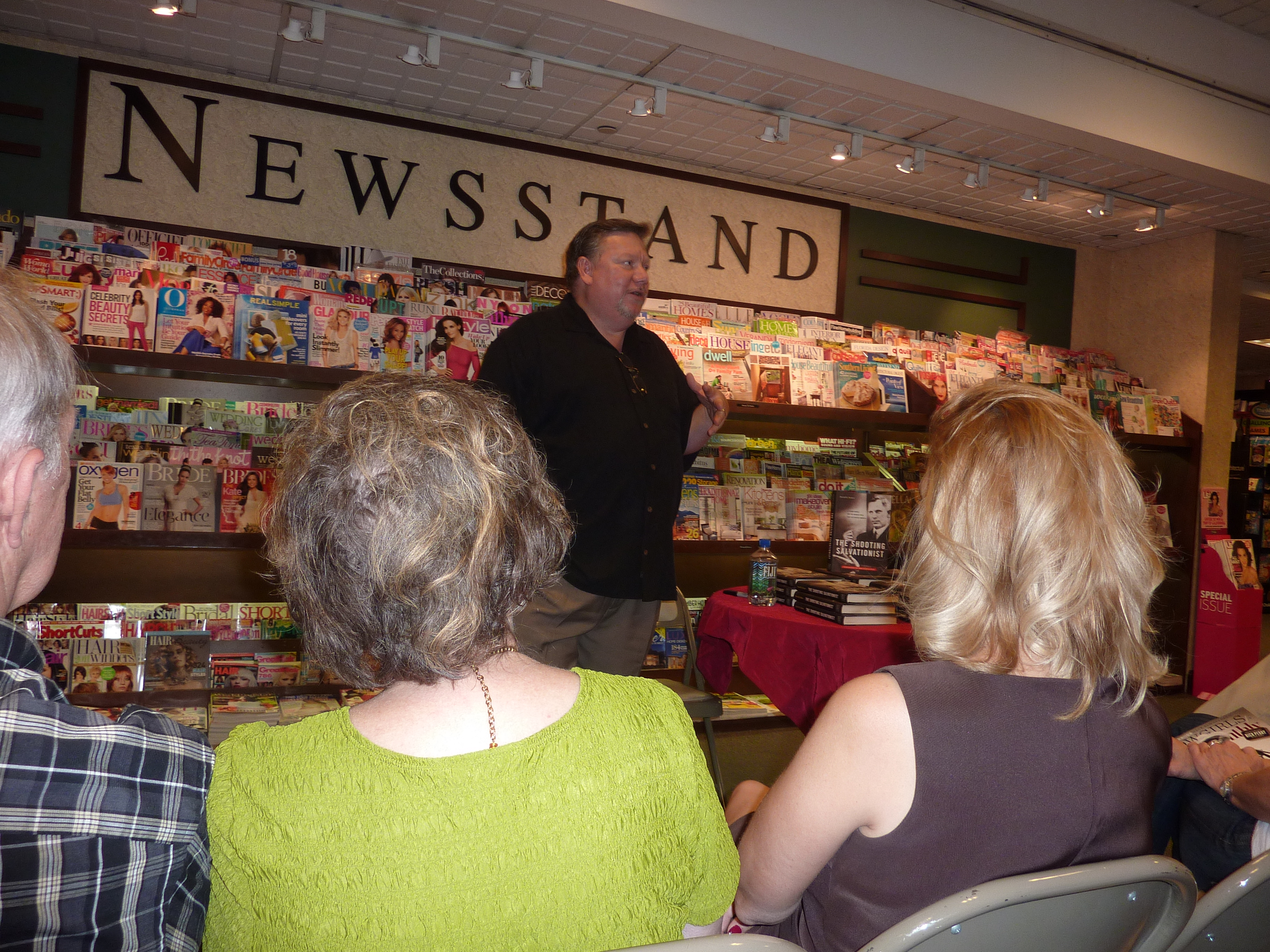
David R. Stokes speaks before his book signing at the Fort Worth Sundance Square Barnes& Noble two blocks from the site of Norris' shooting of Chipps
David R. Stokes is a columnist for Townhall.com. He is also a pastor of a non-denominational church in Fairfax, VA. He studied for the ministry at the same Missouri Bible College from which the late Jerry Falwell got his Bachelors degree before he moved on to bigger and better things. This Bible College, Baptist Bible College, to be precise, has its roots in the ministry of the man who is the subject of the book he is now promoting, The Shooting Salvationist: J. Frank Norris and the Murder Trial That Captivated America (2011 Steerforth Press).
Norris was the pastor of the First Baptist Church of Fort Worth Texas between the years 1909 and 1952 (the year of his death). In the early years of his ministry, he ditched the tame, sane, responsible approach to ministry in which one makes an effort to get along with everyone, for an approach that would generate so much heat it would draw huge crowds to him so he could introduce them to the Light, if you know what I mean. In the process, he was a self-appointed thorn in the side of the underground liquor and gambling interests in Texas, the budding theological liberalism in his alma mater, Baylor, the mayor of Ft. Worth and Star-Telegram founder and all-around entrepreneur Amon G. Carter. This got Norris in hot water with one of the mayor’s friends, another Ft. Worth business leader, Dexter Elliot Chipps, who stormed into Norris’ office one day, threatened to kill him, then walked out. Chipps’ mistake was that he didn’t keep going. He turned for some unknown reason and attempted to reenter the pastor’s office and was met with three or four bullets in the chest. The resulting 1926 murder trial was as big of a media circus as Norris’ hero, William Jennings Bryan’s, recent Skopes Monkey Trial had been, or for those of us in the 21st century, Casey Anthony’s.

Yours truly (left); David R. Stokes (right)
The book is a narrative non-fiction work. It reads somewhat like a novel, but all the dialogue, and much of the narration, even, is directly lifted from his sources which include not only older bios of Norris (pro and con), but much of the most prominent journalistic accounts, legal transcripts and records, as well as personal archives of Norris, Meacham and Carter. The outrageous tactics of Norris in his early ministry make for quite a train wreck, and the history is fascinating, but for folks like myself who grew up in Fort Worth, it gives a lot of new information to an old legend that has lingered in the background of all of our lives, and provides quite a bit of closure as well. I’d like to share with you this fascinating tale that we could only wish were nothing more than a “Texas Tall Tale.”
Skeptical About Interpretation
I have an unbelieving friend with whom I’ve discussed much about the Christian faith. I admit that, having thoroughly proclaimed the fact of God’s holiness, my friend’s personal sinfulness for which he is accountable to that holy God, and the good news that God’s Son has volunteered to represent sinners like him on the cross so that those who would believe in him would have eternal life, and my friend’s subsequent and persistent resistance of that message in favor of his own relativistic and pluralistic form of non-Christian universalism, I have taken the liberty to go on discussing other matters of “religion and politics,” knowing that many of you would advise against such a practice. I’ve even discussed this point with him as well.
Perhaps I ought to wipe the dust from my feet, but for good or ill, in all the discussions in which we engage on the Bible, occasionally I’ll use the word “interpretation” in a sentence, to which my friend will object in so many words: “You’re not supposed to have to interpret the Bible!” I don’t know if this statement is based on some skeptical school of thought. My Googling has not helped me discover if the current trends in anti-Christian philosophizing and rhetoric, a la Hitchens, Dawkins, Maher, etc., make assertions like this (if any of you know, please comment!), but here are a couple of findings related to this question.
About five years ago, the blog Reformation Theology posted on the distinctive method of interpreting the Bible. In a post called “The Reformers’ Hermeneutic,” we read:
The exegesis and interpretation of the bible was the one great means by which the war against Roman corruption was waged; which is almost the same thing as saying that the battle was basically a hermeneutical struggle. In light of these observations, one could say that the key event marking the beginning of the Reformation occurred, not in 1517, when Martin Luther nailed his theses to the church door in Wittenberg; but two years prior to that, when he rejected Origin’s four-layered hermeneutic in favor of what he called the grammatical-historical sense. This one interpretive decision was the seed-idea from which would soon spring up all the fruits of the most massive recovery of doctrinal purity in the history of the Church. (read more)
Then the Lord, through Google, directed me to this Power Point presentation on “Exegetical Skepticism.” Here’s a bit of what it has to say:
There are so many different ways of interpreting the Bible, how can we be confident that our interpretation is correct?Skeptical Answer: We cannot be confident of our ability to interpret. There probably is one correct interpretation, but we won’t know it even if we have it. . . .So, if we can’t be for sure regarding interpretation, we must deal with probabilities rather than certainty.What kind of interpretation is more likely to represent the text’s original meaning?Answer: The most probable interpretation is the one that is consistent with language and literary genre similar to the ways that people typically used and understood them at the time the texts were written. . . .What are some ways to ‘break-out’ of our own cultural and psychological restraints?a.Ways to ‘breakout’ of our limitationsi.Discussion with other Christiansii.Church Historyiii.Approach the scriptures with humility.iv.Learn more about the history surrounding the Biblical texts.Conclusion:Although interpreting the Bible can be, at times, difficult (just as math, psychology, etc. can be difficult), this doesn’t mean we need to be skeptical about interpretation as a whole. Rather, interpretative difficulties should simply encourage humility and hard work.
Full Confidence Conference Photo Gallery
The folks at the Full Confidence Conference didn’t know they had a representative from the shallow end of the Refomred blogosphere covering them until I stuck my camera in their faces. When the audio of the messages are made available, I’ll provide summaries and links, but for now, here are a few photos of some of the folks involved:
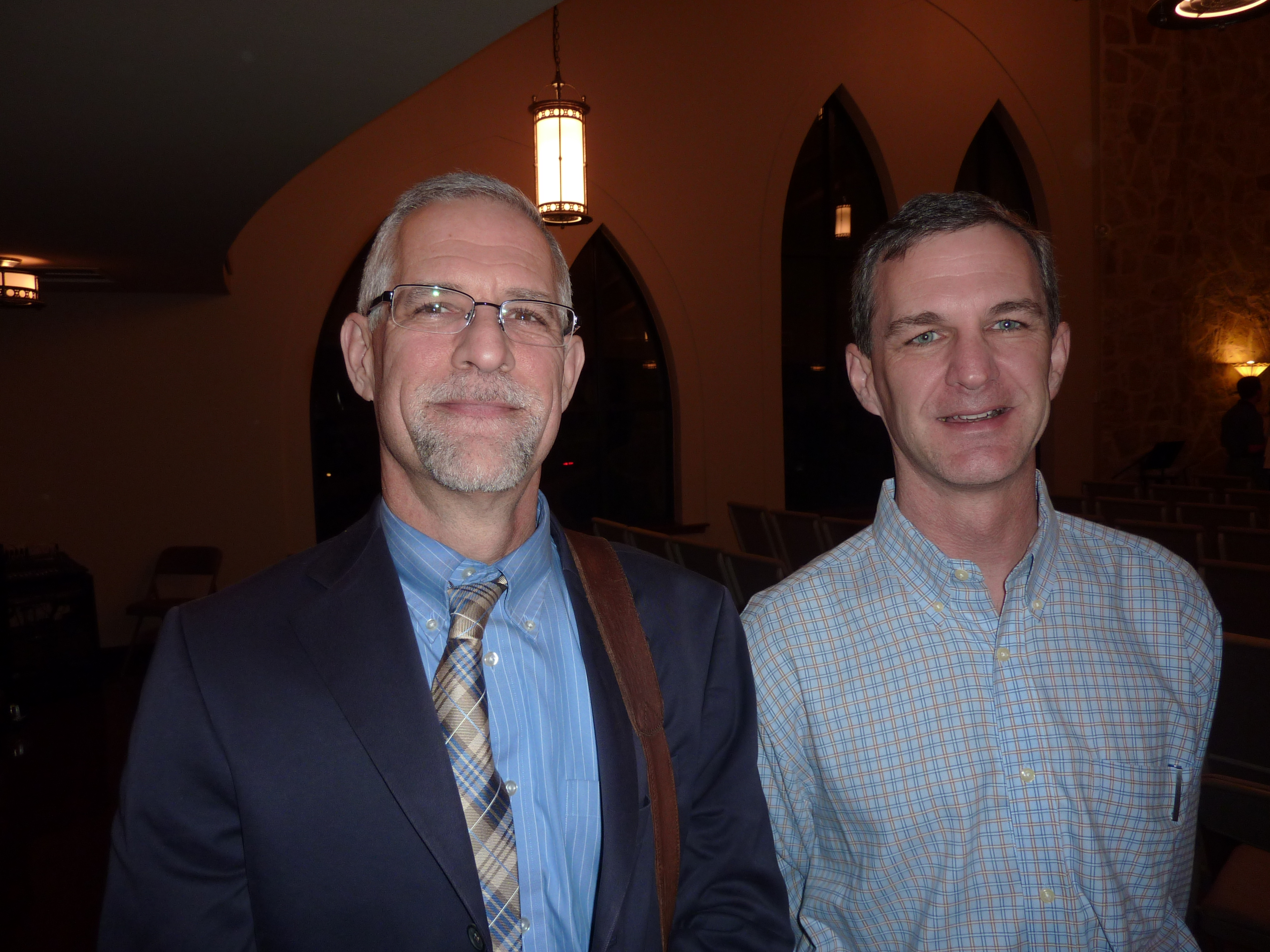
Dr. K. Scott Oliphint (left), with brother Pastor Kyle (right).
Here’s a blooper I just can’t resist sharing with you. Here are Pastor Kyle Oliphint and Dr. David Garner losing focus and starting to chat and look around just as I snap their picture…Hey Kyle! I’m over here! 🙂
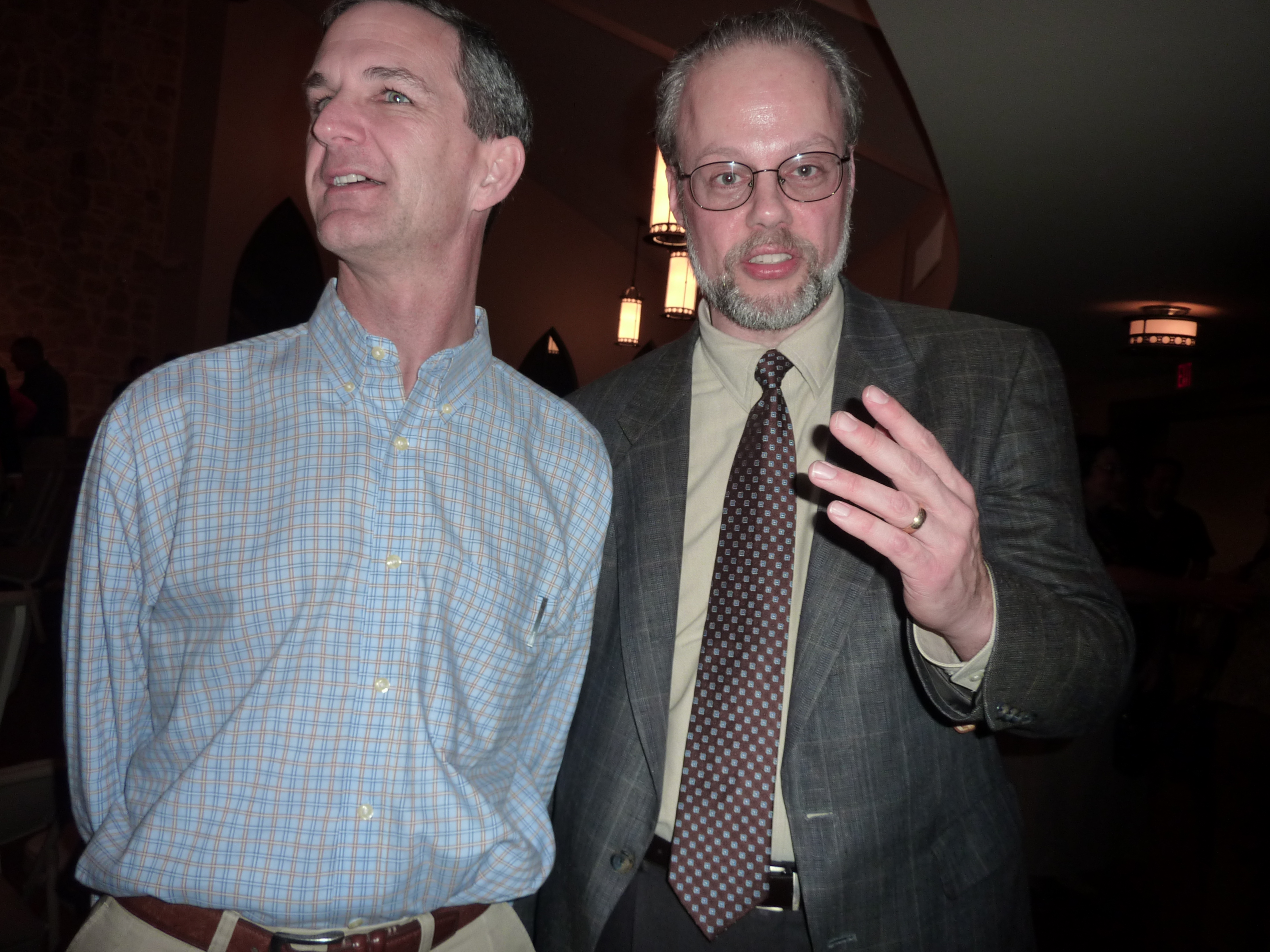
Kyle (right) with Conference organizer, Dr. David Garner.
Next is a look at the “emerging” Westminster generation–Jonathan Brack with Dean of Admissions and son of Dr. K. Scott Oliphint, Jared Oliphint. I hope they enjoyed their little family reunion.
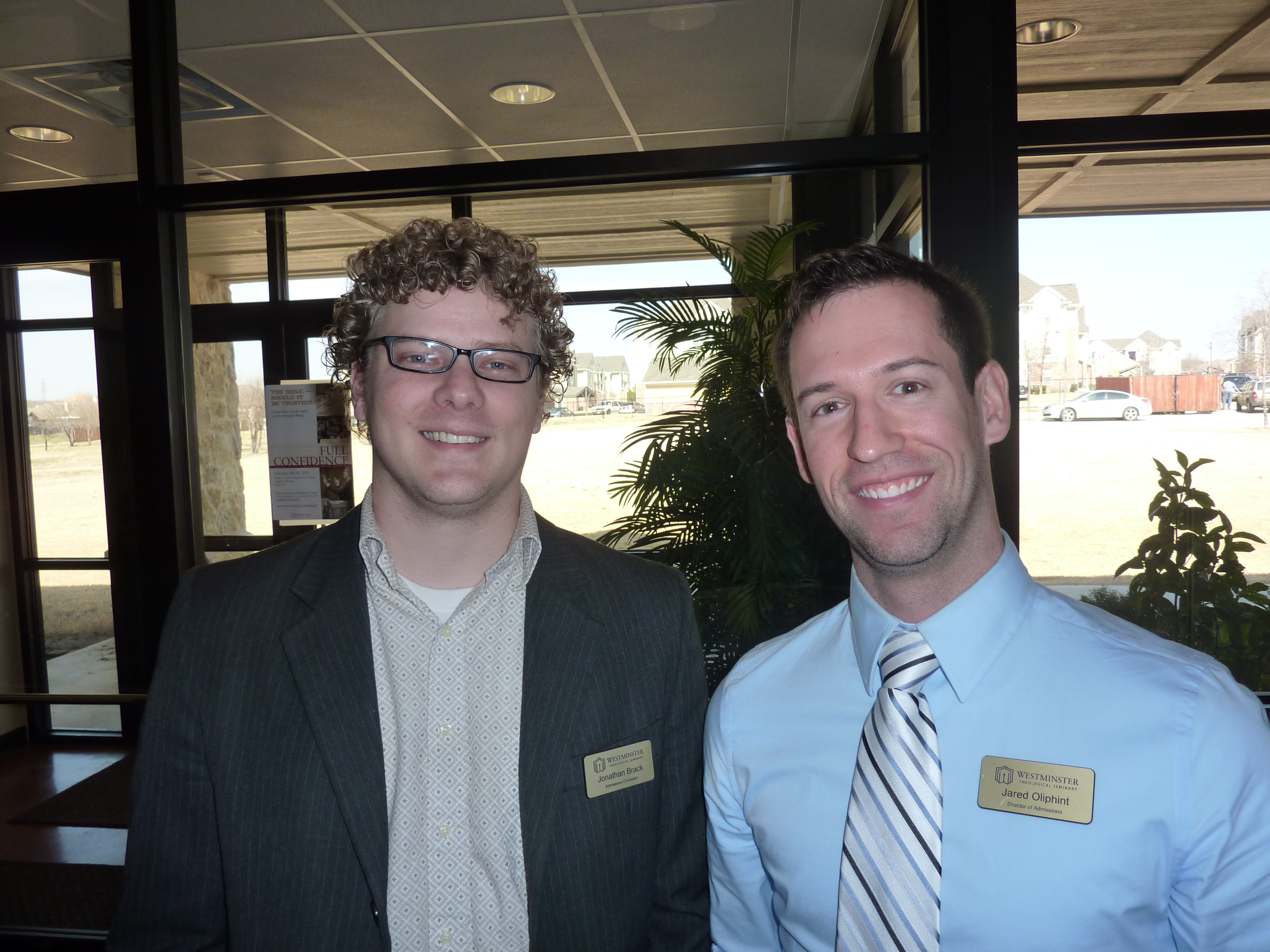
Jonathan Brack (left) with Jared Oliphint (right)
And finally, I took the opportunity to get a snapshot with one of my heroes of the faith, a man who successfully lead his family out of fundamentalism and into the Reformed faith intact, Dr. Thomas R. Browning (Hey, Bob Hayton! Here’s a real, live “Fundamentalist Reformer” for you!). He is the Assistant Pastor of Grace Community Presbyterian Church, and can be found teaching the adult Bible study in the sanctuary most Sunday mornings. In many ways, I am indirectly a product of his influence, in that he taught the guys who, after years of on-again, off-again considering of the doctrines of grace, lovingly latched onto my ankle (like the Calvinist bulldogs they are) and didn’t let up until I said “Uncle!” Every time I think of this guy, I recall the touching tribute once spoken by his son, Gage (a former co-worker): “My dad is my favorite preacher.” Learn more about Dr. Browning and his ministry of preaching and teaching here and here.

John Chitty (left) with Dr. Thomas R. Browning (right)
Full Confidence Conference Coming to Fort Worth This Weekend!
Just to give you a heads up, this Friday night, February 18, 2011 (that’s tomorrow night from the time of this posting), my wife and I will be attending the Fort Worth wing of the Full Confidence Conference Tour put on by Westminster Theological Seminary in Philadelphia, Pennsylvania and hosted by Grace Community Presbyterian Church (PCA) with a small group of friends from my church. In the light of many assaults on the inspiration, inerrancy and authority of Scripture in both the broadly evangelical world, and even the Reformed tradition itself in a few cases, WTS has been traveling the country to reaffirm and build up the Body of Christ to have full confidence in the Word of God.
The Fort Worth, Texas conference is going to feature as speakers, Dr. K. Scott Oliphint (elder brother of GCPC’s pastor, Rev. Kyle Oliphint), Dr. Tim Witmer, Dr. David Garner and Dr. John Currie. You can read their bios at the Full Confidence link above. Pastor Kyle Oliphint has been preaching a series on having full confidence in the Word of God for the past three weeks. I’ve been following them and will share the links next week, but if you want to hear them now just find the link to GCPC’s podcast from their church website and listen for yourself. An exciting bonus for my church, Mid-Cities Orthodox Presbyterian Church, in Bedford, Texas, will have the honor of welcoming Dr. Scott Oliphint to preach in our morning service the Lord’s Day following the conference, Sunday, February 20. I’ll post a link to his sermon as it becomes available.
Here’s a video intro of the conference by one of our speakers:
From KJV Onlyism to Calvinism

Perhaps one day I’ll write something on how King James Onlyism opened my mind and heart to Reformed theology. It had a little to do with this book, The King James Version Defended, by Edward F. Hills.
In an attempt to bring the work of John William Burgon into the twentieth century, Hills, a Westminster Theological Seminary graduate (along with Yale, Harvard, Columbia Theological Seminary and the University of Chicago) made probably the most interesting case in favor of retaining the Textus Receptus as it has been translated in the KJV as the Protestant New Testament, applying the presuppositional apologetic of Cornelius Van Til who developed and taught it at Westminster Theological Seminary in order to arm confessional Reformed Presbyterians, among others, with a consistently Reformed, confessional and covenantal method for defending the faith.
I just got the 2006 edition of it in the mail today. It was updated in conjunction with the Encylcopedia Puritannica Project. Boy, I hope they didn’t screw it up! Hills deserves better than that! Here’s something I posted about this book in the past.
Sister Aimee and the “Anabaptist Nation”

"Sister Aimee" McPherson
I heard an interesting description of how American Christianity effectively developed into a form of Anabaptism. Dr. R. Scott Clark, Professor of Church History and Historical Theology at Westminster Seminary California (WSC), was interviewed this past week on Christ the Center podcast episode #157 regarding his contribution to Always Reformed, a festschrift that has recently been published in honor of WSC President and Professor of Church History, Dr. Robert Godfrey (see Dr. Clark’s post here). From what I’ve been able to gather over the past couple of years, Dr. Godfrey is an earnest student of the phenomenon of Sister Aimee McPherson’s ministry in the 1920’s, and holds her up as an example of what American Christianity is. Clark’s chapter is entitled, “Magic and Noise: Reformed Christianity in Sister’s America.” To some extent, it seems that this very subject of the Anabaptistic flavor of American Christianity is at the heart of this chapter, as may be inferred by the chapter’s title itself.
About twenty-two minutes into the interview, Clark introduces this topic by urging the study of “Sister” (as she is wont to be called) on Reformed believers. He does this because, according to Clark, in many ways McPherson’s type of Christianity is more indicative of the nature of American Christianity than the Reformed faith can lay claim to anymore. America has come a long way since the faith of the pilgrims of Plymouth Rock and the Salem witch trials (which is probably all Americans remember about those early Christian settlers (for help with that, listen to this and this). Clark believes that the Reformed would be aided in reaching America for Christ, and American evangelicals for the Reformed faith if they would see themselves more as cross-cultural missionaries, rather than natives.
Dr. Clark offers the disclaimer that his Anabaptist diagnosis of American Christianity is largely due to the fact that his primary field of research is the sixteenth and seventeenth century Reformation, rather than early twentieth century Christianity. He admits that in part he is interpreting the McPherson phenomenon and the nature of “native” American Christianity in the light of the sixteenth century Anabaptist movement, but he does attempt to support his conclusion with appeals to others who have written more extensively on Christianity in the nineteenth and twentieth centuries.
There are parallels between the Anabaptist movement of the sixteenth century and current American Christianity. Clark explains that people tend to think of the Anabaptist movement as just another facet of the Protestant Reformation, but he points out that the Anabaptists (also known as “Radical Reformers”) more or less “rejected all of the key doctrinal commitments” of the Protestant Reformation in favor of much more radical positions. Clark’s thesis is that the way American Christians commonly think about the nature of authority, epistemology (how we know what we know), Scripture and its authority, the church and eschatology (the doctrine of the end times) often bears strong resemblance to sixteenth and seventeenth century Anabaptism. Dr. Clark goes into a little more detail on this in the interview between minutes 33:15 and 42:06.
This portion of the interview caught my attention because Clark’s comparison is consistent with a conclusion I came to in my own personal pilgrimage from independent Baptist fundamentalism to Reformed theology and practice. After learning that the ultimate source of the bulk of historic Baptist theology comes from the Reformed Westminster Confession of Faith (see my newly updated “Creeds, etc.” page), and the parallels I saw between Baptist distinctives and the historic Anabaptist movement, I concluded that everything that’s right in the Baptist tradition was learned from the Reformed tradition, and everything that’s wrong in the Baptist tradition was learned, or “caught,” if you will, from Anabaptism. I realize that the 1689 Baptist Confession disclaims any formal connection between their doctrines and those of the Anabaptists, but the parallels are just too striking to Reformed paedobaptists.
This is why I encourage you to take time to listen to at least this section of the interview, if you don’t have the time or inclination to enjoy all of it. It’ll be thought-provoking time well-spent, if you ask me.
Listen To This…
Here are the programs I’ve been following this week. If you’ve got the time, it would benefit you to check some of them out:
- “Machen’s Warrior Children” on Christ the Center
- “Gospel-Focused” on White Horse Inn
- January 11 Episode of Dividing Line
- “The Legacy of the King James Bible” on ReformedCast
Christianity and Liberalism Revisited
Here’s a conference I wish I could attend. Believe it or not, I first discovered J. Gresham Machen’s book Christianity and Liberalism in a catalog for Peter Ruckman’s bookstore in the mid-nineties (see also here and here), but I only read it about two years ago. Growing up I was conscious of my fundamentalist pastor talking about “modernism,” but only had a very vague notion of what that might be. So vague, in fact, I couldn’t then, nor could I now define with any certainty just how much I understood about it then.
It is so important that Christians understand that the most basic and foundational thing about Christianity is not how you live, it is what you believe. This is not a denial of the importance of how you live, just a denial that it is what makes you a Christian. Actually, how you live is the product or fruit of what you believe. If you live the cleanest life in the most loving and charitable way, yet deny the deity of Christ, the trinitarian nature of God, or the virgin birth of Christ, etc., then you are not a Christian. This is what liberalism is, although it is so much more at the same time. It exalts the necessity of works over the necessity of orthodox doctrine. That’s why Machen said liberalism is not another form of Christianity, it is an entirely different religion.
Gospel-Driven: From Doctrine to Discipleship

Dr. Michael Horton and me
New St. Peter’s Presbyterian Church in Dallas hosts an annual Reformation Conference the weekend before Reformation Sunday. This year saw their fourth such conference, “Gospel-Driven: From Doctrine to Discipleship,” featuring the teaching of Dr. Michael Scott Horton, Associate Pastor of Christ United Reformed Church of Santee, CA (see Dr. Horton’s Adult Bible Class page), J. Gresham Machen Professor of Systematic Theology and Apologetics at Westminster Seminary California, host of the White Horse Inn radio show (and podcast), Editor-In-Chief of Modern Reformation Magazine, and author of an ever-growing number of books, three of which were the subject of this year’s conference (see his Wikipedia entry for more info).
Two of the three books have already been published, but the third, on which Dr. Horton spoke, is to be published in the coming months. These books are (in order), Christless Christianity, The Gospel-Driven Life, and I think the title of book three will be The Gospel Commission. The first volume addresses the heart of the problem with all of contemporary evangelical, even Reformed, Christianity–an exchange of preaching the gospel of the Lord Jesus Christ for the preaching of self-salvation by self-improvement in a variety of manifestations–preaching “good advice” at the expense of preaching the good news. The Gospel-Driven Life addresses why preaching the gospel (along with regularly receiving the Lord’s Supper) is essential for Christian growth and sanctification, not just evangelism. Finally, The Gospel Commission (if that is it’s actual title) will go into how the church is to obey the imperative Great Commission out of a conscious response to the gospel indicative of the complete authority over heaven and earth given to the Lord Jesus Christ by his Father (Matthew 28:18).
This was an exciting opportunity for me to meet the man who first introduced me to Reformed theology. Back in 1991 Dr. Horton published his first book, Mission Accomplished (later revised and republished as Putting Amazing Back Into Grace). In the providence of God, Dr. Horton was invited to promote the book on a morning talk show on, of all places, the Trinity Broadcasting Network! During this interview, Dr. Horton had the unique opportunity to introduce Calvinism to the constituents of the Word of Faith heresy of Kenneths Hagin and Copeland, Benny Hinn, Oral Roberts, and more recently Joyce Meyer, John Hagee and Joel Osteen, myself among them. I recall mostly his emphasis on how the doctrine of election and predestination, far from squashing evangelism, actually motivates it. I found my introduction to Reformed theology and its benefits fascinating and exciting. At the time Dr. Horton was leading a ministry called Christians United for Reformation (CURE). I subscribed to CURE’s newsletter for a short time–I found it equally fascinating and really cool, but I also found it to be waaay over my head. So I got on with my life, marrying my first wife, moving off to Missouri to study to be an Independent Baptist missionary (which plan would change), living life between my initial and later providential and interesting encounters with Reformed theology.
I brought my copy of Mission Accomplished with me to the conference to get it autographed by Dr. Horton, along with the copy of The Gospel-Driven Life which I purchased at the conference. It was my joy to be able to personally thank him for his introducing me to Reformed theology, and when I mentioned that I saw him on TBN, he grimaced with shame as if a deep, dark secret had been exposed, and we all enjoyed a laugh at the stark irony of his television debut. Then as he opened my book and began writing on the first page, he informed me that the host of that talk show was fired not long after that episode. He assured me that the fact that he had been a guest on the show “was not unrelated” to his firing–WOW! But it makes perfect sense, considering that it would not be long before Dr. Horton would edit an expose of the Word of Faith movement, The Agony of Deceit. But just think, that TBN host’s firing may have just been one of the best things to ever happen to him. I consider it a noble sacrifice for the cause on his part. I just wish I could remember that host’s name so I could search for videos of his interviews on YouTube in the hopes of finding his interview of Michael Horton. Now that would be a blast!
If you’ve never listened to the White Horse Inn, then you are not aware of just what a heady, yet eminently edifying and motivating speaker Dr. Horton is. The way he helped us understand the covenantal nature of God’s relationship to Old Testament Israel and the New Testament Church simply boggles the mind with how it brings together so many aspects of the biblical revelation of redemption and also highlights the importance of the doctrine of justification by grace alone (sola gratia) that is received by faith alone (sola fide). He even mentioned how Pope Benedict XVI has admitted that the Bible’s use of the form and content of ancient Near Eastern Suzerainty/Vassal treaties in his covenantal dealings with his people makes it understandable that the Reformers taught what they did about justification. Horton observed that when the Pope sounds more like the Reformers than contemporary Evangelical theologians, you know you are living in a Salvador Dali painting!
You can download the audio of the messages below (PS–I hear there’s a video in the works, but haven’t heard if and when it’ll be released):
- Christless Christianity: The Problem
- Gospel-Driven Life: The Solution
- Gospel Commission: The Application
- Questions and Answers with Dr. Horton
- The Missionary Servant: The Sermon


 The Misadventures of Captain Headknowledge
Sermon Notes: “Invited to the Supper” (Matthew 22:1-14)
The following sermon was preached by Rev. Joe Troutman at Mid-Cities Presbyterian Church in Bedford, Texas. Listen online or subscribe to the podcast.
God calls all to repent and believe and many refuse, but others believe and are welcome to the feast.
The parable of the wedding feast is the third parable of judgment spoken by Jesus on the week leading to his crucifixion. While the first two primarily targeted the Pharisees, Saducees and Jewish priesthood, this parable applies to all in the nation of Israel who do not follow Christ in faith, but are guilty of rebellion against God.
God will judge everyone who refuses to repent and believe, but will show mercy by bringing to himself repentant believers who had not previously been associated with his covenant people.
Rejection of the Call (Matthew 22:1-7) And again Jesus spoke to them in parables, saying, “The kingdom of heaven may be compared to a king who gave a wedding feast for his son, and sent his servants to call those who were invited to the wedding feast, but they would not come. Again he sent other servants, saying, ‘Tell those who are invited, “See, I have prepared my dinner, my oxen and my fat calves have been slaughtered, and everything is ready. Come to the wedding feast.”’ But they paid no attention and went off, one to his farm, another to his business, while the rest seized his servants, treated them shamefully, and killed them. The king was angry, and he sent his troops and destroyed those murderers and burned their city.
Invitation to All (Matthew 22:8-10) Then he said to his servants, ‘The wedding feast is ready, but those invited were not worthy. Go therefore to the main roads and invite to the wedding feast as many as you find.’ And those servants went out into the roads and gathered all whom they found, both bad and good. So the wedding hall was filled with guests.
Responsibiltiy (11-14) “But when the king came in to look at the guests, he saw there a man who had no wedding garment. And he said to him, ‘Friend, how did you get in here without a wedding garment?’ And he was speechless. Then the king said to the attendants, ‘Bind him hand and foot and cast him into the outer darkness. In that place there will be weeping and gnashing of teeth.’ For many are called, but few are chosen.”
Share this: