Does It Take A Village?
 Yesterday, I subscribed to the podcast for The Village Church. I had noticed their statement of faith was adopted from that of Sovereign Grace Ministries, the network of Charismatic Calvinist churches founded by C. J. Mahaney, author of Living the Cross-Centered Life, (a book I highly recommend) among other titles. The Village Church is not listed among the Texas Sovereign Grace churches at the network’s website, so I suppose it’s safe to say that to look at one is not necessarily to look at the other, if you know what I mean. But, then again, that may not necessarily be so, either.
After I subscribed to the podcast, I took a long walk and listened to a “talk” explaining the philosophy of ministry at The Village Church. Before Josh delved into the “philosophy” he attempted to lay a theological foundation for it. I’ll give you the passages in the theological foundation:
- The Incarnation of the Word John 1:1-2, 14
- The Mission:
- It’s Authority Matthew 28:19-20
- It’s Scope Acts 1:8
- How The Gospel Spreads “. . . and in chapter 7, a man named Stephen comes before the courts and they are trying him and he preaches a fantastic sermon as they pelt him with rockds. And Stephen is killed; he’s the first martyr of the church. But by God’s plan, He uses the suffering and the fear and the martyrdom that transpired after that to spread the church. . . Acts ends in chapter 28, and chapter 29 is for you and me to write. You see, the reality is those guys told some guys, who told some guys, who told somebody, who told somebody, who told somebody, who told somebody, who told Tom Bailey, who told me in 1996. That’s how it happens. . . This is how the gospel has spread. It’s viral. It joust goes and it inundates people, it infiltrates culture, it gets in the hears of humanity and it changes us. This is the church. The church is a group of redeemed people who sit under the proclamation of the word in fellowship as they share life with one another.”
Attraction Versus Incarnation (translation: traditional architecture vs. personal evangelism)
Next, Josh attempts to unpack the role of The Village Church in this viral spread of the gospel. First he describes a few approaches to church ministry: 1) “an attraction based approach to ministry . . . In the Old Testament, it was more of a ‘come and see’ type of religion. They built the temple. They made pilgrimages to the temple. That’s where sacrifices were made. It was a central type of religion. And so the temple was ornate, it was lavished with gold and all the jewels and all of these things because the people would come. And it was through that that you would see the beauty and majesty of God. but when Christ came, it was no longer a ‘come and see.’ Christ says, ‘Go and tell.'” This is what Josh calls an “incarnational approach to ministry.”
“You see, when Chrsit incarnates, He gives something not just to celebrate but to imitate. He is showing us how life is to be done, how ministry is to be done. Christ comes here, he dwells among us. So in one word, our philosophy of ministry is incarnational.” By this he intends that the way people are drawn to the church is not by the impressive church architecture, but in response to being told about the place by a friend, co-worker, family member, etc.
Now I’ll pause for a moment and make a comment. This dichotomy is drawn between church architecture and personal evangelism as if architecture were the primary draw in traditional churches. This is a misrepresentation. And I humbly submit that it is an excuse, in classic charismatic style, to promote their lack of worship enriching externals by putting down traditional “religion” (this word is to be pronounced with a shudder). Again, in classic charismatic style, the Village Church is not going after those who believe in retaining some sense of communion with the saints of all ages, but they are instilling the same old contemporary, “au nauturaul”, organic, reductionistic form of worship.
The next aspect of the “incarnational” philosophy is a little more encouraging. To quote Josh, “And so our hope is that we would fight against [American-style competition among churches] and what we would bring to center stage would be the gospel. But the reality is, what you win them with, you keep them with. So if we win you with some glitz and glamor and high technology and an unbelieveable building, then we’ve got to keep that up. But if we win you with the gospel, then you won’t be surprised when you realize that’s what we try to keep you with.” This I’m all for. But I still object to pitting personal evangelism against architecture alone. Some have grown up in non-traditional churches and it’s what they expect. What if God called the Village Church to build a traditional style building in the future? They’d lose some folks the same way they assume traditional churches lose traditional worshipers when they start singing praise choruses, or installing a smaller pulpit, or getting rid of it altogether. The problem works both ways, if you ask me.
Width vs. Depth
Another encouraging aspect of Village’s philosophy is that they state a desire for deep preaching and deep believers over a desire for buildings full of shallow believers with deep pockets. “. . . He clearly gave us the commission which was to make disciples . . . not even converts, not to put skins up on the wall and say, ‘Look how many converts we have.’ He says, ‘I want disciples, and discipleship is a lifelong, difficult, painful, suffering process, then you die. That’s it.’ And if you and I are not willing to be transformed and beaten and molded and shaped into the image of Christ, then we have no idea what His will is for His church. He wants to take us deep, and if we get wide during the process, hallelujah. But if we take width over depth, we have sold out the gospel.”
Humility
The final aspect of the Village’s stated philosophy of ministry is that believers are to shun a “spirit of entitlement” for a “spirit of humility and sacrifice.” This should probably be a subset of the previous paragraph. Part of going deep as a believer is learning to love others more than oneself. Josh says, “I need you to help me slay me, and you need me to help you slay you. Because it’s not about us. And when we get that, that’s the most freeing reality, because we will exhaust ourselves on ourselves.”
A Question Raised
One thing that would be instructive to note in this regard is how much width has come to the church in so few years. I can tell that it is probably due in part to megachurch contemporary trimmings with actual Word-based preaching (or “talk”-ing). For this I rejoice. But, when will the church get deep enough to not need solely contemporary disregard for the regulative principle of worship? I’m sure the Villagers think they’re abiding by the Word by reducing Christianity to the interpersonal part of it. But there has been not one single word about a Reformed concept of the “ordinary means of grace” approach to ministry. They seem to have divorced, or as usual, put on the back burner the importance of the sacraments in worship. They’ve got prayer, they’ve got praise and they’ve got proclamation. But nobody seems to know how to work the sacraments into their “approach to ministry.” For those who claim to be Reformed, and if these guys are organizing around the Sovereign Grace Ministries statement of faith, then they must be claiming to be Reformed, this contemporary, organic, “Spirit-filled” kind of worship makes you forget about “rituals” like baptism and the Lord’s Supper. Oh, sure, they’ll get around to them, but only because they know they’d be in hot water without them. But, when it comes to the Village’s philosophy of ministry, you’d think there were no such things as sacraments. At least not the Lord’s Supper. Fortunately, Jesus managed to wedge baptism into the commission so it wouldn’t be neglected, too–except, of course, for neglecting to baptize the households of believers and not individuals alone. . .
Good Friday: Meditate on Christ’s Passion
 Consider the events which occurred during the first Passion Week, in which our Lord prepared to go to the cross, to pay the ransom that redeemed the souls of all those his Father gave him (John 6:37-40):
Jesus Christ, having been arrested in the Garden of Gethsemane by the Temple Guards through the guidance of Judas Iscariot, is brought to the house of Annas, who is father-in-law of the current high priest, Caiaphas. There he is interrogated with little result, and sent bound to Caiaphas the high priest, where the Sanhedrin had assembled (John 18:1-24).
Conflicting testimony against Jesus is brought forth by many witnesses, to which Jesus answers nothing. Finally the high priest adjures Jesus to respond under solemn oath, saying “I adjure you, by the Living God, to tell us, are you the Anointed One, the Son of God?” Jesus testifies in the affirmative, “You have said it, and in time you will see the Son of Man seated at the right hand of the Almighty, coming on the clouds of Heaven.” The high priest condemns Jesus for blasphemy, and the Sanhedrinconcurs with a sentence of death (Matthew 26:57-66).
In the morning the whole assembly brings Jesus to the Roman governor Pontius Pilate, under charges of subverting the nation, opposing taxes to Caesar, and making himself a king (Luke 23:1-2). Pilate authorizes the Jewish leaders to judge Jesus according to their own Law and execute sentencing, however the Jewish leaders reply that they are not allowed by the Romans to carry out a sentence of death (John 18:31).
Pilate questions Jesus, and tells the assembly that there is no basis for sentencing. Upon learning that Jesus is from Galilee, Pilate refers the case to the ruler of Galilee, King Herod, who was in Jerusalem for the Passover Feast. Herod questions Jesus but receives no answer; Herod sends Jesus back to Pilate. Pilate tells the assembly that neither he nor Herod have found guilt in Jesus; Pilate resolves to have Jesus whipped and released (Luke 23:3-16).
It was a custom during the feast of Passover for the Romans to release one prisoner as requested by the Jews. Pilate asks the crowd who they would like to be released. Under the guidance of the chief priests, the crowd asks for Barabbas, who had been imprisoned for committing murder during an insurrection. Pilate asks what they would have him do with Jesus, and they demand, “Crucify him” (Mark 15:6-14). Pilate’s wife had seen Jesus in a dream earlier that day; she forewarns Pilate to “have nothing to do with this righteous man” (Matthew 27:19).
Pilate has Jesus flogged, then brings him out to the crowd to release him. The chief priests inform Pilate of a new charge, demanding Jesus be sentenced to death “because he claimed to be God’s son.” This possibility filled Pilate with fear, and he brought Jesus back inside the palace and demanded to know from where he came (John 19:1-9).
Coming before the crowd one last time, Pilate declares Jesus innocent, washing his own hands in water to show he has no part in this condemnation. Nevertheless, Pilate hands Jesus over to be crucified in order to forestall a riot (Matthew 27:24-26). The sentence written is “Jesus of Nazareth, King of the Jews.” Jesus carries his cross to the site of execution, called the place of the Skull, or “Golgotha” in Hebrew and “Calvary” in Latin. There he is crucified along with two criminals (John 19:17-22).
Jesus agonizes on the cross for three hours while the sun is darkened. With a loud cry, Jesus gives up his spirit. There is an earthquake, tombs break open, and the curtain in the Temple is torn from top to bottom. The centurion on guard at the site of crucifixion declares, “Truly this was God’s Son!” (Matthew 27:45-54).
Joseph of Arimathea, a member of the Sanhedrin and secret follower of Jesus, who had not consented to his condemnation, goes to Pilate to request the body of Jesus (Luke 23:50-52). Pilate asks confirmation from the centurion whether Jesus is dead (Mark 15:44). A soldier pierced the side of Jesus with a lance causing blood and water to flow out (John 19:34), and the centurion informs Pilate that Jesus is dead (Mark 15:45).
Joseph of Arimathea takes the body of Jesus, wraps it in a clean linen shroud, and places it in his own new tomb that had been carved in the rock (Matthew 27:59-60) in a garden near the site of crucifixion. Another secret follower of Jesus and member of the Sanhedrin named Nicodemus (John 3:1) also came bringing 75 pounds of myrrh and aloes, and places them in the linen with the body of Jesus, according to Jewish burial customs (John 19:39-40). They rolled a large rock over the entrance of the tomb (Matthew 27:60). Then they returned home and rested, because at sunset began the Sabbath (Luke 23:54-56). —from Wikipedia
Over at Google Maps, you can view a satellite image of Jerusalem and the surrounding area, with tags identifying the events of the entire Passion Week from Christ’s Triumphal Entry, which we commemorated last Sunday through Good Friday which we commemorate tomorrow (or today, depending on when you are reading this). Each tag links to Scripture passages about each event identified on the satellite map.
Now, respond to that which you have taken in about the last week of the life of the Lord Jesus, by singing or praying this hymn written in 1630 by Johann Heermann called, “Ah, Holy Jesus, How Hast Thou Offended?” It is #248 in the Trinity Hymnal.
Ah, Holy Jesus, how hast thou offended, that man to judge thee hath in hate pretended? By foes derided, by thine own rejected, O most afflicted.
Who was the guilty who brought this upon thee? Alas, my treason, Jesus, hath undone thiee. ‘Twas I, Lord Jesus, I it was denied thee: I crucified thee.
Lo, the Good Shepherd for the sheep is offered; the slave hath sinned, and the Son hath suffered: for man’s atonement, while he nothing heedeth, God interceedeth.
For me, kind Jesus, was thine incarnation, thy mortal sorrow, and thy life’s oblation: thy death of anguish and thy bitter passion, for my salvation.
Therefore, kind Jesus, since I cannot pay thee, I do adore thee, and will ever pray thee, think on thy pity and thy love unswerving, not my deserving.
Theological and Doxological Meditation #40
 God’s First Revealed Rule
Q. What did God at first reveal to man for the rule of his obedience?
A. The rule which God at first revealed to man for the rule of his obedience was the moral law (Romans 2:14-15)
Most Perfect is the Law of God
Most perfect is the law of God, restoring those that stray; his testimony is most sure, proclaiming wisdom’s way.
The precepts of the Lord are right; with joy they fill the heart; the Lord’s commandments all are pure, and clearest light impart.
The fear of God is undefiled and ever shall endure; the statutes of the Lord are truth and righteousness most pure.
They warn from ways of wickedness displeasing to the Lord, and in the keeping of his Word there is a great reward.
REFRAIN
O how love I thy law! O how love I thy law! It is my meditation all the day. O how love I thy law! O how love I thy law! It is my meditation all the day.
#153, The Trinity Hymnal (© 1990); from Psalm 19:7-11; 119:97; The Psalter, 1912; KINSMAN C.M. ref.; James McGranahan, 1840-1907; alt. 1990
“Fruit of the Vine”: Three Parts Water, One Part Wine
 A new commenter recently posted a comment on my post from July 31, 2006 on “The Church’s Witness to the Responsible Use of Wine.” Convinced that Keith Mathison’s information about the Church’s early and ongoing use of alcoholic wine, while true, is also misleading, due to Mathison’s lack of reference to its dilution, Barry Traver adds valuable scholarship to the fact that, while the wine used in the Passover before the cross and the Lord’s Supper afterward was certainly fermented, it was also as certainly diluted by three parts water. Following are his remarks which can also be found at the old site at Blogger. I’m posting it here, linking to as many of his references as possible, so that it may benefit those of you who are presently keeping up with this WordPress site. Here are links to the related posts to which Traver responds:
Your post says this:
“We have already mentioned that wine was universally used by the entire church for the first 1,800 years of her existence. During those years, there was never any suggestion that another drink should be used. In the early church, for example, we find clear testimony to the use of wine by such men as Justin Martyr (The First Apology, 65) and Clement of Alexandria (The Instructor, 2.2).”
True, but misleading, since it fails to mention the ancient practice (including 250 B.C. to A.D. 250) of using diluted wine. That fact is brought out clearly in both Justin Martyr and Clement of Alexandria. Read on!
First, let’s look at Charles Hodge’s comments in his Systematic Theology (volume 3, pages 617):”The Elements to be used in the Lord’s Supper…. In most churches, the wine used in the Lord’s Supper is mixed with water. The reasons assigned for this custom, are,
(1.) The eucharist having been instituted at the table of the Paschal supper, and the wine used in the Passover being mixed with water, it is morally certain that the wine used by Christ when instituting this sacrament, was also thus mixed. Hence it was inferred that his disciples in all ages should follow his example. That the Paschal cup contained wine mixed with water rests on the authority of Jewish writers. “It was the general practice of the Jews to dilute their wine with water….” It is certain, from the writings of the fathers, that this custom prevailed extensively in the primitive Church. As the Greeks and Romans were in the habit of mixing water with their wine on all ordinary occasions, it is the more natural that the same usage should prevail in the Church. It is still retained, both by Romanists [i.e., Roman Catholics] and by the Oriental [i.e., Eastern Orthodox] Church.
(2.) Besides this historical reason for the usage in question, it was urged that it adds to the appropriate significance of the ordinance. As water and blood flowed from the side of our Lord on the cross, it is proper, it is said, that water should be mixed with the wine in the service intended to be commemorative of his death….”
Note that Hodge — an advocate of the use of wine in the Lord’s Supper — indicates that “[i]n most churches, the wine used in the Lord’s Supper is mixed with water ….” for two reasons, one based on ancient practice (the “historical reason”) and the other based on “the appropriate significance of the ordinance.” (Hodge is using the word “significance” in its older meaning of a “symbol” or “sign” with a theological reference.)
Like Charles Hodge, Robert Stein — New Testament seminary professor and author of Difficult Passages in the New Testament (Baker, 1990, pp. 233-238) — believes that it “is obvious that the term wine in the Bible does not mean unfermented grape juice….” Stein provides many interesting specifics that support Charles Hodge’s references to “the Greeks and Romans,” “Jewish writers,” and “the writings of the [Church] fathers” on the “prevailing custom” of diluting wine with water:”
In ancient Greek culture, … [w]hat is important to note is that before wine was drunk, it was mixed with water…. The ratio of water to wine varied. Homer (Odyssey 9.208-9) mentions a ratio of twenty parts water to one part wine. Pliny (Natural History, 14.6.54) mentions a ratio of eight parts water to one part wine…. [Stein also mentions Hesiod (three to one), Alexis (four to one), Diocles (two to one), Ion (three to one), Nicochares (five to two), and Anacreon (two to one).] [As] a beverage [wine] was always thought of as a mixed drink. Plutarch (Symposiacs 3.9), for instance, states, ‘We call a mixture “wine,” although the larger of the component parts is water.’ The ratio of water might vary, but only barbarians drank wine unmixed, and a mixture of wine and water of equal parts was seen as ’strong drink’ and frowned upon. The term wine or oinos in the ancient Greek world, then, did not mean wine as we understand it today, but wine mixed with water. Usually a writer simply referred to the mixture of water and wine as ‘wine.’…”
And we … have examples in both Jewish and Christian literature … that wine was likewise understood as being a mixture of wine and water. In several instances in the Old Testament a distinction is made between ‘wine’ and ’strong drink.’…. The 1901 Jewish Encyclopedia (vol. 12, p. 533) states that in the rabbinic period at least, ‘ “yayin”‘ [wine] is to be distinguished from “shekar” [strong drink]: the former is diluted with water…; the latter is undiluted….’ In the Talmud, which contains the oral traditions of Judaism from about 200 B.C. to A.D. 200 (the Mishnah)…, there are several tractates in which the mixture of water and wine is discussed…. In a most important reference (Pesahim 108b) the writer states that the four cups every Jew was to drink during the Passover ritual were to be mixed in a ratio of three parts water to one part wine. From this we can conclude with a fair degree of certainty that the fruit of the vine used at the institution of the Lord’s Supper was a mixture of three parts water to one part wine. In another Jewish reference from around 60 B.C. we read, ‘It is harmful to drink wine alone, or again, to drink water alone, while wine mixed with water is sweet and delicious and enhances one’s enjoyment’ (2 Macc.15:39). In ancient times there were not many beverages that were safe to drink…. The drinking of wine (i.e., a mixture of water and wine) served therefore as a safety measure, since often the water available was not safe….”The burden of proof … is surely upon anyone who would say that the wine of the New Testament is substantially different from the wine mentioned by the Greeks, the rabbis during the Talmudic period, and the early church fathers.
In the writings of the early church fathers it is clear that ‘wine’ means wine mixed with water. Justin Martyr around A.D. 150 described the Lord’s Supper in this way: ‘Bread is brought, and wine and water, and the president sends up prayers and thanksgiving’ (Apology 1.67.5)…. Cyprian around A.D. 250 stated….: ‘Nothing must be done by us but what the Lord first did on our behalf….. Thus, therefore, in considering the cup of the Lord, water alone cannot be offered, even as wine alone cannot be offered….’ (Epistle 62.2, 11, 13). Here it is obvious that unmixed wine and plain water were both found unacceptable at the Lord’s Supper. A mixture of wine and water was the norm…. Earlier (the latter part of the second century) Clement of Alexandria had stated: ‘It is best for the wine to be mixed with as much water as possible…. To … the water, which is in the greatest quantity, there is to be mixed in some of the [wine]….” (Instructor, Book II, Chapter 2, page 243 [A.D. 182-212]).
If wine in Bible times had a maximum alcoholic content of 12% undiluted and if it is true that “we can conclude with a fair degree of certainty that the fruit of the vine used at the institution of the Lord’s Supper was a mixture of three parts water to one part wine,” then that would put the alcohol content of wine used for the Lord’s Supper at 3% or less.
–Barry Traver
Larry Norman Goes “One Way”
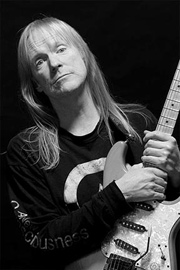 There’s some good reading in the Daily Evangel section, Evangelical News & Views, today about the passing of the Father of Christian Rock, Larry Norman. There is also some great reading about it by Steve Camp at his blog, where he shares a few memories from the days when he spent time with this music ministry mentor of his. But you gotta read, “Larry Norman, Coffee Shop Evangelist” by one of Larry’s more fruitful converts–she went on from her coffee shop conversation with Larry about Jesus to found Jews for Jesus (Wikipedia on J4J)
You know, they always say that you never know what will become of the people with whom you share Christ, the message may go on and on and on. And apparently it did in her case.
I’m not old enough to remember Larry’s music and impact back in the day, but, his legacy in contemporary Christian music played a role in my growing in the grace and knowledge of the Lord Jesus Christ, as I laid on my floor in front of my stereo, listening to Christian rock and reading the lyrics sheets and looking up the Scripture references that were often printed along with the words. I wonder if they still do that on lyrics sheets nowadays . . .
Here’s a nice song that seemed appropriate to feature in light of the passing of the effectively evangelistic Father of Christian Rock, Larry Norman. I’ll post another in the sidebar VODPOD.
<
First Christmas, Easter and Halloween . . . now the pastorate?
 Look at the bottom of my sidebar. I’ve added a couple of RSS Feed widgets. One links to the blog, “Reformation Theology,” where you can find some pretty good reading on Reformed theology, by folks more experienced at expounding it to you than I am. With this feed I’m attempting to, as they say, “light a light.”
The other feed, conversely, is where I, if you will, “curse the darkness.” It’s a link to “Out of Ur,” the blog of “Christian Leadership” Magazine, a subsidiary of “Christianity Today”. It may help us keep our finger on the pulse of the spiralling state of evangelicalism. What I want you to see specifically are the links to “Pagan Christianity” and “Is the Pastorate Pagan?” These deal with a new book called Pagan Christianity?, that has recently been published, co-written by Frank Viola and George Barna, author of Revolution. If you look for them after today, it probably won’t be in my sidebar anymore, but you’ll have to search the archives at “Out of Ur” for these articles.
Since the release of Barna’s book, I’ve been concerned with how addicted most churches seem to be on Barna’s polling of Christianity. Knowing what we now know from his book, Revolution, about his belief that the institutional church is irrelevant, and individuals need to rather “be the church” individually (which is an oxymoron), I fear that his statistical research is actually used to promote this ideal. I submit, either evangelicals who are faithful to God’s Word and historic orthodoxy ought to find other sources for such statistical information, or give up entirely the need to tell us from the pulpit what the latest statistics are that relate to whatever it is that is being preached about on any given Sunday.
So the rolling snowball of Barna’s “Revolution” is growing; with the help of Frank Viola, not only is church irrelevant, traditional forms of church ministry are pagan! Or, so they would have you believe.
Evangelicals are living in perilous times (2 Timothy 3:1-17).
Theological & Doxological Meditation #43
Decalogue’s Preface White Horse Inn “Webisodes” on YouTube
“One of the most urgent tasks facing Evangelical Christendom today is the recovery of the gospel.” – J.I. Packer
The quote above is featured under the title of a blog called, “Recover the Gospel.” Kim Riddlebarger, pastor of Christ Reformed Church in Anaheim, California, co-host of the White Horse Inn Radio Show, and Reformed Blogger extraordinaire, directed his readers to the Recover the Gospel website where they have prepared a series of videos featuring the past two weeks’ episodes of the White Horse Inn for viewing on YouTube.
For those who aren’t aware, The White Horse Inn is a “theological talk show” advocating a return to the solid doctrine and practice of the Calvinist and Lutheran traditions which were foundational to Protestantism. They’re call is for every believer to “Know What You Believe and Why You Believe It.” This is an important message for this generation for very obvious reasons.
What passes for Protestant Christianity nowadays is often hardly Protestant, and some of it does not even legitimately pass as Christian. Here in America, pragmatic and entertaining methods often trump and undermine the validity of the Christian message. Whether we know it or not, Christianity in America is experiencing a “Dark Ages” of its own, because biblical illiteracy and ignorance of Christian history is so rampant that most American Christians are adrift in a see of error which they cannot discern and which is endangering their very souls. The Gospel is in desparate need of recovery in our day, and I urge you to begin your own examination of your personal beliefs with Scripture and historically orthodox resources, making an effort to see how different yours and your church’s views may or may not be from the generations of faithful Protestant Christians who’ve gone before us (which era ended sometime early in the nineteenth century).
I have embedded part one of the YouTube presentation of The White Horse Inn’s recent episode called, “That’s Entertainment,” where the hosts discuss the history of the development of entertainment as a form of ministry in America. You will be introduced to such folks as Charles Finney, Aimee Semple McPherson and Billy Sunday and you will see how what passes for ministry nowadays comes from a long line of unorthodox ministers who were acting in a manner consistent with their unbiblical beliefs. It is simply unacceptable that churches with otherwise orthodox doctrine should emulate such people and attempt to glean so-called “wisdom” from the methods of “successful” “ministers” like these. But back at Recover the Gospel, you’ll find a similar YouTube presentation of the previous White Horse Inn episode which analyzed the errors of Joel Osteen, pastor of the largest church in America.
Pray for your church, pray for your family, and pray that the Lord will give you the wisdom to search the Scriptures daily to see whether the things you are being taught on an ongoing basis are so.
At Last! The Captain on Luther–Audio!

 On Reformation Sunday, 2004, which happened to be Reformation Day itself, my
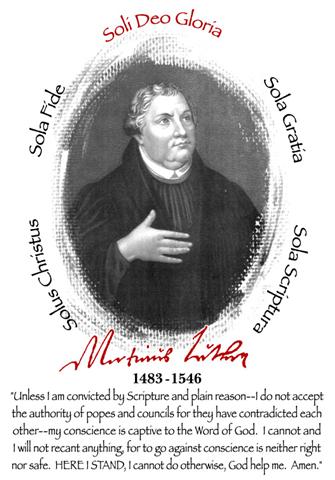 Southern Baptist pastor allowed me to give an oral presentation on Martin Luther at church. Not being a trained, or even talented, speaker, I desired a crutch, so I put together a Power Point slide show to illustrate my presentation. I thought it would also help me make it through my outline as well. I always hoped I’d be able to share it with you, but back when I did the show, I was even more green computer-wise than I am now, so I just recently figured out how to get one of those “My Public Box” thingies in my sidebar and uploaded it. If you’d like to listen, you are certainly invited.
Some of you Luther scholars out there may detect a less than accurate date or fact or two, but give me a break, I’m an amateur. I did what I could with what I had. So, without further ado, if you go over to the black box in the sidebar and click on the top selection, entitled “Reformation Sunday and Gideon Report” (that’s right those Gideons, remeber them?), then you can give it a listen. I know it’s not October or anything, but some of you may enjoy it, if you like mediocre speaking. You can also view the slide show below. . .
Theological & Doxological Meditation #42
The Decalogue’s Sum
Q. What is the sum of the ten commandments?
A. The sum of the ten commandments is, To love the Lord our God with all our heart, with all our soul, with all our strength, and with all our mind; and our neighbor as ourselves (Matthew 22:37-40).
Take Thou Our Minds, Dear Lord
#593, Trinity Hymnal (© 1990)
William Hiram Foulkes, 1918
SURSUM CORDA 10.10.10.10.
George Lomas, 1876
Take thou our minds, dear Lord, we humbly pray; give us the mind of Christ each passing day; teach us to know the truth that sets us free; grant us in all our thoughts to honor thee.
Take thou our hearts, O Christ, they are thine own; come thou within our souls and claim thy throne; help us to shed abroad thy deathless love; use us to make the earth like heav’n above.
Take thou our wills, Most High! Hold thou full sway; have in our inmost souls thy perfect way; guard thou each sacred hour from selfish ease; guide thou our ordered lives as thou dost please.
Take thou our selves, O Lord, mind, heart, and will; through our surrendered souls thy plans fulfill. We yield ourselves to thee—time, talents, all; we hear, and henceforth heed thy sov’reign call.
John Calvin’s Theology: The Rest of the Story
Those who disagree with the Calvinist view of election and reprobation,
 and object to “Calvinism,” per se, usually seem to not realize just how much more there is to Calvinism than his systematization of the Augustinian (i.e., from the 4th century) doctrine of grace versus the Pelagian notion of free will (which comes complete with its own false gospel of works-righteousness). Baptists in particular, who deny the “doctrines of grace,” don’t realize just how much leftover Calvinism there is in their current theology. Those that do, recognize that they are technically categorized as “moderate Calvinists.” Chief among these is what is nowadays called “eternal security.”
Also, there’s the doctrine of original sin, the Biblical doctrine that Adam’s guilt was imputed to all of his descendants, which sinful condition manifests itself in outward sinful acts. Most Baptists today affirm original sin, and they do so because the Baptists who migrated to America were originally Calvinists. Those “General Baptists,” whom modern anti-Calvinistic Baptists sometimes erroneously look back to as their forefathers in the faith, collectively fell away from the faith, and their theological descendants can be found today among modern Unitarianism.
As a proof for this claim, consider the following words from the Wikipedia entry on the General Baptists, to which I linked above: ” . . . traditionally non-creedal, many General Baptist congregations were becoming increasingly liberal in their doctrine, obliging the more orthodox and the more evangelical among them to reconsider their allegiance during this period of revival (Edward’s, Whitefield’s and Wesley’s 18th century First Great Awakening). Before this re-organisation, the English General Baptists had begun to decline numerically due to several factors linked to non-orthodox ‘Free Christianity’. Early Quaker converts were drawn from the General Baptists, and many other churches moved into Unitarianism. . . “
Those General Baptists denied original sin. For example, John Smyth, (first to pastor a church called “Baptist” shortly before he cast his lot with the Mennonites) wrote in his Confession of Faith in 1609 that, “there is no original sin (lit;, no sin of origin or descent), but all sin is actual and voluntary, viz., a word, a deed, or a design against the law of God; and therefore, infants are without sin.” Modern anti-Calvinistic Baptists generally (no pun intended) affirm original sin, and this is because the Baptists from which you descend were originally Calvinists.
Eternal security and original sin managed to stick around because they weren’t offensive enough to undermine the outward results of mass evangelism, the way the doctrines of grace seem to. We have “revivalism” to thank for that. Read Revival and Revivalism: The Making And Marring of American Evangelicalism, by Iain Murry of Banner of Truth Trust, and you’ll learn how the TULIP got plucked in the wake of the Second Great Awakening as otherwise orthodox Christians began to adopt the methods of arch-Pelagian Charles Finney’s “new measures” in order to maximize the effectiveness of their ginned-up revivals.
But enough introduction. What I wanted to point out was just how pervasive Calvinist theology defines modern Baptist and otherwise Evangelical theology. In my last post, I linked to an essay written by B. B. Warfield entitled “Calvin As A Theologian.” This essay was written to set the record straight about all the common misconceptions that have been fabricated by anti-Calvinists in order to not only disagree with the “five points of Calvinism” (aka, TULIP, the doctrines of grace, etc.) but make those under their spiritual care despise Calvin himself and just about everything he stood for. Read Warfield’s introductory remarks, and then go read the entire article:
I am afraid I shall have to ask you at the outset to disabuse your minds of a very common impression, namely, that Calvin’s chief characteristics as a theologian were on the one hand, audacity—perhaps I might even say effrontery—of speculation; and on the other hand, pitilessness of logical development, cold and heartless scholasticism. We have been told, for example, that he reasons on the attributes of God precisely as he would reason on the properties of a triangle. No misconception could be more gross. The speculative theologian of the Reformation was Zwingli, not Calvin. The scholastic theologian among the early Reformers was Peter Martyr, not Calvin. This was thoroughly understood by their contemporaries.
Among the things that we have inherited from Calvinist theology include the following (as Warfield reports):
-
“In one word, he [Calvin] was distinctly a Biblical theologian, or, let us say it frankly, by way of eminence the Biblical theologian of his age. Whither the Bible took him, thither he went; where scriptural declarations failed him, there he stopped short.”
-
“Calvin marked an epoch in the history of the doctrine of the Trinity, but of all great theologians who have occupied themselves with this soaring topic, none has been more determined than he not to lose himself in the intellectual subtleties to which it invites the inquiring mind; and he marked an epoch i the development of the doctrine precisely because his interest in it was vital (that means “spiritual,” or “devout”) and not merely or mainly speculative.”
-
“The fundamental interest of Calvin as a theologian lay, it is clear, in the region broadly designated soteriological. Perhaps we may go further and add that, within this broad field, his interest was most intense in the application to the sinful soul of the salvation wrought out by Christ, — in a word, in what is technically known as the ordo salutis. . . Its [Calvin’s Institutes]effect, at all events, has been to constitute Calvin pre-eminently the theologian of the Holy Spirit.”
-
“He also marks an epoch in the mode of presenting the work of Christ. The presentation of Christ’s work under the rubrics of the three-fold office of Prophet, Priest and King was introduced by him: and from him it was taken over by the entirety of Christendom, not always, it is true, in his spirit or with his completeness of development, but yet with large advantage.”
-
“In Christian ethics, too, his impulse proved epoch-making, and this great science was for a generation cultivated only by his followers.”
-
“It is probable, however, that Calvin’s greatest contribution to theological science lies in the rich development which he gives–and which he was the first to give–to the doctrine of the work of the Holy Spirit. “
-
Finally, here’s Warfield’s summary of Calvin as a theologian: “It has been common (among academic theologians, not pastors and laity who love to hate Calvin) to say that Calvin’s entire theological work may be summed up in this–that he emancipated the soul from the tyranny of human authority and delivered it from the uncertainties of human intermediation in religious things: that he brought the soul into the immediate presence of God and cast it for its spiritual health upon the free grace of God alone.”
-
And of Calvin’s masterpiece, The Institutes of the Christian Religion, Warfield summarizes: “The Institutes is, accordingly, just a treatise on the work of God the Holy Spirit in making God savingly known to sinful man, and bringing sinful man into holy communion with God.”
Far from being some cold, depressing, rigidly logical and academic murderer (we mustn’t forget Servetus!), Calvin was recognized by his peers and his entire generation as an eminently devout and spiritual biblicist whose development of Protestant theology built on the shoulders of Augustine, Anselm, Hus, Bradwardine, Wycliffe, and Luther and helped make Western Civilization what it became in its historical greatness. All by the grace of God, and for his glory alone!
Theological & Doxological Meditation #41
Legal Summary
Q. Where is the moral law summarily comprehended?
A. The moral law is summarily comprehended in the ten commandments (Deuteronomy 10:4; Matthew 19:17).
The Ten Commandments
#724, Trinity Hymnal (© 1990)
Versified by Dewey Westra, 1899-1979
Alt. in Psalter Hymnal, 1987
Tune Name: LES COMMANDMENTS DE DIEU 9.8.9.8.
Genevan Psalter, 1547
Arranged by Claude Goudimel, 1564; rev.
My soul, recall with rev’rent wonder
how God amid the fire and smoke
proclaimed his law with thunder
from Sinai’s mountain when he spoke:
“I am the Lord, your God and Sovereign,
who out of bondage set you free,
who saved you from the land of Egypt.
Then serve no other gods but me.
“You shall not bow to graven idols,
for I, a jealous God, your Lord,
shall punish sin in those who hate me,
but love all those who keep my Word.
“The Lord is God; his name is holy.
Do not his holiness profane.
God surely will not hold them guiltless
who take his holy name in vain.
“Remember, keep the Sabbath holy,
the day God sanctified and blessed.
Six days you shall do all your labor,
but on the seventh you shall rest.
“Honor your father and your mother;
obey the Lord your God’s command,
that you may dwell secure and prosper
with length of days upon the land.
“You shall not hate or kill your neighbor.
Do not commit adultery.
You shall not steal from one another
nor testify untruthfully.
“You shall not covet the possessions
your neighbors value as their own;
home, wife or husband, all their treasures
you shall respect as theirs alone.”
Teach us, Lord God, to love your precepts,
the good commandments of your law.
Give us the grace to keep your statutes
with thankfulness and proper awe.
Jesus’ “Lost Years” Found In the New Testament

In my post last Sunday morning, I blogged about Lee Strobel’s book defending “the Real Jesus.” With this topic fresh in my mind, as well as the Sunday School lesson which I’d prepared for that morning, when class began, during our conversation with the children before the lesson, one of them asked out of the blue where Jesus was between the time he was a kid and the time he began his public ministry. I could tell immediately where he was going. Naturally, he followed up by saying his dad had been watching the History Channel and heard that people say Jesus went to India for some time between the ages of 12 and thirty. In the providence of God, my lesson for the day was from Luke 2:39-52, the account of “The Boy Jesus in the Temple,” as the heading over this passage in the English Standard Version describes it.
I’m not terribly familiar with the claims regarding Jesus’ reputed trip to India, spread by those outside the realm of orthodox Christianity. However, having perused the search engine and scanned a few sites (like this one, for example) and Wikipedia articles (like the one on the gnostic Acts of Thomas and the theosophical Aquarian Gospel), I’ve hit upon the apparent basis for the theory that Jesus went to India as a boy. I’d probably already be more clued in about it if I didn’t avoid History Channel programs of this nature and other popular sources of info on the secularized revisionist research on the “historical Jesus.” But I’m getting ahead of myself.
My immediate response to my student was that there are a lot of people who like Jesus, but who don’t believe the Bible. Often, they are people or groups from other religions that associate Jesus with their beliefs in an attempt to lend credibility to them, or for some other reason. In the middle of giving this summary of where stories like that come from, a verse from my lesson came to mind. “Now his parents went to Jerusalem every year at the Feast of the Passover” (Luke 2:41). After I glanced at the passage for a minute, it became clear to me that even though the verse doesn’t say, “Now Jesus and his parents went . . . ” the context indicates that when his parents went to Jerusalem every year, so did Jesus.
It seems I’ve found a piece of New Testament evidence that would indicate that Jesus of Nazareth did not, in fact, ever go to India, or on any fanciful “magical mystery tour” of eastern religions between the ages of 12 and 30, as suggested by the Aquarian Gospel, but was with his parents every year when they went to Jerusalem to celebrate the Feast of Passover.
Evangelical Defense of the Biblical Historical Jesus
 Many Reformed Christians often decry the glut of Evangelical literature on the market. We frequently wring our hands about how much literature available at your local Christian bookstore isn’t worth buying. For example, I have a friend who always says that you can find better Christian books at Barnes & Noble. I know what he means, and I don’t disagree. However, when those of us with high expectations for Christian books spend all of our time talking about the undesirable aspects of the Evangelical literature, we forget that with the bad comes the good.
I, for one, am glad that the Evangelical bookselling market is there to regularly defending the reliability of the Bible on a popular level against the constant onslaught of critical, skeptical, cynical and outright irreverent and disrespectful “search for the historical Jesus.” I added irreverent and disrespectful with Ann Rice’s comments about her opinion of the critical scholarship she’s read over the years in her historical research for her writings. When I find the article I read in which her opinion was cited, I’ll update this post. But I digress. I’m glad the Evangelical Booksellers market is there if only to provide on a popular level a defense of the reliability of the biblical account of Jesus of Nazareth. The Bible makes lots of historical and theological claims about Jesus, and we, as Evangelicals, are obligated to believe the Word of God on these issues. If we are willing to believe the spiritual revelation about Jesus in the Bible, we’d better be prepared to believe the historical revelation about him, too. After all, Jesus told Nicodemus in John chapter three, “If I have told you earthly things and you do not believe, how can you believe if I tell you heavenly things?” (John 3:12) The historical reliability of the Bible (“earthly things”) is part of the basis for the reliability of the theological reliability of the Bible (“heavenly things”).
That’s why, one day, I hope to get around to reading Lee Strobel’s book, The Case for the Real Jesus. You can check out Zondervan’s website with lots of promotional material about it. But right now, I’m having too much fun along the same lines with one of Zondervan’s other great recent releases, The NIV Archeological Study Bible!
A Slow Holiday Season for the Historical Jesus
I just got home from the barber shop, where I perused the December 24 issue of U. S. News & World Report, which featured as its “holiday” cover story, not some new theory that threatens to change everything we’ve ever thought about Christianity, like we’ve been treated to for the last several years in a row, but an article on how Catholics,  Protestants and Jews are all alike seeing a return to ritual and liturgy among the younger generation which is so underwhelmed by the boomer generation’s attempts to relevantize (is that a word? I’ll look it up later.) their respective religious expressions. We evangelicals will certainly think instantly of the seeker-sensitive model of worship. This trend seems to be reflected in Bill Hybels’ recent change of heart about how his church has been weak on discipleship (or “self-feeding”); at least he’s publicly acknowledging a little self-critical reevaluation. Or is it just vying for some of the consumers to be had among the aforementioned younger generation that’s “seeking” more tradition-sensitive models of worship?
Here’s one interesting excerpt featuring the Evangelical version of this phenomenon:
Talk to Carl Anderson, the senior pastor of Trinity Fellowship Church, and you get an idea. “Seven or eight years ago, there was a sense of disconnectedness and loneliness in our church life,” he says. The entrepreneurial model adopted by so many evangelical churches, with its emphasis on seeker-friendly nontraditional services and programs, had been successful in helping Trinity build its congregation, Anderson explains. But it was less successful in holding on to church members and deepening their faith or their ties with fellow congregants. Searching for more rootedness, Anderson sought to reconnect with the historical church.
Connections. Not surprisingly, that move was threatening to church members who strongly identify with the Reformation and the Protestant rejection of Catholic practices, including most liturgy. But Anderson and others tried to emphasize the power of liturgy to direct worship toward God and “not be all about me,” he says. Anderson also stressed how liturgy “is about us—and not just this church but the connection with other Christians.” Adopting the weekly Eucharist, saying the Nicene Creed every two or three weeks, following the church calendar, Trinity reshaped its worship practices in ways that drove some congregants away. But Anderson remains committed, arguing that traditional practices will help evangelical churches grow beyond the dependence on “celebrity-status pastors.” (emphasis added)
Having looked over Trinity’s website, the only critique I have is in their fear of being divisive with a “detailed confession of faith,” favoring instead as their confession a combination of the Nicene Creed and the ankle-deep NAE Statement of Faith. A little too bare-bones for my taste, but the rest, I really like. But then, I’m part of that younger generation that isn’t into commercialized worship. Would that more “traditional” churches would seriously examine a more historical, liturgical worship that centers on the regulative principle of worship and actively encourages an appreciation of “the communion of saints,” our “connection” with the entire church in all times and places, as we worship God in the heavenly Jerusalem (Hebrews 12:22-24). Speaking of which, the current episode of The White Horse Inn which is featured in my sidebar, deals with this very kind of topic. I highly recommend your listening to it. It will expand your understanding of what’s going on spiritually in Sunday morning worship, and help you have an idea of where I’m coming from on all of this stuff.
Be that as it may, I was relieved that it so far seems to be a slow holiday season for debunkers of the historically orthodox understanding of Christianity in general, and Jesus in particular. As I was flipping through the pages of the magazine, the only thing of that kind of “historical Jesus” hand-wringing was a timely recycling of all the recent junk that had been polluting our airwaves for the past few years.


 The Misadventures of Captain Headknowledge