Christianity and Liberalism Revisited
 This past weekend, Westminster Seminary California’s (WSC) annual conference was held. It was called, “Christianity and Liberalism Revisited,” referring to the title of a book by the founder of Westminster Theological Seminary in Philadelphia, PA, and “the principal figure in the founding” of the Orthodox Presbyterian Church (OPC) in 1936, which in 2011 is celebrating its 75th anniversary. This conference is WSC contribution toward that celebration.
The conference was webcast live on Ustream and the videos are still posted there for your viewing pleasure, and audio is posted at the WSC Resource Center, but I’ll link to them below for your convenience.
- Christianity and Liberalism Today “Michael Horton shows the prophetic insight of Machen’s most famous book in Christianity today.”
- The Perennial (Problem with) Machen “Daryl Hart critiques evangelicals’ use of Machen today.”
- Machen and the Bible “Joel Kim explains the relevance of Machen’s view of the inspiration and authority of the Bible.”
- Machen and the Gospel “J. V. Fesko gives a summary of Machen’s view of the gospel and its relevance today.”
- Machen and Ethics “David VanDrunen explains how Liberalism, in its day, was fundamentally dishonest.”
- Machen, Christianity and the Church “W. Robert Godfrey explains how the church is the mission of God to carry his doctrines to the ends of the earth.”
- Question and Answer Session “The question and answer session from the 2011 Conference ‘Christianity and Liberalism Revisited’”
Bonus! If you’d like to know more about J. Gresham Machen and the Orthodox Presbyterian Church (a local congregation of which denomination my family is currently attending, Mid-Cities OPC), then start with conference speaker Daryl Hart’s page at the OPC website, called, “Machen and the OPC.”
Also, the Rev. Jason Stellman has posted a thought-provoking reflection on Hart’s lecture at his blog Creed, Code, Cult, called, “Catholicity and Liberalism.”
Sister Aimee and the “Anabaptist Nation”

"Sister Aimee" McPherson
I heard an interesting description of how American Christianity effectively developed into a form of Anabaptism. Dr. R. Scott Clark, Professor of Church History and Historical Theology at Westminster Seminary California (WSC), was interviewed this past week on Christ the Center podcast episode #157 regarding his contribution to Always Reformed, a festschrift that has recently been published in honor of WSC President and Professor of Church History, Dr. Robert Godfrey (see Dr. Clark’s post here). From what I’ve been able to gather over the past couple of years, Dr. Godfrey is an earnest student of the phenomenon of Sister Aimee McPherson’s ministry in the 1920’s, and holds her up as an example of what American Christianity is. Clark’s chapter is entitled, “Magic and Noise: Reformed Christianity in Sister’s America.” To some extent, it seems that this very subject of the Anabaptistic flavor of American Christianity is at the heart of this chapter, as may be inferred by the chapter’s title itself.
About twenty-two minutes into the interview, Clark introduces this topic by urging the study of “Sister” (as she is wont to be called) on Reformed believers. He does this because, according to Clark, in many ways McPherson’s type of Christianity is more indicative of the nature of American Christianity than the Reformed faith can lay claim to anymore. America has come a long way since the faith of the pilgrims of Plymouth Rock and the Salem witch trials (which is probably all Americans remember about those early Christian settlers (for help with that, listen to this and this). Clark believes that the Reformed would be aided in reaching America for Christ, and American evangelicals for the Reformed faith if they would see themselves more as cross-cultural missionaries, rather than natives.
Dr. Clark offers the disclaimer that his Anabaptist diagnosis of American Christianity is largely due to the fact that his primary field of research is the sixteenth and seventeenth century Reformation, rather than early twentieth century Christianity. He admits that in part he is interpreting the McPherson phenomenon and the nature of “native” American Christianity in the light of the sixteenth century Anabaptist movement, but he does attempt to support his conclusion with appeals to others who have written more extensively on Christianity in the nineteenth and twentieth centuries.
There are parallels between the Anabaptist movement of the sixteenth century and current American Christianity. Clark explains that people tend to think of the Anabaptist movement as just another facet of the Protestant Reformation, but he points out that the Anabaptists (also known as “Radical Reformers”) more or less “rejected all of the key doctrinal commitments” of the Protestant Reformation in favor of much more radical positions. Clark’s thesis is that the way American Christians commonly think about the nature of authority, epistemology (how we know what we know), Scripture and its authority, the church and eschatology (the doctrine of the end times) often bears strong resemblance to sixteenth and seventeenth century Anabaptism. Dr. Clark goes into a little more detail on this in the interview between minutes 33:15 and 42:06.
This portion of the interview caught my attention because Clark’s comparison is consistent with a conclusion I came to in my own personal pilgrimage from independent Baptist fundamentalism to Reformed theology and practice. After learning that the ultimate source of the bulk of historic Baptist theology comes from the Reformed Westminster Confession of Faith (see my newly updated “Creeds, etc.” page), and the parallels I saw between Baptist distinctives and the historic Anabaptist movement, I concluded that everything that’s right in the Baptist tradition was learned from the Reformed tradition, and everything that’s wrong in the Baptist tradition was learned, or “caught,” if you will, from Anabaptism. I realize that the 1689 Baptist Confession disclaims any formal connection between their doctrines and those of the Anabaptists, but the parallels are just too striking to Reformed paedobaptists.
This is why I encourage you to take time to listen to at least this section of the interview, if you don’t have the time or inclination to enjoy all of it. It’ll be thought-provoking time well-spent, if you ask me.
Listen To This…
Here are the programs I’ve been following this week. If you’ve got the time, it would benefit you to check some of them out:
- “Machen’s Warrior Children” on Christ the Center
- “Gospel-Focused” on White Horse Inn
- January 11 Episode of Dividing Line
- “The Legacy of the King James Bible” on ReformedCast
Did Shakespeare Help Write the King James Bible?
As a child, growing up in an independent Baptist church that used, preached and taught from the King James Bible, I recall occasions in which a relative of ours who did not share our reverence for it, would attempt to undermine our reliance on it by spinning the yarn that William Shakespeare helped translate the KJV, and while doing so, hid some “Easter eggs” in the text of Psalm 46. The phenomenon to which he referred was the fact that the 46th word from the beginning of the psalm is the word “shake” (v. 3) and the 46th word from the end of the psalm is the word “spear” (v. 9). I can’t speak for my parents, but I always found this idea to be ludicrous, even as a child. As much as I’ve searched the internet for explanations, the following from Doug Kutilek makes a few interesting points that demonstrates how far-fetched this religious urban legend is.
The following is from As I See It Volume 5, Number 2, February 2002:
One of the wonders of the internet is how easily it facilitates the dissemination of utterly false and fictitious, or at best highly dubious, information. Whole books have been written about such “urban legends” (you know–the alligators reportedly in the sewers of New York City, and the supposedly “Satanic” nature of the venerable Proctor & Gamble “man in the moon” logo).
Well, not to be out-done by the “children of this world,” Christians also have their “urban legends.” One of these that has been circulating in cyber-space involves the great British playwright William Shakespeare and the famous King James Version of the Bible. The story goes as follows:
The KJV translators reportedly (so this legend has it) consulted Shakespeare, a renowned master of English style, as they were doing their translation work, and to acknowledge surreptitiously, not openly, his part in the work (it would have been scandalous to have a mere actor and author of stage plays participating in the important and sacred work of Bible translation), they translated–or perhaps allowed him to translate (depending on which version of the legend is being told), his complete ignorance of Hebrew notwithstanding–a part of Psalm 46 in a particular way. If one turns to that Psalm, he will discover that the 46th word from the beginning of the Psalm (ignoring the title, which does in fact form a part of the inspired text) is the word “shake.” And if one counts words from the end of the Psalm, the 46th word from the end (ignoring the final word of the Psalm, the Hebrew word selah–again a part of the inspired text) is the word “speare.” So, the 46th word from the beginning and the 46th word from the end of the 46th Psalm are “shake” and “speare.” An apparently remarkable coincidence, to be sure. And the unstated implication is that this somehow adds to the prestige, dignity and authority of the KJV over all other English Bible versions.
But against the theory is the apparent complete absence of any contemporary positive evidence associating the bard of Stratford-on-Avon with the KJV translation committee and its work. Certainly the lengthy account of Shakespeare in the authoritative Dictionary of National Biography, authored by the editor of the work, Sir Sydney Lee, betrays no such knowledge. Nor can I find any reference to the same in several other works on Shakespeare consulted, nor indeed in various standard histories of the English Bible. This is not to say that it is thereby absolutely disproved, though the happenings in Shakespeare’s life in the period 1604 to 1611 (when the KJV was in preparation) are fairly well-known to history, and any part the most famous of English authors might have had in the production of the most famous of English Bible translations could scarcely have gone unnoticed and unreported.
The novelty of the coincidence of the “46s” and “Shakespeare” is not quite so remarkable as it might seem at first blush. The Geneva Bible of 1560 (published 4 years before Shakespeare’s birth and therefore certainly uninfluenced by him in any way–indeed, he was influenced by it) was the Bible most commonly used in the English-speaking world during the far greater part of Shakespeare’s active writing career (he died in 1616, having virtually retired some years earlier; all but 3 of his many plays and the whole of his poetry being commonly ascribed to the years before 1611). It was also the English Bible version most closely followed by the KJV translators in their revision work.
An examination of the Geneva version of Psalm 46 reveals that both words “shake” and “speare” occur in the relevant verses (3 and 9), as in the KJV, though with a slightly different word count. “Shake” is the 48th, rather than 46th, word from the beginning of the Psalm (ignoring the title) and “speare” is the 44th word from the end of the Psalm (or 45th, depending on whether “selah” is excluded from or included in the count). It seems quite probable that the KJV picked up its use of “shake” and “speare” in the 3rd and 9th verses respectively from the prior Geneva Bible (the precise wording of Psalm 46 in the Geneva and the KJV is usually identical, with a relative few differences). Further it is entirely within reason that by merest accident these words ended up 46th from the beginning and end of the Psalm (ignoring the problem counting “selah” causes for the hypothesis).
Since the “official” basis for the KJV revision was the Bishops’ Bible of 1568, a check of the wording and word counts in that version of Psalm 46 would be of interest for comparative purposes, but unfortunately I have no access to it, and must remain in the dark for now as to its precise wording.
If it could actually be established with certainty, or with at least a high degree of probability that the Shakespeare really was “honored” by the translators in the KJV of Psalm 46 in the manner suggested, whether or not he had any part whatsoever in the actual production of that translation, it would make for an interesting footnote. However, until such proof is forthcoming, it is best to leave this with the other “urban legends” of our time.
The Legacy of the King James Bible: Celebrating 400 Years of the Most Influential English Translation
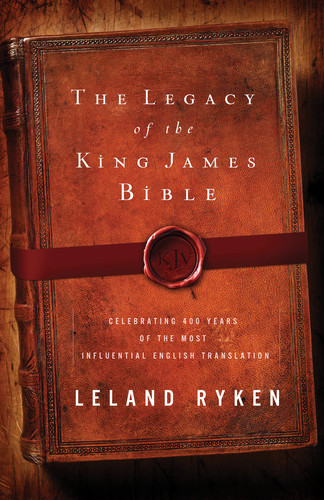 Crossway Books is contributing to this year’s celebration of the 400th anniversary of the publication of the King James Bible with the help of Wheaton College professor of English, Dr. Leland Ryken, author of The Legacy of the King James Bible: Celebrating 400 Years of the Most Influential English Translation. In promotion of this title, Justin Taylor has conducted a concise interview with the author in three parts over at the Crossway Blog. You can watch:
“How Did the King James Bible Come To Be? (Part 1)”
“The Growth of the King James Bible (Part 2)”
“The Influence of the Bible on Literature & Culture (Part 3)”
Don’t miss this opportunity to be reminded of the significance of this venerable Bible translation. As a former radical King James Onlyist who now understands that the world of Bible translation was not supposed to come to a screeching halt with the publication of the KJV, I have often been distressed by the way so many who likewise recognize the need to keep retranslating the Bible would make disrespectful swipes at the KJV. This betrays an arrogance and an ignorance that only the new is worthy of our time. But how much we miss by not familiarizing ourselves with our own history and culture. The fact is that throughout the history and the development of the culture of the English-speaking world, the King James Bible has had a constant and influential presence–and the entire world has been the better for it. Perhaps, too, it’s time that all cultures found something to appreciate in it for a change.
The BBC is celebrating KJV400.
 The BBC is promoting the 400th anniversary of the publication of the Authorized “King James” Version of the Bible. In order to do so, they are airing a series of radio reports entitled, “King James Bible–History and Readings.” Here’s how they introduce the series:
The King James Bible is one of the great English literary works. On the 400th anniversary of its publication, a series of documentaries and readings explore its history and enduring appeal. Features James Naughtie, Simon Schama, Rowan Williams, Emilia Fox, Toby Stephens and others.
The first installment aired today, but you can subscribe to a podcast that follows this series by visiting their site at the link below:
BBC – Podcasts – King James Bible – History and Readings.
For your reading pleasure, peruse this site’s blogs posted under the category of “King James Version.”
Christianity and Liberalism Revisited
Here’s a conference I wish I could attend. Believe it or not, I first discovered J. Gresham Machen’s book Christianity and Liberalism in a catalog for Peter Ruckman’s bookstore in the mid-nineties (see also here and here), but I only read it about two years ago. Growing up I was conscious of my fundamentalist pastor talking about “modernism,” but only had a very vague notion of what that might be. So vague, in fact, I couldn’t then, nor could I now define with any certainty just how much I understood about it then.
It is so important that Christians understand that the most basic and foundational thing about Christianity is not how you live, it is what you believe. This is not a denial of the importance of how you live, just a denial that it is what makes you a Christian. Actually, how you live is the product or fruit of what you believe. If you live the cleanest life in the most loving and charitable way, yet deny the deity of Christ, the trinitarian nature of God, or the virgin birth of Christ, etc., then you are not a Christian. This is what liberalism is, although it is so much more at the same time. It exalts the necessity of works over the necessity of orthodox doctrine. That’s why Machen said liberalism is not another form of Christianity, it is an entirely different religion.
Balm for Believing Victims of Christianity
The following is a sermon by Lutheran (Missouri Synod) Seminary professor, Dr. Rod Rosenbladt, who is also co-host of The White Horse Inn radio show. The title of the sermon is “The Gospel for Those Broken by the Church.” He addresses two kinds of believers who have given up on going to church: the “sad,” who feel they couldn’t measure up, so they quit trying; and the “mad,” who’ve been “used up and spit out” by the church, or who have been justly scandalized by Christianity’s many historic misdeeds. Dr. Rosenbladt’s premise is that the good news of Christ’s cross and blood shed for sinners will save not only the pagan unbeliever, but also the wounded believer who, for whatever reason, has given up on Christianity.
In some ways, Dr. Rosenbladt’s presentation may come off a bit academic, but if you hang with him, you’ll find that the heart of the message is clear as a bell. If you’ve got friends or relatives who are mad or sad at the church, please forward this post to them.
Did Jesus Even Exist?
There’s a growing trend in the realm of skepticism to claim that there is no historical proof that Jesus ever existed in the first place. They believe the contents of the canonical Gospel narratives to have developed during the century following whatever may have actually happened in the first century that caused a group of men to scatter across the Roman Empire and start claiming that the Jewish Messiah had arrived, bringing the kind of Kingdom no one expected–one that would encompass all nations. Technically, the eyewitness accounts that initially testified of his life, ministry, death, resurrection and ascension are sufficient. But usually, only Christian believers and honest historians accept the four Gospels as historically reliable. Others demand supplementary evidence. There’s plenty. Until the late twentieth century, the evidence that currently stands satisfied the demands of historical scholarship. Now, some radical skeptics have imposed a double standard on Jesus and raised the bar, just so they can feel their arguments have more merit. When one’s argument is weak, sometimes the only way it can survive is by putting down the other side.
Anyway, I found an awesome series of YouTube videos presenting some of the major extra-biblical historical references that have provided the evidence for the existence of Jesus of Nazareth. It also defends these citations against common “skeptical interjections.” I think the man who made these did a terrific job. These videos were apparently produced by the folks who run a website called “The Divine Evidence.” I know little about them other than the good job they did in this video presentation, but you can read their “About Us” on the homepage for more info.
On with the show…
Memoir of the Rev. John Brown, part 5

Lithograph of the Reverend John Brown of Haddington
In his employment as a shepherd–a calling so much ennobled in the patriarchal age, and so universally celebrated both in the ancient and modern pastoral–he enjoyed more leisure, and better opportunities, for prosecuting his favourite studies, than could have fallen to his share in almost any other business; nor did he neglect to improve such promising circumstances. In a very short time he left far behind him many who had the advantage of every thing calculated to quicken their progress,–proper books, leisure to study them, and the best masters for their instructors. Left to his own resources, however, he acquired the knowledge of the Latin, Greek, and Hebrew languages, with a rapidity that attraced the attention of the neighbourhood, and became the general topic of conversation. But while this procured him many friends, it at the same time hurt the pride, and excited the malice, of some of his outstripped rivals in the race of literary fame. It was, accordingly, whispered, that the progress he was making in his studies, in the absence of all instruction, bearing no proportion to the powers of the human mind, could only be accounted for by supposing that his unaccountable progress was effected by the agency of the devil; who, with a similar temptation, had seduced the mother of mankind, and has, in all ages, taken the advantage of the studious and scholastic habits of individuals to entangle them in his snares.–“Report ye, and we will report: come, let us smite him with the tongue.” Notwithstanding that this malevolent slander had absurdity deeply imprinted on its forehead, it was eagerly laid hold of by the ignorant and credulous, and so widely circulated, that the innocent victim felt it extremely distressing, and more especially since even Mr. Moncrieff appeared, for a season, to be influenced by it, and withdrew his countenance from him–a thing which, he afterwards admitted, was very cruel and unkind. For although the charge of diabolical intercourse was no longer admissible in the criminal courts of the country, yet the superstitious notions and prejudices handed down from the dark ages of popery were, at that period, so far from being eradicated from the minds of the people, especially in sequestered corners of the country, that such surmises were still capable of ruining a man’s peace, and inflicting a serious wound on a mind of even the most ordinary feeling. To one so ardent in the prosecution of knowledge, and so anxious to attain the qualifications necessary for a minister of the gospel, it must have been no common affliction to have all his pleasing anticipations thus cruelly blighted in a moment; for, as he apprehended, the immediate tendency of this foul reproach was to blast his religious character, and counteract his whole purpose, by shutting against him the door of the divinity hall. On those who were best acquainted with him (the members of a praying society with which he was connected,) the slander had no impression; they continued his steady friends, and their attachment seemed to strengthen in proportion to the anguish he suffered from such an unmerited calumny. In the narrative already quoted we find him speaking thus: “The reproach was exceedingly distressing to me; however, God was gracious, for I enjoyed remarkable mixture of mercy and affliction. At the beginning of the trial these words, ‘The Lord will command his loving-kindness in the day-time, and in the night his song shall be with me, and my prayer unto the God of my life,’ were peculiarly sweet to my soul.”
Memoir of the Rev. John Brown, part 4

Brown’s Self-Interpreting Bible (1859 edition)
We resume our biography of the Reverend John Brown of Haddington (1722-1787), as he joins the Scottish Secession Church and teaches himself Latin and Greek while a humble, rural shepherd, preparing himself to one day become a shepherd of souls. We are also treated to a providential encounter that wins the young Brown the gift of a Greek New Testament.
To this party (the Secession Church) our shepherd considered it his duty to join himself; and, anxious to become a shepherd of souls in their communion, he prosecuted his studies with incredible ardour and perseverance, and soon acquired a considerable acquaintance with the Latin and Greek languages. In these difficult studies he had no instructor, excepting that, on some occasions of rare occurrence, he could find an hour to call on one or other of two neighbouring clergymen, namely, Mr. Moncrieff of Abernethy, and Mr. Johnston of Arngask, father of the late Dr. Johnston of North Leith, who kindly assisted him in surmounting any formidable difficulty that threatened to arrest the progress of literary pursuits. Having now obtained such an acquaintance with the Greek language as enlivened his hopes that he should ultimately succeed in his darling object of acquiring the necessary qualifications for preaching the blessed gospel of our Lord and Saviour Jesus Christ, he pressed forward with renovated vigour and growing confidence. But amongst the many things wanting to accelerate his motion, he was, at this time, anxious to obtain a Greek Testament, that he might have the satisfaction of reading, in the original language, the character and work, the holy life and vicarious death, of Him who feedeth his flock like a shepherd, and laid down his life for his sheep. Buoyed up with these hopes, and excited by this anxiety, after folding his flock one summer evening, and procuring the consent of his fellow-shepherd to watch it next day, he made a nocturnal trip to St. Andrews, distant about twenty-four miles, where he arrived in the morning. He called at the first bookseller’s shop that came in his way, and having inquired for the article in question, the shopman, on observing his apparent rusticity and mountain habiliments (dress characteristic of his occupation), told him that he had Greek Testaments and Hebrew Bibles in abundance, but suspected an English Testament would answer his purpose much better. In the mean time some gentlemen, said to have been professors in the university, happened to enter the shop, and learning what was going on, seemed much of the shopman’s opinion. One of these, however, ordered the volume to be produced, and, taking it in his hand, said, “Young man, here is the Greek Testament, and you shall have it at the easy charge of reading the first passage that turns up.” It was too good an offer to be rejected: the shepherd accepted the challenge, and performed the conditions to the satisfaction and astonishment of the party; and Mr. Brown very modestly retired with his prize.
Memoir of the Rev. John Brown, part 3

“Abraham Offering Up Isaac” from Brown’s Self-Interpreting Bible
In the year 1733 a serious rupture took place in the General Assembly of the Church of Scotland, in consequence of an act of Assembly passed in 1730, by which it was enacted, that reasons of dissent against the decisions of the judicatories of the Church should not be entered on the record; an enactment which prevented all who dissented in any case from exonerating their consciences by recording their dissent. This gave rise to much righteous indignation on the part of the godly ministers in the Church—an indignation which was augmented when, in 1732, the most solemn remonstrances against intrusive settlements were not so much as listened to. Along with these harsh dealings it was made a cause of censure for any minister to animadvert on the proceedings of the Church courts. Several ministers—inasmuch as they were bound by solemn engagement to the truth as expressed in the subordinate standards—found that they could not, as faithful servants of Jesus Christ, submit to censure for what appeared to them their obvious duty. Accordingly, Mr. Ebenezer Erskine, having freely animadverted on the growing defections of the Church, in a sermon delivered before the Synod of Perth and Stirling, in 1732, was called to account before said Synod, where he was found liable to censure in terms of the enactment aforesaid. To this decision, however, from a sense of duty, he peremptorily refused to submit, both before the Synod and General Assembly. Mr. Erskine was at this time joined by Messrs William Wilson, James Fisher, and Alexander Moncrieff: who, after due deliberation, finding that they could not, with a good conscience, continue in the communion of the church under these circumstances, seceded from her ecclesiastical jurisdiction, on the following grounds:–1st. The sufferance of error without adequate censure. 2d. The infringement of the people’s rights in electing their ministers, under the law of patronage. 3d. The neglect or relaxation of discipline. 4th. The restraint on ministerial freedom in opposing error and maladministration. 5th. The refusal of the prevailing party to be reclaimed. On these, and other solemn considerations, stated at large in their Testimony, they constituted themselves into a distinct presbytery, fully persuaded of the lawfulness of their separation.
“Extent”
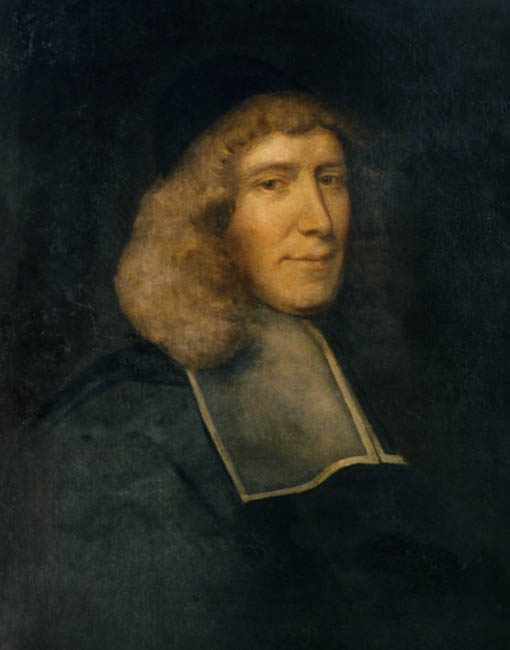
John Owen (1616-1683), thanks to ReformationArt.com
Time for our first break from Brown’s Self-Interpreting Bible. How about if we dabble in the doctrine of particular redemption?
I ran across, once again, the famous quote by Puritan theologian par excellence, John Owen (1616-1683), from his book, The Death of Death in the Death of Christ. Among statements in defense of the Reformed doctrine of particular redemption, this one is literally viral in the Reformed blogosphere. This quote is Owen’s logical critique of general redemption, and is worth thinking through and searching the Scriptures about if you’ve never taken the time.
Anyway, here’s a breakdown of his complex argument from Reformed.org:
The Father imposed His wrath due unto, and the Son underwent punishment for, either:
- All the sins of all men.
- All the sins of some men, or
- Some of the sins of all men.
In which case it may be said:
- That if the last be true, all men have some sins to answer for, and so, none are saved.
- That if the second be true, then Christ, in their stead suffered for all the sins of all the elect in the whole world, and this is the truth.
- But if the first be the case, why are not all men free from the punishment due unto their sins?
You answer, “Because of unbelief.”
I ask, Is this unbelief a sin, or is it not? If it be, then Christ suffered the punishment due unto it, or He did not. If He did, why must that hinder them more than their other sins for which He died? If He did not, He did not die for all their sins!”
I’ve looked at this many times and have until now always had trouble keeping the whole train of thought on the rails in my head, if you know what I mean. Finally, the other day, I decided I’m going to have to do with this what I do with Scripture verses and catechism questions that I want to memorize–put it to music!
The following is the result. It’s roughly based on the tune to the children’s song “I’m in the Lord’s Army,” although there are some divergences. Do what you will with it. So, without further ado, I give you . . .
Extent
by John D. Chitty
Did Christ die for
all sins of all men
or all sins of some men
or some sins of all men?
If Christ died for
some sins of all men,
then all die
for those he did not.
But if Christ died for
all sins of some men,
that’s what we believe,
all th’elect of all the nations!
But if Christ died for
all sins of all men,
why are not
all men saved?
You will answer
“Because of unbelief”–
Is unbelief a sin or not?
If not, why then,
for it give account?
Either for it
Christ was punished, or not!
If he was, then,
why does unbelief
prevent salvation
more than other sins he died for?
But if he did not
die for unbelief,
then for all sins of all men
Christ did not die!
So Christ died for
all sins of some men,
those the Father
gave to His Son!
I’m from Geneva, and I’m here to help!
Memoir of the Rev. John Brown, part 2
 About the eleventh year of his age his father was removed by death; and in some short time after, his loss was doubled in the death of his mother, and he left a poor orphan, without friends who could render him any essential service in his forlorn situation. But another ingredient was still wanting to fill up the bitter cup of adversity. About four months after the death of his mother, he was seized with a fever, four attacks of which rapidly succeeding each other, rendered his recovery almost hopeless: but his Master had employment assigned for him in his church; and having, by a series of afflicting circumstances, impressed his mind with the ineffable importance of eternal things, and rescued him from the jaws of the grave, provided the homeless orphan with a friend and protector. An elder in the parish of Abernethy—an aged shepherd and an eminent Christian, respectable also for his intelligence, though so destitute of education that he could not so much as read—cheerfully embraced the opportunity of supplying the deficiency under which he laboured, by engaging the homeless orphan, to assist him in tending his flock, and in reading for him as opportunity allowed. It will appear strange to many, that men, of considerable talents and religious intelligence, should have been so utterly neglected in their education, particularly in a country so famed for her public seminaries as Scotland has long been. To account for this, we have only to consult the history of the reigns of Charles II and his brother James, where we find that, during that persecuting period, the laws and social regulations of the country were greatly deranged; and that, under the then prelatic ascendancy, the parochial schools, established by our forefathers, were utterly neglected—a fact which shows how nearly allied the prelacy of the times was to popery—nor were they restored by law till eight years after the Revolution of 1688. The young generations, rising during that long period, must, therefore, have been either partially or totally deficient in point of instruction, with the exception merely of those who could afford a very uncommon expense. John Ogilvie, the elder, whose kindness to young Brown we have just mentioned, had felt the privation of parochial instruction. But the connexion with the orphan boy was peculiarly advantageous to both parties, who, well pleased with one another, set to work and constructed a small hut amongst the hills, to protect them from the rain and the storm, where they read and conversed with one another, and sent up their joint supplications to him who fills the hungry with good things, while the rich are sent empty away. During this reciprocity of kind offices and congenial feelings, by a strict attention to the dispensations of Providence, by pondering over the books he read, and the sermons he heard, the young man was brought under very impressive apprehensions of the majesty of God, the hatefulness of sin, the love of Christ, and the utter insignificance of all earthly enjoyments, when contrasted with the glories of heaven; so that the pleasure of his secret devotions was greatly augmented, while he felt his conscience daily becoming more tender, and his walk and conversation more assimilated to that of his Lord and Master. His mountain was now strong, and his state prosperous; but sun and shade are not more vacillating, in the natural world, than hope and fear, joy and sorrow, are in that of the spiritual. His pastoral friend and companion relinquished his mountain occupation, and settling in Abernethy, Mr. Brown was again out of employment; and wishing to provide for himself things honest in the sight of all men, he found it necessary to enter into the service of a neighbouring farmer, whose premises were much more extensive, and his domestics more numerous, and, as it would appear, whose lives were less exemplary than that of his former friend. Here he soon began to feel a sensible decline in his spiritual attainments, and a general lukewarmness and indifference in the exercise of religious duties, though his external deportment was still distinguished by manifold virtues, and particularly by the ornamental grace of meekness, patience, and Christian forbearance, under the most irritating provocations, with a spirit of Christian charity, ever ready to forgive.—A fellow shepherd, who, in his youthful gaiety, had taken a malicious pleasure in ridiculing and otherwise annoying the young man in his devotions, after observing for some time the unalterable serenity and interminable patience with which he endured the unprovoked insult, blushed himself into repentance; nor could he find rest in his own mind till he had acknowledged his fault, expressed the shame and sorrow he felt for what he had done, and had received an assurance of a frank forgiveness. This led to an intimate and cordial friendship, which lasted during life; and the same individual, when on his death-bed, declared that the admonitions and religious instructions he received from Mr. Brown, during their intercourse as fellow-servants, had laid him under obligations which no language could express.


 The Misadventures of Captain Headknowledge
Heresy in Defense of the Fundamentals
Council of Chalcedon, AD 451
“Since therefore the children share in flesh and blood, he himself likewise partook of the same things, that through death he might destroy the one who has the power of death, that is, the devil, and deliver all those who through fear of death were subject to lifelong slavery” (Hebrews 2:14-15 ESV).
Recently, I heard an Independent Fundamental Baptist preacher comment that he believes in salvation “by the blood of Christ, not his death.” One who heard this comment with me registered his shock at the statement. Having discussed this issue with this particular preacher in the past, I knew what he meant by it, and was able to fill in my companion. The following bullet points are a summary of the things I shared with him.
Suffice it to say that there is a segment of Independent Baptist Fundamentalism that so wants to defend the “literal” interpretation of Scripture that it will often deny simple figures of speech in Scripture to the extent that it begins to distort the very fundamentals it intends to defend. One such fundamental of the faith that has suffered such distortion is that of the hypostatic union of Christ’s human and divine natures, of which the historic conciliar statement produced by the Council of Chalcedon (AD 451) expresses the Biblical doctrine quite thoroughly and has served the church well in defining the orthodox position. Although an appeal to the so-called “Definition of Chalcedon” as an expression of Scriptural teaching on the matter falls on deaf fundamentalist ears, it does not change the fact that, historically speaking, for the Protestant as well as the Roman Catholic, to dissent from this Ecumenical Council on the hypostatic union is to be led by blind guides into the ditch of formal heresy. Sad to say, this is the fate of the kind of irresponsible Biblicism that often goes on in the Fundamentalist movement.
I’ve posted on this topic before here and here. The names I’ve used for this fundamentalist heresy are “Divine Blood” and “Celestial Flesh.” These titles describe the ways in which fundamentalists blur the distinction between Christ’s human and divine natures to a possibly heretical extent. This explains the use of these terms in the following bullet points:
I found an excellent, but lengthy, treatment of this doctrine by an Irish Reformed minister. If you’ve ever heard of this doctrine before, and are the least bit concerned about it, please invest the time in reading “Fundamentalists and the ‘Incorruptible’ Blood of Christ” by Martyn McGeown of Covenant Protestant Reformed Church in Ballymena, North Ireland. Although it’s by an Irish writer, much of his essay interacts with American fundamentalist contributions to the controversy as well.
Share this: