A Study in Deformation: Or, How Luther’s Reformation was a High-Water Mark in Church History

October 10, in the year of our Lord . . .
 Arminians.”
  AD 1517-1700? The Age of Reformation (
Summary of Roman Catholic Justification


More Luther on Repentance
I was really impressed with some of the evangelical truth that is contained in some of Martin Luther’s 95 Theses. Consider the first four theses, in which Luther introduces the doctrine of repentance. If he were alive today, I think I could guess which side of the Lordship debate Luther would come down on, couldn’t you?
1. When our Lord and Master Jesus Christ said, “Repent” (Mt 4:17), he willed the entire life of believers to be one of repentance.
2. This word cannot be understood as referring to the sacrament of penance, that is, confession and satisfaction, as administered by the clergy.
3. Yet it does not mean solely inner repentance; such inner repentance is worthless unless it produces various outward mortification of the flesh.
4. The penalty of sin remains as long as the hatred of self (that is, true inner repentance), namely till our entrance into the kingdom of heaven.
Now, let us consider how he elaborates on repentance in the Smalcald Articles:
THE THIRD PART OF THE ARTICLES
Article III: Repentance
This office [of the Law] the New Testament retains and urges, as St. Paul, Rom. 1, 18 does, saying: The wrath of God is revealed from heaven against all ungodliness and unrighteousness of men.Again, 3, 19: All the world is guilty before God. No man is righteous before Him. And Christ says, John 16, 8: The Holy Ghost will reprove the world of sin.This, then, is the thunderbolt of God by which He strikes in a heap [hurls to the ground] both manifest sinners and false saints [hypocrites], and suffers no one to be in the right [declares no one righteous], but drives them all together to terror and despair.This is the hammer, as Jeremiah says, 23, 29: Is not My Word like a hammer that breaketh the rock in pieces?
This is not activa contritio or manufactured repentance, but passiva contritio [torture of conscience], true sorrow of heart, suffering and sensation of death.This, then, is what it means to begin true repentance; and here man must hear such a sentence as this: You are all of no account, whether you be manifest sinners or saints [in your own opinion]; you all must become different and do otherwise than you now are and are doing [no matter what sort of people you are], whether you are as great, wise, powerful, and holy as you may. Here no one is [righteous, holy], godly, etc.
But to this office the New Testament immediately adds the consolatory promise of grace through the Gospel, which must be believed, as Christ declares, Mark 1,15: Repent and believe the Gospel, i.e., become different and do otherwise, and believe My promise. And John, preceding Him, is called a preacher of repentance, however, for the remission of sins, i.e., John was to accuse all, and convict them of being sinners, that they might know what they were before God, and might acknowledge that they were lost men, and might thus be prepared for the Lord, to receive grace, and to expect and accept from Him the remission of sins.
Thus also Christ Himself says, Luke 24, 47: Repentance and remission of sins must be preached in My name among all nations. But whenever the Law alone, without the Gospel being added exercises this its office there is [nothing else than] death and hell, and man must despair, like Saul and Judas; as St. Paul, Rom. 7, 10, says: Through sin the Law killeth. On the other hand, the Gospel brings consolation and remission not only in one way, but through the word and Sacraments, and the like, as we shall hear afterward in order that [thus] there is with the Lord plenteous redemption, as Ps. 130, 7 says against the dreadful captivity of sin.
However, we must now contrast the false repentance of the sophists with true repentance, in order that both may be the better understood.
Of the False Repentance of the Papists.
It was impossible that they should teach correctly concerning repentance, since they did not [rightly] know the real sins [the real sin]. For, as has been shown above, they do not believe aright concerning original sin, but say that the natural powers of man have remained [entirely] unimpaired and incorrupt; that reason can teach aright, and the will can in accordance therewith do aright [perform those things which are taught], that God certainly bestows His grace when a man does as much as is in him, according to his free will.
Read more . . .
Babylonian Captivity of the Church
 A Prelude of Martin Luther
On the Babylonian Captivity of the Church
JESUS
Martin Luther, Augustinian, to his friend, Hermann Tulich, greeting.
(Tulich was born at Steinheim, near Paderborn, in Westphalia; graduated from Wittenberg (A.B., 1511); was a proofreader in Melchior Lotter’s printinghouse at Leipzig. He returned to Wittenberg in 1519 and received the doctorate in 1520; became professor of poetry at the university; rector of the same, 1525. He was a staunch supporter of Luther; rector of the school at Luneberg from 1532 until his death in 1540.)
Whether I wish it or not, I am compelled to become more learned every day, with so many and such able masters eagerly driving me on and making me work. Some two years ago I wrote on indulgences, but in such a way that I now deeply regret having published that little book (probably the Explanations of the Ninety-five Theses (1518)). At that time I still clung with a mighty superstition to the tyranny of Rome, and so I held that indulgences should not be altogether rejected, seeing that they were approved by the common consent of so many. No wonder, for at the time I was still engaged singlehanded in this Sisyphean task. Afterwards, thanks to Sylvester (Sylvester Prierias–more properly called Mazzolini–from Prierio in Piedmont, 1456-1532, was a prior of the Dominicans. He became Grand Inquisitor and Censor of Books in 1515. he and others of the order (e.g., Tetzel and Hochstraten) had written against Luther), and aided by those friars who so strenuously defended indulgences, I saw that they were nothing but impostures of the Roman flatterers, by which thy rob men of their money and their faith in God. Would that I could prevail upon the booksellers and persuade all who have read them to burn the whole of my booklets on indulgences, and instead of all that I have written on this subject adopt this proposition: INDULGENCES ARE WICKED DEVICES OF THE FLATTERIES OF ROME. 
"Disputation of Doctor Martin Luther on the Power and Efficacy of Indulgences" (1517)
.jpg) What better way to begin to remember the life and ministry of Martin Luther, than to read the document which the Lord used so effectively to turn the world upside down and recover the article on which the church stands and falls, the doctrine of justification by faith alone!
What better way to begin to remember the life and ministry of Martin Luther, than to read the document which the Lord used so effectively to turn the world upside down and recover the article on which the church stands and falls, the doctrine of justification by faith alone!
1. When our Lord and Master Jesus Christ said, “Repent” (Mt 4:17), he willed the entire life of believers to be one of repentance.
2. This word cannot be understood as referring to the sacrament of penance, that is, confession and satisfaction, as administered by the clergy.
3. Yet it does not mean solely inner repentance; such inner repentance is worthless unless it produces various outward mortification of the flesh.
4. The penalty of sin remains as long as the hatred of self (that is, true inner repentance), namely till our entrance into the kingdom of heaven.
5. The pope neither desires nor is able to remit any penalties except those imposed by his own authority or that of the canons.
6. The pope cannot remit any guilt, except by declaring and showing that it has been remitted by God; or, to be sure, by remitting guilt in cases reserved to his judgment. If his right to grant remission in these cases were disregarded, the guilt would certainly remain unforgiven.
7. God remits guilt to no one unless at the same time he humbles him in all things and makes him submissive to the vicar, the priest.
8. The penitential canons are imposed only on the living, and, according to the canons themselves, nothing should be imposed on the dying.
9. Therefore the Holy Spirit through the pope is kind to us insofar as the pope in his decrees always makes exception of the article of death and of necessity.
10. Those priests act ignorantly and wickedly who, in the case of the dying, reserve canonical penalties for purgatory.
11. Those tares of changing the canonical penalty to the penalty of purgatory were evidently sown while the bishops slept (Mt 13:25).
12. In former times canonical penalties were imposed, not after, but before absolution, as tests of true contrition.
13. The dying are freed by death from all penalties, are already dead as far as the canon laws are concerned, and have a right to be released from them.
14. Imperfect piety or love on the part of the dying person necessarily brings with it great fear; and the smaller the love, the greater the fear.
15. This fear or horror is sufficient in itself, to say nothing of other things, to constitute the penalty of purgatory, since it is very near to the horror of despair.
16. Hell, purgatory, and heaven seem to differ the same as despair, fear, and assurance of salvation.
17. It seems as though for the souls in purgatory fear should necessarily decrease and love increase.
18. Furthermore, it does not seem proved, either by reason or by Scripture, that souls in purgatory are outside the state of merit, that is, unable to grow in love.
19. Nor does it seem proved that souls in purgatory, at least not all of them, are certain and assured of their own salvation, even if we ourselves may be entirely certain of it.
20. Therefore the pope, when he uses the words “plenary remission of all penalties,” does not actually mean “all penalties,” but only those imposed by himself.
21. Thus those indulgence preachers are in error who say that a man is absolved from every penalty and saved by papal indulgences.
22. As a matter of fact, the pope remits to souls in purgatory no penalty which, according to canon law, they should have paid in this life.
23. If remission of all penalties whatsoever could be granted to anyone at all, certainly it would be granted only to the most perfect, that is, to very few.
24. For this reason most people are necessarily deceived by that indiscriminate and high-sounding promise of release from penalty.
25. That power which the pope has in general over purgatory corresponds to the power which any bishop or curate has in a particular way in his own diocese and parish.
26. The pope does very well when he grants remission to souls in purgatory, not by the power of the keys, which he does not have, but by way of intercession for them.
27. They preach only human doctrines who say that as soon as the money clinks into the money chest, the soul flies out of purgatory.
28. It is certain that when money clinks in the money chest, greed and avarice can be increased; but when the church intercedes, the result is in the hands of God alone.
29. Who knows whether all souls in purgatory wish to be redeemed, since we have exceptions in St. Severinus and St. Paschal, as related in a legend.
30. No one is sure of the integrity of his own contrition, much less of having received plenary remission.
31. The man who actually buys indulgences is as rare as he who is really penitent; indeed, he is exceedingly rare.
32. Those who believe that they can be certain of their salvation because they have indulgence letters will be eternally damned, together with their teachers.
33. Men must especially be on guard against those who say that the pope’s pardons are that inestimable gift of God by which man is reconciled to him.
34. For the graces of indulgences are concerned only with the penalties of sacramental satisfaction established by man.
35. They who teach that contrition is not necessary on the part of those who intend to buy souls out of purgatory or to buy confessional privileges preach unchristian doctrine.
36. Any truly repentant Christian has a right to full remission of penalty and guilt, even without indulgence letters.
37. Any true Christian, whether living or dead, participates in all the blessings of Christ and the church; and this is granted him by God, even without indulgence letters.
38. Nevertheless, papal remission and blessing are by no means to be disregarded, for they are, as I have said (Thesis 6), the proclamation of the divine remission.
39. It is very difficult, even for the most learned theologians, at one and the same time to commend to the people the bounty of indulgences and the need of true contrition.
40. A Christian who is truly contrite seeks and loves to pay penalties for his sins; the bounty of indulgences, however, relaxes penalties and causes men to hate them — at least it furnishes occasion for hating them.
41. Papal indulgences must be preached with caution, lest people erroneously think that they are preferable to other good works of love.
42. Christians are to be taught that the pope does not intend that the buying of indulgences should in any way be compared with works of mercy.
43. Christians are to be taught that he who gives to the poor or lends to the needy does a better deed than he who buys indulgences.
44. Because love grows by works of love, man thereby becomes better. Man does not, however, become better by means of indulgences but is merely freed from penalties.
45. Christians are to be taught that he who sees a needy man and passes him by, yet gives his money for indulgences, does not buy papal indulgences but God’s wrath.
46. Christians are to be taught that, unless they have more than they need, they must reserve enough for their family needs and by no means squander it on indulgences.
47. Christians are to be taught that they buying of indulgences is a matter of free choice, not commanded.
48 Christians are to be taught that the pope, in granting indulgences, needs and thus desires their devout prayer more than their money.
49. Christians are to be taught that papal indulgences are useful only if they do not put their trust in them, but very harmful if they lose their fear of God because of them.
50. Christians are to be taught that if the pope knew the exactions of the indulgence preachers, he would rather that the basilica of St. Peter were burned to ashes than built up with the skin, flesh, and bones of his sheep.
51. Christians are to be taught that the pope would and should wish to give of his own money, even though he had to sell the basilica of St. Peter, to many of those from whom certain hawkers of indulgences cajole money.
52. It is vain to trust in salvation by indulgence letters, even though the indulgence commissary, or even the pope, were to offer his soul as security.
53. They are the enemies of Christ and the pope who forbid altogether the preaching of the Word of God in some churches in order that indulgences may be preached in others.
54. Injury is done to the Word of God when, in the same sermon, an equal or larger amount of time is devoted to indulgences than to the Word.
55. It is certainly the pope’s sentiment that if indulgences, which are a very insignificant thing, are celebrated with one bell, one procession, and one ceremony, then the gospel, which is the very greatest thing, should be preached with a hundred bells, a hundred processions, a hundred ceremonies.
56. The true treasures of the church, out of which the pope distributes indulgences, are not sufficiently discussed or known among the people of Christ.
57. That indulgences are not temporal treasures is certainly clear, for many indulgence sellers do not distribute them freely but only gather them.
58. Nor are they the merits of Christ and the saints, for, even without the pope, the latter always work grace for the inner man, and the cross, death, and hell for the outer man.
59. St. Lawrence said that the poor of the church were the treasures of the church, but he spoke according to the usage of the word in his own time.
60. Without want of consideration we say that the keys of the church, given by the merits of Christ, are that treasure.
61. For it is clear that the pope’s power is of itself sufficient for the remission of penalties and cases reserved by himself.
62. The true treasure of the church is the most holy gospel of the glory and grace of God.
63. But this treasure is naturally most odious, for it makes the first to be last (Mt. 20:16).
64. On the other hand, the treasure of indulgences is naturally most acceptable, for it makes the last to be first.
65. Therefore the treasures of the gospel are nets with which one formerly fished for men of wealth.
66. The treasures of indulgences are nets with which one now fishes for the wealth of men.
67. The indulgences which the demagogues acclaim as the greatest graces are actually understood to be such only insofar as they promote gain.
68. They are nevertheless in truth the most insignificant graces when compared with the grace of God and the piety of the cross.
69. Bishops and curates are bound to admit the commissaries of papal indulgences with all reverence.
70. But they are much more bound to strain their eyes and ears lest these men preach their own dreams instead of what the pope has commissioned.
71. Let him who speaks against the truth concerning papal indulgences be anathema and accursed.
72. But let him who guards against the lust and license of the indulgence preachers be blessed.
73. Just as the pope justly thunders against those who by any means whatever contrive harm to the sale of indulgences.
74. Much more does he intend to thunder against those who use indulgences as a pretext to contrive harm to holy love and truth.
75. To consider papal indulgences so great that they could absolve a man even if he had done the impossible and had violated the mother of God is madness.
76. We say on the contrary that papal indulgences cannot remove the very least of venial sins as far as guilt is concerned.
77. To say that even St. Peter if he were now pope, could not grant greater graces is blasphemy against St. Peter and the pope.
78. We say on the contrary that even the present pope, or any pope whatsoever, has greater graces at his disposal, that is, the gospel, spiritual powers, gifts of healing, etc., as it is written, 1 Co 12[:28].
79. To say that the cross emblazoned with the papal coat of arms, and set up by the indulgence preachers is equal in worth to the cross of Christ is blasphemy.
80. The bishops, curates, and theologians who permit such talk to be spread among the people will have to answer for this.
81. This unbridled preaching of indulgences makes it difficult even for learned men to rescue the reverence which is due the pope from slander or from the shrewd questions of the laity.
82. Such as: “Why does not the pope empty purgatory for the sake of holy love and the dire need of the souls that are there if he redeems an infinite number of souls for the sake of miserable money with which to build a church? The former reason would be most just; the latter is most trivial.
83. Again, “Why are funeral and anniversary masses for the dead continued and why does he not return or permit the withdrawal of the endowments founded for them, since it is wrong to pray for the redeemed?”
84. Again, “What is this new piety of God and the pope that for a consideration of money they permit a man who is impious and their enemy to buy out of purgatory the pious soul of a friend of God and do not rather, because of the need of that pious and beloved soul, free it for pure love’s sake?”
85. Again, “Why are the penitential canons, long since abrogated and dead in actual fact and through disuse, now satisfied by the granting of indulgences as though they were still alive and in force?”
86. Again, “Why does not the pope, whose wealth is today greater than the wealth of the richest Crassus, build this one basilica of St. Peter with his own money rather than with the money of poor believers?”
87. Again, “What does the pope remit or grant to those who by perfect contrition already have a right to full remission and blessings?”
88. Again, “What greater blessing could come to the church than if the pope were to bestow these remissions and blessings on every believer a hundred times a day, as he now does but once?”
89. “Since the pope seeks the salvation of souls rather than money by his indulgences, why does he suspend the indulgences and pardons previously granted when they have equal efficacy?”
90. To repress these very sharp arguments of the laity by force alone, and not to resolve them by giving reasons, is to expose the church and the pope to the ridicule of their enemies and to make Christians unhappy.
91. If, therefore, indulgences were preached according to the spirit and intention of the pope, all these doubts would be readily resolved. Indeed, they would not exist.
92. Away, then, with all those prophets who say to the people of Christ, “Peace, peace,” and there is no peace! (Jer 6:14)
93. Blessed be all those prophets who say to the people of Christ, “Cross, cross,” and there is no cross!
94. Christians should be exhorted to be diligent in following Christ, their Head, through penalties, death and hell.
95. And thus be confident of entering into heaven through many tribulations rather than through the false security of peace (Acts 14:22).
Baptist Successionism

Baptist Successionism: A Crucial Question in Baptist History
American Theological Library Association Monograph Series,
by James Edward McGoldrick,
Metuchen, NJ: The Scarecrow Press, 1994, 181 pp. $27.50
—Charles H. Spurgeon
Objections to Wine Use Answered
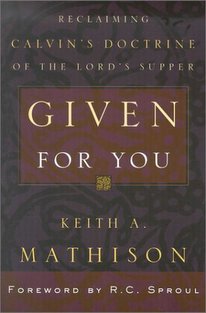 The following is an excerpt from Keith A. Mathison’s book, Given For You: Reclaiming Calvin’s Doctrine of the Lord’s Supper, copyright 2002, P&R Publishing.
Because the substitution of grape juice for wine in the Lord’s Supper has now become the standard practice in many American evangelical churches, many theologians within those communions have found it necessary to justify the change. In this section, we shall address some of the specific objections offered by representative theologians, as well as some other potential objections to the use of wine.
The prominent Baptist theologian A. H. Strong expresses a common objection made by those who have substituted grape juice for wine. He writes, “Although the wine which Jesus poured out was doubtless the ordinary fermented juice of the grape, there is nothing in the symbolism of the ordinance which forbids the use of unfermented juice of the grape,–obedience to the command ‘This do in remembrance of me’ (Luke 22:19) requires only that we should use the ‘fruit of the vine.’ ” (Augustus H. Strong, Systematic Theology (Old Tappan, N.J.: Revell, 1970), 960.) Several points may be raised in response to this argument. First, it should be noted that Strong himself admits that wine was “doubtless” the drink that Jesus used. Second, if we are required to use the “fruit of the vine,” we are required to use wine because, in the context of the institution of the Lord’s Supper, fruit of the vine was a synonym for wine.
Another Baptist theologian, William W. Stevens, presents a similar line of argument in his book Doctrines of the Christian Religion:
The bread used by Jesus was doubtless the unleavened bread of
the Passover meal, as the wine he used was doubtless the fermented
juice of the grape. But this does not mean that we must
of necessity use unleavened bread, nor does it mean that we cannot
use the unfermented juice of the grape. Unleavened bread
is what Jesus had at hand, and his phrase “fruit of the vine” in
Matthew 26:29 would include unfermented juice as well. The
bread and the cup are symbolical only. To insist on literalism
would be tantamount to legalism (William W. Stevens,
Doctrines of the Christian Religion (Nashville: Broadman, 1967), 344.)
Here again we observe that the author in question admits that it is “doubtless” that Jesus himself used wine instead of grape juice. If this is admitted to be the case, the real question is why the author would even desire to change it in the first place. Stevens is simply incorrect when he asserts that the phrase “fruit of the vine” in the context of Matthew 26:29 would include unfermented grape juice as well as wine. In the context of the Passover meal, the phrase “fruit of the vine” was a liturgical term used as a synonym for wine. Finally, the comparison that Stevens makes between leavened and unleavened bread and wine and grape juice overlooks one big difference between the two. Leavened bread is still bread, but grape juice is not wine.
The most influential evangelical Baptist theologian today is Millard Erickson. Like Strong and Stevens before him, he too attempts to justify the substitution of grape juice for wine:
What elements we decide to use in celebrating the Lord’s Supper
will depend, at least in part, upon whether our chief concern is
to duplicate the original conditions as closely as possible or to
capture the symbolism of the sacrament . . . . With respect to
the cup, duplication of the original event would call for wine. . . .
If, on the other hand, representation of the blood of Christ is the
primary consideration, then grape juice will suffice equally well . . . .
Suitability to convey the meaning, not similarity to the original
circumstances, is what is important as far as the elements are
concerned (Millard Erickson, Christian Theology (Grand Rapids:
Baker, 1985), 1125.)
This argument raises a number of important objections that must be noted. First, we are not arguing for duplication, but for obedience. If bread and wine were the elements that Christ ordained to be used, then we have no more right to change them than we have to use something instead of water in baptism. Second, the argument of Erickson (and of Strong and Stevens) changes when the subject is baptism. When discussing baptism, Baptists such as Erickson typically argue from the example of Christ. They insist that early baptism was administered only by means of immersion (This is a questionable assertion, but arguments about the meaning and mode of baptism are beyond the scope of this book. For a concise presentation of the arguments against the view that immersion was or is the only proper mode of baptism, see Jay Adams, The Meaning and Mode of Baptism (Phillipsburg, N.J.: P&R, 1992).) They argue that we must duplicate the baptismal mode that Jesus used. Yet in the case of the Lord’s Supper, they say that only the most basic symbolism need be preserved. But if basic symbolism is all that matters, then it would not matter whether Jesus and the apostles baptized only by means of immersion. Sprinkling and pouring would be acceptable because those modes of baptism convey the meaning of cleansing and purification just as well as immersion.
The dispensationalist Charles Ryrie takes a slightly different approach in his argument for the use of grape juice in the Lord’s Supper:
The Scriptures do not use the word “wine” in connection with
the Supper, only “the cup” or “the fruit of the vine.” Of course
it was juice from the grape, but whether fermented or not is not
stated . . . . For the sake of converted alcoholics or even to forestall
anyone beginning to drink, unfermented juice is preferable in light
of today’s worldwide problem with alcohol (Charles C. Ryrie,
Basic Theology (Wheaton: Victor, 1986), 425.)
There are a number of problems with Ryrie’s argument. First, the word wine does not need to be used when the phrase fruit of the vine is itself a Jewish liturgical term for wine. Second, Ryrie’s argument leave the impression that Jesus may have used grape juice. Since the Lord’s Supper was instituted during a normal Pasover meal in which wine was unquestionably used, such a suggestion is very misleading. As the Baptist theologians Strong and Stevens admit, there is not doubt that Jesus was using wine.
The argument that we should use grape juice instead of wine for the sake of converted alcoholics and because of today’s worldwide alcohol problem simply doesn’t follow. Drunkenness was as much of a problem in biblical times as it is today. Otherwise, why would there be so many biblical condemnations of this sin? Yet, in spite of the fact that drunkenness was a problem even in the first century, Jesus did not hesitate to institute the Lord’s Supper using wine. In addition, the apostle Paul encountered drunkenness in the observance of the Lord’s Supper at Corinth (1 Cor. 11:21). Aside from the fact that it would have been impossibel for the Corinthian Christians to get drunk if they were using grape juice, as some suggest they were, we must observe that Paul did not correct this abuse by advocating the nonuse of wine. Instead, he called for the proper observance of the Lord’s Supper. If alcoholism is a real problem today, it was a real problem in Jesus’ day. Human physiology has not changed drastically in two thousand years. But in spite of the fact that drunkenness was a problen, and in spite of the fact that human beings face the same kinds of temptations, Jesus instituted the Lord’s Supper with the elements of bread and wine. To suggest that the use of wine in the Lord’s Supper contributes to sinful behavior is to condemn Jesus himself.
The Pentecostal theologian J. Rodman Williams provides another faulty argument against the use of wine in the Lord’s Supper:
In the three synoptic accounts of the Lord’s Supper
the content of the cup is called “the fruit of the vine”
(Matt. 26:29; Mark 14:25; Luke 22:18). This doubtless
was wine; however, since wine is not directly mentioned
in any of these accounts, it is irrelevant to insist
(as some do) that wine must be used. Grape juice
equally comes from “fruit of the vine”
(J. Rodman Williams, Revewal Theology
(GrandRapids: Zondervan, 1992), 3:261, n. 178.)
This argument is similar to those made by Strong, Stevens, and Erickson. Unlike their arguments, however, it contains an obvious self-contradiction. Williams says that all three accounts of the Lord’s Supper call the content of the cup “the fruit of the vine.” Then he says that “the fruit of the vine” mentioned in these accounts was doubtlessly wine. Then he contradicts himself by saying that wine is not directly mentioned in any of these accounts. If “the fruit of the vine” is directly mentioned in all three accounts, then wine is directly mentioned in all three accounts. The specific word wine need not be used, so long as an acknowledged synonym for wine is used. It is not irrelevant, therefore, to argue that wine should be used in the Lord’s Supper.
While it is not irrelevant to argue that wine should be used, it is entirely irrelevant to point out, as Williams does, that grape juice comes from the fruit of the vine and is therefore also permissible. Many fruits and berries grow on vines. If Williams’ argument is valid, why limit ourselves to the juice of grapes? Williams himself does not reject the use of wine simply because he believes grape juice also falls under the biblical meaning of the phrase the fruit of the vine. This is evident when we see his suggestion that beverages such as milk and tea are also permissible (Ibid.). Milk and tea most certainly do not come from “the fruit of the vine.” Williams’ entire argument simply ignores the special Jewish liturgical usage of the phrase fruit of the vine. In the context of the Passover meal, the phrase meant “wine,” not any fruit that happened to grow on vines or the juice that could be derived from those fruits. To argue in the manner that Williams argues is to ignore the historical and grammatical context of Jesus’ words.
Not one of the theologians we have cited presents a cogent argument for the rejection of wine and the substitution of grape juice in the observance of the Lord’s Supper. The most that these authors have attempted to prove is that the use of wine is an indifferent matter, but the manner in which they have made this argument would work equally as well against the use of water in baptism. All but one of these authors readily admit that Jesus himself used wine at the first Lord’s Supper, yet their arguments assume that the church can reject its use without providing any biblical reason for doing so.
There are other arguments against the use of wine in the Lord’s Supper that these theologians do not pursue in any detail. For example, some argue that we should not use wine in the Lord’s Supper because any use of alcohol is a sin. As we have seen, this was one of the fundamental arguments of the temperance movement. But it is not based on a shred of biblical or historical evidence. More importantly, it directly contradicts the explicit teaching of the Bible. According to Scripture, wine is a good gift of God to be used in moderation. The abuse of this good gift, like the abuse of any gift from God, is condemned as sin, but the use of wine itself is not condemned as sin anywhere in Scripture.
Another argument against the use of wine in the Lord’s Supper is based on the idea that there are potential alcoholics who would be hurt by this practice. Those who make this argument say that some people are born with a genetic predisposition toward alcoholism. If they were to drink even a small amount of wine at the Lord’s Supper, it could lead them to become alcoholics. This argument, like the previous one, rests upon faulty presuppositions. In the first place, God has revealed in his Word that drunkenness is a sin, a moral and ethical failure, not a physiological or genetic defect. It is an act of disobedience to God.
Ironically, those evangelicals who use this argument have adopted some of the basic assumptions of liberal theology by taking something that God calls “sin” and implying that it is a “disease.” This removes the responsibility for the sin from the person involved. Secondly, this argument implies that Jesus did something wrong when he instituted the Lord’s Supper with wine. If there are people with a genetic predisposition to alcoholism now, there were people with the same disposition at the time of Jesus. Yet Jesus turned water into wine at the wedding feast at Cana and used wine at the first Lord’s Supper. Then he commanded that this sacrament be celebrated until he returns. If there is a genetic predisposition to alcoholism that is triggered by the use of even the smallest amount of wine, then Jesus is responsible for turning many people during the last two thousand years into alcoholics.
Other arguments against the use of wine in the Lord’s Supper are based on passages like Romans 12:2, 2 Corinthians 6:17, and 1 Thessalonians 5:22, where Christians are told to be separate from the world and to abstain from any appearance of evil. The use of such passages as an argument against the use of wine is based on the faulty premise that the use of alcohol is worldly or evil. If this were true, Jesus himself would be guilty of acting in a worldly manner. Jesus drank wine. He made wine. He gave wine to others. Any one of these activities would be labeled sinful by many modern American churches. But they are not sinful. To abstain from all appearance of evil means to abstain from every form and appearance of real sin, not the activity labeled “sin” by modern-day legalists. In any case, it is simply impossible to suggest that a sacrament of the church instituted by Christ himself has the appearance of evil.
Some argue that while wine is used regularly in many cultures, it should not be used in ours because in our culture the use of alcoholic beverages carries different connotations. Therefore, Christians who desire to maintain a credible witness to our culture should not use wine in the Lord’s Supper. However, our obedience to Christ cannot be compromised in order to conform the church to the standards of our culture. The culture is to be conformed to Christ, not the other way around. The problem at the heart of this argument can be readily seen if we examine its effect on areas not related to the Lord’s Supper. In our culture, for example, homosexuality has gradually become more and more acceptable. In order to “maintain a credible witness” to this culture, many Christian churches now ordain homosexuals to the ministry. In addition, many churches refuse to declare what the word of God says about this sin. Is this a credible witness to our culture?
The fact that many in our culture abuse God’s good gifts does not mean that the church must abstain from those things altogether. The church’s response should be to demonstrate the right use of God’s gifts. God’s good gift of sex is abused everywhere in our culture today. The church’s response should not be celibacy. The church maintains a credible witness to the culture by demonstrating the rightful use of that gift within the context of marriage. God’s gift of wine is everywhere abused by drunkards. The church maintains a credible witness by thankfully accepting this gift from God and using it moderately in the way that God intended it to be used. It does not glorify God to abstain from every gift of his that is abused by unbelievers in the culture around us. This would be impossible anyway, since unbelievers abuse everything that God has given us.
A final argument that has been made against the use of wine in the Lord’s Supper is based on the “weaker brother” principle found in Romans 14 and 1 Corinthians 8. According to this argument, it may be technically permissible to use wine, but since many Christians believe it to be a sin, we should abstain from using it in the Lord’s Supper lest we offend these “weaker brethren.” Several observations are in order. In the first place, Paul himself says in these passages that eating meat and drinking wine in and of themselves are indifferent matters (cf. Rom. 14:14, 20). They are sinful only when done in a specific religious context, namely idol worship. Second, if these passages imply that we should permanently abstain from drinking wine, they would equally imply that we should permanently abstain from eating meat (cf. Rom. 14:21). Yet very few strict prohibitionists are also vegetarians.
The primary teaching of these passages is that we should put love for our brothers in Christ ahead of any concern for our “rights.” However, the elders of the church have a responsibility to help “weaker brothers” grow to maturity. They are not to allow “weaker brothers” to remain weak indefinitely. Most importantly for our purposes, it must be observed that nothing in these passages has any bearing on the observance of the Lord’s Supper. However else these passages are used, they cannot be used to negate or change the sacraments instituted by Christ. Even if every other use of alcohol is voluntarily given up for the sake of weak consciences, the church cannot allow this argument to be used as an excuse to change the Lord’s Supper.
Summary
Because of the irrefutable fact that wine was used by Jesus in the institution of the Lord’s Supper, and because the use of wine in the Lord’s Supper was an undisputed practice for the first 1,800 years of the church’s existence, a heavy burden of proof rests upon those who have substituted grape juice for wine. After reviewing some of the most commonly heard objections to the use of wine in the Lord’s Supper, we are forced to conclude that this burden of proof has not been met. In fact, there has never even been an attempt to meet this burden of proof in many of the churches that have made this change. There is simply no legitimate reason for replacing wine with grape juice in the sacrament of the Lord’s Supper.
The Rejection of Wine
 If the entire church used wine in the observance of the Lord’s Supper for 1,800 years without any controversy or disagreement, what caused the change that is so prevalent in American churches today (Much of this section is taken from my “Protestant Transubstantiation,” IIIM Magazine Online 3, no. 4 (January 22-28, 2001))? The historical origin of the modern American evangelical practice of substituting grape juice for wine can be traced directly to the nineteenth-century temperance movement (Cf. Horton, “At Least Weekly,” 168. For a concise summary of the movement, see Kenneth Scott Latourette, A History of Christianity, rev. ed. (San Francisco: HarperCollins, 1975), 2:1269-70.). This movement, which arose in reaction to the widespread abuse of alcohol, ultimately came to the conclusion that the solution to abuse is not right use, but nonuse. Proponents of “temperance” ultimately concluded that any use of alcohol was evil.
While the movement talked about temperance, its ultimate goal was the prohibition of the manufacture and sale of all alcoholic beverages. The American Temperance Society was organized in 1826, and by the 1850’s thirteen states had outlawed the sale of alcohol. Significantly, many of the leaders and members of the movement were Christian clergy and laity. Of course, the idea that alcohol is inherently evil had an impact on the practice of the Lord’s Supper in American churches. The logic of the movement was widely used to reinterpret Scripture. If the use of alcohol is sinful, and if Jesus never sinned, then Jesus could not have used an alcoholic beverage such as wine in the Lord’s Supper. He must have used some other beverage, and it was argued that grape juice is also the “fruit of the vine.” Gradually, churches that had adopted the temperance gospel changed the elements of the sacrament and substituted grape juice for wine.
The history of the temperance movement and Prohibition is fascinating, but it is beyond the scope of this work to trace it in any detail. Suffice it to say that the temperance movement was a moral, political, and cultural failure. The movement failed culturally because it shared one of the flawed presuppositions of Christian liberalism. It placed the responsibility for sin in an external object rather than in the human heart. Getting rid of alcohol did not and could not get rid of sin and evil in the heart of man. The movement failed morally because it allowed itself to be deceived into setting up a higher standard of righteousness than the word of God. By prohibiting what God allowed, the movement fell into self-righteous legalism. The movement’s only lasting “success” is found in those churches that used its logic as the basis for replacing wine with grape juice in the Lord’s Supper.
The Church’s Witness to the Responsible Use of Wine
 My last two posts dealt with Scripture’s testimony to the responsible use of wine, both socially and in the context of worship. Most nowadays would be satisfied to stop there and hear no more, but let us be reminded that Scripture does not speak to us in a vacuum. We receive its testimony through the teaching ministry of the church, and over the millennia, plenty has been said. Let’s consider that which Keith Mathison has brought together for us in this excerpt from his very informative book, Given For You: Reclaiming Calvin’s Doctrine of the Lord’s Supper.
The Testimony of the Church
We have already mentioned that wine was universally used by the entire church for the first 1,800 years of her existence. During those years, there was never any suggestion that another drink should be used. In the early church, for example, we find clear testimony to the use of wine by such men as Justin Martyr (The First Apology, 65) and Clement of Alexandria (The Instructor, 2.2). In the eighth century, the Synod of Constantinople bore witness to the continued use of wine in the Lord’s Super (See John H. Leith, ed., Creeds of the Churches, 3d ed. {Louisville: John Knox, 1982}, 55.).
At the time of the sixteenth-century Protestant Reformation, there were disagreements over virtually every other issue related to the sacraments, but there was no disagreement over the use of wine. All of the churches continued to teach that bread and wine are the proper elements to be used in the Lord’s Supper. Martin Luther taught this in his Small Catechism of 1529, and the Lutheran church continued to teach it in the Augsburg Confession (art. 10). The Anglican Church taught the use of actual bread and wine in the Thirty-nine Articles (art. 28). Even the Anabaptists continued to teach this in the Dordrecht Confession of 1632 (art. 10).
In the Reformed branch of the church, the use of wine was taught and practiced by John Calvin (Calvin, Institutes, 4.17.1). It was also taught in the great sixteenth-century Reformed confessions, such as the Belgic Confession (art. 35), the Heidelberg Catechism (Q. 79), and the Second Helvetic Confession (chap. 19). The use of wine is also clearly taught in the Westminster Confession of Faith and Catechisms. This Confession teaches that Jesus has appointed his ministers to “bless the elements of bread and wine” (29.3). The Larger Catechism repeatedly declares that the elements of the Lord’s Supper are bread and wine (Qq. 168-69, 177). Every Reformed theologian from the time of Calvin forward taught that bread and wine were the proper elements to be used in the Lord’s Supper. This teaching is found in the writings of
Robert Bruce (Robert Bruce, The Mystery of the Lord’s Supper, trans. Thomas F. Torrance {1590-91; reprint, London: James Clarke, 1958}, 43, 76.),
William Ames (William Ames, The Marrow of Theology, trans. John Dykstra Eusden {Durham, N. C.: Labyrinth Press, 1983}, 212),
Francis Turretin (Francis Turretin, Institutes of Elenctic Theology, ed. James t. Dennison Jr., trans. George Musgrave Giger (Phillipsburg, N.J.: P&R, 1992-97), 3:429),
Wilhelmus a Brakel (Wilhelmus a Brakel, The Christian’s Reasonable Service, trans. Bartel Elshout {Morgan, Pa.: Soli Deo Gloria Publications, 1992-94}, 2:528),
Jonathan Edwards (Jonathan Edwards, The Works of Jonathan Edwards {Carlisle, Pa.: Banner of Truth, 1974}, 1:458),
Herman Witsius (Herman Witsius, The Economy of the Covenants Between God and Man {Phillipsburg, N.J.: P&R, 1990}, 2:449-50),
Charles Hodge (Charles Hodge, Systematic Theology {Grand Rapids: Eerdmans, 1989}, 3:616),
A. A. Hodge (A. A. Hodge, Outlines of Theology {1879; reprint, Carlisle, Pa.: Banner of Truth, 1972}, 633-34)
Robert L. Dabney (Robert L. Dabney, Systematic Theology {Carlisle, Pa.: Banner of Truth, 1985}, 801),
W. G. T. Shedd (W. G. T. Shedd, Dogmatic Theology {Grand Rapids: Zondervan, n.d.}, 2:573),
B. B. Warfield (B. B. Warfield, “The Fundamental Significance of the Lord’s Supper,” in Selected Shorter Writings of Benjamin B. Warfield–I, ed. John E. Meeter {Nutley, N.J.: Presbyterian and Reformed, 1970}, 333),
John Murray (John Murray, The Collected Writings of John Murray, vol. 2 {Carlisle, Pa.: Banner of Truth, 1976}, 366, 369),
and Louis Berkhof (Louis Berkhof, Systematic Theology, 4th ed. {Grand Rapids: Eerdmans, 1996}, 617), among many others.
The use of wine in the Lord’s Supper not only is unanimously taught by all the Reformed theologians and confessions from the sixteenth century forward, but also is explicitly taught in modern Presbyterian directories of worship. The Book of Church Order of the Presbyterian Church in America, for example, is clear in its teaching that the proper elements to be used in the Lord’s Supper are bread and wine:
The table, on which the elements are placed, being decently covered,
and furnished with bread and wine, and the communicants
orderly and gravely sitting around it (or in their seats before it),
the elders in a convenient place together, the minister should
then set the elements apart by prayer and thanksgiving. (58-5 [emphasis added])
The Presbyterian Church in America’s directory of worship is in perfect agreement with her doctrinal standards. Both the Confessions and The Book of Church Order clearly declare that the proper elements to be used in the Lord’s Supper are bread and wine, not bread and grape juice.
It may come as a surprise to some, but even the great theologians and confessions of faith in the historic Baptist church taught that bread and wine were the proper elements to be used in the observance of the Lord’s Supper. Great Baptist theologians such as
John Gill (John Gill, A Body of Doctrinal and Practical Divinity {reprint, Paris, Ariz.: Baptist Standard Bearer, 1987}, 918),
John L. Dagg (John L. Dagg, Manual of Church Order {reprint, Bridgewater, Va.: Sprinkle Publications, 1998}, 208-9),
and James Petigru Boyce (James Petigru Boyce, Abstract of Systematic Theology {Phillipsburg, N.J.: P&R, 1996}, xxiii),
all taught that wine was to be used in the Lord’s Supper. The Baptist Confession of Faith of 1689 closely follows the wording of the Westminster Confession of Faith when it says, “The Lord Jesus hath, in this ordinance, appointed his ministers to pray, and bless the elements of bread and wine” (30.3). The Southern Baptist Abstract of Principles of 1859 says, “The Lord’s Supper is an ordinance of Jesus Christ to be administered with the elements of bread and wine . . . ” (art. 16). Even the Baptist Faith and Message, written in 1925, long after the beginning of the temperance movement, declares that bread and wine are to be used in the Lord’s Supper (art. 13) (cf. Leith, Creeds of the Churches, 348).
Until the middle of the nineteenth century, the use of wine in the Lord’s supper was simply a nonissue for Christians. Agreement on the matter was so universal that most confessions and theologians in the history of the church mention the subject in passing, as if they are simply stating the obvious. They do not even bother to present arguments for the use of wine because no one had ever suggested that anything else be used. They consider the use of wine in the Lord’s Supper to be as biblically self-evident as the use of wate in baptism. The nineteenth-century theologians, such as the Presbyterian A. A. Hodge and the Baptist John L. Dagg, who were the first to be confronted with the question, were adamant in their refusal to change the elements of the Lord’s Supper in order to pacify the legalistice spirit of the age.
Reformation Sunday, 2004 — Part One
 October 31,2004, I had a rare privilege to give a Power Point presentation at Shady Grove Baptist Church on the life of Martin Luther and a short summary of the “Pillars of the Reformation,” the five “solas” which encircle Luther in the portrait to the right designed by David Jacks, owner of Theological Pursuits Bookstore, in Fort Worth, Texas. My thanks go to him for both this portrait and the burning bush logo I feature on this weblog (www.reformationshirts.com).
In the previous post you should see an icon which reads “Play This Audio Post.” This is the first few minutes of my 14 minute, 45 second long presentation. Unfortunately, I exceeded the limit of the post, so you’ll have to endure something of a cliffhanger until I regroup and record the rest of the presentation in a future post very soon, tomorrow, God willing.


 The Misadventures of Captain Headknowledge