A Plea for Inconsistency
I had a conversation with a friend of mine a few weeks ago. He’s a Southern Baptist who, as so many of them do today, holds to four of Arminius’ five points. Fortunately, his thinking is inconsistent enough to affirm “eternal security.” But he told me a relative of his was sharing some scripture with him that was beginning to persuade him to believe that a believer just might lose his salvation (“Danger, Will Robinson! Danger!!”) if he refuses to confess his sin. While he already believes that man is fallen, but not so fallen that he can’t do any good accompanying salvation, God’s election of him is conditioned on his decision to receive Christ, Jesus died to make everyone in the world “saveable,” and that, just because the Holy Spirit may be the divine source of faith, and may have awakened you to your need for Christ, that doesn’t mean you have to receive him, my poor friend was in danger of becoming a consistent, five-point Arminian. Now, we just can’t have that!
The saving grace of the overwhelming majority of Southern Baptists is that they haven’t fallen so far from their Calvinist heritage that they’ve enmasse denied the truth that once God has regenerated you, you can “fall from grace” and lose your salvation. They are saved from five-point Arminianism by their logical inconsistency. Of course, it is consistent with a self-centered worldview. Many believers may be offended by the total depravity of the sinner, the sovereignty of God in his unconditional election, the particular redemption of Christ, and the effectual call of the Holy Spirit, because that’s not fair to whomever God was pleased to leave to receive justice, but they’re certainly not offended when the grace over which they’re ultimately sovereign is promised to keep them for eternity! Oh, the blessed consistency of the self-centered four-point Arminian. His focus on his sovereignty and his benefit may be consistent, but his soteriology is definitely (no pun intended) inconsistent.
I attempted to share with my friend some truths from the book of Romans that affirm the Southern Baptist doctrine of “eternal security,” and argued that it goes along with another truth of which he may not have been familiar; namely, the four and a half points of Calvinism to which he currently objects!
I jotted down a short outline of the book of Romans, a survey of the doctrines of grace in each section of the book, and a “moral” or application which underscores his security in the light of the justification which was unconditionally and effectively applied to him. Thought I’d share them with you for your edification and, if need be, scrutiny. Please share with me your thoughts. What did I miss? Did I cover the bases thoroughly enough? Did I strike out? You be the judge.
One of the best ways to get election and eternal security straightened out, and God’s absolute sovereignty over both, is to study the book of Romans. The book of Romans is primarily concerned with the doctrine of justification by faith. If you notice the general outline of Romans, that condemnation and justification are two objective opposites, all the rest falls into place.
Romans 1-3 Condemnation in Adam
Romans 4-8 Justification in Christ
Romans 9-11 Justification and the Jews
Romans 12-16 Living in the Light of Justification in Christ
1-3 Condmenation is our natural state from conception, imputed to us because of our covenantal relationship with God in Adam;
4-8 Christ came as the last Adam to keep the Law, which Adam failed to keep, and to thereby earn eternal life as a man, that his righteousness may be imputed to all whom God has foreknown (defined as, “The Father’s savingly loving the elect before creation”), predestined (defined as, “The Father’s appointing the elect to obtain salvation”), called (defined as the Holy Spirit’s effectively applying the benefits of Christ’s redemption to the elect), justified (defined as “the Father’s declaring believers righteous in Christ”), and glorified (defined as, “The believers’ ultimate conformity to the image of Christ, morally and physically”). Paul applies our justification not only to our initial repentance toward God and faith toward Christ, but to the elect’s whole life of repentance and faith.
9-11 Paul raises and answers the question of God’s faithfulness to the Abrahamic covenant, considering the fact that Gentiles now predominate in “the Israel of God.” Paul’s answer is that God’s Israel are not those who are genealogical children of Abraham, but all who share Abraham’s faith by the sovereign, electing mercy of God, whether Jew or Gentile;
12-16 After eleven chapters of solid theology on the objective doctrine of justification by faith and lays the foundation for the believer’s subjective experience of progressive sanctification, Paul now gets “practical.” In view of the mercies of God (in other words, in view of the doctrine of justification by faith in Christ), Paul beseeches his readers to present themselves as living sacrifices, to exercise the gifts God has given each for the good of the many, gives a list of marks of the true Christian, appeals to us to submit to authority, to fulfill the Law through love, to refrain from judging brothers in Christ, to avoid offending brothers in Christ, or influencing them to violate their conscience and sin against God, to do all as eternally justified believers in the light of Christ’s example, looking forward to the mutual hope shared by believing Jews and Gentiles.
“Now to him who is able to strengthen you according to my gospel and the preaching of Jesus Christ, according to the revelation of the mystery that was kept secret for long ages, but has now been disclosed and through the prophetic writings has been made known to all nations, according to the command of the eternal God, to bring about the obedienc of faith–to the only wise God be glory forevermore through Jesus Christ. Amen” (Romans 16:25-27)
Moral
Allow the objective fact of justification to reassure you in the face of the fact of your subjective failure to be perfectly obedient now. Even though you fail, because of your justification, you walk according to the Spirit, have your mind set on the things of the Spirit, are under grace and free from the condemnation of the Law. And that’s the truth (raspberry)!
postscript: for a great sermon by John Piper on the doxology which closes the book of Romans, and how God strengthens believers, not by anything apart from the gospel, but by the gospel itself (and, like Luther, may I add, the gospel alone–solus benedictus? Somebody help me out with my Latin for “The Gospel Alone”!) click here. There you go, Bob, this post makes me first loser!
Famous Anabaptist Leaders and Their Distinctives
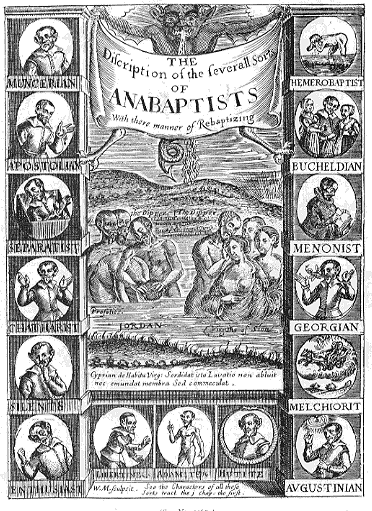 Once again, Dr. Jack Arnold introduces our subject, with a more detailed treatment of it by Dr. Thomas Lindsay. These figures may be considered the “top of the food chain” when it comes to the diverse world of Anabaptist doctrine and practice.
Introduction
As a whole, the Anabaptist movement centered around the common people who wanted the simplicity of New Testament Christianity. However, some outstanding, educated men were leaders among the Anabaptists.
Conrad Grebel Grebel was a prominent member of the church in Zurich. He had been led to the evangelical faith by Zwingli, and heartily approved his work of reforma-tion. But he soon became disappointed with Zwingli and Luther because he felt the church was not being reformed along New Testament lines. In January, 1525, a man named Blaurock asked Grebel to baptize him again, although he had been baptized in infancy. Grebel complied. Thereupon, Blaurock rebaptized others. Thus the Anabaptist movement had its beginnings with Conrad Grebel.
Balthasar Hubmaier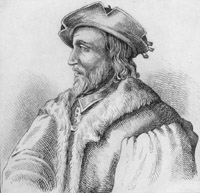 Hubmaier was one of the better educated men of his day, having received his doctorate in theology. He was a priest, and, during his pastorate in Walshut, a great change came over him as he studied the New Testament. He found many things he had been doing were not biblical, and he began to preach reform. Hubmaier’s conscience began to bother him about the Bible’s teachings about baptism, the purity of the church, the new birth, discipleship, and evangelism. Hubmaier rebaptized his entire congregation of 300, and the church renounced all fellowship with Rome. He believed in evangelistic preaching, and went into Moravia where thousands were saved. Hubmaier was probably one of the few Anabaptist leaders who believed in election and predestination. He died a martyr in 1527, and two years later his wife was strangled and thrown in a river.
Jacob Hutter Hutter was a godly man who preached in Austria, Moravia, and Poland until his martyrdom in 1536. He founded a sect called the Hutterites. A group of modern Hutterites in Canada are pictured here.
Menno Simons Simons was a humble man who lived a hard life. A priest of the Roman Catholic Church, he left by his own choice around 1536, believing he could no longer live with his conscience as a Roman Catholic, He felt that neither the Catholics nor the Reformed Church did much for the inner life of a man, that it was all externalism and hypocrisy. He opposed the fanaticism of his day, and could not understand why Christians persecuted one another. He had many struggles over discipleship and holy living, and truly believed that dedicated Christians would receive persecution from the world. Followers of Menno Simon’s teachings came to be called Mennonites, and their work later spread to Russia, the United States and Canada. The Mennonites have always been pacifists, and are earnest, industrious Christians, who have often lived in communal settlements.
The Anabaptist Movement takes shape
This quiet Evangelical movement assumed a more definite form in 1524. Before that date the associations of pious people acted like the Pietists of the seventeenth or the Wesleyans of the eighteenth century. They associated together for mutual edification; they did not obtrusively separate themselves from the corrupt or slothful Church. But in June 1524, delegates representing a very wide circle of “praying assemblies” or Readings met at Waldshut, in the house of Balthasar Hubmaier, bringing their Bibles with them, to consult how to organize their Christian living on the lines laid down in the New Testament. No regular ecclesiastical organisation was formed. The Brethren resolved to separate from the Papal Church; they published a Directory for Christian living, and drew up a statement of principles in which they believed. Amongst other things, they protested against any miraculous efficacy in the Sacraments in general, and held that Baptism is efficacious only when it is received in faith. This led afterwards to the adoption of Baptist views. A second conference was held at Augsburg in 1526, which probably dates the time when adult-baptism became a distinctive belief among all the Brethren. This conference suggested a General Synod which met at Augsburg in 1527 (Aug.), and included among its members, delegates from Munich, Franconia, Ingolstadt, Upper Austria, Styria, and Switzerland. There they drew up a statement of doctrinal truth, which is very simple, and corresponds intimately with what is now taught among the Moravian Brethren. Their Hymnbook does not bear any traces of the errors in doctrine usually attributed to them. Its chief theme is the love of God awakening our love to God and to our fellow-men. Instead of infant baptism they had a ceremony in which the children were consecrated to God. Baptism was regarded as the sign of conversion and of definite resolve to give one’s self up to the worship and service of God. It was administered by sprinkling; the recipient knelt to receive it in the presence of the congregation. The Holy Supper was administered at stated times, and always after one or two days of solemn preparation. Their office-bearers were deacons, elders, masters and teachers, or pastors. They distinguished between pastors who were wandering evangelists and those who were attached to single congregations. The latter, who were ordained by the laying on of hands, alone had the right to dispense the Sacraments. All the deacons, elders, and pastors belonging to communities within a prescribed district, selected from among themselves delegates who formed their ecclesiastical council for the district, and this council elected one of the pastors to act as Bishop or Superintendent. It was the Superintendent who ordained by laying on of hands. The whole of the Brethren were governed ecclesiastically by a series of Synods corresponding to those in the Presbyterian Churches. This organisation enabled the Anabaptists to endure the frightful persecution which they were soon to experience at the hands of the papal and Lutheran State Churches.
Ignorant? No! Fanatics? . . .
The chief leaders were Balthasar Hubmaier and Hans Denck. Hubmaier was a distinguished scholar. He became, at an unusually early age, Professor of theology at Ingolstadt (1512); he was Rector of the famous High School in that city (1515); and Cathedral preacher at Regensburg (Ratisbon) (1516). In 1519, feeling that he could no longer conscientiously occupy such positions, he retired to the little town of Waldshut. Hans Denck was a noted Humanist, a member of the “Erasmus circle” at Basel, and esteemed the most accurate Greek scholar in the learned community. Conrad Grebel, another well-known Anabaptist leader, also belonged to the “Erasmus circle,” and was a member of one of the patrician families of Zurich. Like Hubmaier and Denck, he gave up all to become an evangelist, and spent his life on long preaching tours. These facts are sufficient to refute the common statement that the Anabaptists were ignorant fanatics.
Mystical Denck
Perhaps Denck was the most widely known and highly esteemed. In the summer of 1523 he was appointed Rector of the celebrated Sebaldus School in Nurnberg. In the end of 1524 he was charged with heresy, and along with him Jorg Penz, the artist, the favourite pupil of Albert Durer, and four others. Denck was banished from the city, and his name became well known. This trial and sentence was the occasion of his beginning that life of wandering evangelist which had among other results the conferences in 1526 and 1527, and the organisation above described. Denck had drunk deeply at the well of the fourteenth and fifteenth century Mystics, and his teaching was tinged by many of their ideas. He believed that there was a spark of the divine nature in man, an Inner Word, which urged man to walk in the ways of God, and that man could always keep true to the inward monitor, who was none else than Christ. The accounts given of some of his addresses seem to be echoes of Tauler’s famous sermon on the Bridegroom and the Bride, for he taught that the sufferings of the faithful are to be looked upon as the love-gifts of the Saviour, and are neigher to be mourned nor resisted. We are told in the quaint Chronicle of Sebastian Franck, that the Baptist current swept swiftly through the whole land; many thousands were baptized, and many hearts drawn to them. “For they taught nothing but love, faith, and crucifixion of the flesh, manifesting patience and humility under many sufferings, breaking bread with one another in sign of unity and love, helping one another with true helpfulness, lending, borrowing, giving, learning to have all things in comon, calling each other ‘brother.’ ” (Chronica (Augsburg edition, 1565), f. 164.) He adds that they were accused of many things of which they were innocent, and were treated very tyrannically.
Anabaptist Individualism Defies Classification
The Anabaptists, like the earlier Mystics, displayed a strong individuality; and this makes it impossible to classify their tenets in a body of doctrine which can be held to express the system of intellectual belief which lay at the basis of the whole movement. We have three contemporary accounts which show the divergence of opinion among them–two from hostile and one from a sympathetic historian. Bullinger (Der Wiedertauferen Ursprung, Furgang, Secten, etc. (Zurich, 1560)) attempts a classification of their different divisions, and mentions thirteen distinct sects within the Anabaptist circle; but they manifestly overlap in such a way as to suggest a very large amount of difference which cannot be distinctly tabulated. Sebastian Franck (Chronica (3 pts., Strassburg, 1531)) notes all the varieties of views which Bullinger mentions, but refrains from any classification. “There are,” he says, “more sects and opinions, which I do not know and connot describe, but it appears to me that there are not two to be found who agree with each other on all points.” Kessler (Sabbata (ed. by Egli and Schoch, St. Gall, 1902)), who recounts the story of the Anabaptists of St. Gallen, notes the same great variety of opinions.
Identifying the Leading (though not universal) Ideas
It is quite possible to describe the leading ideas taught by a few noted men and approved of by their immediate circle of followers, and so to arrive with some accuracy at the popularity of certain leading principles among different parties, but it must be remembered that no great leader imposed his opinions on the whole Anabaptist circle, and that the views held at different times by prominent men were not invariably the sentiments which lay at the basis of the whole movement.
Passive Resistance
The doctrine of passive resistance was held by almost all the earlier Anabaptists, but it was taught and practised in such a great variety of ways that a merely general staement gives a misleading idea. All the earlier Anabaptists believed that it was unchristian to return evil for evil, and that they should take the persecutions which came to them without attempting to retaliate. Some, like the young Humanist, Hans Denck, pushed the theory so far that they believed that no real Christian could be either a magistrate or a soldier. A small band of Anabaptists, to whom one of the Counts of Lichtenstein had given shelter at Nikolsburg, told their protector plainly that they utterly disapproved of his threatening the Austrian Commissary with armed resistance if he entered the Nikolsburg territory to seize them. In short, what is called “passive resistance” took any number of forms, from the ordinary Christian maxim to be patient under tribulation, to that inculcated and practised by the modern sect of Dunkhers.
Melchior’s Millennial Madness and Commitment to Christian Charity
The followers of Melchior Hoffman, called “Melciorites,” held apocalyptic or millenarian views, and expected in the near future the return of Christ to reign over His saints; but there is no reason to suppose that this conception was very widely adopted, still less that it can be called a tenet of Anabaptism in general. All the Anabaptists inculcated the duty of charity and the claims of the poor on the richer members of the community; but that is a common Christian precept, and does not necessarily imply communistic theories or practices. All that can be definitely said of the whole Anabaptist circle was that they did kneep very clearly before them the obligations of Christian love. The so-called Communism in Munster will be described later.
Primitive Christianity the Goal . . . was it reached?
When we examine carefully the incidental records of contemporary witnesses observing their Anabaptist neighbours, we reach the general conclusion that their main thought was to reproduce in their own lives what seemed to them to be the beliefs, usages, and social practices of the primitive Christians. Translations of the Bible and of parts of it had been common enough in Germany before Luther’s days. The “common man,” especially the artisan of the towns, knew a great deal about the Bible. It was the one book he read, re-read, and pondered over. Fired with the thoughts created in his mind by its perusal, simple men felt impelled to become itinerant preachers. The “call” came to them, and they responded at once to what they believed to be the divine voice. Witness Hans Ber of Alten-Erlangen, a poor peasant. he rose from his bed one night and suddenly began to put on his clothes. “Whither goest thou?” asked his poor wife. “I know not; God knoweth,” he answered. “What evil have I done thee? Stay and help me to bring up my little children.” “Dear wife,” he answered, “trouble me not with the tings of time. I must away, that I may learn the will of the Lord” (C. A. Cornelius, Geschichte des Munsterischen Aufruhrs (Leipzig, 1855), ii. 49.). Such men wandered about in rude homespun garments, often barefooted, their heads covered with rough felt hats. They craved hospitality in houses, and after supper produced their portions of the Bible, read and expounded, then vanished in the early morning. We are told how Hans Hut came to the house of Franz Strigel at Weier in Franconia, produced his Bible, read and expounded, explained the necessity of adult baptism, convinced Strigel, the house father, and eight others, and baptized them there and then. He wandered forth the same night. None of the baptized saw him again; but the little community remained–a small band of Anabaptists (ibid, ii. 49). (Lindsay, pp. 434-439)
On this day in Christian History: November 3, 75…

Introducing the Anabaptists

I’ve had a couple of requests (like I’m an expert?) to post some information about the Anabaptists. It’s been a long time coming, but here it is. First, I’ll feature some information from the late Dr. Jack Arnold, President of Equipping Pastors International, and Pastor Emeritus of Covenant Presbyterian Church, Oviedo, FL from his series Reformation Men and Theology, lessons 10 and 11. Then, I’ll supplement Dr. Arnold’s info with that of Dr. Thomas Lindsay, Principal, The United Free Church College, Glasgow, Scotland from a chapter in his book A History of the Reformation, volume II: The Reformation in Switzerland, France, the Netherlands, Scotland and England, The Anabaptist and Socinian Movements and the Counter-Reformation. (1928)
Dr. Arnold writes . . .
The Anabaptists were separatists who rejected infant baptism and believed that the outward, external church should consist only of saved and baptized believers. They would rebaptize those who professed Christ who had previously been baptized as infants. The preposition ana means “again,” thus Anabaptists were those who “baptized again.”
The Anabaptist movement officially began around 1522 in Zurich, Switzerland, when certain men wanted the Reformation to proceed more quickly and to be patterned more along New Testament lines than along those pursued by Ulrich Zwingli. Thus, there was a break between Zwingli and these more radical reformers.
It is very difficult to classify the Anabaptists as a single group, for there was wide diversity among them. Some were fanatics and heretics who brought great shame to the work of the Reformation, but others were not nearly so extreme and fanatical. Some were pantheistic, some extremely mystical, some anti-Trinitarian, some extreme millennialists, while others were quite biblical in most areas of their theology. A good majority of the Anabaptists were spiritual people, dedicated to Christ. They were devoted students of the Bible who felt the Reformers were not purifying the church quickly enough or properly applying the principles taught in the New Testament. The original Anabaptists were called “Brethren” or “The Company of the Committed.”
The Anabaptists were probably the least understood and most persecuted of all the groups of the early Reformation era. The Catholics, Lutherans and Calvinists opposed them violently.
Dr. Lindsay elaborates . . .
MULTI-FACETED NATURE OF THE MOVEMENT
It is neither safer nor easy to make abrupt general statements about the causes or character of great popular movements. The elements which combine to bring them into being and keep them in existence are commonly as innumerable as the hues which blend in the colour of a mountain side. Anabaptism was such a complicated movement that it presents peculiar difficulties. As has been said, it had a distinct relation to two different streams of medieval life, the one social and the other religious–the revolts of peasants and artisans, and the successions of the Brethren.
SOCIAL ASPECT–ONGOING CLASS WARFARE
From the third quarter of the fifteenth century social uprisings had taken place almost every decade, all of them more or less impregnated with crude religious beliefs. They were part of the intellectual and moral atmosphere that the “common man,” whether in town or country district, continuously breathed, and their power over him must not be lost sight of. The Reformation movement quickened and strengthened these influences simply because it set all things in motion. It is not possible, therefore, to draw a rigid line of separation between some sides of the Anabaptist movement and the social revolt; and hence it is that there is at least a grain of truth in the conception that the Anabaptists were the revolutionaries of the times of the Reformation.
RELIGIOUS ASPECT–ANTI-CLERICAL, CHARITABLE, “PLAIN” AND SIMPLE
On the other hand, there are good reasons for asserting that the distinctively religious side of Anabaptism had little to do with the anarchic outbreaks. It comes in direct succession from those communities of pious Christians, who, on the testimony of their enemies, lived quiet God-fearing lives, and believed all the articles in the Apostles’ Creed; but who were strongly anti-clerical. They lived unobtrusively, and rarely appear in history save when the chronicle of some town makes casual mention of their existence, or when an Inquisitor ferreted them out and records their so-called heresies. Their objections to the constitution and ceremonies of the medieval Church were exactly those of the Anabaptists of the sixteenth century; and if we do not find a universal repudiation of infant baptism, there are traces that some did not approve of it. They insisted that the service ought to be in the vulgar tongue; they objected to all the Church festivals; to all blessing of buildings, crosses, and candles; they alleged that Christ did not give His Apostles stoles or chasubles; they scoffed at excommunications, Indulgences, and dispensations; they declared that there was no regenerative efficacy in infant baptism; and they were keenly alive to all the injunctions of Christian charity–it was better, they said, to clothe the poor than to expend money on costly vestments or to adorn the walls of Churches, and they kept up schools and hospitals for lepers. They met in each other’s houses for public worship, which took the form of reading and commenting upon the Holy Scriptures.
MEDIEVAL ORIGINS, DIDACTIC & APOLOGETIC PRACTICES
As we are dependent on very casual sources of information, it is not surprising that we cannot trace their continuous descent down to the period of the Reformation; but we do find in the earlier decades of the sixteenth century notices of the existence of small praying communities, which have all the characteristics of those recorded in the Inquisitors’ reports belonging to the end of the fourteenth or beginning of the fifteenth centuries. They appeared in Basel in 1514, in Switzerland in 1515, in Mainz in 1518, and in Augsburg somewhat earlier. By the year 1524, similar “praying circles” were recorded as existing in France, in the Netherlands, in Italy, in Saxony, in Franconia, at Strassburg, and in Bohemia. They used a common catechism for the instruction of their young people which was printed in French, German, Bohemian, and perhaps Italian. In Germany, the Bible was the German Vulgate (a German translation of the Latin Vulgate, jdc)–a version retained among the Anabaptists long after the publication of Luther’s. They exhibited great zeal in printing and distributing the pious literature of the Friends of God of the fourteenth and fifteenth centuries. Many of them taught Baptist views, though the tenets were not universally accepted, and they were already called Anabaptists or Katabaptists–a term of reproach. Some of their more distinguished leaders were pious Humanists, and thier influence may perhaps be seen in the efforts made by the Brethren to print and distribute the Defensor Pacis of Marsiglio of Padua
(Lindsay, pp. 432-434).
Nailing A Reformation Day Reading List from the Blogosphere–Happy Reformation Day!

Doxoblogy: Repent and Reform!
The Bluefish.org.uk: Orthodoxy (On Reformation Day)
titus2talk: Katie Luther: A Proverbs 31 Woman
Reformation Theology: “Reformed Righteousness”
My Reformation Sunday Presentation Delivered Two Years Ago, Part Two
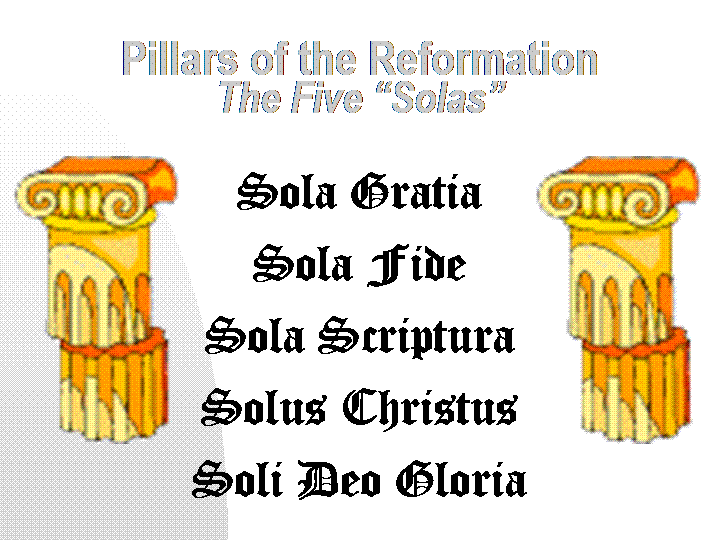
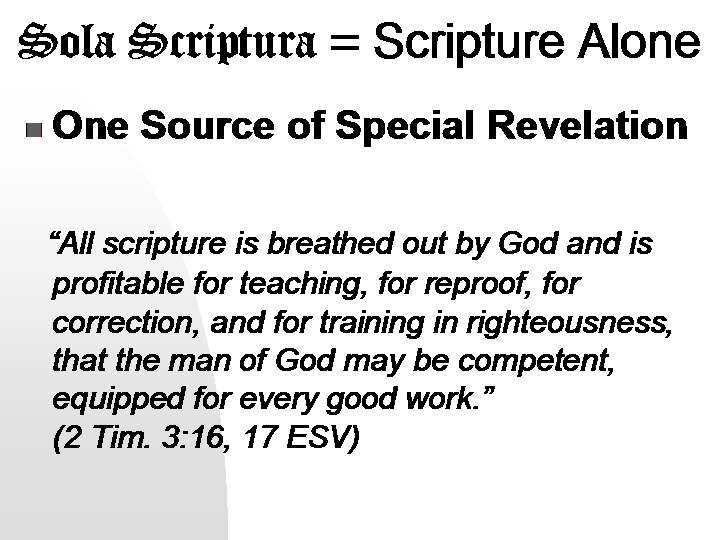
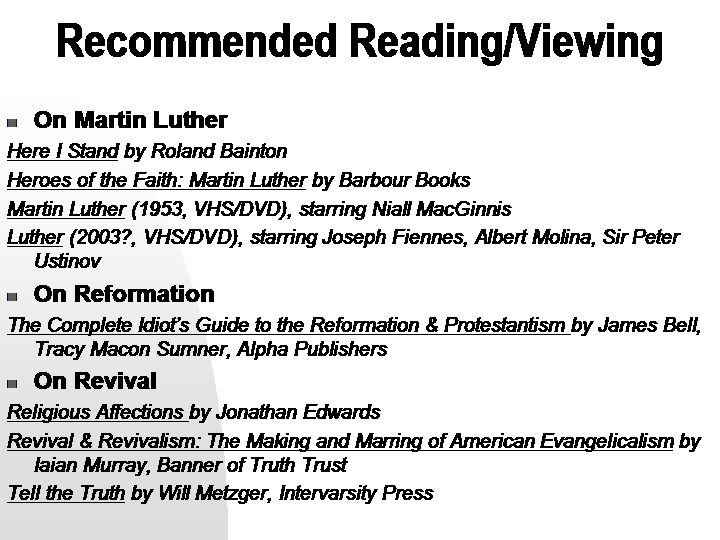
Here’s part two of my Reformation Sunday Power Point presentation on the life of Martin Luther. The previous post included biographical information about Luther; this portion of the presentation attempts to summarize the themes of the five Solas of the Reformation. This part of the presentation I did not have time to present to the church, so there is no commentary to accompany the slides. I hope their contents are self explanatory.




Blogging on the road–don’t have much time. But he…
Blogging on the road–don’t have much time. But here’s some really concise outlines on the life of Martin Luther from Third Millennium Ministries! I’m sure it corrects many of the details of my own presentation of a couple of years ago, the way Gage Browning’s dad, Dr. Tom Browning’s series on the History of the Reformation does! His series is great reading as well, and it’s written by one of my heroes in the faith!!!
MARTIN LUTHER:FROM BIRTH TO HIS CONVERSION (1463-1516)
Reformation Men and Theology, Lesson 3 of 11
by Dr. Jack L. Arnold
(Webpage format)
http://thirdmill.org/newfiles/jac_arnold/CH.Arnold.RMT.3.html
(PDF format)
http://thirdmill.org/newfiles/jac_arnold/CH.Arnold.RMT.3.pdf
MARTIN LUTHER:FROM STRUGGLE WITH ROME UNTIL DEATH (1517-1546)Reformation Men and Theology, Lesson 4 of 11
by Dr. Jack L. Arnold (webpage format)
http://thirdmill.org/newfiles/jac_arnold/CH.Arnold.RMT.4.html
(PDF format)
http://thirdmill.org/newfiles/jac_arnold/CH.Arnold.RMT.4.pdf
Read more from Third Mill!
Luther’s "Zion Song"
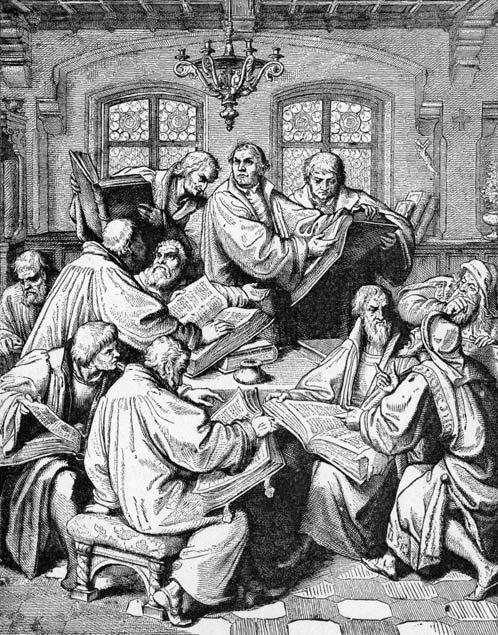
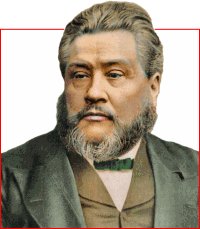
Spurgeon on Luther: A Sunday in Rome

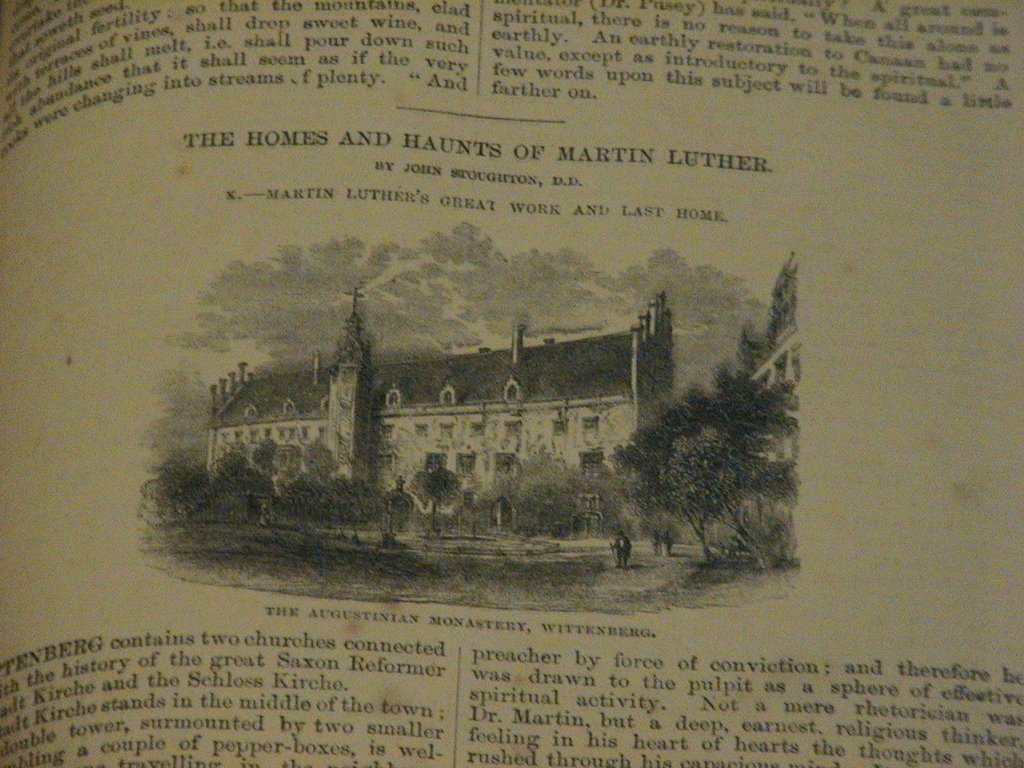
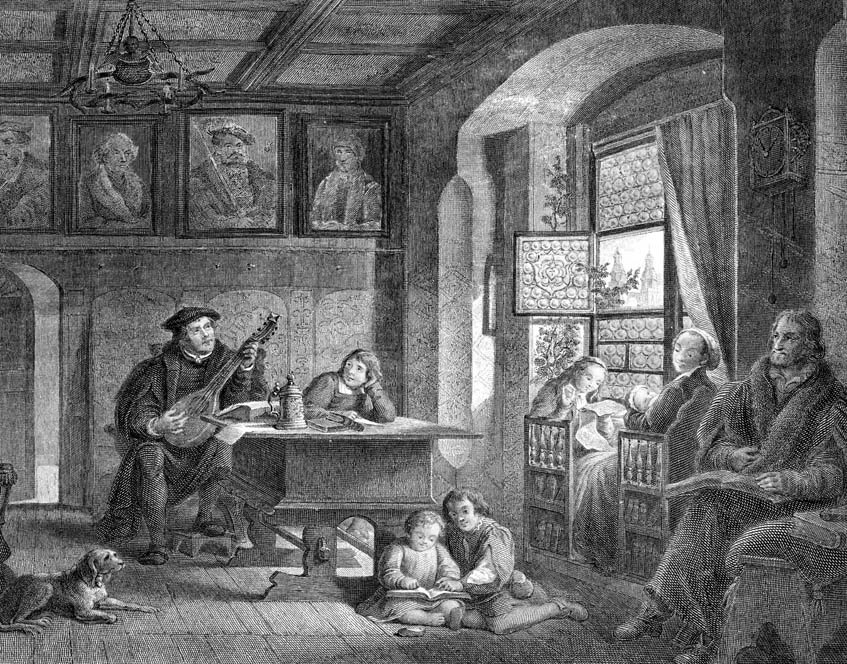
The Homes and Haunts of Martin Luther (3)
from “The Sunday At Home: A Family Magazine for Sabbath Reading”

The Schloss Kirche–The Castle Church at Wittenberg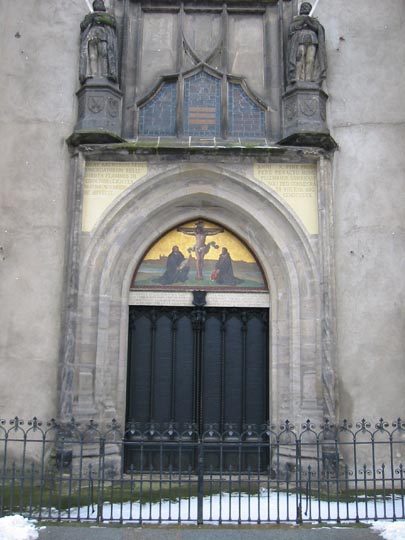
But we must hasten on to the Schloss Kirche, or Castle Church, at the end of the town, opposite to the Elster Gate and the Augustinian Monastery. It is much smaller than the church we have just left; but, on approaching it, the doors arrest our attention from the circumstance of their being connected with one of the boldest acts of Luther’s life. We well remember the doors of the church at Milan, said to have been closed by St. Ambrose against the entrance of the Emperor Theodosius–significant of the courage of a renowned ecclesiastic in the maintenance of discipline. They occur to our recollection as we step up to the threshold of the Schloss Kirche, where the doors are significant of the courage of our Saxoon Reformer in attacking the dogmas on which had rested the reign of ecclesiastical despotism age after age. Against these very doors Luther affixed his ninety-five theses, now world-known–a challenge given to Papal Christendom–a gauntlet thrown down before the Romanised world. It was in the autumn of 1517, on the eve of the feast of All Saints, that Luther, agitated by the sale of indulgences, took certain counter-propositions, which he had elaborated with all the logical skill of the age, so as to cover the whole ground of the controversy as he then apprehended it, and fastened the papers to the panel of the church gate. There it was displayed to public gaze. There it was read. There it was even pondered. The proposition, which serves as a key to the rest, runs thus: “Every Christian who feels a true sorrow, a sincere repentance for his sins, has a plenary remission for his fault, even without an indulgence.” Again: “The true and precious treasure of the Church is the holy gospel of the glory and grace of God.” On that church threshold the public proceedings of the Reformation may be said to have begun. There sounded the trupet-note which rolled over Germany from end to end.
As at Milan, the old doors shut against Theodosius have disappeared; so with the old doors to which Luther’s theses were affixed. No fragment of the panelling even remains, as at Milan. The old doors of the Schloss Kirche were burnt by the French; the present are of bronze, from a design by Quast.
Most visitors to Wittenberg complain of the difficulty of gaining access to the Augustinian Monastery and the Schloss Kirche, from the circumstance of the same person being custodian of the keys to both buildings. When we had surmounted the difficulty, and entered the church, we found ourselves in the presence of a worthy old German couple, who manifested a common interest in the edifice and its memorials, and vied with each other in the office of cicerone. That interest was equalled only by the zeal of the old man in exhibiting photographs, facsimiles, and seal impressions, which form a staple of merchandise on this sacred spot, and the zeal of the old woman in providing for the creature comforts of her husband and lord. The hour of the mid-day meal having arrived, she showed a most exemplary desire that the object of her affections should find rest and refreshment amidst his toils; and, therefore, having sent him to his neighbouring hom, to dine in quiet, she undertook his duties, and, conducting us round the building, pointed out to us the several objects of interest which it contains. Here are the tombs of Frederick the Wise and John the Steadfast, both friends of the Reformer. The monument of Frederick is, as the guide-book says, “a fine work of art, by Peter Vischer, 1527: his bronze statue is full of life, and of a noble character.” The Gothic work of the niche is very beautiful.
But the two main objects are the graves of Martin Luther and Philip Melancthon. They are covered by tablets of bronze inserted in the stone pavement, and preserved by modern trap-doors opening over them. Two such graves are worth coming a long way to see; and he who cares to take the journey for that purpose will not fail to be moved in spirit, as he gazes on the last home of the earthly remains of these two, who, in spite of transient jars, were lovely and pleasant in their lives, and in the tomb, rather than in death, not divided.
It is fitting here first to read the account of Luther’s death:
“Luther had arrived at Eisleben on the 28th of January, 1546, and , although very ill, he took part in the conferences which ensued, up to the 17th of February. He also preached four times, and revised the eclesiastical regulations for the territory of Mansfeldt. On the 17th he was so ill that the counts entreated him not to quit his house. At supper, on the same day, he spoke a great deal about his approaching death; and some one having asked him whether we should recognise one another in the next world, he said he thought we should. On retiring to his chamber, accompanied by Maltre Caelius and his two sons, he went to the window, and remained there for a considerable time engaged in silent prayer. Aurifaber then entered the chamber, to whom he said, ‘I feel very weak, and my pains are worse than ever.’ They gave him a soothing draught, and endeavoured to increase the circulation by friction. He then addressed a few words to Count Albert, who had joined him, and lay down on the bed, saying, ‘If I could 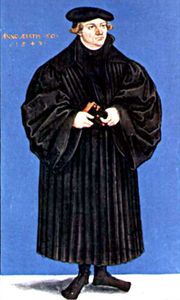 manage to sleep for half an hour I think it would do me good.’ he did fall asleep, and remained in gentle slumber for an hour and a half. On awaking about eleven, he said to those present, ‘What! are you still there? Will you not go, dear friends, and rest yourselves?’ On their replying that they would remain with him, he began to pray saying with fervour, ‘Into Thy hands I commend my spirit: Thou hast redeemed me, oh Lord God of Truth.’ He then said to those present, ‘Pray, all of you, dear friends, for the gospel of our Lord; pray that its reign may extend, for the Council of Trent and the Pope menace it round about.’ He then fell asleep again for about an hour. When he awoke, Dr. Jonas asked him how he felt. ‘Oh my God,’ he replied, ‘I feel very ill. My dear Jonas, I think I shall remain here at Eisleben, here–where I was born.’ He took a turn or two in the room, and then lay down again, and had a number o clothes and cushions placed upon him to produce perspiration. Two physicians, with the count and his wife, entered the chamber. Luther said to them feebly, ‘Friends, I am dying; I shall remain with you here at Eisleben.’ Dr. Jonas expressing a hope that perspiration would, perhaps, supervene and relieve him; ‘No, dear Jonas,’ he replied, ‘I feel no wholesome perspiration, but a cold dry sweat; I get worse and worse every instant.’ He then began praying again: ‘Oh my Father! Thou, the God of our Lord Jesus Christ; Thou, the source of all consolation, I thank Thee for having revealed unto me Thy well-beloved Son, in whom I believe; whom I have preached and acknowledged, and made known; whom I have loved and celebrated, and whom the Pope and the impious persecute. I commend my soul to Thee, oh my Lord Jesus Christ! I am about to quit this terrestrial body, I am about to be removed from this life; but I know that I shall abide eternally with Thee.’ He then thrice repeated, ‘Into Thy hands I commend my spirit; Thou hast redeemed me, oh Lord God of truth.’ All at once his eyes closed, and he fell back in a swoon. Count Albert, and his wife, and the physicians, made every effort to bring him to life, but for some time altogether in vain. When he was somewhat revived, Dr. Jonas said to him, ‘Reverend father, do you die firm in the faith you have taught?’ he opened his eyes, which were half closed, looked fixedly at Jonas, and replied, firmly and distinctly, ‘Yes.’ He then fell asleep; soon after, those nearest to him saw him grow paler and paler: he became cold: his breathing was more and more faint: at length he sent forth one deep sigh, and the great Reformer was dead.”
The corpse was brought to Wittenberg with great honours. In the procession, first went four deacons, then the officers of the Elector, on horseback; next the Counts of Mansfeldt, with their attendants. The corpse followed, in a leaden coffin covered with black velvet, and conveyed on a funeral car. Luther’s widow (who was not with him when he died), in an open chariot, accompanied her husband’s remains as chief mourner. The three sons, a brother, and his wife, and friends, two and two, including Philip Melanchthon and Justus Jonas, brought up the rear.
The coffin being carried into the Schloss Kirche, and placed on a bier in front of the altar, two funeral orations were pronounced; one by Pomer and one by Melanchthon. The latter remarked: “Often have I myself gone to him unawares, and found him dissolved in tears and prayers for the Church of Christ. He devoted a certain portion of almost every day to the reading of the Psalms of David, with which he mingled his own supplications amidst sighs and tears; and he has frequently declared how indignant he felt against those who hastened over devotional exercises, through sloth or the presence of other occupations. When a variety of great and important deliberations respecting public dangers have been pending, we have witnessed his prodigious vigour of mind, his fearless and unshaken courage. Faith was his sheet-anchor, and by the help of God, he was resolved never to be driven from it.”
A brass plate was fixed upon the grave, and still remains, bearing this inscription: “Martini Lutheri, S. Theologiae Doctoris Corpus H. L. S. E. qui anno Christi MDLVI. XII. Cal. Martii Eyslebii in patria S. M. O. C. V. Ann. LXIII. MIIDX.”
Charles V entered Wittenberg after having beseiged it, and expressed a wish to see the famous tomb. Reading the inscription with folded arms, he was asked by a sycophantic attendant whether he would not have the grave opened and the ashes of the arch-heretic scattered to the winds. It is said the emperor’s cheek grew red as he replied, “I war not with the dead. Let this place be respected.”
We have scarcely time left for a visit to the Rathhaus, which is a large building with long rows of windows opening from a plain wall, the deep roof being relieved by four large dormers, each with an ornamental facing, crowned by a fluttering vane. The steps of the main entrance were, when we visited the spot, crowded with the town authorities, who were celebrating the victory of Sedan, on the anniversary of the battle. Flags were flying; bands of music were playing; trade was interrupted. Even the post-office in front of the town-hall to witness the proceedings of the magistrates in honour of the occasion.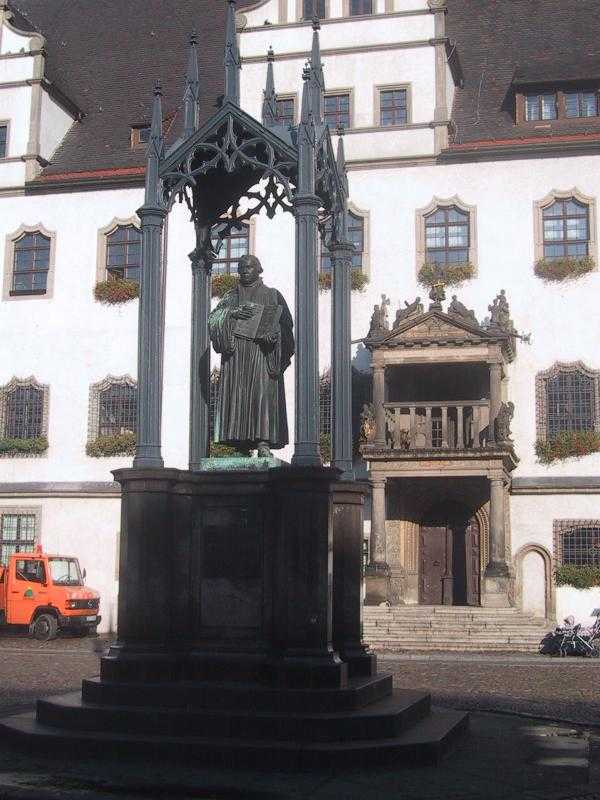
Besides pictures and other curiosities, including a portrait of Gustavus Adolphus, and a sword he left as a memorial of his visit to the Luther shrine, the Rathhaus contains the top of the Reformer’s sacramental cup, and the rosary which he carried when he was a monk. A long catalogue might be drawn up of relics connected with the extraordinary man–now scatterred over different parts of Germany–showing the veneration in which his name is everywhere held. There is an enormous difference between pretended and genuine relics, and between the religious reverence paid to the former and the natural interest taken in the latter. The mouldering bones of mediaeval and primitive saints, exhibited in costly reliquaries within the sacristies of Roman Catholic churches, carry with them no proofs of genuineness, and in very numerous cases must be of a perfectly spurious character; whilst such objects as are shown at Wittenberg and else where, in connection with the history of Luther, are such as, for the most part, carry along with them not only accredited traditions, but manifest signs of credibility in their very form and appearance. Were they brought out to receive religious honours, to have imprinted on them the kisses of superstitious devotees, such a practice would be opposed to the design and spirit of the Reformer’s whole career; but to preserve them as memorials of an illustrious man, and to view them with deep interest when examined under that character, is in accordance with natural feelings which it would be impossible to suppress and absurd to condemn.
The memory of Martin Luther is engraven upon the town of Wittenberg more indelibly and prominently than any other memory. Even the brilliant reputation of Philip Melanchthon pales in connection with the lustre of his colleague’s fame. The fortunes of war, which have thrown shadows over this old German town–such as the Austrian bombardment in 1760, when one-third of the buildings were destroyed, and the Prussian siege in 1814, when the place was taken by storm–are events scarcely remembered even by readers of history, as they walk through the streets of Wittenberg. But everybody, on approaching the gates, thinks of the Saxon monk who there lived and there lies buried. Washington Irving concludes his essay on Shakespeare and Stratford-on-Avon, by remarking that it would have cheered “the spirit of the youthful bard that his name should become the glory of his native place; that his ashes should be religiously guarded as its most precious treasure, and that its lessening spire, on which his eyes were fixed in tearful contemplation, should one day become the beacon, towering amidst the gentle landscape, to guide the literary pilgrim of every nation to his tomb.” It is no depreciation of Shakespeare’s genius to say, that above his aspirations after fame, whatever they might be, rose the aims and desires of Luther; a man absorbed in zeal for the salvation of human souls, and for the glory of his Lord and Saviour Jesus Christ; but it would have filled him with wonder–perhaps given him pleasure–could he have forseen the place he was to occupy in the thistory of the world, and how the double tower of the Stadt Kirche, in which he preached, would become a beacon to guide tens of thousands from both hemispheres to the Augustinian monastery, where he lived, and to the Schloss Kirche, where he lies entombed.
My Reformation Sunday Presentation Delivered Two Years Ago
A couple of years ago, my then-new pastor, Dr. Bill Weaver, responding to my over-abundant gushing about all things Reformed and Reformational, carved out 10 minutes for me to say a few words about the Reformation on Reformation Sunday, October 31, 2004. Being self-conscious about my public speaking weaknesses, I managed to get permission to give a Power-Point presentation on it instead of a customary speech. I have transcribed my slightly longer than ten minutes of commentary on the life of Martin Luther which accompanied the following slides. In a few days, I’ll post the remaining slides I didn’t have time to cover during the presentation.
Hope you enjoy the presentation . . .  Around the world, today is recognized as Reformation Sunday. It’s the anniversary of Martin Luther’s posting of the Ninety-Five Theses on the door of the Castle Church in Wittenberg, Germany. It was the year 1517, which makes that 487 years ago today (489 as of the year 2006–chk).

A little bit about his life . . .

 But here’s the day we must also remember fondly. In this tower at Luther’s monestary, meditating heavily on Romans one, verse seventeen–a verse which has come to be known as “Luther’s Verse.” It reads, “For in the gospel a righteousness from God is revealed.” Or, in the Latin Scriptures which Luther was reading, it used the word “justice”–and he was struck by this phrase, “the justice of God,” or “the righteousness of God,” the terms “righteousness” and “justice” are synonymous. I heard a man explain it this way, “Righteousness is private justice, and justice is public righteousness.” So the righteousness of God is revealed. Luther meditated on this phrase; he prayed about it, asking God to reveal to him the meaning of this, for he was already thoroughly aware that unless a man attains to the absolutely perfect righteousness that God demands, he would not see heaven. The anxiety was so great that he confesses that he, indeed, began to hate God for the righteous requirements of his Law.
Until, he says, he looked at the passage in its context: “the righteousness of God is revealed, a righteousness that is by faith from first to last, just as it is written, “the righteous will live by faith.” When Luther stopped meditating on the phrase itself, and looked at it in its context, he understood, “Oh, it’s in the gospel that the righteousness of God is revealed. And that it is a righteousness that is given to us by faith, as it says here, “a righteousness that is by faith from first to last,” and that, “the righteous live by faith,” and not by their works.
“All at once I felt that I had been born again, and entered into Paradise itself through open gates. Immediately, I saw the whole of Scripture in a different light.”
And he goes on to say that the phrase, “the righteousness of God,” he began to love it with just as much love as he ever hated it before.
 This was the beginning of the end of the status quo in Roman Catholic Europe.
 Well, Martin Luther decided that’s just a step too far. We need to have a discussion about this! Martin Luther never intended to turn the Roman Catholic Church on its head. He never intended to change the world. He wanted to have a debate. He wrote in Latin, what we call the Ninety-Five Theses, but it’s actually entitled, A Disputation on the Power and Efficacy of Indulgences. I thought I would share just a select few to give us an idea of what these were like–just bullet statements, really, sentences numbered, kind of like verses in the Bible, I guess. These two in the middle, theses numbers twenty-seven and twenty-eight, are my favorites, because I believe they are vintage Luther. He was a master of hyperbole. He knew how to speak in a controversial manner, and he knew how to cut to the quick effectively, and get straight to the point. He writes,
“There is no divine authority for preaching that the soul flies out of the purgatory immediately the money clings in the bottom of the chest. It is certainly possible, however, that when money clinks in the bottom of the chest, avarice and greed increase, but when the Church offers intercession, all depends in the will of God.”
Then, toward the end, Luther points out what would be the consequences of suppressing debate on serious matters of conscience such as this one raises. He wrote,
“To suppress them by force alone, and not to refute them by giving reasons, is to expose the church and the pope to the ridicule of their enemies, and to make Christian people unhappy.”
Do you like it when others refuse to answer the serious questions that you have? Martin Luther reminds his colleagues that this is true.

“Unless I am convinced by the testimony of the Holy Scriptures, or by evident reason–for I can believe neither popes nor councils alone, as it is clear that they have erred repeatedly, and contradicted themselves. I consider myself convicted by the testimony of Holy Scripture, which is my basis. My conscience is held captive to the Word of God. Thus I cannot, and will not, recant. Because, acting against one’s conscience is neither safe, nor sound. Here I stand. I can do no other. God help me. Amen.”
Thus concludes the biographical portion.
Homes and Haunts of Martin Luther (2)
 On the Sunday after his arrival, march 8, 1522, he appeared in the pulpit–in his ecclesiastical, not his military attire, we presume–and commenced a course of eight sermons on Charity, Christian Freedom (in use and abuses), Image-worship, Fasting, the Holy Communion and Confession.
“As when in tumults the ignoble
crowd,
Mad are their motions, and their tongues are
loud;
And stones and brands in rattling volleys
fly,
And all the rustic arms that fury can
supply:
If then some grave and pious man
appear,
They hush their noise, and lend a listening
ear;
He soothes with sober words their angry
mood,
And turns their evil passions into
good.”
The Reformation Polka
The Homes and Haunts of Martin Luther (1)

The True Treasures of the Church (from the 95 Theses)
57. That indulgences are not temporal treasures is certainly clear, for many indulgence sellers do not distribute them freely but only gather them.
58. Nor are they the merits of Christ and the saints, for, even without the pope, the latter always work grace for the inner man, and the cross, death, and hell for the outer man.
59. St. Lawrence said that the poor of the church were the treasures of the church, but he spoke according to the usage of the word in his own time.
60. Without want of consideration we say that the keys of the church, given by the merits of Christ, are that treasure.
13 Now when Jesus came into the district of Caesarea Philippi, he asked his disciples, “Who do people say that the Son of Man is?” 14 And they said, “Some say John the Baptist, others say Elijah, and others Jeremiah or one of the prophets.” 15 He said to them, “But who do you say that I am?” 16 Simon Peter replied, “You are the Christ, the Son of the living God.” 17 And Jesus answered him, “Blessed are you, Simon Bar-Jonah! For flesh and blood has not revealed this to you, but my Father who is in heaven. 18 And I tell you, you are Peter, and on this rock [2] I will build my church, and the gates of hell [3] shall not prevail against it. 19 I will give you the keys of the kingdom of heaven, and whatever you bind on earth shall be bound in heaven, and whatever you loose on earth shall be loosed [4] in heaven.”
21 But now the righteousness of God has been manifested apart from the law, although the Law and the Prophets bear witness to it— 22 the righteousness of God through faith in Jesus Christ for all who believe. For there is no distinction: 23 for all have sinned and fall short of the glory of God, 24 and are justified by his grace as a gift, through the redemption that is in Christ Jesus, 25 whom God put forward as a propitiation by his blood, to be received by faith. This was to show God’s righteousness, because in his divine forbearance he had passed over former sins. 26 It was to show his righteousness at the present time, so that he might be just and the justifier of the one who has faith in Jesus.
“I will destroy the wisdom of the wise,and the discernment of the discerning I will thwart.”
20 Where is the one who is wise? Where is the scribe? Where is the debater of this age? Has not God made foolish the wisdom of the world? 21 For since, in the wisdom of God, the world did not know God through wisdom, it pleased God through the folly of what we preach to save those who believe.


 The Misadventures of Captain Headknowledge