A Review of Dr. John Fesko’s Lecture on Word, Water and Spirit, part 1
 On Friday, January 21st, 2011, Dr. John Fesko, Academic Dean and Associate Professor of Systematic Theology at Westminster Seminary California, was the featured speaker at Christ Reformed Church in Anaheim, California, pastored by Dr. Kim Riddlebarger. He was invited to speak on his comprehensive new book, Word, Water and Spirit: A Reformed Perspective on Baptism (© 2010 by J. V. Fesko, published by Reformation Heritage Books). The link to Dr. Fesko’s lecture may be downloaded from this post at the Riddleblog. First, Dr. Fesko describes the background to his book, then he summarizes respectively the history of the doctrine of infant baptism (paedobaptim–Part I of his book), the Biblical-Theological Survey of the Doctrine (Part II), and finally he briefly describes Part III: Systematic-Theological Construction of the Doctrine. This first in a series of posts will review Dr. Fesko’s discussion of the background to his writing of the book.
The background, we learn, is ultimately connected to his upbringing. As an infant, Dr. Fesko was baptized in the mainline denomination of the Presbyterian Church (USA). His parents apparently held nominal ties to this Reformed heritage, and the Fesko family wound up attending a number of churches over the years, landing among the Baptists in the end. While in college, Dr. Fesko listened to R. C. Sproul tapes on his Walkman, which lead him to realize that he was more Reformed than he was Baptist, and so he resolved to examine the outstanding Reformed doctrines he’d yet to deal with to be sure they were true–issues like infant baptism, so that, were he to minister in a Reformed church one day, he would not have to “hold his breath” as he administered the sacrament.
After seminary, while attending the University of Aberdeen in Scotland, Dr. Fesko read a book by Paul Jewett which he says is called, A Case Against Infant Baptism, which inadvertently impressed upon him the indispensability of covenant theology and laid the groundwork to his finally embracing paedobaptism. In searching the web for this title, however, I was unsuccessful in tracking it down, but found instead a book by the same author called Infant Baptism and the Covenant of Grace: An Appraisal of the Argument That As Infants Were Once Circumcised, So They Should Now Be Baptized, which apparently argues for the practice. Unfortunately, Dr. Fesko has a little trouble with recall on this and another title below, but, we can afford to forgive him this minor oversight. I share a marginally similar experience to the one Dr. Fesko describes, in my own examination of the issues related to the biblical doctrine of baptism. Over the past several years since my transition to theologically Reformed convictions, including the truth of infant baptism, I would periodically revisit the case for the Baptist view of believer’s baptism (credobaptism). Each time, after re-exposing my newfound paedobaptistic persuasion to the critique of the Baptist doctrine, I would come away with new reasons to believe that Scripture in fact does command and exemplify infant baptism, although not in a manner that satisfies the Baptistic hermeneutic (method of interpretation) which emphasizes as central the differences between the Mosaic Covenant and the New Covenant, rather than their points of continuity.
The Reformed covenantal hermeneutic emphasizes how the nature, promises and signs of the Covenant of Grace outweigh the various administrative changes between the Mosaic and New Covenants. Big-picture issues like these bring into sharper relief the seemingly unclear Biblical testimony to infant baptism. In other words, with all due respect to my Baptist friends, when it comes to the Mosaic and New Covenant administrations of the overarching Covenant of Grace, they seem unable to see the whole covenantal forest for the New Covenant trees.
The second element in the background to Dr. Fesko’s writing of Word, Water and Spirit comes from his ministerial environment in the South. He says, “if you cannot throw a rock in the Bible without hitting a covenant, in the South, you cannot throw a rock without hitting a Baptist church.” Many Baptists, who, in the providence of God, come to embrace Reformed theology and appreciate so much about the doctrine and practice of a Reformed Presbyterian church will hold out on the Reformed practice of infant baptism. In his ministry to such believers in his congregation, Dr. Fesko tried to provide comprehensive evidence to help his converted Baptist congregants understand and believe in infant baptism, and the degree to which he would prepare such material for their benefit also facilitated his desire to publish on the subject of the Biblical and historical case for infant baptism.
Dr. Fesko was also interested in making sure his congregants understood the Biblical doctrine of baptism as a whole, not just the aspect of it that related to its administration to the infant children of believers. He observes that there is a troubling trend toward church growth by downplaying more objectionable doctrines, like paedobaptism. He desired not only to help people understand infant baptism, he wants them to understand what a sacrament is, what Biblical covenants are, and even the true nature of God’s grace itself. Many struggle to understand what grace is. I, too, struggled to understand the classical definition of grace as “unmerited favor” until I was introduced to the Reformed doctrines of grace. Once I came to grips with the fact that a sinner is unwilling to believe because as one who is dead in sin, he cannot (“Total Depravity”); that God’s election of him is not conditioned on God’s foreknowing or foreseeing that he would receive Christ (“Sovereign Election”); that the atonement of Christ for the elect in particular is properly understood in terms of his mercy, rather than his resentfully seeing such an act as inherently unjust of God’s part (“Particular Redemption”); that when the Holy Spirit enables a sinner who was dead in sin to believe and to willingly embrace Christ as his own crucified and risen Lord (“Effectual Calling”); and that God will not only prevent me from “losing my salvation,” but will graciously preserve me in such a way that I will, by his grace, persevere in my faith in him (“Perseverance of the Saints”–for more biblical testimony on these doctrines of grace, see the link in my Featured Sites widget in the sidebar), then and only then did it make sense to me how it is that grace is God’s favor for me which I in no way earned. It is in this way that God’s grace is truly unmerited favor. Just as Reformed theology helps one truly understand the nature of grace, so does Reformed covenant theology as a whole help the believer understand the Bible’s full teaching on the significance, proper candidates and proper attitude toward the mode of baptism.
God’s progressive revelation of his redemption of the elect in Christ was something Dr. Fesko often found insufficiently treated in the typical book or essay promoting the Reformed doctrine of baptism. Why is redemptive history important in relation to baptism? It helps us to better understand the nature of circumcision and baptism, the connection between the two, and why the sign of the Covenant of Grace is changed from the former to the latter with the transition from the Mosaic to the New Covenant at the first advent of Christ. Dr. Fesko finds that Reformed presentations of infant baptism often focus more on the New Testament in defense of infant baptism, and not quite enough on the Old Testament revelation of the subject. He would remind his readers that as important as the New Testament witness to infant baptism is, Christians ought not to build their doctrines on only half of the Bible, but on the entirety of the Scriptures. Too many do not realize that indeed the doctrine of baptism is, in fact, found in the Old Testament. Pierre Marcel’s book, Baptism and the Covenant of Grace (actually, Marcel wrote Biblical Doctrine of Infant Baptism), which was possibly re-titled Infant Baptism (again, we’re apparently relying on Dr. Fesko’s memory), writes, for example, that for Karl Barth, the Old Testament matters little when it comes to most doctrines, with the possible exception of the doctrine of the atonement.
Dr. Fesko finds that theological journals provide perhaps some of the most helpful information on any doctrinal question, baptism among them. He therefore desired the readers of Word, Water and Spirit, who ordinarily have no access to such information, to benefit from such journals and show them where they can go to learn more on the subject of baptism. This was another compelling reason for him to write the book.
In the next post, we’ll follow Dr. Fesko’s summary of the historical-theological section of the book, which makes up roughly half of its contents.
Mary’s Declaring Women’s Liberation from Feminism!

There’s another great post I am compelled to share with you over at the Gospel Coalition. Dr. Mary Kassian, Distinguished Professor of Women’s Studies at Southern Baptist Theological Seminary is the author of Girls Gone Wise and The Feminist Mistake (I love that title! In case you missed the in-your-face pun, there was a leading feminist book of bygone days called The Feminine Mystique). Dr. Kassian says we’re in a “Post-Feminist” society. But don’t rejoice yet–unlike Francis Schaeffer’s past declaration that America has moved into the “Post-Christian” era, this does not mean that Feminism has lost its influence. It’s simply moved from a movement to an institution. Says Kassian,
“Virtually everyone is a feminist. Yet virtually no one would identify him/herself as such. Feminism has seeped into people’s systems like intravenous drugs into the veins of an unconscious patient. The majority of people in today’s churches are feminists—and they don’t even know it.”
If this doesn’t ring true to you, you’re not paying attention. Our endemic feminism has taken a toll on American local church ministry and American marriages in the past several decades. In the shameful “glory days” when feminism was a movement, all the ideals of feminism were heralded by activists and educators in a counter-cultural push toward so-called “progress,” and not without resistance from the establishment culture. In other words, back then it had to be taught. Nowadays, we and our children of both sexes are so regularly exposed to feminist ideals that feminism is simply caught. Today, it’s the Biblical ideal of manhood and womanhood that has to be purposefully and energetically cultivated.
But thank the Lord that a new counter-cultural movement has arisen in the American church to do just that, teach the complementarian nature of Biblical manhood and womanhood. Feminism has brought America into an age of what is called “egalitarianism,” where the most obvious distinctions between men and women are no longer assumed. Professor Kassian heralds this positive trend and appears resolved to promote it, but not without a caveat. The last thing we need, according to Kassian, and I agree, is to move from this lifestyle of feminist license, declare liberty from feminism for the sake of the Christian family’s faithfulness to God’s Word, and allow it to degenerate into a legalism in which our focus is removed from the cross and onto an over-emphasis on the Biblical roles of manhood and womanhood that would inevitably facilitate yet another swing of the pendulum back in the direction of the radical anti-Scriptural feminism of the 1960’s and ’70’s.
Christian ladies, and gentlemen, check out the Gospel Coalition’s interview with Professor Kassian and learn that more and more Christian women are breathing the air of liberation from the cultural tyranny of feminism!
Gospel Coalition Interviews Michael Horton
 If you’re anything like me, you’re looking forward to your copy of Michael Horton’s new systematic theology, The Christian Faith: A Systematic Theology for Pilgrims on the Way (published by Zondervan), to arrive, if you haven’t already received it. If you aren’t like me, then perhaps this interesting interview of Horton by John Starke, of the Gospel Coalition, promoting his systematic theology, will make you more like me (but only in this one way).
Christianity and Liberalism Revisited
 This past weekend, Westminster Seminary California’s (WSC) annual conference was held. It was called, “Christianity and Liberalism Revisited,” referring to the title of a book by the founder of Westminster Theological Seminary in Philadelphia, PA, and “the principal figure in the founding” of the Orthodox Presbyterian Church (OPC) in 1936, which in 2011 is celebrating its 75th anniversary. This conference is WSC contribution toward that celebration.
The conference was webcast live on Ustream and the videos are still posted there for your viewing pleasure, and audio is posted at the WSC Resource Center, but I’ll link to them below for your convenience.
- Christianity and Liberalism Today “Michael Horton shows the prophetic insight of Machen’s most famous book in Christianity today.”
- The Perennial (Problem with) Machen “Daryl Hart critiques evangelicals’ use of Machen today.”
- Machen and the Bible “Joel Kim explains the relevance of Machen’s view of the inspiration and authority of the Bible.”
- Machen and the Gospel “J. V. Fesko gives a summary of Machen’s view of the gospel and its relevance today.”
- Machen and Ethics “David VanDrunen explains how Liberalism, in its day, was fundamentally dishonest.”
- Machen, Christianity and the Church “W. Robert Godfrey explains how the church is the mission of God to carry his doctrines to the ends of the earth.”
- Question and Answer Session “The question and answer session from the 2011 Conference ‘Christianity and Liberalism Revisited’”
Bonus! If you’d like to know more about J. Gresham Machen and the Orthodox Presbyterian Church (a local congregation of which denomination my family is currently attending, Mid-Cities OPC), then start with conference speaker Daryl Hart’s page at the OPC website, called, “Machen and the OPC.”
Also, the Rev. Jason Stellman has posted a thought-provoking reflection on Hart’s lecture at his blog Creed, Code, Cult, called, “Catholicity and Liberalism.”
“Extent”
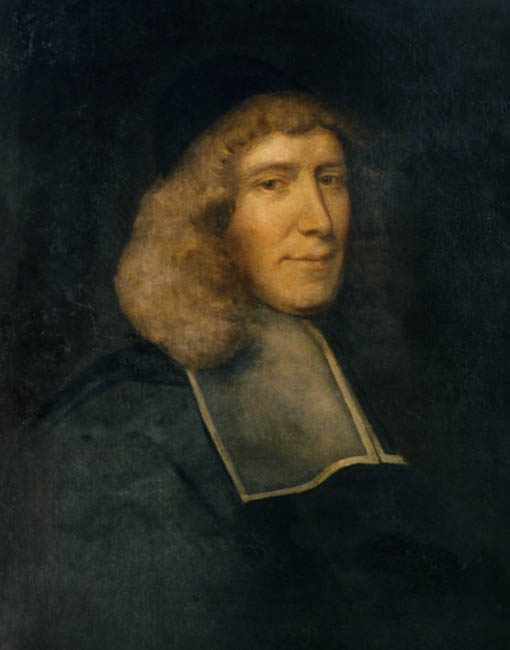
John Owen (1616-1683), thanks to ReformationArt.com
Time for our first break from Brown’s Self-Interpreting Bible. How about if we dabble in the doctrine of particular redemption?
I ran across, once again, the famous quote by Puritan theologian par excellence, John Owen (1616-1683), from his book, The Death of Death in the Death of Christ. Among statements in defense of the Reformed doctrine of particular redemption, this one is literally viral in the Reformed blogosphere. This quote is Owen’s logical critique of general redemption, and is worth thinking through and searching the Scriptures about if you’ve never taken the time.
Anyway, here’s a breakdown of his complex argument from Reformed.org:
The Father imposed His wrath due unto, and the Son underwent punishment for, either:
- All the sins of all men.
- All the sins of some men, or
- Some of the sins of all men.
In which case it may be said:
- That if the last be true, all men have some sins to answer for, and so, none are saved.
- That if the second be true, then Christ, in their stead suffered for all the sins of all the elect in the whole world, and this is the truth.
- But if the first be the case, why are not all men free from the punishment due unto their sins?
You answer, “Because of unbelief.”
I ask, Is this unbelief a sin, or is it not? If it be, then Christ suffered the punishment due unto it, or He did not. If He did, why must that hinder them more than their other sins for which He died? If He did not, He did not die for all their sins!”
I’ve looked at this many times and have until now always had trouble keeping the whole train of thought on the rails in my head, if you know what I mean. Finally, the other day, I decided I’m going to have to do with this what I do with Scripture verses and catechism questions that I want to memorize–put it to music!
The following is the result. It’s roughly based on the tune to the children’s song “I’m in the Lord’s Army,” although there are some divergences. Do what you will with it. So, without further ado, I give you . . .
Extent
by John D. Chitty
Did Christ die for
all sins of all men
or all sins of some men
or some sins of all men?
If Christ died for
some sins of all men,
then all die
for those he did not.
But if Christ died for
all sins of some men,
that’s what we believe,
all th’elect of all the nations!
But if Christ died for
all sins of all men,
why are not
all men saved?
You will answer
“Because of unbelief”–
Is unbelief a sin or not?
If not, why then,
for it give account?
Either for it
Christ was punished, or not!
If he was, then,
why does unbelief
prevent salvation
more than other sins he died for?
But if he did not
die for unbelief,
then for all sins of all men
Christ did not die!
So Christ died for
all sins of some men,
those the Father
gave to His Son!
I’m from Geneva, and I’m here to help!
Tullian’s “Unfashionable” Book Tour
 The new pastor of Coral Ridge Presbyterian Church, Rev. Tullian Tchividjian (last name rhymes with “religion”), is making the rounds promoting his book, Unfashionable. Last week, he appeared on James Robison’s television talk show along with his wife, Kim.
This show is filmed not five miles from my house, but I missed when they were in town for the shooting several weeks ago, otherwise, you probably would have been able to spot my wife and me in the audience. Guess I need to put my name back on the Life Today email list so I’m prepared when people I’ll actually want to see are in town. It doesn’t happen often, but it does happen.
The episode was broadcast last week, but you can view it online here, and read about it at Tchividjian’s own blog here. Also, here’s the search results for “unfashionable” at his blog which lists the posts that contain more about the book.
It turns out that this Unfashionable author’s interview with the White Horse Inn was this Sunday morning as well. You can listen to this more in-depth interview here.
You can read about the book at the Multnomah Books website here.
On the Robison show, Tchividjian cites an anecdote from the life of his legendary grandfather, Billy Graham, who back in the 1950’s was approached by a Hollywood celebrity who gave him the kind of advice about which his grandson now writes. The celebrity told Graham: “Don’t ever try to do Hollywood, because Hollywood will always do it better than you. You give this world the one thing Hollywood can’t–the timeless truth of the Gospel.” That’s similar to one of my mottoes: Leave the entertainment to the entertainers, and leave the ministry to the ministers. The church and the world will both be the better for it.
John Calvin: From the Institutes to Geneva
The following is part 2 an excerpt from Presbyterians: Their History and Beliefs, by Walter L. Lingle (1950, John Knox Press). Read part one here.
Publishes His Institutes. In the spring of 1536, Calvin published a profound little book on theology, which he named The Institutes of the Christian Religion. Today we would call it a book on systematic theology. The book created a real sensation, and theologians knew that a new star of the first magnitude had arisen on the theological horizon. Calvin kept on revising this little book for the next twenty-three years, until it grew into two large volumes. He lived to see this work translated into practically every language of Europe. Theologians still study and refer to “Calvin’s Institutes.”
Find His Life Work in Geneva. John Calvin was only twenty-seven years of age when he published his Institutes, but from that time on he was a marked man. The publication of that book probably determined his life work. It came about in this way. As the persecutions of Protestants in France grew more severe, Calvin decided to leave France and pass over into the Protestant part of Germany. The safest journey was through Switzerland. So one hot night in August, 1536, he pulled up at an inn in Geneva to spend the nigh expecting to continue on his journey the next day. But God had other plans for him.
William Farel, a fiery Protestant with red hair, glittering eyes and a thunderous voice, had begun Christian work in Geneva in 1532. Under his preachng a great deal had been accomplished. He had blasted away the debris of centuries and laid the foundation for real constructive leadership. When Farel heard that John Calvin, the author of the Institutes, was in Geneva, he felt that he had come to the kingdom for such a time as this. So he sought him out and invited and implored him to remain in Geneva and help him. Calvin begged to be excused that he might continue on his journey and devote himself to his studies.
Let Calvin tell the rest of his story as recorded in the Preface to his Commentary on the Psalms: “Then Farel, finding he gained nothing by entreaties, besought God to curse my retirement and the tranquility of my studies if I should withdraw and refuse to give assistance when the necessity was so urgent. By this imprecation I was so struck with terror that I desisted from the journeyI had undertaken, but being sensible of my natural timidity, I would not bring myself under obligations to discharge any particular office.” So John Calvin, who had planned to spend only one night in Geneva, spent the rest of his life there, with the exception of about three years which he spent in exile in Germany.
Wake Up, America!
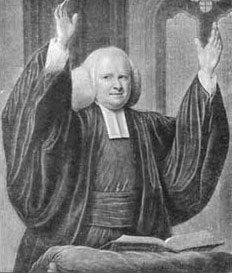 Read Burk Parson’s Tabletalk Magazine article, “A Sower Went Out To Sow . . . ” in which you will be introduced to George Whitefield, the great Calvinistic Methodist evangelist who, along with Jonathan Edwards (of “Sinners in the Hands of an Angry God” fame–aka, “the theologian of revival“), and John Wesley, for whom “the world [was his] parish,” with his earnest and sometimes blunt preaching, was the agent of God in the First Great Awakening.
As I read Parson’s article, it occured to me that I’ve heard evangelicals praying for and even “claiming” revival all of my life, with little to show for it, but a few enthusiastic excesses on the fringe of the charismatic movement. Considering the cultural climate in which we now live, perhaps God is bringing the American people to a greater place of hunger and thirst after righteousness. Pray for revival as we are all providentially confronted with some harsh economic and cultural realities. But, lest another explosion of error results, pray for reformation along with revival. Revival without reformation will bring spiritual life, but can also spread doctrinal error; reformation without revival will improve the church’s theological integrity whether or not spiritual integrity accompanies it. Reformation and revival is what America desparately needs.
The Truth About “Angels & Demons”
This weekend, the companion to The DaVinci Code, called Angels & Demons, hit the theaters. Just a few days before the movie came out, some scholars from Westminster Theological Seminary in Philadelphia, Pennsylvania, announced their website called “The Truth About Angels & Demons,” devoted to addressing the issues raised by Dan Brown’s book and the new movie based thereon. You may have noticed there has not been nearly the controversy swirling around this movie, but that doesn’t mean the story doesn’t distort the truths with which it deals. Hence the concern that, in this generation in which many people learn their history, science and theology from novels and movies, often accepting uncritically that which they read and watch, inaccuracies be corrected on a popular level.
In addition, Dr. Peter Lillback, one of the men behind the website, was interviewed on Issues, Etc., introducing the website and discussing some of the issues dealt with on the site. These issues range from the true identity of the historical secret society called the Illuminati to the conflict between science and religion, to the reason this film hasn’t been quite as controversial as the last. You can listen to this interview here.
Dr. Peter Lillback is a professor of historical theology at Westminster Theological Seminary, and is the author of The Binding of God, Lessons on Liberty: A Primer for Young Patriots, Wall of Misconception: Does the Separation of Church and State Mean the Separation of God and Government?, and George Washington’s Sacred Fire.
Jesus Christ: Sinless Man/Eternal God
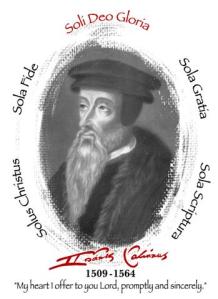
Get this on a t-shirt from reformationshirts.com!
Here’s a follow-up on my series of posts on “Compromising the Full Humanity of Christ” which dealt with the “heavenly flesh of Christ” heresy. In my reading through Calvin’s Institutes in commemoration of his quincentenary, I recently got to a passage in which he deals with this very issue, which he indicates that it predates Anabaptism, tying it to Manichaeism. Let’s read Calvin himself on this . . .
Indeed, the genuineness of his human nature was impugned long ago by both the Manichees and the Marcionites. The Marcionites fancied Christ’s body a mere appearance, while the Manichees dreamed that he was endowed with heavenly flesh. But many strong testimonies of Scripture stand against both (Book 2, chapter 13, section 1)…Marcion imagines that Christ put on a phantasm instead of a body because Paul elsewhere says that Christ was “made in the likeness of man . . . . being found in fashion as a man” (Phil. 2:7-8)…Mani forged him a body of air, because Christ is called “the Second Adam of heaven, heavenly” (1 Cor. 15:47) (Book 2, chapter 13, section 2).
You can read summaries of both of these sections at “Blogging the Institutes” from Reformation21.org, just follow the links in the two parenthetical references in the excerpt above.
Finally, in section 4, Calvin concludes his defense of the biblically orthodox view of Christ’s full humanity (which accords with the Definition of Chalcedon), explaining how it is that Christ’s human nature could be identical to our human nature without original sin–for Calvin, it’s simple, the Holy Spirit sanctified his human nature:
The absurdities with which they wish to weigh us down are stuffed with childish calumnies. They consider it shameful and dishonorable to Christ if he were to derive his origin from men, for he could not be exempted from the common rule, which includes under sin all of Adam’s offspring without exception. But the comparison that we read in Paul readily disposes of this difficulty: “As sin came in . . . through one man, and death through sin . . . so through the righteousness of one man grace abounded” (Rom. 5:12, 18). Another comparison of Paul’s agrees with this: “The first Adam was of the earth, and earthly and natural man, the Second of the heaven, heavenly” (1 Cor. 15:47). The apostle teaches the same thing in another passage, that Christ was sent “in the likeness of sinful flesh” to satisfy the law (Rom. 8:3-4). Thus, so skillfully does he distinguish Christ from the common lot that he is true man but without fault and corruption. But they babble childishly: if Christ is free from all spot, and through the secret working of the Spirit was begotten of the seed of Mary, then woman’s seed is not unclean, but only man’s (you can hear that from many independent Baptist fundamentalists in the 21st century–I heard it all my life.) For we make Christ free of all stain not just because he was begotten of his mother without copulation with man, but because he was sanctified by the Spirit that the generation might be pure and undefiled as would have been true before Adam’s fall. And this remains for us an established fact: whenever Scripture calls our attention to the purity of Christ, it is to be understood of his true human nature, for it would have been superfluous to say that God is pure. Also, the sanctification of which John, ch. 17, speaks would have no place in divine nature (John 17:19). Nor do we imagine that Adam’s seed is twofold, even though no infection came to Christ. For the generation of man is not unclean and vicious of itself, but is so as an accidental quality arising from the Fall. No wonder, then, that Christ, through whom integrity was to be restored, was exempted from common corruption! They thrust upon us as something absurd the fact that if the Word of God became flesh, then he was confined within the narrow prison of an earthly body. This is mere impudence! For even if the Word in his immeasurable essence united with the nature of man into one person, we do not imagine that he was confined therein. Here is something marvelous: the Son of God descended from heaven in such a way that, without leaving heaven, he willed to be borne in the virgin’s womb, to go about the earth, and to hang upon the cross; yet he continuously filled the world even as he had done from the beginning!
That Christ’s human nature is equally sinless and at the same time the product of Mary’s reproductive system is easily seen in Scripture. The Spirit illumined this to my understanding by a simple reading of Luke 1:35 once I came to realize the modern fundamentalist heavenly flesh view with which I was raised had to be wrong:
And the angel answered her, “The Holy Spirit will come upon you, and the power of the Most High will overshadow you; therefore the child to be born will be called holy—the Son of God.”
See the word “therefore” in this verse? The former activity is the reason for the latter condition; the Holy Spirit’s overshadowing Mary in Jesus’ conception is the reason for his holiness. It’s as simple as that! Long ago, I got a grasp of the fact that names in Scripture usually reflect something of the nature or behavior of the people who bear them. In this case, the Spirit’s name is “Holy Spirit.” In short, he’s the Spirit who makes people holy. The human nature of Jesus was holy because of his conception via the Holy Spirit. And believers today are being sanctified (being made holy) by the Holy Spirit through the ordinary means of the preaching of Law and Gospel, signified and sealed to them in the sacraments of baptism and the Lord’s Supper.
Love or Apostasy?

"Extra! Extra! Read all about it!"
Today’s headlines from the Daily Evangel, in the Evangelical News & Views section, includes Christianity Today’s interview with Rick Warren in which he clarifies some of the comments he made during his interview with Larry King on CNN Monday night (click on “Q & A: Rick Warren” in the sidebar). In my last post, I introduced the topic with the statement that “a couple of pastor Warren’s comments troubled me,” then I only blogged on one of them. The second thing was his announcement, as an example of what he calls “interfaith projects” (which he finds far superior to “interfaith dialogue”), that he would attend a Jewish Passover seder hosted by a rabbi friend of his, Elie Spitz. Spitz’s congregation is hosting a “community seder” (see this advertisement).
Larry King had sought a comment from Warren about President Obama’s recent comments regarding Islam in Turkey. Here’s the exchange:
KING: Obama has traveled to Turkey, first president to visit a Muslim country. He had this to say about the United States and Islam in a speech to Turkish parliament. Watch. I’d like you to comment.
(BEGIN VIDEO CLIP)
OBAMA: The United States is not and will never be at war with Islam. In fact, our partnership with the Muslim world is critical, not just in rolling back the violent ideologies that people of all faiths reject, but also to strengthen opportunity for all people.
(END VIDEO CLIP)
KING: What do you think of that?
WARREN: You know, I think that’s the exact right tone, Larry. There are 600,000 Buddhists in the world. There are 800,000 Hindus in the world. There are a billion Muslims in the world. There are 2.3 billion Christians in the world. You have to get along together. That’s why I speak with Jewish groups. I speak to Muslim groups.
We’re all human beings. We have to work on issues we don’t always agree on. I’m not really into what I call inter-faith dialogue. I think that’s a lot of wasted time. I’m interested in what I call inter-faith projects. In other words, I’m not going to convince a lot of people who have other beliefs to change their beliefs and vice versa. But we can work together on issues like poverty, disease, illiteracy and things that — problems common to all humanity.
This week, for instance, tomorrow night, I’m going to a Seder dinner with my dear friend Elie Spitz (ph), who is a local rabbi. We’ll celebrate Passover together. And then later in the work [week? jdc], I’ll do Easter, which is — they’re both all about redemption. My next door neighbor is Muslim. I traveled with him to the Middle East. We’re dear, dear friends. And there’s no reason — what people don’t seem to understand is that you don’t have to agree with everybody in order to love them.
In the CT interview, Warren elaborates on these remarks:
People see me out there — I speak to Muslim groups and Jewish groups, I’m actually having a Passover Seder tomorrow night. People never need to doubt why I do what I do, even when associating with people gets me in all kinds of hot water. Jesus got into hot water for the people he associated with. Fundamentalist groups say Warren hangs out with Jews and Muslims and gays and on and on. The point is, I’m not allowed to not love anybody.
With these words, Warren blurs the lines between loving people regardless of religion or lack thereof, which is of course appropriate, and worshiping with them. It’s not hard to distinguish between the two, yet Warren seems to see no distinction. The apostle Paul wrote in Romans 13:10, “Love does no wrong to a neighbor; therefore love is the fulfilling of the law.” However, in the book of Hebrews, the author of that letter warns Christians against engaging in the worship of unbelieving Jews (Hebrews 5:11-6:8). To do so, according to the author of Hebrews, is tantamount to apostasy. The elements of the Passover seder, like the Old Testament temple worship, are a “copy” and “shadow of the heavenly things” (Hebrews 8:5).
I submit that it is not unloving to refrain from worshiping with those who reject the gospel, while still living a life that does no harm to them. At the same time, I find that this announcement of participating in the copies and shadows of things fulfilled by the Lord Jesus Christ, in the context and company of those who deny his fulfillment of them, is just the logical conclusion of the kind of fuzzy thinking Warren engages in when he calls Roman Catholics and others who distort the gospel, “brothers and sisters in God’s family” (see my previous post).
 Dearly beloved, this type of activity on the part of Protestant (yes, I said “Protestant”) leaders is indicative of the spiritual decline in Christianity that I believe is linked to the kind of sociological decline reported on by Newsweek magazine. What American Christianity needs is a revival and a Reformation. It needs to regain the courage to be Protestant. I would ask you to consider the words of the Cambridge Declaration, a recent statement and call to reformation and revival prepared by the Alliance of Confessing Evangelicals. This statement is found on my “Creeds, Confessions, Catechisms and Statements” page, but here’s the link for your convenience.
The introduction to the Cambridge Declaration describes well the state of affairs and the need of the hour. Please consider them seriously:
Evangelical churches today are increasingly dominated by the spirit of this age rather than by the Spirit of Christ. As evangelicals, we call ourselves to repent of this sin and to recover the historic Christian faith.
In the course of history words change. In our day this has happened to the word “evangelical.” In the past it served as a bond of unity between Christians from a wide diversity of church traditions. Historic evangelicalism was confessional. It embraced the essential truths of Christianity as those were defined by the great ecumenical councils of the church. In addition, evangelicals also shared a common heritage in the “solas” of the sixteenth century Protestant Reformation.
Today the light of the Reformation has been significantly dimmed. The consequence is that the word “evangelical” has become so inclusive as to have lost its meaning. We face the peril of losing the unity it has taken centuries to achieve. Because of this crisis and because of our love of Christ, his gospel and his church, we endeavor to assert anew our commitment to the central truths of the Reformation and of historic evangelicalism. These truths we affirm not because of their role in our traditions, but because we believe that they are central to the Bible.
The Devil is a Degenerate Creation of God
The following is from Institutes of the Christian Religion by John Calvin, published in its final form in 1559 (for more on Calvin and the Institutes, read this). In his summary of the origin of Satan, see if you can tell what’s conspicuous by its absence, and what Calvin writes that has some bearing on what 21st century Christians generally would expect to see here. This passage is from Book 1, chapter 14, section 16.
Yet, since the devil was created by God, let us remember that this malice, which we attribute to his nature, came not from his creation but from his perversion. For, whatever he has that is to be condemned he has derived from his revolt and fall. For this reason, Scripture warns us lest, believing that he has come forth in his present condition from God, we should ascribe to God himself what is utterly alien to him. For this reason, Christ declares that “when Satan lies, he speaks according to his own nature” and states the reason, because “he abode not in the truth” [John 8:44 p.]. Indeed, when Christ states that Satan “abode not in the truth,” he hints that he was once in it, and when he makes him “the father of lies,” he deprives him of imputing to God the fault which he brought upon himself.
But although these things are briefly and not very clearly stated, they are more than enough to clear God’s majesty of all slander. And what concern is it to us to know anything more about devils or to know it for another purpose? Some persons grumble that Scripture does not in numerous passages set forth systematically and clearly that fall of the devils, its cause, manner, time, and charater. But because this has nothing to do with us, it was better not to say anything, or at least to touch upon it lightly, because it did not befit the Holy Spirit to feed our curiosity with empty histories to no effect. And we see that the Lord’s purpose was to teach nothing in his sacred oracles except what we should learn to our edification. Therefore, lest we ourselves linger over superfluous matters, let us be content with this brief summary of the nature of devils: they were when first created angels of God, but by degeneration they ruined themselves, and became the instruments of ruin for others. Because this is profitable to know, it is plainly taught in Peter and Jude. God did not spare those angels who sinned [2 Peter 2:4] and kept not their original nature, but left their abode [Jude 6]. And Paul, in speaking of the “elect angels” [1 Timothy 5:21], is no doubt tacitly contrasting them with the reprobate angels.
Give up? Calvin didn’t identify the pre-fallen Satan as bearing the name Lucifer, based on Isaiah 14:12! That would be because the word Lucifer is used to translate the Hebrew word for “morning star” or “day star” in the King James Version. This was carried over from the Latin Vulgate by the King James translators. “Lucifer” was historically a name for the planet Venus, which happens to be the morning star. Besides, the passage in Isaiah is a prophecy of judgment against the King of Babylon. It’s use in reference to the chief fallen angel is allegorical at best and simply out of context at worst. Before he fell, the Lord and his angels up in heaven did not call him Lucifer as if it were his name. This was popularized in Dante’s Inferno, and Milton’s Paradise Lost. See this Wikipedia article on Lucifer, and this one on Venus for more information.
Furthermore, our eagerness to derive a portrayal of the fall of Satan in Isaiah’s passage is just the kind of “lingering over superfluous matters” that “feed our curiosity with empty histories to no effect.” Calvin writes that things like this have “nothing to do with us” and that “the Lord’s purpose was to teach nothing in his sacred oracles except what we should learn to our edification.” Justin Taylor’s post at “Blogging the Institutes” summarizes Calvin’s remarks well (read Justin’s post here).
Therefore, class, your homework assignment is to memorize what the Bible explicitly (and actually), albeit sketchily, teaches about the fall of Satan and his angels–Jude 6. “And the angels who did not stay within their own position of authority, but left their proper dwelling, he has kept in eternal chains under gloomy darkness until the judgment of the great day—”
Class dismissed.
Christ-Centered Counseling
Along with a local PCA Church, Grace Community Presbyterian in Fort Worth, Texas, I am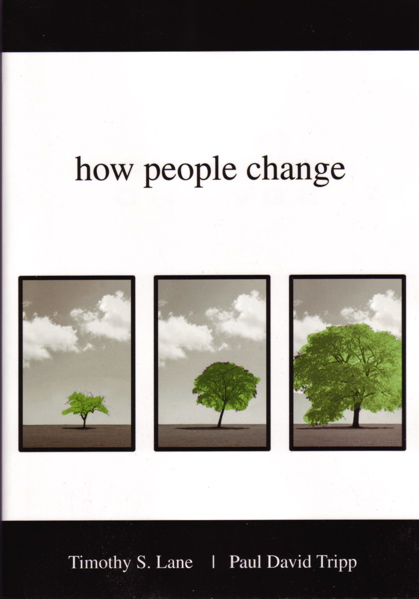 reading through several books this year. For the months of March and April, I’m reading through How People Change by biblical counselors Dr. Timothy Lane, executive director and faculty member of the Christian Counseling and Educational Foundation (CCEF), and Dr. Paul David Tripp, president of Paul Tripp Ministries, pastor, and adjunct professor at Westminster Theological Seminary as well as adjunct faculty member of CCEF. The slogan across the top of the CCEF website (www.ccef.org) is “Restoring Christ to Counseling and Counseling to the Church.” We’re off to a good start.
As you may have guessed, I’m not the sort who naturally gravitates toward such “practical” material. But that’s my own problem. This volume, however, proves promising. I’ve only gotten through chapter one, so far, and it appears to have already gotten my number. The title of chapter one is “the gospel gap” (all titles are in lower case in this book), which the authors summarize in this way:
The good news of the gospel of Jesus Christ is a “then-now-then” gospel…First, there is the “then” of the past. When I embrace Christ by faith, my sins are completely forgiven, and I stand before God as righteous. There is also the “then” of the future, the promise of eternity with the Lord, free of sin and struggle. The church has done fairly well explaining these two “thens” of the gospel, but it has tended to understate or misunderstand the “now” benefits of the work of Christ. What difference does the gospel make in the here and now? How does it help me as a father, a husband, a worker, and a member of the body of Christ? How does it help me respond to difficulty and make decisions? How does it give me meaning, purpose and identity? How does it motivate my ministry to others?
It is in the here and now that many of us experience a gospel blindness. Our sight is dimmed by the tyranny of the urgent, by the siren call of success, by the seductive beauty of physical things, by our inability to admit our own problems, and by the casual relationships within the body of Christ that we mistakenly call fellowship. This blindness is often encouraged by preaching that fails to take the gospel to the specific challenges that people face. People need to see that the gospel belongs in their workplace, their kitchen, their school, their bedroom, their backyard and their van. They need to see the way the gospel makes a connection between what they are doing and what God is doing. They need to understand that their life stories are being lived out within God’s larger story so that they can learn to live each day with a gospel mentality (pages 3-4).
If you’ve been reading my blog for any length of time, you know I’m a big believer in the Christ-centered emphasis of Reformed theology. You may have read previous posts where I’ve recommended books like Christ Centered Preaching and Living the Cross Centered Life. This book on biblical counselling is right up the Christ-centered alley. Here’s a helpful guide for learning to live life in light of the gospel.
Two great passages of Scripture give us a picture of this so-called “then-now-then” application of the gospel to the believer. In his letter to Titus, the apostle Paul writes that the gospel is the basis for the instructions he gives in the first ten verses of chapter two.
11 For the grace of God has appeared, bringing salvation for all people, training us to renounce ungodliness and worldly passions, and to live self-controlled, upright, and godly lives in the present age, waiting for our blessed hope, the appearing of the glory of our great God and Savior Jesus Christ, who gave himself for us to redeem us from all lawlessness and to purify for himself a people for his own possession who are zealous for good works (Titus 2:11-14).
Back “then” the grace of God appeared, bringing salvation for people in every nation (v. 11). “Now,” or as Paul writes, “in the present age” (v. 12), this grace of God trains us to renounce ungodliness and worldly passions, embracing self-control, uprightness, and godliness, “waiting for our blessed hope” (v. 13), in other words, looking forward to “then,” when Christ returns, who, back “then,” gave himself for our redemption from lawlessness to “purify . . . a people for his own posession who are zealous for good works” (v. 14). As you can see, the authors draw directly from Scripture for their approach to counseling, with no modern psychological influences evident. This is Christ-centered counseling if I’ve ever seen it.
Likewise, Peter gives a bit more extensive treatment in his second letter. In fact, in 2 Peter 1:9, the apostle explicitly indicates a professing believer’s tendency to “forget” about what Christ did for him in the gospel. Here is Lane’s and Tripp’s “gospel gap.” Let’s take a look at the passage–2 Peter 1:3-11.
His divine power has granted to us all things that pertain to life and godliness, through the knowledge of him who called us (back “then“) to his own glory and excellence, by which he has granted to us his precious and very great promises (again, past tense), so that through them you may become partakers of the divine nature, having escaped (detecting a pattern yet?) from the corruption that is in the world because of sinful desire.
For this very reason, (“now“) make every effort to supplement your faith with virtue, and virtue with knowledge, and knowledge with self-control, and self-control with steadfastness, and steadfastness with godliness, and godliness with brotherly affection, and brotherly affection with love. For if these qualities are yours and are increasing, they keep you from being ineffective or unfruitful in the knowledge of our Lord Jesus Christ.
For whoever lacks these qualities is so nearsighted that he is blind, having forgotten that he was cleansed from his former sins (here’s the “gospel gap”). Therefore, brothers, be all the more diligent to make your calling and election sure, for if you practice these qualities you will never fall. For in this way there will (“then“) be richly provided for you an entrance into the eternal kingdom of our Lord and Savior Jesus Christ.
For these reasons, and a few others (so far), I’m inclined to believe the promotional synopsis at the Westminster Books website when it claims “This book explains the biblical pattern for change in a clear, practical way that you can apply to the challenges of daily life.”
The Political Conservative’s Obama-Era Survival Pack
I know many theological and political conservative Christian Republicans (as well as those to their right) are grieving the loss to their dream of rebuilding this “Christian nation.” They’re keeping a stiff upper lip as they say good-bye to the out-going evangelical President George Walker Bush, and endure, not without some respect for the historical nature of the event, the election, and now, inauguration of the first African-American President, Barak Hussein Obama. Hard times are coming to the evangelical dream of “taking America back” for Christ, but things are going well for the pluralistic civil religion.
During the next four to eight years, it may serve you well to think through a little more carefully just what is the Christian’s relationship to his government. What vision ought he to have for his nation? Should it be forced into the mold of Old Testament Israel, should a Christian theocracy be established, or are we to forswear all participation in the public square, and stop polishing the brass on the sinking ship of America?
I submit that a firmer grasp on the classical Christian distinction between what Augustine called the City of God and the City of  Man is in order. How is the Christian to live as citizens of the City of God without molding it into the image of the City of Man, and vice versa? This week’s episode of the White Horse Inn, “The City of God,” will tell you. You can read Michael Horton’s intro to the program here. Also, I found particularly helpful and interesting the programs on “Christianity and Politics,” part one and part two, in which, back in September, Dr. Horton interviewed D.G. Hart (author of A Secular Faith: Why Christianity Favors the Separation of Church & State), Dan Bryant (former Republican Assistant Attorney General for the Department of Justice) and Neil McBride (a strategist for the Democratic Party). Their introductions can likewise be read here.
I think learning a little more about what the Bible really expects of Christian citizens will help us all cope while the party who beat us in the last election has their turn at the helm of the ship of state. We, and our country, might just be the better for it. 


 The Misadventures of Captain Headknowledge
Listen to This. . .
Cover of Herman Bavink: Pastor, Churchman, Statesman, and Theologian by Ron Gleason
Don’t miss these great podcasts this week.
Share this: