The Political Conservative’s Obama-Era Survival Pack
I know many theological and political conservative Christian Republicans (as well as those to their right) are grieving the loss to their dream of rebuilding this “Christian nation.” They’re keeping a stiff upper lip as they say good-bye to the out-going evangelical President George Walker Bush, and endure, not without some respect for the historical nature of the event, the election, and now, inauguration of the first African-American President, Barak Hussein Obama. Hard times are coming to the evangelical dream of “taking America back” for Christ, but things are going well for the pluralistic civil religion.
During the next four to eight years, it may serve you well to think through a little more carefully just what is the Christian’s relationship to his government. What vision ought he to have for his nation? Should it be forced into the mold of Old Testament Israel, should a Christian theocracy be established, or are we to forswear all participation in the public square, and stop polishing the brass on the sinking ship of America?
I submit that a firmer grasp on the classical Christian distinction between what Augustine called the City of God and the City of  Man is in order. How is the Christian to live as citizens of the City of God without molding it into the image of the City of Man, and vice versa? This week’s episode of the White Horse Inn, “The City of God,” will tell you. You can read Michael Horton’s intro to the program here. Also, I found particularly helpful and interesting the programs on “Christianity and Politics,” part one and part two, in which, back in September, Dr. Horton interviewed D.G. Hart (author of A Secular Faith: Why Christianity Favors the Separation of Church & State), Dan Bryant (former Republican Assistant Attorney General for the Department of Justice) and Neil McBride (a strategist for the Democratic Party). Their introductions can likewise be read here.
I think learning a little more about what the Bible really expects of Christian citizens will help us all cope while the party who beat us in the last election has their turn at the helm of the ship of state. We, and our country, might just be the better for it. 
Live Blogging 3
for more info on this conference see: http://kimriddlebarger.squarespace.com/the-latest-post/2009/1/8/a-video-conference-on-eschatology-and-live-blogging-of-a-wes.html and follow the links.
10:41AM
Wow! New term from Voythress: protology–the study of first things, as opposed to eschatology, the study of last things. Stick that in your theological glossary.
Waldron’s now affirming that eschatology comes before soteriology in Scripture. Think Gen. 3.
Riddlebarger explained that a regenerate believer is not taken to the condition Adam was in before the fall, but that he is redeemed to the state Adam would have been in, had he been confirmed in righteousness, having succeeded in obeying the command to not eat the forbidden fruit.
Notes on Gaffin’s comments on “Get the Garden right, get Christ right.”1 Cor. 15 Resurrection hope of the church. Christ compares resurrected Christ with Adam before the fall. vs. 45, 47, Christ called the “Second Man.” The deepest perspective Paul provides on redemptive history. There’s no one between Adam, the first and Christ, the Second. Noah, Abraham, Moses, David are below the horizon of Paul’s concern in this chapter, Christ is literally the “eschatological one.” When you understand who Christ is as the esc. Adam, then everything else between Adam and Christ in redemptive history must fit into that.
Poythress: Both kinds of imagery are in Rev. 22. 22:1 shows a final garden, heightened from the original (Gen.3) and the language of the Bride of Christ. Here you have a connection of both “bridal and garden” in Gen 2.
Eph. 5:28ff . . . Was Eve typological of the Church in this passage? Riddlebarger says simply “clearly [she is]” but that he wouldn’t press it too far. Missed Waldron’s reply, but Poythress says there’s a comparison with Eve. Waldron asked if this connection somehow contributes to Mariology? I don’t get it. Anyone out there have a comment?
11:00AM
Moving on to questions about the competing attitudes about the world between dispensationalism and covenantal theology. Should we be optimistic about the success of the gospel, or pessimistic about any need to “polish the brass on a sinking ship?”
Gaffin speaks to the application of this question to suffering. We can be confident that Christ is now healing (I think he said healing) the earth with the gospel. References Mark 10:29-30. Promise of blessings with persecution to followers of Christ. References some passage in the “T books.” With many tribulations we must enter the kingdom of God. Opposition to the gospel results in suffering. There is a positive role of suffering in the church–“filling up the sufferings of Christ”
A short plug for Last Things First: Unlocking Genesis with the Christ of Eschatology.”
Poythress suspects that a hundred years ago, amillers didn’t have Vos’ and Gaffin’s “already/not yet” structure. This is optimistic in a way older amillers didn’t have the benefit of. Christ’s Body is the first fruits of the new heavens and earth. If we participate in that, it’s a spiritual optimism, looking forward to that which is yet to come.
Riddlebarger: the charge that amillers are pessimistic was made by Bahnsen. That amil is escapist like premil, says Bahnsen. Post mil Bahnsen would define optimism/pessimism differently. No economic, cultural, religious transformation before the Return. Optimistic about what God does through Ministry of the Word and administration of the sacraments. Not pessimistic about the gospel, but about human institutions.
Poythress believes it all will be thoroghly transformed in the new heavens and new earth. Amils aren’t giving up on transformation of the world, but don’t expect it until after the consummation. No guarantee to be successful in worldly terms, but should try to think and act Christianly in our worldly context. A Christianized society is not the atmosphere of the New Testament.
Waldron argues for optimism about the spread of the gospel. Optimistic about what? Matt. 16, Lk 13 parable of mustard seed teaches growth of gospel. Mt. 16 shows the church thoroughly on the attack, not under attack by Satan. (?) The gates of hell won’t prevail against the spread of the gospel. Parable of weeds show that good and evil grow together until the end. Not good to emphasize that as good grows, evil shrinks, or vice versa, but that they grow concurrently until the Return of Christ.
11:16AM
Ezk. 40-48 When does a biblical theology of the millennial Temple begin, and what does it look like?
Waldron: Doesn’t teach reinstitution of Old Testament ceremonial, sacrifical system in the Millennial Age.
Riddlebarger: see Beale’s book on the Temple. Hard to unlearn the wooden literal, dispensational interpretation. But it undercuts the beauty of what God is describing.
Poythress: The Temple theme is present by implication in the Garden of Eden. God communes with Adam and Eve as he does with Israel in the Temple. Jacob at Bethel–no physical structure, but a mediation of the presence of God is the point. Ezk. Temple is symbolic of God’s communion with his people. It shouldn’t be astonishing that John 2 indicates that Jesus spoke of his own body in speaking of the Temple. A vision is not a photograph. The Temple is the medium for speaking these concepts of mediated communion with God. You can’t dictate the details of final realities by looking at the type. The reality always exceeds the type.
Barcellos: Angels ascending, descending on the Son of Man?
Poythress: Seen carefully, the Son of Man is the ladder, a mediator between heaven and earth.
Gaffin: Related to the larger question of the biblical theology of the Temple, as you look at Ez 40-48 in its visionary and prophetic character, that whole chunk focuses on what Christ said about whatever promises held out in Old Testament Scriptures, they have their Amen (fulfillment) in Christ. 1 Cor. 3:9–We’re God’s fellow-workers, you’re God’s field/building. Is this an arbitrary connection? It’s a reference to the Garden (field) and the building (New Jerusalem). The New Jerusalem is a consummated Garden of Eden.
(Wow!jdc)
11:30
Supersuccessionism/Replacement theology:
Waldron: The idea that amil says the church replaces Israel as the people of God. It’s a pejorative label.
Poythress: Not replacement, but fulfillment. Christ is the true Israel (Matt. 2). Israel the Son in a subordinate sense. Jesus the heir of the promises made to both Abraham and David. Gal. 3:16 argues that Gentiles and Jews alike participate in these promises. If Christ’s, Abraham’s offspring–heirs according to promise. Jews don’t cease to participate in the promise, but the Gentiles are included. Jewish disbelief is what gets them cut off the tree (Rom 11).
Riddlebarger: Is OT “Judeocentric”? I’m unashamedly a Christian and not a Jew. But I’m reading the OT looking for Christ. Isa 53 and related passages are clear if looking for Christ in the OT.
Gaffin: What is OT Israel typological of? Israel’s God’s chosen Son. Christ is the true Israel. Every promise given to Israel has its focus in Christ and his work. Acts 1:6 asks a Jewish oriented question about the Kingdom of God. Jesus corrects the terms of the question. It’s not is Kingdom being restored to Israel, but will Israel be restored to the Kingdom? In Rom 9-11, Paul sets terms at beginning. 9:6 who is Israel? Not all Israel are Israel, but those who believe, whether Jew or Gentile. Gaffin accepts term supersession in sense of fulfillment not replacement.
Waldron: If Christianity is not the fulfillment of the Old Testament, then what is Christianity?
Poythress: Gal. 4 Jerusalem above is free. She’s our mother. Isa 54 about the expansion of the people of God. Christ is the heir and if you’re in Christ, then you’re the heir. Gal. 3 means you can’t divide Christ into eschatological and political.
Gotta bug out early, but here’s plenty to chew on. Hope some of my notes make sense.
Rest, Renew, Rely

Living the Cross Centered Life by CJ Mahaney
I loaned my copy of C. J. Mahaney’s incredible book,
Living the Cross-Centered Life, to a co-worker who is a young believer trying to grow out of a severly sinful lifestyle. Bemoaning his lack of reading comprehension at times, he asked me what Mahaney meant when he wrote somewhere in the book (I haven’t seen the quote) something to the effect of, “even though I’m living in the flesh, I choose to live by faith.” Unclear as he was to the meaning of this statement, I told him I could only guess that the author meant that he was not going to rely on his own moral fortitude to be godly, but he was going to rely on God’s grace to empower him to obey his commands. He asked me to write something down about that, and the following is what came out of that effort. Hope you find it edifying, if not instructive in any way.
Rest in the Gospel–The Right Basis
The basis for your acceptance by God is the active and passive obedience of Christ. His active obedience is his 33 years of sinless obedience by which he earned eternal life for you; his passive obedience is his suffering and death on the cross, facing for you the consequences of your sin. Therefore, the basis for your acceptance by God is not your behavior. If the basis of your acceptance by God was your behavior, then you would be trying to earn some reward from God and you would be trying to avoid some punishment from God. The right motive for your behavior as a Christian is gratitude for Christ’s work for you.
Renew Your Gratitude–The Right Motive
Fear of punishment and hope of reward is the wrong motive for your behavior as a Christian; gratitude for Christ’s work is the right motive for your behavior as a Christian. Gratitude is what you feel when you are given a gift. When you earn what you have, you’re only thankful to yourself, and that’s not what glorifies God. Both the basis of your acceptance by God, the gospel of Christ’s death and resurrection, and your response characterized by grateful behavior are given to you freely by God’s grace, not procured by your own strength.
Rely on Grace–The Right Source
Grace is not a force like electricity which makes our appliances work, it’s God’s good attitude toward you based on his satisfaction with the obedience and death of his Son, the Lord Jesus Christ. When you successfully resist temptation, and successfully obey his commands, he has granted this success to you as a gift of his gracious disposition toward you because of Christ.
’nuff said
I’m planning to join some friends from a local church who are planning to read through a few books in the coming year. Now that the New Year has come around the bend, it’s time for me to be obtaining the first in the series, procrastinator that I am. The first book we’re going to be reading through and blogging about at their church’s blog is called, Jesus: Made In America, by Steve Nichols. The publisher’s description describes the content in the following way:
Beginning with the Puritans, he leads readers through the various cultural epochs of American history, showing at each stage how American notions of Jesus were shaped by the cultural sensibilities of the times, often with unfortunate results. Always fascinating and often humorous, Jesus Made in America offers a frank assessment of the story of Christianity in America, including the present.
Sounds pretty entertaining as well as enlightening. But since I’ve yet to order a copy of the book, I thought I might check the websites of one of the major Christian booksellers who have locations in my area, in case I can just swing by and pick up a copy on my way home from work tonight. I went to the site for Family Christian Stores and entered “jesus made in america” in the search engine to see if they carry it.
You’ll never guess what the top result was:

Need I say more?
Guess I’ll order it from Westminster Seminary’s bookstore anyway.
Calvinism, Coming to a Young Christian Near You!

Click image to purchase at WTS Books
There’s a book out chronicling the resurgence of Calvinism among the, pardon the expression (keep in mind, I’m using it correctly), emerging generation of teens, twenty-, and thirty-somethings (including myself) who are disillusioned with the shallow theology and over-emphasis on you name it, revivalism, pietism, experientialism, commercialism of the twentieth century. As you know, the list of misguided varieties could go on.
So many of us who’ve grown up as a either a fundamentalist or evangelical Christian have come to the conclusion that what is needed is for the church to get back to the basics of what it means to be a Christian. The basics of Christianity as understood in a broader way than just re-examining my Bible and reconstructing my own version of what I think is the clear teaching of Scripture regarding faith and practice (which is what most of the previous generation think it means to get back to the basics).
Such a tactic is part of the problem–it’s too self-centered and individualistic and often far too reductionistic. It’s not a matter of just throwing out current traditions and starting over with a clean slate. It’s not about reinventing the wheel–those are the kinds that never turn out round. What I’m talking about is getting on the right track–yes, the most biblical track, the most Christian track, the most Protestant track, the most truly evangelical track–a track I didn’t lay myself, but was laid by the faithful followers of Christ who genuinely changed the world in their generation as did the first century apostolic generation.
What generation am I talking about? I’m talking about the generation that laid the tracks of conservative evangelical, confessionally Reformed, Christ-centered Protestant theology. The generation identified in the history books as the Reformers.
I read once that Socrates is known for saying, “Sometimes regress is progress.” The bill of goods that we were sold in the 20th century told us that what’s happening now is better than what happened back then. The present is always preferable to the past. The new is more relevant than the old. Well, some of us have learned that sticking “new and improved” on something doesn’t mean a thing. Some of us have learned that if conservative evangelical, or fundamentalist Christianity is going to make any progress, we’re going to have to regress back to a time when things were genuinely being done right and learn from both their successes and mistakes, receiving the faith in tact as handed down by them and not as re-imagined by modern philosophical influences, be they pragmatism, modernism or post-modernism. Progress will only come through this kind of regress.
Second Timothy 2:2 puts it best: “and what you have heard from me in the presence of many witnesses entrust to faithful men who will be able to teach others also.” But lots of people are entrusting lots of things to lots of “faithful men.” Which version of Christianity is best? There’s a number of us in this new generation who are firmly convinced that what the apostolic churches passed on to faithful men who led the post-apostolic generation, got deformed in the medieval era and was reformed in the sixteenth and seventeenth centuries is the “basics” to which the 21st Century generation of Christians needs to get back to. So much that has transpired since the Reformation era leaves so much to be desired that we don’t trust much of it at all. That’s why we’re turning to Calvinism, also known as Reformed theology.
Journalist Collin Hansen has written Young, Restless, Reformed: A Journalist’s Journey with the New Calvinists. It tells our story. Martin Downes has reviewed the book over at Reformation21.org. Read all about it, then find your place in the 21st Century Reformation.
Why Every Christian Should Build His Own Library
Al Mohler posted a great on Books, Libraries and the Ideal of Christian Scholarship, which reminds us of how Christianity is a religion of the written word, both inspired and uninspired.
He writes:
Christianity has been closely connected with the book and the written word from its inception. Books remain important to Christians–scholars and laypersons alike. We should be thankful that at this historical juncture the book is more accessible than ever. Serious Christians can and should start personal libraries of important and worthy Chrisitan books. Some will be large and some will be small, but each can serve us the way Jerome’s library served him–and blessed the church.
So how does one know which books are right to put in his own library? You’ll begin to figure that out for yourself as you read.
D. James Kennedy Dies
FT. LAUDERDALE, Sept. 5 – Dr. D. James Kennedy, founder and senior pastor for 48 years of Coral Ridge Presbyterian Church (CRPC) in Fort Lauderdale, Fla., passed away peacefully in his sleep at approximately 2:15 a.m. at his home with his wife and daughter by his bedside, following complications from a cardiac event last December. He was 76. Dates and times for a public viewing and funeral and private interment will be released when available. “There are all kinds of wonderful things I could say about my dad,” said daughter Jennifer Kennedy Cassidy. “But one that stands out is his fine example. He ‘walked the walk’ and ‘practiced what he preached.’ His work for Christ is lasting – it will go on and on and make a difference for eternity.”
Dr. Kennedy, who is survived by Anne, his wife of 51 years, and his daughter Jennifer (Kennedy) Cassidy, preached his last sermon from the pulpit of Coral Ridge Presbyterian Church on Christmas Eve Sunday 2006. He suffered a cardiac arrest four days later on Dec. 28, and has since been unable to return to the pulpit. The church announced his retirement on Aug. 26, beginning a process to choose his successor, and had planned a tribute worship service honoring the extensive ministry of Dr. Kennedy on Sept. 23.
“I would like to thank all of you for your prayers, cards, kindnesses and encouragement over the past nine months,” Mrs. Cassidy said during the retirement announcement. “Our family knows that we have come through this difficult time because of God’s grace and your faithful prayers, and it has brought joy to us to see God’s faithfulness in all of this.”
While hindered by persistent health problems that included asthma, as well as chronic and often severe physical pain from compressed vertebrae due to an injury suffered as a young man, Dr. Kennedy was indefatigable in his ministry work. He said on several occasions how much he looked forward to being free from pain in heaven. He was one of the nation’s leading Christian broadcasters and a vigorous and articulate advocate for Christian involvement in public life.
Regardless of one’s opinion of the amount of politics that comprised Dr. Kennedy’s preaching ministry, we should be grateful for his leadership in lending credibility to the idea that Calvinists can be great evangelists, in his writing Evangelism Explosion, currently used by probably more denominations than any other method of evangelism, from what I’ve heard, anyway. I’m glad they’re continuing to air the broadcasts of the church services–I love the music at the beginning and do appreciate some of the informative programs on current events and issues political and religious.
Dear Bloggers, You’ve Got a “Llove” Letter!

Check out my pastor’s new website! www.lloveletters.com. Notice that he’s got a book for sale, too!
Blogging under the identity of “Christian West,” my pastor will be regularly attempting to encourage believers who read his blog to “excercise the Disciplines of Llove.” Click here to read his first post on his blog. . .Failure Is Underrated.
The Best Reformed T-Shirts on the Web!
Objections to Wine Use Answered
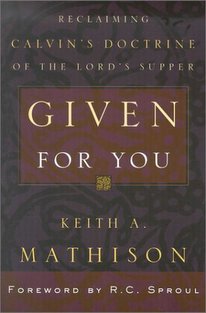 The following is an excerpt from Keith A. Mathison’s book, Given For You: Reclaiming Calvin’s Doctrine of the Lord’s Supper, copyright 2002, P&R Publishing.
Because the substitution of grape juice for wine in the Lord’s Supper has now become the standard practice in many American evangelical churches, many theologians within those communions have found it necessary to justify the change. In this section, we shall address some of the specific objections offered by representative theologians, as well as some other potential objections to the use of wine.
The prominent Baptist theologian A. H. Strong expresses a common objection made by those who have substituted grape juice for wine. He writes, “Although the wine which Jesus poured out was doubtless the ordinary fermented juice of the grape, there is nothing in the symbolism of the ordinance which forbids the use of unfermented juice of the grape,–obedience to the command ‘This do in remembrance of me’ (Luke 22:19) requires only that we should use the ‘fruit of the vine.’ ” (Augustus H. Strong, Systematic Theology (Old Tappan, N.J.: Revell, 1970), 960.) Several points may be raised in response to this argument. First, it should be noted that Strong himself admits that wine was “doubtless” the drink that Jesus used. Second, if we are required to use the “fruit of the vine,” we are required to use wine because, in the context of the institution of the Lord’s Supper, fruit of the vine was a synonym for wine.
Another Baptist theologian, William W. Stevens, presents a similar line of argument in his book Doctrines of the Christian Religion:
The bread used by Jesus was doubtless the unleavened bread of
the Passover meal, as the wine he used was doubtless the fermented
juice of the grape. But this does not mean that we must
of necessity use unleavened bread, nor does it mean that we cannot
use the unfermented juice of the grape. Unleavened bread
is what Jesus had at hand, and his phrase “fruit of the vine” in
Matthew 26:29 would include unfermented juice as well. The
bread and the cup are symbolical only. To insist on literalism
would be tantamount to legalism (William W. Stevens,
Doctrines of the Christian Religion (Nashville: Broadman, 1967), 344.)
Here again we observe that the author in question admits that it is “doubtless” that Jesus himself used wine instead of grape juice. If this is admitted to be the case, the real question is why the author would even desire to change it in the first place. Stevens is simply incorrect when he asserts that the phrase “fruit of the vine” in the context of Matthew 26:29 would include unfermented grape juice as well as wine. In the context of the Passover meal, the phrase “fruit of the vine” was a liturgical term used as a synonym for wine. Finally, the comparison that Stevens makes between leavened and unleavened bread and wine and grape juice overlooks one big difference between the two. Leavened bread is still bread, but grape juice is not wine.
The most influential evangelical Baptist theologian today is Millard Erickson. Like Strong and Stevens before him, he too attempts to justify the substitution of grape juice for wine:
What elements we decide to use in celebrating the Lord’s Supper
will depend, at least in part, upon whether our chief concern is
to duplicate the original conditions as closely as possible or to
capture the symbolism of the sacrament . . . . With respect to
the cup, duplication of the original event would call for wine. . . .
If, on the other hand, representation of the blood of Christ is the
primary consideration, then grape juice will suffice equally well . . . .
Suitability to convey the meaning, not similarity to the original
circumstances, is what is important as far as the elements are
concerned (Millard Erickson, Christian Theology (Grand Rapids:
Baker, 1985), 1125.)
This argument raises a number of important objections that must be noted. First, we are not arguing for duplication, but for obedience. If bread and wine were the elements that Christ ordained to be used, then we have no more right to change them than we have to use something instead of water in baptism. Second, the argument of Erickson (and of Strong and Stevens) changes when the subject is baptism. When discussing baptism, Baptists such as Erickson typically argue from the example of Christ. They insist that early baptism was administered only by means of immersion (This is a questionable assertion, but arguments about the meaning and mode of baptism are beyond the scope of this book. For a concise presentation of the arguments against the view that immersion was or is the only proper mode of baptism, see Jay Adams, The Meaning and Mode of Baptism (Phillipsburg, N.J.: P&R, 1992).) They argue that we must duplicate the baptismal mode that Jesus used. Yet in the case of the Lord’s Supper, they say that only the most basic symbolism need be preserved. But if basic symbolism is all that matters, then it would not matter whether Jesus and the apostles baptized only by means of immersion. Sprinkling and pouring would be acceptable because those modes of baptism convey the meaning of cleansing and purification just as well as immersion.
The dispensationalist Charles Ryrie takes a slightly different approach in his argument for the use of grape juice in the Lord’s Supper:
The Scriptures do not use the word “wine” in connection with
the Supper, only “the cup” or “the fruit of the vine.” Of course
it was juice from the grape, but whether fermented or not is not
stated . . . . For the sake of converted alcoholics or even to forestall
anyone beginning to drink, unfermented juice is preferable in light
of today’s worldwide problem with alcohol (Charles C. Ryrie,
Basic Theology (Wheaton: Victor, 1986), 425.)
There are a number of problems with Ryrie’s argument. First, the word wine does not need to be used when the phrase fruit of the vine is itself a Jewish liturgical term for wine. Second, Ryrie’s argument leave the impression that Jesus may have used grape juice. Since the Lord’s Supper was instituted during a normal Pasover meal in which wine was unquestionably used, such a suggestion is very misleading. As the Baptist theologians Strong and Stevens admit, there is not doubt that Jesus was using wine.
The argument that we should use grape juice instead of wine for the sake of converted alcoholics and because of today’s worldwide alcohol problem simply doesn’t follow. Drunkenness was as much of a problem in biblical times as it is today. Otherwise, why would there be so many biblical condemnations of this sin? Yet, in spite of the fact that drunkenness was a problem even in the first century, Jesus did not hesitate to institute the Lord’s Supper using wine. In addition, the apostle Paul encountered drunkenness in the observance of the Lord’s Supper at Corinth (1 Cor. 11:21). Aside from the fact that it would have been impossibel for the Corinthian Christians to get drunk if they were using grape juice, as some suggest they were, we must observe that Paul did not correct this abuse by advocating the nonuse of wine. Instead, he called for the proper observance of the Lord’s Supper. If alcoholism is a real problem today, it was a real problem in Jesus’ day. Human physiology has not changed drastically in two thousand years. But in spite of the fact that drunkenness was a problen, and in spite of the fact that human beings face the same kinds of temptations, Jesus instituted the Lord’s Supper with the elements of bread and wine. To suggest that the use of wine in the Lord’s Supper contributes to sinful behavior is to condemn Jesus himself.
The Pentecostal theologian J. Rodman Williams provides another faulty argument against the use of wine in the Lord’s Supper:
In the three synoptic accounts of the Lord’s Supper
the content of the cup is called “the fruit of the vine”
(Matt. 26:29; Mark 14:25; Luke 22:18). This doubtless
was wine; however, since wine is not directly mentioned
in any of these accounts, it is irrelevant to insist
(as some do) that wine must be used. Grape juice
equally comes from “fruit of the vine”
(J. Rodman Williams, Revewal Theology
(GrandRapids: Zondervan, 1992), 3:261, n. 178.)
This argument is similar to those made by Strong, Stevens, and Erickson. Unlike their arguments, however, it contains an obvious self-contradiction. Williams says that all three accounts of the Lord’s Supper call the content of the cup “the fruit of the vine.” Then he says that “the fruit of the vine” mentioned in these accounts was doubtlessly wine. Then he contradicts himself by saying that wine is not directly mentioned in any of these accounts. If “the fruit of the vine” is directly mentioned in all three accounts, then wine is directly mentioned in all three accounts. The specific word wine need not be used, so long as an acknowledged synonym for wine is used. It is not irrelevant, therefore, to argue that wine should be used in the Lord’s Supper.
While it is not irrelevant to argue that wine should be used, it is entirely irrelevant to point out, as Williams does, that grape juice comes from the fruit of the vine and is therefore also permissible. Many fruits and berries grow on vines. If Williams’ argument is valid, why limit ourselves to the juice of grapes? Williams himself does not reject the use of wine simply because he believes grape juice also falls under the biblical meaning of the phrase the fruit of the vine. This is evident when we see his suggestion that beverages such as milk and tea are also permissible (Ibid.). Milk and tea most certainly do not come from “the fruit of the vine.” Williams’ entire argument simply ignores the special Jewish liturgical usage of the phrase fruit of the vine. In the context of the Passover meal, the phrase meant “wine,” not any fruit that happened to grow on vines or the juice that could be derived from those fruits. To argue in the manner that Williams argues is to ignore the historical and grammatical context of Jesus’ words.
Not one of the theologians we have cited presents a cogent argument for the rejection of wine and the substitution of grape juice in the observance of the Lord’s Supper. The most that these authors have attempted to prove is that the use of wine is an indifferent matter, but the manner in which they have made this argument would work equally as well against the use of water in baptism. All but one of these authors readily admit that Jesus himself used wine at the first Lord’s Supper, yet their arguments assume that the church can reject its use without providing any biblical reason for doing so.
There are other arguments against the use of wine in the Lord’s Supper that these theologians do not pursue in any detail. For example, some argue that we should not use wine in the Lord’s Supper because any use of alcohol is a sin. As we have seen, this was one of the fundamental arguments of the temperance movement. But it is not based on a shred of biblical or historical evidence. More importantly, it directly contradicts the explicit teaching of the Bible. According to Scripture, wine is a good gift of God to be used in moderation. The abuse of this good gift, like the abuse of any gift from God, is condemned as sin, but the use of wine itself is not condemned as sin anywhere in Scripture.
Another argument against the use of wine in the Lord’s Supper is based on the idea that there are potential alcoholics who would be hurt by this practice. Those who make this argument say that some people are born with a genetic predisposition toward alcoholism. If they were to drink even a small amount of wine at the Lord’s Supper, it could lead them to become alcoholics. This argument, like the previous one, rests upon faulty presuppositions. In the first place, God has revealed in his Word that drunkenness is a sin, a moral and ethical failure, not a physiological or genetic defect. It is an act of disobedience to God.
Ironically, those evangelicals who use this argument have adopted some of the basic assumptions of liberal theology by taking something that God calls “sin” and implying that it is a “disease.” This removes the responsibility for the sin from the person involved. Secondly, this argument implies that Jesus did something wrong when he instituted the Lord’s Supper with wine. If there are people with a genetic predisposition to alcoholism now, there were people with the same disposition at the time of Jesus. Yet Jesus turned water into wine at the wedding feast at Cana and used wine at the first Lord’s Supper. Then he commanded that this sacrament be celebrated until he returns. If there is a genetic predisposition to alcoholism that is triggered by the use of even the smallest amount of wine, then Jesus is responsible for turning many people during the last two thousand years into alcoholics.
Other arguments against the use of wine in the Lord’s Supper are based on passages like Romans 12:2, 2 Corinthians 6:17, and 1 Thessalonians 5:22, where Christians are told to be separate from the world and to abstain from any appearance of evil. The use of such passages as an argument against the use of wine is based on the faulty premise that the use of alcohol is worldly or evil. If this were true, Jesus himself would be guilty of acting in a worldly manner. Jesus drank wine. He made wine. He gave wine to others. Any one of these activities would be labeled sinful by many modern American churches. But they are not sinful. To abstain from all appearance of evil means to abstain from every form and appearance of real sin, not the activity labeled “sin” by modern-day legalists. In any case, it is simply impossible to suggest that a sacrament of the church instituted by Christ himself has the appearance of evil.
Some argue that while wine is used regularly in many cultures, it should not be used in ours because in our culture the use of alcoholic beverages carries different connotations. Therefore, Christians who desire to maintain a credible witness to our culture should not use wine in the Lord’s Supper. However, our obedience to Christ cannot be compromised in order to conform the church to the standards of our culture. The culture is to be conformed to Christ, not the other way around. The problem at the heart of this argument can be readily seen if we examine its effect on areas not related to the Lord’s Supper. In our culture, for example, homosexuality has gradually become more and more acceptable. In order to “maintain a credible witness” to this culture, many Christian churches now ordain homosexuals to the ministry. In addition, many churches refuse to declare what the word of God says about this sin. Is this a credible witness to our culture?
The fact that many in our culture abuse God’s good gifts does not mean that the church must abstain from those things altogether. The church’s response should be to demonstrate the right use of God’s gifts. God’s good gift of sex is abused everywhere in our culture today. The church’s response should not be celibacy. The church maintains a credible witness to the culture by demonstrating the rightful use of that gift within the context of marriage. God’s gift of wine is everywhere abused by drunkards. The church maintains a credible witness by thankfully accepting this gift from God and using it moderately in the way that God intended it to be used. It does not glorify God to abstain from every gift of his that is abused by unbelievers in the culture around us. This would be impossible anyway, since unbelievers abuse everything that God has given us.
A final argument that has been made against the use of wine in the Lord’s Supper is based on the “weaker brother” principle found in Romans 14 and 1 Corinthians 8. According to this argument, it may be technically permissible to use wine, but since many Christians believe it to be a sin, we should abstain from using it in the Lord’s Supper lest we offend these “weaker brethren.” Several observations are in order. In the first place, Paul himself says in these passages that eating meat and drinking wine in and of themselves are indifferent matters (cf. Rom. 14:14, 20). They are sinful only when done in a specific religious context, namely idol worship. Second, if these passages imply that we should permanently abstain from drinking wine, they would equally imply that we should permanently abstain from eating meat (cf. Rom. 14:21). Yet very few strict prohibitionists are also vegetarians.
The primary teaching of these passages is that we should put love for our brothers in Christ ahead of any concern for our “rights.” However, the elders of the church have a responsibility to help “weaker brothers” grow to maturity. They are not to allow “weaker brothers” to remain weak indefinitely. Most importantly for our purposes, it must be observed that nothing in these passages has any bearing on the observance of the Lord’s Supper. However else these passages are used, they cannot be used to negate or change the sacraments instituted by Christ. Even if every other use of alcohol is voluntarily given up for the sake of weak consciences, the church cannot allow this argument to be used as an excuse to change the Lord’s Supper.
Summary
Because of the irrefutable fact that wine was used by Jesus in the institution of the Lord’s Supper, and because the use of wine in the Lord’s Supper was an undisputed practice for the first 1,800 years of the church’s existence, a heavy burden of proof rests upon those who have substituted grape juice for wine. After reviewing some of the most commonly heard objections to the use of wine in the Lord’s Supper, we are forced to conclude that this burden of proof has not been met. In fact, there has never even been an attempt to meet this burden of proof in many of the churches that have made this change. There is simply no legitimate reason for replacing wine with grape juice in the sacrament of the Lord’s Supper.
The Rejection of Wine
 If the entire church used wine in the observance of the Lord’s Supper for 1,800 years without any controversy or disagreement, what caused the change that is so prevalent in American churches today (Much of this section is taken from my “Protestant Transubstantiation,” IIIM Magazine Online 3, no. 4 (January 22-28, 2001))? The historical origin of the modern American evangelical practice of substituting grape juice for wine can be traced directly to the nineteenth-century temperance movement (Cf. Horton, “At Least Weekly,” 168. For a concise summary of the movement, see Kenneth Scott Latourette, A History of Christianity, rev. ed. (San Francisco: HarperCollins, 1975), 2:1269-70.). This movement, which arose in reaction to the widespread abuse of alcohol, ultimately came to the conclusion that the solution to abuse is not right use, but nonuse. Proponents of “temperance” ultimately concluded that any use of alcohol was evil.
While the movement talked about temperance, its ultimate goal was the prohibition of the manufacture and sale of all alcoholic beverages. The American Temperance Society was organized in 1826, and by the 1850’s thirteen states had outlawed the sale of alcohol. Significantly, many of the leaders and members of the movement were Christian clergy and laity. Of course, the idea that alcohol is inherently evil had an impact on the practice of the Lord’s Supper in American churches. The logic of the movement was widely used to reinterpret Scripture. If the use of alcohol is sinful, and if Jesus never sinned, then Jesus could not have used an alcoholic beverage such as wine in the Lord’s Supper. He must have used some other beverage, and it was argued that grape juice is also the “fruit of the vine.” Gradually, churches that had adopted the temperance gospel changed the elements of the sacrament and substituted grape juice for wine.
The history of the temperance movement and Prohibition is fascinating, but it is beyond the scope of this work to trace it in any detail. Suffice it to say that the temperance movement was a moral, political, and cultural failure. The movement failed culturally because it shared one of the flawed presuppositions of Christian liberalism. It placed the responsibility for sin in an external object rather than in the human heart. Getting rid of alcohol did not and could not get rid of sin and evil in the heart of man. The movement failed morally because it allowed itself to be deceived into setting up a higher standard of righteousness than the word of God. By prohibiting what God allowed, the movement fell into self-righteous legalism. The movement’s only lasting “success” is found in those churches that used its logic as the basis for replacing wine with grape juice in the Lord’s Supper.

The Church’s Witness to the Responsible Use of Wine
 My last two posts dealt with Scripture’s testimony to the responsible use of wine, both socially and in the context of worship. Most nowadays would be satisfied to stop there and hear no more, but let us be reminded that Scripture does not speak to us in a vacuum. We receive its testimony through the teaching ministry of the church, and over the millennia, plenty has been said. Let’s consider that which Keith Mathison has brought together for us in this excerpt from his very informative book, Given For You: Reclaiming Calvin’s Doctrine of the Lord’s Supper.
The Testimony of the Church
We have already mentioned that wine was universally used by the entire church for the first 1,800 years of her existence. During those years, there was never any suggestion that another drink should be used. In the early church, for example, we find clear testimony to the use of wine by such men as Justin Martyr (The First Apology, 65) and Clement of Alexandria (The Instructor, 2.2). In the eighth century, the Synod of Constantinople bore witness to the continued use of wine in the Lord’s Super (See John H. Leith, ed., Creeds of the Churches, 3d ed. {Louisville: John Knox, 1982}, 55.).
At the time of the sixteenth-century Protestant Reformation, there were disagreements over virtually every other issue related to the sacraments, but there was no disagreement over the use of wine. All of the churches continued to teach that bread and wine are the proper elements to be used in the Lord’s Supper. Martin Luther taught this in his Small Catechism of 1529, and the Lutheran church continued to teach it in the Augsburg Confession (art. 10). The Anglican Church taught the use of actual bread and wine in the Thirty-nine Articles (art. 28). Even the Anabaptists continued to teach this in the Dordrecht Confession of 1632 (art. 10).
In the Reformed branch of the church, the use of wine was taught and practiced by John Calvin (Calvin, Institutes, 4.17.1). It was also taught in the great sixteenth-century Reformed confessions, such as the Belgic Confession (art. 35), the Heidelberg Catechism (Q. 79), and the Second Helvetic Confession (chap. 19). The use of wine is also clearly taught in the Westminster Confession of Faith and Catechisms. This Confession teaches that Jesus has appointed his ministers to “bless the elements of bread and wine” (29.3). The Larger Catechism repeatedly declares that the elements of the Lord’s Supper are bread and wine (Qq. 168-69, 177). Every Reformed theologian from the time of Calvin forward taught that bread and wine were the proper elements to be used in the Lord’s Supper. This teaching is found in the writings of
Robert Bruce (Robert Bruce, The Mystery of the Lord’s Supper, trans. Thomas F. Torrance {1590-91; reprint, London: James Clarke, 1958}, 43, 76.),
William Ames (William Ames, The Marrow of Theology, trans. John Dykstra Eusden {Durham, N. C.: Labyrinth Press, 1983}, 212),
Francis Turretin (Francis Turretin, Institutes of Elenctic Theology, ed. James t. Dennison Jr., trans. George Musgrave Giger (Phillipsburg, N.J.: P&R, 1992-97), 3:429),
Wilhelmus a Brakel (Wilhelmus a Brakel, The Christian’s Reasonable Service, trans. Bartel Elshout {Morgan, Pa.: Soli Deo Gloria Publications, 1992-94}, 2:528),
Jonathan Edwards (Jonathan Edwards, The Works of Jonathan Edwards {Carlisle, Pa.: Banner of Truth, 1974}, 1:458),
Herman Witsius (Herman Witsius, The Economy of the Covenants Between God and Man {Phillipsburg, N.J.: P&R, 1990}, 2:449-50),
Charles Hodge (Charles Hodge, Systematic Theology {Grand Rapids: Eerdmans, 1989}, 3:616),
A. A. Hodge (A. A. Hodge, Outlines of Theology {1879; reprint, Carlisle, Pa.: Banner of Truth, 1972}, 633-34)
Robert L. Dabney (Robert L. Dabney, Systematic Theology {Carlisle, Pa.: Banner of Truth, 1985}, 801),
W. G. T. Shedd (W. G. T. Shedd, Dogmatic Theology {Grand Rapids: Zondervan, n.d.}, 2:573),
B. B. Warfield (B. B. Warfield, “The Fundamental Significance of the Lord’s Supper,” in Selected Shorter Writings of Benjamin B. Warfield–I, ed. John E. Meeter {Nutley, N.J.: Presbyterian and Reformed, 1970}, 333),
John Murray (John Murray, The Collected Writings of John Murray, vol. 2 {Carlisle, Pa.: Banner of Truth, 1976}, 366, 369),
and Louis Berkhof (Louis Berkhof, Systematic Theology, 4th ed. {Grand Rapids: Eerdmans, 1996}, 617), among many others.
The use of wine in the Lord’s Supper not only is unanimously taught by all the Reformed theologians and confessions from the sixteenth century forward, but also is explicitly taught in modern Presbyterian directories of worship. The Book of Church Order of the Presbyterian Church in America, for example, is clear in its teaching that the proper elements to be used in the Lord’s Supper are bread and wine:
The table, on which the elements are placed, being decently covered,
and furnished with bread and wine, and the communicants
orderly and gravely sitting around it (or in their seats before it),
the elders in a convenient place together, the minister should
then set the elements apart by prayer and thanksgiving. (58-5 [emphasis added])
The Presbyterian Church in America’s directory of worship is in perfect agreement with her doctrinal standards. Both the Confessions and The Book of Church Order clearly declare that the proper elements to be used in the Lord’s Supper are bread and wine, not bread and grape juice.
It may come as a surprise to some, but even the great theologians and confessions of faith in the historic Baptist church taught that bread and wine were the proper elements to be used in the observance of the Lord’s Supper. Great Baptist theologians such as
John Gill (John Gill, A Body of Doctrinal and Practical Divinity {reprint, Paris, Ariz.: Baptist Standard Bearer, 1987}, 918),
John L. Dagg (John L. Dagg, Manual of Church Order {reprint, Bridgewater, Va.: Sprinkle Publications, 1998}, 208-9),
and James Petigru Boyce (James Petigru Boyce, Abstract of Systematic Theology {Phillipsburg, N.J.: P&R, 1996}, xxiii),
all taught that wine was to be used in the Lord’s Supper. The Baptist Confession of Faith of 1689 closely follows the wording of the Westminster Confession of Faith when it says, “The Lord Jesus hath, in this ordinance, appointed his ministers to pray, and bless the elements of bread and wine” (30.3). The Southern Baptist Abstract of Principles of 1859 says, “The Lord’s Supper is an ordinance of Jesus Christ to be administered with the elements of bread and wine . . . ” (art. 16). Even the Baptist Faith and Message, written in 1925, long after the beginning of the temperance movement, declares that bread and wine are to be used in the Lord’s Supper (art. 13) (cf. Leith, Creeds of the Churches, 348).
Until the middle of the nineteenth century, the use of wine in the Lord’s supper was simply a nonissue for Christians. Agreement on the matter was so universal that most confessions and theologians in the history of the church mention the subject in passing, as if they are simply stating the obvious. They do not even bother to present arguments for the use of wine because no one had ever suggested that anything else be used. They consider the use of wine in the Lord’s Supper to be as biblically self-evident as the use of wate in baptism. The nineteenth-century theologians, such as the Presbyterian A. A. Hodge and the Baptist John L. Dagg, who were the first to be confronted with the question, were adamant in their refusal to change the elements of the Lord’s Supper in order to pacify the legalistice spirit of the age.
The Old Testament Witness to the Responsible Use of Wine
 It’s amazing how far afield of important doctrines can human tradition carry us. The use of wine in the Lord’s Supper, and even the biblical definition of wine, is one such example.
There are many intertwined misconceptions surrounding the Christian’s liberty and responsibilities in the biblical use of wine, in personal use, as well as in the context of worship. I offer the following excerpt from Keith A. Mathison’s Given for You: Reclaiming Calvin’s Doctrine of the Lord’s Supper to clear up some of these misconceptions. Following is found in the last chapter, “Practical Issues and Debates,” pages 297-313
BREAD AND WINE
One of the most emotionally charged questions in the modern American evangelical church is whether it is a sin for a Christian to drink an alcoholic beverage such as wine. Most evangelicals and many Reformed Christians are convinced that the consumption of wine in any amount is a sin. As a result of this conviction, many American churches now use grape juice as one of the elements of the Lord’s Supper. This practice raises a number of important questions. Is the consumption of wine by a Christian a sin? Should the church use wine or grape juice (or both) in the Lord’s Supper? In order to answer these questions, we need to discuss several related issues.
By way of introduction to this question, we must first note that it was not a point of dispute in the church for the first 1,800 years of her existence. It is still not a pint of dispute for most of the church around the world today. This issue is primarily debated in the United Staes, and it has been a matter of disagreement in the U.S. only since the middle of the nineteenth century. For the first 1,800 years of the church, the use of wine in the Lord’s Supper was an undisputed and noncontroversial practice. It was the universal practice of Roman Catholics, Eastern Orthodox, and Protestants alike. It remained the universal practice for so long only because the use of wine in the New Testament descriptions of the Lord’s Supper is so unambiguously clear. The substitution of grape juice for wine had its origins, not in the study of Scripture, but in the capitulation of much of the American evangelical church to the demands of the nineteenth-century temperance movement (Horton, “At Least Weekly,” 168).
The Witness of Scripture
In order to demonstrate why wine was universally used in the Lord’s Supper for 1,800 years, we must first examine what the Bible says about wine in general and then examine what it says about the elements of the Lord’s Supper. When we examine Scripture, we see that wine is a good gift from God that is meant to be enjoyed in moderation and that the elements of the Lord’s Supper, as it was observed in the New Testament, were bread and wine–not bread and grape juice (For a good study of this subject, see Kenneth L. Gentry Jr., God Gave Wine: What the Bible Says About Alcohol {Lincoln, Calif.: Oakdown, 2001}. This book is an expanded version of The Christian and Alcoholic Beverage: A Biblical Perspective {Grand Rapids: Baker, 1986}.).
When we look at the Old Testament, we see that godly men gave wine as a gift (cf. Genesis 14:18-20). We also see that God himself commands that wine and strong drink be brought as an offering to him (cf. Exodus 29:38, 40; Leviticus 23:13; Numbers 15:5, 7, 10; 28:7). God always commands that only the best be offered to him as a sacrifice. Nothing unclean or unholy may ever be sacrificed to God. Yet God commands that he be offered wine as a sacrifice. It is impossible, therefore, that wine is inherently evil, unclean, or unholy.
There are numerous places in the Old Testament where wine is explicitly spoken of as a gracious blessing from God (see Genesis 27:28; Deuteronomy 7:12-13; 11:13-14; 14:22-26; Judges 9:13; Psalm 104:14-15; Proverbs 3:9-10; Amos 9:13-14). We see in these verses that an abundance of wine is considered to be one of the covenant blessings promised to those who are faithful. It is inconceivable that God would tell his people that wine is one of the blessings of the covenant if it is, in fact, a curse. In fact, Scripture refers to the removal of wine as part of the curse that falls on covenant breakers (cf. Deuteronomy 28:15, 39; Isaiah 62:8).
In 1 Chronicles 12:38-40, we read of David’s great coronation banquet. In the presence of at least one-third of a million people, an enormous coronation banquet was prepared for David. For three days, a huge assembly of people ate food and drank wine in the presence of God as they celebrated the enthronement of their king. Wine is also spoken of as part of the great eschatological feast (cf. Isaiah 25:6). Would God offer something sinful at a feast he himself prepares?
The Old Testament also uses wine to symbolize things that are unquestionably good. Isaiah, for example, uses wine to symbolize the gospel (Isaiah 55:1). The beauty of marital love is repeatedly compared to wine in the Song of Solomon (1:4; 4:10; 7:6-9; 8:2). God would not use something evil to symbolize the beauty of marital love, much less the gospel. The strict prohibitionist thesis is simply contradicted by Scripture.
Like all of God’s good gifts, wine can be abused. The good gift of food is abused by gluttons. The good gift of language is abused by liars and gossips. The good gift of sex is abused by fornicators, adulterers, and homosexuals. In the same way, the good gift of wine is abused by drunkards. The Old Testament pulls no punches in the condemnation of drunkenness (Job 12:25; Psalm 107:27; Proverbs 20:1; 23:20-21, 29-33; Isaiah 5:11, 22; 28:7-8). However, it is the abuse, not the use, of wine that is condemned by Scripture. The abuse of God’s good gifts is not solved by the ungrateful rejection of those gifts. The abuse of God’s good gifts is solved only by the proper use of them.
In my next posts, I’ll continue with the New Testament witness to the responsible use of wine, the testimony of the church, the rejection of wine, objections answered and summary.


 The Misadventures of Captain Headknowledge
The New Testament Witness to the Responsible Use of Wine
I have included the author’s extensive documentation in complete detail, for the purpose of urging the church leaders among my readers to examine the claims for yourself and see whether these things be so.
In the New Testament, we find a continuation of the same general line of thought that is found in the Old Testament. Wine itself is a good gift of God and is a sin. We see in Luke 7:33-34 that Jesus himself drank wine. In this passage, Jesus draws a parallel between himself and John the Baptist. John was condemned for not eating bread and drinking wine. Jesus was condemned for the exact opposite. he was even accused of being a drunkard. No one would have accused Jesus of being a drunkard if all he drank was grape juice.
In John 2:1-11, we read of Jesus’ first miracle at the wedding in Cana, the turning of water into wine. the Greek word used throughout this passage is oinos, which refers to the fermented juice of the grape, or wine (Cf. Walter Bauer, A Greek-English Lexicon of the New Testament and Other Early Christian Literature, ed. William F. Arndt, F. Wilbur Gingrich, and Frederick W. Danker, 2d ed. {Chicago: University of Chicago Press, 1979}, 562.) If the authors of the New Testament had wanted to refer to unfermented grape juice, they would have used the Greek word trux (Ibid.) Jesus turned water into wine, not grape juice, and it is impossible to believe that Jesus would have provided something inherently sinful to the guests at the wedding. But the fact that Jesus both drank wine and made wine does not mean that he condoned the abuse of wine. Like the old Testament, the New Testament repeatedly condemns drunkenness (Luke 21:34; Romans 13:13; 1 Corinthians 5:11; 6:9-10; Galatians 5:19-21; Ephesians 5:18; 1 Timothy 3:2-3, 8; Titus 2:3; 1 Peter 4:3). The message of Scripture on the general use of wine is clear. Wine is a good gift from God to be used in moderation. The abuse of wine, like the abuse of any other good gift from God, is a sin.
Having examined what Scripture teaches about wine in general, we must next examine what it says about the use of wine in the Lord’s Supper. As we have already seen, the institution of the Lords’ Supper is recorded in all three of the Synoptic Gospels (Matthew 26:27-29; Mark 14:23-25; Luke 22:15-20). In each of these accounts, Jesus identifies the contents of the cup as the “fruit of the vine.” Because the Lord’s Supper was instituted during a Passover meal, it can hardly be denied that this “fruit of the vine” was the same wine that was used at the Passover
See, for example:
Leon Morris, The Gospel According to Matthew (Grand Rapids: Eerdmans, 1992), 660-62;
William Hendricksen, the Gospel of Matthew (Grand Rapids: Baker, 1973), 911;
D. A. Carson, “Matthew,” in The Expositor’s Bible Commentary, vol. 8 (Grand Rapids: Zondervan, 1984), 536;
Craig L. Blomberg, Matthew (Nashville: Broadman and Holmna, 1992), 390-91;
William L. Lane, The Gospel According to mark, New International Commentary on the New Testament (Grand Rapids: Eerdmans, 1974), 507-9;
Norval Geldenhuys, Commnentary on the Gospel of Luke, New International Commentary on the New Testament (Grand Rapids: Eerdmans, 1952), 554;
R. C. H. Lenski, The Interpretation of St. Luke’s Gospel (Columbus: Wartburg Press, 1946), 1043-44;
Joachim Jeremias, The Eucharistic Words of Jesus, trans. Norman Perrin (Philadelphia: Fortress, 1977), 50-51.)
And, as Joachim Jeremias notes, “to genema tes ampelou (‘the fruit of the vine’) for ‘wine’ is in the Judaism of the time of Jesus a set liturgical formula at the blessing of the cup, both before and after the meal.” (Jeremias, Eucharistic Words of Jesus, 183);
and compare:
Philip Schaff, ed., A Religious Encyclopedia of Biblical, Historical, Doctrinal and Practical Theology (New York: Funk and Wagnalls, 1887), 2537-38;
Heinrich Sessemann, “oinos,” in Theological Dictionary of the New Testament, vol. 5, ed. Gerhard Friedrich, trans. and ed. Geoffrey W. Bromiley (Grand Rapids: Eerdmans, 1967), 164;
T. K. Cheyne and J. Sutherland Black, eds., Encyclopaedia Biblica (London: Adam and Charles Black, 1903), 5309;
Blomberg, Matthew, 390-91;
Lenski, Interpretation of St. Luke’s Gospel, 1043-44.
In other words, when the historical and grammatical context is taken into account, there are simply no grounds to conclude that Jesus instituted the Lord’s Supper with anything other than the same wine that was used in the Passover meal.
Tomorrow we’ll hear from the Testimony of the Church regarding the Responsible Use of Wine, especially as applied to the Lord’s Supper.
Share this: