Shooting Salvationist Author’s Video Interview

2011 Steerforth Press--Foreword by Bob Scieffer of CBS News
You’ll see in my blogroll a link to The Shooting Salvationist Blog. In case you missed my post a few weeks ago, there’s a book on the verge of being released focusing on the murder trial of Texas Independent Fundamental Baptist leader and former pastor of First Baptist Church of Fort Worth, J. Frank Norris. My faith in Christ began and was early nurtured in a church founded by a pastor who studied under Norris, and so did David Stokes, the author of the upcoming The Shooting Salvationist–I here in Ft. Worth, and Stokes up in Detroit, Michigan, where Norris would eventually co-pastor Temple Baptist Church with Baptist Bible College founder G. Beauchamp Vick.
Anyway, I just noticed at The Shooting Salvationist site that author David Stokes has posted a video interview about his book. This post is primarily to share the link to this interview which may be watched here. Stokes also just posted today that on July 18, just a few days after the book is released on July 12, 2011, he will be at Book People in Austin for a speaking/signing event which will be broadcast on C-SPAN Book TV (I’ll update this post when I get a date for the broadcast).
This book had been previously released under a different title, which is no longer available. But if you’d like to see what I wrote about Norris and the story of his notorious public ministry (celebrated by many “Old Fashioned Fundamental Baptists”) and murder trial, click on the category “J. Frank Norris” in my sidebar or here.
A True Presbyterian Hymnal for “A True Presbyterian Church”

1961 Edition of the Trinity Hymnal
One of the many factors that won me over to embrace Reformed theology and practice was the fascinating Trinity Hymnal (c. 1990). Back when I worked at what I endearingly call “The Reformation Station,” the print shop where God cornered me after years of on-again, off-again confrontation by the TULIP and other aspects of Reformed belief and behavior, I had the opportunity to print the bulletins for a local PCA church, which would include in its liturgy hymns selected from the Trinity Hymnal, printed in the bulletin, music and all! For this reason, there was a copy of the hymnal in the office, which they could use to prepare those bulletins, and which I could peruse from time to time and thereby enter the world of Reformed psalmody and English hymnody, and further tie my heart to my future spiritual and theological home in the Reformed tradition.
Due to my abundance of affection for the Trinity Hymnal, I was very pleased to notice that I wouldn’t have to wait long to learn its history in Daryl Hart’s OPC history, Between the Times: The Orthodox Presbyterian Church in Transition, 1945-1990 (c. 2011, The Committee for the Historian of the Orthodox Presbyterian Church). The reader of this volume is treated to the story of the hymnal in chapter two, under the simple title, “Trinity Hymnal, 1944-1961.” Here’s a synopsis of what you’re in for if you purchase Hart’s history.
In 1933, the PCUSA revised their hymnal, dropping 400 traditional hymns in favor of songs that reflect the liberalizing trend in the mainline denomination. J. Gresham Machen knew this was a problem. Reasoning from the old adage that the laity learn more theology from singing hymns than from systematic theology, he resolved that something had to be done about it. In the Lord’s providence, from the seed of this thought process on the part of Machen in response to the PCUSA’s threat to further corrupt the doctrine of rank and file Presbyterians, until the final publication of the Trinity Hymnal, a truly orthodox Presbyterian hymnal, 28 years would come and go. But what a glorious harvest of sound theology and biblical doxology would result from such a careful process of cultivation and fertilization.
With this opening anecdote, Dr. Hart surveys the history of American Presbyterian hymnals. Since the first one rolled off the press in 1831 there had been an average of one new hymnal per decade due to the number of controversies and divisions within the PCUSA between 1831 and 1961 (the date of Trinity Hymnal’s eventual publication). Although it would not be published under the auspices of the liberal mainline denomination, the Trinity Hymnal shares this common origin with its predecessors in the crucible of theological controversy. For this reason, it would be compiled with a commitment to aid the worship of the church in accordance with eternal truths, not contemporary trends.
American Presbyterians also produced so many hymnals so frequently because Reformed and Presbyterian practice regarding the Word of God sung as an element of corporate worship was undergoing a transformation from the Scottish and Dutch commitment to exclusive psalmody, to embrace the English hymnody of Isaac Watts, Charles Wesley and others, in order to better respond to the gospel of Christ in terms of the full revelation of Christ in both Testaments.
Much discussion among the members of the Committee on Song in the Public Worship of God over the propriety of this historic move away from the stance of earlier Reformed churches would consume a number of General Assemblies between 1944 and 1961. Dr. Hart reports for us the discussions between the “foreign” element of “psalm-singers” on the committee lead by the Scottish John Murray and his cadre of Scottish and Dutch dissenters and the more Americanized majority who would eventually prevail in the appropriation of English hymn into the practice of not only orthodox Presbyterians in general, but the OPC in particular.

1990 edition of Trinity Hymnal in three colors
With the conclusion of this discussion would arise more rubber-meets-the-road problems like financing the hymnal. We learn the various ideas considered and how the Lord would provide just in time, enabling them to pay off the loans obtained to supplement the giving of Orthodox Presbyterians toward this end, neither too soon, nor too late.
Finally, the reader is pleased to learn just how successful the hymnal was once it hit the market. There really was a need for just such a hymnal among many conservative Protestants outside the OPC.
Chapter two of Hart’s Between the Times is a joy to read, especially if you love the Trinity Hymnal as much as this reviewer does. But with the recent 78th General Assembly of the OPC, we learn that the work of compiling psalms, hymns and spiritual songs to aid the worship of the Reformed is to march forward as it was announced that the OPC will be teaming up with the URCNA to publish a new Psalter-Hymnal in the years to come. I believe there will be enough love in my heart for both of these hymnals to share!
How “Doctrinal Indifferentism” Leads to Works Righteousness
OPC 75 Titles--Confident of Better Things/Between the Times
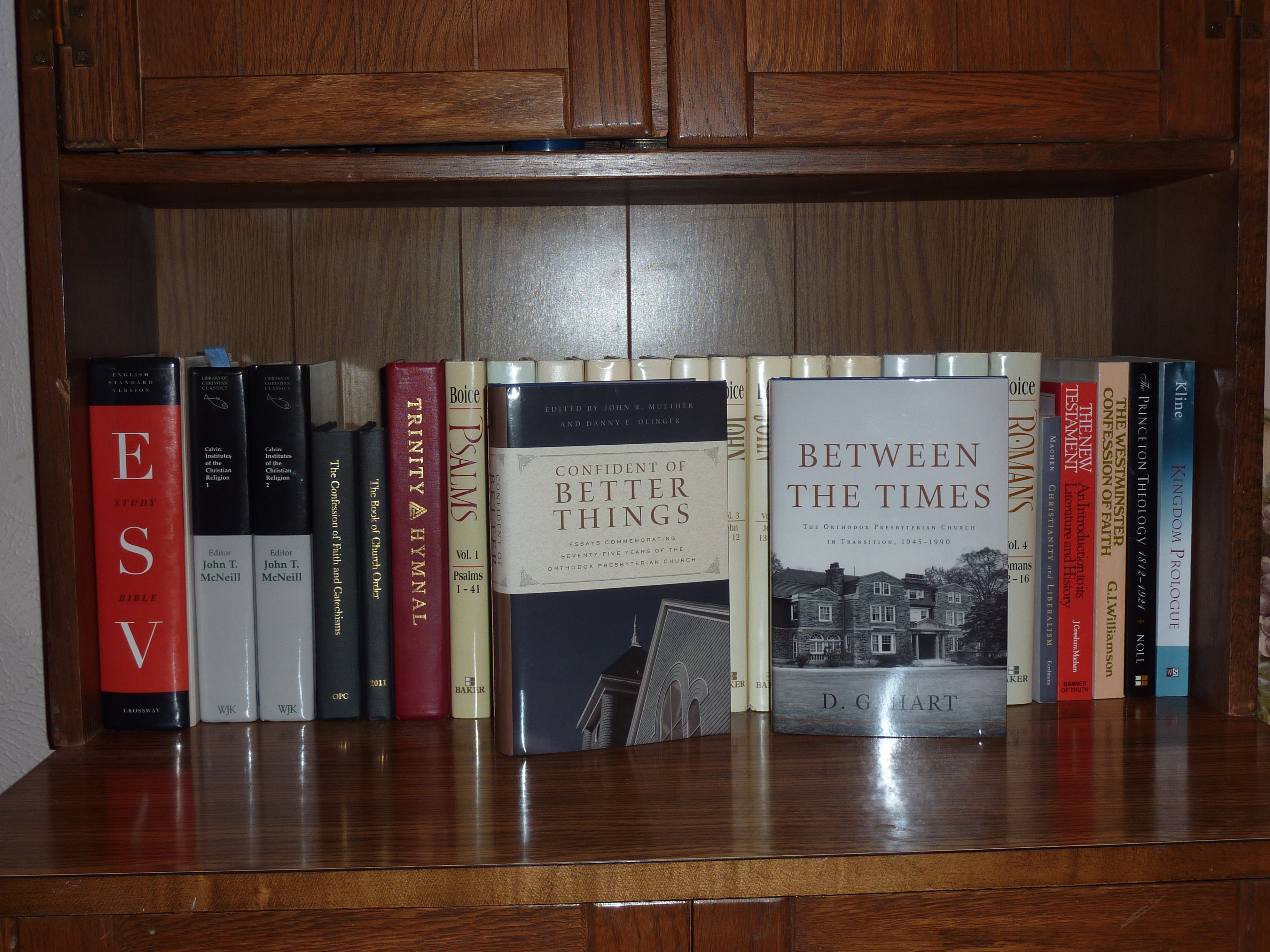
Here’s a helpful paragraph from D. G. Hart’s new history of the Orthodox Presbyterian Church (OPC), released at the 78th General Assembly of the OPC two weeks ago in celebration of the OPC’s 75th anniversary. Here, Hart describes J. Gresham Machen’s reasons for objecting to Princeton Seminary President, J. Ross Stevensons proposal at the 1920 General Assembly of the PCUSA “for a grand plan to unite the largest Protestant denominations into one denomination” (p. 16). Hart writes:
The disadvantage of the plan for union, as Machen and most of his Princeton colleagues pointed out, was that by entering into a united church, Presbyterians would be abandoning those aspects of Protestantism that made them Presbyterian. If predestination, infant baptism, and Presbyterian polity, for instance, were actually revealed in God’s word as true and necessary for faithful witness, how could Presbyterians give away their teaching and practice to join with Baptists, Methodists, Lutherans, and Episcopalians in a generic Protestant church? The other problem with organic union, as Machen argued in a series of articles for church periodicals, was that it was based upon doctrinal indifferentism. Union turned away from serious doctrinal and ecclesiastical differences among Protestants and implied that these were less important than the greater good that a united church could achieve by transforming American society. Opposition to this sort of ecumenism, which was directly linked to the Social Gospel’s goal of ushering in the kingdomof God, was precisely the impetus for Machen’s important book, Christianity and Liberalism (1923). Not only did he argue that Christianity and liberalism were two different religions, and so liberalism needed to be excluded from the church. Machen also showed how American Protestant interdenominational cooperation stemmed from an indifference to Christian teaching and so distorted the gospel into a message of works righteousness.
D. G. Hart, Between the Times: The Orthodox Presbyterian Church in Transition, 1945-1990 (2011, The Committee for the Historian of the Orthodox Presbyterian Church,Willow Grove,PA), pp. 16-17. opc.org/publications.html Check out Hart’s blog, Old Life: Reformed Faith and Practice.
Misadventures in Fundamentalism
2011 Steerforth Press--Foreword by Bob Scieffer of CBS News
The following is best read aloud in a booming announcer voice 😉
Allow me to introduce you to the book I’ve been anticipating most for the past year–The Shooting Salvationist: J. Frank Norris and the Murder Trial That Captivated America (2011, Steerforth Press–Distributed by Random House. Foreword by Ft. Worth native Bob Schieffer of CBS News). Perhaps you’ll recall how last year I went on and on about a book about J. Frank Norris‘ murder trial. Well, that caterpillar quickly entered its cocoon and the butterfly is soon to be released! July 12 is the scheduled date for Pastor David Stokes’ thorough narrative non-fiction work on one of the most colorful fundamentalists of the early 20th century.
A rising star in the Southern Baptist Convention, J. Frank Norris resolved to spread God’s Word in a populist and sensationalist manner–taking on every villain, real or perceived, that crossed his path–doing battle royal in the most public manner as he could to make a big name, not only for himself, but also for the Savior whose cause he strove to promote. Norris’ tactics however, epitomized the very definition of “misadventure.” A burr in the saddle of local Fort Worth, Texas powerful elites, a sworn enemy of the “liquor interests” and self-appointed defender of the faith against the liberalizing tendencies at his alma mater, Baylor University, almost all agree that J. Frank Norris generated more heat than light. The growing crescendo of sensational exploits on these and other fronts would culminate in devastating tragedy and make headlines across the country when Norris shot an infuriated opponent to his death.
The murder trial of J. Frank Norris in the 1920’s was literally the “OJ Trial” of that generation. A relentless media circus hung on every detail of the trial as they kept the country buying paper after paper to learn the fate of this ambitious religious ringleader. You’ll never believe that a story like this is true. You simply have to read it for yourself!
The Shooting Salvationist: J. Frank Norris and the Murder Trial That Captivated America is available for pre-order at the book’s new website. I’ll also be adding The Shooting Salvationist Blog to my blogroll so we may all keep up with it.
John D. Davis on the “Sons of God”

A Dictionary of the Bible, 2nd Edition (1903), John D. Davis, editor
The following is a fascinating Bible Dictionary entry of the biblical useage of the phrase “Sons of God,” with a special treatment on the various interpretations thereof in Genesis 6. The editor of this Bible Dictionary, John D. Davis, was a member of the faculty of the “Old Princeton.” B.B. Warfield himself even contributed a few of the entries in this dictionary as well. It’s written on a very accessible level for laymen to grasp, and now that I have an antiquarian copy of the 1903 Second edition, I’ll be consulting it in my own Bible study, and most likely, this will not be the last you read from it on this blog, as well.
Sons of God
A Dictionary of the Bible by John D. David, Ph.D. D.D., LL.D.
Professor of Oriental and Old Testament Literature in the Theological Seminary, Princeton, N. J.
1898, 1903 by The Trustees of the Presbyterian Board of Publication and Sabbath-School Work.
Pages 701-702
Worshipers and beneficiaries of God…Such was its common Semitic meaning in early times. There is abundant reason to believe that this is its signification in the celebrated passage where it first appears in the Bible. “It came to pass, when men began to multiply on the face of the ground, and daughters were born unto them, that the sons of God saw the daughters of men that they were fair; and they took them wives of all that they chose” (Gen. 6:1-2).
Three interpretations have been proposed. The Sons of God are:
- The great and noble of the earth, and the daughters of men are women of inferior rank (Samaritan version; Greek translation of Symmachus; Targums of Onkelos and Jonathan).
- Angels, who left their first estate and took wives from among the children of men (Book of Enoch, Philo, Josephus, Justin Martyr, Clement of Alexandria, Tertullian).
- Pious men, worshipers of God, who were especially represented by the descendants of Seth. They were attracted by the beauty of women who did not belong to the godly line, married with them, and became secularized (Julius Africanus, Chrysostom, Cyril of Alexandria, Augustine, Jerome).
The first interpretation has no longer any advocates.
In favor of the second, it is asserted that the term denotes angels everywhere else in the O.T. (Job 1:6; 2:1; 38:7; cf. a similar expression Ps. 29:1; 89:6; RV margin; but not Dan. 3:25); that the designation describes angels according to their nature, whereas the ordinary word for angels,mal’akim, messengers, refers to their official employment; and that this interpretation is confirmed by Jude 6 and 2 Pet. 2:4. But that the term relates to the nature of angels lacks proof; it is quite as natural that it should describe angels as worshipers of God. As to the passages in Jude and Peter, to cite them is begging the question, since exegetes point out other references, as Is. 24:21-23. And unless the title be restricted to the special form which it has in the passage under discussion, it is not true that the term denotes angels in all other places where it occurs in the O.T.
- The worshipers of the heathen deity Chemosh are called the people of Chemosh, and his sons and daughters (Num. 21:29; Jer. 48:46).
- When the men of Judah, professed worshipers of Jehovah, took heathen women to wife, Judah was said to have married the daughter of a strange god (Mal. 2:11).
- Moses was directed to say to Pharaoh: “Thus saith the Lord, Israel is my son . . . . . Let my son go” (Ex. 4:22-23).
- “Ye are the children [or sons] of the Lord your God” (Deut. 14:1).
- “They have dealt corruptly with him, they are not his children.” (Deut. 32:5)
- “Is not he [the Lord] thy father?” (Deut. 32:6)
- “The Lord saw it, and abhorred them, because of the provocations of his sons and his daughters” (Deut. 32:19)
- “Ye are the sons of the living God” (Hos. 1:10).
- “When Israel was a child …I…called my son out of Egypt” (Hos. 10:1).
- “Bring my sons from far, and my daughters from the end of the earth; every one that is called by my name, and whom I have created for my glory” (Is. 43:6-7).
- The pious are the generation of God’s children (Ps. 73:15), and Ephraim is his dear son (Jer. 31:20).
Taking a broader survey, and examining Semitic literature other than Hebrew, one observes the same fact. Many a Babylonian styled himself the son of the god whom he worshiped and upon whom he relied for protection and care.
Furthermore, the opinion that the title in Gen. 6:2 means angels is not the earliest view, so far as the records go. The earliest attested interpretation, that of the Samaritan version, regarded the sons of God as men; and later when the angelic theory arose, it was the opinion of a particular school among the Jews, while the more influential party in religious matters still taught that the sons of God were men.
Icon of Seth
The interpretation that the sons of God in Gen. 6:2 were pious people, the worshipers of the true God, more especially that they were the godly descendants of Adam through Seth, whose genealogy is given in Gen. 5, is not only in accordance with Semitic, and particularly biblical, usage of the designation, as already shown, but it is consistent with the context. The sons of God are contrasted with the daughters of men, that is of other men. So Jeremiah says, “God did set signs in Israel and among men;” and the English version supplies the word other before men, in order to bring out the sense (Jer. 32:20). Likewise the psalmist says that the wicked “are not in trouble as men; neither are they plagued like men;” and again the English version supplies the word other (Ps. 73:5). After the same manner Gen. 6:1-2 may be read: “When mankind began to multiply on the face of the ground, and daughters of other men that they were fair; and they took them wives of all that they chose.” The meaning of the writer is that when men began to increase in number, the worshipers of God so far degenerated that in choosing wives for themselves they neglected character, and esteemed beauty of face and form above piety. The offspring of these marriages were perhaps stalwart and violent. Mixture of race in marriage often produces physical strength in the descendants, and lack of religion in the parents is apt to be reproduced in the children. The intermarriage of the sons of God and the daughters of men was offensive in the sight of God. Sentence was pronounced against the wrongdoers. The penalty is not denounced on angels, who were not only implicated, but were the chief sinners, if the sons of God were angels. The punishment is pronounced against man only. Man, not angels, had offended.
Sons of God everywhere in Scripture, from the earliest to the latest times, means the worshipers and beneficiaries of God, both among mortal in immortal beings. But the content of this idea did not remain the same through the ages. It became larger with increasing knowledge of the riches of God. It enlarged, for example, at the time when the Israelites were delivered from Egypt.
- God said: “I have seen the affliction of my people” (Ex. 3:7);
- and again: “Say unto Pharaoh, Israel is my son, my firstborn; who is as dear to me,” so the following words imply, “as Pharaoh’s firstborn is to him” (Ex. 4:22 with 23);
- and again: “I will take you to me for a people, and I will be to you a God” (Ex. 4:7).
Heretofore the title had emphasized a filial relation of men to God, their dependence upon him for protection and care, and their duty of reverence and obedience. Now God formally accepts the obligations which implicitly devolve on him. The content of the title was further enlarged through the teaching of Jesus Christ. He took truths already known, shed light on them, and connected them with this designation.
- He exhibited the fact that God is an actual father and that his people are actual children of God. They are such by the new birth (John3:3,5-6,8; cf. Rev. 11:11),
- begotten of God (John 1:12-13; v.21; and so Eph. 2:5; Jas. 1:18; 1 Pet. 1:23),
- made partakers of the divine nature through the mediation of the indwelling Spirit (John6:48-51; 15:4-5; and so 1 John 3:9),
- and possessing a like character with God, resembling him in holiness, love and elevation above the illusions of earth (1 John 3:9; 4:7; 5:4),
- although falling far short of the divine character in this life (I John 1:8,10).
- They have been adopted as sons (Gal. 4:5), are taught by the Spirit to say Abba, Father (Gal. 6; Rom 8:15), and are led by the Spirit (Rom. 8:14).
Divine Inspiration Required by the Character of the Penmen of the Scriptures

Lithograph of the Reverend John Brown of Haddington
The following continues a series of excerpts from “An Introduction to the Right Understanding of the Oracles of God,” by the Rev. John Brown of Haddington, as published in his Self-Intepreting Bible (1859 edition).
V. The manifest CHARACTER OF THE PENMEN further evinces the divine original of the Scriptures.
They everywhere discover the utmost candour and disinterestedness: they everywhere candidly publish the infirmities, or even faults of themselves, their friends, and nation. None of them ever gained anything in this world by their work but trouble and vexation; and, according to their own principles, they could obtain nothing in the next but everlasting destruction, if they indulged themselves in any imposture.
The matter and mannerof their work infinitely transcended their abilities. Setting their predictions aside for a moment, how could men of the best education, and especially men of no education, form such exalted schemes of sense, piety, and virtue? Or how could wicked men, inspired by Satan, publish and prosecute such a scheme of mystery, holiness, and morality?
Such is the character of Jesus Christ, drawn by the four evangelists, with every mark of simplicity and candour, and in which ignominious suffering is made a leading article, that the delineation thereof—and that too by persons of no uncommon knowledge—without a real and exactly answerable model, would, to every unbiased free-thinker, appear more incredible and impossible than even the incarnation, obedience, and death of the Son of God, therein attested, however astonishing. (emphasis mine)
Machen “Concerning the Times and Seasons”

Notice the similar color schemes? Interesting match!
I just finished reading “Encouragement for New Converts,” chapter 17 of The New Testament: An Introduction to its Literature and History (1976, 2009 Banner of Truth Trust) by J. Gresham Machen. This book makes a concise introduction to the major themes in the New Testament and clearly and effectively makes a positive presentation of orthodox New Testament scholarship, while at the same time providing textually based correctives to the academically popular theories of modernist liberal scholarship. Dr. Machen was, above all else, a New Testament scholar. While most known for both his New Testament Greek for Beginners, which is still used in many seminaries, and his popularly written Christianity and Liberalism, New Testament scholarship is his specialty.
Each chapter in Machen’s New Testament Introduction first assigns a selection of New Testament readings on which the following chapter is based. In this case, I read both 1 and 2 Thessalonians out of my ESV Study Bible before taking in Machen’s seven-page chapter on both books. While reading this chapter, which summarized the occasion, contents and issues related to the these earliest of Paul’s epistles, I was struck while reading the section on “The Second Coming of Christ,” in which he expounds “the second advent, with the events which are immediately to precede it” (p. 119). Machen interacts with the dominant modernist theory that Paul actually expected Christ to return during his lifetime.

Date-Setter, Harold Camping
But there is also a bit of timeliness to Machen’s exposition of 1 Thessalonians 5:1-11, specifically in the light of the current prediction by Harold Camping that Judgment Day has been calculated by him to be soon to occur on May 21, 2011. That’s 51 days and counting! Despite the fact that Jesus himself said, “But concerning that day and hour no one knows, not even the angels of heaven, nor the Son, but the Father only” (Matthew 24:36 ESV), Camping, not to mention all other date-setters, appeal to verses such as 1 Thessalonians 5:4-6, which read, “But you are not in darkness, brothers, for that day to surprise you like a thief. For you are all children of light, children of the day. We are not of the night or of the darkness. So then let us not sleep, as others do, but let us keep awake and be sober.” Machen’s introductory commentary also puts these words in perspective for us in the light of Camping’s millennial madness. Following is Machen’s section on “The Second Coming of Christ,” from pages 119-121 in The New Testament: An Introdcution to its Literature and History. Enjoy!
The Second Coming of Christ
Undoubtedly the second advent, with the events which are immediately to precede it, occupies a central position in the Thessalonian Epistles. Evidently the expectation of Christ’s coming was a fundamental part of Paul’s belief, and had a fundamental place in his preaching. ‘Ye turned unto God from idols, to serve a living and true God, and to wait for his Son from heaven’–these words show clearly how the hope of Christ’s appearing was instilled in the converts from the very beginning, I Thess. 1.9, 10. To serve the living God and to wait for his Son–that is the sum and substance of the Christian life. All through the Epistles the thought of the Parousia–the ‘presence’ or ‘coming’–of Christ appears as a master motive. I Thess. 2.19; 3.13; 4.13 to 5.11, 23, 24; II Thess. 1.5 to 2.12.
This emphasis upon the second coming of Christ is explained if Paul expected Christ to come in the near future. The imminence of the Parousia for Paul appears to be indicated by I Thess. 4.15: ‘For this we say unto you by the word of the Lord, that we that are alive, that are left unto the coming of the Lord, shall in no wise precede them that are fallen asleep.’ This verse is often thought to indicate that Paul confidently expected before his death to witness the coming of the Lord. Apparently he classes himself with those who ‘are left unto the coming of the Lor’ as over against those who will suffer death. In the later epistles, it is further said, Paul held a very different view. From Second Corinthians on, he faced ever more definitely the thought of death, II Cor. 5.1, 8; Phil. 1.20-26. A comparison of I Cor. 15.51 with II Cor 5.1, 8 is thought to indicate that the deadly peril which Paul incurred between the writing of the two Corinthian Epistles, II Cor. 1.8, 9, had weakened his expectation of living until Christ should come. After he had once despaired of life, he could hardly expect with such perfect confidence to escape the experience of death. The possibility of death was too strong to be left completely out of sight.
Plausible as such a view is, it can be held only with certain reservations.
In the first place, we must not exaggerate the nearness of the Parousia according to Paul, even in the earliest period; for in II Thess. 2.1-12 the Thessalonians are reminded of certain events that must occur before Christ would come. The expression of the former Epistle, I Thess. 5.2, that the day of the Lord would come as a thief in the night, was to be taken as a warning to unbelievers to repent while there was yet time, not as a ground for neglecting ordinary provision for the future. In Second Thessalonians Paul finds it necessary to calm the overstrained expectations of the Thessalonian Christians.
Furthermore, it is not only in the earlier epistles that expressions occur which seem to suggest that the Parousia is near: Rom. 13.11; Phil. 4.5. And then it is evident from II Cor. 11.23-29 and from I Cor. 15.30-32 that Paul had undergone dangers before the one mentioned in II Cor. 1.8,9, so that there is no reason to suppose that that one event caused any sudden change in his expectations.
Lastly, in I Cor. 6.14 Paul says that ‘God both raised the Lord, and will raise up us throught his power.’ If that refers to the literal resurrection, then here Paul classes himself among those who are to die; for if he lived to the Parousia, then there would be no need for him to be raised up.
It is therefore very doubtful whether we can put any very definite change in the apostle’s expectations as to his living or dying between First Corinthians and Second Corinthians. A gradual development in his feeling about the matter there no doubt was. During the early part of his life his mind dwelt less upoon the prospect of death than it did after perils of all kinds had made that prospect more and more imminent. But at no time did the apostle regard the privilege of living until the Parousia as a certainty to be put at all in the same category with the Christian hope itself. Especially the passage in First Thessalonians can be rightly interpreted only in the light of the historical occasion for it. Until certain members of the church had died, the Thessalonian Christians had never faced the possibility of dying before the second coming of Christ. Hence they were troubled. Would the brethren who had fallen asleep miss the benefits of Christ’s kingdom? Paul writes to reassure them. He does not contradict their hope of living till the coming of Christ, for God had not revealed to him that that hope would not be realized. But he tells them that, supposing that hope to be justified, even then they will have no advantage over their dead brethren. He classes himself with those who were still alive and might therefore live till Christ should come, as over against those who were already dead and could not therefore live till Christ should come.
Certain passages in the epistles of Paul, which are not confined to any one period of his life, seem to show that at any rate he did not exclude the very real possibility that Christ might come in the near future. But such an expectation of the early coming of Christ was just as far removed as possible from the expectations of fanatical chiliasts. It did not lead Paul to forget that the times and the seasons are entirely in the hand of God. It had no appreciable effect upon his ethics, except to make it more intense, more fully governed by the thought of the judgment seat of Christ. It did not prevent him from laying far-reaching plans, it did not prevent his developing a great philosophy of future history in Romans, chapters 9 to 11. How far he was from falling into the error he combated in Second Thessalonians! Despite his view of the temporary character of the things that are seen, how sane and healthy was his way of dealing with practical problems! He did his duty, and left the details of the future to God. Hence it is hard to discover what Paul thought as to how soon Christ would come–naturally so, for Paul did not try to discover it himself. [emphasis mine, highlighting Machen’s correction of Camping-like date-setting].
Michael Horton on Rightly Divided
Here is Lane Chaplin’s video interview of Dr. Michael Horton on his new book, The Gospel Commission (2011, Baker Book House)—part three of a series starting with Christless Christianity, followed by The Gospel-Driven Life. I’d also like to direct you to the Riddleblog, where Dr. Kim Riddlebarger has provided a nice launch pad to read all seven parts of Dr. Horton’s lengthy and informative review of Rob Bell’s Love Wins.
Divine Inspiration Required by the Manner, Scope and Harmony of the Scriptures

Self-Interpreting Bible (1859 edition), Rev. John Brown of Haddington, original editor
The following continues a series of excerpts from “An Introduction to the Right Understanding of the Oracles of God,” by the Rev. John Brown of Haddington, as published in his Self-Intepreting Bible (1859 edition).
II. The MANNER in which these subjects are exhibited in the Scriptures is evidently divine; –wise, condescending, and yet majestic. The discoveries have been gradual, as men stood in need of them or were in a proper condition to receive them (Gen. 3,9,12,17 & c.; Heb. 1:1). The principal points; as of God’s new-covenant grant of himself to sinful men; his full satisfaction in and with Christ as our Mediator; and the law of the ten commandments; were declared from heaven with uncommon solemnity (Mat. 3:17; 17:5; Ex. 20:1-18, &c.). And, while these and other similar truths are announced in a style the most plain and simple, there appears therein something astonishingly sublime and majestic. While the dictates are authorized with a THUS SAITH THE LORD, the very style, particularly in Scripture songs, Job, Psalms, Lamentations, and Isaiah, and in our Saviour’s discourses, &c., is at once surprisingly suited to the dignity of the Author, the nature of the subject, and the condition of the persons addressed.
III. The manifest SCOPE of the Scriptures is to render sin loathsome and hated, and to promote holiness and virtue; to humble men, and reform them from their beloved lusts and sinful practices, and to exalt and glorify God to the highest. No good angel or man could dare to personate God in the manner of the Scriptures; nor could bad angels or men publish, and so warmly inculcate, what is so remarkably contrary to their own vicious inclinations and honour. It therefore remains that God alone must be the author and inditer of them.
IV. Notwithstanding the dictates of Scripture are so extremely contrary to the natural inclinations of mankind, and were published without any concert by various persons, of very different conditions, and in different ages and places, yet such is the marvellous HARMONY of all the parts, in their whole matter and scope, as irrefragably demonstrates that these penmen must all have been directed by the same Spirit of God. One part of our Bible is so connected with, and tends to the establishment of another, that we cannot reasonably receive any part without receiving the whole. In the New Testament we have the historical narrative of the fulfillment of the typical and verbal predictions of the Old. In both Testaments the subsequent books, or subsequent parts of a book, are connected with that which went before, as a narrative of the execution of a scheme begun, or of the fulfillment of a prophecy declared. If we receive the history, we must also receive the prediction. If we admit the prediction, we must believe the history. To a diligent searcher of the Scriptures, it cannot fail to occasion a most pleasant astonishment, to find everywhere the same facts supposed, related or prepared for; the same doctrines of a gracious redemption through Jesus Christ exhibited, or supposed to be true; the same rules or exemplifications of piety and virtue, and motives thereto; the same promises of mercy, or threatenings of just misery, to persons, societies, or nations, exhibited without a single contradiction. When there is an appearance of contradiction, it will be found that the different passages do not respect the same thing or person, in the same respect, and in the same circumstances of time, place, or manner; and so there is no contradiction at all.
Divine Inspiration Required by the Subject Matter of the Scriptures

John Brown’s Self-Interpreting Bible (1859)
The following continues a series of excerpts from “An Introduction to the Right Understanding of the Oracles of God,” by the Rev. John Brown of Haddington, as published in his Self-Intepreting Bible (1859 edition).
I. The subject MATTER of them requires a divine inspiration. The history of the creation, and part of that of the flood, &c., therein related, were known only to God. Mysteries relative to the Trinity of persons in the Godhead; the covenant of grace; the incarnation of the Son of God; his undertaking, offices, and states, and our union with him; justification, adoption, sanctification, spiritual comfort, and eternal blessedness, in him, are therein declared;–which God only could comprehend or discover.
The scheme of religion therein prescribed is so pure and benevolent, that God alone could devise or appoint it. While it represents the Most High as everywhere present—as infinitely perfect, powerful, wise, and good—holy, just, and true—an infinitely gracious lover of righteousness, and hater of iniquity,–as our bountiful Creator and Preserver, and as the infinitely merciful Redeemer of our souls, by the obedience and death of his only begotten Son,–it requires us to know, believe in, and revere him with our whole heart, soul, mind and strength, as our Father, Friend, Husband, Saviour, and Portion in Christ; and confidently to depend on him, and ask from him whatever we need in time or eternity; and to obey him in all that he commands, as children whom he hath begotten again to a lively hope, and established as the heirs of his everlasting inheritance.
We are here taught how human nature may be truly improved and perfected, by our receiving Jesus Christ as made of God unto us wisdom, righteousness, sanctification, and redemption,–as an effectual principle and root of true holiness;–and by our walking in him by faith, denying ungodliness and worldly lusts, and living soberly, righteously, and godly, patiently, contentedly, and cheerfully,–setting our affections upon things above, where Christ is, and through the Spirit mortifying every sinful and selfish inclination. We are taught to love our neighbours as ourselves, perfectly fulfilling the particular duties of every relative station; and to lay aside all malice, envy, hatred, revenge, or other malevolent dispositions or passions; to love our enemies; to render good for evil, blessing for cursing; and to pray for them that despitefully use us. These laws of universal purity and benevolence are prescribed with an authority proper only to God, and extended to such a compass and degree as God alone can demand: and those sins are forbidden which God alone can observe or prohibit.
The most powerful motives to duty, and dissuasives from vice, are here most wisely proposed, and powerfully urged; motives drawn from the nature, the promises, the threatenings, the mercies, and the judgments of God; particularly from his kindness in the work of our redemption, and his new-covenant relations to us in Christ; and from advantages or disadvantages, temporal, spiritual, and eternal. And, while the most excellent means of directing and exciting to, and of exercising piety and virtue, are established on the most prudent forms and authoritative manner, the most perfect and engaging patterns of holiness and virtue are set before us in the example of Jesus Christ our Redeemer, and of God as reconciled in him, and reconciling the world to himself (Ex. 21:1-17; Lev. 18-20; Deut. 4-25; Mat. 5—7; Rom. 6:12—15; Gal. 5-6; Eph. 4—6; Col. 3:4; 1 Thes. 5; Tit. 2; Jam. 1-5; 1 Pet. 1-5; 2 Pet. 1; 1 John 1—5, &c., &c).
Scripture Exercise, Nos. 2 & 3
The Sunday at Home (1035, February 28, 1874). Click to enlarge.
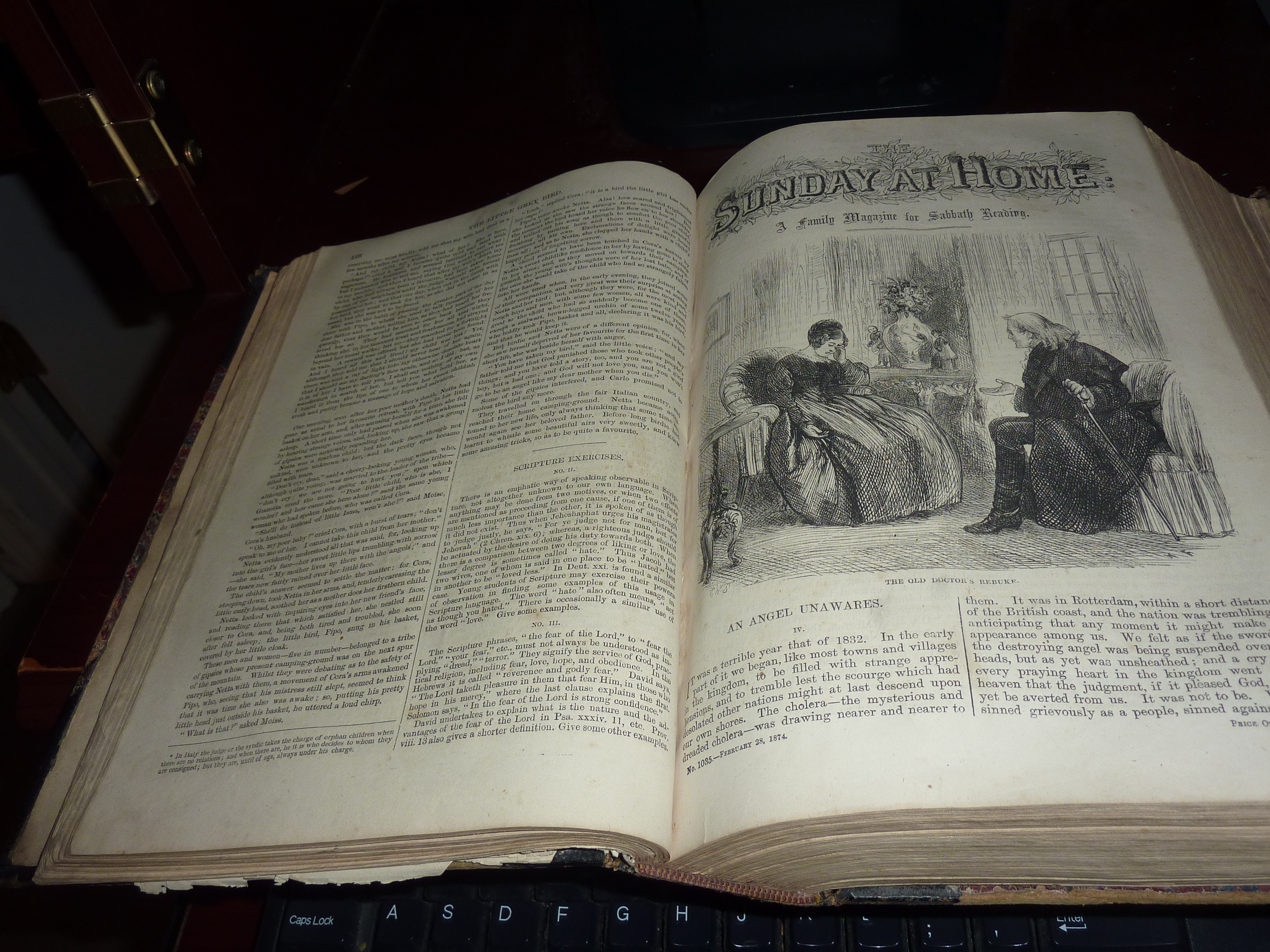
Both of the following Scripture Exercises are from The Sunday at Home: A Family Magazine for Sabbath Reading, (issue no. 1035—February 28, 1874). In the comments thread, give me a good, solid paragraph on why you don’t have time to look up the examples these exercises request. 😉 Or just click “Like” to let me know you’re reading these, and want to see more, comments or no comments. Thanks! The answers will be posted next week.
Scripture Exercise, No. 2
There is an emphatic way of speaking observable in Scripture, not altogether unknown to our own languages. When anything may be done from two motives, or when two effects are mentioned as proceeding from one cause, if one of them is of much less importance than the other, it is spoken of as though it did not exist. Thus when Jehoshaphat urges his magistrates to judge justly, he says, “For ye judge not for man, but for Jehovah” (2 Chron. 14:6); whereas, a righteous judge should be actuated by the desire of doing his duty towards both. When there is a comparison between two degrees of liking or love, the lesser degree is sometimes called “hate.” Thus Jacob had two wives, one of whom is said in one place to be “hated,” but in another to be “loved less.” In Deut. 21 is found a similar case. Young students of Scripture may exercise their powers of observation in finding some examples of this usage in Scripture language. The word “hate” also often means, “act as though you hated.” There is occasionally a similar use of the word “love.” Give some examples.
Scripture Exercise, No. 3
The Scripture phrases, “the fear of the Lord,” to “fear the Lord,” “your fear,” etc., must not always be understood as implying “dread,” “terror.” They signify the service of God, practical religion, including fear, love, hope, and obedience. In the Hebrews it is called “reverence and godly fear.” David says, “The Lord taketh pleasure in them that fear Him, in those who hope in his mercy,” where the last clause explains the first. Solomon says, “In the fear of the Lord is strong confidence.”
David undertakes to explain what is the nature and the advantages of the fear of the Lord in Psalm 34:11, etc. Proverbs 13 also gives a shorter definition. Give some other examples.
Scripture Enigma, No. 4 Answers
From now on, I won’t update the original post itself, but will post the answers separately and link back to the original post, as I’m doing today. That way, the answers won’t be immediately given away, but will be accessible through the trackback link in the comments thread.
Always remember to at least “Like” these posts, if you don’t have time to put any guesses in the comments thread. I would appreciate it, and it would give me enough steam to keep posting these. My Site Stats and encouragement from behind the scenes tell me people are watching for these challenging quizzes; likewise, I’m watching for some personal interaction in the comments thread. If you’ve taken the time to read the questions, take an extra minute to post a guess, say hi, or just click “Like.” Thanks!
Answers to Scripture Enigma, No. 4
W-ater (John8:37,38)
A-rimathea (John19:38)
T-abitha (Acts 9:40)
C-armi (Joshua 7:1)
H-iddekel (Daniel 10:4)
A-mos (Amos 1:1)
N-oadiah (Nehemiah 6:14)
D-emetrius (Acts 19:24)
P-hinehas (Numbers 25:11-13)
R-ezin (2 Kings 16:6)
A-bel (2 Samuel 20:18)
Y-oke (Lamentations 3:27)
The Divine Inspiration of Scripture Demonstrated
Lithograph of the Reverend John Brown of Haddington
Here’s part two of my planned, looong series of consecutive excerpts from “An Introduction to the Right Understanding of the Oracles of God” from the Self-Interpreting Bible (1859 edition), edited by Rev. John Brown of Haddington. You’ll always be able to access each post in this series by clicking on the category “An Introduction to the Right Understanding of the Oracles of God” in the sidebar or at the bottom of any of the posts in this series.
While reason, then, plainly suggests the possibility, the desirableness, and the necessity of a revelation from God, adapted to our circumstances, the books of the Old and New Testament manifest themselves reasonable, credible, and divinely inspired: It is their DIVINE INSPIRATION (which indeed supposes them reasonable and credible) that we now attempt to demonstrate. In what manner the influence, by which the penmen of the Scriptures were directed, affected them, we pretend not fully to explain. It is enough for us to know, that thereby they were infallibly guided and determined to declare what they did not formerly know; to conceive properly of what they had formerly known; and to express their subject in terms absolutely just in themselves, and calculated to convey the truths represented to others. But so far we may conclude, that, while the penmen exercised their own reason and judgment (Ps. 45:1; Mark 12:36; Luke 1:3; Acts 1:1; 1 Pet. 1:11) the Holy Ghost:
(1) Effectually stirred them up to write (2 Pet. 1:21);
(2) Appointed to each his proper share or subject correspondent with his natural talents, and the necessities of the church in his time (Mat. 25:15; 2 Pet. 1:21);
(3) Enlightened their minds, and gave them a duly distinct view of the truths which they were to deliver (Jer. 1:11-16; 13:9-14; Ezek. 4:4-8; Dan. 10:1,14; 9:22-27; 8:15-19; 12:8; Amos 7:7,8; 8:2; Zec. 1:19, 21; 4:11-14; 5:6; John 16:13; Eph. 3:3,4; 1 Pet. 1:10,11). Perhaps this illumination was given all at once to Paul, when caught up to the third heaven, but was bestowed gradually on the other apostles (Mark 4:34; Luke 24:17,45; John 20:22; Acts 2:4; 10:9-15,28,34).
(4) He strengthened and refreshed their memories to recollect whatever they had seen or heard, which he judged proper to be inserted in their writings (Jer. 31:3; Luke 1:3; John 14:26).
(5) Amidst a multitude of facts, he directed them to write precisely what was proper for the edification of the church, and neither more nor less (John 20:30, 31; 21:25; Rom. 4:23, 24; 15:4; 1 Cor. 10:6-11).
(6) He excited in their minds such images and ideas as had been treasured up in their memories, and directed them to other ends and purposes than themselves would ever have done of their own accord. Thus, under inspiration, Amos draws his figures from herds, flocks, and fields; Paul makes use of his classical learning (Amos 1, 9; Acts 17:28; 1 Cor. 15:33; Tit. 1:2).
(7) He immediately suggested and imprinted on their minds such things as could not be known by reason, observation or information, but were matters of pure revelation (Is. 46:9, 10; 41:22,23; 45:21) whether they respected doctrines (1 Tim. 3:16), or facts past or future (Gen. 1:2,3; Lev. 26 &c).
(8) He so superintended every particular writer, as to render him infallible in his matter, words, and arrangement; and by his superintending influence, made them all in connexion so to write, as to render the whole Scripture, at any given period, a sufficient infallible rule to direct men to true holiness and everlasting happiness (Deut. 8:4; Ps. 1:2; 19:7-11; 119:105; Mat. 22:29; Luke 16:29,31; John 5:39; Rom. 15:4; 2 Tim. 3:15-17; 2 Pet. 1:19). Many of the sentences recorded in Scripture are not inspired in themselves, being the words of Satan or of wicked men; but the Scripture report relative to these expressions is directed by divine inspiration. –That our books of the Old and New Testament, the APOCRYPHAL TRACTS being excluded from both, are of an INFALLIBLE and DIVINE original, is thus evident.
Scripture Enigma, No. 4

Scripture Enigma, No. 4
With apologies for the delay in posting these quizzes, here is Scripture Enigma, No. 4, from the February 14, 1874 (issue 1033) of The Sunday at Home: A Family Magazine for Sabbath Reading.
Post any answers you can figure out, or even wild guesses, in the comments thread. Answers will be posted next Friday. Have a nice weekend, and an edifying Lord’s Day.
An element sometimes used as a symbol of the Holy Spirit.
The place to which he belonged who, together with Nicodemus, buried Jesus.
A disciple whom Peter raised from the dead.
The father of Achan.
A river by the banks of which Daniel saw a vision.
An inspired herdman.
A prophetess who endeavoured to intimidate Nehemiah when engaged in rebuilding the wall of Jerusalem.
One who stirred up a revolt against Paul at Ephesus.
One who, for his godly zeal, had conferred pon him and his posterity an everlasting priesthood.
A king of Syria who drove the Jews from Elath.
A place of which it was proverbially said in old time, “They shall surely ask counsel, and so end the matter.”
That which it is good for a man to bear in his youth.
The initials of the above words form a solemn admonition given by our Saviour.


 The Misadventures of Captain Headknowledge
Sodomites Seek “Uber-Rights”
Listen to this fascinating discussion on The Dividing Line of Michael Brown’s new book, A Queer Thing Happened To America, which chronicles the efforts of the last forty years in which unrepentant sodomites have managed to rehabilitate their image in America and politically pressure everyone else to affirm them not only as socially acceptable, but a positive and healthy lifestyle suitable for raising children, and their efforts to redefine marriage while helping slander true, biblical marriage between males and females. You can link to the program from this post.
If that isn’t enough, Dr. James White also expounded Genesis chapter 19 at Phoenix Reformed Baptist Church, reminding us all of many important truths about how it was the abomination of sodomy that brought judgment on Sodom and Gomorrah, not a mere violation of cultural norms regarding hospitality toward travellers, as sodomite apologists argue today. Listen to this eye-opening study. By the way, the title for this post is taken from White’s comments.
Behold, this was the guilt of your sister, Sodom: she and her daughters had pride, excess of food, and prosperous ease, but did not aid the poor and needy. They were haughty and did an abomination before me. So I removed them when I saw it. Ezekiel 16:49-50 (emphasis mine)
You shall not lie with a male as with a woman; it is an abomination. Leviticus 18:22 (emphasis mine)
Share this: