The Problem of “Head Knowledge”

Image via Wikipedia
One topic I haven’t treated nearly enough lies ironically at the heart of the underlying theme of my blog, which theme is an expression of my experience as a fundamentalist turned confessional Reformed Protestant. The topic is the tension in the fundamentalist and evangelical movements between so-called “head knowledge” and “heart knowledge.” Having been too busy living amidst that tension for the past couple of decades, I haven’t done a great deal of blogging about it since I started this blog.
To be truthful, this blog’s title and theme, “The Misadventures of Captain Headknowledge” is both an indictment and a confession. It’s an indictment for the kind of reason that you may have already read about on my “About Me” page. The confession lies in my honest recognition that I am the sort who has the tendency to, as it is sometimes put, read about the Bible, rather than actually take time to read the Bible.” This is certainly a flaw which stunts my spiritual growth in sanctification and the grace and knowledge of the Lord Jesus Christ. To the extent that my blog is a personal confession, it reminds me to cultivate my own spiritual growth. In the past, I was made to feel that many think this means I must therefore utterly repent of and entirely forsake my tendency to “read about the Bible.” But I disagree, and this is where the indictment part comes in. I regard that attitude to be an overreaction to an otherwise valuable gift of God. A love for reading theology and related Christian literature must not supersede my personal study and application of Scripture, but it needn’t be excluded from my life, either. Old Princeton scholar, Benjamin Breckenridge (B.B.) Warfield has the ultimate quote on this issue, from his book, The Religious Life of Theological Students (P & R Publishing Co.):
Nothing could be more fatal, however, than to set these two things over against one another. Recruiting officers do not dispute whether it is better for soldiers to have a right leg or a left leg: soldiers should have both legs. Sometimes we hear it said that ten minutes on your knees will give you a truer, deeper, more operative knowledge of God than ten hours over your books. “What!” is the appropriate response, “than ten hours over your books, on your knees?” Why should you turn from God when you turn to your books, or feel that you must turn from your books in order to turn to God? If learning and devotion are as antagonistic as that, then the intellectual life is in itself accursed, and there can be no question of a religious life for a student, even of theology. HT: Hot Orthodoxy
Such an imbalanced rejection of academic theology as unnecessary or unhelpful “head knowledge” in favor of so-called “heart knowledge” in its extreme forms often seems little more than an individualistic, experiential mysticism. In his book, What is Faith?, J. Gresham Machen writes on the question of anti-intellectualism and the resultant mysticism against which this blog is in part an indictment:
The depreciation of the intellect, with the exaltation in the place of it of the feelings or of the will, is, we think, a basic fact in modern life, which is rapidly leading to a condition in which men neither know anything nor care anything about the doctrinal content of the Christian religion, and in which there is in general a lamentable intellectual decline. (What is Faith?, p.28)
But if theology be thus abandoned, or if rather (to ease the transition) it be made merely the symbolic expression of religious experience, what is to be put into its place?… Mysticism unquestionably is the natural result of the anti-intellectual tendency which now prevails; for mysticism is the consistent exaltation of experience at the expense of thought. (p.35)
How to Draw Distinctions

There are a number of especially common and compelling misconceptions about the Bible which are held by the unbelieving world. One of the more popular ones is using nonmoral Old Testament laws against the eternally binding moral laws. For instance, in arguing against the Christian’s appeal to the Old Testament’s prohibition of homosexuality, many will accuse us of inconsistency since we don’t also equally observe the Mosaic Laws against eating unclean animals like shellfish, or meat with blood in it. From my standpoint as one who grew up being instructed that there are distinctions between moral, civil and ceremonial laws, it looks like those not so informed don’t know how to draw simple distinctions. But the apostle Peter once wrote about the fact that uninformed people twist Scripture to their own destruction (2 Peter 3:16), so I guess it’s not uncommon for unbelievers to have such trouble with handling the Word of God correctly (2 Timothy 2:15).
URCNA Associate Pastor, WSC Professor of Systematic Theology and Apologetics, prolific author and host of The White Horse Inn radio show, Dr. Michael Horton has written an informative explanation of this distinction between Old Testament laws. He shows why and how some were typological and thus temporary, associated with the ancient Israelite theocracy until their fulfillment in the redemptive life and ministry of Israel’s Messiah, the Lord Jesus Christ. He also explains that others are eternally and universally binding on all people at all times and in all places as part of God’s way of informing the world of their common need for redemption in the same Messiah of Israel, the Lord Jesus Christ, since the Bible teaches that the wages of sin is death, but the free gift of God is eternal life in Christ Jesus our Lord (Romans 6:23). After his sacrificial death and miraculous resurrection, Christ has ascended to the right hand of God the Father enthroned in heaven to rule over all the nations spiritually, not geo-politically (John 18:36), through the preaching of the Law and the Gospel by calling out a people for his name (Acts 15:14) from every tongue, tribe and nation (Revelation 14:6).
In “Why Can’t I Own Canadians? Rightly Dividing the Word of Truth,” Horton writes (read the rest here):
The commands in the old covenant law (viz., Leviticus and Deuteronomy) are specific to that remarkable geo-political theocracy that foreshadowed the universal kingdom of Christ. The deliverance of Israel in the exodus anticipates a far greater exodus through the waters of death and hell in Christ. The holy wars pale in comparison with the judgment of the nations that Christ will execute at the end of the age. Even if Israel had been faithful to this covenant, Canaan would have only been a type or small-scale model of the extensiveness and intensiveness of God’s reign at the end of the age. Moses could not give God’s people rest in the land of everlasting Sabbath. As the prophets proclaim, this would only come when one greater than Moses would rescue his people and lead them victoriously into the perfect peace, love, and joy that he would win for his co-heirs.
Substantive Wallace Outweighs Populist Ehrman

Wallace/Ehrman Debate Stage
Saturday night, my son, a few friends and I, attended the debate between Dr. Daniel B. Wallace of the Center for the Study of New Testament Manuscripts (CSNTM) and Dr. Bart D. Ehrman, the best-selling rock star of unbelieving New Testament textual criticism at McFarlin Memorial Auditorium on the campus of Southern Methodist University (SMU). It was a very interesting and entertaining debate. Wallace has a much better sense of humor than the seemingly self-important Ehrman.
I’ve only got one observation about the debate. Just judging from the weightiness of each debater’s arguments, Wallace wins. Compared to Wallace’s informative presentation, Ehrman’s was much clearer, because he generally stayed on a much more simplistic level. While it’s easier to follow a simplistic presentation, it’s also easier to distort the truth in one. But you’d expect me to favor Wallace’s presentation. I agree with him on most of his defense of the New Testament.
But I won’t leave you completely without input from the debate. It turns out that the night of the debate was also the release date of Wallace’s latest book, Revisiting the Corruption of the New Testament: Manuscript, Patristic, and Apocryphal Evidence (2011, Kregel). This is a collection of academic essays by Wallace’s interns with an introductory chapter by Wallace which just happens to contain the information in Wallace’s arguments in Saturday night’s debate. I was able to purchase a pre-autographed copy, so I’ll share some of it with you.

McFarlin Memorial Auditorium
In chapter one, “Lost In Transmission: How Badly Did the Scribes Corrupt the New Testament?” Wallace discusses the number and nature of variant readings, the theological issues involved with the issue of the variants, and the essential reliability of the New Testament manuscripts. You’ll be able to read an excerpt from this chapter at the end of this post.
Chapter two is called “The Least Orthodox Reading is to be Preferred: A New Canon for New Testament Textual Criticism?” by Philip M. Miller. He discusses the historical backdrop of this seeming modern canon of textual criticism, demonstrates Ehrman’s use of this canon, then critiques it, and discusses its value and role.
In chapter three, “The Legacy of a Letter: Sabellianism or Scribal Blunder in John 1.1c?” Matthew P. Morgan presents scribal habits as a “historical lens” on theological development in the early church. He focuses on the roots and rise of Sabellianism, the reactions of the Chruch Fathers to it. Then Morgan analyzes scribal habits in codices Regius and Freerianus, and finishes with a presentation on the grammatical viability of the textual variant in John 1.1c.
Adam G. Messer writes chapter four, “Patristic Theology and Recension in Matthew 24:36: An Evaluation of Ehrman’s Text-Critical Methodology.” According to Messer, those who discern ulterior motives in variants judged to have been purposely made by orthodox scribes, may be assuming too much. “Although any change is a deviation from the original, the difference in a clarification is that it typically better preserves the meaning and buttresses it against heretical counterfesance.”
Tim Ricchuiti has us “Tracking Thomas” in chapter five. In his chapter, Ricchuiti takes “A Text-Critical Look at the Transmission of the Gospel of Thomas.” This chapter provides the “Apocryphal Evidence” in Wallace’s subtitle. Ricchuiti’s “purpose [in this chapter is] (1) to conduct a comparison of the Greek fragments of the Gospel of Thomas to the full Coptic manuscript, (2) to assess the merit of the four manuscripts containing Thomas with respet to their originality, and (3) should the assessment yield fruit, to draw a few conclusions on the scholarly consensus regarding both the character of the Greek fragments versus the Coptic text and the amount of theological alteration present, particularly in Thomas, but more generally in noncanonical works as a whole” (page 226).
Finally, in chapter six, Brian Wright examines several New Testament texts which explicitly call Jesus “theos” or God, attempting to demonstrate that this was not a theological development, as many skeptics claim, but rather began with the first century New Testament writings.
This book looks very satisfying. Pick up a copy for yourself, if you’re inclined to this sort of reading. Now, with all of this in mind, the following is how Dr. Wallace not only introduces his book, but also his argument in the debate. With these words, he gives us sage advice.
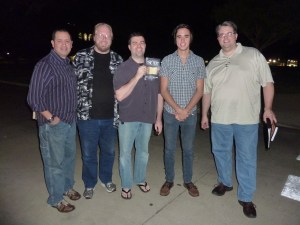
The Debate Spectators (L-R): Victor "I love you, man!" Loredo, Mike Bangs (great last name for a barber, right?), Daniel "Deep Ellum" Garlow (nephew of notorious Dominionist, Jim Garlow, but that's another post), John Brian "J.B." Chitty (lead singer of Denton Drive--click the pic to hear his "Upbeat Thrash Punk"--he says it's positive stuff), and your humble blogger who really needs to stand in back in future group photos.
Two Attitudes to Avoid
To begin with, there are two attitudes that we should try to avoid: absolute certainty and total despair. On the one side are King James Only advocates; they are absolutely certain that the KJV, in every place, exactly represents the original text. To be frank, the quest for certainty often overshadows the quest for truth in conservative theological circles and is a temptation that we need to resist. It is fundamentally the temptation of modernism. To our shame, evangelicals have too often been more concerned to protect our presuppositions than to pursue truth at all costs.
On the other side are a few radical scholars who are so skeptical that no piece of data, no hard fact, is safe in their hands. It all turns to putty because all views are created equal. If everything is equally possible, then no view is more probable than any other view. In Starbucks and on the street, in college classrooms and on the airwaves, you can hear the line “We really don’t know what the NT originally said since we no longer possess the originals and since there could have been tremendous tampering with the text before our existing copies were produced.”
But are any biblical scholars this skeptical? Robert Funk, the head of the Jesus Seminar, seemed to be. In The Five Gospels he said,
Even careful copyists make mistakes, as every proofreader knows. So we will never be able to claim certain knowledge of exactly what the original text of any biblical writing was.
The temporal gap that separates Jesus from the first surviving copies of the gospels—about one hundred and seventy-five years—corresponds to the lapse in time from 1776—the writing of the Declaration of Independence—to 1950. What if the oldest copies of the founding document dated only from 1950?
Funk’s attitude is easy to see: rampant skepticism over recovering the original wording of any part of the NT. This is the temptation of postmodernism. The only certainty is uncertainty itself. It is the one absolute that denies all the others. Concomitant with this is an intellectual pride—pride that one “knows” enough to be skeptical about all positions.
Where does Ehrman stand on this spectrum? I do not know. On the one hand, he has said such things as the following:
If the primary purpose of this discipline is to get back to the original text, we may as well admit either defeat or victory, depending on how one chooses to look at it, because we’re not going to get much closer to the original text than we already are.
… [A]t this stage, our work on the original amounts to little more than tinkering. There’s something about historical scholarship that refuses to concede that a major task has been accomplished, but there it is.
In spite of these remarkable [textual differences, scholars are convinced that we can reconstruct the original words of the New Testament with reasonable (although probably not 100 percent) accuracy.
The first statements were made at the Society of Biblical Literature in an address to text-critical scholars. The last is in a college textbook. All of this sounds as if Ehrman would align himself more with those who are fairly sure about what the wording of the autographic text is.
But here is what Ehrman wrote in his immensely popular book Misquoting Jesus:
Not only do we not have the originals, we don’t have the first copies of the originals. We don’t even have copies of the copies of the originals, or copies of the copies of the copies of the originals. What we have are copies made later—much later….And these copies all differ from one another, in many thousands of places….[T]hese copies differ from one another in so many places that we don’t even known (sic) how many differences there are.
We could go on nearly forever talking about specific places in which the texts of the New Testament came to be changed, either accidentally or intentionally. . . . [T]he examples are not just in the hundreds but in the thousands.
And here is what he wrote in another popular book, Lost Christianities:
The fact that we have thousands of New Testament manuscripts does not in itself mean that we can rest assured that we know what the original text said. If we have very few early copies—in fact, scarcely any—how can we know that the text was not changed significantly before the New Testament began to be reproduced in such large quantities?
The cumulative effect of these latter statements seems to be not only that we have no certainty about the wording of the original but that, even where we are sure of the wording, the core theology is not nearly as “orthodox” as we had thought. According to this line of thinking, the message of whole books has been corrupted in the hands of the scribes; and the church, in later centuries, adopted the doctrine of the winners—those who corrupted the text and conformed it to their own notion of orthodoxy.
So you can see my dilemma. I am not sure what Ehrman believes. Is the task done? Have we essentially recovered the wording of the original text? Or should we be hyperskeptical about the whole enterprise? It seems that Ehrman puts a far more skeptical spin on things when speaking in the public square than he does when speaking to professional colleagues.
These two attitudes—total despair and absolute certainty—are the Scylla and Charybdis that we must steer between.
(Daniel B. Wallace, ed. Revisiting the Corruption of the New Testament: Manuscript, Patristic, and Apocryphal Evidence, ©2011, Kregel. Pages 23-26)
C. S. Lewis on Higher Criticism, part 2

The following is the next few paragraphs from C. S. Lewis’ essay, “Fern Seed and Elephants,” in which he gives one educated sheep’s skeptical perception of modern liberal theology and higher textual criticism. You will find among Lewis’ comments that he evidences a lack of entire agreement with the doctrine of the inerrancy of Scripture, but overall, his critiques of the more extermely liberal theological and textual critical views remain helpful even for conservative Evangelical inerrantists.
For more information on the Evangelical doctrine of the inerrancy of Scripture, read the Chicago Statement on Biblical Inerrancy (this link takes you to my Creeds, etc. page on the statement, from which you may link elsewhere to read the document).
The Skepticism of One Educated Sheep
The undermining of the old orthodoxy has been mainly the work of divines engaged in New Testament criticism. The authority of experts in that discipline is the authority in deference to whom we are asked to give up a huge mass of beliefs shared in common by the early Church, the Fathers, the Middle Ages, the Reformers, and even the nineteenth century. I want to explain what it is that makes me skeptical about this authority. Ignorantly skeptical, as you will all too easily see. But the scepticism is the father of the ignorance. It is hard to persevere in a close study when you can work up no prima facie confidence in your teachers.
Lewis’ First Bleat: New Testament Critics Lack Literary Judgment
First then, whatever these men may be as Biblical critics, I distrust them as critics. They seem to me to lack literary judgement, to be imperceptive about the very quality of the texts they are reading. It sounds a strange charge to bring against men who have been steeped in those books all their lives. But that might be just the trouble. A man who has spent his youth and manhood in the minute study of New Testament texts and of other people’s studies of them, whose literary experience of those texts lacks any standard of comparison such as can only grow from a wide and deep and genial experience of literature in general, is, I should think, very likely to miss the obvious thing about them. If he tells me that something in a Gospel is legend or romance, I want to know how many legends and romances he has read, how well his palate is trained in detecting them by the flavour; not how many years he has spend on that Gospel. But I had better turn to examples.
“Reportage,” or a Genre Ahead of its Time
In what is already a very old commentary I read that the fourth Gospel is regarded by one school as a ‘spiritual romance’, ‘a poem not a history’, to be judged by the same canons as Nathan’s parable, the book of Jonah, Paradise Lost ‘or, more exactly, Pilgrim’s Progress‘. After a man has said that, why need one attend to anything else he says about any book in the world? Note that he regards Pilgrim’s Progress, a story which professes to be a dream and flaunts its allegorical nature by every single proper name it uses, as the closest parallel. Note that the whole epic panoply of Milton goes for nothing. But even if we leave our the grosser absurdities and keep to Jonah, the insensitiveness is crass – Jonah, a tale with as few even pretended historical attachments as Job, grotesque in incident and surely not without a distinct, though of course edifying, vein of typically Jewish humour. Then turn to John. Read the dialogues: that with the Samaritan woman at the well, or that which follows the healing of the man born blind. Look at its pictures: Jesus (if I may use the word) doodling with his finger in the dust; the unforgettable nv vuz (13:30). I have been reading poems, romances, vision-literature, legends, myths all my life. I know what they are like. I know that not one of them is like this. Of this text there are only two possible views. Either this is reportage – though it may no doubt contain errors – pretty close up to the facts; nearly as close as Boswell. Or else, some unknown writer in the second century, without known predecessors, or successors, suddenly anticipated the whole technique of modern, novelistic, realistic narrative. If it is untrue, it must be narrative of that kind. The reader who doesn’t see this has simply not learned to read. I would recommend him to read Auerbach.
“Reassimilating” the Parousia and the Passion
Here, from Bultmann’s Theology of the New Testament is another: ‘Observe in what unassimilated fashion the prediction of the parousia (Mark 8:38) follows upon the prediction of the passion (8:31). What can he mean? Unassimilated? Bultmann believes that predictions of the parousia are older than those of the passion. He therefore wants to believer – and no doubt does believe – that when they occur in the same passage some discrepancy or ‘unassimilation’ must be perceptible between them. But surly he foists this on the text with shocking lack of perception. Peter has confessed Jesus to be the Anointed One. That flash of glory is hardly over before the dark prophecy begins – that the Son of Man must suffer and die. Then this contrast is repeated. Peter, raised for a moment by his confession, makes his false step: the crushing rebuff ‘Get thee behind me’ follows. Then, across that momentary ruin which Peter (as so often) becomes, the voice of the Master, turning to the crowd, generalizes the moral. All his followers must take up the cross. This avoidance of suffering, this self-preservation, is not what life is really about. Then, more definitely still, the summons to martyrdom. You must stand to your tackling. If you disown Christ here and now, he will disown you later. Logically, emotionally, imaginatively, the sequence is perfect. Only a Bultmann could think otherwise.
The Personality of the Lord
Finally, from the same Bultmann: ‘the personality of Jesus has no importance for the kerygma either of Paul or John… Indeed, the tradition of the earliest Church did not even unconsciously preserve a picture of his personality. Every attempt to reconstruct one remains a play of subjective imagination.’
So there is no personality of our Lord presented in the New Testament. Through what strange process has this learned German gone in order to make himself blind to what all men except him see? What evidence have we that he would recognize a personality if it were there? For it is Bultmann contra mundum. If anything whatever is common to all believers, and even to many unbelievers, it is the sense that in the Gospels they have met a personality. There are characters whom we know to be historical but of whom we do not feel that we have any personal knowledge – knowledge by acquaintance; such are Alexander, Attila, or William of Orange. There are others who make no claim to historical reality but whom, none the less, we know as we know real people: Falstaff, Uncle Toby, Mr. Pickwick. But there are only three characters who, claiming the first sort of reality, also actually have the second. And surely everyone knows who they are: Plato’s Socrates, the Jesus of the Gospels, and Boswell’s Johnson. Our acquaintance with them shows itself in a dozen ways. When we look into the apocryphal gospels, we find ourselves constantly saying of this or that logion, ‘No. It’s a fine saying, but not his. That wasn’t how he talked’ – just as we do with all pseudo-Johnsoniana. We are not in the least perturbed by the contrasts within each character: the union in Socrates of silly and scabrous titters about Greek pederasty with the highest mystical fervor and the homeliest good sense; in Johnson, of profound gravity and melancholy with that love of fun and nonsense which Boswell never understood though Fanny Burney did; in Jesus of peasant shrewdness, intolerable severity, and irresistible tenderness. So strong is the flavour of the personality that, even while he says things which, on any other assumption than that of divine Incarnation in the fullest sense, would be appallingly arrogant, yet we – and many unbelievers too – accept him as his own valuation when he says ‘I am meek and lowly of heart’. Even those passages in the New Testament which superficially, and in intention, are most concerned with the divine, and least with the human nature, bring us fact to face with the personality. I am not sure that they don’t do this more than any others. ‘We beheld his glory, the glory as of the only begotten of the Father, full of graciousness and reality… which we have looked upon and our hands have handled. What is gained by trying to evade or dissipate this shattering immediacy of personal contact by talk about ‘that significance which the early Church found that it was impelled to attribute to the Master’? This hits us in the face. Not what they were impelled to do but what impelled them. I begin to fear that by personality Dr. Bultmann means what I should call impersonality: what you’d get in a Dictionary of National Biography article or an obituary or a Victorian Life and Letters of Yeshua Bar-Yosef in three volumes with photographs.
That then is my first bleat. These men ask me to believe they can read between the lines of the old texts; the evidence is their obvious inability to read (in any sense worth discussing) the lines themselves. They claim to see fern-seed and can’t see an elephant ten yards way in broad daylight.
C. S. Lewis on Higher Criticism, part 1

I’m looking forward to attending the upcoming debate between the evangelical Dr. Dan Wallace of the Center for the Study of New Testament Manuscripts and the agnostic Dr. Bart D. Ehrman of the University of North Carolina, Chapel Hill on the trustworthiness of the text of the New Testament at McFarlin Auditorium on the campus of Southern Methodist University in Dallas, Texas on Saturday, October 1, 2011. (debate website) This debate necessarily involves the issue of the undermining effect the discipline of higher textual criticism has had on orthodox theology in general, and the orthodox doctrine of the inspiration, infallibility, inerrancy and authority of the Holy Scriptures of the Old and New Testaments in particular.
Several decades ago, world famous Christian apologist, novelist and literary critic, Dr. C. S. Lewis, addressed a body of Anglican ministers and shared his concerns as an educated parishioner (or “sheep”) that modern higher criticism lacks credibility, and thus higher critics, in his view, lack literary judgment. The next several posts will include sections of this lengthy lecture/essay including my own helpful section titles. It is not the easiest read, due to many unfamiliar literary or other academic references, but there is much wisdom to be gained by the diligent reader, and it may help to motivate further diligence to know that it is generously sprinkled throughout with Lewis’ characteristic wit.
Originally entitled ‘Modern Theology and Biblical Criticism’, Lewis read this essay at Westcott House, Cambridge, on 11 May 1959. Published under that title in Christian Reflections (1981), it is now in Fern-seed and Elephants (1998). HT: Homepage for Orthodox Theology
Introduction: A Sheep to Shepherds
This paper arose out of a conversation I had with the Principal one night last term. A book of Alec Vidler’s happened to be lying on the table and I expressed my reaction to the sort of theology it contained. My reaction was a hasty and ignorant one, produced with the freedom that comes after dinner. One thing led to another and before we were done I was saying a good deal more than I had meant about the type of thought which, so far as I could gather, is no dominant in many theological colleges. He then said, ‘I wish you would come and say all this to my young men.’ He knew of course that I was extremely ignorant of the whole thing. But I think his idea was that you ought to know how a certain sort of theology strikes the outsider. Though I may have nothing but misunderstandings to lay before you, you ought to know that such misunderstandings exist. That sort of thing is easy to overlook inside one’s own circle. The minds you daily meet have been conditioned by the same studies and prevalent opinions as your own. That may mislead you. For of course as priests it is the outsiders you will have to cope with. You exist in the long run for no other purpose. The proper study of shepherds is sheep, not (save accidentally) other shepherds. And woe to you if you do not evangelize. I am not trying to teach my grandmother. I am a sheep, telling shepherds what only a sheep can tell them. And now I begin my bleating.
How the Uneducated Might Respond to Modern Theology
There are two sorts of outsiders: the uneducated, and those who are educated in some way but not in your own way. How you are to deal with the first class, if you hold views like Loisy’s or Schweitzer’s or Bultmann’s or Tillich’s or even Alec Vidler’s, I simply don’t know. I see – and I’m told that you see – that it would hardly do to tell them what you really believe. A theology which denies the historicity of nearly everything in the Gospels to which Christian life and affections and thought have been fastened for nearly two millennia – which either denies the miraculous altogether or, more strangely, after swallowing the camel of the Resurrection strains at such gnats as the feeding of the multitudes – if offered to the uneducated man can produce only one or other of two effects. It will make him a Roman Catholic or an atheist. What you offer him he will not recognize as Christianity. If he holds to what he calls Christianity he will leave a Church in which it is no longer taught and look for one where it is. If he agrees with your version he will no longer call himself a Christian and no longer come to church. In his crude, coarse way, he would respect you much more if you did the same. An experienced clergyman told me that the most liberal priests, faced with this problem, have recalled from its grave the late medieval conception of two truths: a picture-truth which can be preached to the people, and an esoteric truth for use among the clergy. I shouldn’t think you will enjoy this conception much once you have put it into practice. I’m sure if I had to produce picture-truths to a parishioner in great anguish or under fierce temptation, and produce them with that seriousness and fervor which his condition demanded, while knowing all the time that I didn’t exactly – only in some Pickwickian sense – believe them myself, I’d find my forehead getting red and damp and my collar getting tight. But that is your headache, not mine. You have, after all, a different sort of collar. I claim to belong to the second group of outsiders: educated, but not theologically educated. How one member of that group feels I must now try to tell you.
Mixing Politics and Religion
Despite the last few posts on the New Apostolic Reformation, I generally reserve my political views for my Facebook page, but the intersection of this current political issue with theological issues commends its appearing on my blog to some extent. You may have heard that the next weekly Republican debate will feature questions submitted by the general population via YouTube. I simply could not resist taking this opportunity to question the logic of this association of Rick Perry with the so-called Dominionists of the New Apostolic Reformation. I’m neither endorsing Rick Perry nor Dominionism, just attempting to point out how the political Left are demagoguing on this issue (at which they are masters, if you ask me), at least in the blogosphere. A prime source of Left-wing blogging on the topic of the New Apostolic Reformation is called NAR Watch. Much of the information is interesting and useful, but I still contend that they engage in too much assumption as it relates to just what members of this movement wants out of any presidential candidates they may endorse.
The following video is my question submitted for consideration to be used on the night of the debate. I’m not holding my breath that it’ll actually be aired, but I’d like to share it with you. Most of you could probably take it or leave it, but if you either enjoyed it very much, or seriously take issue with it, please take the opportunity to go to the FoxNews Channel’s YouTube page, browse through the hundreds of videos which are apparently organized in no particular order, and click on either the thumbs up or thumbs down icon so others can see whether my question warrants attention.
No jokes about my booming announcer voice 😉
All in all, this whole episode is a great argument for Two Kingdom theology (also see here).
Interacting with the New Apostolic Reformation: Political Activism and Theocracy

C. Peter Wagner, "Intellectual Godfather" of the New Apostolic Reformation
Over the next several weeks, I’m going to attempt to interact with Dr. C. Peter Wagner’s defense of what he has called the New Apostolic Reformation (NAR). The statement is simply titled, “The New Apostolic Reformation: An Update by C. Peter Wagner, Ph. D.” Wagner taught Church Growth for thirty years at Fuller Theological Seminary (which is no bastion of theological orthodoxy). According to his statement, NAR is simply a label given to trends in rapidly growing sectors of global Christianity. Wagner writes:
The NAR is not an organization. No one can join or carry a card. It has no leader. I have been called the “founder,” but this is not the case. One reason I might be seen as an “intellectual godfather” is that I might have been the first to observe the movement, give a name to it, and describe its characteristics as I saw them. When this began to come together through my research in 1993, I was Professor of Church Growth at Fuller Theological Seminary, where I taught for 30 years. The roots of the NAR go back to the beginning of the African Independent Church Movement in 1900, the Chinese House Church Movement beginning in 1976, the U.S. Independent Charismatic Movement beginning in the 1970s and the Latin American Grassroots Church Movement beginning around the same time. I was neither the founder nor a member of any of these movements. I was simply a professor who observed that they were the fastest growing churches in their respective regions and that they had a number of common characteristics.
The distinctives to which Wagner refers are listed in his statement as “Apostolic Governance,” “The Office of Prophet,” “Dominionism,” “Extra-biblical revelation,” and “Supernatural Signs and Wonders.” These are the elements which are most commonly criticized by theological critics such as myself. The political activism of the movement in America is what is being focused on in media reports, and political water-cooler discussions.
The political Left in the United States is expressing tremendous alarm about the fact that some who have associations with this movement of radical charismatic churches are lending political support to leading conservative Republican candidates. In 2008, they criticized the fact that Sarah Palin had been formally “prayed over” by such figures. When Wisconsin Congresswoman, Michelle Bachmann, began running for the Republican Presidential nomination this year, political opponents began connecting dots between her and the NAR, but it was not until Texas Governor, Rick Perry, entered the same contest that the media hype about certain NAR-aligned figures who joined Perry in organizing a non-denominational, and arguably non-political, prayer rally days prior reached a fever pitch.
In light of this fact, Dr. Wagner stated a position on the concept of theocracy, as it relates to the political activity of NAR personalities:
The usual meaning of theocracy is that a nation is run by authorized representatives of the church or its foundational religious equivalent. Everyone I known in NAR would absolutely reject this idea, thinking back toConstantine’s failed experiment or some of the oppressive Islamic governments today. The way to achieve dominion is not to become “America’s Taliban,” but rather to have kingdom-minded people in every one of the Seven Mountains: Religion, Family, Education, Government, Media, Arts & Entertainment, and Business so that they can use their influence to create an environment in which the blessings and prosperity of the Kingdom of God can permeate all areas of society.
I agree at least to this extent with Wagner. The broad coalition of politically active American evangelicals known popularly as the Religious Right, far from setting their sights on theocracy, grant to the U. S. Constitution and the Bill of Rights, as they stand written today, for better or worse, a kind of inspiration that arguably rivals that of the Holy Scriptures themselves. In light of the imminently important Establishment and Free Expression Clauses of the First Amendment, it is grossly inaccurate to accuse even NAR figures as theocrats, much less Governor Perry.
One of the concerns of NAR’s political critics is that should America collapse, the danger is that radical fringe elements could take over the Federal Government. In my view, it is more likely that radical Muslim groups would try that to a greater extent than any radical elements associated with Christianity.
John Hendryx at Monergism.com has addressed the issues of theocracy and the proper goals of Christian influence on the government in an article entitled, “Do Christians Want a Theocratic or Secularist State? Or Neither?” This is a well-written article which emphasizes Christians’ recognition of the need for checks and balances and the separation of powers.
Too much power in the hands of anyone, including certain denominations of Christians, is dangerous because man is corruptible. That is why limited government and a balance of power is a reasonable idea, because it understands the sinful limitations of human beings, whether they be secularist, Christian, Muslim or Buddhist.
Even though Christians know the only truth, they also know themselves too well as sinners to be without the restraint of law or a balance of power.
Finally, Hendryx included a note on the issue of theocracy which he points out highlights the importance and impact of biblical eschatology. For it is specifically the Postmillennial factions on both sides of the political aisle (Liberation theology on the Left, Theonomy on the Right) which would promote something that would more accurately be characterized as theocracy. To the extent that NAR draws from the wells of R. J. Rushdoony’s theonomy, criticism is fair. But as Wagner notes, “NAR has no official statements of theology or ecclesiology.” This means not all Christian political activists aligned with the New Apostolic Reformation necessarily have the same eschatological view.
In support of Hendryx’s claim about the “theocratic” Postmillenial views of Liberation theology, consider the controversy in the last presidential election cycle during which then candidate Barack Obama was criticized for his twenty-year membership in Chicago’s Trinity United Church of Christ, pastored by Black Liberation Theologian, Dr. Jeremiah Wright. According to Stanley Kurtz, writing in Radical-In-Chief: Barack Obama and the Untold Story of American Socialism (© 2010, Threshold Editions):
Wright openly denies the distinction between religion and politics, disdaining preachers who refuse to connect Jesus to liberationist militancy. Obama has indeed taken political instruction from Wright, and Wright’s history strongly suggests that this was a common occurrence. Obama’s greatest hope, in fact, was to build a political movement around Wright and preachers like him (p. 327).
I don’t personally believe that the New Apostolic Reformation will be nearly as successful at influencing (read: “taking dominion over”) the so-called “SevenMountains” for Christ as they would desire, nor as much as the political Left fears. I predict they will simply counteract the Light provided by the more traditional, and less cultic, strains of orthodox Christianity before the watching world.
Evangelicals, Meet the Two Kingdoms

It may just begin to be “all about” Dr. Darryl G. Hart from now on. (But I jest–read Hart’s post to know what I mean by that–and notice my comment on his post). Hart, his new book, and his Augustinian approach to the relationship of the church to culture and politics, known to conservative Protestants (as opposed to “Evangelicals”) as the Two Kingdoms view, have been introduced to the broadly Evangelical listeners to Christian talk radio.
Janet Mefferd is appropriately the host of Salem Radio Network‘s The Janet Mefferd Show, which is broadcast here in the Dallas/Fort Worth Metroplex on 100.7 FM KWRD. Mefferd may have just given Dr. Hart his big break–and may it redound to the benefit and enrichment of Evangelical understanding of their place in the political and cultural life of the United States of America. On her Thursday, Sept. 1st program, Mefferd interviewed Dr. Darryl G. Hart about his latest book, From Billy Graham to Sarah Palin: Evangelicals and the Betrayal of American Conservatism (2011, Wm. B. Eerdmans Publishing Co.). This book “provides an iconoclastic new history of the entrance of evangelical Christians into national American politics. Examining the key players of the Religious Right–Billy Graham, Jerry Falwell, Chuck Colson, James Dobson, Pat Robertson, and many others–D. G. Hart argues that evangelicalism is (and always has been) a bad fit with classic political conservatism” (punctuation improved by me).
On the air, before God and the Religious Right, Janet Mefferd encouraged Dr. Hart by her agreement with him that politically conservative Evangelicals could learn a thing or two from St. Augustine’s ancient classic City of God, which is the theological progenitor of the Two Kingdoms approach to “Christ and Culture.”
Here’s a transcript of Hart’s description of this Augustinian Two Kingdom view of Christ and Culture and how it applies to the Religious Right:
Mefferd: …This concept that we need to embrace, I think, and you’re absolutely right about this, is this Augustinian view of the relationship between the city of God and the city of Man as we’re examining politics. Explain briefly what that is, the City of God and the City of Man.
Hart: Well, Augustine wrote this book at the time when the Roman Empire was falling, and people were blaming the Christian Church for that fall—that Rome had turned from its own gods to this other God, and so Christians were to blame. And part of Augustine’s defense, was to say that God’s ways are higher than Man’s ways, and you cannot identify the history of salvation with the history of any particular place or empire, like the Roman Empire, so there is this City of God that transcends the City of Man. And the application for America, as for any nation, would be that God doesn’t have necessarily a special relationship with any particular nation, though he did at one time with Israel, but now has a special relationship with his church which transcends all nations. You find churches and church members around the world, and that is where God’s plan of redemption is being carried out, in the “City of God,” the Church being sort of the earthly representation of it. And the “City of Man,” the affairs of nations, are things that God controls through his providential power, but you cannot correlate what God is doing necessarily in a redemptive way with the rise and fall of empires or nations.
Mefferd: Which may be sounding sort of heretical to a lot of very patriotic Evangelical conservatives who say, you know, this is a nation founded in large part by Christians, on Christian principles, etc., etc., and yet, you almost set yourself up for, if and when, God forbid, America does have a decline or a fall, as the Roman Empire did, then we may be in a bad place of saying, while, you know, this is somehow the Church’s fault, and, I think you’re absolutely right, we have to think in a different way as Christians about God’s purposes in the world beyond just who we want to get into office at a particular time, you know?
Hart: Right. I think we’re all prone to think this way. Though, I mean, even if I trip, or if I oversleep, you know, I wonder if it’s because yesterday I yelled at my wife that these things are happening to me. So, we always want to view our relationship to God, and what happens in our lives, as whether we’re living in favor or out of favor, and we do that in politics as well, but it’s not a very helpful way for looking at politics. And political conservatives have actually drawn on that Augustinian perspective often.
Dr. Hart also has a thought-provoking defense of Rick Perry’s recent appeal to states rights as a way to deal with the issue of gay marriage. But I’ll leave that for you to find for yourself on the podcast.
Shooting Salvationist Author on Book-TV
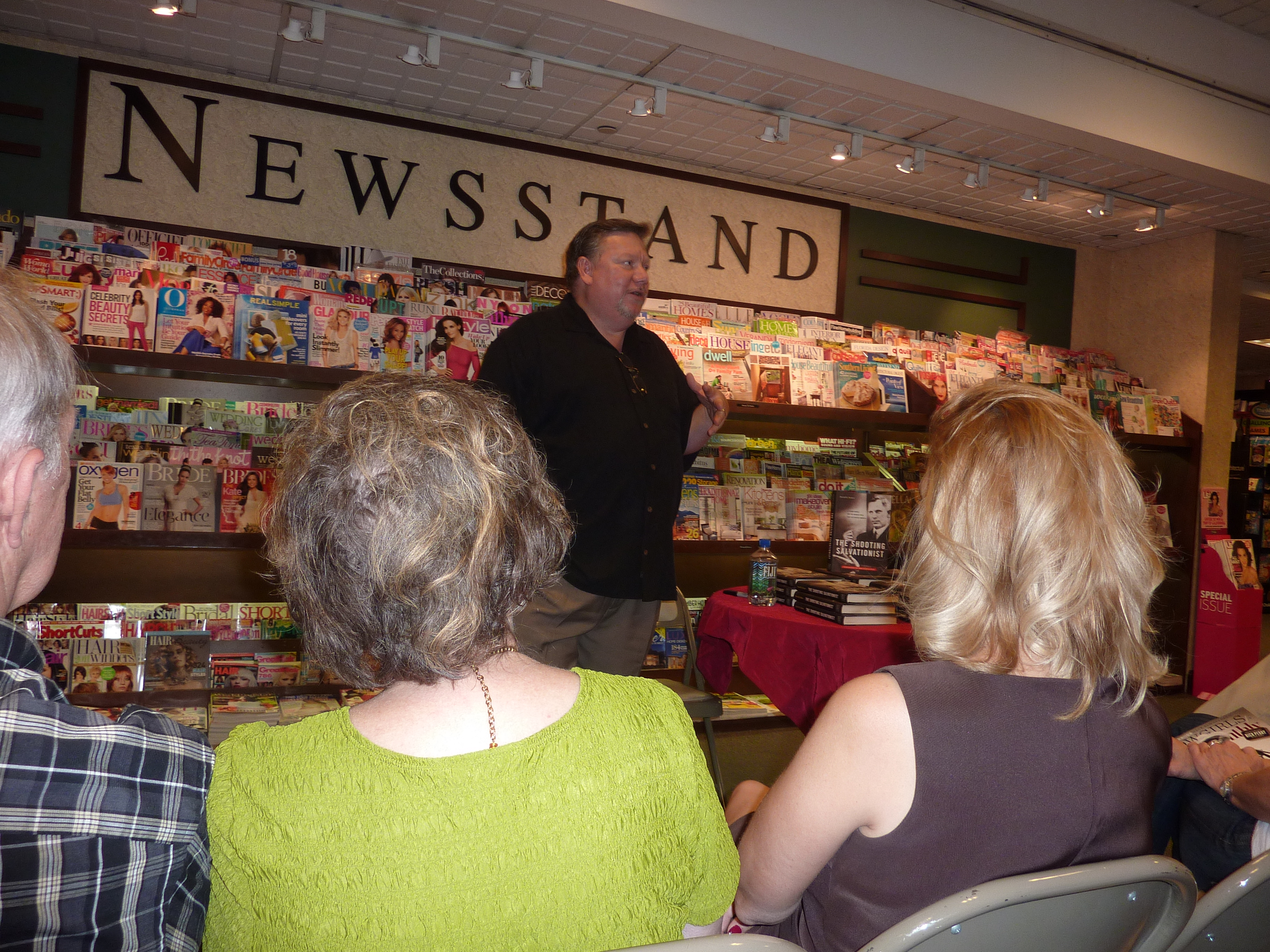
David R. Stokes speaks before his book signing at the Fort Worth Sundance Square Barnes& Noble two blocks from the site of Norris' shooting of Chipps
This weekend C-SPAN2 is airing a speech delivered by David R. Stokes, the author of The Shooting Salvationist: J. Frank Norris and the Murder Trial that Captivated America (©2011 Steerforth Press) at a recent book signing in Austin, TX. It played last night at 9pm (Eastern), it has replayed once this morning, but you can still catch it one final time this afternoon at 3pm (Eastern).
The program has already been added to the BookTV online archive, so it may be accessed there if you miss this afternoon’s showing.
Don’t forget to purchase your copy of The Shooting Salvationist at Amazon.com or from the book’s official website.
This Is No Texas Tall Tale
“J. Frank Norris Week” continues! Last night I joined David R. Stokes, author of The Shooting Salvationist: J. Frank Norris and the Murder Trial that Captivated America at the Fort Worth Sundance Square Barnes & Noble Bookstore, where he spoke for a few minutes before sitting down to sign books. The pictures in this post are from last night’s signing. The text is my semi-formal, though concise, review of the book, which has also been posted at the book’s Amazon.com page. As emotionally dependent as I have become on this book, it was hard for me to step back and write an objective review that is comparable to a professional, or at least experienced, reviewer’s work until I decided to recommend the book in an email to another writer, who shall remain nameless. I gave him the following summary, and decided that this is about as good a review as anyone’s ever going to get out of me. Hope you find it helpful, and feel free to help us spread the word about this story that has been gratefully recovered from historical obscurity.
David R. Stokes speaks before his book signing at the Fort Worth Sundance Square Barnes& Noble two blocks from the site of Norris' shooting of Chipps
David R. Stokes is a columnist for Townhall.com. He is also a pastor of a non-denominational church in Fairfax, VA. He studied for the ministry at the same Missouri Bible College from which the late Jerry Falwell got his Bachelors degree before he moved on to bigger and better things. This Bible College, Baptist Bible College, to be precise, has its roots in the ministry of the man who is the subject of the book he is now promoting, The Shooting Salvationist: J. Frank Norris and the Murder Trial That Captivated America (2011 Steerforth Press).
Norris was the pastor of the First Baptist Church of Fort Worth Texas between the years 1909 and 1952 (the year of his death). In the early years of his ministry, he ditched the tame, sane, responsible approach to ministry in which one makes an effort to get along with everyone, for an approach that would generate so much heat it would draw huge crowds to him so he could introduce them to the Light, if you know what I mean. In the process, he was a self-appointed thorn in the side of the underground liquor and gambling interests in Texas, the budding theological liberalism in his alma mater, Baylor, the mayor of Ft. Worth and Star-Telegram founder and all-around entrepreneur Amon G. Carter. This got Norris in hot water with one of the mayor’s friends, another Ft. Worth business leader, Dexter Elliot Chipps, who stormed into Norris’ office one day, threatened to kill him, then walked out. Chipps’ mistake was that he didn’t keep going. He turned for some unknown reason and attempted to reenter the pastor’s office and was met with three or four bullets in the chest. The resulting 1926 murder trial was as big of a media circus as Norris’ hero, William Jennings Bryan’s, recent Skopes Monkey Trial had been, or for those of us in the 21st century, Casey Anthony’s.

Yours truly (left); David R. Stokes (right)
The book is a narrative non-fiction work. It reads somewhat like a novel, but all the dialogue, and much of the narration, even, is directly lifted from his sources which include not only older bios of Norris (pro and con), but much of the most prominent journalistic accounts, legal transcripts and records, as well as personal archives of Norris, Meacham and Carter. The outrageous tactics of Norris in his early ministry make for quite a train wreck, and the history is fascinating, but for folks like myself who grew up in Fort Worth, it gives a lot of new information to an old legend that has lingered in the background of all of our lives, and provides quite a bit of closure as well. I’d like to share with you this fascinating tale that we could only wish were nothing more than a “Texas Tall Tale.”
Politics, Religion and a Gun

David Stokes’ interview with 90.1FM KERA host Krys Boyd on her D/FW local NPR talk show, Think with Krys Boyd, has been uploaded. You can listen to it here.
And so, J. Frank Norris week continues at The Misadventures of Captain Headknowledge! Just wait until tomorrow…
The Shooting Salvationist Author Comes to Ft. Worth

Make that "Wednesday, July 20" at the Sundance Square Barnes & Noble in Ft. Worth
Fairfax, Virginia Baptist Bible Fellowship local church pastor David Stokes grew up as a member of Detroit’s Temple Baptist Church, not twenty years after J. Frank Norris pastored that church at the same time that he pastored First Baptist Church in Fort Worth, Texas. In his day, Norris was known as the “Texas Tornado,” and the “Pistol-Packing Parson.” The memory of J. Frank Norris casts a long shadow for those whose lives were touched by his sensationalistic and controversial ministry. It must be as true for those like Stokes who grew up in the decades following Norris’ death, as it is for us down here in Fort Worth, who boast of relatives with stories of personal connections to the famous fundamentalist firebrand. For example, my own mother grew up playing with Norris’ grandson, George. He was my mother’s best friend’s boyfriend. My great-grandmother hosted the visiting preacher at her house, where lively discussions are said to have ensued between Norris and my great-great grandmother, charming them with the admission that “the only person who could ever change his mind was Mrs. Freeman.” Not only that, J. Frank Norris even performed the wedding ceremony for my son’s great-grandparents on his mother’s side. For better or worse, J. Frank Norris is one of the more colorful cast members in the dramatic history of Fort Worth, Texas. Featuring his battle with the Southern Baptist Convention over Baylor University’s teaching evolution and his own personal war against corruption in local politics as well as the Prohibition-era liquor trade itself, I’ve always said, even as a one-time devoted follower, that the life story of J. Frank Norris would make a great gangster movie!
It looks like the novel on which that movie could be based has just been written by David Stokes. The book is called The Shooting Salvationist: J. Frank Norris and the Murder Trial that Captivated America (©2011 Steerforth Press). The only difference is, Stokes’ story is more of a courtroom drama. But that’s alright with me. At 1pm Central time today, Stokes will be interviewed on the local NPR station, 90.1FM KERA on “Think with Krys Boyd.” (you can sign up for the podcast here if you miss it live). Tomorrow night, from 7:00 to 9:00pm Central time, Stokes will hold a book signing at Barnes and Noble in Fort Worth’s Sundance Square just a few blocks away from the site of FBCFW during Norris’ ministry (see my previous post). On his Facebook page, Stokes reports “apparently there will be some “protesters” on Tuesday night when I speak at the Barnes and Noble in Fort Worth — should be interesting.” You can get familiar with one of those potential protesters at The J. Frank Norris Historical Society, started a year ago by a former associate of Norris’, Roy Emerson Falls.
If you’ve never heard of J. Frank Norris, or if you’ve always known about him–love him or hate him, you’ll be both shocked and in awe of the story of J. Frank Norris and the trial that failed to sentence Norris the electric chair for the death of Dexter Elliott Chipps.
The Shooting Salvationist Released Today!

2011 Steerforth Press--Foreword by Bob Scieffer of CBS News
Join me next Wednesday night, July 20 at the Barnes and Noble in Sundance Square in Fort Worth to meet the author of The Shooting Salvationist, David R. Stokes, get his autograph and/or a pic. I’m planning to post a review of the book just as soon as I finish my Advance Reading Copy. Probably next week.
PS–As an added bonus, you’ll probably also get to meet Rev. Roy E. Falls of The J. Frank Norris Historical Society protesting out front. When Stokes met him last year, he said he was sweet. A good time should be had by all (with the possible exception of Rev. Falls)!
Date: Wednesday, July 20, 2011
Start Time: 6:00 pm End Time: 8:00 pm
(Time Zone: US/Central)
Location: Barnes and Noble – Sundance Square
Category: The Shooting Salvationist Book Tour
Description
Phone: (817) 332-7178
Contact: Debby White
Email: debby@theshootingsalvationist.com
More Info: http://store-locator.barnesandnoble.com/store/2788
Barnes and Noble – Sundance Square
401 Commerce Street
Fort Worth TX 76102
The Alarm
Sinner, art thou still secure?
Wilt thou still refuse to pray?
Can thy heart or hands endure
In the Lord’s avenging day?
See his mighty arm is bar’d
Awful terrors clothe his brow;
For his judgment stand prepar’d;
Thou must either break or bow.
At his presence nature shakes,
Earth affrighted hastes to flee;
Solid mountains melt, like wax;
What will then become of thee?
Who his coming may abide?
You that glory in your shame,
Will you find a place to hide,
When the world is wrapp’d in flame?
Then the great, the rich, the wise,
Trembling, guilty, all condemned,
Must behold the wrathful eyes
Of the Judge they once blasphem’d.
Where are now their haughty looks?
Oh! Their horror and despair
When they see the open’d books
And the dreadful sentence hear.
Lord prepare us by thy grace;
Soon must we resign our breath
And our souls be called to pass
Through the iron gate of death
Let us now our day improve,
Listen to the gospel voice,
Seek the things that are above,
Scorn the world’s pretended joys.
O! When flesh and heart shall fail,
Let thy love our spirits cheer,
Strengthen’d thus we shall prevail
Over Satan, sin and fear.
Trusting in thy precious Name
May we thus our journey end;
Then our foes shall lose their aim
And the Judge will be our friend.
–from The Evangelical Primer, ninth edition, 1817 by Joseph Emerson


 The Misadventures of Captain Headknowledge
My Favorite Sport!
Rangers Ballpark in Arlington, home of the Texas Rangers
I’m one of those especially unfortunate fellows who grew up with a love-hate relationship with sports. I played several sports on several little league teams as a child, and played plenty of sports in the streets of my neighborhood. My lack of skill then is probably the chief reason I do not follow sports today, although I do tend to catch the Super Bowl, mostly for the commercials. My new membership in a Reformed church and their biblical and confessional (we view these two adjectives as synonymous) emphasis on delighting in the Lord on the Lord’s Day may have implications for the Super Bowl in the future. All I can say is, thanks be to God for digital video recording.
In light of my lack of interest in sports, I am fond of informing folks that “my sports are politics and religion,” which probably tells people I can relate even less to them, when they may already see me as a socially challenged individual who doesn’t follow sports. It is for this reason that you may not be surprised by my interest in the following lecture series that was held at Christ Reformed Church (URCNA) in Washington, D.C., called “Christianity & Politics,” which is yet another venue for the Westminster Seminary California faculty and alumni, among others, to focus our attention on their attempt at recovering the Reformed notion of the Two Kingdoms approach to the relationship between “Christ and Culture.” A timely offering in this year of presidential politics.
Here’s their introduction to the series, speaker bios and links to the lectures:
Why We Confuse Church & State
Separation of church and state?
Whatever you may think of the contemporary application of our first amendment freedom of religion, Christianity and politics are ever confused in our national consciousness. Preachers seek influence in the political sphere; politicians manipulate and calculate the faithful in their constituencies.
What are the faithful to do? How should we understand our callings as citizens, both on earth below and in heaven above?
Christianity & Politics presents a range of speakers approaching this topic from a range of perspectives while discussing topics as diverse as the mission of the church, the place of evangelicals in American political culture, natural law, and the spirituality of the church.…
Lectures [were] sponsored by Christ Reformed Church, and [took] place in our place of worship, historic Grace Reformed Church, home of President Theodore Roosevelt….
Speakers
MICHAEL HORTON is the J. Gresham Machen Professor of Systematic Theology and Apologetics at Westminster Seminary California, Host of the White Horse Inn radio program and Editor-in-Chief of Modern Reformation magazine. He is a minister in the United Reformed Church.
MICHAEL GERSON is an opinion writer for the Washington Post and former head speech writer and senior policy advisor to President George W. Bush.
DARRYL HART is Assistant Professor of History at Hillsdale College, author of numerous books, and blogs on religion and public life at oldlife.org.
TERRY EASTLAND is the Publisher of The Weekly Standard and an elder at Fourth Presbyterian Church in Bethesda, Maryland.
BRIAN LEE is the pastor of Christ Reformed Church in Washington, DC (United Reformed Church). He is a Guest Faculty at Reformed Theological Seminary and formerly worked on Capitol Hill, the National Endowment for the Humanities, and the Department of Defense.
DAVID VAN DRUNEN is the Robert B. Strimple Professor of Systematic Theology and Christian Ethics at Westminster Seminary California. He is a minister in the Orthodox Presbyterian Church and holds a Law Degree from Northwestern University School of Law.
DAVID COFFIN is the Senior Pastor at New Hope Presbyterian Church in Fairfax, Virginia.
Audio
Michael Horton
The Great Commission (Sermon on Matthew 28)
The Great Commission and Social Justice — (Q&A Session)
Michael Gerson, Darryl Hart, Terry Eastland
The Future of Evangelical Politics (roundtable discussion)
Brian Lee
The Primacy of “Church” in “Church & State” (Sermon on Romans 12)
“Govern Well?” or “Be Governed”? — (Q&A Session)
David VanDrunen
Natural Law and Christian Politics — (Q&A Session)
David Coffin
The Biblical Doctrine of the Spirituality of the Church (Sermon on John 18)
The Historical Doctrine of the Spirituality of the Church — (Q&A Session)
HT: Christ Reformed Church Presents
Share this: