Commentary on “The First Prohibition”
The following is an addendum to Theological & Doxological Meditation #47, containing commentary on the Scripture proofs which provide the basis for the answers to the questions of the Westminster Shorter Catechism. From now on, each Theological & Doxological Meditation will contain such commentary. They are offered with a view to the edification and instruction of believers and the calling of unbelievers to repentance and faith.
47. Q. What is forbidden in the first commandment?
A. The first commandment forbids the denying (Psalm 14:1), or not worshiping and glorifying the true God as God (Romans 1:21), and our God (Psalm 81:10-11); and the giving of that worship and glory to any other, which is due to him alone (Romans 1:25-26).
Question #47 of the Westminster Shorter Catechism focuses on the prohibitions implied by the first commandment, “You shall have no other gods before me.” Here’s what answer #47 looks like when you break down the various concepts and pair them up with the Scripture proofs provided, on which the language is based:
1. The first commandment forbids the denying . . . the true God . . . . (Psalm 14:1);
2. The first commandment forbids not worshiping and glorifying the true God as God (Romans 1:21);
3. The first commandment forbids the denying, or not worshipping the true God as God, and our God (Psalm 81:10-11);
4. The first commandment forbids . . . the giving of that worship and glory to any other, which is due to him alone (Romans 1:25-26)
Denying the True God
Psalm 14:1 – “The fool says in his heart, ‘There is no God.’ They are corrupt, they do abominable deeds, there is none who does good.”
The fool of verse one is the one who not only does not call upon the Lord (v.4), but he is also an “evildoer” who actively opposes those who do acknowledge the only true God. The fuller description of the fool of verse one is contained in verses two and three, which the Apostle Paul would quote in Romans 3 as a general description of all, whether Jew or Gentile, who are “under sin” (Romans 3:9), having not been justified by God’s grace alone, through faith alone, because of Christ alone to the glory of God alone.
Not Worshiping and Glorifying the True God as God
Romans 1:21 – “For although they knew God, they did not honor him as God or give thanks to him, but they became futile in their thinking, and their foolish hearts were darkened.”
Fools who deny and refuse to worship and glorify the true God know that he exists, and that they ought to worship and glorify him; but knowing this with futile minds and darkened hearts, they were unwilling and unable to express gratitude and honor to him. This is what happens when “head knowledge” and “heart knowledge” are not informed by, and obediently mindful of, God’s revelation. God reveals himself in the world and in his Word, and with darkened hearts and futile minds, Jew and Gentile alike does that which is prohibited by the first commandment—he does not worship and glorify the true God as God.
Our God
Psalm 81:10 – “I am the Lord your God, who brought you up out of the land of Egypt . Open your mouth wide, and I will fill it. 11 “But my people did not listen to my voice; Israel would not submit to me.”
As initiator of the covenant, God embraces the Israelites as “his people” and calls on them to “receive the covenant as an expression of his grace, believe in him and live as he directs (ESV Study Bible note on Ps. 81:8-10), embracing him as “our God.” This clearly implies the exclusivity which is so unpopular in pluralistic societies such as ours—such exclusivity is the solemn command of God. As Christians, if the Lord is our God, then the gods of non-Christian religions are to be excluded as “legitimate object(s) of worship” (Williamson, The Westminster Confession of Faith; Presbyterian & Reformed Publishers).
The Worship and Glory of Other Gods
Romans 1:25 – “because they exchanged the truth about God for a lie and worshiped and served the creature rather than the Creator, who is blessed forever! Amen. 26 For this reason God gave them up to dishonorable passions. For their women exchanged natural relations for those that are contrary to nature;”
Finally, the crass outward exchanging of the only true God for false gods, or rather, in the terms of the catechism, “the giving of that worship and glory to any other, which is due to him alone.” Each command of the Decalogue (the “Ten Words”, aka, Ten Commandments) is written in terms of the most harmful outward expression of a whole range of sins, all of which are violations of the spirit, if not the letter, of the Law. Such a range is partly what the Westminster Shorter Catechism seems intending to convey in its repeated examination (as we shall notice in the weeks to come)of that which each command prescribes and prohibits.
As our Lord demonstrates in his commentary regarding some of God’s commands in the Sermon on the Mount, there are more ways than one to violate the commandments of God. Reformed theologians tend to categorize these ways in the following terms: each command implies the opposite prohibition, and vice versa (which the catechism expressly spells out); and every day we break God’s Law in thought, word and deed. Truly, God’s commands condemn us all in ways we will never be able to fully comprehend.
This is the reason it was necessary for God to take on a human nature untainted by the curse of original sin, that he might keep all of the commands and their implied prohibitions (and vice versa) in thought, word and deed perfectly every day of his life. This is called “the active obedience of Christ.” Christ obeyed the Law perfectly, which the first man, Adam, failed to do, and thus Christ earned eternal life by his flawless works. The righteousness accrued by the active obedience of Christ is freely available and offered to all who will believe, for when Christ was crucified, his unjust death was a sacrifice that propitiated, or turned away God’s furious wrath onto himself from the sins of all those God the Father gave to him before the world was made.
“So then, the law was our guardian until Christ came, in order that we might be justified by faith” (Galatians 3:24). Trust Christ today, and be saved from God’s wrath against all sins, chief among them being the giving of worship and glory to any other, that is due to him alone!
Misadventures Around the Blogosphere
 Attention: Commenter Kevin Moon–You’ve recently been expressing a serious desire (here and here)to observe me handle a blog topic with Scripture. Well, here you go, Brother! Whaddaya think?
In other news, I had a thing or two to say about the validity, or lack thereof, of Henry Morris’ brand of evangelical scientific creationism over at Fundamentally Reformed. Some of you may find this exchange challenging. If so, be sure to let me hear about it.
Does Lack of Perseverance Imply Limited Atonement?
21 And you, who once were alienated and hostile in mind, doing evil  deeds, 22 he has now reconciled in his body of flesh by his death, in order to present you holy and blameless and above reproach before him, 23 if indeed you continue in the faith, stable and steadfast, not shifting from the hope of the gospel that you heard, which has been proclaimed in all creation [1] under heaven, and of which I, Paul, became a minister. (Colossians 1:21-23)
This passage clearly implies the doctrine of the Perseverance of the Saints, or as I renamed it, Persevering Grace for the Saints. It basically says that Jesus actually reconciled a professing believer if he continues, or perseveres, in the faith. Simple enough, those who persevere are the ones who were truly reconciled to the Father in Christ’s death on the cross.
But look what happens when you read its opposite:
if you shift from the hope of the gospel that you heard, are unstable, waver and do not continue in the faith, then Christ has not reconciled you in his body of flesh by his death in order to present you holy and blameless and above reproach before him.
Do you read what I read? When I think of it in this way, my logic tells me that lack of perseverance may be evidence for limited atonement. In other words, if you don’t persevere in the faith, then Jesus didn’t die for you.
What say you? Am I reading limited atonement into this passage, or am I properly drawing limited atonement out of the text? Eisegesis or exegesis? You be the judge (That means post your opinion!).
John MacArthur Makes the Rounds
Last year I heard John MacArthur on his radio show, Grace to You, talk about his philosophy of preaching. He believes that the deeper he goes in exposition, the higher it can lift up the hearers in worship of God. MacArthur has dug until he hit paydirt in his latest book, A Tale of Two Sons: The Inside Story of a Father, His Sons, and a Shocking Murder. This book is an exposition of the most famous of Jesus’ parables: The Prodigal Son (Luke 15:11-32). In his exposition, MacArthur goes into the background cultural implications of the words of the parable to show that at every point in the action, the story is geared to offend the sensibilities of the original Jewish hearers. Being a culture steeped in their focus on honor and shame, this parable stirs up the Jews, interrupts them in their honorable comfort zones and forces them to grapple with a concept of God that is willing to suffer the shame of filthy, worthless sinners who come to repentance. In fact, he takes great joy in doing so!
To make the long story short, MacArthur points out that the Father represents Jesus in the parable, the Prodigal Son represents the tax collectors and sinners who’d just gathered to hear Jesus speak (Luke 15:1), and the older brother represents the Pharisees (v. 2). In the two parables preceding that of the Prodigal Son, Jesus highlights the joy God takes in recovering lost sinners. MacArthur points out that Pharisees, by contrast, take no joy in the repentance of shameful sinners, but rather, take joy in the recovery of lost sheep and coins ($$$!). These themes show up in spades in Jesus’ “Inside Story of a Father, [and] His Sons.”
The worship begins when, after hearing how the son’s shameful demad for his inheritance, his subsequent prodigal living and his rock bottom experience communing with shameful swine and his eventual determination to return to his Father, MacArthur compares the compassionate, watchful father who runs through the village in the most shameful way possible [by (1) lifting his robe so he can (2) run (!)] to protect his repentant son from the violent mistreatment he would have certainly received from the honorable local citizenry, to Jesus, who, being the most Honorable of them all, suffered the shame which my shameful behavior has incurred, so he could rejoice over my repentance and return to his loving embrace! You gotta read this book, or at least look up the series on the radio show, repent of your sins and worship Christ who has given and suffered so much for you.
Now that this book is available, naturally, MacArthur has to promote the book. That’s what brought him last Friday to Crossroads Christian Church in Grand Prairie, Texas. I took the opportunity of accompanying my wife to the event to hear him preach all of the above, and then some, for just over an hour (as is his usual habit). Following, are a few pictures from the event:




“Foundational” Headknowledge
 Don’t you love all those tricky things everyone ought to memorize in the Bible? The three big lists that ought to be memorized include the Ten Commandments, the Beatitudes, and perhaps most elusive of all (it has been for me), the Twelve Apostles. But these twelve elusive guys have just been apprehended. I’ll never have trouble again remembering their names. As I studied for this week’s Sunday School lesson from Acts one on The Great Commission, Christ’s Ascension and what I’m calling “Foundation Repair” (replacing Judas Iscariot with Matthias), I noticed some things that will help me remember their names forever. Perhaps one flaw is that the replacement, Matthias, isn’t listed, but it’s a mnemonic device which includes Judas Iscariot. Since we hear more in the Bible about Judas than Matthias, I think it’s appropriate to keep him in mind, even though his office was given to another.
The thing I noticed in the list of apostles in Acts chapter one is that half of the list is taken care of with three names. There are two Simons, Peter and the Zealot; there are two Judases, Isacariot and the Son of James (notice this helpful transition); and there are two Jameses, the son of Alphaeus and the brother of John. Six down, only six to go. But how do we simplify these?
Half of the remaining six end with a “u” sound: Matthew, Andrew, Bartholomew. These, we’ll lump together, and the rest are easy: John, Thomas and Phillip. But did you notice that if you insert these last three after the first six, it provides another memorable link. Since the second James listed is the brother of John, that should help you remember that the next name in the list is John, who are bundled with Thomas and Phillip. Then all you have to remember is the “-ew” names: Matthew, Andrew, Bartholomew.
So, there you have it. A mnemonic device to help us all memorize the names of the Twelve Apostles! I have provided a visual aid that you could perhaps download for your own personal use, or go ahead and make another for yourself, if you prefer. I hope this helps with your biblical headknowledge!
Jesus, the First Resurrection!
We interrupt the mundane theological debates at hand to proclaim to you Jesus, Our Resurrection! Those who believe will share, not only in his death, but also in his resurrection! Jesus is the First Resurrection (Revelation 20:4-5)! For more on this odd refernce, see Kim Riddlebarger’s sermon, “They Came To Life And Reigned With Christ For A Thousand Years”
Don’t forget, Easter–or “Resurrection Sunday,” if you prefer–is only two weeks away!
Christ is Risen!!! In John 11, we learn about Jesus our resurrection: let’s read about it together . . .
The Death of Lazarus
· Jesus’ ministry coming to an end; his greatest sign about to be given by which Jesus revealed the glory of God the Father (see John 17:1-6).
· Jesus and his disciples are on their way to Jerusalem for the last time, to keep Jesus’ last Passover feast, the meal in which the Jews took part in the great work of redemption in the Old Testament, the exodus from bondage in Egypt. This last Passover will become Jesus’ Last Supper where he will update some of the symbols in the meal to communicate his ultimate work of redemption for not only Jews, but also for Gentiles from every nation.
11:1 Now a certain man was ill, Lazarus of Bethany, the village of Mary and her sister Martha. 2 It was Mary who anointed the Lord with ointment and wiped his feet with her hair, whose brother Lazarus was ill. 3 So the sisters sent to him, saying, “Lord, he whom you love is ill.” 4 But when Jesus heard it he said, “This illness does not lead to death. It is for the glory of God, so that the Son of God may be glorified through it.”
· Jesus had some friends in Bethany, where Mary and Martha would take care of Jesus whenever he came that way. Mary will become famous for how she prepares Jesus for his burial in chapter 12.
· The sisters send word that their brother is sick, but Jesus, by the Holy Spirit, knows that this is not the last anyone will see of Lazarus. But that what is about to happen will help Jesus glorify his Father in heaven.
5 Now Jesus loved Martha and her sister and Lazarus. 6 So, when he heard that Lazarus was ill, he stayed two days longer in the place where he was. 7 Then after this he said to the disciples, “Let us go to Judea again.” 8 The disciples said to him, “Rabbi, the Jews were just now seeking to stone you, and are you going there again?” 9 Jesus answered, “Are there not twelve hours in the day? If anyone walks in the day, he does not stumble, because he sees the light of this world. 10 But if anyone walks in the night, he stumbles, because the light is not in him.” 11 After saying these things, he said to them, “Our friend Lazarus has fallen asleep, but I go to awaken him.” 12 The disciples said to him, “Lord, if he has fallen asleep, he will recover.” 13 Now Jesus had spoken of his death, but they thought that he meant taking rest in sleep. 14 Then Jesus told them plainly, “Lazarus has died, 15 and for your sake I am glad that I was not there, so that you may believe. But let us go to him.” 16 So Thomas, called the Twin, said to his fellow disciples, “Let us also go, that we may die with him.”
· (5-6) Normally, if we call for someone to help, and if they are slow to come, we think they don’t like us much; but John wrote that because Jesus loved Lazarus and his sisters, he put off showing up for two days! That means God has a plan!
· (7-10) When Jesus is ready he calls his disciples to follow him to Judea. Bethany is in Judea, as is Jerusalem, where the Jews wait to kill Jesus. The disciples fear the danger and remind Jesus, hoping he’ll just let Lazarus recover on his own, so they can stay safe. But Jesus tells them plainly that Lazarus is dead and Jesus is to go raise him to give them a sign that will strengthen their faith in him. Finally, Thomas speaks for the whole group when he resolves to follow Jesus even to the cross! This is how far God calls us to follow Jesus, too, and when that time comes, he gives us the grace to be willing to do so, if we believe (Hebrews 12:1-4).
I Am the Resurrection and the Life
17 Now when Jesus came, he found that Lazarus had already been in the tomb four days. 18 Bethany was near Jerusalem, about two miles off (15 stadia), 19 and many of the Jews had come to Martha and Mary to console them concerning their brother. 20 So when Martha heard that Jesus was coming, she went and met him, but Mary remained seated in the house. 21 Martha said to Jesus, “Lord, if you had been here, my brother would not have died. 22 But even now I know that whatever you ask from God, God will give you.” 23 Jesus said to her, “Your brother will rise again.” 24 Martha said to him, “I know that he will rise again in the resurrection on the last day.” 25 Jesus said to her, “I am the resurrection and the life. [4] Whoever believes in me, though he die, yet shall he live, 26 and everyone who lives and believes in me shall never die. Do you believe this?” 27 She said to him, “Yes, Lord; I believe that you are the Christ, the Son of God, who is coming into the world.”
· (17-22) When Jesus and the disciples get to Bethany, they find that dead Lazarus has been buried for four days, and many people from Jerusalem had come to console Martha and Mary. When the sisters hear of Jesus’ arrival, Martha hurries to greet Jesus and reaffirm her faith in him, even though he didn’t do what she had originally asked for. We can rest assured that when we pray for something, if we don’t get it, we can know that it’s only because God plans to do something even better for your good and his glory (Romans 8:26-30)!
· (23-27) When Jesus promises Lazarus will rise from the dead, Martha misunderstands, thinking that Jesus is talking about the end of the world when everyone will rise from the dead. But, again, Jesus plans to do something better than we expect! Jesus proclaims that he is resurrection himself, and we who believe in him will experience a spiritual resurrection, because of which, though we may die physically one day, we can be sure we will live in God’s presence forever (Romans 6:5)! Now I ask you what Jesus asked Martha: “Do you believe this?” Do you believe that Jesus is the Christ, whom God sent to die because of your sins and to rise from the dead that you may live forever because God has justified you by giving you Jesus’ rigteousness?
Jesus Weeps
28 When she had said this, she went and called her sister Mary, saying in private, “The Teacher is here and is calling for you.” 29 And when she heard it, she rose quickly and went to him. 30 Now Jesus had not yet come into the village, but was still in the place where Martha had met him. 31 When the Jews who were with her in the house, consoling her, saw Mary rise quickly and go out, they followed her, supposing that she was going to the tomb to weep there. 32 Now when Mary came to where Jesus was and saw him, she fell at his feet, saying to him, “Lord, if you had been here, my brother would not have died.” 33 When Jesus saw her weeping, and the Jews who had come with her also weeping, he was deeply moved in his spirit and greatly troubled. 34 And he said, “Where have you laid him?” They said to him, “Lord, come and see.” 35 Jesus wept. 36 So the Jews said, “See how he loved him!” 37 But some of them said, “Could not he who opened the eyes of the blind man also have kept this man from dying?”
· Now Martha fetches Mary so she may greet Jesus and be comforted by her. Jesus felt sorry for Mary when she came and complained to him in tears. Jesus asks to see Lazarus’ tomb, and when he sees it, he weeps with Mary (Romans 12:15) over Lazarus’ death. This, as usual, serves to divide the people who witness Jesus’ works: some admire his love for Lazarus, while others complain that Jesus’ tears aren’t good enough.
Jesus Raises Lazarus
38 Then Jesus, deeply moved again, came to the tomb. It was a cave, and a stone lay against it. 39 Jesus said, “Take away the stone.” Martha, the sister of the dead man, said to him, “Lord, by this time there will be an odor, for he has been dead four days.” 40 Jesus said to her, “Did I not tell you that if you believed you would see the glory of God?” 41 So they took away the stone. And Jesus lifted up his eyes and said, “Father, I thank you that you have heard me. 42 I knew that you always hear me, but I said this on account of the people standing around, that they may believe that you sent me.” 43 When he had said these things, he cried out with a loud voice, “Lazarus, come out.” 44 The man who had died came out, his hands and feet bound with linen strips, and his face wrapped with a cloth. Jesus said to them, “Unbind him, and let him go.”
· When Jesus commands the stone be removed, Martha reminds him Lazarus’ decomposing body will stink, but Jesus reminds her of his words to her about trusting Jesus so she can see how he will glorify God the Father. Then Jesus prays for the Father to raise Lazarus, and he prays for this so that those who witness this sign will believe that Jesus is the Christ, sent by God the Father.
The Plot to Kill Jesus
45 Many of the Jews therefore, who had come with Mary and had seen what he did, believed in him, 46 but some of them went to the Pharisees and told them what Jesus had done. 47 So the chief priests and the Pharisees gathered the Council and said, “What are we to do? For this man performs many signs. 48 If we let him go on like this, everyone will believe in him, and the Romans will come and take away both our place and our nation.” 49 But one of them, Caiaphas, who was high priest that year, said to them, “You know nothing at all. 50 Nor do you understand that it is better for you that one man should die for the people, not that the whole nation should perish.” 51 He did not say this of his own accord, but being high priest that year he prophesied that Jesus would die for the nation, 52 and not for the nation only, but also to gather into one the children of God who are scattered abroad. 53 So from that day on they made plans to put him to death.
· Some of the Jews who saw the resurrection of Lazarus believed and so received a spiritual resurrection of their own in Jesus! They were raised to life by God and believed in Jesus! But others went and reported this miracle to the Pharisees, who, with the chief priests, gathered the Council to determine what to do next about this trouble-maker, Jesus. They feared that if they left Jesus alone, and everyone receives him, then the Romans would consider it a threat and would send troops to punish the nation of Israel. But John points out that the high priests words also prophesied about Jesus’ mission: it is better that one sinless man should die on behalf of sinners, than it is for the large group of sinners to die themselves. John uses the high priest’s words to teach us that by his death, Jesus would save not only Jews, but Gentiles from all around the world, too! Gentiles like me and you, who believe (Romans 9:22-26)! Out of hatred for Jesus, and fear of the Romans, they meant evil toward Jesus, but God meant good for his chosen people from all around the world (cf. Genesis 50:20).
54 Jesus therefore no longer walked openly among the Jews, but went from there to the region near the wilderness, to a town called Ephraim, and there he stayed with the disciples.
· Jesus knew how much the Jews in Jerusalem hated him, but he desired to keep the Passover, so he waited in Ephraim to keep safe until the time of the Feast.
55 Now the Passover of the Jews was at hand, and many went up from the country to Jerusalem before the Passover to purify themselves. 56 They were looking for [5] Jesus and saying to one another as they stood in the temple, “What do you think? That he will not come to the feast at all?” 57 Now the chief priests and the Pharisees had given orders that if anyone knew where he was, he should let them know, so that they might arrest him.
· Although the Jews want to arrest Jesus and kill him for their own good, God sent Jesus to die for sin, so that through believing in Jesus, sinners like you and me could be brought to life in Jesus, Our Resurrection!
The Sign of Jonah: What Christ’s Resurrection Says About Jesus, Believers and Unbelievers
 Matthew 12:38 Then some of the scribes and Pharisees answered him, saying, “Teacher, we wish to see a sign from you.”
-
They just saw him cast a demon out of a blind and mute man, and they said he did it by the power of the devil. But it was really a sign that the kingdom of God has come, and they refused to believe it and will be judged. He also said they said bad things about him because they don’t believe and don’t want to repent. Like a bad tree bears bad fruit, so does a bad heart speak unbelieving, sinful words in response to God’s Word.
-
Having seen and denied a sign, they want one done on demand, wanting to condemn him if he doesn’t.
39 But he answered them, “An evil and adulterous generation seeks for a sign, but no sign will be given to it except the sign of the prophet Jonah.
-
They are not true children of Abraham, but of the devil (John 8:39-47). Abraham heard the gospel and believed, they hear it and deny it, because they are not of God.
-
Jesus won’t do tricks on demand, so the only sign they get is a reminder of a past prophet.
40 “For just as Jonah was three days and three nights in the belly of the great fish, so will the Son of Man be three days and three nights in the heart of the earth.
-
Jonah signifies Jesus in that he experienced a kind of death and resurrection over a three-day period just as Jesus would one day.
-
The resurrection is one of the most important teachings about Jesus there is in the Bible: 1) it tells us things about Jesus: a. His claims as Judge and Savior are true (Acts 17:31; 1 Cor. 15:1-11, 20) b.Jesus’ victory over death (Acts 2:24; 1 Cor. 15:54-57) c. Jesus’ righteousness (John 16:10) d. Jesus’ deity (Romans 1:4) e. Jesus’ resurrection leads to his ascension and enthronement, so identifies him as King (Acts 1:9-11; 2:33-34; Phil. 2:9-11; cf. Isa. 53:10-12) f. Jesus is our Great High Priest forever (Heb. 7:16-17) 2) it tells us things about believers: a. Signifies their forgiveness and justification (Romans 4:25; 1 Cor. 15:17;Heb.7:24-25) b.Signifies their hope of resurrection in the future (Romans 6:4-11; 1 Cor. 15:42-57) c. Signifies their life to God and death to sin, the power of which is defeated by the resurrection (Romans 6:11). Believers can resist temptation, if you remind yourself of the fact that Jesus’ resurrection means sin is not your lord anymore. d. Without it, their faith would be worthless, they’d still be condemned to suffer the consequences of their own sin, and have no hope of eternal life in resurrected bodies (1 Cor. 15:12-20).
3) it tell us things about unbelievers (See following verses):
41 “The men of Nineveh will rise up at the judgment with this generation and condemn it, for they repented at the preaching of Jonah, and behold, something greater than Jonah is here.
-
Jesus’ resurrection signifies that the unrepentant will suffer the consequences of their sins, because they rejected the preaching of the greatest Prophet, whereas the people of Ninevah repented at the preaching of Jonah.
42 “The queen of the South will rise up at the judgment with this generation and condemn it, for she came from the ends of the earth to hear the wisdom of Solomon, and behold, something greater than Solomon is here.
-
To add weight to this testimony, Jesus refers to another example of Gentiles gladly receiving from types of Christ, and this fact makes the scribes’ and Pharisees’ rejection of Jesus that much more dangerous to them.
-
Remember that when you hear the Word of God, God will judge you on whether you believe his promises, and whether you repent and obey when you hear his commands. If you love Jesus, you will believe what he says, like Abraham, and you will obey his commands.
Corinthian Creed Added to My Box
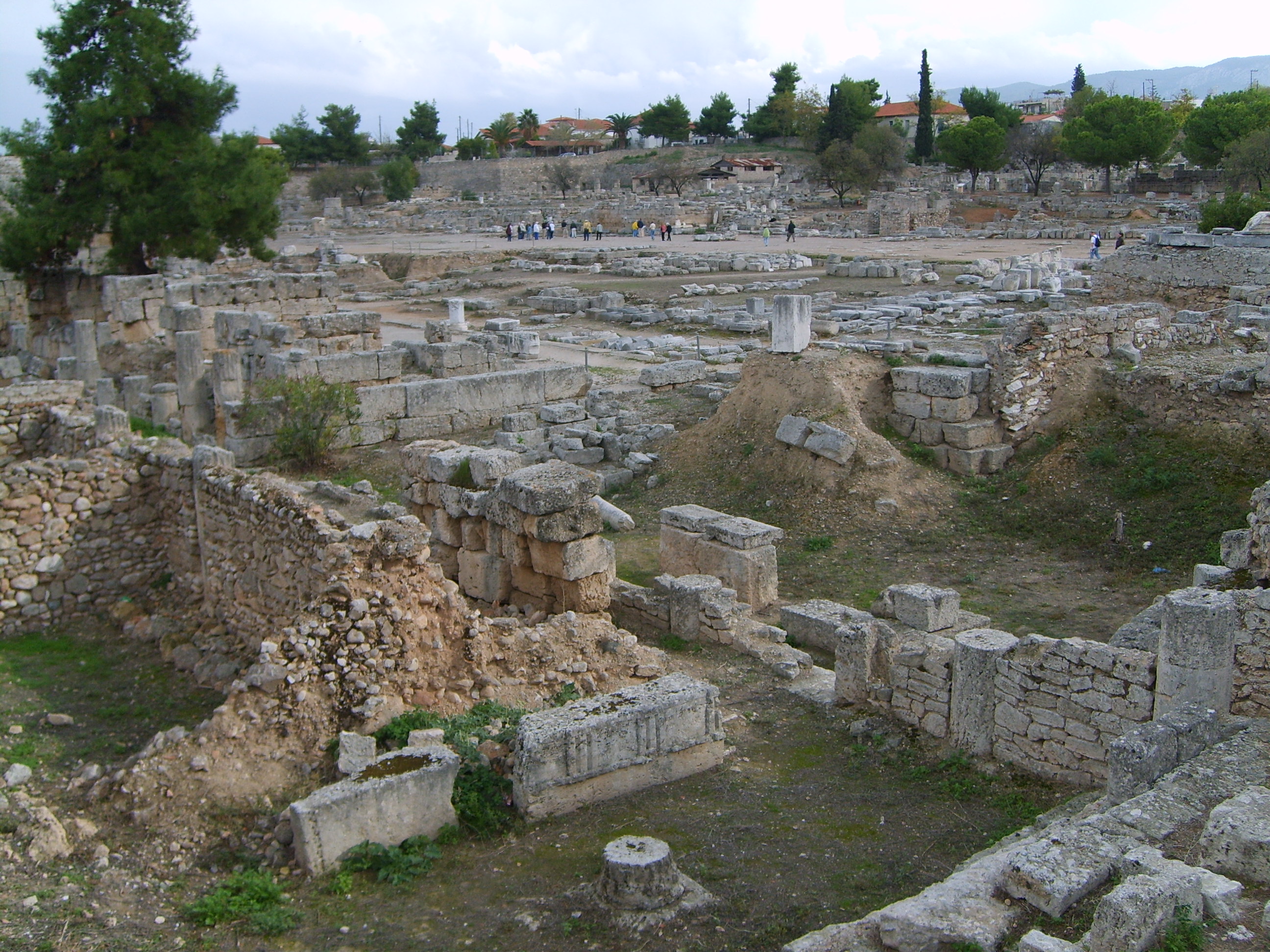
Over in my sidebar, you will find the recording made of the quartet who performed the song, “Corinthian Creed,” which I wrote to summarize the teaching of 1 Corinthians 15 on Paul’s defense of, teaching about and exhortations in light of the resurrection of Christ and our future resurrection at his Second Coming. Just find the black box on the lower right side of this page and select the file at the top of the list called “Corinthian Creed” and you’ll be able to hear our performance.
For a further introduction, read what I wrote about it back on September 30, 2006. Above, you may enjoy a view scanning across the ruins of Ancient Corinth which I shot on my Holy Land Tour in November of 2007, of which, more pictures are available for viewing in my Flikr photo box which is also in the sidebar to the right.
Jesus’ “Lost Years” Found In the New Testament

In my post last Sunday morning, I blogged about Lee Strobel’s book defending “the Real Jesus.” With this topic fresh in my mind, as well as the Sunday School lesson which I’d prepared for that morning, when class began, during our conversation with the children before the lesson, one of them asked out of the blue where Jesus was between the time he was a kid and the time he began his public ministry. I could tell immediately where he was going. Naturally, he followed up by saying his dad had been watching the History Channel and heard that people say Jesus went to India for some time between the ages of 12 and thirty. In the providence of God, my lesson for the day was from Luke 2:39-52, the account of “The Boy Jesus in the Temple,” as the heading over this passage in the English Standard Version describes it.
I’m not terribly familiar with the claims regarding Jesus’ reputed trip to India, spread by those outside the realm of orthodox Christianity. However, having perused the search engine and scanned a few sites (like this one, for example) and Wikipedia articles (like the one on the gnostic Acts of Thomas and the theosophical Aquarian Gospel), I’ve hit upon the apparent basis for the theory that Jesus went to India as a boy. I’d probably already be more clued in about it if I didn’t avoid History Channel programs of this nature and other popular sources of info on the secularized revisionist research on the “historical Jesus.” But I’m getting ahead of myself.
My immediate response to my student was that there are a lot of people who like Jesus, but who don’t believe the Bible. Often, they are people or groups from other religions that associate Jesus with their beliefs in an attempt to lend credibility to them, or for some other reason. In the middle of giving this summary of where stories like that come from, a verse from my lesson came to mind. “Now his parents went to Jerusalem every year at the Feast of the Passover” (Luke 2:41). After I glanced at the passage for a minute, it became clear to me that even though the verse doesn’t say, “Now Jesus and his parents went . . . ” the context indicates that when his parents went to Jerusalem every year, so did Jesus.
It seems I’ve found a piece of New Testament evidence that would indicate that Jesus of Nazareth did not, in fact, ever go to India, or on any fanciful “magical mystery tour” of eastern religions between the ages of 12 and 30, as suggested by the Aquarian Gospel, but was with his parents every year when they went to Jerusalem to celebrate the Feast of Passover.
Outlining “The Love Chapter”
Love needed in my service
If I speak in the tongues of men and of angels, but have not love, I am a noisy gong or a clanging cymbal. And if I have prophetic powers, and understand all mysteries and all knowledge, and if I have all faith, so as to remove mountains, but have not love, I am nothing. If I give away all I have, and if I deliver up my body to be burned, but have not love, I gain nothing.
Affirmations and Denials on Love
Love is patient and kind;
 love does not envy or boast;
it is not arrogant or rude.
It does not insist on its own way;
It is not irritable or resentful;
It does not rejoice at wrongdoing, but rejoices with the truth.
Permanence of Love
Love bears all things, believes all things, hopes all things, endures all things.
Love never ends.
As for prophecies, they will pass away;
As for tongues, they will cease;
As for knowledge, it will pass away.
For we know in part and we prophesy in part, but when the perfect comes, the partial will pass away.
Maturity of Love
When I was a child, I spoke like a child, I thought like a child, I reasoned like a child.
When I became a man, I gave up childish ways.
For now we see in a mirror dimly, but then face to face.
Now I know in part;
Then I shall know fully, even as I have been fully known.
Relative Value of Love
So now faith, hope and love abide, these three; but the greatest of these is love.
New Files Added to My Public Box!
If you’d like a little Audio for Mind and Heart, I’ve just added a song I sang at church a  couple of Sunday mornings ago (you’ll be able to tell I’m not looking for a Dove award!), as well as the sermon preached to me upon my ordination to the office of deacon, just prior to my election to serve in that capacity by Shady Grove Baptist Church. Listen and praise the Lord with me in song and in hearing and heeding his Word preached.
Righteousness Apart From Law
The Righteousness From God Apart From Law
John Calvin’s Commentary on Romans 3:21-22
21. But now without the law, etc. It is not certain for what distinct reason he calls that the righteousness of God, which we obtain by faith; whether it be, because it can alone stand before God, or because the Lord in his mercy confers it on us. As both interpretations are suitable, we contend for neither. This righteousness then, which God communicates to man, and accepts alone, and owns as righteousness, has been revealed, he says, without the law, that is without the aid of the law; and the law is to be understood as meaning works; for it is not proper to refer this to its teaching, which he immediately adduces as bearing witness to the gratuitous righteousness of faith. Some confine it to ceremonies; but this view I shall presently show to be unsound and frigid. We ought then to know, that the merits of works are excluded. We also see that he blends not works with the mercy of God; but having taken away and wholly removed all confidence in works, he sets up mercy alone.
It is not unknown to me, that Augustine gives a different explanation; for he thinks that the righteousness of God is the grace of regeneration; and this grace he allows to be free, because God renews us, when unworthy, by his Spirit; and from this he excludes the works of the law, that is, those works, by which men of themselves endeavor, without renovation, to render God indebted to them. (Deum promereri — to oblige God.) I also well know, that some new speculators proudly adduce this sentiment, as though it were at this day revealed to them. But that the Apostle includes all works without exception, even those which the Lord produces in his own people, is evident from the context.
For no doubt Abraham was regenerated and led by the Spirit of God at the time when he denied that he was justified by works. Hence he excluded from man’s justification not only works morally good, as they commonly call them, and such as are done by the impulse of nature, but also all those which even the faithful can perform. Professor Hodge very justly observes, “It never was the doctrine of the Reformation, or of the Lutheran and Calvinistic divines, that the imputation of righteousness affected the moral character of those concerned. It is true,” he adds, “whom God justifies he also sanctifies; but justification is not sanctification, and the imputation of righteousness is not the infusion of righteousness.” — Ed. Again, since this is a definition of the righteousness of faith, “Blessed are they whose iniquities are forgiven,” there is no question to be made about this or that kind of work; but the merit of works being abolished, the remission of sins alone is set down as the cause of righteousness.
They think that these two things well agree, — that man is justified by faith through the grace of Christ, — and that he is yet justified by the works, which proceed from spiritual regeneration; for God gratuitously renews us, and we also receive his gift by faith. But Paul takes up a very different principle, — that the consciences of men will never be tranquillized until they recumb on the mercy of God alone. “The foundation of your trust before God, must be either your own righteousness out and out, or the righteousness of Christ out and out. … If you are to lean upon your own merit, lean upon it wholly — if you are to lean upon Christ, lean upon him wholly. The two will not amalgamate together, and it is the attempt to do so, which keeps many a weary and heavy-laden inquirer at a distance from rest, and at a distance from the truth of the gospel. Maintain a clear and consistent posture. Stand not before God with one foot upon a rock and the other upon a treacherous quicksand…We call upon you not to lean so much as the weight of one grain or scruple of your confidence upon your own doings — to leave this ground entirely, and to come over entirely to the ground of a Redeemer’s blood and a Redeemer’s righteousness.” — Dr. Chalmers Hence, in another place, after having taught us that God is in Christ justifying men, he expresses the manner, — “by not imputing to them their sins.” In like manner, in his Epistle to the Galatians, he puts the law in opposition to faith with regard to justification; for the law promises life to those who do what it commands, (Galatians 3:12) and it requires not only the outward performance of works, but also sincere love to God. It hence follows, that in the righteousness of faith, no merit of works is allowed. It then appears evident, that it is but a frivolous sophistry to say, that we are justified in Christ, because we are renewed by the Spirit, inasmuch as we are the members of Christ, — that we are justified by faith, because we are united by faith to the body of Christ, — that we are justified freely, because God finds nothing in us but sin.
But we are in Christ because we are out of ourselves; and justified by faith, because we must recumb on the mercy of God alone, and on his gratuitous promises; and freely, because God reconciles us to himself by burying our sins. Nor can this indeed be confined to the commencement of justification, as they dream; for this definition — “Blessed are they whose iniquities are forgiven” — was applicable to David, after he had long exercised himself in the service of God; and Abraham, thirty years after his call, though a remarkable example of holiness, had yet no works for which he could glory before God, and hence his faith in the promise was imputed to him for righteousness; and when Paul teaches us that God justifies men by not imputing their sins, he quotes a passage, which is daily repeated in the Church. Still more, the conscience, by which we are disturbed on the score of works, performs its office, not for one day only, but continues to do so through life. It hence follows that we cannot remain, even to death, in a justified state, except we look to Christ only, in whom God has adopted us, and regards us now as accepted. Hence also is their sophistry confuted, who falsely accuse us of asserting, that according to Scripture we are justified by faith only, while the exclusive word only, is nowhere to be found in Scripture. But if justification depends not either on the law, or on ourselves, why should it not be ascribed to mercy alone? and if it be from mercy only, it is then by faith only.
The particle now may be taken adversatively, and not with reference to time; as we often use now for but. “The words but now may be regarded merely as marking the transition from one paragraph to another, or as a designation of tense; now, i.e., under the gospel dispensation. In favor of this view is the phrase, “to declare at this time his righteousness (Romans 3:26) .” — Hodge But if you prefer to regard it as an adverb of time, I willingly admit it, so that there may be no room to suspect an evasion; yet the abrogation of ceremonies alone is not to be understood; for it was only the design of the Apostle to illustrate by a comparison the grace by which we excel the fathers. Then the meaning is, that by the preaching of the gospel, after the appearance of Christ in the flesh, the righteousness of faith was revealed. It does not, however, hence follow, that it was hid before the coming of Christ; for a twofold manifestation is to be here noticed: the first in the Old Testament, which was by the word and sacraments; the other in the New, which contains the completion of ceremonies and promises, as exhibited in Christ himself: and we may add, that by the gospel it has received a fuller brightness.
Being proved [or approved] by the testimony, “Testimonio comprobata,” etc., so Beza and Pareus render μαρτυρουμένη; “Being attested,” Doddridge; “Being testified,” Macknight Schleusner gives a paraphrase, “Being predicted and promised;” and this no doubt is the full meaning. — Ed. etc. He adds this, lest in the conferring of free righteousness the gospel should seem to militate against the law. As then he has denied that the righteousness of faith needs the aid of the law, so now he asserts that it is confirmed by its testimony. If then the law affords its testimony to gratuitous righteousness, it is evident that the law was not given for this end, to teach men how to obtain righteousness by works. Hence they pervert it, who turn it to answer any purpose of this kind. And further, if you desire a proof of this truth, examine in order the chief things taught by Moses, and you will find that man, being cast from the kingdom of God, had no other restoration from the beginning than that contained in the evangelical promises through the blessed seed, by whom, as it had been foretold, the serpent’s head was to be bruised, and through whom a blessing to the nations had been promised: you will find in the commandments a demonstration of your iniquity, and from the sacrifices and oblations you may learn that satisfaction and cleansing are to be obtained in Christ alone. Concurrent with what is said here is this striking and condensed passage from Scott, — “It has been witnessed by the law and the Prophets; the ceremonies typified it; the very strictness of the moral law and its awful curses, being compared with the promises of mercy to sinners, implied it; the promises and predictions of the Messiah bore witness to it; the faith and hope of ancient believers recognized it; and the whole Old Testament, rightly understood, taught men to expect and depend on it.” — Ed. When you come to the Prophets you will find the clearest promises of gratuitous mercy. On this subject see my Institutes.
22. Even the righteousness of God, etc. The words which follow, “by or through the faith of Jesus Christ,” mean not the faith which is his, but the faith of which he is the object. They ought to be rendered “through faith in Jesus Christ.” The genitive case has often this meaning: “Εχετε πίστιν Θεοῦ — Have faith in (of) God,” (Mark 11:22); “Εν πίστει ζῶ τὟ τοῦ υἱοῦ τοῦ Θεοῦ — I live by the faith of the Son of God;” [Galatians 2:20;] it should be in our language, “I live by faith in the Son of God.” This genitive case of the object is an Hebraism, and is of frequent occurrence. — Ed. He shows in few words what this justification is, even that which is found in Christ and is apprehended by faith. At the same time, by introducing again the name of God, he seems to make God the founder, (autorem, the author,) and not only the approver of the righteousness of which he speaks; as though he had said, that it flows from him alone, or that its origin is from heaven, but that it is made manifest to us in Christ.
When therefore we discuss this subject, we ought to proceed in this way: First, the question respecting our justification is to be referred, not to the judgment of men, but to the judgment of God, before whom nothing is counted righteousness, but perfect and absolute obedience to the law; which appears clear from its promises and threatenings: if no one is found who has attained to such a perfect measure of holiness, it follows that all are in themselves destitute of righteousness. Secondly, it is necessary that Christ should come to our aid; who, being alone just, can render us just by transferring to us his own righteousness. You now see how the righteousness of faith is the righteousness of Christ. When therefore we are justified, the efficient cause is the mercy of God, the meritorious is Christ, the instrumental is the word in connection with faith. The original is this, “Ut ergo justificemur, causa efficiens est misericordia Dei, Christus materia, verbum cum fide instrumentum — When therefore we are justified, the efficient cause is God’s mercy, Christ is the material, the word with faith is the instrument.” — Ed. Hence faith is said to justify, because it is the instrument by which we receive Christ, in whom righteousness is conveyed to us. Having been made partakers of Christ, we ourselves are not only just, but our works also are counted just before God, and for this reason, because whatever imperfections there may be in them, are obliterated by the blood of Christ; the promises, which are conditional, are also by the same grace fulfilled to us; for God rewards our works as perfect, inasmuch as their defects are covered by free pardon.
Unto all and upon all, Εἰς πάντας και ἐπι πάντας. He makes a similar difference in his expressions in verse 30. This righteousness, as some say, came to the Jews, as it had been promised to them, and upon the Gentiles, as a gift with which they were not acquainted, and it was conferred on them. But the possession was equal and belonged to all who believed, and to none else, whether Jews or Gentiles.
Stuart connects these words with “manifested,” or revealed, in verse 21. It is manifested to all, and manifested for all; that is, for the real benefit of all who believe; in other words, it is offered to all, but becomes of real advantage only to those who believe. But the simpler mode is to consider the words, which is, as in our version, to be understood. ‘Ερχομένη is the word which Luther adopts. — Ed. etc. For the sake of amplifying, he repeats the same thing in different forms; it was, that he might more fully express what we have already heard, that faith alone is required, that the faithful are not distinguished by external marks, and that hence it matters not whether they be Gentiles or Jews.
Roman Truths
Before I elaborate on my “Roman Truths,” please allow me to defend myself with the following quote of Martin Luther on the Book of Romans cited by Dr. Tom Browning on page 3 in the introduction to his series of lessons on “The Pinnacle of Christian Doctrine.”
Browning writes that Luther writes:
This epistle is really the chief part of the New Testament, and is truly the purest gospel. It is worthy not only that every Christian should know it word for word, by heart, but also that he should occupy himself with it every day, as the daily bread of the soul. We can never read it or ponder over it too much; for the more we deal with it, the more precious it becomes and the better it tastes (Martin Luther, Lutherʹs works, vol. 35: Word and Sacrament I edited by J. J. Pelikan, H. C. Oswald & H. T. Lehmann (Fortress Press: Philadelphia, 1960; reprinted 1999), 365).
So, in my own defense, last night I was pondering the precious and delicious letter of Paul to the Romans. In my much pondering of this book, I often attempt to come up with an original outline of the book which will the reader or Bible student remember the broad themes of this revolutionary, reforming and reviving book of Romans. I can’t help it if it came out like this!
Roman Truths
1. The Bad News (Romans 1:1–3:20)
2. The Good News (Romans 3:21-8)
3. Good News and the Jews (Romans 9-11)
4. The Good News Wearing Shoes (Romans 12-16)
Somebody help me! I’m losing control of my homiletics!!!
Second Creation, Second Adam

ii. Allows man to eat meat for the first time (vs. 2-4).
iii. Institutes death sentence for those who commit murder (vs. 5-6).
iv. God promises mercy with a covenant sign, the rainbow (vs. 8-17).
2. Jesus was the spiritual Second Adam because Adam was the photographic negative of Jesus(Romans 5:14-19).


 The Misadventures of Captain Headknowledge
Announcing the Online Literary Study Bible!
The ESV Blog has unveiled an opportunity to get free access to the online version of the recently released ESV Literary Study Bible in a post entitled, Literary Study Bible Now Available In Print and Online.
My copy has finally arrived in the mail (it was my birthday present to myself!) so I qualified for 6 months of free access. Do you?
If you’d like to hear Leland Ryken explain the value of studying the literary forms of Scripture, and their relevance to sound interpretation, listen to “Words of Delight: The Bible as Literature,” which is featured on his page at SermonAudio.com.
Share this: