“Rob Bellion” is as the Sin of Witchcraft!
In past years, one of my children was exposed to the teaching of Rob Bell by means of at least one of his Nooma videos played in my former church’s youth group, and presumably in some ways through his influence on the teacher of that class. Knowing his interest in Bell’s teaching, and being singularly interested in keeping up with who’s teaching what, I urged him a number of times that Bell’s teaching is not good for an orthodox church. The rest of the time I would tease him in a good-natured, but persistent way, that “Rob Bellion” is as the sin of witchcraft! This is my own personal play on the KJV’s translation of Samuel’s words to Saul when he refused to obey the Lord’s commands regarding the spoils of his fight with Amalek, whom he was to wipe out entirely as God’s appointed means of judgment against them for the way they attacked the children of Israel at Rephidim while they were still lead by Moses and the pillar of cloud and fire (1 Samuel 15:23; cf. Ex. 17:8-16; Deut. 25:17-19). Notice from the parallel line of 1 Samuel 15:23, that Saul’s “rebellion” is tantamount to a rejection of the word of the LORD regarding his plans to judge and destroy his enemies (see the whole passage, 1 Samuel 15:1-35). Such is the heresy of the universalist Rob Bell.
Justin Taylor at “Between Two Worlds,” a Gospel Coalition blog, shows Bell’s promotional material related to his latest book, Love Wins: Heaven, Hell and the Fate of Every Person Who Ever Lived, surely not to help sell his book, but to raise our awareness of how Bell’s trajectory towards theological liberalism is becoming more and more apparent in his growing trend of teaching the heresy of universalism. This is the doctrine that, in eternity, regardless of one’s reception or rejection of Christ during his lifetime, everyone will be forgiven and reconciled to God, and none will justly spend eternity hell. It’s funny how so many people who break the law wind up complaining about the fact that they had to suffer the consequences of their crime. This is analogous to the fact that unbelievers find the doctrine of eternal conscious torment in hell so unattractive. Hell, condemnation and the righteous judgment of an infinite, eternal and holy God is bad public relations for Christianity, if you listen to Rob Bell. But compare the concept of universalism with what the Lord Jesus said in John 3:16-21:
“For God so loved the world, that he gave his only Son, that whoever believes in him should not perish but have eternal life. For God did not send his Son into the world to condemn the world, but in order that the world might be saved through him. Whoever believes in him is not condemned, but whoever does not believe is condemned already, because he has not believed in the name of the only Son of God. And this is the judgment: the light has come into the world, and people loved the darkness rather than the light because their works were evil. For everyone who does wicked things hates the light and does not come to the light, lest his works should be exposed. But whoever does what is true comes to the light, so that it may be clearly seen that his works have been carried out in God.”
Here, Christ clearly states that the condition for escaping condemnation is faith in him. Reader, be clear: if you do not trust the Christ of the Scriptures, not the Christ of any cult’s misinterpretation or “reimagining” of him, not the Christ of the Gnostic gospels, but the Jesus Christ of historic, apostolic, catholic, orthodox, evangelical Protestant Christianity, then you are already under the condemnation of God. If you persist in this unbelief, you will not be saved in the end. Your end will be the Lake of Fire (Revelation 20:11-15). Confess that you are indeed a sinner, repent by turning from your sins and cling to Christ (Acts 26:18) who suffered for sinners in every nation, sinners like you (1 John 1:8-10). Reject your false gods and goddesses (you know who you are!), and run to Christ, who lives to justify the wicked who repent and believe.
With Rob Bell, on the issue of universalism, finding the error in his teaching is no longer a matter of reading between the lines. Watch the video below and you will see Bell himself explain how we need to deny the Biblical doctrine of eternal, conscious torment in Hell because it makes people reject Christianity. Apparently, what the world thinks about Christianity is more important to Bell than what God reveals in his Word. Read Taylor’s post, “Rob Bell: Universalist?”
If you find that your church has been, or is being exposed to the teachings of Rob Bell, I would suggest that you present the facts regarding Bell to your pastor and patiently, but persistently, help them see that he is not just an emerging evangelical postmodern hipster, but a theological liberal of the first order whose materials ought to be avoided by every church and Christian that loves the Word of God. This is a process I had the regretful duty of engaging in myself back then.
This article by former co-founder of Brian McLaren’s Emergent Village, Mark Driscoll (who later separated from them when they began showing signs of postmodern liberalism) navigate what he calls “The Emerging Church Highway.” It would also behoove you to read D. A. Carson’s book, Becoming Conversant with the Emerging Church: Understanding a Movement and It’s Implications (2005, Zondervan).
Finding Your Way
 Dr. Kim Riddlebarger has written a helpful article in the January/February 2011 issue of Modern Reformation Magazine called “‘You Are Here'”: The Map of Redemptive History.” Especially enlightening for us recovering Dispensationalists is his treatment of the ever-popular “signs of the times.” If you like scouring current events for prophetic fulfillment, be ready to have your bubble burst! You’ll have to subscribe at the Modern Reformation website to view the entire article.
I’ve frequently repeated the saying of apparently unknown origin, “you can’t know where you’re going until you know where you’ve been.” I, however, usually modify it this way: “When you learn where you’ve been, you can see where you are, and know where you’re going.” In other words, as this applies to the visible church, when we’re informed by church history, we learn from many of the valuable lessons learned in the past, and it helps us figure out how to avoid those mistakes in the future. But if we ignore the past lessons learned, we in the present are doomed to repeat the mistakes of the past (an allusion to a better known saying). Dr. Riddlebarger assists us by appropriately moving us further back into our formative collective past by summarizing the history of redemption as progressively revealed in the Bible. His article helps us see where the church has been from the very beginning, the book of Genesis, and the promise and fulfillment of redemption in the Person and Work of Christ. But especially, we learn how to better interpret those signs of the times which we recognize in the present, and the portions of Scripture that reveal them, and how they point forward to the future coming of the Lord Jesus Christ. If you want the theological terminology, Dr. Riddlebarger helps the Dispensational-Premillennialist see how the Amillennial view of eschatology interprets end-times prophecy. If you’d like to learn more about Amillennial eschatology, I’d like to recommend Dr. Riddlebarger’s audio series “Amillennialism 101” located in the sidebar of his Riddleblog, and his books, A Case for Amillennialism, and Man of Sin. If you give this position some thought, I think you’ll find it makes clear some things that remain fuzzy for the average Dispensationalist.
In “You Are Here,” His synopsis of the article is as follows:
In this article, I will concentrate upon the nature of the course of the post-apostolic history of the church as defined in the New Testament itself, and consider several of the signposts—given to us by those same New Testament writers—that serve as indicators of what to expect as post-apostolic history continues to unfold until the end of the age.
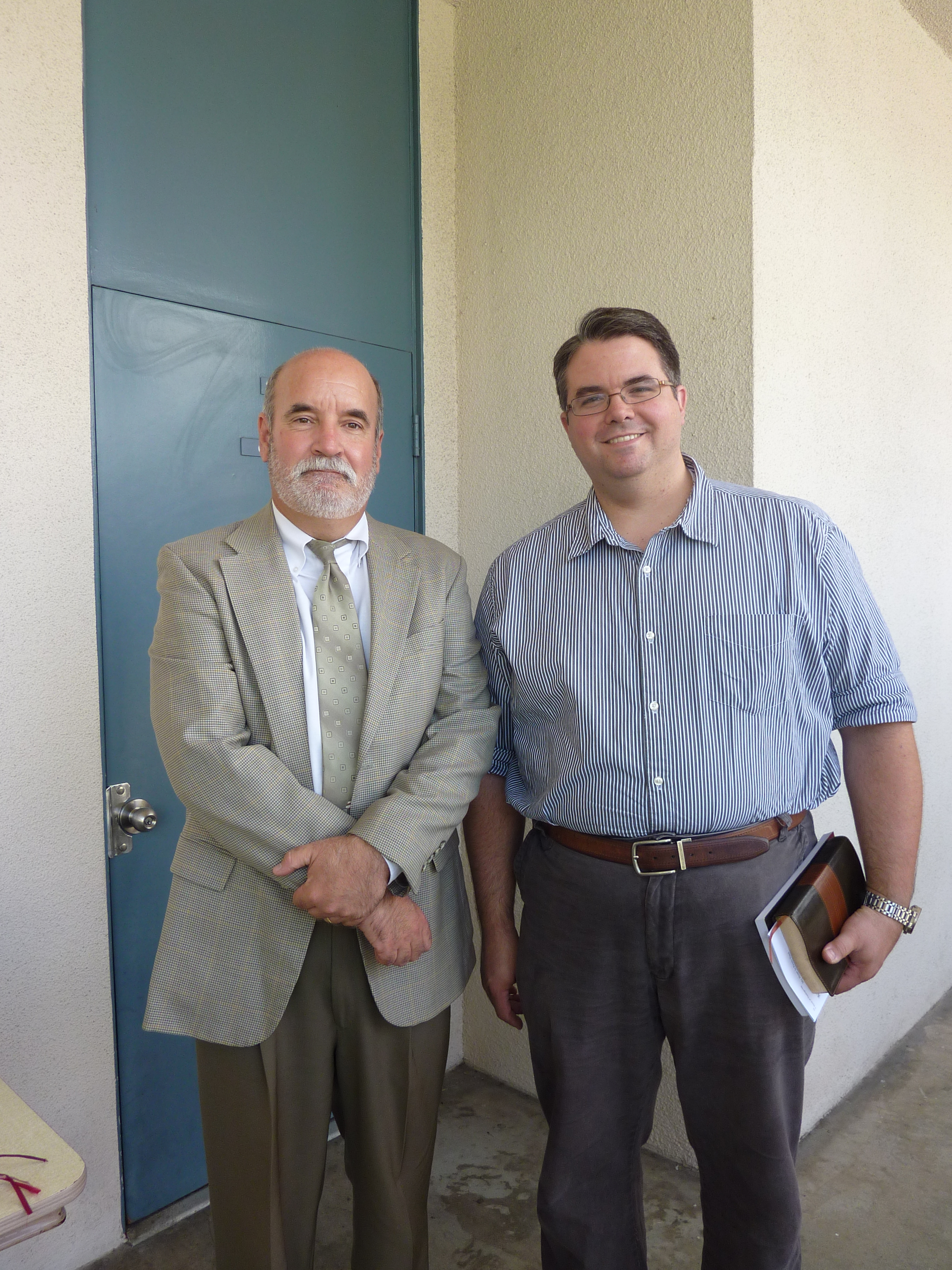
Dr. Kim Riddlebarger (Left) and myself (Right) after services at Christ Reformed Church, Anaheim, CA.
Dr. Riddlebarger illustrates the history of redemption and the end times by the image of a Mall Directory with it’s “You Are Here” sign. He writes:
The practical ramifications of finding the “You Are Here” arrow are immediately apparent. Since we live in the post-apostolic age—some two thousand years removed from the time of the apostles—how do we relate to the apostolic age so long ago? Should we do as many Pentecostals do and understand the dramatic events found in the book of Acts as normative for what should go on in the church today? Or should we see ourselves as living in a different age entirely—one that has little or no connection to the time of the apostles?
We can push this matter even further. How do we as Christians living in the post-apostolic age relate to the old covenant era that preceded the time of the apostles? Can we look to the history of ancient Israel to help us understand how we are to relate to non-Christians around us? Should we look to the monarchy in Israel for guidance as to how the nations of the earth should govern themselves in the modern world?
These questions find their answers in knowing where we are in terms of the progress of history after the close of the canon of Scripture with the composition of the book of Revelation, written in the early- to mid-nineties of the first century. For those of us who live nearly two thousand years after “Bible times,” where do we place the “You Are Here” arrow? In order to place that arrow properly, we need to have a good understanding of what has gone before, especially since those living during the apostolic era (that is, Jesus and the apostles) told us what to expect after the close of the apostolic age.
We are also introduced to the so-called “Already/Not Yet” approach to the Kingdom of God in the New Testament:
In the so-called prison letters (Ephesians, Philippians, and Colossians), Paul speaks of a believer’s heavenly citizenship (Phil. 3:20) based on the believer’s assurance that Jesus’ bodily resurrection guarantees our own resurrection at the end of the age (Phil. 3:21). Paul also tells us to seek the things above where Christ is (Col. 3:1-3) because this gives us a heavenly perspective on earthly things. Paul reminds us that all those who trust in Christ are seen as though they were already raised with Christ and seated with him in the heavenly realms (Eph. 2:4-7). For Paul, Christ’s death and resurrection (the critical historical events of the apostolic era) ensure our own salvation and grant us a heavenly perspective on earthly things. Even though the “You Are Here” arrow is placed in our own day and age some two thousand years after the apostolic age, the placement of the arrow itself must be seen as the guarantee that the same Savior—who was crucified, died, and was buried—will also ensure we reach our final goal: the redemption of our bodies and life eternal.
This future hope based upon certain historical events reflects another major theme running throughout the New Testament: What God has done in Jesus Christ (“the already”) ensures that everything God has promised his people will come to pass (“the not yet”). Paul speaks this way in Romans 8:23-25 when he talks of understanding our present sufferings in the light of that glory yet to be revealed when Christ returns at the end of the age. Because we trust in the finished work of Jesus Christ, we are indwelt by the Holy Spirit, who not only grants us hope (based on what God has already done for us through the doing and dying of Jesus), but the Spirit’s indwelling is itself the guarantee of the redemption of our bodies (Eph. 1:13-14).
This “already/not yet” perspective on things reminds us that we are pilgrims making our journey to the heavenly city. Although God has ordained all things in this life—giving everything we do meaning and purpose—the journey is not complete until we reach our final destination. Like the ancient Israelites who wandered through the wilderness of the Sinai desert awaiting entrance into the Promised Land of Canaan, we too look forward to our entrance into that heavenly city of which the earthly Canaan was but a dim shadow. Material blessings are not an end in themselves, but point to heavenly blessings far greater than our minds can conceive. This is what the author of Hebrews was getting at when he commended Abraham for looking beyond the land of the promise to what lies ahead at the end of the age (Heb. 11:9-10).
When we see God’s record of faithfulness in the past, we are able to look to the future, knowing that God keeps his promises. Knowing how things will turn out in the end gives us the “big picture” perspective we need to make sense of a life lived between the time of Christ’s first advent and his second. The “You Are Here” arrow makes sense only when placed on a map of the whole shopping mall. An arrow on a blank sheet of plastic does us no good. The same holds true for seeing our current place in redemptive history in the light of all God has done before we came along, knowing that Christ’s finished work is the guarantee of reaching our final destiny. The arrow makes sense only against the big-picture backdrop of redemptive history.
But what about the signs of the times? Here’s an excerpt of Dr. Riddlebarger’s treatment of them:
There are three categories of “signs” of the end in the New Testament. The first category of signs includes those that are specific to the apostolic era. The second group deals with those signs that characterize the entire interadvental age (the time between Christ’s first and second coming). The third group of signs includes those that specifically serve to herald the end of the age.
As for those signs that are specific to the apostolic age—those signs to be witnessed by the disciples in their lifetimes (“this generation,” Matt. 24:23)—there are four specific events foretold by Jesus. There will be false prophets, along with the arrest and persecution of the disciples (Matt. 24:9-14; Mark 13:9-13; Luke 21:12-19). Jesus also predicts the Roman siege of Jeru-salem, as the so-called “times of the Gentiles” begins (Luke 19:41-44; 21:24). Our Lord also speaks of the destruction of the city and the temple in A.D. 70 (Matt. 24:1-2; 14-22; Mark 13:1-2; 14-20; Luke 24:56; 20-24). Finally, Jesus speaks of the desolation and the Diaspora of Israel (Matt. 23:37-38), which came to pass with the complex of events associated with the Jewish Wars. These signs have been fulfilled with an amazing accuracy.
Then there are a series of signs that characterize the entire interadvental-period birth pains of the age to come. Jesus warns of false Christs (Matt. 24:3-8; Mark 13:3-8; Luke 21:7-11), wars and rumors of wars (Matt. 24:3-8; Mark 13:3-8; Luke 21:7-11), earthquakes and famine (Matt. 24:3-8; Mark 13:3-8; Luke 21:7-11), false teachers and false doctrine (2 Tim. 3:1-5), as well as the persecution of believers (2 Tim. 3:12-17). These things are not only present during the lifetimes of the apostles, but may be said to characterize the entire post-apostolic era. Given the presence of such things until our Lord returns, Jesus compared the interadvental age to the days of Noah (Matt. 24:37-38). God has announced that judgment is at hand, yet unbelievers go on with their immorality as though nothing important was about to happen.
Finally, the New Testament speaks of certain signs that particularly serve to herald the end of the age and the return of our Lord. The first such sign is that the gospel must be preached to the ends of the earth (Matt. 24:14)….
The second sign that foretells of the end is the salvation of “all Israel” as recounted by Paul in Romans 11:25-26….I take Paul to be speaking of the dramatic conversion of large numbers of ethnic Jews immediately before the time of the end as gospel progress rebounds from a largely Gentile mission to a Jewish one. I understand “all Israel” to be a reference to those ethnic Jews who embrace Jesus as their Messiah because God once again has mercy upon his ancient people. These folk become members of Christ’s church as a testimony to the grace of God. This mass conversion of “all Israel” tells us the end is at hand….
The land promise God made to Abraham (Gen. 15:18-21) has already been fulfilled—at least that is what Joshua reports (Josh. 23:14). It is Paul who universalizes the original land of promise far beyond the narrow confines from the rivers of Egypt and the Euphrates to include the whole world (Rom. 4:13). Although Israel’s national role in redemptive history has run its course with the coming of Jesus, when we see large number of Jews becoming Christians we know that the end is rapidly drawing near. The presence of a modern nation-state of Israel in the ancient land of promise is certainly tied to God’s mysterious purposes for the Jews, because all of the promises God made to the true children of Abraham (those Jews and Gentiles alike), who believe the promise and receive the Holy Spirit, have come to pass because Christ has come and the gospel has been preached to the Gentile nations….
The third sign of the impending dawn of the end of the age is a great apostasy, which is closely connected to the appearance of the man of sin (“the antichrist”), who is the final eschatological enemy of the church (2 Thess. 2:1-12; Rev. 20:7-10). Although Christians have often been tempted to see any moral decline in their own age as a sign of the end, the final apostasy will surpass anything witnessed to date. Even though there have been many “wannabe” antichrists since the apostolic era, and many of the signs associated with the antichrist have been present to some degree throughout the post-apostolic period, at some point in the future God will cease his restraint of the mystery of lawlessness (2 Thess. 2:7), when Satan is released from the abyss (Rev. 20:7-10). Only then will the final antichrist appear, soon to be crushed by Jesus at his return.
When this final apostasy occurs and the final antichrist is revealed, God’s people will face horrific persecution from a reinvigorated beast (the state) and its leader (the antichrist) who insist that the people of God declare “Caesar is Lord.” This is the one thing Christians will refuse to do, while at the same time refusal to do so is that which provokes the beast to its great fury against the people of God. Thankfully, the reign of this archenemy of Christ and his people will be short, as he is revealed only to go to his destruction (2 Thess. 2:8; Rev. 20:7-10).
Although it would behoove you to invest in a subscription to Modern Reformation Magazine to read the entire article for yourself, and benefit from the other helpful features, I’ve pretty much given you the heart of the article. I don’t want you to wonder as you wander, unnecessarily fearing things you shouldn’t as you look forward to the return of Christ. Reformed theology in general, and Reformed Amillennial eschatology in particular, is a liberating, comforting and most importantly, Biblical approach to our redemption in Christ from “In” (see Genesis 1:1) to “Amen” (see Revelation 22:21).
David Prays Like a Calvinist
“What do you have that you did not receive? If then you received it, why do you boast as if you did not receive it?” 1Corinthians 4:7
Since the turn of the New Year, our family decided to work our way together through the ESV Study Bible reading plan. Each night, we stop what we’re doing for a good half hour or so, and take turns reading aloud each of the four sections of Scripture, as divided up in the plan. A few days ago, we finished the book of 1 Chronicles, and this prayer of David’s caught my attention:
Therefore David blessed the LORD in the presence of all the assembly. And David said: “Blessed are you, O LORD, the God of Israel our father, forever and ever. Yours, O LORD, is the greatness and the power and the glory and the victory and the majesty, for all that is in the heavens and in the earth is yours. Yours is the kingdom, O LORD, and you are exalted as head above all. Both riches and honor come from you, and you rule over all. In your hand are power and might, and in your hand it is to make great and to give strength to all. And now we thank you, our God, and praise your glorious name.
“But who am I, and what is my people, that we should be able thus to offer willingly? For all things come from you, and of your own have we given you. For we are strangers before you and sojourners, as all our fathers were. Our days on the earth are like a shadow, and there is no abiding. O LORD our God, all this abundance that we have provided for building you a house for your holy name comes from your hand and is all your own. I know, my God, that you test the heart and have pleasure in uprightness. In the uprightness of my heart I have freely offered all these things, and now I have seen your people, who are present here, offering freely and joyously to you. O LORD, the God of Abraham, Isaac, and Israel, our fathers, keep forever such purposes and thoughts in the hearts of your people, and direct their hearts toward you. Grant to Solomon my son a whole heart that he may keep your commandments, your testimonies, and your statutes, performing all, and that he may build the palace for which I have made provision.”(1 Chronicles 29:10-19 ESV, emphasis mine)
When reading through the passage above, I had to chuckle a little, as I was reminded of this passage from Charles Spurgeon’s sermon, “Free Will—A Slave.”
Your fallen nature was put out of order; your will, amongst other things, has clean gone astray from God. But I tell you what will be the best proof of that; it is the great fact that you never did meet a Christian in your life who ever said he came to Christ without Christ coming to him. You have heard a great many Arminian sermons, I dare say; but you never heard an Arminian prayer—for the saints in prayer appear as one in word, and deed and mind. An Arminian on his knees would pray desperately like a Calvinist. He cannot pray about free-will: there is no room for it. Fancy him praying, “Lord,I thank thee I am not like those poor presumptuous Calvinists. Lord, I was born with a glorious free-will; I was born with power by which I can turn to thee of myself; I have improved my grace. If everybody had done the same with their grace that I have, they might all have been saved. Lord, I know thou dost not make us willing if we are not willing ourselves. Thou givest grace to everybody; some do not improve it, but I do. There are many that will go to hell as much bought with the blood of Christ as I was; they had as much of the Holy Ghost given to them; they had as good a chance, and were as much blessed as I am. It was not thy grace that made us to differ; I know it did a great deal, still I turned the point; I made use of what was given me, and others did not—that is the difference between me and them.” That is a prayer for the devil, for nobody else would offer such a prayer as that. Ah! when they are preaching and talking very slowly, there may be wrong doctrine; but when they come to pray, the true thing slips out; they cannot help it. If a man talks very slowly, he may speak in a fine manner; but when he comes to talk fast, the old brogue of his country, where he was born, slips out. I ask you again, did you ever meet a Christian man who said, “I came to Christ without the power of the Spirit?” If you ever did meet such a man, you need have no hesitation in saying, “My dear sir, I quite believe it—and I believe you went away again without the power of the Spirit, and that you know nothing about the matter, and are in the gall of bitterness and the bond of iniquity.” Do I hear one Christian man saying, “I sought Jesus before he sought me; I went to the Spirit, and the Spirit did not come to me”? No, beloved; we are obliged, each one of us, to put our hands to our hearts and say—
“Grace taught my soul to pray,
And made my eyes to o’erflow;
‘Twas grace that kept me to this day,
And will not let me go.”
Is there one here—a solitary one—man or woman, young or old, who can say, “I sought God before he sought me?” No; even you who are a little Arminian, will sing—
“O yes! I do love Jesus—
Because he first loved me.”
So you see, that in attributing to the LORD himself all that David and the people freely and willingly did, David betrays a theology that is not unlike that theology which has been derived from Scripture from the earliest days of the church, against which the ungrateful and self-sufficient regularly hurl accusations. Augustine’s prayerful confession of God’s absolute sovereignty and grace to empower the believer’s very obedience provoked Pelagius to twist Scripture to his own destruction in order to make man the source of his own salvation; Calvin’s systematization of this Biblical and Augustinian faith entrusted to him by his fathers in the faith provoked, after his death, a Dutch Reformed theologian named Jakob Hermanszoon, that is, Jacob Arminius (in Latin), to, if not distort the Word as devastatingly as Pelagius had before him, so distort the doctrines of grace that his followers would later remonstrate against them, creating the need for the Synod of Dort, which produced the world famous Canons of Dort (find them at my Creeds, etc. page) which serve as the source and inspiration of the infamous, yet Biblical acronym, TULIP. Even Great Awakening revivalist, George Whitefield endured the fiery darts of his beloved friend and fellow revivalist, John Wesley. How gracious is the Lord, who generously grants salvation to even those who do not properly recognize his absolute sovereignty, suffering the remaining sin within them which persists in grasping for some way to have a hand in his own eternal salvation.
Praise the Lord that King David’s eyes were clear in this regard as he lead the people of Israel in freely and willingly making generous donations toward the planned building of the temple in Jerusalem, which was entrusted to David’s son, Solomon. King David’s public confession of their unworthiness to even do so at all, and acknowledgement of the LORD’s gracious provision of the very materials which they would freely and willingly offer, contrasts sharply with the self-congratulatory words of that proto-Pelagian king, Nebuchadnezzar, who would one day take David’s kingdom into the original Babylonian captivity (see Daniel 4:28-33).
How beautiful is the corporate confession of the Reformed in this regard! In the words of the Belgic Confession (also linked to from the Creeds, etc. page), the Reformed confess the teaching of the Scriptures that “’A person cannot receive even one thing unless it is given him from heaven(John 3:27’” and so confess:
Therefore we reject everything taught to the contrary concerning man’s free will, since man is nothing but the slave of sin and cannot do a thing unless it is “given him from heaven.”
For who can boast of being able to do anything good by himself, since Christ says, “No one can come to me unless my Father who sent me draws him”? (John 6:44)
Who can glory in his own will when he understands that “the mind of the flesh is enmity against God”? (Romans 8:7) Who can speak of his own knowledge in view of the fact that “the natural man does not understand the things of the Spirit of God”? (1 Cor. 2:14)
In short, who can produce a single thought, since he knows that we are “not able to think a thing” about ourselves, by ourselves, but that “our ability is from God”? (2 Corinthians 3:5)
And therefore, what the apostle says ought rightly to stand fixed and firm: “God works within us both to will and to do according to his good pleasure.” (Philippians 2:13)
For there is no understanding nor will conforming to God’s understanding and will apart from Christ’s involvement, as he teaches us when he says, “Without me you can do nothing.” (John 15:5)
In this way it is clear that the content of King David’s “Calvinist” prayer demonstrates how consistent with Scripture is the Reformed confession of faith.
A Review of Dr. John Fesko’s Lecture on Word, Water and Spirit, part 3

In Part II of Dr. John Fesko’s book, Word, Water and Spirit: A Reformed Perspective on Baptism (2010, Reformation Heritage Books), he, in 3 chapters deals with the Biblical data related to baptism as “New Creation” (chapter 8), “Covenant Judgment” (9) and as “Eschatalogical Judgment” (10). The following is my summary of his remarks on this material at the Christ Reformed Church Friday Night Author’s Forum in Anaheim, California last Friday, January 21, 2011.
When you look at New Testament texts that teach about baptism, not merely the occurrences of the event, but which present the theology behind the event, the passages tend to point back to Old Testament passages and concepts. In 1Peter 3, the apostle shows the correspondence between the flood and baptism:
For Christ also suffered once for sins, the righteous for the unrighteous, that he might bring us to God, being put to death in the flesh but made alive in the spirit, in which he went and proclaimed to the spirits in prison, because they formerly did not obey, when God’s patience waited in the days of Noah, while the ark was being prepared, in which a few, that is, eight persons, were brought safely through water. Baptism, which corresponds to this, now saves you, not as a removal of dirt from the body but as an appeal to God for a good conscience, through the resurrection of Jesus Christ, who has gone into heaven and is at the right hand of God, with angels, authorities, and powers having been subjected to him.(1 Peter 3:18-22).
Elsewhere, the apostle Paul mentions the Israelites were baptized while crossing the Red Sea.
For I want you to know, brothers, that our fathers were all under the cloud, and all passed through the sea, and all were baptized into Moses in the cloud and in the sea, and all ate the same spiritual food, and all drank the same spiritual drink. For they drank from the spiritual Rock that followed them, and the Rock was Christ. Nevertheless, with most of them God was not pleased, for they were overthrown in the wilderness (1 Corinthians 10:1-5).
Notice that not only did the adults of the nation of Israel cross the sea and so become baptized into Moses, but so did the entire households of those adults, which necessarily includes any and all infants that were present at the time. Even the cloud, we learn, typifies the Holy Spirit in 1 Corinthians 10, says Dr. Fesko (see Isaiah 63:10-14).
Colossians 2:11-12 has been the field of a pitched battle between credobaptists and paedobaptists:
In him also you were circumcised with a circumcision made without hands, by putting off the body of the flesh, by the circumcision of Christ, having been buried with him in baptism, in which you were also raised with him through faith in the powerful working of God, who raised him from the dead (Colossians 2:11-12).
Critical of the paedobaptist appeal to such a correspondence between circumcision and baptism based on this text, some Baptists argue that circumcision is a physical, national rite–the “Jewish passport,” if you will–whereas baptism is entirely spiritual. To this, Fesko responds by pointing out that water of baptism is physical. Old Testament circumcision had spiritual connotations as well as baptism. For example, in Deuteronomy 10:16, the Israelites are commanded to circumcise their hearts. “Circumcise therefore the foreskin of your heart, and be no longer stubborn” (Deuteronomy 10:16). Later, we find that in chapter 30, this command becomes a promise, when Moses proclaims that the LORD will circumcise their hearts. “And the LORD your God will circumcise your heart and the heart of your offspring, so that you will love the LORD your God with all your heart and with all your soul, that you may live” (Deuteronomy 30:6). Paul in Romans 2:28-29 says the true Jew has had his heart circumcised.
“For no one is a Jew who is merely one outwardly, nor is circumcision outward and physical. But a Jew is one inwardly, and circumcision is a matter of the heart, by the Spirit, not by the letter. His praise is not from man but from God (Romans 2:28-29).
Thus Fesko describes the spiritual referent of circumcision.
But why was the act of circumcision chosen to serve as the sign of the covenant in the first place? Remember the first gospel promise in Genesis 3:15?
“And I will put enmity between you and the woman, and between your seed and her seed; he shall bruise you on the head, and you shall bruise him on the heel” (Genesis 3:15 NASB).
It is the seed of the woman who will bruise the serpent’s head. Elsewhere in the Old Testament, it is the seed of Abraham who will be “cut off.” The prophets applies the terminology of circumcision to the cross of Christ. Consider Isaiah’s great 53rd chapter alludes to circumcision in the sacrificial death of the Servant of the LORD: “By oppression and judgment he was taken away; and as for his generation, who considered that he was cut off out of the land of the living, stricken for the transgression of my people?” (Isaiah 53:8)
In Genesis 17, those who are circumcised are included in the covenant, and those who are not are said to be “cut off” from covenantal relationship with the LORD.
He who is eight days old among you shall be circumcised. Every male throughout your generations, whether born in your house or bought with your money from any foreigner who is not of your offspring, both he who is born in your house and he who is bought with your money, shall surely be circumcised. So shall my covenant be in your flesh an everlasting covenant. Any uncircumcised male who is not circumcised in the flesh of his foreskin shall be cut off from his people; he has broken my covenant” (Genesis 17:12-14).
Finally, the sex of the recipient of circumcision was significant in its allusion to the fact that the Seed of Abraham to come, who would be cut off for his people, would be a male—the Lord Jesus Christ. These are some of the reasons that the act of circumcision is the appropriate sign of the Covenant of Grace. Therefore it makes sense that when we go to the New Testament, we find in Colossians 2 that when Paul makes reference to the “circumcision of Christ,” it is to his crucifixion, when Christ was cut off for his people, that he refers.
But why is it, then, that circumcision is replaced as the sign of the Covenant of Grace by a rite such as water baptism? What is it about the application of water that so well fulfills in the New Testament the significance of Old Testament circumcision? In the opening of the Gospels, John the Baptist announces:
“I baptize you with water for repentance, but he who is coming after me is mightier than I, whose sandals I am not worthy to carry. He will baptize you with the Holy Spirit and fire. His winnowing fork is in his hand, and he will clear his threshing floor and gather his wheat into the barn, but the chaff he will burn with unquenchable fire” (Matthew 3:11-12).
Did John simply pull this ceremony out of thin air? Did he appropriate the immersion ceremonies of the Qumran community with whom he is considered to have possibly resided for a time? Was he simply applying Jewish proselyte baptism to repentant Jews? In the case of Jewish proselyte baptism, Dr. Fesko’s research seemed to indicate that, in fact, this baptism may have been devised only sometime after Christians began baptizing in the name of Jesus, and it may have been that they did so in imitation of Christian baptism. Instead, Dr. Fesko affirms that the true point of origin of John’s baptism is found in the Old Testament itself.
Joel refers to an outpouring of the Spirit (Joel 2:28); again, the Genesis flood corresponds to baptism in Peter (1 Peter 3:18-22); Ezekiel’s vision of the Temple features water flowing out from underneath it which makes fruitful everything it touches (Ezekiel 47:1-12); in Isaiah, the Spirit is poured out, making the desert bloom like the garden of Eden (Isaiah 51:3; cf. 35:5-7). John, then, would have concluded from passages like these that the Messiah would come and would baptize his people in the Spirit. Therefore, now, under the New Covenant, we baptize young and old, male and female to testify to the fact that the Christ has come and fulfilled circumcision by being cut off for his people and he has baptized his people in the Spirit.
For the most part, baptism is presented as a blessing, but what about the baptized who apostatize? Is baptism somehow neutralized, or rendered ineffective? Dr. Fesko declares that there are no neutral encounters with the living God, according to the Word of God. You do not enter God’s presence and leave unchanged. The professing believer, and his household, receives the visible sign of the baptism of the Spirit either to their blessing or to their cursing. When Christ was crucified between two thieves, was the thief who asked him to remember him the only one affected by his encounter with the Son of God? No, the other thief, who mocked Christ, went to his doom. Scripture identifies Christ either as the Rock on which the believing fall upon, or he is the Rock which crushes those on whom it falls (Matthew 21:44). Thus, the revelation of Christ is double-edged.
Ministers often fear that when they see no tangible results to their preaching in terms of conversion, that perhaps the preaching of the Word is an ineffective enterprise. But the faithful minister who sees no results isn’t a failure, for the unresponsive will be judged. Just as the Old Testament prophets preached with no prospect of positive response. Isaiah was called to preach a message of judgment. Paul, in 2 Corinthians 2:14-16 says that ministers are either the fragrance of life to some, and the fragrance of death to others. Consider the warnings for unworthy reception of the Lord’s Supper—Paul indicated that for this reason, some were sick and dead among the Corinthians (1 Corinthians 11:27-32). Likewise, water baptism is either the water of new creation, or it is the water of judgment. Again, during the flood, those sealed in the ark were saved through the waters (1 Peter 3:20), while those outside of the ark were lost in judgment. Similarly, the Israelites in the exodus were saved through their Red Sea baptism, while their Egyptian pursuers were drowned (Exodus 14:26-29).
Subjecting the New Testament doctrine of baptism to the classical Protestant hermeneutic of the analogy of faith, by interpreting unclear passages in light of the clear parallel passages, demonstrates how it corresponds in many of its particulars to circumcision. I find it especially helpful to see how the connection between the two is found ultimately in the Lord Jesus Christ himself. The Great Seed of Abraham has been cut off from the covenant for the transgressions of his people, and he now baptizes his redeemed with cleansing influence of the Holy Spirit, but false professors who receive the sign of the Spirit’s cleansing will instead be burned with unquenchable fire (Matthew 3:11b-12).
Listen to This. . .
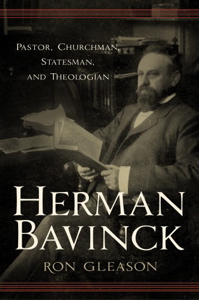
Cover of Herman Bavink: Pastor, Churchman, Statesman, and Theologian by Ron Gleason
Don’t miss these great podcasts this week.
- The White Horse Inn— “Exile, Exodus and Conquest“: On this program the hosts will explore the themes of exile, exodus and conquest showing how they each culminate in the great announcement that Jesus Christ has been given “all authority in heaven and earth” to judge, to save, and to reign forever.
- Christ the Center— “The Life and Thought of Herman Bavink“: Dr. Ron Gleason discusses his new intellectual biography, Herman Bavink: Pastor, Churchman, Statesman, and Theologian.
- Mid-Cities OPC Sermon—“Cleaning House in the Family of God” (Matthew 12:43-50). Preached by Pastor Joe Troutman on January 16, 2011. This is the church plant my family is visiting. I think you’ll appreciate Rev. Troutman’s preaching.
Heresy in Defense of the Fundamentals
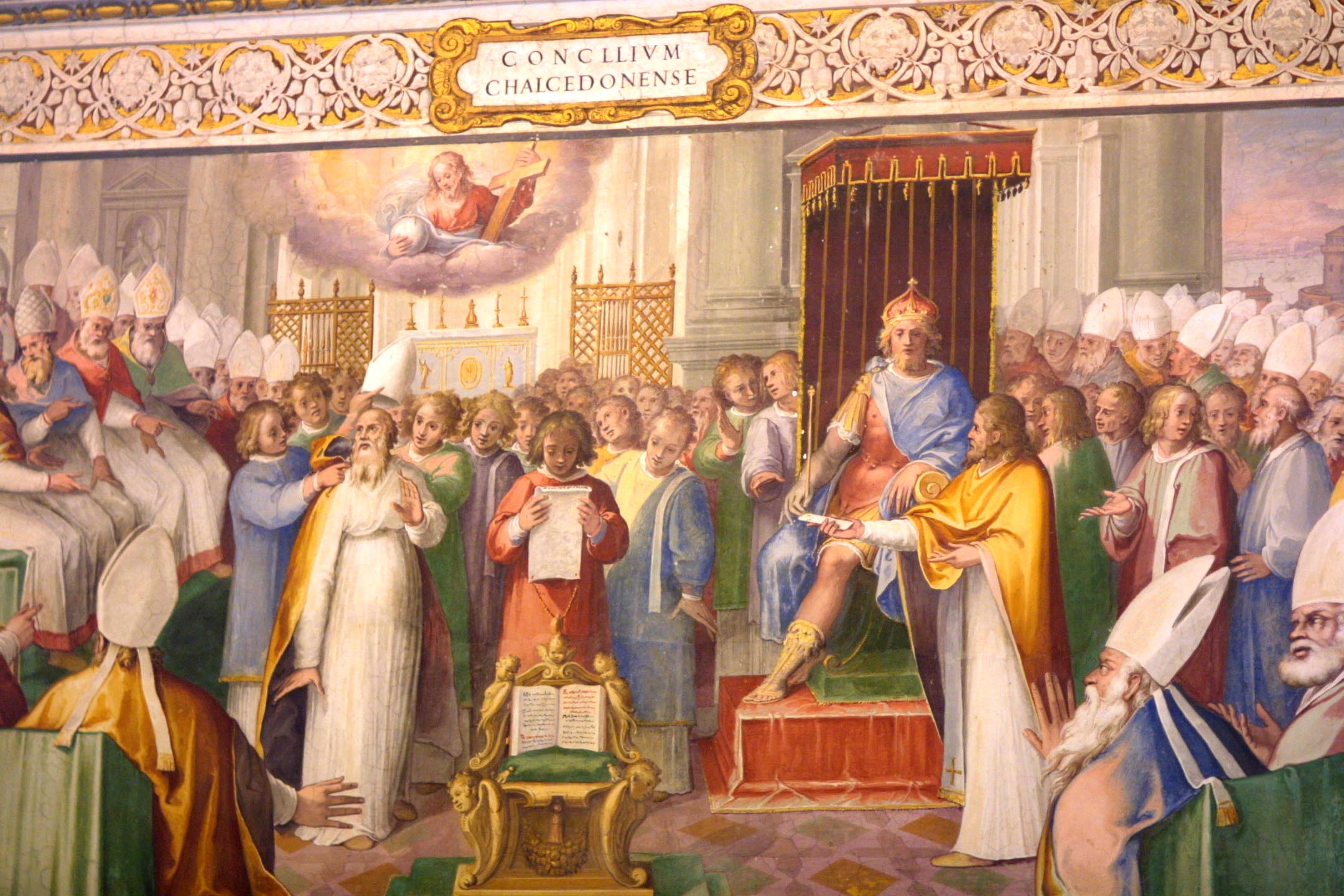
Council of Chalcedon, AD 451
“Since therefore the children share in flesh and blood, he himself likewise partook of the same things, that through death he might destroy the one who has the power of death, that is, the devil, and deliver all those who through fear of death were subject to lifelong slavery” (Hebrews 2:14-15 ESV).
Recently, I heard an Independent Fundamental Baptist preacher comment that he believes in salvation “by the blood of Christ, not his death.” One who heard this comment with me registered his shock at the statement. Having discussed this issue with this particular preacher in the past, I knew what he meant by it, and was able to fill in my companion. The following bullet points are a summary of the things I shared with him.
Suffice it to say that there is a segment of Independent Baptist Fundamentalism that so wants to defend the “literal” interpretation of Scripture that it will often deny simple figures of speech in Scripture to the extent that it begins to distort the very fundamentals it intends to defend. One such fundamental of the faith that has suffered such distortion is that of the hypostatic union of Christ’s human and divine natures, of which the historic conciliar statement produced by the Council of Chalcedon (AD 451) expresses the Biblical doctrine quite thoroughly and has served the church well in defining the orthodox position. Although an appeal to the so-called “Definition of Chalcedon” as an expression of Scriptural teaching on the matter falls on deaf fundamentalist ears, it does not change the fact that, historically speaking, for the Protestant as well as the Roman Catholic, to dissent from this Ecumenical Council on the hypostatic union is to be led by blind guides into the ditch of formal heresy. Sad to say, this is the fate of the kind of irresponsible Biblicism that often goes on in the Fundamentalist movement.
I’ve posted on this topic before here and here. The names I’ve used for this fundamentalist heresy are “Divine Blood” and “Celestial Flesh.” These titles describe the ways in which fundamentalists blur the distinction between Christ’s human and divine natures to a possibly heretical extent. This explains the use of these terms in the following bullet points:
- Divine Blood proponents believe a biological myth that the male seed provides the blood to the conceived egg (see this post).
- Divine Blood proponents believe in the seminal headship of Adam to the neglect of his federal headship. The Reformed affirm that seminal headship conveys actual moral corruption by means of “ordinary generation” (WCF 6.3), and that federal headship is the imputation of Adam’s guilt to all of his posterity (aka, “original sin”).
- Divine Blood proponents therefore conclude that sin itself is actually transmitted in human blood from Adam through the father to his offspring, and that therefore Christ was sinless primarily because he did not have a human father who would transmit his sin-tainted blood to him, thus making him a sinner.
- Divine Blood proponents misinterpret Heb 10:5 to teach that God the Father specially created an embryo and implanted it in Mary’s womb, so that Jesus was not the result of the supernatural fertilization of one of Mary’s eggs. This Christological error dates back to the radical reformation of the Anabaptist movement in a teaching called the “Celestial Flesh of Christ” (see this post).
- Divine Blood proponents believe that the references in Hebrews to a “greater and more perfect tabernacle” (Heb. 9:11-10:14) mean that Christ had to actually transport this divine blood shed on the cross into the presence of God after his resurrection, but before his appearance to the apostles, in a “literal” heavenly temple to pour it on a “literal” mercy seat. Little do they realize that Scripture elsewhere reveals Christ as the true Temple (see John 2:18-22; Heb. 10:20). Thus his sacrificial death, associated with and proclaimed as the fulfillment of the Old Testament sacrificial system by metonymous reference to his blood, is his offering of this ultimate sacrifice “once for all (time)” on the cross (Heb. 7:27; 9:12, 26; 10:10). His ascension and heavenly session actually serves as the anti-type to the references to the yearly repetition of the Aaronic priesthood which is contrasted with Christ’s sitting down at the right hand of the Father after making his ultimate once for all sacrifice (Heb. 10:11-14).
- Thus, Divine Blood proponents confuse the human and divine natures of Christ. If his blood isn’t ordinary human blood derived from a human conception, albeit overshadowed by the Holy Spirit, then his blood is less than fully human, a compromise of the historic orthodox interpretation of Scripture, which is exemplified by the Chalcedonian Definition. The confusion of Christ’s human and divine natures repeats the kind of mistake made by the monophysites of ancient church history. The “hypostatic union” of a completely human nature and a completely divine nature without confusing them or so separating them that they are no longer united in one person, Jesus of Nazareth, is the orthodox, biblical teaching on the God-Man. One should not define Christ’s human nature in terms of his divine attributes, nor define his divine nature in terms of his human attributes. To hold to a “celestial flesh” and “divine blood” view of Christ’s nature is just such an error.
I found an excellent, but lengthy, treatment of this doctrine by an Irish Reformed minister. If you’ve ever heard of this doctrine before, and are the least bit concerned about it, please invest the time in reading “Fundamentalists and the ‘Incorruptible’ Blood of Christ” by Martyn McGeown of Covenant Protestant Reformed Church in Ballymena, North Ireland. Although it’s by an Irish writer, much of his essay interacts with American fundamentalist contributions to the controversy as well.
God’s Law Reveals Your Misery
3. How do you come to know your misery?
A. The law of God tells me.1
1. Romans 3:20 “For by works of the law no human being will be justified in his sight, since through the law comes knowledge of sin.”
Romans 7:7-25 “What then shall we say? That the law is sin? By no means! Yet if it had not been for the law, I would not have known sin. For I would not have known what it is to covet if the law had not said, ‘You shall not covet.’ But sin, seizing an opportunity through the commandment, produced in me all kinds of covetousness. For apart from the law, sin lies dead. I was once alive apart from the law, but when the commandment came, sin came alive and I died. The very commandment that promised life proved to be death to me. For sin, seizing an opportunity through the commandment, deceived me and through it killed me. So the law is holy, and the commandment is holy and righteous and good.
“Did that which is good, then, bring death to me? By no means! It was sin, producing death in me through what is good, in order that sin might be shown to be sin, and through the commandment might become sinful beyond measure. For we know that the law is spiritual, but I am of the flesh, sold under sin. For I do not understand my own actions. For I do not do what I want, but I do the very thing I hate. Now if I do what I do not want, I agree with the law, that it is good. So now it is no longer I who do it, but sin that dwells within me. For I know that nothing good dwells in me, that is, in my flesh. For I have the desire to do what is right, but not the ability to carry it out. For I do not do the good I want, but the evil I do not want is what I keep on doing. Now if I do what I do not want, it is no longer I who do it, but sin that dwells within me. So I find it to be a law that when I want to do right, evil lies close at hand. For I delight in the law of God, in my inner being, but I see in my members another law waging war against the law of my mind and making me captive to the law of sin that dwells in my members. Wretched man that I am! Who will deliver me from this body of death? Thanks be to God through Jesus Christ our Lord! So then, I myself serve the law of God with my mind, but with my flesh I serve the law of sin.”
4. What does God’s law require of us?
A. Christ teaches us this in summary in Matthew 22: Love the Lord your God with all your heart and with all your soul and with all your mind [and with all your strength—KJV].1 This is the first and greatest commandment. And the second is like it: Love your neighbor as yourself.2 All “the Law and the Prophets” (the Old Testament) hang on these two commandments.
1. Deuteronomy 6:5 “You shall love the LORD your God with all your heart and with all your soul and with all your might.”
2. Leviticus 19:18 “You shall not take vengeance or bear a grudge against the sons of your own people, but you shall love your neighbor as yourself: I am the LORD.”
5. Can you live up to all this perfectly?
A. No.1 I have a natural tendency to hate God and my neighbor.2
1. Romans 3:9-20,23 “What then? Are we Jews any better off? No, not at all. For we have already charged that all, both Jews and Greeks, are under sin, as it is written: ‘None is righteous, no, not one;no one understands;no one seeks for God.All have turned aside; together they have become worthless;no one does good, not even one.’Their throat is an open grave;they use their tongues to deceive.’‘The venom of asps is under their lips.’‘Their mouth is full of curses and bitterness.’ ‘Their feet are swift to shed blood;in their paths are ruin and misery, and the way of peace they have not known.’‘There is no fear of God before their eyes.’ Now we know that whatever the law says it speaks to those who are under the law, so that every mouth may be stopped, and the whole world may be held accountable to God. For by works of the law no human being will be justified in his sight, since through the law comes knowledge of sin.”
“for all have sinned and fall short of the glory of God”
1 John 1:8,10 “If we say we have no sin, we deceive ourselves, and the truth is not in us.” “If we say we have not sinned, we make him a liar, and his word is not in us.”
2. Genesis 6:5 “The LORD saw that the wickedness of man was great in the earth, and that every intention of the thoughts of his heart was only evil continually.”
Jeremiah 17:9 “The heart is deceitful above all things, and desperately sick; who can understand it?”
Romans 7:23-24 “but I see in my members another law waging war against the law of my mind and making me captive to the law of sin that dwells in my members. Wretched man that I am! Who will deliver me from this body of death?”
Romans 8:7 “For the mind that is set on the flesh is hostile to God, for it does not submit to God’s law; indeed, it cannot.”
Ephesians 2:1-3 “And you were dead in the trespasses and sins in which you once walked, following the course of this world, following the prince of the power of the air, the spirit that is now at work in the sons of disobedience— among whom we all once lived in the passions of our flesh, carrying out the desires of the body and the mind, and were by nature children of wrath, like the rest of mankind.”
Titus 3:3 “For we ourselves were once foolish, disobedient, led astray, slaves to various passions and pleasures, passing our days in malice and envy, hated by others and hating one another.”
Rev. John Brown’s Original Preface
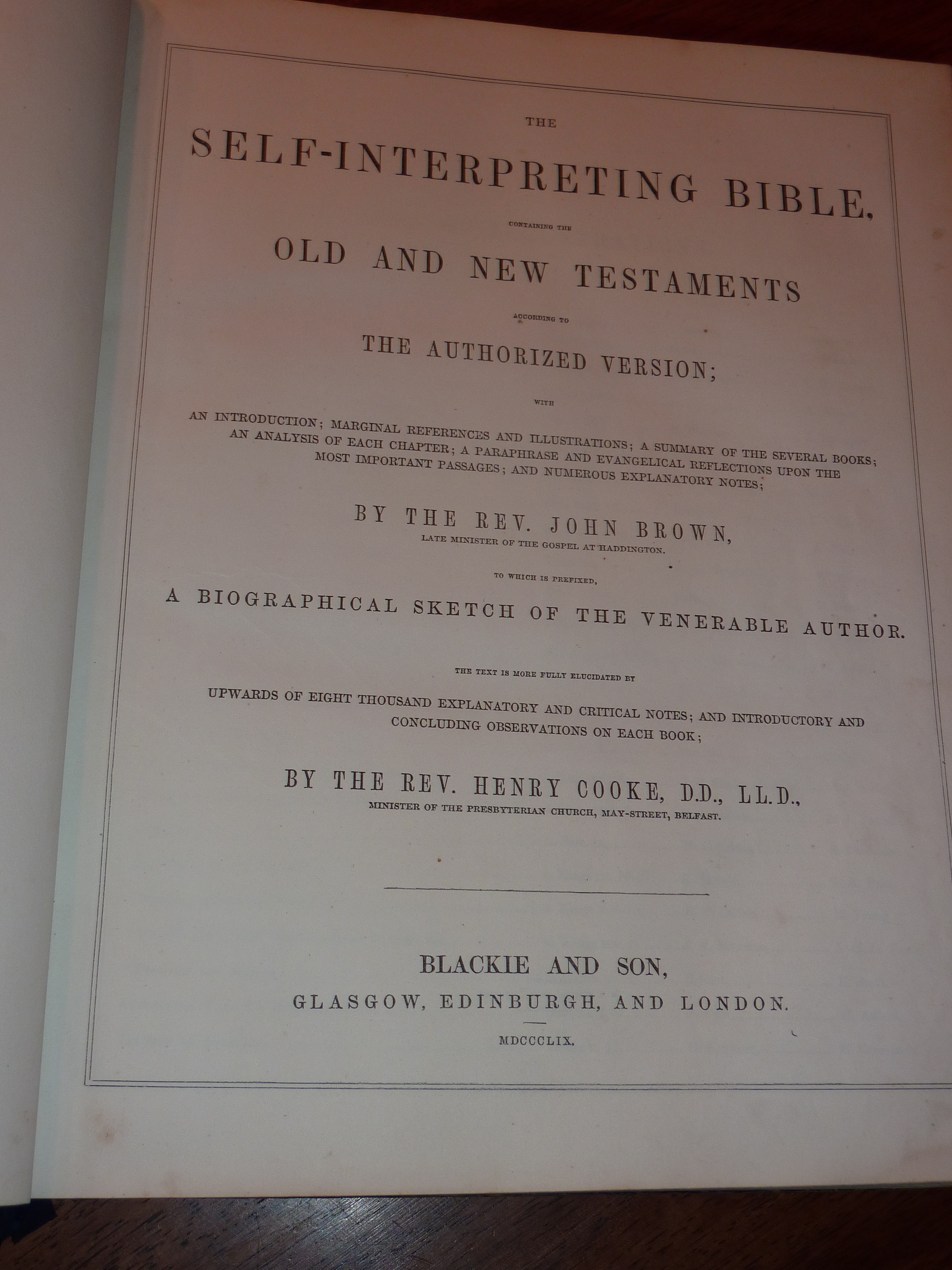
Title Page to Brown's Self-Interpreting Bible
The following is the original preface to Rev. John Brown’s Self-Interpreting Bible, in which he explains the various features he’s included, and shows how they will aid the reader in understanding and profiting spiritually from the Word of God. I’ve highlighted the features as they occur throughout. The rest is original to the editor.
My intention in the coming posts will be to demonstrate to varying degrees, each of these features, along with pictures of the numerous beautiful lithographs that are found along the way.
PREFACE TO THE ORIGINAL EDITION
Not to depreciate the valuable commentaries of Pool, Patrick, Clarke, Henry, Burkitt, Gill, and Doddridge, &c., but to exhibit their principal substance with all possible advantage, in a manner that might best comport with the ability and leisure of the poorer and labouring part of mankind; and especially to render the oracles of God their own interpreter, and enable every serious reader to judge for himself what doctrines ought to be believed, and what duties practiced by the Christian, are the avowed aims of this publication.
In the copious INTRODUCTION, the principal proofs of the Divine Authority of the Old and New Testaments, and the rules necessary to promote the profitable perusal of the oracles of God therein contained, are largely exhibited. The connected scheme of the Hebrew Laws, and their evangelical signification,–and of the fate of nations, narrated or predicted in Scripture, as subservient to the glorious work of our redemption,–together with the large Chronological Index,–form a summary of the most celebrated labours of the learned world on these diversified subjects. An accurate attention thereto will, through the blessing of God, greatly assist in searching the Scriptures with success.
The contents of the sacred books, and their respective chapters, are an accurate, full and explicatory representation of their subject. Properly attending to these, the reader must discern of whom, or of what, the Holy Ghost there speaks, and understand the passage accordingly. He may easily fix in his mind a general, but distinct view of the whole system of inspiration; and thus be capable, with the utmost readiness, to find out or compare whatever passages of Scripture he may desire.
The EXPLANATORY NOTES are chiefly confined to the figurative, the prophetic, and the practical parts. Here the obscurity of Scripture, or the importance of faith and holiness, chiefly required them.
In our Saviour’s delightful discourses, and the epistles of his inspired Messengers, our holy religion is most fully delineated; and there the explication is peculiarly extensive, and attempts to exhibit the substance of many learned and expensive commentaries, in a manner which, attending to the beautiful connexion, clearly unfolds the scope and meaning of the Spirit of God.
A particular and lively application of divine truth to the heart, and an unspotted holiness of conversation, being the immediate end of God’s revelations to men, the contents of each chapter, which are often in an explicatory manner, are in the Reflections practically summed up, and directed home to the reader himself, for enlightening his understanding, awakening his conscience, warming his heart, and for directing and animating his practice.
An exact knowledge of the seasons in which the oracles of God were delivered, or the events mentioned in them took place, being of no small importance for obtaining a distinct perception of their meaning, the dates before and after our Saviour’s incarnation have been adjusted from the best chronologers, and marked in the margin.

Lithograph of the Reverend John Brown of Haddington
But, as every Protestant must allow the Scripture itself to be its own best interpreter—as God, to oblige men to a diligent search of his word, comparing spiritual things with spiritual, has seldom fully unfolded any of his more important truths in one particular passage—the uncommon collection of Parallel Scriptures, such as is not to be found anywhere else that I know of, has formed the most laborious, and will, to the diligent peruser, be found by far the most valuable part of the work. Some of these are similar in phrase, others in meaning, and, in fine, others in their scope and design. In these, and others which may be added, we have a delightful view of the harmony of the Scripture, and multiplied proofs of every article of our Christian faith; we have a real Concordance, which may abundantly furnish preachers and others with their desired quotations; we have, in little room, a large Commentary, infinitely more certain than any dictates of men; and of which the very words are, as nails and as goads, pointed and fastened by the great Master of assemblies. In a truly diligent comparison of them, many texts all at once explain, and are explained by each other. Nor, unless at first, will the careful reader find much trouble in comparing the texts: but the mere view of the marginal quotations will direct his memory to that part of them which corresponds with the sentence to which they are annexed for explication. And, for his encouragement, I can only say, that my labour, in collecting the parallel texts in this work, has afforded me much more pleasant insight into the oracles of God than all the numerous commentaries which I ever perused.
Thus we may listen to, and converse with God, and lay our consciences open to the inspired arrows of our all-conquering Redeemer;–we find his words, and eat them, to the joy and health of our soul; we hide them in our heart, that we may not sin against him; we become mighty in the Scriptures, and expert in handling this sword of the Spirit, in opposition to every enemy of our soul: in fine, we are made wise unto salvation; are reproved, corrected, and instructed in righteousness, and perfectly furnished for every good work. May the Lord himself prosper it for these ends!
J. BROWN
Jesus Storybook Bible as a bible study material (via Mission NPIC)
The next time you’re in a Christian bookstore, see if you can find this book on their shelves. If so, look through it and you’ll see why this story makes perfect sense. I recall seeing a blogpost back when this book was first published that quoted the author’s pastor, Tim Keller, as saying that every pastor should read this book, because it would improve their preaching. It really is true!

via Mission NPIC
Should 1 John 5:7 Be In The Bible?
Interested in learning more? Select from this list of articles relevant to 1 John 5:7 at Bible.org.
Because the American Church is Losing Its Mind…
 …here is a helpful reminder of what it means to be an Evangelical who believes in the inspiration of Scripture. What follows is Michael Horton’s introduction to this past Sunday’s White Horse Inn radio show. Too many so-called “Bible believing Christians” have forgotten this…or never knew it. Now’s your chance. Then listen to the entire program here.
According to Jesus, the words of Scripture simply are identical with the word of God. The apostle Paul said that, “the Scriptures are breathed out by God,” and Peter said that, “no prophecy ever came from human initiative, but men spoke from God.” For its first sixteen centuries the Christian church enjoyed unanimous consensus concerning the nature of Scripture. This view came to be known as “verbal-plenary inspiration.” This means that the Bible is breathed out by God not only in its intended meaning but in its very words. In spite of all the other differences the Protestant Reformers and Rome agreed on this essential point. But this consensus was challenged by radical Protestant movements. The Protestant Reformers themselves faced the challenge of the radical Anabaptists who valued a supposedly “inner word” in their hearts, a direct immediate, and private revelation over the external word conveyed through Scripture and preaching. The Reformers called this “enthusiasm” meaning literally, “God withinism.” Like Adam after the fall our natural tendency is to want to bring ultimate authority inside our own hearts and minds under our control, instead of hearing an external word of command and promise from our covenant Lord.
By the time of the Enlightenment a full assault on the reliability, authority, and inspiration of Scripture penetrated theological academies and churches. Sometimes it came in the form of denials of any need for special revelation since general revelation and reason were thought to be sufficient. But in the Romantic era, through liberal theologians like Friedrich Schleiermacher, challenges came in the form of making anything and everything a medium of inspired utterance. Every impulse from the inner voice of the pious soul could be regarded as inspired. In Protestant Liberalism, then, we meet the convergence of radical Protestant enthusiasm and rationalistic criticism of God’s miraculous intervention. As a result the Bible came increasingly not as a written treasure of God’s communication to us, but as a record of our attempts to express in words that universal religious experience that is common to everyone. In this perspective inspiration doesn’t come to us from outside of ourselves as a characteristic of the Biblical texts, but from within individuals and communities and their spiritual experience.
Historically Evangelicals were known for defending a high view of Scripture against these challenges. The giants of old Princeton: Charles Hodge, A.A. Hodge, B.B. Warfield, helped to shape a new generation of conservative Protestants as mainline Protestantism became racked with debates over inspiration. Led by Carl Henry, John Stott, F.F. Bruce, and many other theologians and Biblical scholars, Evangelicalism provided a sustained defense of Scripture with two generations of fruitful successors. But today the old arguments against the classic Christian view of Scripture are being retro-fitted with new lingo and updated arguments. Even within Evangelical circles there is a growing tendency to treat the Bible more as a record of the evolving religious experience of the community rather than as a revelation from heaven through human agents. In this program we will unpack the meaning of Biblical inspiration and take a look at some of the challenges that we face today.
A Question of Chicken and Egg from John’s First Epistle
First John 5:1 reads “Everyone who believes that Jesus is the Christ has been born of God, and everyone who loves the Father loves whoever has been born of him.” Most contemporary fundamentalist and evangelical Christians miss the implication of the apostle John’s wording “has been born of God” as it relates to those who believe. Does this text imply that those who believe were first born of God? Does it therefore imply that regeneration precedes faith? Or must we deny this implication based on our preconceived notion that regeneration is not possible until after we make the right decision to choose to believe?
Reformed Baptist apologist, Dr. James White, has posted a short video explaining this passage in the light of the apostle John’s repeated use of the language “everyone who _____ has been born of God.” He explains that all agree that in the case of two other texts from the same epistle, 1 John 2:29 and 4:7, the apostle’s clear implication is that the action of the believer is the result, and therefore logically follows, the fact of his having been born of God. In these two passages, the actions are “practicing righteousness” (2:29), and “loving” (4:7). In other words, it’s easy to accept the idea that “everyone who practices righteousness has been born of God” at face value, and it is easy to agree that everyone who loves God and his neighbor is one who has been born of God. No one’s tradition teaches the contrary. However, when it comes to the exact same grammatical structure in the first verse of chapter five, we are told by many that we must not make the same inference that being born of God is the prerequisite of saving faith. Dr. White attempts to make the case that this is no more than reading one’s tradition into the text, rather than basing one’s interpretation of the verse on what the text demonstrably means. I agree with him. Watch the following video, and see if you, too, can agree with the apostle John that “everyone who believes that Jesus is the Christ has been born of God.”
When “Whosoever” Misseth the Point

Some of us think the chorus in "Whosoever Meaneth Me" sounds like the theme to Hogan's Heroes. Visit http://free-loops.com/download-free-loop-3481.html to listen and compare to the hymn's midi below!
For God so loved the world, that he gave his only begotten Son, that whosoever believeth in him, should not perish, but have everlasting life. (John 3:16 KJV)
For God so loved the world, that he gave his only Son, that whoever believes in him should not perish, but have eternal life (ESV)
For God loved the world in this way: He gave his one and only Son, so that everyone who believes in him will not perish but have eternal life. (HCSB)
The first citation of John 3:16 is from the King James Version, which contains—and established—the traditional wording of this verse, no less in the case of the highlighted phrase in question, “whosoever believeth.” The second updates, but carries this traditional translation forward, while the third, from the Holman Christian Standard Bible (HCSB), seems to have come a little closer to the literal meaning of the verse.
This can be seen by examining the original Greek, from which all three versions are translated: pas o pisteuo. Pas means “all,” “any,” “each,” “everyone,” “all things,” etc., in individual contexts like this one, but it is usually found in collective contexts, where it means “some of all sorts.” This is the word that is translated “whosoever” in the King James Version, “whoever” in many modern translations like the ESV, and “everyone” in the HCSB. The NET Bible has some helpful notes in this regard, which may be accessed here.
In the great debate between Calvinists and Arminians about the extent of Christ’s atonement, the latter camp has, in an effort to emphasize the fact that Jesus died for everyone without distinction, turned the KJV’s “whosoever” into three words: “For God so loved the world, that he gave his only begotten Son, that Who … So … Ever (!). With often little regard for the context of this verse, Arminians will focus on this one little three letter Greek word, and seemingly make it the point of the passage, which it is not.
Pas is not the only word in this phrase. “Everyone” in this context does not stand alone. It is modified by the action taken by each member in the group of people so identified. The action they take is pisteuo: “believing.” So, the first thing we must clarify is that this verse is not intended to state or imply the number of people for whom Christ died; it merely expresses the purpose behind the Father’s giving of the Son to the world: to grant eternal life to pas (everyone) o (who, or that) pisteuo (believes).
On the Nov. 17 episode of The Dividing Line, Dr. James White explained why “whosoever,” “whoever,” and “everyone” are used to translate pas. He said that when pas is used with a singular participle (in this case, “believes”), what is being communicated is a group that is defined by the action in that participle. Since the emphasis of the verse is on the mutual activity of the group, rather than the indistinct universality of the group itself, perhaps it may help direct our attention to “believes” if translators rendered pas o pisteuo as “all those who believe,” or just “those who believe.” But I’m no scholar.
Therefore, pas o piteuo makes neither of the following Arminian emphases:
- It does not mean that God sent Jesus to propitiate the Father in his death for everyone indiscriminately;
- It does not mean that everyone indiscriminately has the inherent moral ability to believe.
What this phrase does mean, though, is that God loved the world by sending his only Son in order to grant eternal life to those, and only those, who actually come to faith. If God sent his only Son to die for everyone indiscriminately, then everyone indiscriminately would come to faith, for he would have, with the atonement, granted faith to everyone indiscriminately. If everyone indiscriminately had the inherent moral ability to obey the command to believe, then God’s Word would be untrue (Romans 8:7; Ephesians 2:8,9).
Let us not read things into the Word of God which are not there. John 3:16 is not a proof text for general redemption (the doctrine that Christ died for everyone indiscriminately), nor a view of human sinfulness that leaves room for some amount of inherent righteousness that enables the self-determining sinner (which creature does not exist) the ability “of his own free will” to “decide to follow Jesus” without the prior work of the Holy Spirit’s effectual calling (Romans 8:30).
Are you one of those who’ve come to believe in the one and only Son of God? Then you have received the Father’s saving love in the gift of his Son who became incarnate for you, obeyed God’s Law perfectly for you, died suffering the consequences of your sin, and rose on the third day that you also might be raised up to eternal life spiritually now (regeneration), and physically upon his return (resurrection). I urge you to do what you can to reciprocate his love by Spirit-empowered love for him and your neighbor. We love because he first loved us.
“Whosoever Meaneth Me?” (audio) “Whosoever” means all those, and only those, who believe.
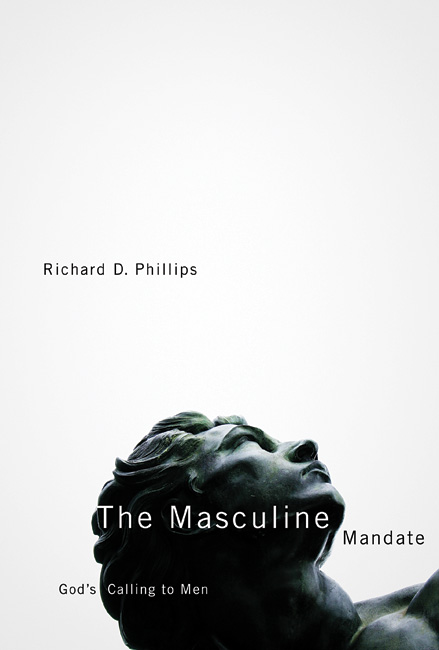
The Masculine Mandate, part 3
In this post, Richard Phillips gets into the details of his exposition and application of the “masculine mandate” in Genesis 2:15.
 Host: I was in a church where home men’s groups were reading this book (Wild at Heart) and going off on men’s trips. I remember thinking, “Well, what is distinctively Christian about this? I mean, it’s good that we want men to be men, and to be tough, and I actually expected to have more of that in your book since you’re a tank commander. And, you know, to have more of this emphasis on men being manly men, and that’s a good emphasis, and it’s right, but, I really liked how in the book you bring out the story of the professional dirt bike racer . . . Brian Deacon . . . talked about doing all of that before he was in Christ. He was doing all of those manly things, but that’s not what made him a man, but knowing what God’s will for him and knowing the Lord is.
Richard Phillips: A couple of years ago, I was speaking at a men’s conference. So I’m sitting at a barber shop, and I’m reading ESPN Magazine. They have an article about Brian Deacon, this hooligan, X-game, trick-bike jumper. He’s like the Michael Jordan of that quasi-sport. He has a near-death crash. He got his girlfriend pregnant, and she’s off living with her parents. Meanwhile, he has this nationally televised crash, and he loses half his blood, and he goes to his girlfriend’s house to be medically rehabilitated. Meanwhile, she’s been converted to Christ at her parents’ church. He starts going to the parents’ church, and he gets converted. He heals up, and he comes back to the Metal Militia and starts leading a Bible study, and, one by one, leads most of these guys … he leads them all, one by one, to Christ.
Then I read another interview, where the typical thing’s happening: some guys saying, you know, “Dude, you’ve change! What happened to you? You’re Brian Deacon!” And Deacon says, “You know what? I’ve realized that I’ve got to become a man.” Now, the last thing this guy needs to be told is that being a man is going off on ego trips (see parts 1 & 2). You know, what he needs to be told is what his duty is as a husband and father biblically and what biblical love is. And biblically, what it means to be a covenantally faithful man. And I’m reading all this stuff, and I’m thinking, “I gotta write a book on this.”
Host: So let’s talk about that. The mandate involves two aspects, working and keeping; that’s what man was placed in the garden to do. Could you help us to understand what you mean by “work”? What is man’s specific duty in working, and what is he supposed to do?
Richard Phillips: Yeah, thanks. The two in the Hebrew, the two verbs are abad and shamar. Very simple, basic Hebrew words appear hundreds of times in the Old Testament. They’re kind of, you know, building block common verbs.
Abad, in a construction context, means “to build.” In a Temple context, it’s used of the priests serving the Temple. And in an agricultural setting, such as the garden, it’s used as farming. You know, cultivating, causing things to grow. And, what we see is, the man is given the mandate by God–and this is all in the agricultural meaning–what God calls a man to do. The first thing is, that he is to engage in labor that is to have the result of causing good things to grow. Now that alone is paradigm shifting.
Now one thing that strikes me is that in American culture, we don’t think of the man as the nurturer. Biblically he is. I’m not saying women aren’t nurturers. But I am saying that it is the role of a man in a relationship to grow and cultivate and engage in activity and ministry and labor that will cause others to grow. It may be to cause a business to grow. In marriage, it means your job is to, your wife’s heart is the garden in which you’re to have a spade and you’re to minister in that garden so that she grows spiritually.
I mean, you know, as a pastor, how often do I have someone come into my office and say, “Help, pastor. I’ve got a lot of problems in my relationship with my mother.” The answer is, virtually never. It may happen once or twice, you know. But how often do I have someone come and say, “Oh, my relationship with my dad…” All the time. Why? Because the father is the one through whose ministry we gain so much of our identity and who we are, and the cultivation of character and faith and all those things result from the man’s role.
And so, it’s enormously helpful for Brian Deacon to be told, “Hey, Brian, if you want to be a man now, what you are to do is, like Adam, you’re put by God to work the garden. To engage in sacrifical ministry that would cause us to grow. You’re to do that in all your relationships. And so the book works that out. First in principle, that in various relationships–marriage, fatherhood, church, friendship, those kinds of things.
The other verb is shamar. Another very common word. It means “to watch over and protect.” In Psalm 121, “the LORD will keep you.” The LORD watches over you, he neither slumbers nor sleeps. He will keep your life. That’s shamar. And so, Adam was placed by God into his covenantal world of relationships and duties, to cause the garden to grow and to keep the garden safe. And likewise, godly men are to engage in a life of labor, the effect of which is that those under our care are to be kept safe, and their growth will be nurtured by our ministry.
That’s it. Isn’t that beautifully simple?
Host: It is. It’s profound as well….
Richard Phillips: Profoundly simple, but it requires the redeeming work of Jesus Christ in my life fully expressing itself for me to do it. It’s anything but easy. But to me that is so helpfully clear: I’m a husband–what am I to do? My wife is to feel safe in our relationship, and I’m to make her–I’m to make her safe, to promote her safety, and I am to engage in ministry to her so that she grows.
Now you read Ephesians 5:22 and following and 1 Peter 3:1-6 and that is a good summary of what the apostles are teaching. So it’s a profoundly simple, but powerful paradigm.
Listen to Christ the Center episode #87 on The Masculine Mandate today!


 The Misadventures of Captain Headknowledge
Total Depravity Implies Total Inability
Matthew 19:16-26 ESV
You see? The doctrines of grace are biblical, if one would only open his mind, heart and eyes to find them on the surface of the text of the Bible.
The doctrine of Total Depravity is the foundation of the rest of the doctrines of grace, also known as the TULIP. Edwin H. Palmer, in his book, The Five Points of Calvinism (©1972, Baker Books), outlines the doctrine of Total Depravity as follows (pages 9-16):
Share this: