Today is Finney Day
 Today’s date, August 29, is the date of the birth of, according to American and religious historians of every stripe, one of the most significant Americans in history, Charles Grandison Finney.
Consider this short bio:
August 29, 1792-Birth of Charles G. Finney, American revivalist and educator. Originally trained in law, he was converted to Christian faith at age 29, conducted revival services for eight years and, from 1835 until his death, maintained a close affiliation with Oberlin College in Ohio.
Sounds pretty innocuous. There is definitely much more to the story.
Next, consider this somewhat more detailed, but still quite “objective” summary of Finney’s life and “ministry”:
Charles Grandison Finney gave
the region [a portion of western New York famous for its revivalism, radicalism and communitarian experiments] its name [the Burned-Over District], referring to it as a “burnt district” because so many revivals had taken place there during America’s Second Great Awakening. Finney himself was born in Connecticut but migrated with his parents to western New York. He was starting a career as a lawyer when on Oct. 10, 1821, he saw a brilliant light in his law office and underwent an immediate conversion at the age of 29: “I have a retainer from the Lord Jesus.” He became a missionary to Jefferson County for the Female Missionary Society of the Western District of New York. He rejected traditional Calvinist theology and Unitarianism and became a founder of New School Presbyterianism that emphasized an evangelistic style of religion, pioneering new techniques of revivalism called the “New Measures” used by a growing number of disciples called the “Holy Band.” He was a charismatic speaker, tall, handsome, with striking blue eyes and a dramatic voice. When he spoke, his body writhed and he seemed possessed by the Holy Spirit. From his ordination in 1824 until his death in 1875, he was the most popular preacher in America. Thousands came to his tent meetings in Utica, Rome, Auburn and Troy. In October 1825 he began preaching every night in the town of Western, continued throughout the winter, beginning the first of what he called the “great Western revivals.” He pioneered revival meetings in large cities after 1827.
His Rochester revival in 1830 was described as intense, lasting weeks with hundreds of “inquiry meetings” and praying for individuals by name and putting them on the “anxious seat” for public prayer and granting them immediate admission into church membership upon public demonstration of conversion. He promoted temperance and women’s rights, allowing women to pray in public during his revivals. He founded a newspaper, the New York Evangelist, with financial support from Lewis and Arthur Tappan. In 1835, Finney became president of Oberlin College in Ohio and wrote a handbook for revival ministers. He blazed the trail that would later be followed by Dwight L. Moody, Billy Sunday and Billy Graham. (read more about the Burned-Over District here.)
Now consider the theology behind this man of such accomplishments:
Charles G. Finney determined from his earliest days as a young Christian to counteract what he believed to be the evangelism-crippling effects of the Calvinism espoused by men such as Asahel Nettleton. Believing himself to be a corrective for an overemphasis on divine sovereignty, Finney stressed the responsibility of human beings as free moral agents.
Because he was trained as a lawyer and tragically lacking in theological education, Finney’s reading of Scripture persuaded him to see salvation in terms of legalistic moral philosophy. Such a framework demanded that those held responsible to obey the law must be free to obey. While
Nettleton stressed the freedom of God, Finney chose to emphasize the freedom of man.Finney believed humans were voluntarily, not constitutionally, depraved. Election unto salvation resulted from divine foreknowledge of one’s response to the gospel. The atonement provided by Jesus paid for no one’s sins as a penal substitution, but rather allowed God to pardon sinners without violating his own nature and law.
Michael Horton has accurately
summarized Finney’s beliefs:
“God is not sovereign;
man is not a sinner by nature;
the atonement is not a true payment for sin;
justification by imputation is insulting to reason and morality;
the new birth is simply the effect of successful techniques;
and revival is a natural result of clever campaigns.”
(read more about Charles Finney’s Man-Centered Revivalism here.)
August 29th. Birthday of a significant figure in American and Christian history.
Kind of makes you want to take off work, doesn’t it?
God Bless America. 
Christ And . . .
Last week, a comment from “John the Curious Catholic” inspired me to post the followi ng. He’s a Catholic examining Protestant theology; I wrote the following once to help a couple of Protestants who were examining the Roman Catholic teachings. John, feel free to correct or contend with whatever I may have misconstrued or treated too simplistically. All I know about the subject, I learned from the guy in the picture (R. C. Sproul). If you want more detailed info, consult his website, www.ligonier.org. But considering, this isn’t your first rodeo, you probably already have! At any rate, happy reading!
Detailing the Historic Errors of Roman Catholicism, Contrasted with the Historic and Scriptural Emphases of the Protestant Reformation
“This Jesus is the stone that was rejected by you, the builders, which has become the cornerstone. And there is salvation in no one else, for there is no other name under heaven given among men by which we must be saved.” (Acts 4:11-12)
” . . . the household of God, built on the foundation of the apostles and prophets, Christ Jesus himself being the cornerstone, in whome the whole structure, being joined together, grows into a holy temple in the Lord.” (Ephesians 2:19b-21)
Roman Revelation:
The Word of Christ and Church Tradition
The Roman Catholic Church subscribes to the “Two Source” theory of revelati0n. This is the view that Church Tradition alongside Scripture serves as God’s means of revealing divine truth to the world. Church Tradition develops in many ways: Ecumenical and Catholic Councils, writings of the Church Fathers, “ex cathedra” (from the throne) pronouncements by Popes.
The Reformers had respect for all aspects of “Church Tradition” — they knew it has its place; however, they also knew that the authority of Scripture exceeds the authority of all other forms of Church authority. Creeds, Councils, Fathers, Popes, Bishops are all subject to Scripture, according to Protestant doctrine because God has “exalted above all things [his] name and [his] word” (Psalm 138:2). The Reformers’ work was to examine all these things in the light of Scripture, rejecting that which is not consistent with Scripture, maintaining that which is. Scripture alone was written by Christ’s Apostles and it is their writings which embodies the foundation of which Christ himself is the cornerstone. It is written in the Acts of the Apostles that the converts on the first Day of Pentecost following Christ’s ascension ” . . . devoted themselves to the apostles’ teaching . . . ” Inasmuch as the Roman Catholic Church seeks divine revelation in the Word of Christ and postapostolic Church Tradition, they undermine their devotion to the Apostles’ teaching, whereas the Protestant Church obediently confesses that divine revelation is only found in the writings of the Apostles (meaning the New Testament) and Prophets (meaning the Old Testament). Their slogan for this biblical emphasis was, “SOLA SCRIPTURA,” that is, “Scripture Alone.”
Not only did the Roman Catholic Church undermine the authority of Scripture by Church Tradition (cf. Matthew 15:6b-7a), they also corrupted the Word of God by weaving into its contents apocryphal books which demonstrably lack the marks of inspiration borne by the canonical Old and New Testaments. While it is true that some early editions of the Authorized Version commissioned by King James I of England and produced by Anglican clergy and scholars contained the Apocrypha, they published them separately between the Testaments for use as informative intertestamental history, similar to our modern English translations which frequently contain articles detailing this very same information. The only difference between then and now is that then, they provided the original sources; now we merely condense this material in essay form. Furthermore, the 39 Articles of the Church of England explicitly deny the inspiration of the Apocryphal books.
Theological and Doxological Meditation #21
 The Redeemer’s Identity
Q. Who is the Redeemer of God’s Elect?
A. The Only Redeemer of God’s Elect is the Lord Jesus Christ (1 Timothy 2:5), who, being the eternal Son of God, became man (John 1:14), and so was, and continues to be, God and man in two distinct natures, and one person (Romans 9:5), forever (Hebrews 7:24).
Of the Father’s Love Begotten
#162, Trinity Hymnal (© 1990)
Aurelius Clemens Prudentius, 348-413
Translated by John Mason Neale, 1854;
Henry W. Baker, 1859
Of the Father’s love begotten
ere the worlds began to be,
he is Alpha and Omega,
he the Source, the Ending he,
of the things that are, that have been,
and that future years shall see,
evermore and evermore!
O that birth forever blessed,
when the Virgin, full of grace,
by the Holy Ghost conceiving,
bore the Savior of our race;
and the babe, the world’s Redeemer,
first revealed his sacred face,
evermore and evermore!
This is he whom heav’n-taught singers
sang of old with one accord,
whom the Scriptures of the prophets
promised in their faithful word;
now he shines, the long expected;
let creation praise its Lord,
evermore and evermore!
O ye heights of heav’n adore him;
angel hosts, his praises sing;
all dominions, bow before him
and extol our God and King;
let no tongue on earth be silent,
every voice in concert ring,
evermore and evermore!
Christ, to thee, with God the Father,
and, O Holy Ghost, to thee,
hymn, and chant, and high thanksgiving,
and unwearied praises be,
honor, glory, and dominion,
and eternal victory,
evermore and evermore!
True Experimental Calvinism: Chosen Without the Frozen, Part 2
 The following is the response to my previous post, “Chosen without the Frozen,” by my friend, Gage Browning. Spending time over at his blog, “experimental calvinism,” which may be linked to by clicking on the title above, is highly recommended.
True Religion
by guest blogger, Gage Browning!
Is Religion itself a bad thing? I have heard people say, “it’s not about rules, it’s about relationship.” Funny, in all of my relationships, there are certain rules to follow. What husband doesn’t have rules in his home, most of them dictated by his wife? Nevertheless, I understand the mentality that says, “Religion” is a bad thing. I grew up seeing what oppressive legalistic religion looks like in my early years as an independent, fundamental Baptist. But God rescued me from that tradition that adds burdensome “blue laws” to the Law of God, as if the Law wasn’t heavy enough.
So I understand some of what Steve Brown is saying. The brand of Christianity that I was in when I was young, would never allow its pastors to “eat and drink” with sinners. I dare say that if “religion” is a set of man-made rules followed by those who’ve never experienced the grace of God in the gospel, then yes, that type of religion is “dead orthodoxy.” That type of “religion” wouldn’t have done the woman caught in adultery any good, and would have hurt the woman with the issue of blood.
What type of religion is good? True religion is consumed with the gospel. True religion is consumed, obsessed, and overcome by the gospel. A life overcome by the gospel acts a certain way. A life overcome by the gospel lives a certain way. A life overcome by the gospel believes certain things. A life consumed by the gospe . . . is what it means to be “experimental.” In other words, it’s experiential. This is not a simple, “head and heart” thing. It’s a kind of religion that is affected by the Scripture, that it invades all of your being. After reading what Steve Brown said, I couldn’t help but think of a story.
There was a young oriental boy that accepted an apprenticeship to learn to carve jade.
The first day he arrived at his new master’s hut, his master gave him a small piece of jade to hold in his hand. His master said, “Hold this jade, squeeze it, rub it. Do not put it down until I say.”
With that admonition, the boy’s teacher went about his chores. Finally at the end of the day, the master asked the boy to give him the stone and sent him home.
The next day, the boy was looking forward to carving his first piece of jade. He was disappointed when his master asked him to do the same thing all over again. His master repeated, “Hold this jade, squeeze it, rub it. Do not put it down until I say.”
The boy grew tired of holding the jade and was glad when dark came and he was able to go home, but the next day it was the same thing all over again, even the very same words! “Hold this jade, squeeze it, rub it. Do not put it down until I say.”
The same tiring routine went on day after day, until the boy decided he absolutely could take it no more. He made up his mind: he would find another vocation. So, when he saw his master he blurted out, “Today is my last day. I am wasting my time and yours. You have taught me nothing. I have spent all my time squeezing your stupid jade. I cannot endure another day.”
He expected his master to explode in rage. Bu the old man peered into his eyes and softly said, “Ah, just so. Well, since it is your last day and you have learned nothing perhaps you would humor your master and repeat the same old stupid task one last time.”
With that, he reached out his old wrinkled hand and dropped a beautiful lime green stone in the boy’s hand. The boy instinctively began to rub it and the old man shuffled off to do his chores. The boy realized something was wrong. He looked down at the stone and looked up at the bowed figure of the old man, and suddenly, he found himself shouting, “Master! Master!”
The old man turned around and the boy wondered why the old man was smiling a toothless smile. “Yes, my son?” he asked.
Breathless, the young boy stammered, “Master, I do not know what this stone is, but I know what it is not. It is most definitely no jade.”
You see, the young apprentice was now an experienced, or “experimental,” apprentice. Likewise, to be an experimental Calvinist, one must know and have experienced the gospel. It is still amazing to me to know that when God the Father looks at me, he doesn’t say, “Guilty,” he says, “Innocent,” because Jesus’ righteousness has been credited to me. Is this not the experience of the prophet in Isaiah, chapter 6?
When Isaiah was confronted with the Majesty of God, he was overcome by his own sin. Then he hit the streets with the good news when his sin was taken away. “Here I am, Lord, send me.”
This is true religion. One that has seen the glory of God compared to his own sinfulness, and lived to tell about it, because of the grace of God in Christ. True religion is when an adulturous woman is forgiven, and then goes home and gratefully tries to sin no more. It is when a woman pours out her heart and soul, and yes, even her perfume, and pours it on the feet of the Savior and wipes his feet with her hair.
True religion is experimental. It’s not Presbyterian, although I am one. It’s not heady, intellectual Calvinism, although I wave the TULIP flag.
True religion is experimental. True religion knows and loves the gospel.
True religion has experienced saving grace. True religion is not concerned with legalistic rules, but loves the Law of God.
True religion is the experience of a brand that is plucked from the fire, begging to serve the risen Christ.
This is true religion, and this is what I long for in my own life. I want to feel it, taste it, know it, believe it, experience and tell others about it.
True religion is consumed with the gospel so that when he sees fake religion he knows it immediately, much like the young apprentice knew when fake jade was in his hand. We are all apprentices, hopefully, “experimental” ones.
Chosen Without the Frozen
Today I’m posting an article from “Plain Truth” magazine, published by the now Evangelical Worldwide Church of God (dare I say it?) denomination. Now that they’ve repented of their Hebert W. Armstrongism, with its British-Israelism and whatever other kooky ideas they espoused, they use their magazine to promote what they call (in, unfortunately characteristic American Evangelical posturing) “Christianity without the Religion.”
Well, it just so happens that one of the regular columnists in this magazine is a Reformed Presbyterian who teaches at Reformed Theological Seminary and has himself long been an advocate of “Christianity without the Religion.” When I first saw that Steve Brown, of Key Life Ministries was writing for the magazine, I knew it was a good fit considering their mutual hobby-horse. I thought to post this because I want us all to read my buddy, Gage’s analysis of it. Gage Browning’s blog is called “Experimental Calvinism.” No, that doesn’t mean Gage is out to experiment with Calvinism and attempt to reinvent the proverbial wheel (which never comes out round), he means “experimental” in an archaic sense of genuine experience, or to further muddy the waters, “Chosen without the Frozen,” or to put it simply, practicing what you preach. This has become a concern of his in recent years and its always healthy to probe beneath the veneer of our creeds and confessions and look for the works that are to follow the professed faith.
So, without further ado, submitted to the examination of Gage Browning, my favorite advocate of “Christianity without the Religion,” here’s Steve Brown:
He Doesn’t Fit My Mold
Plain Truth Magazine Vol. 71, Number 5: Sept/Oct ’06
Do you know what I just discovered? I’ve made Jesus into a Presbyterian! Is that crazy or what? Don’t get me wrong. I think he should be.
In fact, for years I tried to force him into that mold–correct, nice, proper and, if he lived in the 21st century, an owner of blue chip stocks.
I always thought that Jesus would be comfortable in most Presbyterian churches and would subscribe to The Westminster Confession of Faith.
If Jesus’ incarnation had taken place in modern times, I was quite certain that he would be a Republican.
That was before the real Jesus showed up.
Perhaps the most salient fact about Jesus is that he surprises us. Well, “surprise” may not be the right word. he offends, amazes, shocks and, of course, confuses us.
And he refuses to fit into the mold we have designed for him.
If Jesus were just a man, that would not be such a big deal. There is nothing surprising about people who do weird things.
I can deal with a psychotic megalomaniac, or, perhaps, a neurotic religious nut.
But when Jesus offends, amazes, shocks and confuses me, that is another matter altogether because he isn’t just a man. He is God.
Beggars’ cups of blind men, crutches of cripples and caskets of the dead were thrown away because of him. Lew Wallace, the 19th century military leader and writer (author of Ben Hur–a great novel! jdc), said this:
After six years given to the impartial investigation of Christianity, as to its truth or falsity, I have come to the deliberate conclusion that Jesus Christ was the Messiah of the Jews, the Savior of the world and my personal Savior.
That’s so true. But an impartial investigation of Christianity isn’t enough, is it?
The relationship isn’t a relationship of the mind . . . but of the heart. (There’s that famous “Headknowledge/Heartknowledge” dichotomy my online identity attempts to challenge! jdc.)
I’ve walked with Jesus for more than six years, and the more I hang out with him, the more I’ve learned that he isn’t what I always thought.
I, for instance, have had an increasing awareness that he doesn’t like religious people very much . . . and Presbyterians are quite religious.
Jesus was never angry at the prostitutes (Luke 7), the woman caught in adultery (John 8) or the woman who had been through a series of husbands (John 4). His harshest words were reserved for those who were very religious and who did everything right.
That can be disturbing to someone like me. I am, in fact, probably the most “religious” person you know. I teach religious stuff to religious students at a religious institution. I write religious books.
I teach religious seminars and I preach religious sermons.
I’m really religious, and I thought that Jesus would be pleased with that because . . . well, because he was religious, too.
Now, I’m not too sure.
In fact, not only have I come to see some things about him, I’ve come to see some things about me that are not altogether that flattering.
I’ve come to see the number of times that I’ve used religion as a substitute for God, a method whereby I could be self-righteous and display a badge of honor among the less religious.
Now all of that isn’t looking so good. So, I repent.
Richard Pratt, my colleague at the seminary, says, “Those who make their living at religion will lose one or the other.”
I don’t agree with that totally (I need the job), but I know what he’s saying.
Be careful about religion–it will make you feel that you are close to God, that you are pure and that you are serving him when you’re not.
For instance, Jesus refused to choose sides, and I’m always choosing sides.
A friend of mine told me years ago, “Steve, I don’t know where you will be in 20 years but, wherever you are, you’ll be waving a flag for something.”
Jesus’ criticism of the Pharisees was so harsh one can’t read it without wincing. And yet, on more than one occasion, he is at a dinner party with Pharisees.
What’s with that?
He reached out to the oppressed and was on the side of the poor and, at the same time, became friends with the oppressor and the ones that made the poor poorer.
I just can’t understand why he loved Matthew, or why Jesus was so close to the affluent.
He was clear about sexual immorality. In the Sermon on the Mount, he went further than the law in his comments about lust being as bad as the actual sin of adultery. His teaching on divorce is quite cut and dried.
In fact, he goes beyond Moses. Okay. I can understand that . . . but why in the world is he spending time with adulterers and divorced people?
He is living in the middle of an occupied country, and yet he is often seen reaching out to the occupiers. Man, that just doesn’t make sense. I want to say, “Jesus, just choose a side and stand with your side.”
He says, “I don’t have a side.”
As you know, I’m quite political. I have, on occasion, been called opinionated . . . well . . . uh . . . maybe more than occasionally.
The more I walk with Jesus, the more I’m learning to see people through his eyes. That means I’m called to reach out to people who aren’t the kind of people I want to know . . . people who are on the “other side.”
I like Republicans and Presbyterians, but I have the feeling that Jesus wouldn’t spend as much time with Republicans and Presbyterians as I do.
Jesus was not very proper. Presbyterians may be mean, sinfual and arrogant . . . but we are always proper. As you look at the social events Jesus attended, you begin to realize that he is not necessarily someone you would invite to your dinner party. Talk about offensive . . . offensive as in affirming a prostitute who crashes the party, making wine so a party wouldn’t be spoiled and pointing out the ego at the head table.
Did you hear about the man who, in a dream, was being given a tour of the different levels of hell? In the first level, things were horrible and he asked his tour guide what they had done.
The guide said,”Those are Baptists who danced.”
Then they went to the second level and it was even worse. To his query, the guide said, “These were the Episcopalians who spent their capital.”
When they got to the third level it was getting a whole lot worse. The man asked the tour director what they had done. “They are Pentecostals who refused to raise their hands.”
Finally, they reached the deepest level of hell. The people there were in agony. “Good heavens,” the man asked, “what did these people do?”
“They are Presbyterians, who smiled, said, ‘Praise the Lord!’ in a formal worship service and used the wrong fork at dinner.”
Okay, I repent.
You too . . . even if you aren’t a Presbyterian.
He asked me to remind you to go and do something that causes an uptight Christian to doubt your salvation.
I’ve walked with Jesus for more than six years,
Take Down the Tent, the Revival’s Over
 August 13, 1908
Death of Ira Sankey, 68.
He was Dwight Moody’s song evangelist from 1870. During their revival crusades, Sankey penned many hymn tunes, of which the most enduring today are HIDING IN THEE (“O Safe to the Rock that is Higher than I“) and SANKEY (“Faith is the Victory“).
Having read the above from an enewsletter I receive, I was reminded of the following by John MacArthur, published the Christian Research Journal, Volume 23, #2. This is a great article on the relative merits of classical hymnody, revival songs, and contemporary music.
Captain Headknowledge Gets Honorable Mention!
This write-up published in the August, 2006 issue of the Shady Grove Baptist Church newsletter, “The Llove Letter.”
I once heard a very wise pastor (I’ll let you guess who) state that most Christians’ theology is derived from hymns we sing to be true to the Word of God. One hymn that was brought to my attention this week fulfills that requirement, I believe. It is “Faith’s Review and Expectation.” It is the review of one man’s journey, by God’s redeeming faith and grace, from a life of sin and wretchedness, to a life of following God’s leading through times of trial and life-threatening situations, and was inspired by David’s prayer in 1 Chronicles 17. It also looks forward to the promise of life everlasting through that saving faith. The song was written in 1772 by a man once known as “The Great Blasphemer.” In 1748, after struggling as the captain of a ship through ten days of a violent storm, on the eleventh day he lashed himself to the helm in an attempt to keep the ship on course, and remained tied there for eleven hours, battling for the survival of his ship, crew, and cargo . . . and thinking about his life. Later, he would comment, ” On that day the Lord sent from on high and delivered me out of deep waters.” Slowly, God began changing his life, until he eventually became a preacher and hymn writer.
Below are the two final “missing” verses to this hymn:
Yes, when this flesh and heart shall fail,
and mortal life shall cease,
I shall possess, within the veil,
a life of joy and peace.
The earth’s hail soon dissolve like snow,
The sun forbear to shine;
But God, who call’d me here below,
Will be forever mine.
So, the next time you sing “Faith’s Review and Expectation,” remember the captain of a slave ship, John Newton, who was changed by God’s “Amazing Grace,” and remember that you know “The rest of the hymn.”
My thanks to Captain Headknowledge, and my apologies to Paul Harvey.
Together, Everyone Accomplishes More!
 My online blogging brother up in Minnesota (actually, he’s a member of Bethlehem Baptist Church, pastored by John Piper), Bob Layton, when he read my recent series on the Lord’s Supper, did some online research of his own that adds a lot of historical material which was somewhat, but not by far, beyond the scope of my series. Bob’s info gives names, dates and places to all of my series’ general references. It’s called, “Welch’s Grape Juice, Worldly Wisdom, and Wine.” It’s a great read and collection of informative links!
It’s pretty amazing reading when you think of the impact of one man’s efforts to introduce an extrabiblical tradition to the Evangelical movement!
Theological and Doxological Meditation #20
 Deliverance from the Fall
Q. Did God leave all mankind to perish
in the estate of sin and misery?
A. God, having out of his mere good pleasure,
from all eternity elected some to everlasting life (Ephesians 1:4),
did enter into a covenant of grace,
to deliver them out of the estate of sine and misery,
and to bring them into an estate of salvation by a Redeemer
(Romans 3:21-22).
How Vast the Benefits Divine
#470, Trinity Hymnal (© 1990)
Augustus M. Toplady, 1774
Alt. 1961
How vast the benefits divine
which we in Christ possess!
We are redeemed from guilt and shame
and called to holiness.
But not for works which we have done,
or shall hereafter do,
hath God decreed on sinful men
salvation to bestow.
The glory, Lord, from first to last,
is due to thee alone;
aught to ourselves we dare not take,
or rob thee of thy crown.
Our glorious Surety undertook
to satisfy for man,
and grace was given us in him
before the world began.
This is thy will, that in thy love
we ever should abide;
that earth and hell should not prevail
to turn thy word aside.
Not one of all the chosen race
but shall to heav’n attain,
partake on earth the purposed grace
and then with Jesus reign.
Objections to Wine Use Answered
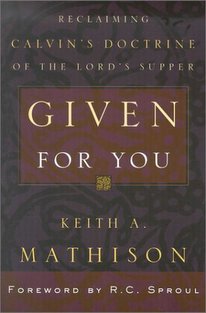 The following is an excerpt from Keith A. Mathison’s book, Given For You: Reclaiming Calvin’s Doctrine of the Lord’s Supper, copyright 2002, P&R Publishing.
Because the substitution of grape juice for wine in the Lord’s Supper has now become the standard practice in many American evangelical churches, many theologians within those communions have found it necessary to justify the change. In this section, we shall address some of the specific objections offered by representative theologians, as well as some other potential objections to the use of wine.
The prominent Baptist theologian A. H. Strong expresses a common objection made by those who have substituted grape juice for wine. He writes, “Although the wine which Jesus poured out was doubtless the ordinary fermented juice of the grape, there is nothing in the symbolism of the ordinance which forbids the use of unfermented juice of the grape,–obedience to the command ‘This do in remembrance of me’ (Luke 22:19) requires only that we should use the ‘fruit of the vine.’ ” (Augustus H. Strong, Systematic Theology (Old Tappan, N.J.: Revell, 1970), 960.) Several points may be raised in response to this argument. First, it should be noted that Strong himself admits that wine was “doubtless” the drink that Jesus used. Second, if we are required to use the “fruit of the vine,” we are required to use wine because, in the context of the institution of the Lord’s Supper, fruit of the vine was a synonym for wine.
Another Baptist theologian, William W. Stevens, presents a similar line of argument in his book Doctrines of the Christian Religion:
The bread used by Jesus was doubtless the unleavened bread of
the Passover meal, as the wine he used was doubtless the fermented
juice of the grape. But this does not mean that we must
of necessity use unleavened bread, nor does it mean that we cannot
use the unfermented juice of the grape. Unleavened bread
is what Jesus had at hand, and his phrase “fruit of the vine” in
Matthew 26:29 would include unfermented juice as well. The
bread and the cup are symbolical only. To insist on literalism
would be tantamount to legalism (William W. Stevens,
Doctrines of the Christian Religion (Nashville: Broadman, 1967), 344.)
Here again we observe that the author in question admits that it is “doubtless” that Jesus himself used wine instead of grape juice. If this is admitted to be the case, the real question is why the author would even desire to change it in the first place. Stevens is simply incorrect when he asserts that the phrase “fruit of the vine” in the context of Matthew 26:29 would include unfermented grape juice as well as wine. In the context of the Passover meal, the phrase “fruit of the vine” was a liturgical term used as a synonym for wine. Finally, the comparison that Stevens makes between leavened and unleavened bread and wine and grape juice overlooks one big difference between the two. Leavened bread is still bread, but grape juice is not wine.
The most influential evangelical Baptist theologian today is Millard Erickson. Like Strong and Stevens before him, he too attempts to justify the substitution of grape juice for wine:
What elements we decide to use in celebrating the Lord’s Supper
will depend, at least in part, upon whether our chief concern is
to duplicate the original conditions as closely as possible or to
capture the symbolism of the sacrament . . . . With respect to
the cup, duplication of the original event would call for wine. . . .
If, on the other hand, representation of the blood of Christ is the
primary consideration, then grape juice will suffice equally well . . . .
Suitability to convey the meaning, not similarity to the original
circumstances, is what is important as far as the elements are
concerned (Millard Erickson, Christian Theology (Grand Rapids:
Baker, 1985), 1125.)
This argument raises a number of important objections that must be noted. First, we are not arguing for duplication, but for obedience. If bread and wine were the elements that Christ ordained to be used, then we have no more right to change them than we have to use something instead of water in baptism. Second, the argument of Erickson (and of Strong and Stevens) changes when the subject is baptism. When discussing baptism, Baptists such as Erickson typically argue from the example of Christ. They insist that early baptism was administered only by means of immersion (This is a questionable assertion, but arguments about the meaning and mode of baptism are beyond the scope of this book. For a concise presentation of the arguments against the view that immersion was or is the only proper mode of baptism, see Jay Adams, The Meaning and Mode of Baptism (Phillipsburg, N.J.: P&R, 1992).) They argue that we must duplicate the baptismal mode that Jesus used. Yet in the case of the Lord’s Supper, they say that only the most basic symbolism need be preserved. But if basic symbolism is all that matters, then it would not matter whether Jesus and the apostles baptized only by means of immersion. Sprinkling and pouring would be acceptable because those modes of baptism convey the meaning of cleansing and purification just as well as immersion.
The dispensationalist Charles Ryrie takes a slightly different approach in his argument for the use of grape juice in the Lord’s Supper:
The Scriptures do not use the word “wine” in connection with
the Supper, only “the cup” or “the fruit of the vine.” Of course
it was juice from the grape, but whether fermented or not is not
stated . . . . For the sake of converted alcoholics or even to forestall
anyone beginning to drink, unfermented juice is preferable in light
of today’s worldwide problem with alcohol (Charles C. Ryrie,
Basic Theology (Wheaton: Victor, 1986), 425.)
There are a number of problems with Ryrie’s argument. First, the word wine does not need to be used when the phrase fruit of the vine is itself a Jewish liturgical term for wine. Second, Ryrie’s argument leave the impression that Jesus may have used grape juice. Since the Lord’s Supper was instituted during a normal Pasover meal in which wine was unquestionably used, such a suggestion is very misleading. As the Baptist theologians Strong and Stevens admit, there is not doubt that Jesus was using wine.
The argument that we should use grape juice instead of wine for the sake of converted alcoholics and because of today’s worldwide alcohol problem simply doesn’t follow. Drunkenness was as much of a problem in biblical times as it is today. Otherwise, why would there be so many biblical condemnations of this sin? Yet, in spite of the fact that drunkenness was a problem even in the first century, Jesus did not hesitate to institute the Lord’s Supper using wine. In addition, the apostle Paul encountered drunkenness in the observance of the Lord’s Supper at Corinth (1 Cor. 11:21). Aside from the fact that it would have been impossibel for the Corinthian Christians to get drunk if they were using grape juice, as some suggest they were, we must observe that Paul did not correct this abuse by advocating the nonuse of wine. Instead, he called for the proper observance of the Lord’s Supper. If alcoholism is a real problem today, it was a real problem in Jesus’ day. Human physiology has not changed drastically in two thousand years. But in spite of the fact that drunkenness was a problen, and in spite of the fact that human beings face the same kinds of temptations, Jesus instituted the Lord’s Supper with the elements of bread and wine. To suggest that the use of wine in the Lord’s Supper contributes to sinful behavior is to condemn Jesus himself.
The Pentecostal theologian J. Rodman Williams provides another faulty argument against the use of wine in the Lord’s Supper:
In the three synoptic accounts of the Lord’s Supper
the content of the cup is called “the fruit of the vine”
(Matt. 26:29; Mark 14:25; Luke 22:18). This doubtless
was wine; however, since wine is not directly mentioned
in any of these accounts, it is irrelevant to insist
(as some do) that wine must be used. Grape juice
equally comes from “fruit of the vine”
(J. Rodman Williams, Revewal Theology
(GrandRapids: Zondervan, 1992), 3:261, n. 178.)
This argument is similar to those made by Strong, Stevens, and Erickson. Unlike their arguments, however, it contains an obvious self-contradiction. Williams says that all three accounts of the Lord’s Supper call the content of the cup “the fruit of the vine.” Then he says that “the fruit of the vine” mentioned in these accounts was doubtlessly wine. Then he contradicts himself by saying that wine is not directly mentioned in any of these accounts. If “the fruit of the vine” is directly mentioned in all three accounts, then wine is directly mentioned in all three accounts. The specific word wine need not be used, so long as an acknowledged synonym for wine is used. It is not irrelevant, therefore, to argue that wine should be used in the Lord’s Supper.
While it is not irrelevant to argue that wine should be used, it is entirely irrelevant to point out, as Williams does, that grape juice comes from the fruit of the vine and is therefore also permissible. Many fruits and berries grow on vines. If Williams’ argument is valid, why limit ourselves to the juice of grapes? Williams himself does not reject the use of wine simply because he believes grape juice also falls under the biblical meaning of the phrase the fruit of the vine. This is evident when we see his suggestion that beverages such as milk and tea are also permissible (Ibid.). Milk and tea most certainly do not come from “the fruit of the vine.” Williams’ entire argument simply ignores the special Jewish liturgical usage of the phrase fruit of the vine. In the context of the Passover meal, the phrase meant “wine,” not any fruit that happened to grow on vines or the juice that could be derived from those fruits. To argue in the manner that Williams argues is to ignore the historical and grammatical context of Jesus’ words.
Not one of the theologians we have cited presents a cogent argument for the rejection of wine and the substitution of grape juice in the observance of the Lord’s Supper. The most that these authors have attempted to prove is that the use of wine is an indifferent matter, but the manner in which they have made this argument would work equally as well against the use of water in baptism. All but one of these authors readily admit that Jesus himself used wine at the first Lord’s Supper, yet their arguments assume that the church can reject its use without providing any biblical reason for doing so.
There are other arguments against the use of wine in the Lord’s Supper that these theologians do not pursue in any detail. For example, some argue that we should not use wine in the Lord’s Supper because any use of alcohol is a sin. As we have seen, this was one of the fundamental arguments of the temperance movement. But it is not based on a shred of biblical or historical evidence. More importantly, it directly contradicts the explicit teaching of the Bible. According to Scripture, wine is a good gift of God to be used in moderation. The abuse of this good gift, like the abuse of any gift from God, is condemned as sin, but the use of wine itself is not condemned as sin anywhere in Scripture.
Another argument against the use of wine in the Lord’s Supper is based on the idea that there are potential alcoholics who would be hurt by this practice. Those who make this argument say that some people are born with a genetic predisposition toward alcoholism. If they were to drink even a small amount of wine at the Lord’s Supper, it could lead them to become alcoholics. This argument, like the previous one, rests upon faulty presuppositions. In the first place, God has revealed in his Word that drunkenness is a sin, a moral and ethical failure, not a physiological or genetic defect. It is an act of disobedience to God.
Ironically, those evangelicals who use this argument have adopted some of the basic assumptions of liberal theology by taking something that God calls “sin” and implying that it is a “disease.” This removes the responsibility for the sin from the person involved. Secondly, this argument implies that Jesus did something wrong when he instituted the Lord’s Supper with wine. If there are people with a genetic predisposition to alcoholism now, there were people with the same disposition at the time of Jesus. Yet Jesus turned water into wine at the wedding feast at Cana and used wine at the first Lord’s Supper. Then he commanded that this sacrament be celebrated until he returns. If there is a genetic predisposition to alcoholism that is triggered by the use of even the smallest amount of wine, then Jesus is responsible for turning many people during the last two thousand years into alcoholics.
Other arguments against the use of wine in the Lord’s Supper are based on passages like Romans 12:2, 2 Corinthians 6:17, and 1 Thessalonians 5:22, where Christians are told to be separate from the world and to abstain from any appearance of evil. The use of such passages as an argument against the use of wine is based on the faulty premise that the use of alcohol is worldly or evil. If this were true, Jesus himself would be guilty of acting in a worldly manner. Jesus drank wine. He made wine. He gave wine to others. Any one of these activities would be labeled sinful by many modern American churches. But they are not sinful. To abstain from all appearance of evil means to abstain from every form and appearance of real sin, not the activity labeled “sin” by modern-day legalists. In any case, it is simply impossible to suggest that a sacrament of the church instituted by Christ himself has the appearance of evil.
Some argue that while wine is used regularly in many cultures, it should not be used in ours because in our culture the use of alcoholic beverages carries different connotations. Therefore, Christians who desire to maintain a credible witness to our culture should not use wine in the Lord’s Supper. However, our obedience to Christ cannot be compromised in order to conform the church to the standards of our culture. The culture is to be conformed to Christ, not the other way around. The problem at the heart of this argument can be readily seen if we examine its effect on areas not related to the Lord’s Supper. In our culture, for example, homosexuality has gradually become more and more acceptable. In order to “maintain a credible witness” to this culture, many Christian churches now ordain homosexuals to the ministry. In addition, many churches refuse to declare what the word of God says about this sin. Is this a credible witness to our culture?
The fact that many in our culture abuse God’s good gifts does not mean that the church must abstain from those things altogether. The church’s response should be to demonstrate the right use of God’s gifts. God’s good gift of sex is abused everywhere in our culture today. The church’s response should not be celibacy. The church maintains a credible witness to the culture by demonstrating the rightful use of that gift within the context of marriage. God’s gift of wine is everywhere abused by drunkards. The church maintains a credible witness by thankfully accepting this gift from God and using it moderately in the way that God intended it to be used. It does not glorify God to abstain from every gift of his that is abused by unbelievers in the culture around us. This would be impossible anyway, since unbelievers abuse everything that God has given us.
A final argument that has been made against the use of wine in the Lord’s Supper is based on the “weaker brother” principle found in Romans 14 and 1 Corinthians 8. According to this argument, it may be technically permissible to use wine, but since many Christians believe it to be a sin, we should abstain from using it in the Lord’s Supper lest we offend these “weaker brethren.” Several observations are in order. In the first place, Paul himself says in these passages that eating meat and drinking wine in and of themselves are indifferent matters (cf. Rom. 14:14, 20). They are sinful only when done in a specific religious context, namely idol worship. Second, if these passages imply that we should permanently abstain from drinking wine, they would equally imply that we should permanently abstain from eating meat (cf. Rom. 14:21). Yet very few strict prohibitionists are also vegetarians.
The primary teaching of these passages is that we should put love for our brothers in Christ ahead of any concern for our “rights.” However, the elders of the church have a responsibility to help “weaker brothers” grow to maturity. They are not to allow “weaker brothers” to remain weak indefinitely. Most importantly for our purposes, it must be observed that nothing in these passages has any bearing on the observance of the Lord’s Supper. However else these passages are used, they cannot be used to negate or change the sacraments instituted by Christ. Even if every other use of alcohol is voluntarily given up for the sake of weak consciences, the church cannot allow this argument to be used as an excuse to change the Lord’s Supper.
Summary
Because of the irrefutable fact that wine was used by Jesus in the institution of the Lord’s Supper, and because the use of wine in the Lord’s Supper was an undisputed practice for the first 1,800 years of the church’s existence, a heavy burden of proof rests upon those who have substituted grape juice for wine. After reviewing some of the most commonly heard objections to the use of wine in the Lord’s Supper, we are forced to conclude that this burden of proof has not been met. In fact, there has never even been an attempt to meet this burden of proof in many of the churches that have made this change. There is simply no legitimate reason for replacing wine with grape juice in the sacrament of the Lord’s Supper.
The Rejection of Wine
 If the entire church used wine in the observance of the Lord’s Supper for 1,800 years without any controversy or disagreement, what caused the change that is so prevalent in American churches today (Much of this section is taken from my “Protestant Transubstantiation,” IIIM Magazine Online 3, no. 4 (January 22-28, 2001))? The historical origin of the modern American evangelical practice of substituting grape juice for wine can be traced directly to the nineteenth-century temperance movement (Cf. Horton, “At Least Weekly,” 168. For a concise summary of the movement, see Kenneth Scott Latourette, A History of Christianity, rev. ed. (San Francisco: HarperCollins, 1975), 2:1269-70.). This movement, which arose in reaction to the widespread abuse of alcohol, ultimately came to the conclusion that the solution to abuse is not right use, but nonuse. Proponents of “temperance” ultimately concluded that any use of alcohol was evil.
While the movement talked about temperance, its ultimate goal was the prohibition of the manufacture and sale of all alcoholic beverages. The American Temperance Society was organized in 1826, and by the 1850’s thirteen states had outlawed the sale of alcohol. Significantly, many of the leaders and members of the movement were Christian clergy and laity. Of course, the idea that alcohol is inherently evil had an impact on the practice of the Lord’s Supper in American churches. The logic of the movement was widely used to reinterpret Scripture. If the use of alcohol is sinful, and if Jesus never sinned, then Jesus could not have used an alcoholic beverage such as wine in the Lord’s Supper. He must have used some other beverage, and it was argued that grape juice is also the “fruit of the vine.” Gradually, churches that had adopted the temperance gospel changed the elements of the sacrament and substituted grape juice for wine.
The history of the temperance movement and Prohibition is fascinating, but it is beyond the scope of this work to trace it in any detail. Suffice it to say that the temperance movement was a moral, political, and cultural failure. The movement failed culturally because it shared one of the flawed presuppositions of Christian liberalism. It placed the responsibility for sin in an external object rather than in the human heart. Getting rid of alcohol did not and could not get rid of sin and evil in the heart of man. The movement failed morally because it allowed itself to be deceived into setting up a higher standard of righteousness than the word of God. By prohibiting what God allowed, the movement fell into self-righteous legalism. The movement’s only lasting “success” is found in those churches that used its logic as the basis for replacing wine with grape juice in the Lord’s Supper.
The Church’s Witness to the Responsible Use of Wine
 My last two posts dealt with Scripture’s testimony to the responsible use of wine, both socially and in the context of worship. Most nowadays would be satisfied to stop there and hear no more, but let us be reminded that Scripture does not speak to us in a vacuum. We receive its testimony through the teaching ministry of the church, and over the millennia, plenty has been said. Let’s consider that which Keith Mathison has brought together for us in this excerpt from his very informative book, Given For You: Reclaiming Calvin’s Doctrine of the Lord’s Supper.
The Testimony of the Church
We have already mentioned that wine was universally used by the entire church for the first 1,800 years of her existence. During those years, there was never any suggestion that another drink should be used. In the early church, for example, we find clear testimony to the use of wine by such men as Justin Martyr (The First Apology, 65) and Clement of Alexandria (The Instructor, 2.2). In the eighth century, the Synod of Constantinople bore witness to the continued use of wine in the Lord’s Super (See John H. Leith, ed., Creeds of the Churches, 3d ed. {Louisville: John Knox, 1982}, 55.).
At the time of the sixteenth-century Protestant Reformation, there were disagreements over virtually every other issue related to the sacraments, but there was no disagreement over the use of wine. All of the churches continued to teach that bread and wine are the proper elements to be used in the Lord’s Supper. Martin Luther taught this in his Small Catechism of 1529, and the Lutheran church continued to teach it in the Augsburg Confession (art. 10). The Anglican Church taught the use of actual bread and wine in the Thirty-nine Articles (art. 28). Even the Anabaptists continued to teach this in the Dordrecht Confession of 1632 (art. 10).
In the Reformed branch of the church, the use of wine was taught and practiced by John Calvin (Calvin, Institutes, 4.17.1). It was also taught in the great sixteenth-century Reformed confessions, such as the Belgic Confession (art. 35), the Heidelberg Catechism (Q. 79), and the Second Helvetic Confession (chap. 19). The use of wine is also clearly taught in the Westminster Confession of Faith and Catechisms. This Confession teaches that Jesus has appointed his ministers to “bless the elements of bread and wine” (29.3). The Larger Catechism repeatedly declares that the elements of the Lord’s Supper are bread and wine (Qq. 168-69, 177). Every Reformed theologian from the time of Calvin forward taught that bread and wine were the proper elements to be used in the Lord’s Supper. This teaching is found in the writings of
Robert Bruce (Robert Bruce, The Mystery of the Lord’s Supper, trans. Thomas F. Torrance {1590-91; reprint, London: James Clarke, 1958}, 43, 76.),
William Ames (William Ames, The Marrow of Theology, trans. John Dykstra Eusden {Durham, N. C.: Labyrinth Press, 1983}, 212),
Francis Turretin (Francis Turretin, Institutes of Elenctic Theology, ed. James t. Dennison Jr., trans. George Musgrave Giger (Phillipsburg, N.J.: P&R, 1992-97), 3:429),
Wilhelmus a Brakel (Wilhelmus a Brakel, The Christian’s Reasonable Service, trans. Bartel Elshout {Morgan, Pa.: Soli Deo Gloria Publications, 1992-94}, 2:528),
Jonathan Edwards (Jonathan Edwards, The Works of Jonathan Edwards {Carlisle, Pa.: Banner of Truth, 1974}, 1:458),
Herman Witsius (Herman Witsius, The Economy of the Covenants Between God and Man {Phillipsburg, N.J.: P&R, 1990}, 2:449-50),
Charles Hodge (Charles Hodge, Systematic Theology {Grand Rapids: Eerdmans, 1989}, 3:616),
A. A. Hodge (A. A. Hodge, Outlines of Theology {1879; reprint, Carlisle, Pa.: Banner of Truth, 1972}, 633-34)
Robert L. Dabney (Robert L. Dabney, Systematic Theology {Carlisle, Pa.: Banner of Truth, 1985}, 801),
W. G. T. Shedd (W. G. T. Shedd, Dogmatic Theology {Grand Rapids: Zondervan, n.d.}, 2:573),
B. B. Warfield (B. B. Warfield, “The Fundamental Significance of the Lord’s Supper,” in Selected Shorter Writings of Benjamin B. Warfield–I, ed. John E. Meeter {Nutley, N.J.: Presbyterian and Reformed, 1970}, 333),
John Murray (John Murray, The Collected Writings of John Murray, vol. 2 {Carlisle, Pa.: Banner of Truth, 1976}, 366, 369),
and Louis Berkhof (Louis Berkhof, Systematic Theology, 4th ed. {Grand Rapids: Eerdmans, 1996}, 617), among many others.
The use of wine in the Lord’s Supper not only is unanimously taught by all the Reformed theologians and confessions from the sixteenth century forward, but also is explicitly taught in modern Presbyterian directories of worship. The Book of Church Order of the Presbyterian Church in America, for example, is clear in its teaching that the proper elements to be used in the Lord’s Supper are bread and wine:
The table, on which the elements are placed, being decently covered,
and furnished with bread and wine, and the communicants
orderly and gravely sitting around it (or in their seats before it),
the elders in a convenient place together, the minister should
then set the elements apart by prayer and thanksgiving. (58-5 [emphasis added])
The Presbyterian Church in America’s directory of worship is in perfect agreement with her doctrinal standards. Both the Confessions and The Book of Church Order clearly declare that the proper elements to be used in the Lord’s Supper are bread and wine, not bread and grape juice.
It may come as a surprise to some, but even the great theologians and confessions of faith in the historic Baptist church taught that bread and wine were the proper elements to be used in the observance of the Lord’s Supper. Great Baptist theologians such as
John Gill (John Gill, A Body of Doctrinal and Practical Divinity {reprint, Paris, Ariz.: Baptist Standard Bearer, 1987}, 918),
John L. Dagg (John L. Dagg, Manual of Church Order {reprint, Bridgewater, Va.: Sprinkle Publications, 1998}, 208-9),
and James Petigru Boyce (James Petigru Boyce, Abstract of Systematic Theology {Phillipsburg, N.J.: P&R, 1996}, xxiii),
all taught that wine was to be used in the Lord’s Supper. The Baptist Confession of Faith of 1689 closely follows the wording of the Westminster Confession of Faith when it says, “The Lord Jesus hath, in this ordinance, appointed his ministers to pray, and bless the elements of bread and wine” (30.3). The Southern Baptist Abstract of Principles of 1859 says, “The Lord’s Supper is an ordinance of Jesus Christ to be administered with the elements of bread and wine . . . ” (art. 16). Even the Baptist Faith and Message, written in 1925, long after the beginning of the temperance movement, declares that bread and wine are to be used in the Lord’s Supper (art. 13) (cf. Leith, Creeds of the Churches, 348).
Until the middle of the nineteenth century, the use of wine in the Lord’s supper was simply a nonissue for Christians. Agreement on the matter was so universal that most confessions and theologians in the history of the church mention the subject in passing, as if they are simply stating the obvious. They do not even bother to present arguments for the use of wine because no one had ever suggested that anything else be used. They consider the use of wine in the Lord’s Supper to be as biblically self-evident as the use of wate in baptism. The nineteenth-century theologians, such as the Presbyterian A. A. Hodge and the Baptist John L. Dagg, who were the first to be confronted with the question, were adamant in their refusal to change the elements of the Lord’s Supper in order to pacify the legalistice spirit of the age.
The Old Testament Witness to the Responsible Use of Wine
 It’s amazing how far afield of important doctrines can human tradition carry us. The use of wine in the Lord’s Supper, and even the biblical definition of wine, is one such example.
There are many intertwined misconceptions surrounding the Christian’s liberty and responsibilities in the biblical use of wine, in personal use, as well as in the context of worship. I offer the following excerpt from Keith A. Mathison’s Given for You: Reclaiming Calvin’s Doctrine of the Lord’s Supper to clear up some of these misconceptions. Following is found in the last chapter, “Practical Issues and Debates,” pages 297-313
BREAD AND WINE
One of the most emotionally charged questions in the modern American evangelical church is whether it is a sin for a Christian to drink an alcoholic beverage such as wine. Most evangelicals and many Reformed Christians are convinced that the consumption of wine in any amount is a sin. As a result of this conviction, many American churches now use grape juice as one of the elements of the Lord’s Supper. This practice raises a number of important questions. Is the consumption of wine by a Christian a sin? Should the church use wine or grape juice (or both) in the Lord’s Supper? In order to answer these questions, we need to discuss several related issues.
By way of introduction to this question, we must first note that it was not a point of dispute in the church for the first 1,800 years of her existence. It is still not a pint of dispute for most of the church around the world today. This issue is primarily debated in the United Staes, and it has been a matter of disagreement in the U.S. only since the middle of the nineteenth century. For the first 1,800 years of the church, the use of wine in the Lord’s Supper was an undisputed and noncontroversial practice. It was the universal practice of Roman Catholics, Eastern Orthodox, and Protestants alike. It remained the universal practice for so long only because the use of wine in the New Testament descriptions of the Lord’s Supper is so unambiguously clear. The substitution of grape juice for wine had its origins, not in the study of Scripture, but in the capitulation of much of the American evangelical church to the demands of the nineteenth-century temperance movement (Horton, “At Least Weekly,” 168).
The Witness of Scripture
In order to demonstrate why wine was universally used in the Lord’s Supper for 1,800 years, we must first examine what the Bible says about wine in general and then examine what it says about the elements of the Lord’s Supper. When we examine Scripture, we see that wine is a good gift from God that is meant to be enjoyed in moderation and that the elements of the Lord’s Supper, as it was observed in the New Testament, were bread and wine–not bread and grape juice (For a good study of this subject, see Kenneth L. Gentry Jr., God Gave Wine: What the Bible Says About Alcohol {Lincoln, Calif.: Oakdown, 2001}. This book is an expanded version of The Christian and Alcoholic Beverage: A Biblical Perspective {Grand Rapids: Baker, 1986}.).
When we look at the Old Testament, we see that godly men gave wine as a gift (cf. Genesis 14:18-20). We also see that God himself commands that wine and strong drink be brought as an offering to him (cf. Exodus 29:38, 40; Leviticus 23:13; Numbers 15:5, 7, 10; 28:7). God always commands that only the best be offered to him as a sacrifice. Nothing unclean or unholy may ever be sacrificed to God. Yet God commands that he be offered wine as a sacrifice. It is impossible, therefore, that wine is inherently evil, unclean, or unholy.
There are numerous places in the Old Testament where wine is explicitly spoken of as a gracious blessing from God (see Genesis 27:28; Deuteronomy 7:12-13; 11:13-14; 14:22-26; Judges 9:13; Psalm 104:14-15; Proverbs 3:9-10; Amos 9:13-14). We see in these verses that an abundance of wine is considered to be one of the covenant blessings promised to those who are faithful. It is inconceivable that God would tell his people that wine is one of the blessings of the covenant if it is, in fact, a curse. In fact, Scripture refers to the removal of wine as part of the curse that falls on covenant breakers (cf. Deuteronomy 28:15, 39; Isaiah 62:8).
In 1 Chronicles 12:38-40, we read of David’s great coronation banquet. In the presence of at least one-third of a million people, an enormous coronation banquet was prepared for David. For three days, a huge assembly of people ate food and drank wine in the presence of God as they celebrated the enthronement of their king. Wine is also spoken of as part of the great eschatological feast (cf. Isaiah 25:6). Would God offer something sinful at a feast he himself prepares?
The Old Testament also uses wine to symbolize things that are unquestionably good. Isaiah, for example, uses wine to symbolize the gospel (Isaiah 55:1). The beauty of marital love is repeatedly compared to wine in the Song of Solomon (1:4; 4:10; 7:6-9; 8:2). God would not use something evil to symbolize the beauty of marital love, much less the gospel. The strict prohibitionist thesis is simply contradicted by Scripture.
Like all of God’s good gifts, wine can be abused. The good gift of food is abused by gluttons. The good gift of language is abused by liars and gossips. The good gift of sex is abused by fornicators, adulterers, and homosexuals. In the same way, the good gift of wine is abused by drunkards. The Old Testament pulls no punches in the condemnation of drunkenness (Job 12:25; Psalm 107:27; Proverbs 20:1; 23:20-21, 29-33; Isaiah 5:11, 22; 28:7-8). However, it is the abuse, not the use, of wine that is condemned by Scripture. The abuse of God’s good gifts is not solved by the ungrateful rejection of those gifts. The abuse of God’s good gifts is solved only by the proper use of them.
In my next posts, I’ll continue with the New Testament witness to the responsible use of wine, the testimony of the church, the rejection of wine, objections answered and summary.
Theological and Doxological Meditation #19
 Misery of Man’s Estate
Q. What is the misery of that estate
whereinto man fell?
A. All mankind by their fall
lost communion with God (Genesis 3:8),
are under his wrath and curse
(Ephesians 2:3; Galatians 3:10),
and so, made liable to all miseries in this life,
to death itself, and to the pains of hell forever
(Romans 6:23; Matthew 25:41).
O Safe to the Rock That Is Higher Than I
#655, Trinity Hymnal (© 1990)
William O. Cushing, 1876
O safe to the Rock that is higher than I
my soul in its conflicts and sorrows would fly;
so sinful, so weary, thine, thine would I be;
thou blest Rock of Ages, I’m hiding in thee.
Hiding in thee, hiding in thee–
thou blest Rock of Ages, I’m hiding in thee.
In the calm of the noontide, in sorrow’s lone hour,
in times when temptation casts o’er me its pow’r,
in the tempests of life, on its wide, heaving sea,
thou blest Rock of Ages, I’m hiding in thee.
Hiding in thee, hiding in thee–
thou blest Rock of Ages, I’m hiding in thee.
How oft in the conflict, when pressed by the foe,
I have fled to my refuge and breathed out my woe!
How often when trials like sea billows roll,
have I hidden in thee, O thou Rock of my soul!
Hiding in thee, hiding in thee–
thou blest Rock of Ages, I’m hiding in thee.


 The Misadventures of Captain Headknowledge

The New Testament Witness to the Responsible Use of Wine
I have included the author’s extensive documentation in complete detail, for the purpose of urging the church leaders among my readers to examine the claims for yourself and see whether these things be so.
In the New Testament, we find a continuation of the same general line of thought that is found in the Old Testament. Wine itself is a good gift of God and is a sin. We see in Luke 7:33-34 that Jesus himself drank wine. In this passage, Jesus draws a parallel between himself and John the Baptist. John was condemned for not eating bread and drinking wine. Jesus was condemned for the exact opposite. he was even accused of being a drunkard. No one would have accused Jesus of being a drunkard if all he drank was grape juice.
In John 2:1-11, we read of Jesus’ first miracle at the wedding in Cana, the turning of water into wine. the Greek word used throughout this passage is oinos, which refers to the fermented juice of the grape, or wine (Cf. Walter Bauer, A Greek-English Lexicon of the New Testament and Other Early Christian Literature, ed. William F. Arndt, F. Wilbur Gingrich, and Frederick W. Danker, 2d ed. {Chicago: University of Chicago Press, 1979}, 562.) If the authors of the New Testament had wanted to refer to unfermented grape juice, they would have used the Greek word trux (Ibid.) Jesus turned water into wine, not grape juice, and it is impossible to believe that Jesus would have provided something inherently sinful to the guests at the wedding. But the fact that Jesus both drank wine and made wine does not mean that he condoned the abuse of wine. Like the old Testament, the New Testament repeatedly condemns drunkenness (Luke 21:34; Romans 13:13; 1 Corinthians 5:11; 6:9-10; Galatians 5:19-21; Ephesians 5:18; 1 Timothy 3:2-3, 8; Titus 2:3; 1 Peter 4:3). The message of Scripture on the general use of wine is clear. Wine is a good gift from God to be used in moderation. The abuse of wine, like the abuse of any other good gift from God, is a sin.
Having examined what Scripture teaches about wine in general, we must next examine what it says about the use of wine in the Lord’s Supper. As we have already seen, the institution of the Lords’ Supper is recorded in all three of the Synoptic Gospels (Matthew 26:27-29; Mark 14:23-25; Luke 22:15-20). In each of these accounts, Jesus identifies the contents of the cup as the “fruit of the vine.” Because the Lord’s Supper was instituted during a Passover meal, it can hardly be denied that this “fruit of the vine” was the same wine that was used at the Passover
See, for example:
Leon Morris, The Gospel According to Matthew (Grand Rapids: Eerdmans, 1992), 660-62;
William Hendricksen, the Gospel of Matthew (Grand Rapids: Baker, 1973), 911;
D. A. Carson, “Matthew,” in The Expositor’s Bible Commentary, vol. 8 (Grand Rapids: Zondervan, 1984), 536;
Craig L. Blomberg, Matthew (Nashville: Broadman and Holmna, 1992), 390-91;
William L. Lane, The Gospel According to mark, New International Commentary on the New Testament (Grand Rapids: Eerdmans, 1974), 507-9;
Norval Geldenhuys, Commnentary on the Gospel of Luke, New International Commentary on the New Testament (Grand Rapids: Eerdmans, 1952), 554;
R. C. H. Lenski, The Interpretation of St. Luke’s Gospel (Columbus: Wartburg Press, 1946), 1043-44;
Joachim Jeremias, The Eucharistic Words of Jesus, trans. Norman Perrin (Philadelphia: Fortress, 1977), 50-51.)
And, as Joachim Jeremias notes, “to genema tes ampelou (‘the fruit of the vine’) for ‘wine’ is in the Judaism of the time of Jesus a set liturgical formula at the blessing of the cup, both before and after the meal.” (Jeremias, Eucharistic Words of Jesus, 183);
and compare:
Philip Schaff, ed., A Religious Encyclopedia of Biblical, Historical, Doctrinal and Practical Theology (New York: Funk and Wagnalls, 1887), 2537-38;
Heinrich Sessemann, “oinos,” in Theological Dictionary of the New Testament, vol. 5, ed. Gerhard Friedrich, trans. and ed. Geoffrey W. Bromiley (Grand Rapids: Eerdmans, 1967), 164;
T. K. Cheyne and J. Sutherland Black, eds., Encyclopaedia Biblica (London: Adam and Charles Black, 1903), 5309;
Blomberg, Matthew, 390-91;
Lenski, Interpretation of St. Luke’s Gospel, 1043-44.
In other words, when the historical and grammatical context is taken into account, there are simply no grounds to conclude that Jesus instituted the Lord’s Supper with anything other than the same wine that was used in the Passover meal.
Tomorrow we’ll hear from the Testimony of the Church regarding the Responsible Use of Wine, especially as applied to the Lord’s Supper.
Share this: