Scripture Enigma, No. 2
Click to enlarge and read; right click to download
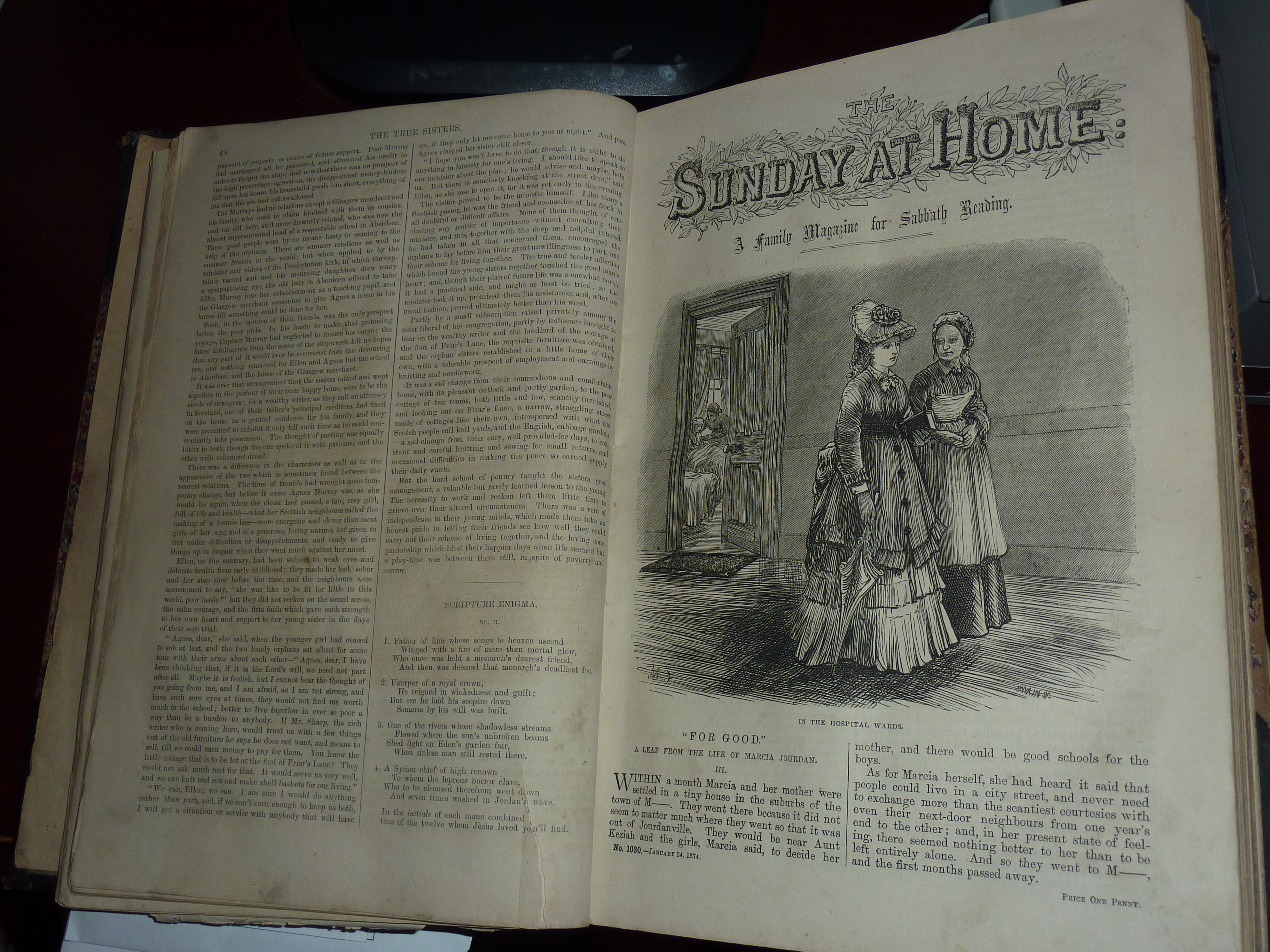
Here’s Scripture Enigma, No. II from the January 17, 1874 edition of The Sunday at Home: A Family Magazine for Sabbath Reading.
Father of him whose songs to heaven ascend
Winged with a fire of more than mortal glow,
Who once was held a monarch’s dearest friend,
and then was deemed that monarch’s deadliest foe.
Usurper of a royal crown,
He reigned in wickedness and guilt;
But ere he laid his scepter down
Samaria by his will was built.
One of the rivers whose shadowless streams
Flowed where the sun’s unbroken beams
Shed light on Eden’s garden fair,
When sinless man still rested there.
A Syrian chief of high renown
To whom the leprous horror clave,
Who to be cleansed therefrom went down
And seven times washed in Jordan’s wave.
In the initials of each name combined
One of the twelve whom Jesus loved you’ll find.
Answers:
- J-esse (1 Chronicles 2:15)
- O-mri (1 Kings 16:16, 24)
- H-iddekel (Genesis 2:14)
- N-aaman (2 Kings 5:14)
A Review of Dr. John Fesko’s Lecture on Word, Water and Spirit, part 1
 On Friday, January 21st, 2011, Dr. John Fesko, Academic Dean and Associate Professor of Systematic Theology at Westminster Seminary California, was the featured speaker at Christ Reformed Church in Anaheim, California, pastored by Dr. Kim Riddlebarger. He was invited to speak on his comprehensive new book, Word, Water and Spirit: A Reformed Perspective on Baptism (© 2010 by J. V. Fesko, published by Reformation Heritage Books). The link to Dr. Fesko’s lecture may be downloaded from this post at the Riddleblog. First, Dr. Fesko describes the background to his book, then he summarizes respectively the history of the doctrine of infant baptism (paedobaptim–Part I of his book), the Biblical-Theological Survey of the Doctrine (Part II), and finally he briefly describes Part III: Systematic-Theological Construction of the Doctrine. This first in a series of posts will review Dr. Fesko’s discussion of the background to his writing of the book.
The background, we learn, is ultimately connected to his upbringing. As an infant, Dr. Fesko was baptized in the mainline denomination of the Presbyterian Church (USA). His parents apparently held nominal ties to this Reformed heritage, and the Fesko family wound up attending a number of churches over the years, landing among the Baptists in the end. While in college, Dr. Fesko listened to R. C. Sproul tapes on his Walkman, which lead him to realize that he was more Reformed than he was Baptist, and so he resolved to examine the outstanding Reformed doctrines he’d yet to deal with to be sure they were true–issues like infant baptism, so that, were he to minister in a Reformed church one day, he would not have to “hold his breath” as he administered the sacrament.
After seminary, while attending the University of Aberdeen in Scotland, Dr. Fesko read a book by Paul Jewett which he says is called, A Case Against Infant Baptism, which inadvertently impressed upon him the indispensability of covenant theology and laid the groundwork to his finally embracing paedobaptism. In searching the web for this title, however, I was unsuccessful in tracking it down, but found instead a book by the same author called Infant Baptism and the Covenant of Grace: An Appraisal of the Argument That As Infants Were Once Circumcised, So They Should Now Be Baptized, which apparently argues for the practice. Unfortunately, Dr. Fesko has a little trouble with recall on this and another title below, but, we can afford to forgive him this minor oversight. I share a marginally similar experience to the one Dr. Fesko describes, in my own examination of the issues related to the biblical doctrine of baptism. Over the past several years since my transition to theologically Reformed convictions, including the truth of infant baptism, I would periodically revisit the case for the Baptist view of believer’s baptism (credobaptism). Each time, after re-exposing my newfound paedobaptistic persuasion to the critique of the Baptist doctrine, I would come away with new reasons to believe that Scripture in fact does command and exemplify infant baptism, although not in a manner that satisfies the Baptistic hermeneutic (method of interpretation) which emphasizes as central the differences between the Mosaic Covenant and the New Covenant, rather than their points of continuity.
The Reformed covenantal hermeneutic emphasizes how the nature, promises and signs of the Covenant of Grace outweigh the various administrative changes between the Mosaic and New Covenants. Big-picture issues like these bring into sharper relief the seemingly unclear Biblical testimony to infant baptism. In other words, with all due respect to my Baptist friends, when it comes to the Mosaic and New Covenant administrations of the overarching Covenant of Grace, they seem unable to see the whole covenantal forest for the New Covenant trees.
The second element in the background to Dr. Fesko’s writing of Word, Water and Spirit comes from his ministerial environment in the South. He says, “if you cannot throw a rock in the Bible without hitting a covenant, in the South, you cannot throw a rock without hitting a Baptist church.” Many Baptists, who, in the providence of God, come to embrace Reformed theology and appreciate so much about the doctrine and practice of a Reformed Presbyterian church will hold out on the Reformed practice of infant baptism. In his ministry to such believers in his congregation, Dr. Fesko tried to provide comprehensive evidence to help his converted Baptist congregants understand and believe in infant baptism, and the degree to which he would prepare such material for their benefit also facilitated his desire to publish on the subject of the Biblical and historical case for infant baptism.
Dr. Fesko was also interested in making sure his congregants understood the Biblical doctrine of baptism as a whole, not just the aspect of it that related to its administration to the infant children of believers. He observes that there is a troubling trend toward church growth by downplaying more objectionable doctrines, like paedobaptism. He desired not only to help people understand infant baptism, he wants them to understand what a sacrament is, what Biblical covenants are, and even the true nature of God’s grace itself. Many struggle to understand what grace is. I, too, struggled to understand the classical definition of grace as “unmerited favor” until I was introduced to the Reformed doctrines of grace. Once I came to grips with the fact that a sinner is unwilling to believe because as one who is dead in sin, he cannot (“Total Depravity”); that God’s election of him is not conditioned on God’s foreknowing or foreseeing that he would receive Christ (“Sovereign Election”); that the atonement of Christ for the elect in particular is properly understood in terms of his mercy, rather than his resentfully seeing such an act as inherently unjust of God’s part (“Particular Redemption”); that when the Holy Spirit enables a sinner who was dead in sin to believe and to willingly embrace Christ as his own crucified and risen Lord (“Effectual Calling”); and that God will not only prevent me from “losing my salvation,” but will graciously preserve me in such a way that I will, by his grace, persevere in my faith in him (“Perseverance of the Saints”–for more biblical testimony on these doctrines of grace, see the link in my Featured Sites widget in the sidebar), then and only then did it make sense to me how it is that grace is God’s favor for me which I in no way earned. It is in this way that God’s grace is truly unmerited favor. Just as Reformed theology helps one truly understand the nature of grace, so does Reformed covenant theology as a whole help the believer understand the Bible’s full teaching on the significance, proper candidates and proper attitude toward the mode of baptism.
God’s progressive revelation of his redemption of the elect in Christ was something Dr. Fesko often found insufficiently treated in the typical book or essay promoting the Reformed doctrine of baptism. Why is redemptive history important in relation to baptism? It helps us to better understand the nature of circumcision and baptism, the connection between the two, and why the sign of the Covenant of Grace is changed from the former to the latter with the transition from the Mosaic to the New Covenant at the first advent of Christ. Dr. Fesko finds that Reformed presentations of infant baptism often focus more on the New Testament in defense of infant baptism, and not quite enough on the Old Testament revelation of the subject. He would remind his readers that as important as the New Testament witness to infant baptism is, Christians ought not to build their doctrines on only half of the Bible, but on the entirety of the Scriptures. Too many do not realize that indeed the doctrine of baptism is, in fact, found in the Old Testament. Pierre Marcel’s book, Baptism and the Covenant of Grace (actually, Marcel wrote Biblical Doctrine of Infant Baptism), which was possibly re-titled Infant Baptism (again, we’re apparently relying on Dr. Fesko’s memory), writes, for example, that for Karl Barth, the Old Testament matters little when it comes to most doctrines, with the possible exception of the doctrine of the atonement.
Dr. Fesko finds that theological journals provide perhaps some of the most helpful information on any doctrinal question, baptism among them. He therefore desired the readers of Word, Water and Spirit, who ordinarily have no access to such information, to benefit from such journals and show them where they can go to learn more on the subject of baptism. This was another compelling reason for him to write the book.
In the next post, we’ll follow Dr. Fesko’s summary of the historical-theological section of the book, which makes up roughly half of its contents.
Revisiting “The Right Story”

- (The following was originally posted on March 3, 2006. It reappears here in a slightly edited form.)
“You can’t help nobody if you can’t tell ‘em the right story.” Jack Cash, brother of Johnny Cash, as portrayed in the movie, Walk the Line.
Every story is about fall and redemption in one way or another. There would be no plot if there were no problem to solve or conflict to resolve. The story of the entire human race is that of its fall and redemption. Your story is about your fall and your redemption. The mission of the church is to tell this story; to introduce the characters to the plot: they’ve fallen and they can’t get themselves up on their own, their problem is so bad, they can’t solve it themselves, they need Another to solve it for them, the conflict that has entered their life has killed them, and they need Another to return them to life.
Stories are often considered mere entertainment. And to be sure, the church in this Laodicean (Revelation 3:14-22) generation has caught on to the idea that entertainment will help them tell the Story. Even if at times they’re telling the right story, that of the fall of man into sin and the sinless Christ who was crucified and raised for sinners, they’ve wrapped it up in so much entertainment that many are in danger of overlooking the Gift because they’re so fascinated by the wrapping paper. If sinners are distracted from the Story by trappings geared toward appealing to their interests, or meeting their felt needs, the church can’t help them. At other times, the church forgets to get around to the Story at all because they’re so aware of all the other stories in the Bible. “Christians don’t need to hear the Story this week, they’ve already heard and believed and received it, now they need to hear what they need to do,” and thus the Story is placed on the shelf in the interest of relevance or practicality. But no matter how much they mean to help, they “can’t help nobody if [they ain’t tellin’ ’em] the right story.”
The church seeks to tell a story, but all too often it’s not the Story they were commissioned to tell (Matthew 28:19-20). Many times they tell their own story. A story about how they’ve picked themselves up by their own bootstraps, a story about what a great example they are. When this is the story they tell, the Holy Spirit won’t bring sinners to life, nor will he empower believers to serve. All applications and all examples, and all pastoral autobiography are not to stand alone. They are to be built on the firm foundation of the Story, explicitly told each week.
We’ve fallen into sin so there’s nothing we can do to redeem ourselves:
the sinless Christ was crucified because we are sinners who deserve to die;
Christ rose from the dead on the third day because God has accepted Christ’s death in the place of sinners who come to believe and repent of their sins;
saved sinners are called to be holy and to serve others, which brings them into conflict with the sin that yet remains in their natures and they aren’t always able to be holy and serve others (Romans 7).
That’s why the Right Story must remain central: The Gospel is for Christians, too!
They must be reminded that even though they’ve been saved they still need to hear the Gospel addressed to them (1 John 1:9) to cleanse them so they can progress on the journey to glorification by way of sanctification (Proverbs 4:18).
When the preacher neglects to tell the church the Right Story, he can’t help the church grow in grace.
- (Dr. R. Scott Clark gives a fuller, more Christ-centered summary of the Right Story at Westminster Seminary California’s Valiant for Truth blog. Read his post, “The Christian Life.”)
Mary’s Declaring Women’s Liberation from Feminism!

There’s another great post I am compelled to share with you over at the Gospel Coalition. Dr. Mary Kassian, Distinguished Professor of Women’s Studies at Southern Baptist Theological Seminary is the author of Girls Gone Wise and The Feminist Mistake (I love that title! In case you missed the in-your-face pun, there was a leading feminist book of bygone days called The Feminine Mystique). Dr. Kassian says we’re in a “Post-Feminist” society. But don’t rejoice yet–unlike Francis Schaeffer’s past declaration that America has moved into the “Post-Christian” era, this does not mean that Feminism has lost its influence. It’s simply moved from a movement to an institution. Says Kassian,
“Virtually everyone is a feminist. Yet virtually no one would identify him/herself as such. Feminism has seeped into people’s systems like intravenous drugs into the veins of an unconscious patient. The majority of people in today’s churches are feminists—and they don’t even know it.”
If this doesn’t ring true to you, you’re not paying attention. Our endemic feminism has taken a toll on American local church ministry and American marriages in the past several decades. In the shameful “glory days” when feminism was a movement, all the ideals of feminism were heralded by activists and educators in a counter-cultural push toward so-called “progress,” and not without resistance from the establishment culture. In other words, back then it had to be taught. Nowadays, we and our children of both sexes are so regularly exposed to feminist ideals that feminism is simply caught. Today, it’s the Biblical ideal of manhood and womanhood that has to be purposefully and energetically cultivated.
But thank the Lord that a new counter-cultural movement has arisen in the American church to do just that, teach the complementarian nature of Biblical manhood and womanhood. Feminism has brought America into an age of what is called “egalitarianism,” where the most obvious distinctions between men and women are no longer assumed. Professor Kassian heralds this positive trend and appears resolved to promote it, but not without a caveat. The last thing we need, according to Kassian, and I agree, is to move from this lifestyle of feminist license, declare liberty from feminism for the sake of the Christian family’s faithfulness to God’s Word, and allow it to degenerate into a legalism in which our focus is removed from the cross and onto an over-emphasis on the Biblical roles of manhood and womanhood that would inevitably facilitate yet another swing of the pendulum back in the direction of the radical anti-Scriptural feminism of the 1960’s and ’70’s.
Christian ladies, and gentlemen, check out the Gospel Coalition’s interview with Professor Kassian and learn that more and more Christian women are breathing the air of liberation from the cultural tyranny of feminism!
Gospel Coalition Interviews Michael Horton
 If you’re anything like me, you’re looking forward to your copy of Michael Horton’s new systematic theology, The Christian Faith: A Systematic Theology for Pilgrims on the Way (published by Zondervan), to arrive, if you haven’t already received it. If you aren’t like me, then perhaps this interesting interview of Horton by John Starke, of the Gospel Coalition, promoting his systematic theology, will make you more like me (but only in this one way).
Updates
If you haven’t visited the Captain’s “Creeds, Etc.” page lately, you might find it rather helpful. Just click the link thereto found at the top of this page, and you will find several historic and modern “catholic” creedal statements, Protestant Confessions of Faith and Catechisms, and various other helpful doctrinal statements, both historic and modern.
Bible Questions on the History of the Kings of Judah and Israel, No. 1
 This week, it’s not a “Scripture Enigma,” it’s the first in a series of questions on the history of the kings of Judah and Israel, from The Sunday at Home: A Family Magazine for Sabbath Reading (No. 1028–January 10, 1874). This post will be updated with the answers in one week. By the way, Scripture Enigma, No. 1 has been updated with its answers. Please post any answers or guesses in the comments thread. Or comment on the anxiety such questions give you. You can even feel free to comment asking for hints. Anything! Just comment! 😉
- What reasons did the people of Israel assign for their wish to be governed by kings?
- How had they been previously governed?
- Where do you find that God had anticipated this desire, and what directions had He given with regard to it?
- By whom was the first king of Israel selected? Mention his name—his father—his tribe.
- Describe his personal appearance.
- By who was he anointed? And where? On what errand was he engaged at the time? What change came over him from that time?
- Where was he first proclaimed king? How did God show his displeasure with the people at the time?
- What indications can you find of filial obedience, modesty, and courage in the early history of Saul?
- For what reasons did God take the kingdom from him? When was this first told him, and by whom? How did the tidings affect Samuel?
- Give other passages from God’s Word, which teach us that outward observances of religion have no value with God unless accompanied by a life of obedience.
- Saul professed repentance—but what showed that his repentance was not sincere?
- From this time we see a great change in Saul. What affliction came upon him? How did he obtain relief?
- Have we any indications of a loss of personal courage?
- What aroused his jealousy of David?
- What does the Bible say about envy?
- From this time Saul’s heart was set on David’s death. Mention any occasions on which David narrowly escaped his enemy, and how he was delivered.
- Mention any indications of relenting.
- On what two occasions was Saul’s life spared when he was in David’s power?
- What proofs have we of the tender love between David and Jonathan, Saul’s son? Show that its foundation was laid in true religion.
- Saul was left by God. To whom then did he seek for help? And with what consequences?
- What was his end? Which of his sons died with him? By whom, and where were they buried?
- How long did Saul reign?
- What became of the other sons of Saul?
Answers:
- 1. 1 Sam. 8:5, 20
- 1 Sam. 8:7; 10:19; 12:11-12
- Deut. 17:14-20
- 1 Sam. 9:1, 16, 17
- 1 Sam. 9:2; 10:23
- 1 Sam. 9:3-4, 19-20; 10:1, 9, 11
- 1 Sam. 9:14, 15; 12:16-18
- 1 Sam. 9:5, 21; 10:21-23; 11
- 1 Sam. 13:8-14; 15:23, 28-29, 35; 16:1
- Psa. 1:7-14; Prov. 21:3; Isa. 1;11-17; Jer. 7:21-23; Micah 6:6-8; Matt. 7:21-23
- See his self-justification, 1 Sam. 15:15. His excuses, 5:21. When at last confession was extorted from him, he feard losing the respect of the people, not the favour of God, 5:30.
- 1 Sam. 16:14-18, 23.
- 1 Sam. 17:11; 28:5.
- 1 Sam. 18:8, 9, 15, 29.
- Prov. 14:30; 27:4; S. Song 8:6; Gal. 5:21; Jas. 3:14, 16.
- 1 Sam.19:10-12; 23:26-28; 24:3.
- 1 Sam. 19:6; 24:16-22; 26:21-25.
- 1 Sam. 24:3-7; 26:6-12.
- 1 Sam. 18: 1-4; 19:2; 20:3, 11-17, 34; 23:16-18; 2 Sam. 1:26.
- 1 Sam. 28:6-20.
- 1 Sam. 31:1-6, 8-13.
- Acts 13:21.
- 2 Sam. 4:5-7; 21:5-9.
Christianity and Liberalism Revisited
 This past weekend, Westminster Seminary California’s (WSC) annual conference was held. It was called, “Christianity and Liberalism Revisited,” referring to the title of a book by the founder of Westminster Theological Seminary in Philadelphia, PA, and “the principal figure in the founding” of the Orthodox Presbyterian Church (OPC) in 1936, which in 2011 is celebrating its 75th anniversary. This conference is WSC contribution toward that celebration.
The conference was webcast live on Ustream and the videos are still posted there for your viewing pleasure, and audio is posted at the WSC Resource Center, but I’ll link to them below for your convenience.
- Christianity and Liberalism Today “Michael Horton shows the prophetic insight of Machen’s most famous book in Christianity today.”
- The Perennial (Problem with) Machen “Daryl Hart critiques evangelicals’ use of Machen today.”
- Machen and the Bible “Joel Kim explains the relevance of Machen’s view of the inspiration and authority of the Bible.”
- Machen and the Gospel “J. V. Fesko gives a summary of Machen’s view of the gospel and its relevance today.”
- Machen and Ethics “David VanDrunen explains how Liberalism, in its day, was fundamentally dishonest.”
- Machen, Christianity and the Church “W. Robert Godfrey explains how the church is the mission of God to carry his doctrines to the ends of the earth.”
- Question and Answer Session “The question and answer session from the 2011 Conference ‘Christianity and Liberalism Revisited’”
Bonus! If you’d like to know more about J. Gresham Machen and the Orthodox Presbyterian Church (a local congregation of which denomination my family is currently attending, Mid-Cities OPC), then start with conference speaker Daryl Hart’s page at the OPC website, called, “Machen and the OPC.”
Also, the Rev. Jason Stellman has posted a thought-provoking reflection on Hart’s lecture at his blog Creed, Code, Cult, called, “Catholicity and Liberalism.”
Sister Aimee and the “Anabaptist Nation”

"Sister Aimee" McPherson
I heard an interesting description of how American Christianity effectively developed into a form of Anabaptism. Dr. R. Scott Clark, Professor of Church History and Historical Theology at Westminster Seminary California (WSC), was interviewed this past week on Christ the Center podcast episode #157 regarding his contribution to Always Reformed, a festschrift that has recently been published in honor of WSC President and Professor of Church History, Dr. Robert Godfrey (see Dr. Clark’s post here). From what I’ve been able to gather over the past couple of years, Dr. Godfrey is an earnest student of the phenomenon of Sister Aimee McPherson’s ministry in the 1920’s, and holds her up as an example of what American Christianity is. Clark’s chapter is entitled, “Magic and Noise: Reformed Christianity in Sister’s America.” To some extent, it seems that this very subject of the Anabaptistic flavor of American Christianity is at the heart of this chapter, as may be inferred by the chapter’s title itself.
About twenty-two minutes into the interview, Clark introduces this topic by urging the study of “Sister” (as she is wont to be called) on Reformed believers. He does this because, according to Clark, in many ways McPherson’s type of Christianity is more indicative of the nature of American Christianity than the Reformed faith can lay claim to anymore. America has come a long way since the faith of the pilgrims of Plymouth Rock and the Salem witch trials (which is probably all Americans remember about those early Christian settlers (for help with that, listen to this and this). Clark believes that the Reformed would be aided in reaching America for Christ, and American evangelicals for the Reformed faith if they would see themselves more as cross-cultural missionaries, rather than natives.
Dr. Clark offers the disclaimer that his Anabaptist diagnosis of American Christianity is largely due to the fact that his primary field of research is the sixteenth and seventeenth century Reformation, rather than early twentieth century Christianity. He admits that in part he is interpreting the McPherson phenomenon and the nature of “native” American Christianity in the light of the sixteenth century Anabaptist movement, but he does attempt to support his conclusion with appeals to others who have written more extensively on Christianity in the nineteenth and twentieth centuries.
There are parallels between the Anabaptist movement of the sixteenth century and current American Christianity. Clark explains that people tend to think of the Anabaptist movement as just another facet of the Protestant Reformation, but he points out that the Anabaptists (also known as “Radical Reformers”) more or less “rejected all of the key doctrinal commitments” of the Protestant Reformation in favor of much more radical positions. Clark’s thesis is that the way American Christians commonly think about the nature of authority, epistemology (how we know what we know), Scripture and its authority, the church and eschatology (the doctrine of the end times) often bears strong resemblance to sixteenth and seventeenth century Anabaptism. Dr. Clark goes into a little more detail on this in the interview between minutes 33:15 and 42:06.
This portion of the interview caught my attention because Clark’s comparison is consistent with a conclusion I came to in my own personal pilgrimage from independent Baptist fundamentalism to Reformed theology and practice. After learning that the ultimate source of the bulk of historic Baptist theology comes from the Reformed Westminster Confession of Faith (see my newly updated “Creeds, etc.” page), and the parallels I saw between Baptist distinctives and the historic Anabaptist movement, I concluded that everything that’s right in the Baptist tradition was learned from the Reformed tradition, and everything that’s wrong in the Baptist tradition was learned, or “caught,” if you will, from Anabaptism. I realize that the 1689 Baptist Confession disclaims any formal connection between their doctrines and those of the Anabaptists, but the parallels are just too striking to Reformed paedobaptists.
This is why I encourage you to take time to listen to at least this section of the interview, if you don’t have the time or inclination to enjoy all of it. It’ll be thought-provoking time well-spent, if you ask me.
Scripture Enigma, No. 1

Scripture Enigma, No. 1--The Sunday at Home, 1874
I have in my possession an antiquarian volume which contains all the issues of a weekly religious magazine from England published in the year 1874. The book and magazine are called The Sunday at Home: A Family Magazine for Sabbath Reading. Each issue includes articles on various topics related to the Christian faith, family devotionals, even serial novels. But one of the most intriguing features of this magazine is a little quiz called “Scripture Enigma.” These are often really, really tough! In the light of the recent reports of very poor biblical literacy on the part of evangelicals, perhaps it would be appropriate to challenge you to crack open your Bibles to track down the solutions to some of these riddles. I’m planning to post one each week in the hopes that some of you will take up the challenge and post your answers in the comments thread. In some of the quizzes, the first letter of each answer will spell a word that solves the riddle that comes after the numbered list of other riddles. This is the case in this week’s “Enigma.” Other weeks will feature other sorts of biblical mind-teasers. I’ll update these posts with the correct answers the following week, and then I’ll post the next quiz. So, without further ado, grab your Bibles!
SCRIPTURE ENIGMA,
NO. I
1. Sweet home! from whence the feet of Jesus sped
with tender sympathy to raise the dead.
2. ‘Twas Rezin’s mighty king this city chose,
To give to Syria, driving thence her foes.
3. From out these vineyards came a lion wild,
In angry rage, ‘gainst Manoah’s favour’d child.
4. Within this city’s walls they mourned for shame,
When evil tidings of Damascus came.
5. An aged patriarch, ere he closed his life,
Bade his loved son go seek from thence a wife.
6. Oh! woe was thine, for those who dwelt in thee,
Through Israel’s sword, entered captivity.
7. This city of the Jews in peace he trod,
Waiting in faith the kingdom of his God.
8. There the disciples saw there risen Lord,
and worshipped him, though not with one accord.
9. “Go to this land,” he said, “there corn to buy;
Hasten, my sons, or we shall surely die.”
Nearing Jerusalem, to this place they came
(My nine initial letters tell its name),
Where Jesus bade his two disciples speed
To loose a colt, and say the Lord hath need.
Thine, mighty God, is all on land and sea;
Yet, wondrous love! the Lord has need of thee.
UPDATE:
Answers
BETHPHAGE – Matt. 21:1
1. Bethany (John 11:1)
2. Elath (2 Kings 16:6)
3. Timnath (Judges 14:5,6)
4. Hamath (Jeremiah 49:23)
5. Padan-aram (Genesis 28:1)
6. Heshbon (Numbers 21:25)
7. Arimathea (Mark 15:43)
8. Galilee (Matthew 28:16,17)
9. Egypt (Genesis 42:1,2)
The Captain Gets a Facelift
No Botox jokes, now. But I’m rather pleased with the new theme, plus you may be interested to peruse my overhauled Creeds, Etc. page. What do you think?
Listen To This…
Here are the programs I’ve been following this week. If you’ve got the time, it would benefit you to check some of them out:
- “Machen’s Warrior Children” on Christ the Center
- “Gospel-Focused” on White Horse Inn
- January 11 Episode of Dividing Line
- “The Legacy of the King James Bible” on ReformedCast
Did Shakespeare Help Write the King James Bible?
As a child, growing up in an independent Baptist church that used, preached and taught from the King James Bible, I recall occasions in which a relative of ours who did not share our reverence for it, would attempt to undermine our reliance on it by spinning the yarn that William Shakespeare helped translate the KJV, and while doing so, hid some “Easter eggs” in the text of Psalm 46. The phenomenon to which he referred was the fact that the 46th word from the beginning of the psalm is the word “shake” (v. 3) and the 46th word from the end of the psalm is the word “spear” (v. 9). I can’t speak for my parents, but I always found this idea to be ludicrous, even as a child. As much as I’ve searched the internet for explanations, the following from Doug Kutilek makes a few interesting points that demonstrates how far-fetched this religious urban legend is.
The following is from As I See It Volume 5, Number 2, February 2002:
One of the wonders of the internet is how easily it facilitates the dissemination of utterly false and fictitious, or at best highly dubious, information. Whole books have been written about such “urban legends” (you know–the alligators reportedly in the sewers of New York City, and the supposedly “Satanic” nature of the venerable Proctor & Gamble “man in the moon” logo).
Well, not to be out-done by the “children of this world,” Christians also have their “urban legends.” One of these that has been circulating in cyber-space involves the great British playwright William Shakespeare and the famous King James Version of the Bible. The story goes as follows:
The KJV translators reportedly (so this legend has it) consulted Shakespeare, a renowned master of English style, as they were doing their translation work, and to acknowledge surreptitiously, not openly, his part in the work (it would have been scandalous to have a mere actor and author of stage plays participating in the important and sacred work of Bible translation), they translated–or perhaps allowed him to translate (depending on which version of the legend is being told), his complete ignorance of Hebrew notwithstanding–a part of Psalm 46 in a particular way. If one turns to that Psalm, he will discover that the 46th word from the beginning of the Psalm (ignoring the title, which does in fact form a part of the inspired text) is the word “shake.” And if one counts words from the end of the Psalm, the 46th word from the end (ignoring the final word of the Psalm, the Hebrew word selah–again a part of the inspired text) is the word “speare.” So, the 46th word from the beginning and the 46th word from the end of the 46th Psalm are “shake” and “speare.” An apparently remarkable coincidence, to be sure. And the unstated implication is that this somehow adds to the prestige, dignity and authority of the KJV over all other English Bible versions.
But against the theory is the apparent complete absence of any contemporary positive evidence associating the bard of Stratford-on-Avon with the KJV translation committee and its work. Certainly the lengthy account of Shakespeare in the authoritative Dictionary of National Biography, authored by the editor of the work, Sir Sydney Lee, betrays no such knowledge. Nor can I find any reference to the same in several other works on Shakespeare consulted, nor indeed in various standard histories of the English Bible. This is not to say that it is thereby absolutely disproved, though the happenings in Shakespeare’s life in the period 1604 to 1611 (when the KJV was in preparation) are fairly well-known to history, and any part the most famous of English authors might have had in the production of the most famous of English Bible translations could scarcely have gone unnoticed and unreported.
The novelty of the coincidence of the “46s” and “Shakespeare” is not quite so remarkable as it might seem at first blush. The Geneva Bible of 1560 (published 4 years before Shakespeare’s birth and therefore certainly uninfluenced by him in any way–indeed, he was influenced by it) was the Bible most commonly used in the English-speaking world during the far greater part of Shakespeare’s active writing career (he died in 1616, having virtually retired some years earlier; all but 3 of his many plays and the whole of his poetry being commonly ascribed to the years before 1611). It was also the English Bible version most closely followed by the KJV translators in their revision work.
An examination of the Geneva version of Psalm 46 reveals that both words “shake” and “speare” occur in the relevant verses (3 and 9), as in the KJV, though with a slightly different word count. “Shake” is the 48th, rather than 46th, word from the beginning of the Psalm (ignoring the title) and “speare” is the 44th word from the end of the Psalm (or 45th, depending on whether “selah” is excluded from or included in the count). It seems quite probable that the KJV picked up its use of “shake” and “speare” in the 3rd and 9th verses respectively from the prior Geneva Bible (the precise wording of Psalm 46 in the Geneva and the KJV is usually identical, with a relative few differences). Further it is entirely within reason that by merest accident these words ended up 46th from the beginning and end of the Psalm (ignoring the problem counting “selah” causes for the hypothesis).
Since the “official” basis for the KJV revision was the Bishops’ Bible of 1568, a check of the wording and word counts in that version of Psalm 46 would be of interest for comparative purposes, but unfortunately I have no access to it, and must remain in the dark for now as to its precise wording.
If it could actually be established with certainty, or with at least a high degree of probability that the Shakespeare really was “honored” by the translators in the KJV of Psalm 46 in the manner suggested, whether or not he had any part whatsoever in the actual production of that translation, it would make for an interesting footnote. However, until such proof is forthcoming, it is best to leave this with the other “urban legends” of our time.
The Legacy of the King James Bible: Celebrating 400 Years of the Most Influential English Translation
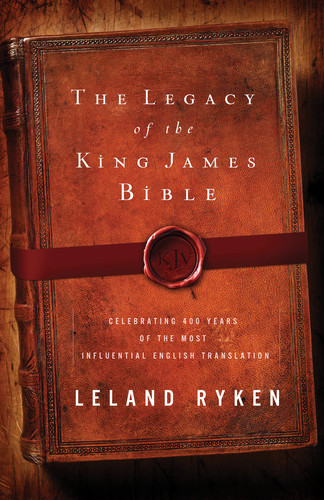 Crossway Books is contributing to this year’s celebration of the 400th anniversary of the publication of the King James Bible with the help of Wheaton College professor of English, Dr. Leland Ryken, author of The Legacy of the King James Bible: Celebrating 400 Years of the Most Influential English Translation. In promotion of this title, Justin Taylor has conducted a concise interview with the author in three parts over at the Crossway Blog. You can watch:
“How Did the King James Bible Come To Be? (Part 1)”
“The Growth of the King James Bible (Part 2)”
“The Influence of the Bible on Literature & Culture (Part 3)”
Don’t miss this opportunity to be reminded of the significance of this venerable Bible translation. As a former radical King James Onlyist who now understands that the world of Bible translation was not supposed to come to a screeching halt with the publication of the KJV, I have often been distressed by the way so many who likewise recognize the need to keep retranslating the Bible would make disrespectful swipes at the KJV. This betrays an arrogance and an ignorance that only the new is worthy of our time. But how much we miss by not familiarizing ourselves with our own history and culture. The fact is that throughout the history and the development of the culture of the English-speaking world, the King James Bible has had a constant and influential presence–and the entire world has been the better for it. Perhaps, too, it’s time that all cultures found something to appreciate in it for a change.


 The Misadventures of Captain Headknowledge
Listen to This. . .
Cover of Herman Bavink: Pastor, Churchman, Statesman, and Theologian by Ron Gleason
Don’t miss these great podcasts this week.
Share this: