Listen To This…
Here are the programs I’ve been following this week. If you’ve got the time, it would benefit you to check some of them out:
- “Machen’s Warrior Children” on Christ the Center
- “Gospel-Focused” on White Horse Inn
- January 11 Episode of Dividing Line
- “The Legacy of the King James Bible” on ReformedCast
Did Shakespeare Help Write the King James Bible?
As a child, growing up in an independent Baptist church that used, preached and taught from the King James Bible, I recall occasions in which a relative of ours who did not share our reverence for it, would attempt to undermine our reliance on it by spinning the yarn that William Shakespeare helped translate the KJV, and while doing so, hid some “Easter eggs” in the text of Psalm 46. The phenomenon to which he referred was the fact that the 46th word from the beginning of the psalm is the word “shake” (v. 3) and the 46th word from the end of the psalm is the word “spear” (v. 9). I can’t speak for my parents, but I always found this idea to be ludicrous, even as a child. As much as I’ve searched the internet for explanations, the following from Doug Kutilek makes a few interesting points that demonstrates how far-fetched this religious urban legend is.
The following is from As I See It Volume 5, Number 2, February 2002:
One of the wonders of the internet is how easily it facilitates the dissemination of utterly false and fictitious, or at best highly dubious, information. Whole books have been written about such “urban legends” (you know–the alligators reportedly in the sewers of New York City, and the supposedly “Satanic” nature of the venerable Proctor & Gamble “man in the moon” logo).
Well, not to be out-done by the “children of this world,” Christians also have their “urban legends.” One of these that has been circulating in cyber-space involves the great British playwright William Shakespeare and the famous King James Version of the Bible. The story goes as follows:
The KJV translators reportedly (so this legend has it) consulted Shakespeare, a renowned master of English style, as they were doing their translation work, and to acknowledge surreptitiously, not openly, his part in the work (it would have been scandalous to have a mere actor and author of stage plays participating in the important and sacred work of Bible translation), they translated–or perhaps allowed him to translate (depending on which version of the legend is being told), his complete ignorance of Hebrew notwithstanding–a part of Psalm 46 in a particular way. If one turns to that Psalm, he will discover that the 46th word from the beginning of the Psalm (ignoring the title, which does in fact form a part of the inspired text) is the word “shake.” And if one counts words from the end of the Psalm, the 46th word from the end (ignoring the final word of the Psalm, the Hebrew word selah–again a part of the inspired text) is the word “speare.” So, the 46th word from the beginning and the 46th word from the end of the 46th Psalm are “shake” and “speare.” An apparently remarkable coincidence, to be sure. And the unstated implication is that this somehow adds to the prestige, dignity and authority of the KJV over all other English Bible versions.
But against the theory is the apparent complete absence of any contemporary positive evidence associating the bard of Stratford-on-Avon with the KJV translation committee and its work. Certainly the lengthy account of Shakespeare in the authoritative Dictionary of National Biography, authored by the editor of the work, Sir Sydney Lee, betrays no such knowledge. Nor can I find any reference to the same in several other works on Shakespeare consulted, nor indeed in various standard histories of the English Bible. This is not to say that it is thereby absolutely disproved, though the happenings in Shakespeare’s life in the period 1604 to 1611 (when the KJV was in preparation) are fairly well-known to history, and any part the most famous of English authors might have had in the production of the most famous of English Bible translations could scarcely have gone unnoticed and unreported.
The novelty of the coincidence of the “46s” and “Shakespeare” is not quite so remarkable as it might seem at first blush. The Geneva Bible of 1560 (published 4 years before Shakespeare’s birth and therefore certainly uninfluenced by him in any way–indeed, he was influenced by it) was the Bible most commonly used in the English-speaking world during the far greater part of Shakespeare’s active writing career (he died in 1616, having virtually retired some years earlier; all but 3 of his many plays and the whole of his poetry being commonly ascribed to the years before 1611). It was also the English Bible version most closely followed by the KJV translators in their revision work.
An examination of the Geneva version of Psalm 46 reveals that both words “shake” and “speare” occur in the relevant verses (3 and 9), as in the KJV, though with a slightly different word count. “Shake” is the 48th, rather than 46th, word from the beginning of the Psalm (ignoring the title) and “speare” is the 44th word from the end of the Psalm (or 45th, depending on whether “selah” is excluded from or included in the count). It seems quite probable that the KJV picked up its use of “shake” and “speare” in the 3rd and 9th verses respectively from the prior Geneva Bible (the precise wording of Psalm 46 in the Geneva and the KJV is usually identical, with a relative few differences). Further it is entirely within reason that by merest accident these words ended up 46th from the beginning and end of the Psalm (ignoring the problem counting “selah” causes for the hypothesis).
Since the “official” basis for the KJV revision was the Bishops’ Bible of 1568, a check of the wording and word counts in that version of Psalm 46 would be of interest for comparative purposes, but unfortunately I have no access to it, and must remain in the dark for now as to its precise wording.
If it could actually be established with certainty, or with at least a high degree of probability that the Shakespeare really was “honored” by the translators in the KJV of Psalm 46 in the manner suggested, whether or not he had any part whatsoever in the actual production of that translation, it would make for an interesting footnote. However, until such proof is forthcoming, it is best to leave this with the other “urban legends” of our time.
The Legacy of the King James Bible: Celebrating 400 Years of the Most Influential English Translation
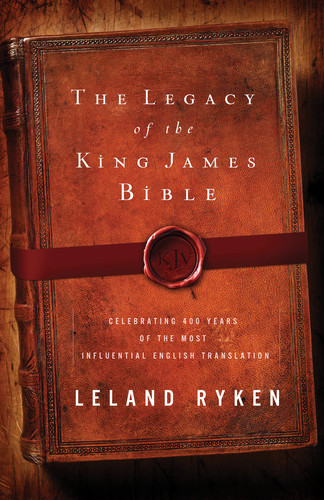 Crossway Books is contributing to this year’s celebration of the 400th anniversary of the publication of the King James Bible with the help of Wheaton College professor of English, Dr. Leland Ryken, author of The Legacy of the King James Bible: Celebrating 400 Years of the Most Influential English Translation. In promotion of this title, Justin Taylor has conducted a concise interview with the author in three parts over at the Crossway Blog. You can watch:
“How Did the King James Bible Come To Be? (Part 1)”
“The Growth of the King James Bible (Part 2)”
“The Influence of the Bible on Literature & Culture (Part 3)”
Don’t miss this opportunity to be reminded of the significance of this venerable Bible translation. As a former radical King James Onlyist who now understands that the world of Bible translation was not supposed to come to a screeching halt with the publication of the KJV, I have often been distressed by the way so many who likewise recognize the need to keep retranslating the Bible would make disrespectful swipes at the KJV. This betrays an arrogance and an ignorance that only the new is worthy of our time. But how much we miss by not familiarizing ourselves with our own history and culture. The fact is that throughout the history and the development of the culture of the English-speaking world, the King James Bible has had a constant and influential presence–and the entire world has been the better for it. Perhaps, too, it’s time that all cultures found something to appreciate in it for a change.
The BBC is celebrating KJV400.
 The BBC is promoting the 400th anniversary of the publication of the Authorized “King James” Version of the Bible. In order to do so, they are airing a series of radio reports entitled, “King James Bible–History and Readings.” Here’s how they introduce the series:
The King James Bible is one of the great English literary works. On the 400th anniversary of its publication, a series of documentaries and readings explore its history and enduring appeal. Features James Naughtie, Simon Schama, Rowan Williams, Emilia Fox, Toby Stephens and others.
The first installment aired today, but you can subscribe to a podcast that follows this series by visiting their site at the link below:
BBC – Podcasts – King James Bible – History and Readings.
For your reading pleasure, peruse this site’s blogs posted under the category of “King James Version.”
Meet Dr. Liam Goligher
Tenth Presbyterian Church is truly one of the flagship churches of the Reformed tradition in America. Two especially prominent ministers have pastored it, namely, Donald Grey Barnhouse, more recently James Montgomery Boice and finally, Dr. Philip Ryken, who has recently moved to the presidency of Wheaton College. If you’ve never heard any of these men preach, you have missed a great blessing.
Justin Taylor blogged on the announcement of the new candidate to follow in these great preachers’ footsteps, Glasgow, Scotland native, Dr. William “Liam” Goligher. You can read his post here, and the announcement published by the Pastoral Selection Committee of Tenth Presbyterian may be found at the following link here.
2010 in review
The stats helper monkeys at WordPress.com mulled over how this blog did in 2010, and here’s a high level summary of its overall blog health:

The Blog-Health-o-Meter™ reads Wow.
Crunchy numbers

A Boeing 747-400 passenger jet can hold 416 passengers. This blog was viewed about 4,200 times in 2010. That’s about 10 full 747s.
In 2010, there were 39 new posts, growing the total archive of this blog to 426 posts. There were 31 pictures uploaded, taking up a total of 51mb. That’s about 3 pictures per month.
The busiest day of the year was August 20th with 91 views. The most popular post that day was You Have Not Because You Ask Not!.
Where did they come from?
The top referring sites in 2010 were stufffundieslike.com, facebook.com, fundamentallyreformed.com, networkedblogs.com, and kjvonlydebate.com.
Some visitors came searching, mostly for jack chick, captain headknowledge, john calvin, j frank norris, and “jack chick”.
Attractions in 2010
These are the posts and pages that got the most views in 2010.
You Have Not Because You Ask Not! December 2008
25 comments
Jack Chick Earns the Respect of the Underground Comics Industry April 2010
4 comments
Meet the Godfather of Fundamentalism, J. Frank Norris June 2010
6 comments
“Extent” August 2010
24 comments
About Me September 2007


 The Misadventures of Captain Headknowledge