An Easter Sign I Can Get PASSION-ate About!!! (In a Good Way)
Driving home from work, I found a ripe banana in the trash bin of badly written 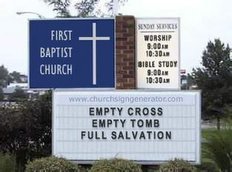 church signs. This sign was lettered by a nearby Assembly of God church. This, once again, is not a photo of the actual sign, but a facsimile of it with the help of www.churchsigngenerator.com. The Lord Jesus Christ is no longer hanging on a cross, he is no longer lying in a borrowed tomb, Christ has risen, sinners may now be justified by faith because of his righteousness alone. The fact that the Lord Jesus Christ . . .
* veiled his eternal, divine attributes . . .
* humbled himself by taking on the form of a servant in his incarnation . . .
* Perfectly keeping the Covenant of Works which our first human father, Adam, failed to keep, thereby earning eternal life . . .
* Silently suffering the ridicule, rejection, hatred and violence of the self-righteous . . .
* Although sinless, received sin’s penalty, death, on behalf of those whom God the Father gave him before the world was created . . .
* Lay buried in a borrowed tomb . . .
* Rose from the dead, indicating that the sacrifice he’d just offered to God the Father had been received and that justification has actually, and irrevocably, been obtained for those whom the Father chose and gave to him . . .
. . . is the reason any of us has a hope beyond the grave, has the grace to believe, receive, and gratefully love and obey the Lord Jesus Christ who was sent to us by the Father; the benefits of whose work are graciously and effectually applied by the Holy Spirit to those who, realizing their lack of righteousness before the Holy God and Creator of the universe, repent of their sins and believe this Good News!
If you have never considered the claims of God’s Law on you, may you realize by examining its perfect standard, that you fall short and have no righteousness to stand on before God, repent of your sins and turn to Christ in faith which is evidenced by loving and grateful, though imperfect, obedience and call on him for salvation today!
If you have called on the Lord, renew your faith in him in response to the reminder of all that he is and has done for you, and renew your repentance from the works that betray your lack of love and gratitude for your gracious, loving, merciful Savior!
And remember to have a wonderful Easter weekend, beloved, because Christ’s empty cross and Christ’s empty tomb point us to the fact of full salvation through his death and resurrection!!!
AMEN

"Covenant" versus "Relationship"
Historic orthodoxy (Catholic and Protestant) has recognized the basic mode of God’s revelation to and communion with Man in terms of the concept of covenant. The concept of covenant can be generally understood by observing the biblical accounts of God’s taking the initiative to bestow the knowledge of his being, personhood and attributes on his fallen creatures, announcing an unconditional promise to them, and at times presenting conditions for various reasons with various effects.
In nineteenth through twenty-first century American Christianity, however, the term most popularly utilized to represent God’s revelation to and communion with man is the term, “relationship.” The use of this term is detrimental to a clear understanding of God’s “relation” to man, because our use of this term generally grows out of the common romantic or humanly familial senses of the word. Furthermore, the fact that the term is utilized as opposed to “covenant” is evidence of the widespread lack of sound theological and biblical discipleship among American Christians, a group described by German neo-orthodox theologian (no, I don’t endorse “neo-orthodoxy”) Dietrich Bonhoeffer as “Protestantism without the Reformation.”
Anti-Intellectualism: Archenemy of Captain Headknowledge!

Read the Christianity Today article, “Full Gospel’s Fractured Thinking.”
This is an interview with the author of a new book analyzing the state of anti-intellectualism in the Pentecostal tradition. But if you’re not Pentecostal, don’t rush into this article assuming they’re the only culprits guilty of this disease within the ranks of Christianity; you’d better be ready to receive a dose of this medicine yourself!
“Do not be conformed to this world, but be transformed by the renewal of your mind, that by testing you may discern what is the will of God, what is good and acceptable and perfect.” Romans 12:2 ESV
The Corinthian Creed copyright 2005, John Douglas …
The Corinthian Creed
copyright 2005, John Douglas Chitty
(these are the lyrics sung in the audioblog below)
We believe that Chirst died for our sins
according to the Scriptures;
That he was buried,
that he was raised on the third day
according to the Scriptures.
Then he appeared to Peter,
then to the Twelve;
after that he appeared to more than
five hundred brothers at the same time.
Then he appeared to James,
then to all the Apostles;
and last of all,
he appeared to Paul,
as to one born out of due time.
chorus
We believe this is of first importance:
Christ died for our sins,
According to the Scriptures,
the third day, he rose again.
We believe in resurrection
for if the dead don’t rise,
our faith is vain,
we’re still in sin,
and lost is he who dies.
But Christ in fact is risen,
the firstfruits of the dead.
For as all die in Adam,
so all live in Christ, their Head.
Christ our King rose first,
so, when he comes, shall we,
for he must reign and conquer
till his last foe, Death’s, defeat!
repeat chorus
Why, then, do we suffer,
if the dead in Christ won’t rise?
If so, let us eat and drink,
for tomorrow we will die.
Do not be deceived,
wake up and do what’s right.
Do not go on sinning
like the ones who lack God’s light.
But someone will ask,
“What kind of bodies will arise?”
You fool! No seed, when planted, will grow
unless first it dies!
repeat chorus
We believe there is a natural body,
and one of the Spirit.
The natural body perishes,
sin’s curse is buried with it.
As Christ raised the third day,
at last in all his glory,
so will those who follow him
and trust the Gospel story.
Adam of the earth,
Jesus Christ of heaven.
As we’ve borne Adam’s image,
We will bear Christ’s image, even!
repeat chorus
We believe when Christ our King returns
all sleeping saints to waken,
we may not all sleep,
but all will gain a transformation.
So will come to pass
the saying that is written:
“Death is swallowed up in victory,
sin is finally smitten.”
But thanks be to God,
through Christ, our Victory!
Be strengthened in his service,
knowing death won’t end the story!
We believe this is of first importance:
Christ died for our sins.
According to the Scriptures,
the third day he rose again!
No Grace By Any Other Name Smells As Sovereign!
 How many of you are familiar with the acronym to the right? It is a very famous mnemonic device developed centuries ago to detail the Biblical doctrines that are involved in the work of our sovereign God’s bestowal of his grace on those whom he’s chosen, for whom his Son died, and to whom his Holy Spirit applied the benefits of the Son’s redemptive work on the cross, effectively calling him (drawing him, as the verse under the acronym describes it) to faith.
The one thing I’d like to point out about the TULIP is how these doctrines show how the Trinity works together to redeem sinners.
But first, quick definitions for each point, otherwise known as “the Five Points of Calvinism.”
Total Depravity–Man is fallen in Adam. Fallen Man always and only sins; Although he may perform outward works that benefit others, Fallen Man neither understands, desires nor has the ability to do anything good in the eyes of God, let alone anything good toward his own salvation; he is at God’s mercy.
Unconditional Election–Before the foundation of the world, God chose an innumerable host of the yet uncreated fallen sinners to give to his beloved Son for redemption, and the rest of fallen humanity were passed over and are left to suffer the just recompense for their fallen condition. God elected these people on the basis of his own eternal purpose, without regard to anything good or bad in those he chose.
Limited Atonement–Jesus earned eternal life by his perfect obedience to God’s Law during his incarnation on the earth; Jesus suffered the penalty of the sins of the elect alone on the cross, trading their sin for his righteousness so that they could share in his reward for eternity.
Irresistable Grace–The Holy Spirit’s work of convicting the elect of their sin, regenerating them through the agency of the gospel preached, granting them the gift of faith to receive Christ freely offered in the gospel.
Perseverance of the Saints–The redeemed elect will be preserved eternally from falling away from their God and Savior; the elect will persevere to the end and be saved.
So, have you begun to notice the trinitarian pattern?
A totally depraved SINNER is chosen by the FATHER, redeemed by the SON, and born again by the HOLY SPIRIT and the result is a SAINT who perseveres!
Holy, holy, holy, Lord God Almighty!
God in three persons, blessed Trinity!!!
Church Signs Make Me "PASSION-ate!"
 A Lesson in Indicatives and Imperatives
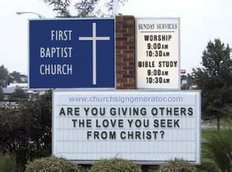
I was driving by a church yesterday and read a sign that contained the message in the picture at right. This is not a photo of the actual sign, but a simulation provided with the help of www.churchsigngenerator.com. A very entertaining site.
Well, what do you think is wrong with this picture, as it relates to what I’ve posted in the past about indicatives and imperatives?
1. Q. Which part of this sign’s question falls into the category of indicative?
A. ” . . . the love you seek from Christ”
2. Q. Which part falls into that of imperative?
A. “Are you giving others the love . . . “
3. Q. Which idea logically precedes the other?
A. The Imperative precedes the Indicative in this sign, which signifies that our obedience earns God’s love.
4. Q. Does this order of concepts constitute Biblical Christianity?
A. No, Biblical Christianity is constituted by God’s indicatives calling for our response in obedience to the imperatives.
The basic message of this sign is “God promises to give his love to those who will love others the way he promises to love them.” Or more starkly, if that’s possible, “If you love others the way you want Christ to love you, then you’ll earn the right for Christ to love you.” That’s an imperative-driven indicative.
Now many Christians will drive by and accept this clumslily worded message as a challenge to love others. If you asked them, they would affirm that they didn’t earn God’s love, but the truth has fallen on such hard times, that they don’t see any theological error in the sentiment on the sign. Christians today believe love is more important than truth. That’s why they see no value in taking signs like this to task for the “abstract, irrelevant” theology. Although they’ve learned that the theologically correct idea is that they don’t deserve God’s love, they live as if they can earn it by doing something for God. That’s the kind of preaching that’s most popular today. It goes largely unrecognized because it’s never put this frankly. But anytime you hear a preacher major on some command of Scripture and then work his way from the command to Scripture’s promises of God’s grace, he is preaching salvation by works, no matter what he calls it.
The Biblical order, once again, class, is that Christians who’ve received God’s grace are to respond in grateful love to God’s grace by obeying his commands to love others. Since I don’t have time now to spell out a laundry list of Scripture let my mantra suffice, “We love because he first loved us. (1 John 4:19; read the whole paragraph from verse 13-21 and you’ll need little other Scriptural proof of my assertions)”
Okay, gotta go. Remember, God has loved those of you who believe because Christ earned righteousness for you and then traded it with you for your sin. He did what you couldn’t and then suffered what you should’ve so you wouldn’t have to and also so that he can share with you the reward he, and he alone, deserves. Now once this truth hits you, you should feel grateful and love this person who gave his life for you on the cross so that you could live. He says, if you love me, keep my commandments. He commands us to love others. Therefore, the sign should read something like this:
“Are you giving others the love Christ gave you?”
Now that’s an indicative-driven imperative!
The Captain Headknowledge Biblical and Theological Journal: The Prodigal and the Patriarch
Genesis 33:1-4
And Jacob lifted up his eyes and looked, and behold, Esau was coming, and four hundred men with him. So he divided the children among Leah and Rachel and the two female servants. And he put the servants with their children in front, then Leah with her children, and Rachel and Joseph last of all. He himself went on before them, bowing himself to the ground seven times, until he came near to his brother.
But Esau ran to meet him and embraced him and fell on his neck and kissed him, and they wept.
Jacob returns, fearing an envious, hateful brother. The prodigal son returned to his father in humiliation and poverty and his brother envied his gracious reception by their father. The attitude of Esau anticipated by Jacob is similar to the attitude exhibited by the prodigal’s brother who stayed among the father’s household, neither seeking nor desiring his grace.
However, in the narrative featuring Jacob and Esau, the roles are reversed. The recipient of the covenant blessings is the one who left home and prospered, and now he returns in prodigal-like humility to Isaac’s hairy prodigal son who stayed home and only troubled his father’s house.
Esau surprised Jacob, as the father surprised the prodigal. But, more accurately, the prodigal receives the patriarch as he ought. Jesus’ parable was a story told to point out the hypocrisy of the religious who resent God’s gracious reconciliation with sinners. Moses’ account of Esau’s reconciliation with Jacob thus parallels the parable, for Jacob equated his acceptance by Esau with his acceptance by God whom he not only saw face to face, but prevailed in wrestling with for his blessing.
Although Esau was passed over in God’s election of his younger brother, he is the better of the reprobates of Jesus’ day who received the Lord’s rebuke for their envy of God’s grace toward sinners. Esau may have initially envied Jacob, but time moved Esau to relent and acknowledge God’s will for the patriarch Jacob.
God graciously receives sinners who come to him, regardless how distasteful those sinners may seem to the present residents of God’s covenantal community. As we have been forgiven, may we rejoice at others who receive God’s grace though everything about them tempts us to treat them as second-class citizens. God doesn’t need the consent of sinners he’s previously received to justify the wicked who come to him in faith and repentance, receiveing the signs of the covenant alongside them. If they don’t deserve God’s grace, neither do we.

Basic Doctrine Quiz
from The White Horse Inn radio show
The following questions are offered to demonstrate the deeply practical and relevant nature of theological study. Salvation is not conditioned on perfect coherence on every question, but hopefully these questions and answers will spur us to dig deeper to gain a fuller understanding of our Christian faith.
True or False
God and Christ
1. Jesus was God but only appeared to be human.
2. Jesus was the first of all God’s created beings.
3. Jesus had a human body and a divine soul.
4. In the Old Testament, God was known as the Father, in the New Testament, as the Son and after Pentecost, as the Holy Spirit.
5. Mary is the Mother of God.
6. God chooses people because he knows in advance that they will choose him.
Salvation
7. The only way we can be saved is by perfect conformity to the Law of God.
8. We are saved by grace after all that we can do.
9. I am saved because of my decision to accept Christ.
10. God is so sovereign he can change his mind.
11. The Bible teaches that there is an age of accountability, and children who die before they reach this age go to heaven because they are innocent.
12. If I die with unconfessed sin, I will not go to heaven.
13. The main motivation for holiness is fear of punishment and hope of reward.
14. God cannot hold someone guilty for the sins of another.
15. Justification is the process by which a person through faith in Christ and sorrow for his sins receives the gift of the Holy Spirit and so becomes a child of God.
16. God cannot require anything of us which cannot be performed.
17. True Christians believe in a literal interpretation of the Bible.
18. “God helps those who help themselves” is a sound biblical principle.
19. Though no one is perfect, God looks on the heart to see who really loves him.
Basic Doctrine Quiz Key
Preface
I suppose “basic” is misleading, but this quiz is geared to motivate us to deepen our understanding of theology. The spirit of this age cries for the “practical” which usually leads us to neglect the finer points of theology due to the apparent lack of immediate practical value. However, doctrine may be considered the most practical thing about Christianity for it is what we believe about God, Christ and his salvation that provides the starting point in our sanctification into the image of Christ. Merely learning good practical tips for successful living may help us have a more pleasant existence for now, but it doesn’t necessarily accomplish that inward moral transformation which God intends to work in us through the knowledge of God which is learned in his Word and illuminated by his Spirit. This idea is reflected in Rich Mullins’ tribute to the Apostle’s Creed called, “I Believe,” in which he sings, “I believe what I believe is what makes me what I am—I did not make it, no, it is making me—it is the very truth of God, not the invention of any man.” Indeed, the truth of God which we confess as his church is what makes us. As Moses gazed on God’s visible glory on the mountain and came away reflecting God’s glory himself, as we study, learn, meditate and apply God’s revelation of himself in Scripture, so will we come away reflecting a little more of the light of God’s glory in our thoughts, words and deeds.
You may notice that much of the material in the following explanations deal with historical facts rather than solely Scriptural citations. The reason for this is that the task of growing in the knowledge of God (“theology”) is not performed in a vacuum. The vital truths that define the Christian Faith were built on the foundation of the Apostles and Prophets, with Christ as the Cornerstone in the first century. As time has worn on, however, some of the hard questions raised by the faith once delivered to the saints have had to be wrestled with and the answers our forefathers in the Faith formulated provide valuable building materials on Scripture’s apostolic foundation. They likewise provide a means of the Holy Spirit’s work of illuminating the truth of Scripture to us through God’s gift to the church in the teaching ministry of our Pastors and teachers throughout history.
When Joseph finally saw his brothers bow before him in fulfillment of the dreams given him by God, and as the brothers were expressing their remorse for their past sins toward him, Joseph readily forgave them, explaining, “what you meant for evil, God meant for good.” This well describes the net effect of the theological controversies of the past. As false teachers rise and mislead the sheep, the true shepherds have to go back to the Scriptures and utilize the sharp minds they developed for the task in order to combat these heresies. Consequentially, the church as a whole gains a sharper understanding of the essential truths of the Faith. What the devil in the persons of the false teachers meant for evil, God meant for good, in causing his people to cling closer to his Word and grow more mature in the Faith. This is a never ending process which God continues to use to this day.
C.S. Lewis once wrote something to the effect that “the value of reading old books is not that they don’t make mistakes, they just don’t make the same mistakes we make.” Looking to the wisdom of those who’ve gone before us and examining it in the light of Scripture broadens our understanding. If we know where we’ve come from, we can better see where we are, and we can tell where we are going. Sometimes we find that we’ve strayed from the right path and thus we can learn how to correct our course. All for the glory of God and the good of his people.
1. Jesus was God but only appeared to be human. False! To answer true is to affirm Docetism. Scripture teaches that Jesus took on a true human nature in every respect but sin.
2. Jesus was the first of all God’s created beings. False! To answer true is to affirm Arianism. Scripture teaches that Christ existed eternally as God with the Father (John 1:1-2) and the Holy Spirit — the Arian heresy today exists in the Jehovah’s Witness doctrine of Christ.
3. Jesus had a human body and a divine soul. False! To answer true is to affirm Apollonarianism, which taught matter is associated with humanness, and spirit is associated with deity. Scripture teaches that Christ took on a true human nature, body and soul, in every respect but sin.)
4. In the Old Testament, God was known as the Father, in the New Testament, God was known as the Son, and after Pentecost, God is known as the Holy Spirit. False! To answer true is to affirm Modalism. This heresy taught that God was One Person operating in three modes of being; much like Clark Kent was never around when Superman was on the job. The God of Scripture is immutable; he never changes. God is eternally three Persons,not parts or modes of being, and one God. Today, Oneness Pentecostals perpetuate this heresy (even T.D. Jakes and Joel Osteen).
One of the best ways to conceive the Trinity goes like this:
· The FATHER is God, but the Father is NOT the Son or the Spirit;
· The SON is God, but the Son is NOT the Father or the Spirit;
· The SPIRIT is God, but the Spirit is NOT the Father or the Son.
5. Mary is the Mother of God. True! This title was originally coined in defense of the Deity of Christ against Nestorianism, not to promote the deity of Mary or presuming a role for her in mediating with her Son between sinners and the Father. Over the centuries all of the Roman Catholic “Mariolatry” (combination of “Mary” and “idolatry”) became associated with it, which explains why it fell out of favor during the Reformation.
Nestorianism taught the doctrine affirmed in the question: Christ only appeared to be human, because spirit is good, and flesh is bad. They thought a good God couldn’t truly become an evil physical person.
6. God chooses people because he knew in advance that they would choose him. False! To answer true is to affirm Arminianism, which denied faith was God’s gift, but which merits God’s election of the believer, having foreseen his choice to believe before time began, and ordaining accordingly. Most evangelicals believe this today. Scripture defines foreknowledge not as foreseeing a choice, but as his choosing to know a people in an intimate sense before time began, thus electing them according to his own purpose.)
7. The only way we can be saved is by perfect conformity to the Law of God. True! God judges according to works. By whose works will you be judged? Your own? If so, you will be condemned. God saves by grace when he imputes the works of Jesus Christ to whoever believes. Eternal life is obtained not by lessening the severity of God’s Law, but by perfectly fulfilling the Law’s demands. God’s Law not only demanded obedient works, but the satisfaction of God’s justice for broken Laws by the death of a substitute, which, of course, Christ also provided.
8. We are saved by grace after all that we can do. False! The source of this statement is the Book of Mormon, Second Nephi 25:23.
9. I am saved because of my decision to accept Christ. False! Based on the Dispensationalist error called by its critics, “Decisional Regeneration,” in which man’s nature is a trichotomy of body, soul, and spirit; the soul being unaffected by the Fall into sin, thus has the capacity to will to receive Christ and thus please God by faith although the body and spirit are bound as slaves to sin. Scripture teaches that man is a dichotomy of the material and immaterial which entirely fell into the bondage of sin and spiritual death, only resurrected by the grace of God, simultaneously bestowing regeneration and the gift of faith which may only then receive Christ freely offered in the Gospel.
10. God is so sovereign he can change his mind. False! God is so sovereign that he can will and do anything that is consistent with his nature which happens to be immutable (unchangeable).
11. The Bible teaches that there is an age of accountability, and children who die before they reach this age go to heaven because they are innocent, or “safe.” False! All people are sinful from their conception. Scripture nowhere explicitly nor implicitly teaches that accountability for sin is conditioned on one’s comprehension of his accountability for sin. Adam’s sin was imputed to all his descendants, thus all are accountable from conception. Infants get to heaven based on the free grace of God which bestows the faith to receive the benefits of redemption in Christ even before they can comprehend it. This fact does not imply whether all dying infants are elect, or only some. We must trust in God whose wisdom and sovereignty are always to be accounted just.
12. If I die with unconfessed sin I will not go to heaven. False! If this were true, no one would ever make it to heaven. Christ died for all of your sins. In Christ the believer has died to the condemnation of the Law and there is therefore no condemnation for those whoare in Christ.
13. The main motivation for punishment is fear of punishment and hope of reward. False! This idea is based on a quote from John Wesley. The motivation for holiness is grateful love for the grace freely given by God.
14. God cannot hold someone guilty for the sins of another. False! If God cannot hold Adam’s children as guilty for Adam’s sin, then God cannot hold believers in Christ as justified by his death.
15. Justification is the process by which a person by faith in Christ and sorrow for sin receives the gift of the Holy Spirit and so becomes a child of God. False! This is a direct quote of Kenneth Baker in his book, Fundamentals of Catholicism. Justification is an act of God’s free grace wherein God pardons all our sins and accepts us as righteous in his sight, only for the righteousness of Christ imputed to us, and received by faith alone.
16. God cannot require anything of us which cannot be performed. False! First, Pelagius (4th century) and later by Arminius and John Wesley. John Wesley became convinced of this false notion by reasoning from Matthew 5:48 (“be perfect, as your heavenly Father is perfect”) that if God commands us to be perfect, then we can be. There is a difference between natural ability (the functional capacity to do that which we choose to do, which all have, saved and lost), and moral ability (the capacity to do that which is consistent with our nature– outside of Christ and dead in sin, man doesn’t have the ability to obey God’s righteous commands, but he is held accountable for his sin all the same).
17. True Christians believe in a literal interpretation of the Bible. False! Scripture is interpreted according to the rules governing each particular type of literature contained in Scripture. Poetry and symbolic (apocalyptic) literature are not to be taken at the same kind of face value which historical narrative and didactic (teaching) literature is to be taken. This was originally called, “sensus literalis,” the sense of the words. Thanks to modern Dispensationalism, “literal” interpretation means that apocalyptic literature is to be interpreted on the same literalistic sense in which historical narrative is, as if “literal” means “anti-figurative.”
18. “God helps those who help themselves” is a sound biblical principle. False! This is a proverb of Benjamin Franklin’s Poor Richard’s Almanac. In a recent poll 66% of American Evangelicals thought this was a biblical quotation.
19. Though no one is perfect, God looks on the heart to see who really loves him. False! When God looks on our hearts he sees only sin. God doesn’t grade on a curve; sin must be punished. God saves those who believe based on the sinlessness in Christ’s heart alone! Jesus said our love is shown by our obedience to his commands (John 14:15; cf. Exodus 20:4); by this standard we all are exposed as sinners who don’t love God (or Jesus) nearly enough to do us any spiritual good toward our salvation.
How Not To Promote Your Church!
 Church Signs Make Me “Passionate”
This was the subject line of an email I once wrote to my Pastor back when the church was on the brink of the “greatest evangelistic opportunity” in church history. Yes, you remember, that was the year the “Passion of the Christ” came out. Anyway, the week before Easter (the movie was released on Ash Wednesday of that year) I was innocently driving down the road when this sore thumb of a church sign jumped out into the road and accosted me. Perhaps no one else noticed, but it really bothered me. It read: “Experience the Passion of the Christ this Easter.” Experience the Passion on Easter? I thought Christ experienced his “passion” on Good Friday? Well, anyway, that was the thought that rushed to my head to defend myself against this assault on my logic. Of course, forgetting that I’m a member of a Southern Baptist Church in the 21st Century, all I got in response to my statement was an explanation of how Christ wasn’t actually crucified on Friday, but rather on Wednesday . . . or was it Thursday? You know how it goes.
Anyway, this is just one humorous example of the emotional response church signs engender in me. What other kinds drive me nuts, you may ask? Well, look in your email software and open any list of good sayings of church signs that someone has sent you in the past, and one or all of those qualify. Besides insulting the intelligence of driversby, and diminishing the dignity of church in general, the more clever they try to be, the worse the effect, in my humble opinion.
Today I discovered a new one. Here’s how not to promote your church, or brag about your orthodoxy. I’m a 5 point Calvinist, and this sign still makes me nuts! If you want to know why, then post a comment to this post.
May Our Pastors Give Themselves to the Word of God and Prayer
 “When you come bring the cloak which I left at Troas with Carpus, and the books, especially the parchments.” 2 Timothy 4:13
As a theological “bibliophile,” I have found another quality post on another quality blog to recommend to you. J. Ligon Duncan, a renowned minister in the Presbyterian Church in America, has posted a solid challenge to deepen our pastors’ well from which the Holy Spirit may draw in order to use them to feed the sheep (which am us)! Go to blog.togetherforthegospel.org and read the February 13 post entitled, “Pastors-Studying and Reading 1.”
On Head and Heart
I would like to refer you to a recent post by a soul mate of mine named Dan Phillips, who has just written on the connection and valuable relationship between “headknowledge” and “heartknowledge.” He shows how a great theologian of the early twentieth century helped him understand this truth. Consult www.teampyro.blogspot.com and read Phillips’ February 4 post entitled, “How J. Gresham Machen helped (and revolutionized) a young convert.” It will not only bless you, but challenge you that “knowing facts” about Jesus is an essential element in your “relationship” with Jesus.
The Captain Headknowledge Biblical & Theological Journal
 God’s Covenant with Abram
Genesis 15:1-6
1 After these things the word of the LORD came to Abram in a vision: “Fear not, Abram, I am your shield; your reward shall be very great.” 2 But Abram said, “O Lord GOD, what will you give me, for I continue childless, and the heir of my house is Eliezer of Damascus?” [The barren household having adopted its servant as heir, Abram appeals to the LORD (“Covenant Suzerain”). The LORD affirms he is Abram’s shield, reward and deliverance following the exchanges with the Kings of Salem and Sodom. Melchizedek, the King of Salem, blessed Abram’s God as Abram’s shield; from the spoils of the King of Sodom, Abram refused to enrich or reward himself.]
3 And Abram said, “Behold, you have given me no offspring, and a member of my household will be my heir.”
4 And behold, the word of the LORD came to him: “This man shall not be your heir; your very own son shall be your heir.”
5 And he brought him outside and said, “Look toward heaven, and number the stars, if you are able to number them.” Then he said to him, “So shall your offspring be.” [The LORD multiplies his promise and illustrates the abundance of his promised children by comparing their number to that of the stars. The use of this hyperbole points to the fact that even accurate human calculation cannot number his descendents; it could if his children were restricted to the children of Isaac and the Ishmaelites; Israel and the Edomites and whichever other ethnic families may descend from him by ordinary generation. If Abram is to bless all families of the earth (Gen. 12:3), then God here also promises to bring forth the children of Abram from every family of the earth. Thus the progress of Scripture’s Special Revelation.]
6 And he believed the LORD, and he counted it to him as righteousness. [Here is a transaction which transpired without a word, or a finger lifted; an invisible transaction between the mind/heart of Abram and the omniscient “Covenant Suzerain.” Abram believed the promise made to him by the LORD. This was not a conscious effort on Abram’s part to earn that which the LORD claims, but merely an expression borne out of grateful credulity. Abram knows the LORD not only can, but has, does and will keep his covenant oaths. The LORD, God Most High at this moment performs a judicial or an economic function and grants that believing Abram has officially met the terms of a covenant. God is the active initiator of this process by the power of his promise (the power of God to salvation, cf. Rom. 1:16), which is passively and gratefully received by means of faith: Abram has been given knowledge of the fact of what God says he’ll do (cognition, or “headknowledge”), he believes it is true that God can and will do it (assent), and he also trusts God to do it. These are the three levels of biblical faith: cognition, assent, trust. Thus we see that “headknowledge” is just the first step to true faith! Abram is assured of the certainty of God’s promise of an abundant offspring and will demonstrate that he stakes all on God’s promise (Gen. 22:1-19).
Differences on one Saint’s capacity for forgiveness
Saturday, January 21st, I went to the blog of my favorite Contemporary Christian musician, Steve Camp (www.stevenjcamp.blogspot.com) and was disheartened to find he’d posted part of an article criticizing the new movie, “End of the Spear,” (PG 13 for intense, not graphic violence), which is the famous story of Nate Saint, Jim Elliot and three other missionaries in Equador whose lives were taken by a tribe considered at the time one of the most violent in the world, only to be converted to Christianity and true and lasting repentence of their violent ways once the wives of some of the slain missionaries went to live with the tribe, partly so that a young female member of the tribe, whom they’d previously rescued (it’s a long story), could prove to her tribe that not all foreigners are out to kill them. It’s a beautiful and compelling story, portrayed in the film from the perspective of the tribe, and is well worth watching. Below, I have cut and pasted the correspondence between myself and Steve Camp over the production company’s surprising and controversial decision to hire an activist for the unrepentant, sodomite lifestyle in the lead role.
“Capt. HeadKnowledge” said…
Forgive me if I’m getting off topic, however, I am compelled to defend Steve Saint’s decision to retain Chad Allen as the lead in “End of the Spear.” I was not sure how to respond otherwise, so I must intrude on this line of comments.On Thursday, before the release of the film, Steve Saint and Bill Ewing were interviewed on Michael Medved’s radio show. When Medved asked about the controversy over Allen, Saint commented that Allen had simply been the best audition, and they hired him. Fair enough. Saint, not being an American citizen, was originally unaware of Allen’s “politically corrupt” (PC)sodomite lifestyle. When he was informed, he was very let down. His initial response was much as your own. He feared this would tarnish the missionaries’ good names and bring undue stress to the Woudani people from any controversy over Allen’s participation, and Saint realized that the only way to rectify this would be for him personally to fire him. He found it hard to bring himself to do this. As Saint began to give it a second thought, he decided to keep him in the hopes that the message of the film would somehow affect him toward righteousness; undoubtedly, Saint prays for his salvation, as your post encourages all of us to do. Seems Steve’s “evangelistic” motives are paying off. A lot of Christians are praying for Allen who weren’t previously doing so. To Steve Saint’s own Master he stands and falls. His motive was honorable and I believe defensible. Forgive him if your faith is not such as can approve him in his decision, but he made the decision with the heart of a forgiving Christian himself.Now, if I may offer my own two-cents’ worth on Saint’s decision to keep Allen: I believe there is nothing inherent in film that is able either to promote the Kingdom of God. It is, after all, specifically the Gospel preached which is the power of God to salvation. Western Christianity is too turned on by the modern spirit of “Christian” commercialization and entertainment, as if it’s going to “help” advance God’s Kingdom. This is a pipe dream. Preaching is preaching and art is art, and outside the intervention of God, rarely shall the latter “assist” the former; rather Christians need to learn to leave the entertainment to the entertainers. To discriminate against the best audition because of his outside commitments is to consciously choose to make a film of lesser quality than possible. To consciously lower your production standards to satisfy a bunch of trigger-happy brethren is to compromise the quality of art. Sure, it may not have been the greatest work of art ever made, but they did what they could with what they had; Saint’s sanctified conscience is clear on the matter, he regrets the controversy this may cause, but he stands by his decision because Jesus and his dad both died for unlovely characters such as Chad Allen in the past. Steve’s honestly trying to follow in his dad’s footsteps.
January 22, 2006 7:15 AM
SJ C@mp said…
Captain Headknowledge:Here is a link to read the complete story.Steve Saint is wrong on this… The spin he is trying to do to justify his actions are shameful and probably driven by the motive that he doesn’t want this to hurt box office support (always follow the money). He should own this, repent of it, and ask forgiveness from the Christian community that he is desperately trying to market this film to.In the meantime, don’t go see the movie, but pray for Chad Allen that he comes to a saving knowledge of Jesus Christ.
January 22, 2006 10:38 AM


 The Misadventures of Captain Headknowledge