Theological Word of the Day
 A new feed has been added to the Daily Evangel in the sidebar: The Theological Word of the Day, brought to you by Reclaiming the Mind Ministries and Christians in Context. Just another service to keep the world safe for theological literacy.
I’m from Geneva, and I’m here to help!
How Isn’t Proverbs 8 About the Son?

 I read an interesting article by Anthony Selvaggio over at Reformation21 entitled, “D oes Proverbs Speak of Jesus?” Selvaggio is the author of a book on Proverbs that has yet to be released, and in his article he summarizes the homework he did to determine in what way the book of Proverbs does legitimately reveal Christ in a way that takes the text of the book seriously. One section of his article deals with what he calls “The Ontological Jesus.” I would like to reproduce some of what he writes here and attempt to answer a question that was raised in my mind by what he wrote about it.
Selvaggio writes the following under the heading “Proverbs and the Ontological Jesus“:
A second connection between Jesus and Proverbs is that Jesus is, in a sense, wisdom itself. That is, he is, ontologically speaking, the embodiment and personification of wisdom as the second person of the Trinity. Some scholars suggest that Proverbs contains a direct allusion to this ontological reality.
Although this issue is hotly debated, some scholars contend that Proverbs 8 contains a direct allusion to Jesus because it personifies wisdom and references wisdom’s role in the work of creation, “I was there when he set the heavens in place, when he marked out the horizon on the face of the deep, when he established the clouds above and fixed securely the fountains of the deep,” (NIV Proverbs 8:27-28). Many scholars also see a connection between this text and the prologue of John’s Gospel (John 1:1-4, 10) and the prologue of the epistle to the Hebrews (Hebrews 1:1-2), both of which depict Jesus as being intimately involved as the architect of the original creation event.
While at first this connection between Jesus and Proverbs may seem quite compelling, we should be very cautious in making a direct link between the personified wisdom of Proverbs 8 and Jesus because the wisdom of Proverbs 8 declares the following, “The LORD brought me forth as the first of his works, before his deeds of old;” (Proverbs 8:22). This text seems to imply that wisdom being spoken of here is part of the creation and, of course, Jesus is not a created being and to believe such is to embrace the ancient heresy of Arianism. In fact, Arius and his followers used this very text to support their heretical views. Therefore, I believe it is best to avoid drawing a direct connection between the wisdom referred to in Proverbs 8 and Jesus. [2]
However, while Proverbs 8 is not a direct link to Jesus as ontological wisdom, the New Testament provides us with other legitimate grounds for establishing such a connection. The New Testament explicitly teaches that Jesus is the wisdom of God. This type of ontological connection is unequivocally made by texts like 1 Corinthians 1:30, which declares that Jesus is “wisdom from God,” and Colossians 2:3, which states that in Christ are “hidden all the treasures of wisdom and knowledge” (see also Colossians 1:15-17 and Matthew 11:19). As Tremper Longman notes, the apostle Paul teaches us that Jesus is “the very incarnation of wisdom.” [3]
On the surface it seems untenable to avoid using the Proverbs 8 passage on wisdom personified simply because Arius used it to deny the eternality of the Son. If the Evangelists so clearly show Christ walking in wisdom and the Pauline epistles proclaim Christ as the very incarnation of wisdom, then it would certainly be compelling to see Solomon’s personification of wisdom to refer to Jesus Christ himself. I confess that when considering the issue in this way it seems if you are going to allow the one, you would have to allow the other, even though Solomon’s personification of wisdom testifies that he was God’s first creation.
Were such an interpretation truly intended by the text, then the burden would seem to shift to finding some distinct sense in which it could be said that Christ was God’s first creation without contradicting the biblical doctrine of the eternal pre-existence of God the Son. However, just as it is not true that, as Arius and his followers sang, “there was a time when he was not,” it also untrue that “there was a time when he was not wise.” It would be just as absurd to say that a previously unwise God first created wisdom and then created the universe by means of it, as it would be absurd to say there is a sense in which God the Son was God’s first creation without contradicting his eternal pre-existence. Thinking through this question in this way makes it clear to me that neither of these absurdities were the intention of the author, and neither was it Solomon’s intention to allude to the coming Messiah in his personification of wisdom in Proverbs 8.
The bottom line for me is the fact that when Solomon personified wisdom in Proverbs, there is no evidence that he was intending to portray the long-promised seed of Abraham and ultimate Son of David. But Jesus as “the incarnation of wisdom” can still be pointed to from the Old Testament book of Proverbs since he certainly lived in perfect accord with the proverbs, and the New Testament explicitly equates wisdom with Jesus in a manner that makes it more than a mere attribute of the divine Son of God.
The Late Tony Snow, Journalist with Christian Headknowledge

Tony Snow
Today I’m mourning the death of my favorite journalist, conservative political commentator and former White House Press Secretary, Tony Snow. Tony died at about 2am Eastern on Saturday, July 12, 2008. You can read about his accomplishments at Wikipedia.
Besides his transparent genuineness, cheerful goodwill and thoughtful manner of communicating his ideas in defense of his conservative political ideals, as well as, for a time, in defense of the Bush administration, one of the things I really appreciated about him as a conservative commentator, was the fact that even though Tony Snow was a Roman Catholic and I’m a confessionally Reformed conservative evangelical, whenever he spoke on religious issues, he didn’t make me want to pull my hair out, as Rush Limbaugh (United Methodist) and D/FW local radio host, Mark Davis (Episcopalian–but don’t get me wrong, he’s an incredible radio personality in every other respect), often can. In fact, he originally made me suspect he may have been Reformed, before I learned better. He was informed on religious and theological issues in a way that seemed to surpass his peers in the secular news media. To read more on his personal faith, see evangelical columnist, Cal Thomas’ column, “The Tony Snow I Know,” and you may gain some insight in his recent Christianity Today article, “Cancer’s Unexpected Blessings.”
His intelligence and warmth in an often cold and stupid industry will be sorely missed. Thanks, Tony, for what you brought to politics and religion.
Historical Revisionism in Defense of the Prosperity Gospel
 Ever heard of H. Vinson Synan? He’s an important Pentecostal historian, according to Wikipedia. He earned his credentials by being the first to conclude based on the facts of history that the Pentecostal movement is rooted in Wesleyan Holiness theology. This conclusion has apparently been affirmed by his peers who have checked his sources and found a there there. This is the view I’ve always heard about Pentecostal origins. I guess Synan is a scholarly force to be reckoned with.
This past week, however, on Kenneth Copeland’s daily television show, the Prosperity preacher extraordinaire has been interviewing Doug Wead, former member of George H. W. Bush’s staff, a presidential and religious historian who has written a few books and earned some experience researching history for himself. Wead is speaking out against Senator Grasseley’s investigation into the financial goings on of six major Prosperity Gospel ministries, which may have some basis, considering this is the nation built in part on the ideal of absolute religious liberty. Of course, it’s not the theology the government’s worried about, but rather the extravagent lifestyles of the heads of these supposedly non-profit organizations.
Well, as Wead was discussing issues related to the above, he blew my mind with a little historical revisionism, apparently hoping to legitimize the prosperity gospel by being able to say this doctrine doesn’t come from Copeland or Hagin or Creflo Dollar (which is the greatest last name for a prosperity preacher, if you ask me!) He said there is historical precedent for the prosperity gospel in the wealth of the medieval Roman Catholic church until St. Francis began teaching something a little less prosperity-minded. This fascinated me, because I recall in Hank Hanegraaff’s book, Counterfeit Revival, how that the Holy Laughter revivalists pointed to ecstatic outbursts of laughter and barking and what not in the revival meetings of the First Great Awakening to legitimize the same phenomena among their number nowadays. Hanegraaff pointed out in his book, though, that there was a little detail overlooked by the Holy Laughter crowd–how that Wesley and Edwards and Whitefield, et al, viewed these phenomena as inappropriate, and made efforts to curtail such disorderly outbursts.
So, the tradition continues in relation to the prosperity gospel! I looked up Doug Wead’s website and contacted him by email to inquire into more detail about such claims. After all, he just touched on it on Copeland’s show. Wead told me he read an article by Synan which mentioned this association. So, naturally, my first trip was to Wikipedia, to find out what information the online community has collected there about this seemingly important historian. You can read all about him here.
So, after reading up on Synan, I went back to one of Wead’s blogs, and did a search for Synan or prosperity theology related blogging, and I hit paydirt. Wead had recently posted on his blog an article by H. Vinson Synon on “What’s so attractive about the Prosperity Gospel?” If you haven’t had your credulity stretched lately, I recommend this read as a good opportunity to catch up for lost incredulity. Suffice it to say, medieval Romanism is just the tip of the iceberg of prosperity preaching in church history, if you ask Synan. Read the article and then join me in telling Doug and his readers what you think and then come back here and share your thoughts with me, too. I only wish I could snap a picture of the look on your face when you see what Prosperity history has in store for you!
A New Project to Assist the Global Church!
 I just read a great post over at Ligonier Ministries’ blog and viewed a promotional video about Gospel Translations, a wikipedia-like resource by Open Source Mission translating donated theological materials into many foreign languages in an attempt to make sound theology more accessible to the majority of Christians nowadays–the ones who happen to currently reside outside the European and North American realm. I’ve been concerned about this for some time, and am excited to see a new effort underway! Another seemingly worthwhile effort is Third Millennium Ministries. See what your church can do to support such worthwhile efforts, and save the growing Christian world from the pernicious influence of Word of Faith theology that is pumped into developing nations through TBN and their brood of false teachers!
Theological & Doxological Meditation #45
 Q. Which is the first commandment?
A. The first commandment is, You shall have no other gods before me (Exodus 20:3).
Holy, holy, holy! Lord God Almighty!
Early in the morning our song shall rise to thee.
Holy, Holy, holy! Merciful and mighty
God in three Persons, blessed Trinity!
Holy, holy, holy! All the saints adore thee,
casting down their golden crowns around the glassy sea;
cherubim and seraphim falling down before thee,
who wert, and art, and evermore shalt be.
Holy, holy, holy! Though the darkness hide thee,
though the eye of sinful man thy glory may not see,
only thou art holy; there is none beside thee
perfect in pow’r, in love, and purity.
Holy, holy, holy! Lord God Almighty!
All thy works shall praise thy name in earth and sky and sea.
Holy, holy, holy! Merciful and mighty!
God in three Persons, blessed Trinity!
#100 Trinity Hymnal; Reginald Heber, 1783-1826; NICEA 11.12.12.10.; John B. Dykes, 1861
John MacArthur Makes the Rounds
Last year I heard John MacArthur on his radio show, Grace to You, talk about his philosophy of preaching. He believes that the deeper he goes in exposition, the higher it can lift up the hearers in worship of God. MacArthur has dug until he hit paydirt in his latest book, A Tale of Two Sons: The Inside Story of a Father, His Sons, and a Shocking Murder. This book is an exposition of the most famous of Jesus’ parables: The Prodigal Son (Luke 15:11-32). In his exposition, MacArthur goes into the background cultural implications of the words of the parable to show that at every point in the action, the story is geared to offend the sensibilities of the original Jewish hearers. Being a culture steeped in their focus on honor and shame, this parable stirs up the Jews, interrupts them in their honorable comfort zones and forces them to grapple with a concept of God that is willing to suffer the shame of filthy, worthless sinners who come to repentance. In fact, he takes great joy in doing so!
To make the long story short, MacArthur points out that the Father represents Jesus in the parable, the Prodigal Son represents the tax collectors and sinners who’d just gathered to hear Jesus speak (Luke 15:1), and the older brother represents the Pharisees (v. 2). In the two parables preceding that of the Prodigal Son, Jesus highlights the joy God takes in recovering lost sinners. MacArthur points out that Pharisees, by contrast, take no joy in the repentance of shameful sinners, but rather, take joy in the recovery of lost sheep and coins ($$$!). These themes show up in spades in Jesus’ “Inside Story of a Father, [and] His Sons.”
The worship begins when, after hearing how the son’s shameful demad for his inheritance, his subsequent prodigal living and his rock bottom experience communing with shameful swine and his eventual determination to return to his Father, MacArthur compares the compassionate, watchful father who runs through the village in the most shameful way possible [by (1) lifting his robe so he can (2) run (!)] to protect his repentant son from the violent mistreatment he would have certainly received from the honorable local citizenry, to Jesus, who, being the most Honorable of them all, suffered the shame which my shameful behavior has incurred, so he could rejoice over my repentance and return to his loving embrace! You gotta read this book, or at least look up the series on the radio show, repent of your sins and worship Christ who has given and suffered so much for you.
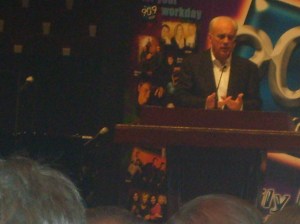
Now that this book is available, naturally, MacArthur has to promote the book. That’s what brought him last Friday to Crossroads Christian Church in Grand Prairie, Texas. I took the opportunity of accompanying my wife to the event to hear him preach all of the above, and then some, for just over an hour (as is his usual habit). Following, are a few pictures from the event:



The Church of Oprah, Nineteenth Century
 With all the hubbub about Oprah and her latest guru, Eckhart Tolle (personally, I prefer, “Tolle Lege“), I’ve been doing a little digging about “spirituality.” If you’ve read Christianity in Crisis by Hank Hanegraaff, then you’ve heard of Phineas Parkhurst Quimby. He is likely the ultimate source of the errors and heresies of the Word of Faith theology of T. L. Osborn, Kenneths Hagin & Copeland, Oral Roberts, John Avanzini, Robert Tilton, Creflo Dollar, T. D. Jakes, Joel Osteen, Joyce Meyer and John Hagee.
He’s also the ultimate source of the theologies of the New Thought Movement. Wikipedia summarizes New Thoughts basic beliefs as follows:
By the end of the 19th century, the chief tenets of New Thought had become stabilized:
- Infinite Intelligence or God is omnipotent and omnipresent.
- Spirit is the ultimate reality.
- True human self-hood is divine. (Christ Consciousness)
- Divinely attuned thought is a positive force for good.
- Most disease is mental in origin.
- Right thinking has a healing effect.
From its initial emphasis on the healing of disease, New Thought had developed into an intensely individualistic and optimistic philosophy of life and conduct.
Can you see the ties between New Thought and Word of Faith?
 Had Oprah been around back in the nineteenth century, she’d’ve had Phineas Parkhurst Quimby on her show. . .
Does It Take A Village?
 Yesterday, I subscribed to the podcast for The Village Church. I had noticed their statement of faith was adopted from that of Sovereign Grace Ministries, the network of Charismatic Calvinist churches founded by C. J. Mahaney, author of Living the Cross-Centered Life, (a book I highly recommend) among other titles. The Village Church is not listed among the Texas Sovereign Grace churches at the network’s website, so I suppose it’s safe to say that to look at one is not necessarily to look at the other, if you know what I mean. But, then again, that may not necessarily be so, either.
After I subscribed to the podcast, I took a long walk and listened to a “talk” explaining the philosophy of ministry at The Village Church. Before Josh delved into the “philosophy” he attempted to lay a theological foundation for it. I’ll give you the passages in the theological foundation:
- The Incarnation of the Word John 1:1-2, 14
- The Mission:
- It’s Authority Matthew 28:19-20
- It’s Scope Acts 1:8
- How The Gospel Spreads “. . . and in chapter 7, a man named Stephen comes before the courts and they are trying him and he preaches a fantastic sermon as they pelt him with rockds. And Stephen is killed; he’s the first martyr of the church. But by God’s plan, He uses the suffering and the fear and the martyrdom that transpired after that to spread the church. . . Acts ends in chapter 28, and chapter 29 is for you and me to write. You see, the reality is those guys told some guys, who told some guys, who told somebody, who told somebody, who told somebody, who told somebody, who told Tom Bailey, who told me in 1996. That’s how it happens. . . This is how the gospel has spread. It’s viral. It joust goes and it inundates people, it infiltrates culture, it gets in the hears of humanity and it changes us. This is the church. The church is a group of redeemed people who sit under the proclamation of the word in fellowship as they share life with one another.”
Attraction Versus Incarnation (translation: traditional architecture vs. personal evangelism)
Next, Josh attempts to unpack the role of The Village Church in this viral spread of the gospel. First he describes a few approaches to church ministry: 1) “an attraction based approach to ministry . . . In the Old Testament, it was more of a ‘come and see’ type of religion. They built the temple. They made pilgrimages to the temple. That’s where sacrifices were made. It was a central type of religion. And so the temple was ornate, it was lavished with gold and all the jewels and all of these things because the people would come. And it was through that that you would see the beauty and majesty of God. but when Christ came, it was no longer a ‘come and see.’ Christ says, ‘Go and tell.'” This is what Josh calls an “incarnational approach to ministry.”
“You see, when Chrsit incarnates, He gives something not just to celebrate but to imitate. He is showing us how life is to be done, how ministry is to be done. Christ comes here, he dwells among us. So in one word, our philosophy of ministry is incarnational.” By this he intends that the way people are drawn to the church is not by the impressive church architecture, but in response to being told about the place by a friend, co-worker, family member, etc.
Now I’ll pause for a moment and make a comment. This dichotomy is drawn between church architecture and personal evangelism as if architecture were the primary draw in traditional churches. This is a misrepresentation. And I humbly submit that it is an excuse, in classic charismatic style, to promote their lack of worship enriching externals by putting down traditional “religion” (this word is to be pronounced with a shudder). Again, in classic charismatic style, the Village Church is not going after those who believe in retaining some sense of communion with the saints of all ages, but they are instilling the same old contemporary, “au nauturaul”, organic, reductionistic form of worship.
The next aspect of the “incarnational” philosophy is a little more encouraging. To quote Josh, “And so our hope is that we would fight against [American-style competition among churches] and what we would bring to center stage would be the gospel. But the reality is, what you win them with, you keep them with. So if we win you with some glitz and glamor and high technology and an unbelieveable building, then we’ve got to keep that up. But if we win you with the gospel, then you won’t be surprised when you realize that’s what we try to keep you with.” This I’m all for. But I still object to pitting personal evangelism against architecture alone. Some have grown up in non-traditional churches and it’s what they expect. What if God called the Village Church to build a traditional style building in the future? They’d lose some folks the same way they assume traditional churches lose traditional worshipers when they start singing praise choruses, or installing a smaller pulpit, or getting rid of it altogether. The problem works both ways, if you ask me.
Width vs. Depth
Another encouraging aspect of Village’s philosophy is that they state a desire for deep preaching and deep believers over a desire for buildings full of shallow believers with deep pockets. “. . . He clearly gave us the commission which was to make disciples . . . not even converts, not to put skins up on the wall and say, ‘Look how many converts we have.’ He says, ‘I want disciples, and discipleship is a lifelong, difficult, painful, suffering process, then you die. That’s it.’ And if you and I are not willing to be transformed and beaten and molded and shaped into the image of Christ, then we have no idea what His will is for His church. He wants to take us deep, and if we get wide during the process, hallelujah. But if we take width over depth, we have sold out the gospel.”
Humility
The final aspect of the Village’s stated philosophy of ministry is that believers are to shun a “spirit of entitlement” for a “spirit of humility and sacrifice.” This should probably be a subset of the previous paragraph. Part of going deep as a believer is learning to love others more than oneself. Josh says, “I need you to help me slay me, and you need me to help you slay you. Because it’s not about us. And when we get that, that’s the most freeing reality, because we will exhaust ourselves on ourselves.”
A Question Raised
One thing that would be instructive to note in this regard is how much width has come to the church in so few years. I can tell that it is probably due in part to megachurch contemporary trimmings with actual Word-based preaching (or “talk”-ing). For this I rejoice. But, when will the church get deep enough to not need solely contemporary disregard for the regulative principle of worship? I’m sure the Villagers think they’re abiding by the Word by reducing Christianity to the interpersonal part of it. But there has been not one single word about a Reformed concept of the “ordinary means of grace” approach to ministry. They seem to have divorced, or as usual, put on the back burner the importance of the sacraments in worship. They’ve got prayer, they’ve got praise and they’ve got proclamation. But nobody seems to know how to work the sacraments into their “approach to ministry.” For those who claim to be Reformed, and if these guys are organizing around the Sovereign Grace Ministries statement of faith, then they must be claiming to be Reformed, this contemporary, organic, “Spirit-filled” kind of worship makes you forget about “rituals” like baptism and the Lord’s Supper. Oh, sure, they’ll get around to them, but only because they know they’d be in hot water without them. But, when it comes to the Village’s philosophy of ministry, you’d think there were no such things as sacraments. At least not the Lord’s Supper. Fortunately, Jesus managed to wedge baptism into the commission so it wouldn’t be neglected, too–except, of course, for neglecting to baptize the households of believers and not individuals alone. . .
Theological & Doxological Meditation #44
Preface’s Teaching
Q. What does the preface to the ten commandments teach us?
A. The preface to the ten commandments teaches us, that because God is the Lord, and our God, and Redeemer, therefore we are bound to keep all his commandments (Luke 1:74-75; 1 Peter 1:15-18).
What shall I render to my God for all his kindness shown? My feet shall visit thine abode, my songs address thy throne.
How much is mercy thy delight, thou ever-blessed God! How dear thy servants in thy sight! How precious is their blood!
How happy all thy servants are! How great thy grace to me! My life, which thou hast made thy care, Lord, I devote to thee.
Now I am thine, forever thine, nor shall my purpose move; thy hand hath loosed my bonds of pain, and bound me with thy love.
Here in thy courts I leave my vow, and thy rich grace record; witness, ye saints who hear me now, if I forsake the Lord.
#637, Trinity Hymnal; from Psalm 116:12-19; Isaac Watts, 1719; DOWNS C.M.; Lowell Mason, 1832
Good Friday: Meditate on Christ’s Passion
 Consider the events which occurred during the first Passion Week, in which our Lord prepared to go to the cross, to pay the ransom that redeemed the souls of all those his Father gave him (John 6:37-40):
Jesus Christ, having been arrested in the Garden of Gethsemane by the Temple Guards through the guidance of Judas Iscariot, is brought to the house of Annas, who is father-in-law of the current high priest, Caiaphas. There he is interrogated with little result, and sent bound to Caiaphas the high priest, where the Sanhedrin had assembled (John 18:1-24).
Conflicting testimony against Jesus is brought forth by many witnesses, to which Jesus answers nothing. Finally the high priest adjures Jesus to respond under solemn oath, saying “I adjure you, by the Living God, to tell us, are you the Anointed One, the Son of God?” Jesus testifies in the affirmative, “You have said it, and in time you will see the Son of Man seated at the right hand of the Almighty, coming on the clouds of Heaven.” The high priest condemns Jesus for blasphemy, and the Sanhedrinconcurs with a sentence of death (Matthew 26:57-66).
In the morning the whole assembly brings Jesus to the Roman governor Pontius Pilate, under charges of subverting the nation, opposing taxes to Caesar, and making himself a king (Luke 23:1-2). Pilate authorizes the Jewish leaders to judge Jesus according to their own Law and execute sentencing, however the Jewish leaders reply that they are not allowed by the Romans to carry out a sentence of death (John 18:31).
Pilate questions Jesus, and tells the assembly that there is no basis for sentencing. Upon learning that Jesus is from Galilee, Pilate refers the case to the ruler of Galilee, King Herod, who was in Jerusalem for the Passover Feast. Herod questions Jesus but receives no answer; Herod sends Jesus back to Pilate. Pilate tells the assembly that neither he nor Herod have found guilt in Jesus; Pilate resolves to have Jesus whipped and released (Luke 23:3-16).
It was a custom during the feast of Passover for the Romans to release one prisoner as requested by the Jews. Pilate asks the crowd who they would like to be released. Under the guidance of the chief priests, the crowd asks for Barabbas, who had been imprisoned for committing murder during an insurrection. Pilate asks what they would have him do with Jesus, and they demand, “Crucify him” (Mark 15:6-14). Pilate’s wife had seen Jesus in a dream earlier that day; she forewarns Pilate to “have nothing to do with this righteous man” (Matthew 27:19).
Pilate has Jesus flogged, then brings him out to the crowd to release him. The chief priests inform Pilate of a new charge, demanding Jesus be sentenced to death “because he claimed to be God’s son.” This possibility filled Pilate with fear, and he brought Jesus back inside the palace and demanded to know from where he came (John 19:1-9).
Coming before the crowd one last time, Pilate declares Jesus innocent, washing his own hands in water to show he has no part in this condemnation. Nevertheless, Pilate hands Jesus over to be crucified in order to forestall a riot (Matthew 27:24-26). The sentence written is “Jesus of Nazareth, King of the Jews.” Jesus carries his cross to the site of execution, called the place of the Skull, or “Golgotha” in Hebrew and “Calvary” in Latin. There he is crucified along with two criminals (John 19:17-22).
Jesus agonizes on the cross for three hours while the sun is darkened. With a loud cry, Jesus gives up his spirit. There is an earthquake, tombs break open, and the curtain in the Temple is torn from top to bottom. The centurion on guard at the site of crucifixion declares, “Truly this was God’s Son!” (Matthew 27:45-54).
Joseph of Arimathea, a member of the Sanhedrin and secret follower of Jesus, who had not consented to his condemnation, goes to Pilate to request the body of Jesus (Luke 23:50-52). Pilate asks confirmation from the centurion whether Jesus is dead (Mark 15:44). A soldier pierced the side of Jesus with a lance causing blood and water to flow out (John 19:34), and the centurion informs Pilate that Jesus is dead (Mark 15:45).
Joseph of Arimathea takes the body of Jesus, wraps it in a clean linen shroud, and places it in his own new tomb that had been carved in the rock (Matthew 27:59-60) in a garden near the site of crucifixion. Another secret follower of Jesus and member of the Sanhedrin named Nicodemus (John 3:1) also came bringing 75 pounds of myrrh and aloes, and places them in the linen with the body of Jesus, according to Jewish burial customs (John 19:39-40). They rolled a large rock over the entrance of the tomb (Matthew 27:60). Then they returned home and rested, because at sunset began the Sabbath (Luke 23:54-56). —from Wikipedia
Over at Google Maps, you can view a satellite image of Jerusalem and the surrounding area, with tags identifying the events of the entire Passion Week from Christ’s Triumphal Entry, which we commemorated last Sunday through Good Friday which we commemorate tomorrow (or today, depending on when you are reading this). Each tag links to Scripture passages about each event identified on the satellite map.
Now, respond to that which you have taken in about the last week of the life of the Lord Jesus, by singing or praying this hymn written in 1630 by Johann Heermann called, “Ah, Holy Jesus, How Hast Thou Offended?” It is #248 in the Trinity Hymnal.
Ah, Holy Jesus, how hast thou offended, that man to judge thee hath in hate pretended? By foes derided, by thine own rejected, O most afflicted.
Who was the guilty who brought this upon thee? Alas, my treason, Jesus, hath undone thiee. ‘Twas I, Lord Jesus, I it was denied thee: I crucified thee.
Lo, the Good Shepherd for the sheep is offered; the slave hath sinned, and the Son hath suffered: for man’s atonement, while he nothing heedeth, God interceedeth.
For me, kind Jesus, was thine incarnation, thy mortal sorrow, and thy life’s oblation: thy death of anguish and thy bitter passion, for my salvation.
Therefore, kind Jesus, since I cannot pay thee, I do adore thee, and will ever pray thee, think on thy pity and thy love unswerving, not my deserving.
Worshiping With the Mind
 I started reading Paul S. Jones’ 2006 publication, Singing and Making Music: Issues in Church Music Today. I’m enjoying it very much. Having scanned ahead, I must concur with J. Ligon Duncan’s endorsement which is emblazoned across the front cover. He says, “Theologically astute, musically adept, construcively provocative.” Provocative, indeed. There are some thought-provoking preferences publicshed and recommendations made, of which only someone of Jones’ level of training would ever get around to thinking. But that shouldn’t make us shy away from considering the value of those opinions, but lead us to think a little more thoroughly about all facets of the way we worship God through music in corporate worship.
I thought I’d share an interesting excerpt with you from chapter six, “Leading in Worship as Accompanist.” Jones writes a few paragraphs that reminds us of the importance of spiritual, theological and biblical depth in the words we sing as a church, as well as the fact that accompanists can help highlight the lyrical content of the music in an effort to aid us in comprehending and understanding (and thus properly participating in) what we sing. Jones writes the following on pages 42-44 of his book:
The Accompanist’s Role
The accompanist directly influences singing. This is true not only of congregations, but of choirs and soloists. An accompanist can influence the singer as much as the choir director can (and often more). Why? Because we respond naturally in music to what we hear more than to what we see, read, or are told. For example, in a band or orchestra, the percussion section must be especially attentive to the conductor. If the snare drum moves a little faster or slower than the baton, the entire ensemble will move with the drummer. The percussive nature of the piano has a similar rhythmic effect. The choir or congregation will typically move along with what it hears. The organ, if it is a good one, has sufficient sound capacity to lead with force; but even here it is articulation that provides much of the rhythmic clarity.
So, then, if the accompanist influences the way in which a congregation sings, in what ways is this true? In addition to tempo and rhythm, which have already been mentioned, the accompanist influences volume and dynamic. Pacing (time between verses and how long chords are held), style, and articulation can also be included in the list, as can breathing and ensemble (togetherness/unity). Most significantly, through these various parameters one can affect people’s thinking as well as their connection to the truths being sung.
This last sphere of influence–thought–is the most important, and all the others are connected to it. Thought is missing more and more in worship today. Apparently we are more concerned about our emotional connection and what we are “getting” out of the worship experience than in being cognitively engaged or spiritually awakened. This mindset is one of the primary reasons that hymns have fallen out of popularity and use in many churches. It is because they require thought; and as a people, we do not want to think. Not many years ago I read a short article by a seminary professor in a prominent Christian periodical. He wrote something along the lines of, “Let’s stop being enslaved to the present rationalistic, intellect-centered approach to church that characterizes much of evangelicalism.” Well, he got his wish. Today most evangelicals come to church to be refreshed, not to work or think.
Yet proper worship does take work. It also takes thought, preparation, and action. If we understood that our singing is not for ourselves or directed principally to each other, but to and for God, that understanding would make a difference in how we engage in it. If we were more conscious of the fact that when we sing we are praising God and praying to him, that we are in the presence of the King of Glory, we would realize how important it is to know what we are singing.
Congregational music should deliver Christian doctrine, quote Scripture, or offer a message of challenge or encouragement to fellow believers while pointing all to Christ. Often, congregational song is prayer. How we think about these songs and how we sing them matters. The accompanist has a lot to do with that. I would venture that it is the single most important thing that one does as an accompanist. Such responsibility demands preparation on our parts. It requires practice. . . . “
Presbyterian & Reformed Publishing currently has this listed among their “Bargain Books” going for $8.50, if you’re interested in obtaining a copy. I recommend it for those who want to learn more about how to worship God well through the gift of music.
Theological and Doxological Meditation #40
 God’s First Revealed Rule
Q. What did God at first reveal to man for the rule of his obedience?
A. The rule which God at first revealed to man for the rule of his obedience was the moral law (Romans 2:14-15)
Most Perfect is the Law of God
Most perfect is the law of God, restoring those that stray; his testimony is most sure, proclaiming wisdom’s way.
The precepts of the Lord are right; with joy they fill the heart; the Lord’s commandments all are pure, and clearest light impart.
The fear of God is undefiled and ever shall endure; the statutes of the Lord are truth and righteousness most pure.
They warn from ways of wickedness displeasing to the Lord, and in the keeping of his Word there is a great reward.
REFRAIN
O how love I thy law! O how love I thy law! It is my meditation all the day. O how love I thy law! O how love I thy law! It is my meditation all the day.
#153, The Trinity Hymnal (© 1990); from Psalm 19:7-11; 119:97; The Psalter, 1912; KINSMAN C.M. ref.; James McGranahan, 1840-1907; alt. 1990
Jesus, the First Resurrection!
We interrupt the mundane theological debates at hand to proclaim to you Jesus, Our Resurrection! Those who believe will share, not only in his death, but also in his resurrection! Jesus is the First Resurrection (Revelation 20:4-5)! For more on this odd refernce, see Kim Riddlebarger’s sermon, “They Came To Life And Reigned With Christ For A Thousand Years”
Don’t forget, Easter–or “Resurrection Sunday,” if you prefer–is only two weeks away!
Christ is Risen!!! In John 11, we learn about Jesus our resurrection: let’s read about it together . . .
The Death of Lazarus
· Jesus’ ministry coming to an end; his greatest sign about to be given by which Jesus revealed the glory of God the Father (see John 17:1-6).
· Jesus and his disciples are on their way to Jerusalem for the last time, to keep Jesus’ last Passover feast, the meal in which the Jews took part in the great work of redemption in the Old Testament, the exodus from bondage in Egypt. This last Passover will become Jesus’ Last Supper where he will update some of the symbols in the meal to communicate his ultimate work of redemption for not only Jews, but also for Gentiles from every nation.
11:1 Now a certain man was ill, Lazarus of Bethany, the village of Mary and her sister Martha. 2 It was Mary who anointed the Lord with ointment and wiped his feet with her hair, whose brother Lazarus was ill. 3 So the sisters sent to him, saying, “Lord, he whom you love is ill.” 4 But when Jesus heard it he said, “This illness does not lead to death. It is for the glory of God, so that the Son of God may be glorified through it.”
· Jesus had some friends in Bethany, where Mary and Martha would take care of Jesus whenever he came that way. Mary will become famous for how she prepares Jesus for his burial in chapter 12.
· The sisters send word that their brother is sick, but Jesus, by the Holy Spirit, knows that this is not the last anyone will see of Lazarus. But that what is about to happen will help Jesus glorify his Father in heaven.
5 Now Jesus loved Martha and her sister and Lazarus. 6 So, when he heard that Lazarus was ill, he stayed two days longer in the place where he was. 7 Then after this he said to the disciples, “Let us go to Judea again.” 8 The disciples said to him, “Rabbi, the Jews were just now seeking to stone you, and are you going there again?” 9 Jesus answered, “Are there not twelve hours in the day? If anyone walks in the day, he does not stumble, because he sees the light of this world. 10 But if anyone walks in the night, he stumbles, because the light is not in him.” 11 After saying these things, he said to them, “Our friend Lazarus has fallen asleep, but I go to awaken him.” 12 The disciples said to him, “Lord, if he has fallen asleep, he will recover.” 13 Now Jesus had spoken of his death, but they thought that he meant taking rest in sleep. 14 Then Jesus told them plainly, “Lazarus has died, 15 and for your sake I am glad that I was not there, so that you may believe. But let us go to him.” 16 So Thomas, called the Twin, said to his fellow disciples, “Let us also go, that we may die with him.”
· (5-6) Normally, if we call for someone to help, and if they are slow to come, we think they don’t like us much; but John wrote that because Jesus loved Lazarus and his sisters, he put off showing up for two days! That means God has a plan!
· (7-10) When Jesus is ready he calls his disciples to follow him to Judea. Bethany is in Judea, as is Jerusalem, where the Jews wait to kill Jesus. The disciples fear the danger and remind Jesus, hoping he’ll just let Lazarus recover on his own, so they can stay safe. But Jesus tells them plainly that Lazarus is dead and Jesus is to go raise him to give them a sign that will strengthen their faith in him. Finally, Thomas speaks for the whole group when he resolves to follow Jesus even to the cross! This is how far God calls us to follow Jesus, too, and when that time comes, he gives us the grace to be willing to do so, if we believe (Hebrews 12:1-4).
I Am the Resurrection and the Life
17 Now when Jesus came, he found that Lazarus had already been in the tomb four days. 18 Bethany was near Jerusalem, about two miles off (15 stadia), 19 and many of the Jews had come to Martha and Mary to console them concerning their brother. 20 So when Martha heard that Jesus was coming, she went and met him, but Mary remained seated in the house. 21 Martha said to Jesus, “Lord, if you had been here, my brother would not have died. 22 But even now I know that whatever you ask from God, God will give you.” 23 Jesus said to her, “Your brother will rise again.” 24 Martha said to him, “I know that he will rise again in the resurrection on the last day.” 25 Jesus said to her, “I am the resurrection and the life. [4] Whoever believes in me, though he die, yet shall he live, 26 and everyone who lives and believes in me shall never die. Do you believe this?” 27 She said to him, “Yes, Lord; I believe that you are the Christ, the Son of God, who is coming into the world.”
· (17-22) When Jesus and the disciples get to Bethany, they find that dead Lazarus has been buried for four days, and many people from Jerusalem had come to console Martha and Mary. When the sisters hear of Jesus’ arrival, Martha hurries to greet Jesus and reaffirm her faith in him, even though he didn’t do what she had originally asked for. We can rest assured that when we pray for something, if we don’t get it, we can know that it’s only because God plans to do something even better for your good and his glory (Romans 8:26-30)!
· (23-27) When Jesus promises Lazarus will rise from the dead, Martha misunderstands, thinking that Jesus is talking about the end of the world when everyone will rise from the dead. But, again, Jesus plans to do something better than we expect! Jesus proclaims that he is resurrection himself, and we who believe in him will experience a spiritual resurrection, because of which, though we may die physically one day, we can be sure we will live in God’s presence forever (Romans 6:5)! Now I ask you what Jesus asked Martha: “Do you believe this?” Do you believe that Jesus is the Christ, whom God sent to die because of your sins and to rise from the dead that you may live forever because God has justified you by giving you Jesus’ rigteousness?
Jesus Weeps
28 When she had said this, she went and called her sister Mary, saying in private, “The Teacher is here and is calling for you.” 29 And when she heard it, she rose quickly and went to him. 30 Now Jesus had not yet come into the village, but was still in the place where Martha had met him. 31 When the Jews who were with her in the house, consoling her, saw Mary rise quickly and go out, they followed her, supposing that she was going to the tomb to weep there. 32 Now when Mary came to where Jesus was and saw him, she fell at his feet, saying to him, “Lord, if you had been here, my brother would not have died.” 33 When Jesus saw her weeping, and the Jews who had come with her also weeping, he was deeply moved in his spirit and greatly troubled. 34 And he said, “Where have you laid him?” They said to him, “Lord, come and see.” 35 Jesus wept. 36 So the Jews said, “See how he loved him!” 37 But some of them said, “Could not he who opened the eyes of the blind man also have kept this man from dying?”
· Now Martha fetches Mary so she may greet Jesus and be comforted by her. Jesus felt sorry for Mary when she came and complained to him in tears. Jesus asks to see Lazarus’ tomb, and when he sees it, he weeps with Mary (Romans 12:15) over Lazarus’ death. This, as usual, serves to divide the people who witness Jesus’ works: some admire his love for Lazarus, while others complain that Jesus’ tears aren’t good enough.
Jesus Raises Lazarus
38 Then Jesus, deeply moved again, came to the tomb. It was a cave, and a stone lay against it. 39 Jesus said, “Take away the stone.” Martha, the sister of the dead man, said to him, “Lord, by this time there will be an odor, for he has been dead four days.” 40 Jesus said to her, “Did I not tell you that if you believed you would see the glory of God?” 41 So they took away the stone. And Jesus lifted up his eyes and said, “Father, I thank you that you have heard me. 42 I knew that you always hear me, but I said this on account of the people standing around, that they may believe that you sent me.” 43 When he had said these things, he cried out with a loud voice, “Lazarus, come out.” 44 The man who had died came out, his hands and feet bound with linen strips, and his face wrapped with a cloth. Jesus said to them, “Unbind him, and let him go.”
· When Jesus commands the stone be removed, Martha reminds him Lazarus’ decomposing body will stink, but Jesus reminds her of his words to her about trusting Jesus so she can see how he will glorify God the Father. Then Jesus prays for the Father to raise Lazarus, and he prays for this so that those who witness this sign will believe that Jesus is the Christ, sent by God the Father.
The Plot to Kill Jesus
45 Many of the Jews therefore, who had come with Mary and had seen what he did, believed in him, 46 but some of them went to the Pharisees and told them what Jesus had done. 47 So the chief priests and the Pharisees gathered the Council and said, “What are we to do? For this man performs many signs. 48 If we let him go on like this, everyone will believe in him, and the Romans will come and take away both our place and our nation.” 49 But one of them, Caiaphas, who was high priest that year, said to them, “You know nothing at all. 50 Nor do you understand that it is better for you that one man should die for the people, not that the whole nation should perish.” 51 He did not say this of his own accord, but being high priest that year he prophesied that Jesus would die for the nation, 52 and not for the nation only, but also to gather into one the children of God who are scattered abroad. 53 So from that day on they made plans to put him to death.
· Some of the Jews who saw the resurrection of Lazarus believed and so received a spiritual resurrection of their own in Jesus! They were raised to life by God and believed in Jesus! But others went and reported this miracle to the Pharisees, who, with the chief priests, gathered the Council to determine what to do next about this trouble-maker, Jesus. They feared that if they left Jesus alone, and everyone receives him, then the Romans would consider it a threat and would send troops to punish the nation of Israel. But John points out that the high priests words also prophesied about Jesus’ mission: it is better that one sinless man should die on behalf of sinners, than it is for the large group of sinners to die themselves. John uses the high priest’s words to teach us that by his death, Jesus would save not only Jews, but Gentiles from all around the world, too! Gentiles like me and you, who believe (Romans 9:22-26)! Out of hatred for Jesus, and fear of the Romans, they meant evil toward Jesus, but God meant good for his chosen people from all around the world (cf. Genesis 50:20).
54 Jesus therefore no longer walked openly among the Jews, but went from there to the region near the wilderness, to a town called Ephraim, and there he stayed with the disciples.
· Jesus knew how much the Jews in Jerusalem hated him, but he desired to keep the Passover, so he waited in Ephraim to keep safe until the time of the Feast.
55 Now the Passover of the Jews was at hand, and many went up from the country to Jerusalem before the Passover to purify themselves. 56 They were looking for [5] Jesus and saying to one another as they stood in the temple, “What do you think? That he will not come to the feast at all?” 57 Now the chief priests and the Pharisees had given orders that if anyone knew where he was, he should let them know, so that they might arrest him.
· Although the Jews want to arrest Jesus and kill him for their own good, God sent Jesus to die for sin, so that through believing in Jesus, sinners like you and me could be brought to life in Jesus, Our Resurrection!
A Little More Guidance on “Guidance”
 Looking around the internet for some more resources to help you get an idea of just how mystical most modern American Evangelical Christians are, I decided to see what has been written in the way of critique regarding the Southern Baptist phenomenon of the ninties, Henry Blackaby’s bestseller, Experiencing God. A simple Yahoo search yielded an interesting review from 1994 by Greg Gilbert for 9Marks Ministries, the verysame source that got me on this topic in the first place last Monday. Gilbert’s remarks are remarkably positive overall, but has a lengthy caution regarding the very subjective, mystical tendency I’m trying to spotlight. Gilbert writes:
Blackaby’s teaching throughout Experiencing God is heavily tilted toward discerning some particular “assignment” or “task” from God for a person’s life. His illustrations often begin with words like, “One of our churches believed that God was calling them to . . .” or “Our association was convinced that God wanted us to . . .”(pp. 23, 41) He writes on page 24, “Whenever God gives you a directive, it is always right.” What, though, is the nature of such directives? How does God give them? Blackaby’s conception of these “tasks” or “directives” seems to be a subjective impression on the mind about God’s will for a particular circumstance. God communicates directly to the mind of the Christian and tells him, almost audibly it seems, what should be done. “When God speaks to you in yourquiet time, immediately write down what He said,” (p.172). This belief that God gives direct, subjective impressions to His people is certainly not without merit. Perhaps most importantly, it underlines the reality that God is imminently present and involved in the world. He has not left it to run itself, but is determined to be a part of His people’s lives. There are, though, some cautions that should be raised about such a belief. (Read more)
Gilbert not only offered the criticisms contained in the article, but also made a recommendation for those of you asking, “So, if Blackaby’s version of “leading, guiding and directing” by the Holy Spirit is problematic, where can I learn the way of the Spirit’s leadership more perfectly?” Gilbert’s answer is to direct you to the teaching and writing ministry of Jim Eliff called Christian Communication Worldwide, whose stated ”compelling interests are the reformation of the church, biblical evangelism, and the hope for authentic revival in our day.” Elliff has written a book called, Led by the Spirit: How the Holy Spirit Guides the Believer. I’m intrigued. Whenever I get around to ordering it, perhaps I’ll write a few posts featuring his wisdom from the written Word of God on the subject.


 The Misadventures of Captain Headknowledge