Dynamics of Church Planting | Christ the Center Podcast

Church planting is one way the Lord expands his kingdom on earth. Christ called his disciples to go forth and make disciples of men, baptizing them in the name of the Father, Son, and Holy Spirit. Faithful discipleship is connected with the local church. That point has been debated in and of itself, but the proper means of church planting has been a much more contentious subject.
In this episode, Andrew Moody and Eric Watkins work through several dynamics of church planting. Rev. Moody serves as Evangelist at San Antonio Reformed Church in San Antonio, Texas, and Rev. Watkins is Pastor of Covenant Presbyterian Church in St. Augustine, Florida. Both Eric and Andrew bring experience to this interesting discussion on planting Reformed churches.
Participants: Andrew Moody, Camden Bucey, Eric Watkins, Jim Cassidy
HT: Reformed Forum
Understanding Law & Gospel
 On this episode of the White Horse Inn, Michael Horton addresses the topic, “Understanding Law and Gospel.”
There he goes again… 🙂
Heresy in the Headlines: Camping & Schuller
Strike Three and You’re Out
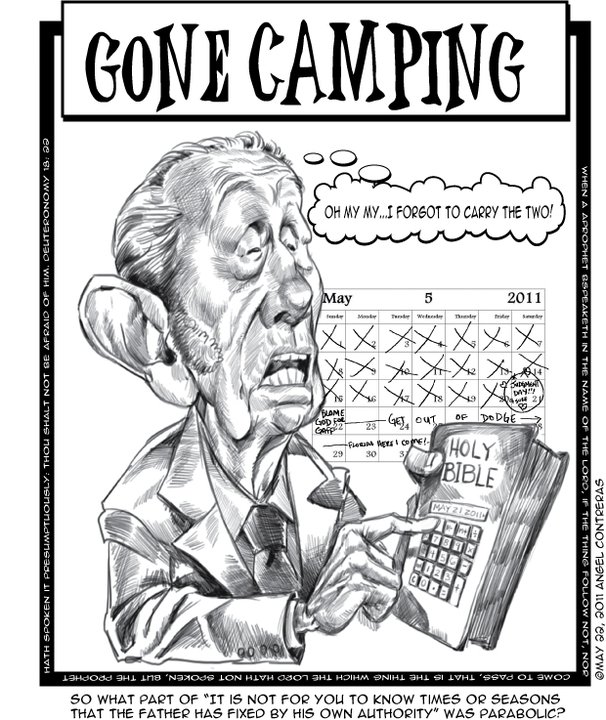
You may have heard that last week Harold Camping apologized for setting dates for the rapture. His bizarre application of civil engineer math geekiness to biblical hermeneutics misleads him to believe he could calculate the date of the rapture and the final judgment (See Robert Godfrey’s posts on Camping parts 1, 2, 3, 4 and 5). Strike one was back in 1994—No rapture. Camping discovers his miscalculation, and revises his date to May 21, 2011, which is also to kick off five months of judgment apparently in the form of rolling earthquakes that were to begin at a certain time of day all around the globe. Perhaps you noticed the billboards in some parts of the country, but most of you will recall the media attention given to it in the weeks leading up to Camping’s second date. May 21, 2011 comes and goes: strike two! Upon this failure, he claims that the rapture really did happen, but it was a spiritual rapture, and that a spiritual judgment has begun which will culminate in the complete end of the world all at once on October 21, 2011. Nothing. Strike three and you’re out, Harold Camping! In the stressful aftermath of this publicly humiliating fiasco, which brought much grief, consternation, and in some parts of the world, persecution, Camping suffers a stroke, and he is removed from regular broadcasting on Family Radio. I don’t know if the strike was brought on by the stress of the events, but a stroke he suffered, nonetheless.
Now that he’s had time to recover, this past week, Camping posts a letter on the Family Radio website apologizing for his “sin” of setting dates (read the letter here). In some ways it is an impressive statement. I was particularly moved to see his state in no uncertain terms that those of us who harped on Jesus’ words that “no man will know the day or hour” were right, and that he was wrong:
…we now realize that those people who were calling our attention to the Bible’s statement that “of that day and hour knoweth no man” (Matthew 24:36 & Mark 13:32), were right in their understanding of those verses and Family Radio was wrong. Whether God will ever give us any indication of the date of His return is hidden in God’s divine plan.
But this candid concession and apology was not good enough for Dan Elmendorf, former Family Radio broadcaster and now founder of Redeemer Broadcasting. In his weekly program, “A Plain Answer,” Elmendorf reminds us that the sin of date-setting was the least of Camping’s doctrinal problems. Absent from Camping’s open letter is any expression of repentance for having called on Christians to leave organized churches in which the gospel is preached and the sacraments of baptism and the Lord’s Supper are administered under the oversight by elders with the authority of exercising church discipline on members whose lives are persistently refusing to conform to a biblical standard of holiness and obedience to Scripture. Apparently, Camping still believes, and would have his listeners believe, that “the church age has ended.” So, it’s not that Camping has repented of the more heretical nature of his controversial “ministry.” I recommend that you listen to Elmendorf’s program, the first segment of which addresses Camping’s “weak apology.” The host shares some insight and experience which you can’t get from the Associated Press stories.
The Schuller’s Take Their Ball and Leave
In another recent instance of heresy in the headlines, it is reported that the entire family of positive-thinking televangelist, Robert Schuller, are leaving Crystal Cathedral Ministries. The 85 year-old Schuller, having retired from weekly “ministry” in 2009, was succeeded by his daughter, Sheila Schuller Coleman. According to the LA Times, Coleman announced this past Sunday that she will leave the Crystal Cathedral to start a new church citing a “hostile working environment” stemming from a growing divide between the Schuller family and the Crystal Cathedral’s board of directors. Robert Schuller and his wife applaud Coleman’s decision, but announce they will not be joining her at her new church, and that their plans for weekly worship are not yet finally decided. They will not, however, have any further public association with the work of the Crystal Cathedral and it’s broadcast The Hour of Power, started by Robert Schuller back in 1970. It seems that all positive (as opposed to “good”) things must come to an end. In my humble opinion, this end has been long overdue.
Jesus Loves Religion

Portrait of a Religious Republican
Many of you may have already seen this viral video originally posted by The Resurgence website. A co-worker told me about it and it linked (at that time) to The Resurgence. At that point it had three million views. By the time I got home Friday morning and pulled it up again (about four hours later), it had six million views! Now it’s plateaued at over seven million. It’s effective, because it’s edgy. It’s edgy because it features a misdefinition of the word “Religion.”
Watch the video, before we move on:
Another friend of mine shared it on his Facebook page, with a lengthy discussion in which I just had to participate. Here’s what I wrote:
This forty-something Republican is down with most of this. But the “semantic” issue is that by “religion” he does mean legalism, but I’d like to submit that he’s also talking about hypocrisy. But I guess if he used the right words, it wouldn’t have been nearly as edgy and would have gotten a couple million fewer views on YouTube. At first I thought he was coming too close to advocating “don’t go to church, be the church” like Barna’s “Revolutionaries,” but I rewatched it and retained his clarification about “loving the church” which I suppose means he doesn’t advocate dropping out. He’s just, again, challenging legalism and hypocrisy.
Fortunately, a trained professional has now written a lengthy and helpful critique, which is not uncomplimentary, about this latest YouTube phenomenon. Kevin DeYoung, co-author of Why We Love the Church: In Praise of Institutions and Organized Religion (2009?, Moody Publishers) writes “Does Jesus Hate Religion? Kinda Sorta, Not Really.” Here’s DeYoung’s comments on the poet’s misleading use of the word “religion,” how religious Jesus was, and how religious he wants his followers to be:
More important is Bethke’s opening line: “Jesus came to abolish religion.” That’s the whole point of the poem. The argument—and most poems are arguing for something—rests on the sharp distinction between religion on one side and Jesus on the other. Whether this argument is fair depends on your definition of religion. Bethke sees religion as a man made attempt to earn God’s favor. Religion equals self-righteousness, moral preening, and hypocrisy. Religion is all law and no gospel. If that’s religion, then Jesus is certainly against it.
But that’s not what religion is. We can say that’s what is has become for some people or what we understand it to be. But words still matter and we shouldn’t just define them however we want. “Jesus hates religion” communicates something that “Jesus hates self-righteousness” doesn’t. To say that Jesus hates pride and hypocrisy is old news. To say he hates religion—now, that has a kick to it. People hear “religion” and think of rules, rituals, dogma, pastors, priests, institutions. People love Oprah and the Shack and “spiritual, not religious” bumper stickers because the mood of our country is one that wants God without the strictures that come with traditional Christianity. We love the Jesus that hates religion.
The only problem is, he didn’t. Jesus was a Jew. He went to services at the synagogue. He observed Jewish holy days. He did not come to abolish the Law or the Prophets, but to fulfill them (Matt. 5:17). He founded the church (Matt. 16:18). He established church discipline (Matt. 18:15-20). He instituted a ritual meal (Matt. 26:26-28). He told his disciples to baptize people and to teach others to obey everything he commanded (Matt. 28:19-20). He insisted that people believe in him and believe certain things about him (John 3:16-18; 8:24). If religion is characterized by doctrine, commands, rituals, and structure, then Jesus is not your go-to guy for hating religion. This was the central point behind the book Ted Kluck and I wrote a few years ago.
The word “religion” occurs five times in English Standard Version of the Bible. It is, by itself, an entirely neutral word. Religion can refer to Judaism (Acts 26:5) or the Jewish-Christian faith (Acts 25:19). Religion can be bad when it is self-made (Col. 2:23) or fails to tame the tongue (James 1:26). But religion can also be good when it cares for widows and orphans and practices moral purity (James 1:27). Unless we define the word to suit our purposes, there is simply no biblical grounds for saying Jesus hated religion. What might be gained by using such language will, without a careful explanation and caveats, be outweighed by what is lost when we give the impression that religion is the alloy that corrupts a relationship with Jesus.
Update: Poet Jefferson Bethke responds on his Facebook page to those using his video to “bash the church”:
If you are using my video to bash “the church” be careful. I was in no way intending to do that. My heart came from trying to highlight and expose legalism and hypocrisy. The Church is Jesus’ bride so be careful how you speak of His wife. If a normal dude has right to get pissed when you bash His wife, it makes me tremble to think how great the weight is when we do it to Jesus’ wife. The church is His vehicle to reach a lost word. A hospital for sinners. Saying you love Jesus but hate the Church, is like a fiancé saying he loves his future bride, but hates her kids. We are all under grace. Look to Him.
How to make Joel Osteen nervous
Ask him a politically-charged question about biblical sexual morality.
It’s good that Joel was able to get what he’s bound to believe out of his mouth. He would do well to work toward not only believing these things, but also ministering these truths in the way Paul advised Timothy in 2 Timothy 4:1-5, which reads,
I charge you in the presence of God and of Christ Jesus, who is to judge the living and the dead, and by his appearing and his kingdom: preach the word; be ready in season and out of season; reprove, rebuke, and exhort, with complete patience and teaching. For the time is coming when people will not endure sound teaching, but having itching ears they will accumulate for themselves teachers to suit their own passions, and will turn away from listening to the truth and wander off into myths. As for you, always be sober-minded, endure suffering, do the work of an evangelist, fulfill your ministry.
For the record, according to Joel Osteen, he believes that the Bible teaches the following:
“You shall not lie with a male as with a woman; it is an abomination” (Leviticus 18:22).
“If a man lies with a male as with a woman, both of them have committed an abomination…” (Leviticus 20:13).
“…and the men likewise gave up natural relations with women and were consumed with passion for one another, men committing shameless acts with men and receiving in themselves the due penalty for their error”(Romans 1:27).
“…just as Sodom and Gomorrah and the surrounding cities, which likewise indulged in sexual immorality and pursued unnatural desire, serve as an example by undergoing a punishment of eternal fire” (Jude 1:7; cf. Gen. 19).
But this next passage shows Joel should have also qualified his initially reassuring assertion to Oprah that “I think [homosexuals] will [go to heaven].” He does clarify that “they need forgiveness of their sins,” but this was an attempt to evade putting the two together until Oprah had to pull it out of him in uncertain terms. In this, he sounds nothing like the apostle Paul, whose inspired assertion is much clearer:
“Or do you not know that the unrighteous will not inherit the kingdom of God? Do not be deceived: neither the sexually immoral, nor idolaters, nor adulterers, nor men who practice homosexuality, nor thieves, nor the greedy, nor drunkards, nor revilers, nor swindlers will inherit the kingdom of God” (1 Corinthians 6:9-10).
Fortunately for homosexuals who repent and for Joel Osteen, Paul goes on in verse 11 to proclaim:
“And such were some of you. But you were washed, you were sanctified, you were justified in the name of the Lord Jesus Christ and by the Spirit of our God” (1 Corinthians 6:11).
It is the desire of every loving, right-minded Christian that the homosexuals should, by the grace of the Spirit of God,
- believe the good news of forgiveness through the sinless life, atoning death and enlivening resurrection of the Lord Jesus Christ, and so be justified through faith alone…
- repent of his sins, including the sin of homosexuality…
- be washed clean in the waters of baptism…
- learn to obey all that Christ taught, including his and his apostles’ teachings on sexual morality. Or, as Paul put it above “[be] sanctified.”
Short of this, the regrettable fact remains that the homosexual, as well as the sexually immoral, the idolater, the adulterer, the thief, the greedy, the drunkard, the reviler and the swindler, among other kinds of sinner, will not inherit the kingdom of God.
The Christ of the Bible
HT: Cado Odac
Sermon Notes: “Invited to the Supper” (Matthew 22:1-14)

The following sermon was preached by Rev. Joe Troutman at Mid-Cities Presbyterian Church in Bedford, Texas. Listen online or subscribe to the podcast.
God calls all to repent and believe and many refuse, but others believe and are welcome to the feast.
The parable of the wedding feast is the third parable of judgment spoken by Jesus on the week leading to his crucifixion. While the first two primarily targeted the Pharisees, Saducees and Jewish priesthood, this parable applies to all in the nation of Israel who do not follow Christ in faith, but are guilty of rebellion against God.
God will judge everyone who refuses to repent and believe, but will show mercy by bringing to himself repentant believers who had not previously been associated with his covenant people.
Rejection of the Call (Matthew 22:1-7) And again Jesus spoke to them in parables, saying, “The kingdom of heaven may be compared to a king who gave a wedding feast for his son, and sent his servants to call those who were invited to the wedding feast, but they would not come. Again he sent other servants, saying, ‘Tell those who are invited, “See, I have prepared my dinner, my oxen and my fat calves have been slaughtered, and everything is ready. Come to the wedding feast.”’ But they paid no attention and went off, one to his farm, another to his business, while the rest seized his servants, treated them shamefully, and killed them. The king was angry, and he sent his troops and destroyed those murderers and burned their city.
- The setting of the parable of the wedding feast is a feast thrown in a kingdom by the king for his son.
- It was customary to send invitations with the expectation of a response of intention to attend, followed by a second call—an announcement that the meal is now ready, and that those invited are to now come to the feast.
- Historically it was often a crime for those who promise to attend to then refuse to do so.
- Jesus’ parable portrays an absurd exaggeration of this scenario.
- In verses 5 and 6, the rejection of the invited guests evidences their ingratitude: some ignored the servant sent to call them, others mistreated and killed him, just as the Israelites always did the Old Testament prophets.
- In verse 7, the king is rightfully angry and sends troops to kill the invited guests and burns down their city.
- The guests reflect what Israel had been doing to God for generations. The king’s judgment in the parable reflects the wrath to come both in AD 70 and the Final Judgment upon Christ’s return.
Invitation to All (Matthew 22:8-10) Then he said to his servants, ‘The wedding feast is ready, but those invited were not worthy. Go therefore to the main roads and invite to the wedding feast as many as you find.’ And those servants went out into the roads and gathered all whom they found, both bad and good. So the wedding hall was filled with guests.
- In verse 8, the food is made ready.
- In verse 9, the servants are sent to anyone who will come, who demonstrate a faith not found among the invited guests, as the Centurion whose servant Jesus healed in Matthew 8, of which Jesus said “Truly, I tell you, with no one in Israel have I found such faith I tell you, many will come from east and west and recline at table with Abraham, Isaac, and Jacob in the kingdom of heaven, while the sons of the kingdom will be thrown into the outer darkness. In that place there will be weeping and gnashing of teeth” (Matthew 8:10-12).
- Throughout all of the Scriptures, one plan of salvation is revealed: both Jew and Gentile must have faith in the Messiah of Israel. Just as Old Testament Judaism sometimes included Gentiles, so Christianity does not exclude all Jews—for example, first century Christianity was largely Jewish—but all who respond to the invitation are welcome to the wedding feast.
- Thus the invitation in the parable is what is expressed in the Westminster Shorter Catechism (Q&A 31) as “the free offer of the gospel.”
- The church offers salvation to all—God sorts out those who respond from those who do not respond. The church gives a general call which may be rejected or falsely received. The Holy Spirit gives an effectual call by which those who respond will necessarily be saved.
Responsibiltiy (11-14) “But when the king came in to look at the guests, he saw there a man who had no wedding garment. And he said to him, ‘Friend, how did you get in here without a wedding garment?’ And he was speechless. Then the king said to the attendants, ‘Bind him hand and foot and cast him into the outer darkness. In that place there will be weeping and gnashing of teeth.’ For many are called, but few are chosen.”
- The king of the parable goes in disguise to inquire of one who attends the wedding feast without a wedding garment, and throws him out into outer darkness.
- The wedding garment represents the fruit of faith: grateful, obedient works.
- In the local church, all respond to the call to worship, but not all truly believe, evidenced by a life of unrepentant disobedience. Thus, some in the local church will be found to be without their “wedding garment.”
- In verse 14, God’s choice is shown to be the ultimate factor. If God doesn’t effectually call his chosen, all would refuse to come as the invited guests at the beginning of the parable, and as the citizens of Israel who will not have Jesus to be their Messiah.
- Though many be called, few are chosen. True believers must humbly and charitably receive all who profess faith in Christ, they must not proudly exclude those who differ on non-essentials, as if they belonged to the one true church.
- There is a visible church comprised of all professing believers (all who have responded to the general call), and there is an invisible church comprised of the elect (all brought effectively to Christ by the Holy Spirit’s effectual call).
- Thus, church membership alone is not saving; renewal of the heart by the Holy Spirit to repent and believe is necessary.
- Without faith, there is no hope. With faith comes true membership in the invisible church, which the parable portrays by those who come to the wedding feast wearing their wedding garment.
Sermon Notes: A Tale of Two Sons (Matthew 21:23-32)
The following sermon was preached on October 30, 2011 by Rev. Joe Troutman at Mid-Cities Presbyterian Church in Bedford, Texas. Listen to the sermon at this link, or subscribe to the podcast.
In fulfillment of the old Testament Scriptures, Jesus Christ came to bring salvation to every sinner who repents and believes in him.
A Question of Authority (Matthew 21:23) And when he entered the temple, the chief priests and the elders of the people came up to him as he was teaching, and said, “By what authority are you doing these things, and who gave you this authority?”
- The beginning of a long series of exchanges between Jesus and the Temple leaders which culminates in the seven woes pronounced upon their hypocrisy in Matthew 23.
- The leaders should have known Jesus’ authority was from heaven.
A Question in Response (Matthew 21:24-27) Jesus answered them, “I also will ask you one question, and if you tell me the answer, then I also will tell you by what authority I do these things. The baptism of John, from where did it come? From heaven or from man?” And they discussed it among themselves, saying, “If we say, ‘From heaven,’ he will say to us, ‘Why then did you not believe him?’ But if we say, ‘From man,’ we are afraid of the crowd, for they all hold that John was a prophet.” So they answered Jesus, “We do not know.” And he said to them, “Neither will I tell you by what authority I do these things.
- Jesus demonstrates his authority by asking a question of the chief priests.
- Jesus’ question makes them weigh the politics of their answer. They want to admit John’s authority from heaven, but knew doing so would be to regard Jesus as something more than just a rabble rouser.
- The leaders lie when they claim to not know the source of John’s authority, and Jesus, knowing this, refuses to answer them.
The Answer (Matthew 21:28-32) “What do you think? A man had two sons. And he went to the first and said, ‘Son, go and work in the vineyard today.’ And he answered, ‘I will not,’ but afterward he changed his mind and went. And he went to the other son and said the same. And he answered, ‘I go, sir,’ but did not go. Which of the two did the will of his father?” They said, “The first.” Jesus said to them, “Truly, I say to you, the tax collectors and the prostitutes go into the kingdom of God before you. For John came to you in the way of righteousness, and you did not believe him, but the tax collectors and the prostitutes believed him. And even when you saw it, you did not afterward change your minds and believe him.
- Jesus’ parable illustrates the chief priests’ weakness and inability which comes from unbelief.
- Neither the first nor the second son were honorable in their response to the command of their father.
- The tax collectors and prostetutes represent the first son of the parable.
- The chief priests and elders represent the second son who professes faith and obedience yet fails in both regards. They should have known
- Christian churches are full of unbelieving, unrepentant sinners who profess faith but do not demonstrate this faith in their walk.
- It is often asked how can we hold accountable to God those who never hear about Jesus? But this parable, and Jesus’ encounter with the chief priests and elders of Israel show us that knowing about Jesus is no guarantee of faith and repentance.
- Without God working in your heart, you will not be able to believe but God is working, using his Word, calling each of us, believer and unbeliever, to repentance and faith.
- Christ suffered the consequences of the sins of the first son in the parable, and likewise those of sinners today who come to Christ in faith. Repent of your sins and trust Christ today, and you will be forgiven of your sins, and you will have done the will of your Father in heaven.
Union with Christ and Justification
Happy Reformation Day! October 31, 2011 marks the 494th anniversary of the legendary event considered the spark that ignited the Protestant Reformation when Augustinian monk, Martin Luther, nailed the Disputation on the Power and Efficacy of Indulgences(commonly known as the 95 Theses) to the door of the castle church in Wittenberg, Germany in 1517. In the years that followed, Luther lead the movement to reform the church’s understanding of what the Bible teaches about the doctrine of justification by God’s grace alone, received through faith alone, in Christ alone, according to Scripture alone, to the glory of God alone. The Lutheran tradition would build on Luther’s work on justification, and they placed it at the center and starting point of all of the benefits of the redemption purchased
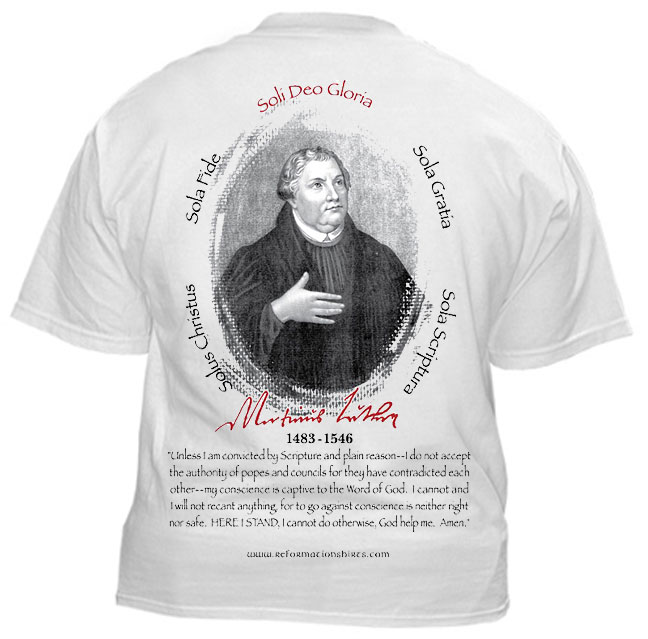
Purchase your Martin Luther T-Shirt from ReformationShirts.com
by Christ for his people. But biblical reformation of soteriology didn’t end with Luther and the Lutherans. The Reformed movement also grew alongside of the Lutheran movement, and while both were co-belligerents against the Roman doctrines of justification and the other benefits of redemption in Christ, they differed on the most biblical way to systematize these truths.
Friday on the Reformed Forum’s podcast, Christ the Center, Camden Bucey, Jim Cassidy and Jeff Waddington interviewed Dr. Lane Tipton, the new Charles Khrae Professor of Biblical and Systematic Theology at Westminster Theological Seminary in Philadelphia, Pennsylvania. Dr. Tipton was allowed two hours to spell out the differences between the Lutheran and Reformed approaches to justification and many current issues related to this essential aspect of Protestant theology, such as whether Dr. Michael Horton’s academic work on the subject is moving Reformed theology toward a more Lutheran, and therefore,according to Dr. Tipton, semi-Pelagian doctrine of justification. Listen to the podcast at this link.
I was introduced to Reformed theology by Michael Horton’s materials and the Lord used his parachurch ministries Christian United for Reformation (CURE) and the Alliance of Confessing Evangelicals (ACE) and the White Horse Inn radio show to gradually bring me around to embrace it. I will certainly be looking forward to a future Christ the Center program in which Dr. Horton responds to Dr. Tipton’s characterization of his work on justification and the other benefits of redemption in Christ. More public dialogue on this ought to take place, IMHO. At this point, Dr. Tipton’s case sounds convincing and more in line with the Reformed confessions and catechisms, as opposed to Dr. Horton’s efforts to, as I once heard him state on the air, build a kind of ecumenism between Reformed, Lutheran and Anglican traditions. I can see how some synthesis may be taking place in that effort. But what do I know?
Reformata, Semper Reformanda!
Sermon Notes: “The Fruit of Faith” (Matthew 21:17-22)
The following sermon notes summarize “The Fruit of Faith,” preached on Sunday, October 23, 2011 by Rev. Joe Troutman at Mid-Cities Presbyterian Chruch (OPC) in Bedford, Texas (listen online or subscribe to the podcast). My apologies for not posting last week’s sermon on the cleansing of the Temple, on which this sermon builds. I’ll try to post it at a later date. In the meantime, you can listen to that sermon, “The King Comes Home” (Matthew 21:12-17) at this link.
Text of Preparation: John 15:1-17
“I am the true vine, and my Father is the vinedresser. Every branch in me that does not bear fruit he takes away, and every branch that does bear fruit he prunes, that it may bear more fruit. Already you are clean because of the word that I have spoken to you. Abide in me, and I in you. As the branch cannot bear fruit by itself, unless it abides in the vine, neither can you, unless you abide in me. I am the vine; you are the branches. Whoever abides in me and I in him, he it is that bears much fruit, for apart from me you can do nothing. If anyone does not abide in me he is thrown away like a branch and withers; and the branches are gathered, thrown into the fire, and burned. If you abide in me, and my words abide in you, ask whatever you wish, and it will be done for you. By this my Father is glorified, that you bear much fruit and so prove to be my disciples. As the Father has loved me, so have I loved you. Abide in my love. If you keep my commandments, you will abide in my love, just as I have kept my Father’s commandments and abide in his love. These things I have spoken to you, that my joy may be in you, and that your joy may be full.
“This is my commandment, that you love one another as I have loved you. Greater love has no one than this, that someone lay down his life for his friends. You are my friends if you do what I command you. No longer do I call you servants, for the servant does not know what his master is doing; but I have called you friends, for all that I have heard from my Father I have made known to you. You did not choose me, but I chose you and appointed you that you should go and bear fruit and that your fruit should abide, so that whatever you ask the Father in my name, he may give it to you. These things I command you, so that you will love one another.
Introduction
Jewish worship was coming to an end. The Temple gave the appearance of worship as the leaves on the fig tree in today’s text give the appearance of fruitfulness. In their Temple worship, the Jews honored God with their lips, but their heart was far from him. Christ’s cleansing of the Temple in the previous passage was a judgment against their worship, not their commercialism.
Matthew 21:17-22 illustrates the importance of context. In his cursing of the fig tree, Jesus was not being vindictive, but performing a prophetic act against the nation of Israel as a whole: Those who don’t bear fruit will be cursed like the fig tree, but those who believe will bear the good fruit of true worship and righteousness.
In Search of Fruit (Matthew 21:17-19) And leaving them, he went out of the city to Bethany and lodged there. In the morning, as he was returning to the city, he became hungry. And seeing a fig tree by the wayside, he went to it and found nothing on it but only leaves. And he said to it, “May no fruit ever come from you again!” And the fig tree withered at once.
- The glory of God having departed the Temple, Christ returns to Bethany. Matthew and Mark use differing chronologies in their accounts of the cleansing of the Temple and the cursing of the fig tree. But both show the relationship between both events. One cannot be understood apart from the other.
- The fig tree was a symbol of the nation of Israel. “Woe is me! For I have become as when the summer fruit has been gathered, as when the grapes have been gleaned: there is no cluster to eat, no first-ripe fig that my soul desires (Micah 7:1).
- Jesus went to the tree in search of fruit, just as he went to the Temple in search of true worship. Neither provided what he sought.
- Professed faith is unfruitful for those who do not truly abide in Christ by faith (see John 15 above). As John the Baptist warned, the tree that does not bear fruit will be cut down and thrown into the fire. “’Bear fruit in keeping with repentance. And do not presume to say to yourselves, ‘We have Abraham as our father,’ for I tell you, God is able from these stones to raise up children for Abraham. Even now the axe is laid to the root of the trees. Every tree therefore that does not bear good fruit is cut down and thrown into the fire’” (Matthew 3:8-10).
- Thus Christ’s cursing of the fig tree as a prophetic warning was an act of mercy and a call to repentance. May believers never depart into false worship—we must trust the Lord to instruct us in the true worship of God, not our own wisdom.
Faith Yields Fruit (Matthew 21:20-22) When the disciples saw it, they marveled, saying, “How did the fig tree wither at once?” And Jesus answered them, “Truly, I say to you, if you have faith and do not doubt, you will not only do what has been done to the fig tree, but even if you say to this mountain, ‘Be taken up and thrown into the sea,’ it will happen. And whatever you ask in prayer, you will receive, if you have faith.”
- Christ’s reference to the moving of a mountain by faith seems to allude to Zechariah 4:6-9, in which Zerubbabel’s obstacles to rebuilding the Temple after Israel’s return from Babylonian captivity are compared to a mountain being made a plain. “Then he said to me, “This is the word of the LORD to Zerubbabel: Not by might, nor by power, but by my Spirit, says the LORD of hosts. Who are you, O great mountain? Before Zerubbabel you shall become a plain. And he shall bring forward the top stone amid shouts of ‘Grace, grace to it!’” Then the word of the LORD came to me, saying, “The hands of Zerubbabel have laid the foundation of this house; his hands shall also complete it. Then you will know that the LORD of hosts has sent me to you.
- The marveling of the disciples evidenced their lack of faith. Had they the faith of a mustard seed, they would have understood that nothing is impossible for God, be it the withering of a tree, the moving of a mountain or the production of the fruit of true worship and righteousness.
- True worship is impossible “in the flesh,” that is, apart from faith in Christ, but is possible “in Christ,” that is, through saving faith in him. The corporate worship of God is an amazing event: believers stand on holy ground in God’s presence. Unbelievers who presume to worship will prove unfruitful in the worship of God, and they will be judged by Christ as were the fig tree and the Temple.
- The promise in verse 22, “And whatever you ask in prayer, you will receive, if you have faith,” is simply an encouragement to come to God in faith by prayer in acknowledgement of our utter dependence on him. Lack of prayer is the result of self-sufficiency. Christians depend on the outpouring of God’s grace upon them, as a tree is dependent on the rain for life and fruitfulness. Faith in Christ will bear the fruit of the Spirit as described in Galatians 5:22-23, which reads, “But the fruit of the Spirit is love, joy, peace, patience, kindness, goodness, faithfulness, gentleness, self-control; against such things there is no law.”
The Once and Future King (Matthew 21:1-11)
Sermon Notes from Sunday, October 9, 2011. Delivered by Rev. Joe Troutman at Mid-Cities Presbyterian Church (OPC). Listen online.
Jesus comes into Jerusalem as king, but in a week’s time he will have been crucified and raised from the dead for sinners like you and me.
Westminster Shorter Catechism 26
Q. How doth Christ execute the office of a king?
A. Christ executeth the office of a king, in subduing us to himself, in ruling and defending us (Psalm 110:3; Matthew 28:18-20; John 17:2; Colossians 1:13), and in restraining and conquering all his and our enemies (Psalm 2:6-9; Psalm 110:1-2; Matthew 12:28; 1 Corinthians 15:24-26; Colossians 2:15).
“The Lord Has Need of Them” (Matthew 21:1-5) Now when they drew near to Jerusalem and came to Bethphage, to the Mount of Olives, then Jesus sent two disciples, saying to them, “Go into the village in front of you, and immediately you will find a donkey tied, and a colt with her. Untie them and bring them to me. If anyone says anything to you, you shall say, ‘The Lord needs them,’ and he will send them at once.” This took place to fulfill what was spoken by the prophet, saying, “Say to the daughter of Zion, ‘Behold, your king is coming to you, humble, and mounted on a donkey, on a colt, the foal of a beast of burden.’”
- Jesus demonstrates that he is Israel’s Messiah by fulfilling Isaiah 62:11 and Zechariah 9:9
- Behold, the LORD has proclaimed to the end of the earth: Say to the daughter of Zion, “Behold, your salvation comes; behold, his reward is with him, and his recompense before him.”(Isaiah 62:11 ESV)
- Rejoice greatly, O daughter of Zion! Shout aloud, O daughter of Jerusalem! Behold, your king is coming to you; righteous and having salvation is he, humble and mounted on a donkey, on a colt, the foal of a donkey. (Zechariah 9:9 ESV)
- What was this need? To show us that “[our] salvation comes” (Is. 62:11)
- “By sending for the donkey and colt, Jesus is giving us what we need to believe in him as our Savior.”
- Our need was for a Passover Lamb—we need Someone to die in our place; to wash us clean; to be protected and redeemed from our captivity to sin.
- To those who need God to show that he is real, he has done so by these prophecies of Israel’s Messiah, and their fulfillment hundreds of years later in Jesus of Nazareth.
- God shows us that he is the true God of Israel: the God of Abraham, Isaac and Jacob, and that Jesus is the true King of Israel, who subdues sinners to himself, rules and defends us who believe, and restrains and conquers all his and our enemies.
“Hosanna” (Matthew 21:6-9) The disciples went and did as Jesus had directed them. They brought the donkey and the colt and put on them their cloaks, and he sat on them. Most of the crowd spread their cloaks on the road, and others cut branches from the trees and spread them on the road. And the crowds that went before him and that followed him were shouting, “Hosanna to the Son of David! Blessed is he who comes in the name of the Lord! Hosanna in the highest!”
- Foreshadowed in Jehu’s servants’ response to Jehu’s anointing as King of Israel, and prophecy to defeat the evil king Ahab
- Then in haste every man of them took his garment and put it under him on the bare steps, and they blew the trumpet and proclaimed, “Jehu is king.” (2 Kings 9:13 ESV).
- In crying “Hosanna (Heb. “O Save!” ) to the Son of David!”, the people declare who Jesus is, the rightful King of Israel.
- In crying “Blessed is he who comes in the name of the Lord!” the people sing a portion of the Hallel (Psalms 113-118)—a portion of which is sung after the drinking of “the Cup of Redemption” during the Passover seder (see Psalm 118:26a). Jesus comes to redeem his people from sin, as God redeemed Israel from Egypt.
- Parallels between Israel’s captivity in Egypt and their present occupation by Rome spark strong Jewish nationalism during the Passover season. Rome watches for seditious behavior. The notion of a pretender to the throne of Israel is the very kind of threat for which they watch, and this makes Christ’s entry into Jerusalem especially dangerous. But notice the humility of this King who enters triumphantly, not on a warhorse, but rather on a lowly donkey.
“The King Enters His City” (Matthew 21:10-11) And when he entered Jerusalem, the whole city was stirred up, saying, “Who is this?” And the crowds said, “This is the prophet Jesus, from Nazareth of Galilee.”
- Christ enters Jerusalem but is not recognized by her citizens as their long-awaited King.
-
- The true light, which gives light to everyone, was coming into the world. He was in the world, and the world was made through him, yet the world did not know him. He came to his own, and his own people did not receive him. (John 1:9-11 ESV)
- Foreshadows Christ’s rejection by the people at the end of this Passion Week. Jesus comes to Jerusalem as King, but Jerusalem was not his Kingdom.
- When Jesus walked the earth, his Kingdom was located wherever he went. Jesus wasn’t entering his Kingdom in his Triumphal Entry into Jerusalem, he brought his Kingdom with him. Christ’s Kingdom is “not of this world” (see John 18:36).
- The true light, which gives light to everyone, was coming into the world. He was in the world, and the world was made through him, yet the world did not know him. He came to his own, and his own people did not receive him. (John 1:9-11 ESV)
- Christ does triumphantly enter to conquer, but not to conquer the Romans.
- The Triumphal Entry clearly showed that Jesus was Messiah according to Zechariah 9:9.
- The Triumphal Entry set in motion the events that would lead to his crucifixion.
- The Triumphal Entry threatens Rome, but Christ’s act in the following passage will be a threat to the Jewish priests and other religious leaders.
- Christ did not come to overthrow the Romans and reign in Jerusalem, but to die on a cross for the very people who sent him there: sinners like you and me. He went willingly, but it was yours and my sins which drove him to the cross. He went lovingly to suffer and to die for those who will come to believe. In his crucifixion, the King of Israel will conquer by accomplishing the salvation of his people.
- The King came once riding on the foal of a donkey; he went unrecognized by some, met with indifference by others and still others met him with hostility. He was openly rejected and nailed to a cross.
- But the King will come again riding on the clouds with power and glory (Matthew 24:30). The time of his return remains hidden but he will come to judge as the Ruler of the earth.
- At this time, every knee will bow and every tongue will confess that Jesus Christ is Lord to the glory of God the Father (see Philippians 2:9-11).
- Those who already believe, trust and love Jesus will rejoice at his coming and will kneel again.
- Those who refuse to humbly submit to the Lord in response to his first coming will be humbled and bowed against their wills when he returns to judge.
Everyone who believes in the Lord Jesus Christ will bow his knee willingly, lovingly, obediently and instantly. Repent, believe in him—today—now!—while it’s still called today (see Hebrews 3:13), so that when he comes in glory he will know you as his own and you will rejoice at his coming and not be fearful.
Christology 101 by James White

Tuesday’s The Dividing Line podcast, by Reformed Baptist elder and apologist Dr. James R. White, features a 2 1/2 hour long discussion of the Christological controversies of the first several hundred years of church history. Today, churches by and large are negligent in informing their members on the facts of the church history. This makes the average Christian a viable target for informed unbelievers who are out to smear the truth of God’s infallible Word as it has been defended and preserved in the earthen vessels (2 Corinthians 4:7 KJV) of fallible servants of God and the church. Please take the time to listen to Dr. White’s summary of this important segment of Christian history warts and all, and share this with any believing friend who would benefit from the information that you think might actually listen to it. Click here to listen to “Christology 101”
Walking By Faith, Not By Sight (Matthew 20:29-34)

My daughter, Abigail, frequently announces that our pastor at Mid-Cities Presbyterian Church (OPC), Rev. Joe Troutman, is her favorite preacher. Mine, too, Abigail! I think I’ll begin posting links to his sermons so his exposition and application of God’s Word can build you up in your faith, or grant saving faith to those of you who may not already have it. I’ll include my notes of his remarks and sometimes will include a few of my own. Sunday, October 2, 2011, the text was Matthew 20:29-34 and the sermon was entitled, “Walking By Faith, Not By Sight.” (Listen here)
The Son of David, our Lord Jesus Christ, opens the eyes of the blind and sets his people free.
Blind Men Who Could See “And as they went out of Jericho, a great crowd followed him. And behold, there were two blind men sitting by the roadside, and when they heard that Jesus was passing by, they cried out, ’Lord, have mercy on us, Son of David!’” (Matthew 20:29-30 ESV)
- “Lord, have mercy!” This phrase was adapted and sung as Kyrie Eleison in Eastern Orthodox, Roman Catholic, Lutheran and Anglican liturgies, but according to church historian, Philip Schaff, “The Reformed liturgies dropped it altogether” (The New Schaff-Hertzog Encyclopedia of Religious Knowledge, “Liturgics,” page 503).
- Jesus approaches Jerusalem in military procession in anticipation of his triumphal entry. Blind men are bold to call out for him to stop. We are given such boldness by in faith in Christ, to call on God with our requests.
Lord Have Mercy “The crowd rebuked them, telling them to be silent, but they cried out all the more, ‘Lord, have mercy on us, Son of David!’ And stopping, Jesus called them and said, ‘What do you want me to do for you?’ They said to him, ‘Lord, let our eyes be opened’” (Matthew 20:31-33 ESV).
- How persistent are you in your prayers? If God will listen to a couple of blind beggars, he will certainly listen to his children who believe, worship and glorify him. These blind men have literally “walked by faith, not by sight.”
Mercy “And Jesus in pity touched their eyes, and immediately they recovered their sight and followed him” (Matthew 20:34 ESV).
- “Therefore the LORD waits to be gracious to you, and therefore he exalts himself to show mercy to you. For the LORD is a God of justice; blessed are all those who wait for him” (Isaiah 30:18 ESV).
- Healing these blind men was part of Christ’s mission; he was not sidetracked by their bold request.
- Christ’s touching the blind men to heal them was not necessary, but rather a benedictory laying on of hand.
- “[T]he LORD opens the eyes of the blind. The LORD lifts up those who are bowed down; the LORD loves the righteous” (Psalm 146:8 ESV).
- Their calling Christ the Son of David indicates their confession of faith in him as the Messiah who has come to save them. Healing is a sign of the deity of Christ who came so sinners who believe will have eternal life.
- The Lord Jesus Christ, the true King of Israel, does what we cannot: he gives spiritual sight to us who are spiritually blind, that we may see him as the coming Messiah who was born to die for our sins. May your eyes be opened, and may the Lord graciously grant you such saving faith!
A True Presbyterian Hymnal for “A True Presbyterian Church”

1961 Edition of the Trinity Hymnal
One of the many factors that won me over to embrace Reformed theology and practice was the fascinating Trinity Hymnal (c. 1990). Back when I worked at what I endearingly call “The Reformation Station,” the print shop where God cornered me after years of on-again, off-again confrontation by the TULIP and other aspects of Reformed belief and behavior, I had the opportunity to print the bulletins for a local PCA church, which would include in its liturgy hymns selected from the Trinity Hymnal, printed in the bulletin, music and all! For this reason, there was a copy of the hymnal in the office, which they could use to prepare those bulletins, and which I could peruse from time to time and thereby enter the world of Reformed psalmody and English hymnody, and further tie my heart to my future spiritual and theological home in the Reformed tradition.
Due to my abundance of affection for the Trinity Hymnal, I was very pleased to notice that I wouldn’t have to wait long to learn its history in Daryl Hart’s OPC history, Between the Times: The Orthodox Presbyterian Church in Transition, 1945-1990 (c. 2011, The Committee for the Historian of the Orthodox Presbyterian Church). The reader of this volume is treated to the story of the hymnal in chapter two, under the simple title, “Trinity Hymnal, 1944-1961.” Here’s a synopsis of what you’re in for if you purchase Hart’s history.
In 1933, the PCUSA revised their hymnal, dropping 400 traditional hymns in favor of songs that reflect the liberalizing trend in the mainline denomination. J. Gresham Machen knew this was a problem. Reasoning from the old adage that the laity learn more theology from singing hymns than from systematic theology, he resolved that something had to be done about it. In the Lord’s providence, from the seed of this thought process on the part of Machen in response to the PCUSA’s threat to further corrupt the doctrine of rank and file Presbyterians, until the final publication of the Trinity Hymnal, a truly orthodox Presbyterian hymnal, 28 years would come and go. But what a glorious harvest of sound theology and biblical doxology would result from such a careful process of cultivation and fertilization.
With this opening anecdote, Dr. Hart surveys the history of American Presbyterian hymnals. Since the first one rolled off the press in 1831 there had been an average of one new hymnal per decade due to the number of controversies and divisions within the PCUSA between 1831 and 1961 (the date of Trinity Hymnal’s eventual publication). Although it would not be published under the auspices of the liberal mainline denomination, the Trinity Hymnal shares this common origin with its predecessors in the crucible of theological controversy. For this reason, it would be compiled with a commitment to aid the worship of the church in accordance with eternal truths, not contemporary trends.
American Presbyterians also produced so many hymnals so frequently because Reformed and Presbyterian practice regarding the Word of God sung as an element of corporate worship was undergoing a transformation from the Scottish and Dutch commitment to exclusive psalmody, to embrace the English hymnody of Isaac Watts, Charles Wesley and others, in order to better respond to the gospel of Christ in terms of the full revelation of Christ in both Testaments.
Much discussion among the members of the Committee on Song in the Public Worship of God over the propriety of this historic move away from the stance of earlier Reformed churches would consume a number of General Assemblies between 1944 and 1961. Dr. Hart reports for us the discussions between the “foreign” element of “psalm-singers” on the committee lead by the Scottish John Murray and his cadre of Scottish and Dutch dissenters and the more Americanized majority who would eventually prevail in the appropriation of English hymn into the practice of not only orthodox Presbyterians in general, but the OPC in particular.

1990 edition of Trinity Hymnal in three colors
With the conclusion of this discussion would arise more rubber-meets-the-road problems like financing the hymnal. We learn the various ideas considered and how the Lord would provide just in time, enabling them to pay off the loans obtained to supplement the giving of Orthodox Presbyterians toward this end, neither too soon, nor too late.
Finally, the reader is pleased to learn just how successful the hymnal was once it hit the market. There really was a need for just such a hymnal among many conservative Protestants outside the OPC.
Chapter two of Hart’s Between the Times is a joy to read, especially if you love the Trinity Hymnal as much as this reviewer does. But with the recent 78th General Assembly of the OPC, we learn that the work of compiling psalms, hymns and spiritual songs to aid the worship of the Reformed is to march forward as it was announced that the OPC will be teaming up with the URCNA to publish a new Psalter-Hymnal in the years to come. I believe there will be enough love in my heart for both of these hymnals to share!


 The Misadventures of Captain Headknowledge
The Instrument of Faith
Who will become a child of God? The one who is “in Christ.” Who will get “into Christ”? The one who receives Christ by faith, or, according to the original Greek, believing “into” him. John writes, “But to all who did receive him, who believed in (literally, “into”) his name, he gave the right to become children of God” (John 1:12).
Faith which places the sinner “in Christ” is not merely an acknowledgment that there was a historical figure named Jesus of Nazareth who embarked on an itinerant ministry which lead many first century Jews to conclude that he was the Anointed One (“Christ”) proclaimed by the Old Testament prophets. Faith in Christ does begin with such knowledge, even assenting to the truthfulness of such a proposition, but it must also result in a willingness to rest on the righteousness which Christ is proclaimed in the gospel message to have earned by his flawless observance of the law of Moses which has at its heart the moral law of God, confessing that by one’s own observance of God’s law he will not be able to earn for himself the same kind of inherent righteousness. As Paul writes in Galatians 2:16:
So being found in Christ depends on having the righteousness of Christ which comes from God, and having the righteousness which comes from God depends on faith. In Philippians 3:9 it is written, “and be found in him, not having a righteousness of my own that comes from the law, but that which comes through faith in Christ, the righteousness from God that depends on faith.” So we see that when faith is imputed as righteousness, faith is not the thing that makes a person inherently righteous, but rather it is simply what the Westminster Divines call in Q&A #73 of the Larger Catechism, “an instrument by which he receiveth and applieth Christ and his righteousness.”
Share this: