Category Archives: King James Version

Riplinger Fails Pop Quiz

An Independent Baptist ministry student who is also a dear friend of mine showed me a new book he’s begun reading. It’s new to him, although I’ve known about it for quite some time. The book is Gail Riplinger’s massive In Awe of Thy Word: Understanding the King James Bible, It’s Mystery and History Letter by Letter. No, I haven’t read the book yet, but knowing the track record of inaccurate documentation Gail and most KJV-onlyists like her have, I decided to give her a pop quiz of sorts.
Ever heard of lucky-dipping? That’s what R. C. Sproul calls the practice of opening the Bible and picking a verse at random, expecting God to have a message for you. Well, I decided that in order to conduct this quiz on Mrs. Riplinger, I’d pick the first piece of documentation that I saw that was used in an attempt to legitimize any of the fallacious Ruckmanite, extreme KJV-only claims that she may have catalogued in her book.
The “lucky” footnote happened to be found on page 788 of her book. Now, I had neither the time nor the opportunity to transcribe the passage in question, but I took a few notes on a few sentences and will attempt to reconstruct the gist of what I saw on the page in relation to Riplinger’s attempt to disprove the supposed “myth” that John Wycliffe translated St. Jerome’s Latin Vulgate in his effort to make the Word of God accessible to the common people, as he knew it was for the first century recipients of the New Testament.
First, Riplinger attempts to document that “Wycliffe had access to Hebrew Old Testament manuscripts which were in ‘complete agreement’ with the Old Latin [purportedly followed by] Wycliffe” (In Awe of Thy Word, p. 788).
Then Riplinger claims that Wycliffe refers to manuscripts being “corrected according to the Greek exemplar.” “Once Jerome’s text was corrected,” writes Riplinger, “there was ‘complete agreement’ of his translation [Wycliffe’s] with Hebrew and Greek manuscripts.” (ibid)
Riplinger’s citations offered to “document” the claim that Wycliffe “corrected” the Latin Vulgate in order to bring it into “complete agreement” with the Hebrew and Greek manuscript evidence before translating it come from pages 143 and 157 of whichever edition Riplinger owns of Wycliffe’s 1378 work entitled, On the Truth of Holy Scripture. Unfortunately, I have yet to locate the text of Wycliffe’s book online, and have not yet gone to the library to request a copy of it through the interlibrary loan process, which is about as speedy as applying for a job with the federal government. Well, perhaps a little more expeditious than that. If any of my readers are able to locate the online text yourself, I’d appreciate the link.
Undeterred, I thought today to look at less radical KJV-Onlyist, Dr. David Cloud’s Way of Life Literature website and see if he ever reviewed the book. His review of New Age Bible Versions was excellent, and is part of the reason I had the audacity to assume that her bad scholarship is so pervasive that it would be statistically likely that I find a sample of documented misinformation on the first try. Although Dr. Cloud hadn’t bothered to do as extensive of a review of this book as he did for NAVB, he did write a page length treatment of the very question I’m attempting to examine!
In Dr. Cloud’s “Friday Church News Notes” dated August 12, 2005 (vol. 6, issue 32), under the title, “WHAT ABOUT GAIL RIPLINGER’S NEW BOOK?” he writes, “Her newest book again contains many good things in defense of the KJV but it is interspersed with serious mistakes so that it is impossible to have confidence in her research or conclusions at any point. For example, in chapter 22 she claims that John Wycliffe did not use the Latin Vulgate as the basis for his translation but that he used Hebrew, Greek and Old Latin sources. She says it is a “myth” to say that Wycliffe used the Latin Vulgate. As a matter of fact, a careful comparison of the Wycliffe Bible with the Latin Vulgate and the Old Latin demonstrates that Wycliffe consistently used the Vulgate, with only a very few exceptions. I have done extensive research into the textual basis of the Wycliffe New Testament and it contains most of the textual corruptions found in the Vulgate. For example, the Wycliffe Bible omits “for thine is the kingdom, and the power, and the glory, for ever” in Mat. 6:13, “to repentance” in Mat. 9:13 and Mk. 2:17, “spoken by Daniel the prophet” in Mk. 13:14, “get thee behind me Satan” in Lk. 4:8, “the Lord” from 1 Cor. 15:47, “in Christ” in Gal. 3:17, and “God” in 1 Timothy 3:16, to mention only a few of its textual errors. In most of these instances, these things are omitted in the Wycliffe and the Latin Vulgate but are NOT omitted in the Old Latin, so that it is obvious that Wycliffe was indeed following the Vulgate rather than the Traditional Greek Text or the Old Latin. Mrs. Riplinger gives so much seeming documentation that the average reader is convinced that her scholarship is sound, not being in a position to see that she frequently misuses her quotes and reaches conclusions not supported by the facts given in the documents that she cites as her authority.”
Boy, can I call ’em, or what? Thanks to the Lord for sending me to the right note, and thanks to Dr. Cloud for doing more homework than the average IFBx KJV-Onlyist!

Jerry & Jimmy: History Repeats Itself

Jerome’s fourth century Latin Vulgate was enforced by the medieval Roman Catholic Church as the only acceptable version to be studied to the exclusion of original language sources. Roman Catholic clergy studied Latin and gained some knowledge of Scripture, but were chiefly schooled in theology with little critique of it in light of Scripture. They accepted tradition and papal decrees as equally legitimate sources of divine revelation intended by God to inform the faith and practice of the Church.
The Renaissance emphasis of “ad fontes” brought original language scholarship into vogue among some Roman Catholic scholars. Comparison of the Latin Vulgate with original language sources led many to criticize the Latin translation, and comparison of medieval church tradition with Scripture and patristic writings also led them to criticize Roman Catholic doctrine and practice. Numerous calls for Reformation were diligently suppressed for centuries until the civil government began to side with the views of the Reformers in the sixteenth century, with an eye on the economic and nationalistic advantages that they saw could result as well.
Generally speaking, the modern fundamentalist proponents of the exclusive use of the King James Version of Holy Scripture repeat this history. Like medieval Roman Catholicism, many modern fundamentalist King James Onlyists similarly discourage or exclude all critical comparison of their favored translation with original language sources. This is inconsistent with the work of the Protestant Reformers who risked and sacrificed so much for years for the right and privilege to translate the original language sources of Scripture into the language of the common man. This rejection of modern translation of even the Hebrew and Greek texts which underlie the King James Version leaves the English Bible less readable to the common man, ministers and laity alike, who are not well-versed in reading the often archaic English of a version translated almost four centuries ago.

Modern extreme fundamentalists seem to refuse to learn the lessons of even their own Protestant heritage, and in this way, among others, repeat the mistakes of history. Fundamentalist discouragement of critical thinking and study is a tyranny comparable to that of medieval Roman Catholicism, while exposure to the views of the broader evangelical community in regard to textual critical and translational issues will inevitably prove both enlightening and liberating to the truth-seeking fundamentalist. Words Martin Luther directed toward the tyranny of the medieval Roman Catholic Church apply well to modern Protestant fundamentalist King James Onlyists: ” 90. To suppress them by force alone, and not to refute them by giving reasons, is to expose the church and the pope to the ridicule of their enemies, and to make Christian people unhappy. ” Although King James Onlyists don’t have the civil authority to literally force their followers to abstain from modern biblical scholarship and modern Bible translations, and do, in fact, offer reasons for this expectation, the social pressure exerted in their preaching and personal relationships, likewise “makes Christian people unhappy” who seek to honestly examine for themselves the competing claims of both sides of the English Bible Version debate.
Consider the following passage from William Tyndale: A Biography by David Daniell (copyright 1994 by Yale University). On page 287, Dr. Daniell writes, under the heading of Scripture as a Whole Book:
” . . . that there was a language called Hebrew at all, or that it had any connection whatsoever with the Bible, would have been news to most of the ordinary population. Religion was in Latin: the Mass was in Latin; all the other services, like baptism, were in Latin; everything the priest did was in Latin; the Psalms in the Mass were in Latin; the Bible-readings in the services, such as they were, were in Latin; the Bible, when visible, was a big Latin volume; some priests, and most laymen, had only a few words of Latin, if that.”
This was the passage that opened my eyes to the way the extreme King James Only movement repeats the history of the medieval Roman Catholic Church in placing obstacles between the laity and the Word of God. Indeed, considering the common discouragement of critical thinking and research among modern fundamentalist King James Onlyists, it is almost as if the fact that there is a language called Hebrew at all (or Greek, for that matter), or that it had any connection whatsoever with the Bible, would have been news to most of the followers of King James Onlyists.
Funny how history repeats itself. From St. Jerome (Jerry) to King James (Jimmy), there is nothing new under the sun.
Illustration of Tyndale by www.reformationart.com

The Old King James!

Here’s a little ditty I came up with about 12 or 13 years ago, back when I was a flaming King James Onlyist who was currently reading through Riplinger’s New Age Bible Versions for the second time straight. Now, for those of you who don’t know, that’s unusual for me. I’m a slow reader, but I found the steam to plow through almost 700 pages of mediocre writing and even worse scholarship twice in a row! Truly, New Age Bible Versions was, I repeat was, one of the landmark (no pun intended) experiences in my theological journey. Of course, my first wife had just left me at the time, so I guess that’s where I found all the free time.
There’s another product from that little “sabbatical” of sorts related to my zeal for the Old King James that I intend to share with you one day, but for now, I’ll introduce you to one of my masterpieces. The song, “The Old King James,” is written to the tune of a song featured in the movie which is my namesake, Chitty Chitty Bang Bang. The original song is entitled, “Me ol’ Bamboo.” It was an entertaining song and (dare I say it? There are Baptists reading this!) dance routine featuring Dick Van Dyke, portraying inventor Caractacus Potts, who is hiding out from a hostile pursuer whom he’d just victimized at the fair with one of his lame-brain inventions.
This period of “divorce recovery” was early in my membership at my previous church, as well. At that period of my life, I was a subscriber to Peter Ruckman’s Bible Believer’s Bulletin,” and an avid reader of his books, so when I found out that this new church I was considering went to camp every year on the week when the camp director welcomed Ruckman to preach, I signed up without any more ado! One summer, after I wrote this song, I even had the privilege of forming a quartet and performing this song in the presence of the man himself–The king of the King James Onlyists! The speed-readin’ German with the mouth that puts Luther to shame! The one, the ONLY (God is gracious!), Dr. Peter S. Ruckman!!! I didn’t have the heart to look behind me on the platform where he sat after we sang our song, but my good friend with the guitar said Ruckman was slapping his knee and cracking up.
After the good Doctor ended his sermon, and the chapel service concluded, a young lady representing one of the youth groups in attendance approached me for a copy of the song so that they may edify themselves in their faith in “The Bible God uses and Satan hates” back home. I hope they’re still enjoying it! And I hope my KJV-Onlyist readers enjoy it as well, and for those of you who are not of that persuasion, I think you may find it likewise serves as quite a parody, if you ‘ve got the stomach for it. So, may I now introduce to you . . .
The Old King James
by John D. Chitty, circa 1994-5
(sung to the tune of “Me ol’ Bamboo,” from Chitty Chitty Bang Bang)
A new king named James Stuart
came to England long ago,
He called a group together
to see how to run the show.
They said, “Let’s make the Bible
to be cherished far and wide!”
In seven years came the Old King James,
we call the Authorized!
Oh!
The Old King James, the Old King James,
You better-never-bother with the Old King James!
It’ll judge you when Christ comes to reign,
So you better-never-bother with the Old King James!
1611!
1611!
The Scribes and Pharisees may think
their versions fill the bill,
But nothing else will ever better
manifest his will!
The Bible’s quick and powerful,
and sharper than a sword,
To make a wayward sinner come
and call upon the Lord!
Oh!
The Old King James, the Old King James!
You better-never-bother with the Old King James!
It’ll judge you when Christ comes to reign,
So you better-never-bother with the Old King James!
1611!
1611!
In the word of a king
is the power to win souls!
Any less authority
is likely full of holes!
God said it! So believe it!
Now, you know that it is true:
“For God so loved the world,
he gave his ONLY BEGOTTEN Son to die for you!”
Oh!
The Old King James! The Old King James!
You better-never-bother with the Old King James!
It’ll judge you when Christ comes to reign!
So you better-never-bother with the Old King James!
1611!
1611!
The Reformation Bible
keeps sound doctrine as it is!
It don’t delete the message
like the Catholic Bible did!
The Authorized King James Bible
is what it claims to be:
The Word that God inspired,
translated and gave to me!
Oh!
The Old King James! The Old King James!
You better-never-bother with the Old King James!
It’ll judge you when Christ comes to reign,
So you better-never-bother with the Old King James!

A Dark Day for KJV Onlyists . . .
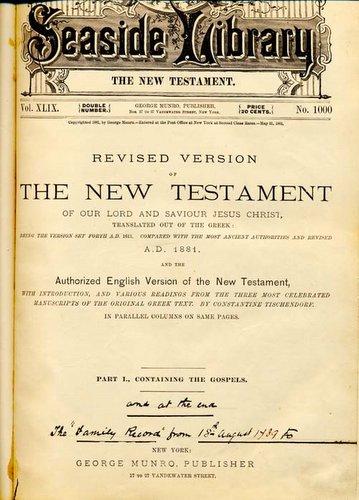
On this day in Christian History:

May 17, 1881 — The Revised Version (RV or ERV) of the New Testament was first published in England. The Old Testament was completed in 1885. In 1905 the American Standard Version (ASV) — based on the textual foundation of the ERV–was published in the U. S.

KING JAMES ONLYISTS, PUT ON YOUR SACKCLOTH AND ASHES!!!

Lately, I’ve been reading Kim Riddlebarger’s doctoral dissertation on B. B. Warfield, which partially discusses his interest in the burgeoning field of higher criticism. The “Lion of Princeton” was convinced that this methodology would help recover the original text of the Bible, and could also be useful in demonstrating the inerrancy of Scripture, if it’s used objectively!Warfield recognized, however, that due to the concurrent rise of evolutionary scientific naturalism, most European scholars were not using higher criticism objectively, and that goes, I’m sure, to some extent, for Westcott and Hort, the men who spearheaded the 1881 Revised Version’s “Critical New Testament,” but were, in fact, subjectively looking at the facts from their naturalistic viewpoint. In other words, having a prior committment to the idea that God has not inspired or preserved an inerrant canon of Scripture, the vast majority of liberal higher critics were too often using this inductive scientific method to destroy Christian orthodox confession regarding its Sacred Text. However, even as blind squirrels often find nuts, the advent of Westcott and Hort’s critical text did at least manage to break the Byzantine Text’s undue dominance in the church’s understanding of the transmission of the New Testament.


On this side of the pond, Warfield’s use of higher criticism contributed to his influence in the modern evangelical understanding of the inerrancy of Scripture! So you see, higher criticism is neutral and can aid us in the search for truth when used in an objective manner; at least that was Warfield’s conviction.

It is true that theories come and go, including some of the theories of Westcott and Hort and the liberal higher critics. But if we are committed to Christian orthodoxy, and with Anselm, “believe in order to understand,” we will find that, in part, through the ordinary means of higher textual criticism, God has providentially allowed us to arrive at a far closer proximity to the original text of Scripture than we’ve ever reached before!

Happy Birthday, Revised Version and all modern English translations!

Posted by Picasa