Evangelicals, Meet the Two Kingdoms

It may just begin to be “all about” Dr. Darryl G. Hart from now on. (But I jest–read Hart’s post to know what I mean by that–and notice my comment on his post). Hart, his new book, and his Augustinian approach to the relationship of the church to culture and politics, known to conservative Protestants (as opposed to “Evangelicals”) as the Two Kingdoms view, have been introduced to the broadly Evangelical listeners to Christian talk radio.
Janet Mefferd is appropriately the host of Salem Radio Network‘s The Janet Mefferd Show, which is broadcast here in the Dallas/Fort Worth Metroplex on 100.7 FM KWRD. Mefferd may have just given Dr. Hart his big break–and may it redound to the benefit and enrichment of Evangelical understanding of their place in the political and cultural life of the United States of America. On her Thursday, Sept. 1st program, Mefferd interviewed Dr. Darryl G. Hart about his latest book, From Billy Graham to Sarah Palin: Evangelicals and the Betrayal of American Conservatism (2011, Wm. B. Eerdmans Publishing Co.). This book “provides an iconoclastic new history of the entrance of evangelical Christians into national American politics. Examining the key players of the Religious Right–Billy Graham, Jerry Falwell, Chuck Colson, James Dobson, Pat Robertson, and many others–D. G. Hart argues that evangelicalism is (and always has been) a bad fit with classic political conservatism” (punctuation improved by me).
On the air, before God and the Religious Right, Janet Mefferd encouraged Dr. Hart by her agreement with him that politically conservative Evangelicals could learn a thing or two from St. Augustine’s ancient classic City of God, which is the theological progenitor of the Two Kingdoms approach to “Christ and Culture.”
Here’s a transcript of Hart’s description of this Augustinian Two Kingdom view of Christ and Culture and how it applies to the Religious Right:
Mefferd: …This concept that we need to embrace, I think, and you’re absolutely right about this, is this Augustinian view of the relationship between the city of God and the city of Man as we’re examining politics. Explain briefly what that is, the City of God and the City of Man.
Hart: Well, Augustine wrote this book at the time when the Roman Empire was falling, and people were blaming the Christian Church for that fall—that Rome had turned from its own gods to this other God, and so Christians were to blame. And part of Augustine’s defense, was to say that God’s ways are higher than Man’s ways, and you cannot identify the history of salvation with the history of any particular place or empire, like the Roman Empire, so there is this City of God that transcends the City of Man. And the application for America, as for any nation, would be that God doesn’t have necessarily a special relationship with any particular nation, though he did at one time with Israel, but now has a special relationship with his church which transcends all nations. You find churches and church members around the world, and that is where God’s plan of redemption is being carried out, in the “City of God,” the Church being sort of the earthly representation of it. And the “City of Man,” the affairs of nations, are things that God controls through his providential power, but you cannot correlate what God is doing necessarily in a redemptive way with the rise and fall of empires or nations.
Mefferd: Which may be sounding sort of heretical to a lot of very patriotic Evangelical conservatives who say, you know, this is a nation founded in large part by Christians, on Christian principles, etc., etc., and yet, you almost set yourself up for, if and when, God forbid, America does have a decline or a fall, as the Roman Empire did, then we may be in a bad place of saying, while, you know, this is somehow the Church’s fault, and, I think you’re absolutely right, we have to think in a different way as Christians about God’s purposes in the world beyond just who we want to get into office at a particular time, you know?
Hart: Right. I think we’re all prone to think this way. Though, I mean, even if I trip, or if I oversleep, you know, I wonder if it’s because yesterday I yelled at my wife that these things are happening to me. So, we always want to view our relationship to God, and what happens in our lives, as whether we’re living in favor or out of favor, and we do that in politics as well, but it’s not a very helpful way for looking at politics. And political conservatives have actually drawn on that Augustinian perspective often.
Dr. Hart also has a thought-provoking defense of Rick Perry’s recent appeal to states rights as a way to deal with the issue of gay marriage. But I’ll leave that for you to find for yourself on the podcast.
Politics, Religion and a Gun

David Stokes’ interview with 90.1FM KERA host Krys Boyd on her D/FW local NPR talk show, Think with Krys Boyd, has been uploaded. You can listen to it here.
And so, J. Frank Norris week continues at The Misadventures of Captain Headknowledge! Just wait until tomorrow…
The Shooting Salvationist Author Comes to Ft. Worth

Make that "Wednesday, July 20" at the Sundance Square Barnes & Noble in Ft. Worth
Fairfax, Virginia Baptist Bible Fellowship local church pastor David Stokes grew up as a member of Detroit’s Temple Baptist Church, not twenty years after J. Frank Norris pastored that church at the same time that he pastored First Baptist Church in Fort Worth, Texas. In his day, Norris was known as the “Texas Tornado,” and the “Pistol-Packing Parson.” The memory of J. Frank Norris casts a long shadow for those whose lives were touched by his sensationalistic and controversial ministry. It must be as true for those like Stokes who grew up in the decades following Norris’ death, as it is for us down here in Fort Worth, who boast of relatives with stories of personal connections to the famous fundamentalist firebrand. For example, my own mother grew up playing with Norris’ grandson, George. He was my mother’s best friend’s boyfriend. My great-grandmother hosted the visiting preacher at her house, where lively discussions are said to have ensued between Norris and my great-great grandmother, charming them with the admission that “the only person who could ever change his mind was Mrs. Freeman.” Not only that, J. Frank Norris even performed the wedding ceremony for my son’s great-grandparents on his mother’s side. For better or worse, J. Frank Norris is one of the more colorful cast members in the dramatic history of Fort Worth, Texas. Featuring his battle with the Southern Baptist Convention over Baylor University’s teaching evolution and his own personal war against corruption in local politics as well as the Prohibition-era liquor trade itself, I’ve always said, even as a one-time devoted follower, that the life story of J. Frank Norris would make a great gangster movie!
It looks like the novel on which that movie could be based has just been written by David Stokes. The book is called The Shooting Salvationist: J. Frank Norris and the Murder Trial that Captivated America (©2011 Steerforth Press). The only difference is, Stokes’ story is more of a courtroom drama. But that’s alright with me. At 1pm Central time today, Stokes will be interviewed on the local NPR station, 90.1FM KERA on “Think with Krys Boyd.” (you can sign up for the podcast here if you miss it live). Tomorrow night, from 7:00 to 9:00pm Central time, Stokes will hold a book signing at Barnes and Noble in Fort Worth’s Sundance Square just a few blocks away from the site of FBCFW during Norris’ ministry (see my previous post). On his Facebook page, Stokes reports “apparently there will be some “protesters” on Tuesday night when I speak at the Barnes and Noble in Fort Worth — should be interesting.” You can get familiar with one of those potential protesters at The J. Frank Norris Historical Society, started a year ago by a former associate of Norris’, Roy Emerson Falls.
If you’ve never heard of J. Frank Norris, or if you’ve always known about him–love him or hate him, you’ll be both shocked and in awe of the story of J. Frank Norris and the trial that failed to sentence Norris the electric chair for the death of Dexter Elliott Chipps.
Won’t We Leave Behind the Litmus Test of Wooden Literalism?
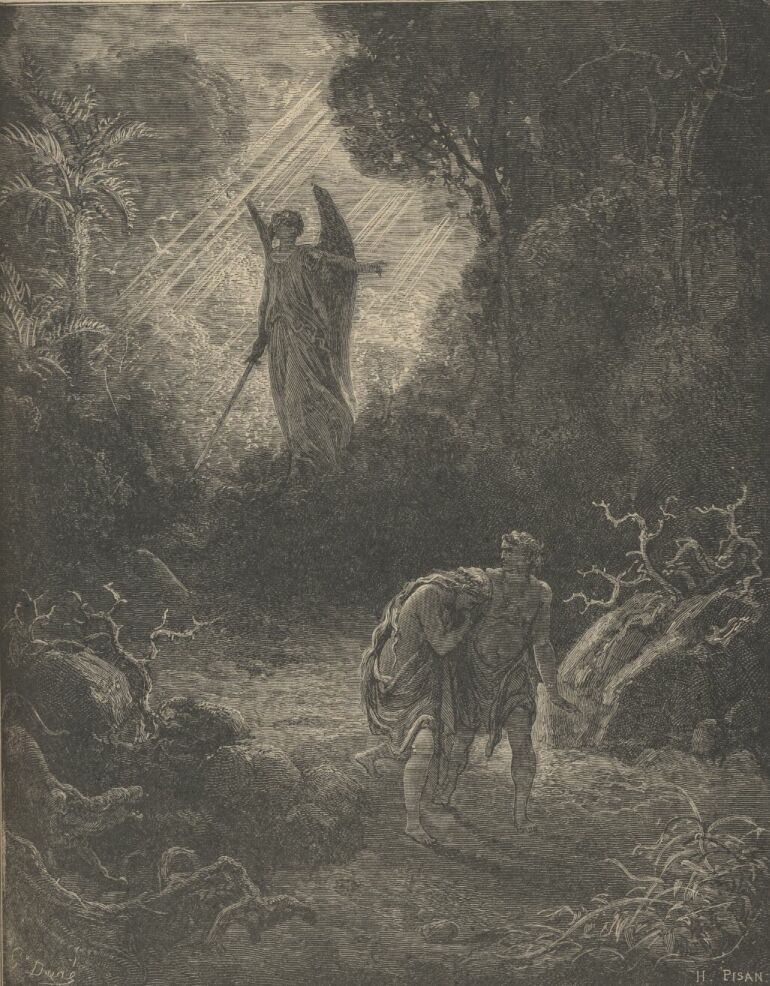
Nothing tickles me like Hank Hanegraaff’s affinity for alliteration! You remember Hank–he’s the host of The Bible Answer Man (BAM) radio show. I like Hank because he believes that “Truth Matters,” even if he disagrees with the doctrines of grace and is an evidentialist apologist. Some of my more hard core Reformed brethren may think that because of these two issues alone, I shouldn’t waste any more time listening to his show.
Despite occasional disagreements, there are many strengths to BAM and the Christian Research Institute that keep me coming back for more. Hank isn’t politically (or is that “religiously”?) correct–back in 1999, he suffered the slings and arrows of the Evangelical community who were capitalizing on what Hank in his inimitable way called “sensationalism and selling” as they geared up for Y2K for denying it was a danger; much more recently, he broke many hearts by refusing to bow to the golden idol of dispensational premillennialism expounding what he calls “Exegetical Eschatology.”
Well, now he’s cast his lot against the populist view again–this time the issue is the Genesis creation days. I found Hank’s remarks from his introduction to the Friday Bible Answer Man broadcast especially helpful in encouraging us to remember that not everything is a fundamental over which Bible believing Christians must divide. How to interpret Genesis chapter one is one such, in Hank’s words, “in house debate which Christians can debate vigorously without dividing over.”
A couple of comments and then right to our callers. I’ve been getting a lot of questions at the CRI, through social media, through the Bible Answer Man broadcast and otherwise regarding the Genesis creation days. Are they literal? Are they long? Or, are they literary? Of course, there are three dominant schools of thought within Evangelical Christianity regarding the Genesis days of creation.
First, the popular 24 hour view that posits that God created the heavens and the earth in 6 sequential literal days. Therefore a majority of young earth creationists view the earth to be approximately 6,000 years old and consider all death, including animal death, to be a direct function of Adam’s Fall.
Furthermore, there’s a day-age perspective. That perspective posits that God created the heavens and the earth in 6 long sequential day-ages which total billions of years. So, in contrast to the 24 hour perspective, the day-age perspective posits that “nature, red in tooth and claw” is the result of God’s very good creation prior to Adam’s Fall to a life perpetuated by sin and terminated by death.
And then there’s a very noteworthy framework perspective, which holds the seven days of creation are non-literal, non-sequential but nonetheless historical. In concert with the day-age perspective, they view animal death as consistent with the goodness of God’s creation and believe that the age question is settled by natural revelation, in other words, by reading God’s Book of Nature, as opposed to settling it by reading special revelation, in other words, the Bible.
All three perspectives hold to essential Christian doctrine, thus they commonly debate non-essential differences without dividing over them. And I want to park on that for just a second. There are essentials, and as Christians we stand shoulder to shoulder with respect to essential Christian doctrine. The problem is, I think, that a divisiveness has crept into the Body of Christ whereby this age issue has become an acid test for orthodoxy. Therein lies, I think, a substantial problem.
Better that we adhere to the maxim: “In essentials unity; in non-essentials, liberty; in all things, charity.” And then learn—“Iron sharpens iron.”I’ve learned a great deal by reading the presuppositions of the framework hypothesis. I’ve learned a great deal by reading the literature of old earth creationists; I’ve learned a great deal, in fact, my own conversion was radically affected by, the literature of young earth creationism.
Now I have disagreements with old earth creationism, because of the concordism that is apparent there, where you try to take science–modern cosmology, as an example–and fit it into the biblical text such that “he stretches out the heavens” becomes a pretext for Big Bang cosmology. I may agree with Big Bang cosmology, but I certainly don’t think the texts that are used as pretexts should be used in that sense.
I think the same thing is going on by a lot of the texts used by young earth creationism. But at the end of the day this is still an issue that involves debate, not division, so let’s not make it an acid test for orthodoxy, and divide unnecessarily, when, no matter how much time modern cosmologies posit for the age of the earth, or the universe, we don’t have enough time to form a simple protein molecule by random processes much less a living cell. So the real enemy is the evolutionary paradigm which is not only not tenable in an age of scientific enlightenment, but flies in the face of common sense—nothing cannot produce everything. The only logical thing we can say in an age of scientific enlightenment, is “In the beginning God”—an uncaused First Cause is the reason we have the effect of a universe finely tuned for human life.
What To Do? Ten Days After Camping’s Failed Prediction
 So it has been ten days since Harold Camping’s prediction failed to come to pass as “guaranteed” by himself, rather than the Bible (as he falsely claimed). In the wake of this failure, many people around the world are left in various states of loss. For some, it is a loss of pets who were euthanized in preparation of last Saturday; for others, the loss of money; and for many more, the loss of pride in their teacher’s genius and their own “inside scoop” about the end of the world.
There are various ways people respond to anti-climactic events such as this one: some may (please grant it, Lord!) repent of their blasphemous repudiation that the institutional church is under Satan’s control (Matthew 12:31) and resubmit themselves to the ministry of the Word of the gospel preached and the administration of the sacraments of baptism and the Lord’s Supper along with the oversight of biblically faithful elders who are watching out for the souls of those entrusted to their care (Hebrews 13:17). This is the ideal result, but may sadly be the minority report barring the grace and mercy of God, and the loving care of the Christians around them who come along side them to help in this matter. If you are a believer who reads Scripture and confesses the essential truths of the faith along with the rest of the universal church as expressed in the ancient catholic creeds and the historic Protestant confessions, please stand by ready to pray for and with these imperiled souls, graciously ready to assist those around you who were victimized by Camping’s false teachings.
It has been reported, regrettably, that for others, deliverance didn’t come, but their own deaths, whether at their own hands, or the hands of others (don’t neglect to read these two previous links!). Responsibility for tragic unintended consequences such as these have been denied by Harold Camping, who minimizes his role (listen to his callous responses from last week’s press conference).
Whatever the circumstances in the lives of Camping’s followers, it would behoove all of the surviving ones to take a half an hour and give a thoughtful listen to Redeemer Broadcasting’s recent episode of A Plain Answer, entitled, “One Week After Harold Camping’s May 21 Date.” Those of you who ought to be watching for opportunities to minister to Camping’s bewildered followers will also be equipped by it. If nothing else, encourage them to stop listening to Family Radio altogether and seek the greener pastures of Redeemer Broadcasting. This page will explain why.
Horton on Modern Israel

Don’t miss Dr. Michael Horton’s great blog post responding to many Evangelicals’ negative reaction to President Obama’s recent comments about the borders of Israel. Many Evangelicals react negatively because, due to a largely Dispensationalist method of interpreting Scripture, they see the modern state of Israel in identical terms as the Bible views ancient Israel back when they were actually in covenant with God. Dr. Horton presents a more biblical approach to what happened with ancient Israel and the Mosaic covenant, and applies it to how we ought to view modern Jews in modern Israel in light of the cross of Christ. Read, “Biblical Foreign Policy?“
By the way, I dug Benjamin Netanyahu’s speech before both houses of Congress yesterday!
Short of Repentance, Camping to Spare Us?
 “The online apologetics and discernment work Apprising Ministries” has posted a good survey of Monday’s press conference on Harold Camping’s hopefully final episode of Open Forum. Short of apologizing and repenting of his errors, it seems Camping may at least spare us of five more months of hand wringing about the supposed judgment to come on October 21, 2011.
I haven’t listened to the entire program personally, but what little I have heard leads me to conclude that Camping’s bottom line is that he wasn’t wrong about something happening on May 21, 2011, but that he forgot to interpret it spiritually. You can download the Open Forum press conference here, however, and listen for yourself.
A “spiritual” rapture and five “spiritual” months of “spiritual” rolling earthquakes?
Camping also continues to insist that God is still to destroy the world by fire in five months. So, perhaps he’s made a note to himself to more quickly announce that if the world isn’t destroyed by fire in October, then he has a handy out that God…”spiritually” destroyed the earth by fire? Uh huh.
Apprising Ministries’ Ken Silva fills in a few more blanks:
It seems, rather than humbly admitting his error, Camping now speculates he “misinterpreted the Bible” and rather than May 21st beginning “the end of the world” supposedly we’re to believe that it was actually “the spiritual beginning of the physical end” not too unlike the eschatology of the non-Christian cult of the Jehovah’s Witnesses. Camping is quoted as dreaming:
“Were not changing a date at all; we’re just learning that we have to be a little more spiritual about this,” he said in a rambling 90-minute radio broadcast that was part sermon, part press conference. “But on Oct. 21, the world will be destroyed. It won’t be five months of destruction. It will come at once.” (Online source)
Sort of reminds one of the Pathological Liar, an old SNL character of Jon Lovitz, “this isn’t changing a date…um, I’ve had a new revelation from God—yeah, that’s the ticket—er, an invisible thing happened, see. So, you can’t say I’m wrong; trust me, yeah, it happened. Really, it did.” Cabanatuan continues:
The good news, for those dreading five more months of talk about the rapture, is that Family Radio will be taking down its billboards, ceasing distribution of Bible tracts and literature about Judgment Day and focusing its programming on religious music and God’s word, not on a countdown to the end.
“We don’t need to talk about it anymore,” Camping said. “The world has been warned – my it has been warned. We have done our share and the media picked it up. The world has been warned that it is under judgment.” (Online source)
Yes, it has; in Scripture, and now we’re in the position of having to warn the world about false prophets like Harold Camping, whom the Lord did not send, that are in reality prophesying to you a lying vision, worthless divination, and the deceit of their own minds (Jeremiah 14:14) and are not repentant for the damage they cause . . . . (read more)
Harold Camping: Tune in Monday

(05-22) 19:18 PDT ALAMEDA — The man who said the world was going to end appeared at his front door in Alameda a day later, very much alive but not so well.”It has been a really tough weekend,” said Harold Camping, the 89-year-old fundamentalist radio preacher who convinced hundreds of his followers that the rapture would occur on Saturday at6 p.m.
Massive earthquakes would strike, he said. Believers would ascend to heaven and the rest would be left to wander a godforsaken planet until Oct. 21, when Camping promised a fiery end to the world.But today, almost 18 hours after he thought he’d be in Heaven, there was Camping, “flabbergasted” inAlameda, wearing tan slacks, a tucked-in polo shirt and a light jacket.
Birds chirped. A gentle breeze blew. Across the street, neighbors focused on their yard work and the latest neighborhood gossip.
“I’m looking for answers,” Camping said, adding that meant frequent prayer and consultations with friends. “But now I have nothing else to say,” he said, closing the door to his home. “I’ll be back to work Monday and will say more then.”
Camping’s followers will surely be listening. Read more
Gone Camping!
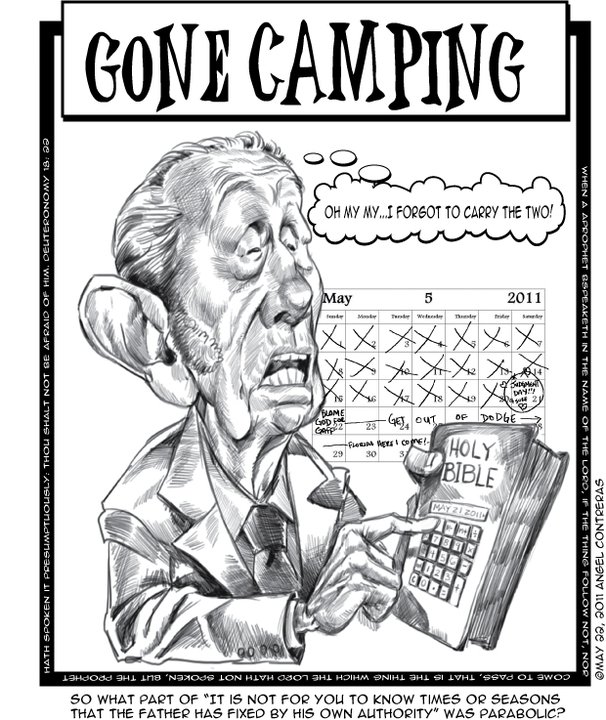
Click to "embiggen" and read the fine print
Allow me to recommend Redeemer Broadcasting

Don’t miss their program A Plain Answer! Today’s episode: “May 21 and Harold Camping’s Failed Prophecy.”
Harold Camping Preached Judgment, Not Christ
This is the day proclaimed by false teacher Harold Camping as the beginning of Judgment Day. According to him, May 21, 2011 begins a five month period in which earthquakes will destroy those of us who do not believe his false gospel of God’s wrath. But God will rapture those, and only those, believers in him who have believe that Satan is in control of all the churches (and has been since 1988), have left them and have embraced the message, not of Christ’s sinless life, propitiatory death and glorious resurrection for sinners, but of the coming of Judgment Day on this day, May 21, 2011. Camping and his followers see themselves, not as the apostles bearing witness to the death and resurrection of Christ and proclaiming the forgiveness of sins through repentance and faith in his name, but as the Old Testament prophets, principally like Jonah, who are sent with a message of impending judgment, calling on all to “cry mightily unto God for mercy.”
This is nothing but a simple case of losing focus on the centrality of the cross of Christ in Christian proclamation. The apostle Paul writes that the gospel is “the power of God for salvation to everyone who believes” (Romans 1:16). Elsewhere, he writes, “But what does it say? “The word is near you, in your mouth and in your heart” (that is, the word of faith that we proclaim); because, if you confess with your mouth that Jesus is Lord and believe in your heart that God raised him from the dead, you will be saved. For with the heart one believes and is justified, and with the mouth one confesses and is saved. For the Scripture says, “Everyone who believes in him will not be put to shame” (Romans 10:8-11). What is the principal work of Christ in focus in this call to faith? His resurrection on the third day after his death for sinners. Verse seventeen of this very passage points out that it this word of Christ, his death and resurrection for sinners, through which faith comes, and no other. If we lose focus on the cross of Christ, even in favor of his other works, like his promised return in glory, we will not be preaching the message through which the Holy Spirit will impart faith, and those to whom we preach will not be saved. This is just one of Harold Camping’s numerous errors, not to mention heresies, in his so-called “radio ministry.”
For this reason, I want to survey the Acts of the Apostles and see how that they who were called to lay the foundation of the church (see Eph. 2:20) bore witness to Christ throughout the world in order to be reminded of the centrality of the cross in our testimony before the lost world.
In the first book [The Gospel According to Luke], O Theophilus, I have dealt with all that Jesus began to do and teach, until the day when he was taken up, after he had given commands through the Holy Spirit to the apostles whom he had chosen. He presented himself alive to them after his suffering by many proofs, appearing to them during forty days and speaking about the kingdom of God.
And while staying with them he ordered them not to depart fromJerusalem, but to wait for the promise of the Father, which, he said, “you heard from me; for John baptized with water, but you will be baptized with the Holy Spirit not many days from now.”
So when they had come together, they asked him, “Lord, will you at this time restore the kingdom to Israel?” He said to them, “It is not for you to know times or seasons that the Father has fixed by his own authority. But you will receive power when the Holy Spirit has come upon you, and you will be my witnesses in Jerusalem and in all Judea and Samaria, and to the end of the earth.” And when he had said these things, as they were looking on, he was lifted up, and a cloud took him out of their sight. And while they were gazing into heaven as he went, behold, two men stood by them in white robes, and said, “Men of Galilee, why do you stand looking into heaven? This Jesus, who was taken up from you into heaven, will come in the same way as you saw him go into heaven.” (Acts 1:1-11; emphasis mine)
With this introduction of Christ’s call to bear witness to him throughout the world to an ever-widening extent, our focus in this survey will be upon a selected few of the ten major speeches recorded in the Acts. Three are preached by Peter, one by Stephen, and six by Paul, of whose consist of one from each of his missionary journeys (the first addressing Jews, the second Gentiles, the third Christians, followed by three defense speeches before authorities).
Peter’s Witness (Acts 2:14-36)
In Peter’s sermon on the Day of Pentecost after Christ’s Ascension, he first explains how that the disciples’ speaking in tongues is a fulfillment of Joel’s apocalyptic prophecy (Joel 2:28-32) emphasizing not the coming of Judgment Day, but salvation through faith (Acts 2:14-21). In verse 22, he transitions from the miraculous to the subject of his sermon by the fact that Jesus’ miracles attested to his divine sanction, and immediately proclaims the death of Christ as being the predetermined plan of God (v. 23), and proclaims his resurrection, explicitly stating that it is this to which they bear witness: “This Jesus God raised up, and of that we all are witnesses” (Acts 2:32).
Stephen’s Witness (Acts 7:1-53)
After preaching Christ as the promised prophet who is like Moses in that he would mediate a better covenant than that which Moses mediated (Acts 7:37; cf. 2 Cor. 3), although explicit reference is not made to Christ’s death and resurrection, it is at least assumed (his audience were Jews who were well aware of the death of Jesus), and his resurrection and ascension are implied by his declaring his vision of the exalted Christ, sitting on the right hand of God the Father (Acts 7:56). Then Luke, the human author of Acts, portrays Stephen’s death as an allusion to the propitiatory nature of Christ’s crucifixion (that it renders God favorable toward sinners) as the martyr prays that his executioners’ sins would be forgiven, just as Christ also prayed (see Luke 23:34), and his very death is thus a testimony to the cross of Christ itself (cf. Col. 1:24). The word “martyr” in fact means “witness,” and such witness Stephen indeed bears to his death. Saul of Tarsus held the coats of those who stoned Stephen, but he would not come to faith until he himself would come face to face with the risen Christ.
Paul’s Witness (Acts 17:22-31)
Contrary to Harold Camping’s emphasis that the cross and resurrection need not be preached, but exclusively the coming judgment, Paul preaches God’s judgment as signified and assured to come due to Christ’s resurrection from death (v. 31). The response of the Athenians to Paul’s preaching of the resurrection shows its central character in his sermon (v.32) and we see that as a result of such preaching, faith was granted to Dionysius the Areopagite and Damaris (v.34).
Conclusion
If I’ve learned one thing in my past teaching ministry, it is that the easiest thing in the world to do is to forget to tie that which you teach or apply to the cross and resurrection of Christ. We must redouble our efforts to make sure the gospel is kept central in all of our preaching and teaching because it, and only it is the message by which God promises to save those who believe (1 Peter 1:25; James 1:21). If we learn anything from the tragedy playing out before our eyes this weekend, let it be the importance of the cross of Christ. Pray for your friends and loved ones who may have been deceived by Camping’s false gospel of Judgment Day that they might lose faith in Camping, but that their faith in Christ crucified and risen for them may not fail.
Update Rapture Fail Tomorrow

From the Rapture Fail website:
RaptureFail has been set up to allow people around the world to catalogue the failure of Harold Camping’s Rapture prophecy for the 21st of May 2011.
As Christians who take the Bible seriously we believe that “prophecies” like these demean the church’s witness in the world. The purpose of this site is to demonstrate very clearly (and to mock gently) that this is a false prophecy and that Harold Camping is a false prophet.
As 6pm on the 21st of May passes around the world, RaptureFail will show that the Rapture is not occurring by utilising the power of the internet and global user input. Everybody who participates in this project will be part of the undermining of this embarrassment to the Body of Christ.
The Bible is Not an Engineering Book

Harold Camping, Engineer
Several weeks ago, Dr. W. Robert Godfrey posted a 5-part series of blogs on Harold Camping from the perspective of one who knew this apocalyptic radio personality. When Godfrey was a child, he was a member of the same Christian Reformed congregation as Harold Camping—we’re talking, back in the ‘50’s! With this personal connection, Dr. Godfrey was able to introduce us to Camping and his teachings, not from a malicious and mocking point of view, but as one who grieves and prays for Harold Camping and his followers. I highly recommend his series, the links to which are given at the end of this post.
In part one, we learn how Camping reads the Bible.
Engineer
Camping was a bright and studious man who had been educated as an engineer. In the 1950s he owned a very successful construction company which built churches as well as other significant buildings. This educational background is critical to understanding Camping. His education was not in the liberal arts or theology. He had not been prepared to read literature or ancient texts. He knew no Greek or Hebrew. He was not formally introduced to the study of theology. His reading of the Bible, as it evolved over the decades, reflected his training in engineering. He reads the Bible like a mathematical or scientific textbook.
Yesterday, I downloaded the archived episodes of Harold Camping’s radio show “Open Forum” beginning with last Saturday’s episode, and I’ll continue downloading and listening through the time after his predicted date of the beginning of Judgment Day.On the May 15 episode of Open Forum, one caller points to Camping’s mathematical calculations as evidence that he’s not basing his prediction on what the Bible says but that he is instead “leaning on his own understanding.” The caller is correct, in that, just as Dr. Godfrey informs us, Camping’s presupposition about the Bible is that it is a precise mathematical text (Camping’s “own understanding”), when in fact, it is not. Sound interpretation of the literary genres of Scripture often involves the use of round numbers. But this is a fact which Camping denies. At minute 14:38 in the May 15 episode, we hear the following:
Caller: But you’ve had to apply these calculations…and-and-and with the calendars and adding. Nowhere does it say to do that, and that’s leaning to your own understanding. You would have to be perfect in your interpretation and unfallible (sic).
Camping: Well, first of all-first of all, when we developed the time in the Bible, we’re not looking at the calendars that have been developed by the various nations because sometimes they have dropped out some days or whatever. We work through the information that is all from God, namely, going from one year to the next, we go from 365.2422 days. We’re not looking at calendars, but when we come to talking about when in the Old Testament or whatever, we have to relate it to some kind of calendar, and so always—and archaeologists do the same thing—they coordinate it with our modern calendar, otherwise you’re neither coming or going, you don’t know where you are. You don’t pay any attention to all the different calendars that have been developed throughout time, only pay attention to the actuality. The astronomers have measured this again and again. It’s the way God has created the world, that there are 365.2422 days in a year. So if we multiply the number of years from one point to another, times that number, we can know exactly the number of days, and so on. So it’s all done with exquisite accuracy. And the Bible is a very, very analytical book. It is not—and when you’re working with the timeline in the bible and any evidence in the Bible, it has to be looked at very analytically, just like an engineering book, and that’s why we can come to such solid truths as what we’re talking about. But if we look at the Bible like the philosophers do [certainly by this he means seminary trained Bible scholars], they are not very careful in what they are using for their measurements. They can give an idea based on, “It could well be this…” and then they go ahead and they introduce some other information on that kind of a statement. “It could well be this.” No way! You can’t do that. It has to be, “It will be this because of what we read in the Bible,” and we go to our facts all the time. The Bible is dripping with facts, not with guesses. But thank you for calling and sharing and shall we take our next call, please? Welcome to Open Forum . . . (emphasis mine)
So, we see that according to Harold Camping, theological and hermeneutical expertise is “leaning on one’s own understanding,” but appealing to the laws of mathematics, astronomy and the practice of archaeologists, or looking at the Bible like an engineering book, will not make you misinterpret the Bible. This is the typical attitude of the rationalistic Biblicist.
Dr. Godfrey’s blog series is called, “The End of the World According to Harold Camping.” Read parts one, two, three, four, and five.
Those who’d like to read an introduction to the proper approach to Scripture can learn a lot by reading The Chicago Statement on Biblical Inerrancy which may be accessed from my “Creeds, Etc.” page.
Interviewing the Interviewer and “Heaven & Hell”

Martin Bashir
You just have to listen to this program. Martin Bashir, the MSNBC journalist who gave Rob Bell a challenging interview about the contents of his new book Love Wins, was interviewed himself on the Paul Edwards Program about that interview. Edwards not only wanted to know how Bashir prepared for his interview with Bell, but also wanted him to confirm or squash the rumor that’s been going around that he is himself a Christian and a member of Redeemer PCA in New York City. Bashir explains his own motives and methods for his Bell interview.
It’s an awesome program! Gene Veith or someone else well versed in the Protestant doctrine of vocation should interview him further as an example of a Christian pursuing excellence in his journalistic vocation for the glory of God. I think that would be an interesting discussion.
Listen to “MSNBC’s Martin Bashir on the Paul Edwards Program.”
Also listen to this special episode of the White Horse Inn, “Heaven and Hell,” in which the “usual cast of characters” discuss Rob Bell and Love Wins with Kevin DeYoung, a leader of the so-called “New Calvinism,” or “The Young, Restless and Reformed” movement, the orthodox alternative to the postmodern liberalism of Rob Bell, Brian McLaren, Doug Pagitt, etc.
Emerging Monastic Transformationalism versus Biblical Christianity

How timely. The March/April 2011 issue of Modern Reformation magazine has arrived, featuring an article related to the postmodern liberal (aka, “emerging”) emphasis on being “missional.” Editor-in-Chief Dr. Michael Horton attempts to demonstrate how this emphasis tends to emphasize certain aspects of medieval monasticism in his piece called, “Missional Church or New Monasticism?“.
Medieval monasticism was divided between those who prized the contemplative life (spiritual ascent to heaven through private disciplines of the mind) and those who gave priority to the active life (spiritual ascent through good works, especially for the poor). Francis of Assisi–and the Franciscan Order named after him–emphasized the latter.
First, today we see a revival of contemplative spirituality. It is a traditional evangelical emphasis on personal piety: discipleship as inner transformation through spiritual disciplines. Richard Foster’s Celebration of Discipline (1979) introduced many evangelicals to the medieval mystics and contemplative writers. From The Divine Conspiracy (1998) to The Great Omission: Reclaiming Jesus’ Essential Teachings on Discipleship (2006), Dallas Willard has repeated this call to discipleship: inner transformation through the spiritual disciplines.
Next, Horton explains how contemplative and postmodern liberal writers tend to confuse Scriptural gospel indicatives with sin-exposing legal imperatives of Scripture, tending to warp the gospel into how one lives, rather than the message Christ sent ambassadors to proclaim.
Both contemplative (“spiritual disciplines”) and active (Emergent) writers tend to blur and merge commands and promises, indicativees and imperatives. That is, there is a strong tendency to identify the gospel with what we do rather than with what God has done for us–and the world–in Jesus Christ. We are active agents more than beneficiaries and witnesses of God’s reconciling work, building his kingdom through our efforts more than receiving a kingdom that expands through preaching and Sacrament. . . . (emphasis mine)
Although the Emergent movement reflects a more communal emphasis on social transformation, it shares the medieval, Anabaptist, and Pietist emphasis on deeds over creeds. Brian McLaren explains, “Anabaptists see the Christian faith primarily as a way of life,” focusing on Jesus’ Sermon on the Mount rather than on Paul and doctrines concerning personal salvation [Brian McLaren, A Generous Orthodoxy (Grand Rapids: Zondervan: 2004), 206.] More than proclaiming Christ’s finished work of reconciling sinners to the Father, the focus is on completing Christ’s redeeming work of social transformation. Tony Jones, another leader in this movement, relates: “In an emergent church, you’re likely to hear a phrase like ‘Our calling as a church is to partner with God in the work that God is already doing in the world–to cooperate in the building of God’s Kingdom.'” Trying to anticipate Reformed objections he notes, “Many theological assumptions lie behind this statement,” although “the idea that human beings con ‘cooperate’ with God is particularly galling to conservative Calvinists, who generally deny the human ability to participate with God’s work” [Tony Jones, The New Christian: Dispatches from the Emergent Frontier (New York: Jossey-Bass, 2009), 72].
According to McLaren, being “missional” means that we encourage Buddhists, Muslims, and Jews to become better Buddhists, Muslims, and Jews to become better Buddhists, Muslims, and Jews as followers of Jesus’ example. It is not what we proclaim but how we live that transforms the world. McLaren writes, “To say that Jesus is Savior is to say that in Jesus, God is intervening as Savior in all of these ways, judging (naming evil as evil), forgiving (breaking the vicious cycle of cause and effect, making reconciliation possible), and teaching (showing how to set chain reactions of good in motion)” [McLaren, 96]. There is no mention of Christ bearing God’s wrath in our place–in fact, no mention of the cross having any impact on the vertical (God-human) relationship. “Then, because we are so often ignorantly wrong and stupid, Jesus comes with saving teaching, profound yet amazingly compact: Love God with your whole heart, soul, mind, and strength, Jesus says, and love your neighbor as yourself, and that is enough.” This is what it means to say that “Jesus is saving the world” [McLaren, 97]. Although Jesus called this the summary of the law (Matt. 22:37-40, citing Deut. 6:5) for McLaren it becomes the summary of the gospel.
Horton then goes on to constructively explain the proper distinction between law and gospel:
First, “living the gospel” is a category mistake. By definition, the gospel is news (euangelion, “good news”). You don’t “do” news: you do law and you hear gospel. Second, the specific content of this good news is the forgiveness of sins through faith in Christ’s saving life, death, and resurrection. We are beneficiaries of this action, not active participants. Scripture certainly teaches that we live in view of God’s mercies, in a manner worthy of the gospel we profess, and so forth. However, it represents our lives and good works as the fruit of the faith created by the gospel, not as part of the gospel itself. (emphasis mine)
Third, the Scriptures teach consistently that faith comes through the proclamation of the gospel, not through good works. Christ himself was not arrested and arraigned because he was trying to restore family values or feed the poor. Even his miraculous signs were not by themselves offensive, except as they were signs testifying to his claims about himself. The mounting ire of the religious leaders toward Jesus coalesced around him making himself equal with God (John 5:18) and forgiving sins in his own person, directly, over against the temple and its sacrificial system (Mark 2:7). In fact, at his trial he was chared by the Jewish Council with announcing the destruction of the temple. When the high priest asked, “Are you the Christ, the Son of the Blessed?” Jesus answered: “I am, and you will see the Son of Man seated at the right hand of Power, and coming with the clouds of heaven.” With that, “the high priest tore his garments and said, ‘What further witnesses do we need? You have heard his blasphemy. What is your decision?” And they all condemned him as deserving death” (Mark 14:53-64).
Jesus was never charged on the grounds of trying to bring world peace: quite the contrary (Matt. 10:34-37). Jesus’ opponents never included a revolutionary blueprint for improving world conditions among the indictments against him. In fact, his mission was an utter failure for those who saw him as a leader of political revolution. He will return in glory to judge, to deliver, and to make all things new in a global political kingdom of righteousness and blessing. However, between his advents is the space in history for repentance and faith.
Thus, Horton contrasts the Jesus of the Bible and the Christianity of the Bible with the Jesus of postmodern liberalism and it’s appropriation of medieval contemplative spiritual disciplines and politically liberal social justice activism. The simple fact is that the Christian is not the gospel, and his Christian obedience is not the gospel (but rather its result)–the gospel of Jesus Christ will be heard each Lord’s Day at a church that is committed to proclaiming it, and that is likewise committed to doctrinal (doctrines like the deity of Christ, his virgin birth, his penal-substitutionary atonement, etc.) as well as practical discipleship in Christian obedience that leaves Christians to work this out in the various vocations to which the Lord may call his people, not specifically the favored social agenda of any local church, be it a liberal or conservative agenda. Here is the context in which true liberty in Christ will emerge, in a spirituality that will gradually, neither instantaneously nor holistically (in this age before Christ’s return to glorify his people) see Christians growing in love for God and neighbor in response to the preached gospel of the grace and forgiveness of God in the Lord Jesus Christ.


 The Misadventures of Captain Headknowledge
How to Draw Distinctions
There are a number of especially common and compelling misconceptions about the Bible which are held by the unbelieving world. One of the more popular ones is using nonmoral Old Testament laws against the eternally binding moral laws. For instance, in arguing against the Christian’s appeal to the Old Testament’s prohibition of homosexuality, many will accuse us of inconsistency since we don’t also equally observe the Mosaic Laws against eating unclean animals like shellfish, or meat with blood in it. From my standpoint as one who grew up being instructed that there are distinctions between moral, civil and ceremonial laws, it looks like those not so informed don’t know how to draw simple distinctions. But the apostle Peter once wrote about the fact that uninformed people twist Scripture to their own destruction (2 Peter 3:16), so I guess it’s not uncommon for unbelievers to have such trouble with handling the Word of God correctly (2 Timothy 2:15).
URCNA Associate Pastor, WSC Professor of Systematic Theology and Apologetics, prolific author and host of The White Horse Inn radio show, Dr. Michael Horton has written an informative explanation of this distinction between Old Testament laws. He shows why and how some were typological and thus temporary, associated with the ancient Israelite theocracy until their fulfillment in the redemptive life and ministry of Israel’s Messiah, the Lord Jesus Christ. He also explains that others are eternally and universally binding on all people at all times and in all places as part of God’s way of informing the world of their common need for redemption in the same Messiah of Israel, the Lord Jesus Christ, since the Bible teaches that the wages of sin is death, but the free gift of God is eternal life in Christ Jesus our Lord (Romans 6:23). After his sacrificial death and miraculous resurrection, Christ has ascended to the right hand of God the Father enthroned in heaven to rule over all the nations spiritually, not geo-politically (John 18:36), through the preaching of the Law and the Gospel by calling out a people for his name (Acts 15:14) from every tongue, tribe and nation (Revelation 14:6).
In “Why Can’t I Own Canadians? Rightly Dividing the Word of Truth,” Horton writes (read the rest here):
Share this: