Creeds and Confessions in the Contemporary Church | Christ the Center Podcast

On this episode, we welcome Rev. Dr. Carl R. Trueman to discuss the important role of creeds and confessions in the church through his book The Creedal Imperative. Dr. Trueman is the Paul Woolley Professor of Historical Theology and Church History at Westminster Theological Seminary and Pastor of Cornerstone Orthodox Presbyterian Church in Ambler, PA. Dr. Trueman brings his critical thought and historic sensitivity to this important plea to many conservative evangelicals.
Participants: Camden Bucey, Carl Trueman, Jared Oliphint
HT: Reformed Forum
Dynamics of Church Planting | Christ the Center Podcast

Church planting is one way the Lord expands his kingdom on earth. Christ called his disciples to go forth and make disciples of men, baptizing them in the name of the Father, Son, and Holy Spirit. Faithful discipleship is connected with the local church. That point has been debated in and of itself, but the proper means of church planting has been a much more contentious subject.
In this episode, Andrew Moody and Eric Watkins work through several dynamics of church planting. Rev. Moody serves as Evangelist at San Antonio Reformed Church in San Antonio, Texas, and Rev. Watkins is Pastor of Covenant Presbyterian Church in St. Augustine, Florida. Both Eric and Andrew bring experience to this interesting discussion on planting Reformed churches.
Participants: Andrew Moody, Camden Bucey, Eric Watkins, Jim Cassidy
HT: Reformed Forum
Reformed Forum: Nature and Scripture
I just thought I’d share the video of one of my favorite podcasts, if you’ve got the time.
Reformed Forum is a reformed theology media network, which seeks to serve the church by providing content dedicated to issues in reformed theology. (Link)
The flagship podcast of the Reformed Forum media network is the weekly program, Christ the Center. Hosted by Camden Bucey, a doctoral student at Westminster Theological Seminary in Philadelphia, Pennsylvania, who is often joined by a panel of other students, Christ the Center features interviews of authors and theologians, as well as discussions among the panelists themselves. While accessible and engaging, these guys are not afraid of dealing with the technical and academic aspects of Reformed theology, but I know everyone will find something that will benefit them.
The most recent episode posted at the Reformed Forum YouTube channel deals with the issue of “Nature and Scripture”:
In 1946, the faculty of Westminster Theological Seminary published a symposium on the doctrine of Scipture titled The Infallible Word. Cornelius Van Til’s contribution, an essay titled “Nature and Scripture,” is an important work describing the relationship of general and special revelation. In this episode, Dr. K. Scott Oliphint, Professor of Apologetics and Systematic Theology at Westminster, expounds on this essay and connects it to contemporary issues in philosophy and theological methodology. (Link)
God Imputes Righteousness, Not Faith

Q. 73. How doth faith justify a sinner in the sight of God?
A. Faith justifies a sinner in the sight of God, not because of those other graces which do always accompany it, or of good works that are the fruits of it, nor as if the grace of faith, or any act thereof, were imputed to him for his justification (Romans 4:5; 10:10); but only as it is an instrument by which he receiveth and applieth Christ and his righteousness.
Believing is not a good work. It earns nothing. If there were such a thing as a righteous person other than Jesus Christ, there would be no need to impute his righteousness to him. For this hypothetical person who earns righteousness by his own good works, having Christ’s righteousness imputed or credited to him would be superfluous, redundant, and unnecessary.
Christ did not come to call those who think their righteousness is good enough. God did not send his Son to die for those who never come to admit that they deserve to die because of their sin. In Romans 4:5, Paul describes God as “him who justifies the ungodly.” The ungodly one who despairs of his inability to earn righteousness by his good works is the kind of person whom God justifies, or declares righteous in his sight.
In this same passage, Paul explains that “his [the ungodly person’s] faith is counted as righteousness.” This is the biblical doctrine of imputation, and Paul elaborates on it in the rest of his sentence which concludes in verses 6 -8: “… just as David also speaks of the blessing of the one to whom God counts [imputes] righteousness apart from works: ‘Blessed are those whose lawless deeds are forgiven, and whose sins are covered; blessed is the man against whom the Lord will not count [impute, KJV] his sin.’” As you see, the Bible teaches that while a man’s faith may in one sense be “imputed,” or “counted” as righteousness, in a greater sense, what is really going on is that Christ’s righteousness is being imputed to the ungodly believer–the righteousness of Christ is counted as the righteousness of the ungodly believer. It is a careless misreading to interpret the Bible as teaching that God imputes faith to the ungodly; rather, God imputes the righteousness of Christ to him.
What, then, is the source of this faith by which we are justified by the imputed righteousness of Christ? “For with the heart one believes and is justified, and with the mouth one confesses and is saved” (Romans 10:10). In the song, “Rock of Ages,” Christians sing, “Nothing in my hand I bring/Simply to the cross I cling.” It is not the work of our hands by which we are justified, but the gracious gift of faith which emerges from a regenerate, spiritually living heart which has been newly freed from sin and empowered to rest on the finished work of his righteous Savior who has been crucified and risen for him. We may be justified by a righteousness that is not our own, but that righteousness is received by a faith that is very much our own, graciously enabled by the power of the Holy Spirit.
Answer #73 of the Westminster Larger Catechism, then, further denies that the faith by which he is justified was not imputed to him—it was not the faith of another, but his own faith which arises by God’s grace from his own regenerate heart. His faith is the fruit grown on the good tree of his own regenerate heart.
Union with Christ and Justification
Happy Reformation Day! October 31, 2011 marks the 494th anniversary of the legendary event considered the spark that ignited the Protestant Reformation when Augustinian monk, Martin Luther, nailed the Disputation on the Power and Efficacy of Indulgences(commonly known as the 95 Theses) to the door of the castle church in Wittenberg, Germany in 1517. In the years that followed, Luther lead the movement to reform the church’s understanding of what the Bible teaches about the doctrine of justification by God’s grace alone, received through faith alone, in Christ alone, according to Scripture alone, to the glory of God alone. The Lutheran tradition would build on Luther’s work on justification, and they placed it at the center and starting point of all of the benefits of the redemption purchased
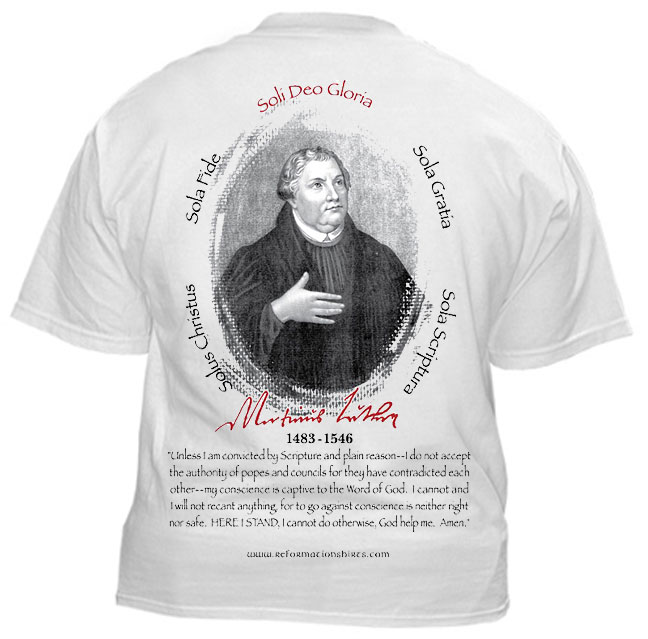
Purchase your Martin Luther T-Shirt from ReformationShirts.com
by Christ for his people. But biblical reformation of soteriology didn’t end with Luther and the Lutherans. The Reformed movement also grew alongside of the Lutheran movement, and while both were co-belligerents against the Roman doctrines of justification and the other benefits of redemption in Christ, they differed on the most biblical way to systematize these truths.
Friday on the Reformed Forum’s podcast, Christ the Center, Camden Bucey, Jim Cassidy and Jeff Waddington interviewed Dr. Lane Tipton, the new Charles Khrae Professor of Biblical and Systematic Theology at Westminster Theological Seminary in Philadelphia, Pennsylvania. Dr. Tipton was allowed two hours to spell out the differences between the Lutheran and Reformed approaches to justification and many current issues related to this essential aspect of Protestant theology, such as whether Dr. Michael Horton’s academic work on the subject is moving Reformed theology toward a more Lutheran, and therefore,according to Dr. Tipton, semi-Pelagian doctrine of justification. Listen to the podcast at this link.
I was introduced to Reformed theology by Michael Horton’s materials and the Lord used his parachurch ministries Christian United for Reformation (CURE) and the Alliance of Confessing Evangelicals (ACE) and the White Horse Inn radio show to gradually bring me around to embrace it. I will certainly be looking forward to a future Christ the Center program in which Dr. Horton responds to Dr. Tipton’s characterization of his work on justification and the other benefits of redemption in Christ. More public dialogue on this ought to take place, IMHO. At this point, Dr. Tipton’s case sounds convincing and more in line with the Reformed confessions and catechisms, as opposed to Dr. Horton’s efforts to, as I once heard him state on the air, build a kind of ecumenism between Reformed, Lutheran and Anglican traditions. I can see how some synthesis may be taking place in that effort. But what do I know?
Reformata, Semper Reformanda!
My Favorite Sport!

Rangers Ballpark in Arlington, home of the Texas Rangers
I’m one of those especially unfortunate fellows who grew up with a love-hate relationship with sports. I played several sports on several little league teams as a child, and played plenty of sports in the streets of my neighborhood. My lack of skill then is probably the chief reason I do not follow sports today, although I do tend to catch the Super Bowl, mostly for the commercials. My new membership in a Reformed church and their biblical and confessional (we view these two adjectives as synonymous) emphasis on delighting in the Lord on the Lord’s Day may have implications for the Super Bowl in the future. All I can say is, thanks be to God for digital video recording.
In light of my lack of interest in sports, I am fond of informing folks that “my sports are politics and religion,” which probably tells people I can relate even less to them, when they may already see me as a socially challenged individual who doesn’t follow sports. It is for this reason that you may not be surprised by my interest in the following lecture series that was held at Christ Reformed Church (URCNA) in Washington, D.C., called “Christianity & Politics,” which is yet another venue for the Westminster Seminary California faculty and alumni, among others, to focus our attention on their attempt at recovering the Reformed notion of the Two Kingdoms approach to the relationship between “Christ and Culture.” A timely offering in this year of presidential politics.
Here’s their introduction to the series, speaker bios and links to the lectures:
Why We Confuse Church & State
Separation of church and state?
Whatever you may think of the contemporary application of our first amendment freedom of religion, Christianity and politics are ever confused in our national consciousness. Preachers seek influence in the political sphere; politicians manipulate and calculate the faithful in their constituencies.
What are the faithful to do? How should we understand our callings as citizens, both on earth below and in heaven above?
Christianity & Politics presents a range of speakers approaching this topic from a range of perspectives while discussing topics as diverse as the mission of the church, the place of evangelicals in American political culture, natural law, and the spirituality of the church.…
Lectures [were] sponsored by Christ Reformed Church, and [took] place in our place of worship, historic Grace Reformed Church, home of President Theodore Roosevelt….
Speakers
MICHAEL HORTON is the J. Gresham Machen Professor of Systematic Theology and Apologetics at Westminster Seminary California, Host of the White Horse Inn radio program and Editor-in-Chief of Modern Reformation magazine. He is a minister in the United Reformed Church.
MICHAEL GERSON is an opinion writer for the Washington Post and former head speech writer and senior policy advisor to President George W. Bush.
DARRYL HART is Assistant Professor of History at Hillsdale College, author of numerous books, and blogs on religion and public life at oldlife.org.
TERRY EASTLAND is the Publisher of The Weekly Standard and an elder at Fourth Presbyterian Church in Bethesda, Maryland.
BRIAN LEE is the pastor of Christ Reformed Church in Washington, DC (United Reformed Church). He is a Guest Faculty at Reformed Theological Seminary and formerly worked on Capitol Hill, the National Endowment for the Humanities, and the Department of Defense.
DAVID VAN DRUNEN is the Robert B. Strimple Professor of Systematic Theology and Christian Ethics at Westminster Seminary California. He is a minister in the Orthodox Presbyterian Church and holds a Law Degree from Northwestern University School of Law.
DAVID COFFIN is the Senior Pastor at New Hope Presbyterian Church in Fairfax, Virginia.
Audio
Michael Horton
The Great Commission (Sermon on Matthew 28)
The Great Commission and Social Justice — (Q&A Session)
Michael Gerson, Darryl Hart, Terry Eastland
The Future of Evangelical Politics (roundtable discussion)
Brian Lee
The Primacy of “Church” in “Church & State” (Sermon on Romans 12)
“Govern Well?” or “Be Governed”? — (Q&A Session)
David VanDrunen
Natural Law and Christian Politics — (Q&A Session)
David Coffin
The Biblical Doctrine of the Spirituality of the Church (Sermon on John 18)
The Historical Doctrine of the Spirituality of the Church — (Q&A Session)
Confessions of a Restlessly Reforming Evangelical Fundamentalist

Old Life--Home of the Nicotine Theological Journal. Picture by The Sacred Sandwich
Dig my latest comment at Darryl G. Hart’s Old Life Theological Society. His post is titled, “Young, Restless and Lutheran?” He questions whether the broad approach of the Young, Restless and Reformed movement isn’t so broad that it might be more accurate to call it “Young, Restless and Lutheran,” given that, in Hart’s view, it’s less about Reformed theology in general or the five points of Calvinism in particular (no pun intended), and more about having been inspired by a bigger vision of God at the hands of John Piper channeling Jonathan Edwards, and generally begins reminding us all how much less Reformed they are than he and his Truly Reformed OPC brethren are (among whom I eagerly anticipate numbering me and mine). This is my summary, anyway, be it accurate or not.
I found the post and some of the resultant comments engaging enough that I just had to share my own experience at moving from Fundamentalism, through Evangelicalism and into Reformed Confessionalism. Although I write with tongue-in-cheek, the experiences are all very real (and they’re just the tip of the iceberg).
Confessions of a Restlessly Reforming Evangelical Fundamentalist:
Fortunately, I bypassed the whole Piper YRR movement (Piper’s creative and independent streak is waaay too Baptist for my taste) and swallowed the whole TR thing hook, line and sinker…Or so I thought. The further one goes, the more one discovers which exaggerates the differences between what it means to be Evangelical (in modern Western Christianity, that is) and what it means to be Reformed.
First, you fall for the 5 points; then you get over the hump about baptism (my logic was, “if the seventeenth century Baptists agreed with Presbyterians on so much,” as I was then coming to perceive, “then what makes them think Presbyterians are so wrong about baptism?”)…
…then you deal with stuff like exclusive “Acapulco” psalmody, and, for me living in a region where there is no glut of Reformed churches, I take the lazy man’s approach and say this isn’t an issue I have the luxury of standing for, even if I were persuaded of it. And some of their arguments I do find attractively compelling. If it weren’t for those of the advocates of instrumental hymnody.
Now that I’m preparing to join an OPC church, and begin reading all this vast literature about this “splinter group” of a denomination, I feel I’ve come full circle in some ways back to a Presbyterian version of my separatistic IFB background (even the local church planting missions emphasis is reminiscent of the IFB, without the Faith Promise giving campaigns), if you consider some of you more outspoken OPC guys’ position and attitude about TGC and T4G.
Yes, growing up among separatistic fundamentalists, yet consuming my fair share of big tent Evangelical media, it is quite a process in coming to a point where you can confidently call yourself “Reformed” without crossing your fingers behind your back.
Theological & Doxological Meditation #45

The First Commandment: Worship the Right God
Q. Which is the first commandment?
A. The first commandment is, Thou shalt have no other gods before me (Exodus 20:3; Deuteronomy 5:7).
God Is Known Among His People
(play file 066 in “T&D mp3″ sidebar widget)
#66, Trinity Hymnal (© 1990)
From Psalm 76
The Psalter 1912; alt. 1990, mod.
God is known among his people,
every mouth his praises fill;
From of old he has established
his abode onZion’s hill;
There he broke the sword and arrow,
bade the noise of war be still.
Excellent and glorious are you,
With your trophies from the fray;
You have slain the mighty warriors,
Wrapped in sleep of death are they;
When your anger once is risen,
Who can stand in that dread day?
When from heav’n your sentence sounded,
All the earth in fear was still,
While to save the meek and lowly
God in judgment wrought his will;
e’en the wrath of man shall praise you,
your designs it shall fulfill.
Vow and pay unto Jehovah,
Him your God forever own;
All men, bring your gifts before him,
Worship him, and him alone;
Mighty kings obey and fear him,
Princes bow before his throne.
A True Presbyterian Hymnal for “A True Presbyterian Church”

1961 Edition of the Trinity Hymnal
One of the many factors that won me over to embrace Reformed theology and practice was the fascinating Trinity Hymnal (c. 1990). Back when I worked at what I endearingly call “The Reformation Station,” the print shop where God cornered me after years of on-again, off-again confrontation by the TULIP and other aspects of Reformed belief and behavior, I had the opportunity to print the bulletins for a local PCA church, which would include in its liturgy hymns selected from the Trinity Hymnal, printed in the bulletin, music and all! For this reason, there was a copy of the hymnal in the office, which they could use to prepare those bulletins, and which I could peruse from time to time and thereby enter the world of Reformed psalmody and English hymnody, and further tie my heart to my future spiritual and theological home in the Reformed tradition.
Due to my abundance of affection for the Trinity Hymnal, I was very pleased to notice that I wouldn’t have to wait long to learn its history in Daryl Hart’s OPC history, Between the Times: The Orthodox Presbyterian Church in Transition, 1945-1990 (c. 2011, The Committee for the Historian of the Orthodox Presbyterian Church). The reader of this volume is treated to the story of the hymnal in chapter two, under the simple title, “Trinity Hymnal, 1944-1961.” Here’s a synopsis of what you’re in for if you purchase Hart’s history.
In 1933, the PCUSA revised their hymnal, dropping 400 traditional hymns in favor of songs that reflect the liberalizing trend in the mainline denomination. J. Gresham Machen knew this was a problem. Reasoning from the old adage that the laity learn more theology from singing hymns than from systematic theology, he resolved that something had to be done about it. In the Lord’s providence, from the seed of this thought process on the part of Machen in response to the PCUSA’s threat to further corrupt the doctrine of rank and file Presbyterians, until the final publication of the Trinity Hymnal, a truly orthodox Presbyterian hymnal, 28 years would come and go. But what a glorious harvest of sound theology and biblical doxology would result from such a careful process of cultivation and fertilization.
With this opening anecdote, Dr. Hart surveys the history of American Presbyterian hymnals. Since the first one rolled off the press in 1831 there had been an average of one new hymnal per decade due to the number of controversies and divisions within the PCUSA between 1831 and 1961 (the date of Trinity Hymnal’s eventual publication). Although it would not be published under the auspices of the liberal mainline denomination, the Trinity Hymnal shares this common origin with its predecessors in the crucible of theological controversy. For this reason, it would be compiled with a commitment to aid the worship of the church in accordance with eternal truths, not contemporary trends.
American Presbyterians also produced so many hymnals so frequently because Reformed and Presbyterian practice regarding the Word of God sung as an element of corporate worship was undergoing a transformation from the Scottish and Dutch commitment to exclusive psalmody, to embrace the English hymnody of Isaac Watts, Charles Wesley and others, in order to better respond to the gospel of Christ in terms of the full revelation of Christ in both Testaments.
Much discussion among the members of the Committee on Song in the Public Worship of God over the propriety of this historic move away from the stance of earlier Reformed churches would consume a number of General Assemblies between 1944 and 1961. Dr. Hart reports for us the discussions between the “foreign” element of “psalm-singers” on the committee lead by the Scottish John Murray and his cadre of Scottish and Dutch dissenters and the more Americanized majority who would eventually prevail in the appropriation of English hymn into the practice of not only orthodox Presbyterians in general, but the OPC in particular.

1990 edition of Trinity Hymnal in three colors
With the conclusion of this discussion would arise more rubber-meets-the-road problems like financing the hymnal. We learn the various ideas considered and how the Lord would provide just in time, enabling them to pay off the loans obtained to supplement the giving of Orthodox Presbyterians toward this end, neither too soon, nor too late.
Finally, the reader is pleased to learn just how successful the hymnal was once it hit the market. There really was a need for just such a hymnal among many conservative Protestants outside the OPC.
Chapter two of Hart’s Between the Times is a joy to read, especially if you love the Trinity Hymnal as much as this reviewer does. But with the recent 78th General Assembly of the OPC, we learn that the work of compiling psalms, hymns and spiritual songs to aid the worship of the Reformed is to march forward as it was announced that the OPC will be teaming up with the URCNA to publish a new Psalter-Hymnal in the years to come. I believe there will be enough love in my heart for both of these hymnals to share!
How “Doctrinal Indifferentism” Leads to Works Righteousness
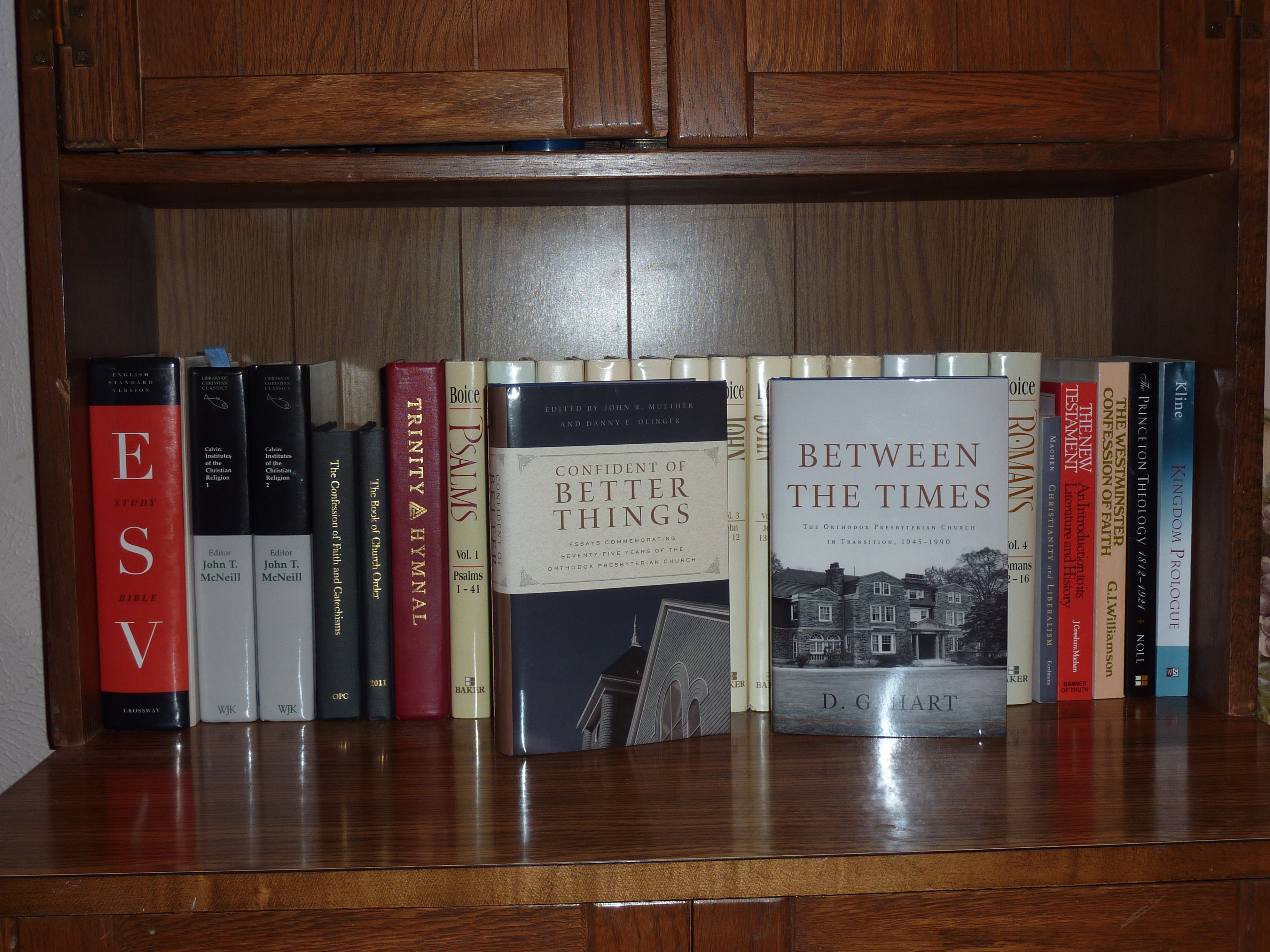
OPC 75 Titles--Confident of Better Things/Between the Times
Here’s a helpful paragraph from D. G. Hart’s new history of the Orthodox Presbyterian Church (OPC), released at the 78th General Assembly of the OPC two weeks ago in celebration of the OPC’s 75th anniversary. Here, Hart describes J. Gresham Machen’s reasons for objecting to Princeton Seminary President, J. Ross Stevensons proposal at the 1920 General Assembly of the PCUSA “for a grand plan to unite the largest Protestant denominations into one denomination” (p. 16). Hart writes:
The disadvantage of the plan for union, as Machen and most of his Princeton colleagues pointed out, was that by entering into a united church, Presbyterians would be abandoning those aspects of Protestantism that made them Presbyterian. If predestination, infant baptism, and Presbyterian polity, for instance, were actually revealed in God’s word as true and necessary for faithful witness, how could Presbyterians give away their teaching and practice to join with Baptists, Methodists, Lutherans, and Episcopalians in a generic Protestant church? The other problem with organic union, as Machen argued in a series of articles for church periodicals, was that it was based upon doctrinal indifferentism. Union turned away from serious doctrinal and ecclesiastical differences among Protestants and implied that these were less important than the greater good that a united church could achieve by transforming American society. Opposition to this sort of ecumenism, which was directly linked to the Social Gospel’s goal of ushering in the kingdomof God, was precisely the impetus for Machen’s important book, Christianity and Liberalism (1923). Not only did he argue that Christianity and liberalism were two different religions, and so liberalism needed to be excluded from the church. Machen also showed how American Protestant interdenominational cooperation stemmed from an indifference to Christian teaching and so distorted the gospel into a message of works righteousness.
D. G. Hart, Between the Times: The Orthodox Presbyterian Church in Transition, 1945-1990 (2011, The Committee for the Historian of the Orthodox Presbyterian Church,Willow Grove,PA), pp. 16-17. opc.org/publications.html Check out Hart’s blog, Old Life: Reformed Faith and Practice.
Confessional Creationism
In all my searching and discussing the issue of the interpretation of the days of creation in Genesis 1, Google directed me to a statement from Westminster Theological Seminary declaring the results of their research into the history of how this issue has been treated by the leaders of the Augustinian and Reformed traditions going all the way back to Augustine himself. The statement is called, “Westminster Theological Seminary and the Days of Creation.“
The discussion among Presbyterians revolves around the reasons the Westminster Divines selected the language they did in when they framed the chapter on Creation in the Westminster Confession of Faith. The phrase in question will be highlighted in the following citation:
I. It pleased God the Father, Son, and Holy Ghost, for the manifestation of the glory of His eternal power, wisdom, and goodness, in the beginning, to create, or make of nothing, the world, and all things therein whether visible or invisible, in the space of six days; and all very good.
The question is raised as to why the wording “in the space of six days.” Why not simply “in six days”? The statement explains:
“The paraphrase view is doubtful because if the Standards had intended simply to utilize biblical language, “in six days” would have sufficed and been a more natural choice. The words “the space of,” as the other view above recognizes, seem deliberately chosen as an interpretive or clarifying addition that functions both to affirm and to exclude or negate.
To make the long story short, the statement concludes that the divines intended to exclude Augustine’s view that God created everything instantaneously inspiring the six days, as Calvin described the view (which he did not hold), “for the mere purpose of conveying instruction.” You can read more about this discussion in the statement itself. You can link to it from the title above, and I have also added a link to the page on my “Recommended Sites” page for future reference.
Finally, here’s a quote that sums up the entire issue as they see it. I find it rather helpful:
With Augustine and E. J. Young, the revered teacher of our senior faculty members, we recognize that the exegetical question of the length of the days of Genesis 1 may be an issue which cannot be, and therefore is not intended by God to be, answered in dogmatic terms. To insist that it must comes dangerously close to demanding from God revelation which he has not been pleased to bestow upon us, and responding to a threat to the biblical world view with weapons that are not crafted from the words which have proceeded out of the mouth of God.
The 78th General Assembly of the Orthodox Presbyterian Church Report – Sunday, June 12, 2011
Joe Coker of Pilgrimage to Geneva passes on information about the 75th anniversary OPC General Assembly:
The 78th General Assembly of the Orthodox Presbyterian Church Report – Sunday, June 12, 2011.
John D. Davis on the “Sons of God”

A Dictionary of the Bible, 2nd Edition (1903), John D. Davis, editor
The following is a fascinating Bible Dictionary entry of the biblical useage of the phrase “Sons of God,” with a special treatment on the various interpretations thereof in Genesis 6. The editor of this Bible Dictionary, John D. Davis, was a member of the faculty of the “Old Princeton.” B.B. Warfield himself even contributed a few of the entries in this dictionary as well. It’s written on a very accessible level for laymen to grasp, and now that I have an antiquarian copy of the 1903 Second edition, I’ll be consulting it in my own Bible study, and most likely, this will not be the last you read from it on this blog, as well.
Sons of God
A Dictionary of the Bible by John D. David, Ph.D. D.D., LL.D.
Professor of Oriental and Old Testament Literature in the Theological Seminary, Princeton, N. J.
1898, 1903 by The Trustees of the Presbyterian Board of Publication and Sabbath-School Work.
Pages 701-702
Worshipers and beneficiaries of God…Such was its common Semitic meaning in early times. There is abundant reason to believe that this is its signification in the celebrated passage where it first appears in the Bible. “It came to pass, when men began to multiply on the face of the ground, and daughters were born unto them, that the sons of God saw the daughters of men that they were fair; and they took them wives of all that they chose” (Gen. 6:1-2).
Three interpretations have been proposed. The Sons of God are:
- The great and noble of the earth, and the daughters of men are women of inferior rank (Samaritan version; Greek translation of Symmachus; Targums of Onkelos and Jonathan).
- Angels, who left their first estate and took wives from among the children of men (Book of Enoch, Philo, Josephus, Justin Martyr, Clement of Alexandria, Tertullian).
- Pious men, worshipers of God, who were especially represented by the descendants of Seth. They were attracted by the beauty of women who did not belong to the godly line, married with them, and became secularized (Julius Africanus, Chrysostom, Cyril of Alexandria, Augustine, Jerome).
The first interpretation has no longer any advocates.
In favor of the second, it is asserted that the term denotes angels everywhere else in the O.T. (Job 1:6; 2:1; 38:7; cf. a similar expression Ps. 29:1; 89:6; RV margin; but not Dan. 3:25); that the designation describes angels according to their nature, whereas the ordinary word for angels,mal’akim, messengers, refers to their official employment; and that this interpretation is confirmed by Jude 6 and 2 Pet. 2:4. But that the term relates to the nature of angels lacks proof; it is quite as natural that it should describe angels as worshipers of God. As to the passages in Jude and Peter, to cite them is begging the question, since exegetes point out other references, as Is. 24:21-23. And unless the title be restricted to the special form which it has in the passage under discussion, it is not true that the term denotes angels in all other places where it occurs in the O.T.
- The worshipers of the heathen deity Chemosh are called the people of Chemosh, and his sons and daughters (Num. 21:29; Jer. 48:46).
- When the men of Judah, professed worshipers of Jehovah, took heathen women to wife, Judah was said to have married the daughter of a strange god (Mal. 2:11).
- Moses was directed to say to Pharaoh: “Thus saith the Lord, Israel is my son . . . . . Let my son go” (Ex. 4:22-23).
- “Ye are the children [or sons] of the Lord your God” (Deut. 14:1).
- “They have dealt corruptly with him, they are not his children.” (Deut. 32:5)
- “Is not he [the Lord] thy father?” (Deut. 32:6)
- “The Lord saw it, and abhorred them, because of the provocations of his sons and his daughters” (Deut. 32:19)
- “Ye are the sons of the living God” (Hos. 1:10).
- “When Israel was a child …I…called my son out of Egypt” (Hos. 10:1).
- “Bring my sons from far, and my daughters from the end of the earth; every one that is called by my name, and whom I have created for my glory” (Is. 43:6-7).
- The pious are the generation of God’s children (Ps. 73:15), and Ephraim is his dear son (Jer. 31:20).
Taking a broader survey, and examining Semitic literature other than Hebrew, one observes the same fact. Many a Babylonian styled himself the son of the god whom he worshiped and upon whom he relied for protection and care.
Furthermore, the opinion that the title in Gen. 6:2 means angels is not the earliest view, so far as the records go. The earliest attested interpretation, that of the Samaritan version, regarded the sons of God as men; and later when the angelic theory arose, it was the opinion of a particular school among the Jews, while the more influential party in religious matters still taught that the sons of God were men.
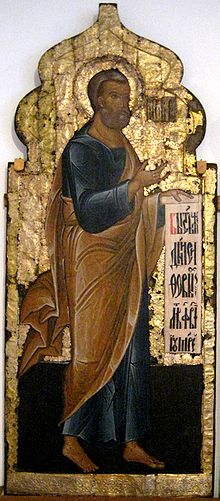
Icon of Seth
The interpretation that the sons of God in Gen. 6:2 were pious people, the worshipers of the true God, more especially that they were the godly descendants of Adam through Seth, whose genealogy is given in Gen. 5, is not only in accordance with Semitic, and particularly biblical, usage of the designation, as already shown, but it is consistent with the context. The sons of God are contrasted with the daughters of men, that is of other men. So Jeremiah says, “God did set signs in Israel and among men;” and the English version supplies the word other before men, in order to bring out the sense (Jer. 32:20). Likewise the psalmist says that the wicked “are not in trouble as men; neither are they plagued like men;” and again the English version supplies the word other (Ps. 73:5). After the same manner Gen. 6:1-2 may be read: “When mankind began to multiply on the face of the ground, and daughters of other men that they were fair; and they took them wives of all that they chose.” The meaning of the writer is that when men began to increase in number, the worshipers of God so far degenerated that in choosing wives for themselves they neglected character, and esteemed beauty of face and form above piety. The offspring of these marriages were perhaps stalwart and violent. Mixture of race in marriage often produces physical strength in the descendants, and lack of religion in the parents is apt to be reproduced in the children. The intermarriage of the sons of God and the daughters of men was offensive in the sight of God. Sentence was pronounced against the wrongdoers. The penalty is not denounced on angels, who were not only implicated, but were the chief sinners, if the sons of God were angels. The punishment is pronounced against man only. Man, not angels, had offended.
Sons of God everywhere in Scripture, from the earliest to the latest times, means the worshipers and beneficiaries of God, both among mortal in immortal beings. But the content of this idea did not remain the same through the ages. It became larger with increasing knowledge of the riches of God. It enlarged, for example, at the time when the Israelites were delivered from Egypt.
- God said: “I have seen the affliction of my people” (Ex. 3:7);
- and again: “Say unto Pharaoh, Israel is my son, my firstborn; who is as dear to me,” so the following words imply, “as Pharaoh’s firstborn is to him” (Ex. 4:22 with 23);
- and again: “I will take you to me for a people, and I will be to you a God” (Ex. 4:7).
Heretofore the title had emphasized a filial relation of men to God, their dependence upon him for protection and care, and their duty of reverence and obedience. Now God formally accepts the obligations which implicitly devolve on him. The content of the title was further enlarged through the teaching of Jesus Christ. He took truths already known, shed light on them, and connected them with this designation.
- He exhibited the fact that God is an actual father and that his people are actual children of God. They are such by the new birth (John3:3,5-6,8; cf. Rev. 11:11),
- begotten of God (John 1:12-13; v.21; and so Eph. 2:5; Jas. 1:18; 1 Pet. 1:23),
- made partakers of the divine nature through the mediation of the indwelling Spirit (John6:48-51; 15:4-5; and so 1 John 3:9),
- and possessing a like character with God, resembling him in holiness, love and elevation above the illusions of earth (1 John 3:9; 4:7; 5:4),
- although falling far short of the divine character in this life (I John 1:8,10).
- They have been adopted as sons (Gal. 4:5), are taught by the Spirit to say Abba, Father (Gal. 6; Rom 8:15), and are led by the Spirit (Rom. 8:14).
Interviewing the Interviewer and “Heaven & Hell”

Martin Bashir
You just have to listen to this program. Martin Bashir, the MSNBC journalist who gave Rob Bell a challenging interview about the contents of his new book Love Wins, was interviewed himself on the Paul Edwards Program about that interview. Edwards not only wanted to know how Bashir prepared for his interview with Bell, but also wanted him to confirm or squash the rumor that’s been going around that he is himself a Christian and a member of Redeemer PCA in New York City. Bashir explains his own motives and methods for his Bell interview.
It’s an awesome program! Gene Veith or someone else well versed in the Protestant doctrine of vocation should interview him further as an example of a Christian pursuing excellence in his journalistic vocation for the glory of God. I think that would be an interesting discussion.
Listen to “MSNBC’s Martin Bashir on the Paul Edwards Program.”
Also listen to this special episode of the White Horse Inn, “Heaven and Hell,” in which the “usual cast of characters” discuss Rob Bell and Love Wins with Kevin DeYoung, a leader of the so-called “New Calvinism,” or “The Young, Restless and Reformed” movement, the orthodox alternative to the postmodern liberalism of Rob Bell, Brian McLaren, Doug Pagitt, etc.


 The Misadventures of Captain Headknowledge
The Instrument of Faith
Who will become a child of God? The one who is “in Christ.” Who will get “into Christ”? The one who receives Christ by faith, or, according to the original Greek, believing “into” him. John writes, “But to all who did receive him, who believed in (literally, “into”) his name, he gave the right to become children of God” (John 1:12).
Faith which places the sinner “in Christ” is not merely an acknowledgment that there was a historical figure named Jesus of Nazareth who embarked on an itinerant ministry which lead many first century Jews to conclude that he was the Anointed One (“Christ”) proclaimed by the Old Testament prophets. Faith in Christ does begin with such knowledge, even assenting to the truthfulness of such a proposition, but it must also result in a willingness to rest on the righteousness which Christ is proclaimed in the gospel message to have earned by his flawless observance of the law of Moses which has at its heart the moral law of God, confessing that by one’s own observance of God’s law he will not be able to earn for himself the same kind of inherent righteousness. As Paul writes in Galatians 2:16:
So being found in Christ depends on having the righteousness of Christ which comes from God, and having the righteousness which comes from God depends on faith. In Philippians 3:9 it is written, “and be found in him, not having a righteousness of my own that comes from the law, but that which comes through faith in Christ, the righteousness from God that depends on faith.” So we see that when faith is imputed as righteousness, faith is not the thing that makes a person inherently righteous, but rather it is simply what the Westminster Divines call in Q&A #73 of the Larger Catechism, “an instrument by which he receiveth and applieth Christ and his righteousness.”
Share this: