The Mission of the Church

Don’t miss the latest episode of Westminster Seminary California’s Office Hours podcast, featuring an interview with Rev. Kevin DeYoung, pastor of University Reformed Church in Lansing, Michigan. Rev. DeYoung is the co-author of What is the Mission of the Church? and writes from his unique perspective as one who “ought to be Emergent, but isn’t.” Office Hours host, Dr. R. Scott Clark discusses with him how the biblical mission of the church compares to some of the many trendier ways of being “missional.” One of the key issues they discuss is the fact that the promises of God for the individual and the cosmos, both of which are contained in the gospel which it is the church’s mission to proclaim, are positive blessings which God will bring about in his time and in his way, and for which it is not always intended that we are to draw up a missional strategy of social outreach in order to participate in the fulfillment of these promises.
Kevin DeYoung also blogs at the Gospel Coalition. I just subscribed to his RSS Feed.
Introduce your child to Lady Jane Grey

I just added the website of author Simonetta Carr to my Recommended Sites page. She is the author of a series of children’s books called Christian Biographies for Young Readers. These are beautifully illustrated and informative stories of the lives of heroes of the faith to which most children’s books do not get around to featuring. Carr’s series includes titles on the lives of Athanasius, Augustine, John Calvin, John Owen and most recently, the martyr Lady Jane Grey.
I strongly recommend that you get these titles and read them to your children of any age. They are simple enough for your toddlers to get it, but informative enough to educate your interested pre-teens and even young teens, like my daughter, will enjoy them, too. She’s already submitted a request for her copy of Lady Jane Grey. She saw a movie about this martyr on Netflix last year and when I asked what the story was about, she explained that Grey was going to be killed for being a Protestant. Profoundly, yet humorously, she added, “A good way to die.”
Heresy in the Headlines: Camping & Schuller
Strike Three and You’re Out
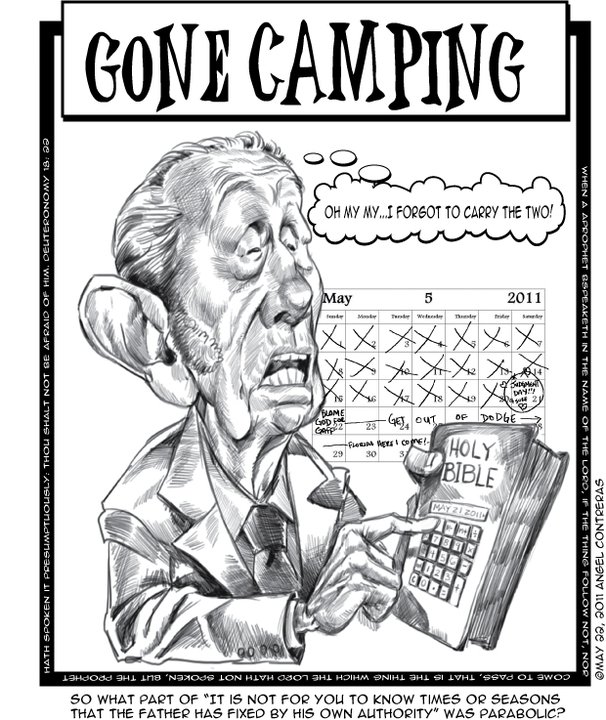
You may have heard that last week Harold Camping apologized for setting dates for the rapture. His bizarre application of civil engineer math geekiness to biblical hermeneutics misleads him to believe he could calculate the date of the rapture and the final judgment (See Robert Godfrey’s posts on Camping parts 1, 2, 3, 4 and 5). Strike one was back in 1994—No rapture. Camping discovers his miscalculation, and revises his date to May 21, 2011, which is also to kick off five months of judgment apparently in the form of rolling earthquakes that were to begin at a certain time of day all around the globe. Perhaps you noticed the billboards in some parts of the country, but most of you will recall the media attention given to it in the weeks leading up to Camping’s second date. May 21, 2011 comes and goes: strike two! Upon this failure, he claims that the rapture really did happen, but it was a spiritual rapture, and that a spiritual judgment has begun which will culminate in the complete end of the world all at once on October 21, 2011. Nothing. Strike three and you’re out, Harold Camping! In the stressful aftermath of this publicly humiliating fiasco, which brought much grief, consternation, and in some parts of the world, persecution, Camping suffers a stroke, and he is removed from regular broadcasting on Family Radio. I don’t know if the strike was brought on by the stress of the events, but a stroke he suffered, nonetheless.
Now that he’s had time to recover, this past week, Camping posts a letter on the Family Radio website apologizing for his “sin” of setting dates (read the letter here). In some ways it is an impressive statement. I was particularly moved to see his state in no uncertain terms that those of us who harped on Jesus’ words that “no man will know the day or hour” were right, and that he was wrong:
…we now realize that those people who were calling our attention to the Bible’s statement that “of that day and hour knoweth no man” (Matthew 24:36 & Mark 13:32), were right in their understanding of those verses and Family Radio was wrong. Whether God will ever give us any indication of the date of His return is hidden in God’s divine plan.
But this candid concession and apology was not good enough for Dan Elmendorf, former Family Radio broadcaster and now founder of Redeemer Broadcasting. In his weekly program, “A Plain Answer,” Elmendorf reminds us that the sin of date-setting was the least of Camping’s doctrinal problems. Absent from Camping’s open letter is any expression of repentance for having called on Christians to leave organized churches in which the gospel is preached and the sacraments of baptism and the Lord’s Supper are administered under the oversight by elders with the authority of exercising church discipline on members whose lives are persistently refusing to conform to a biblical standard of holiness and obedience to Scripture. Apparently, Camping still believes, and would have his listeners believe, that “the church age has ended.” So, it’s not that Camping has repented of the more heretical nature of his controversial “ministry.” I recommend that you listen to Elmendorf’s program, the first segment of which addresses Camping’s “weak apology.” The host shares some insight and experience which you can’t get from the Associated Press stories.
The Schuller’s Take Their Ball and Leave
In another recent instance of heresy in the headlines, it is reported that the entire family of positive-thinking televangelist, Robert Schuller, are leaving Crystal Cathedral Ministries. The 85 year-old Schuller, having retired from weekly “ministry” in 2009, was succeeded by his daughter, Sheila Schuller Coleman. According to the LA Times, Coleman announced this past Sunday that she will leave the Crystal Cathedral to start a new church citing a “hostile working environment” stemming from a growing divide between the Schuller family and the Crystal Cathedral’s board of directors. Robert Schuller and his wife applaud Coleman’s decision, but announce they will not be joining her at her new church, and that their plans for weekly worship are not yet finally decided. They will not, however, have any further public association with the work of the Crystal Cathedral and it’s broadcast The Hour of Power, started by Robert Schuller back in 1970. It seems that all positive (as opposed to “good”) things must come to an end. In my humble opinion, this end has been long overdue.
How to make Joel Osteen nervous
Ask him a politically-charged question about biblical sexual morality.
It’s good that Joel was able to get what he’s bound to believe out of his mouth. He would do well to work toward not only believing these things, but also ministering these truths in the way Paul advised Timothy in 2 Timothy 4:1-5, which reads,
I charge you in the presence of God and of Christ Jesus, who is to judge the living and the dead, and by his appearing and his kingdom: preach the word; be ready in season and out of season; reprove, rebuke, and exhort, with complete patience and teaching. For the time is coming when people will not endure sound teaching, but having itching ears they will accumulate for themselves teachers to suit their own passions, and will turn away from listening to the truth and wander off into myths. As for you, always be sober-minded, endure suffering, do the work of an evangelist, fulfill your ministry.
For the record, according to Joel Osteen, he believes that the Bible teaches the following:
“You shall not lie with a male as with a woman; it is an abomination” (Leviticus 18:22).
“If a man lies with a male as with a woman, both of them have committed an abomination…” (Leviticus 20:13).
“…and the men likewise gave up natural relations with women and were consumed with passion for one another, men committing shameless acts with men and receiving in themselves the due penalty for their error”(Romans 1:27).
“…just as Sodom and Gomorrah and the surrounding cities, which likewise indulged in sexual immorality and pursued unnatural desire, serve as an example by undergoing a punishment of eternal fire” (Jude 1:7; cf. Gen. 19).
But this next passage shows Joel should have also qualified his initially reassuring assertion to Oprah that “I think [homosexuals] will [go to heaven].” He does clarify that “they need forgiveness of their sins,” but this was an attempt to evade putting the two together until Oprah had to pull it out of him in uncertain terms. In this, he sounds nothing like the apostle Paul, whose inspired assertion is much clearer:
“Or do you not know that the unrighteous will not inherit the kingdom of God? Do not be deceived: neither the sexually immoral, nor idolaters, nor adulterers, nor men who practice homosexuality, nor thieves, nor the greedy, nor drunkards, nor revilers, nor swindlers will inherit the kingdom of God” (1 Corinthians 6:9-10).
Fortunately for homosexuals who repent and for Joel Osteen, Paul goes on in verse 11 to proclaim:
“And such were some of you. But you were washed, you were sanctified, you were justified in the name of the Lord Jesus Christ and by the Spirit of our God” (1 Corinthians 6:11).
It is the desire of every loving, right-minded Christian that the homosexuals should, by the grace of the Spirit of God,
- believe the good news of forgiveness through the sinless life, atoning death and enlivening resurrection of the Lord Jesus Christ, and so be justified through faith alone…
- repent of his sins, including the sin of homosexuality…
- be washed clean in the waters of baptism…
- learn to obey all that Christ taught, including his and his apostles’ teachings on sexual morality. Or, as Paul put it above “[be] sanctified.”
Short of this, the regrettable fact remains that the homosexual, as well as the sexually immoral, the idolater, the adulterer, the thief, the greedy, the drunkard, the reviler and the swindler, among other kinds of sinner, will not inherit the kingdom of God.
“Fundamental of all true religion”

“Master, which is the great commandment in the law? Jesus said unto him, Thou shalt love the Lord thy God with all thy heart, and with all thy soul, and with all thy mind. This is the first and great commandment. And the second is like unto it, Thou shalt love thy neighbour as thyself. On these two commandments hang tall the law and the prophets” (Matthew 22:36-40 KJV).
“These two commandments include the substance of the whole moral law, which is fundamental to all true religion. They include the whole natural law, which was originally written in the heart of man; the obligation of which can never be dissolved, and which all the revelations of God are founded on, and designed to enforce.”
Commentary by Rev. John Brown of Haddington from The Self-Interpreting Bible 1859.
Theology, Ethics and . . . What?

I am currently reading Michael Horton’s Thanksgiving post at Out of the Horse’s Mouth (the White Horse Inn blog), “Joining the Thanksgiving Parade.” In his introduction, he brings up a famous quote–sort of a theological proverb. Here’s Horton’s words:
The Heidelberg Catechism, in fact, is structured in terms of Guilt, Grace, and Gratitude, leading G. C. Berkouwer to conclude, “The essence of theology is grace; the essence of ethics is gratitude.” Or, as we have say around here, duties (imperatives) are always grounded in gospel promise (indicatives). The appropriate response to a gift is thankfulness. (emphasis mine)
In light of this reminder, I simply have a question for students of Reformed theology in general, and the Heidelberg Catechism in particular:
- If grace is the essence of theology, and gratitude is the essence of ethics, then guilt is the essence of what?
Please submit your answers in the comments thread.
May the grace of God in Christ crucified and risen to atone for your guilt inspire much gratitude in you this Thanksgiving!
Sermon Notes: “Invited to the Supper” (Matthew 22:1-14)

The following sermon was preached by Rev. Joe Troutman at Mid-Cities Presbyterian Church in Bedford, Texas. Listen online or subscribe to the podcast.
God calls all to repent and believe and many refuse, but others believe and are welcome to the feast.
The parable of the wedding feast is the third parable of judgment spoken by Jesus on the week leading to his crucifixion. While the first two primarily targeted the Pharisees, Saducees and Jewish priesthood, this parable applies to all in the nation of Israel who do not follow Christ in faith, but are guilty of rebellion against God.
God will judge everyone who refuses to repent and believe, but will show mercy by bringing to himself repentant believers who had not previously been associated with his covenant people.
Rejection of the Call (Matthew 22:1-7) And again Jesus spoke to them in parables, saying, “The kingdom of heaven may be compared to a king who gave a wedding feast for his son, and sent his servants to call those who were invited to the wedding feast, but they would not come. Again he sent other servants, saying, ‘Tell those who are invited, “See, I have prepared my dinner, my oxen and my fat calves have been slaughtered, and everything is ready. Come to the wedding feast.”’ But they paid no attention and went off, one to his farm, another to his business, while the rest seized his servants, treated them shamefully, and killed them. The king was angry, and he sent his troops and destroyed those murderers and burned their city.
- The setting of the parable of the wedding feast is a feast thrown in a kingdom by the king for his son.
- It was customary to send invitations with the expectation of a response of intention to attend, followed by a second call—an announcement that the meal is now ready, and that those invited are to now come to the feast.
- Historically it was often a crime for those who promise to attend to then refuse to do so.
- Jesus’ parable portrays an absurd exaggeration of this scenario.
- In verses 5 and 6, the rejection of the invited guests evidences their ingratitude: some ignored the servant sent to call them, others mistreated and killed him, just as the Israelites always did the Old Testament prophets.
- In verse 7, the king is rightfully angry and sends troops to kill the invited guests and burns down their city.
- The guests reflect what Israel had been doing to God for generations. The king’s judgment in the parable reflects the wrath to come both in AD 70 and the Final Judgment upon Christ’s return.
Invitation to All (Matthew 22:8-10) Then he said to his servants, ‘The wedding feast is ready, but those invited were not worthy. Go therefore to the main roads and invite to the wedding feast as many as you find.’ And those servants went out into the roads and gathered all whom they found, both bad and good. So the wedding hall was filled with guests.
- In verse 8, the food is made ready.
- In verse 9, the servants are sent to anyone who will come, who demonstrate a faith not found among the invited guests, as the Centurion whose servant Jesus healed in Matthew 8, of which Jesus said “Truly, I tell you, with no one in Israel have I found such faith I tell you, many will come from east and west and recline at table with Abraham, Isaac, and Jacob in the kingdom of heaven, while the sons of the kingdom will be thrown into the outer darkness. In that place there will be weeping and gnashing of teeth” (Matthew 8:10-12).
- Throughout all of the Scriptures, one plan of salvation is revealed: both Jew and Gentile must have faith in the Messiah of Israel. Just as Old Testament Judaism sometimes included Gentiles, so Christianity does not exclude all Jews—for example, first century Christianity was largely Jewish—but all who respond to the invitation are welcome to the wedding feast.
- Thus the invitation in the parable is what is expressed in the Westminster Shorter Catechism (Q&A 31) as “the free offer of the gospel.”
- The church offers salvation to all—God sorts out those who respond from those who do not respond. The church gives a general call which may be rejected or falsely received. The Holy Spirit gives an effectual call by which those who respond will necessarily be saved.
Responsibiltiy (11-14) “But when the king came in to look at the guests, he saw there a man who had no wedding garment. And he said to him, ‘Friend, how did you get in here without a wedding garment?’ And he was speechless. Then the king said to the attendants, ‘Bind him hand and foot and cast him into the outer darkness. In that place there will be weeping and gnashing of teeth.’ For many are called, but few are chosen.”
- The king of the parable goes in disguise to inquire of one who attends the wedding feast without a wedding garment, and throws him out into outer darkness.
- The wedding garment represents the fruit of faith: grateful, obedient works.
- In the local church, all respond to the call to worship, but not all truly believe, evidenced by a life of unrepentant disobedience. Thus, some in the local church will be found to be without their “wedding garment.”
- In verse 14, God’s choice is shown to be the ultimate factor. If God doesn’t effectually call his chosen, all would refuse to come as the invited guests at the beginning of the parable, and as the citizens of Israel who will not have Jesus to be their Messiah.
- Though many be called, few are chosen. True believers must humbly and charitably receive all who profess faith in Christ, they must not proudly exclude those who differ on non-essentials, as if they belonged to the one true church.
- There is a visible church comprised of all professing believers (all who have responded to the general call), and there is an invisible church comprised of the elect (all brought effectively to Christ by the Holy Spirit’s effectual call).
- Thus, church membership alone is not saving; renewal of the heart by the Holy Spirit to repent and believe is necessary.
- Without faith, there is no hope. With faith comes true membership in the invisible church, which the parable portrays by those who come to the wedding feast wearing their wedding garment.
Was Martin Luther Anti-Semitic?

November 10th was the 528th birthday of Protestant Reformer, Martin Luther. The Lutheran radio show, Issues, Etc., hosted by Todd Wilken, interviewed Uwe Siemon-Netto of the League of Faithful Masks, and author of The Fabricated Luther, about the popular notion that the writings of Martin Luther which were critical of the Jews were in fact part of the source of the twentieth-century Nazi form of anti-Semitism. I will attempt to summarize Siemon-Netto’s explanation and defense of Martin Luther.
Some of Martin Luther’s writings from late in his ministry certainly do not match the political-correctness of modern Western civilization, but they are hardly the source of Nazi sentiment against the Jews. For starters, late in his life, Luther was wracked with physical pain and illness, which took a serious toll on him. Psychologically, people under such severe physical and emotional stress are prone to give expression to ideas which they otherwise would not. Luther’s earlier writings were are more affirming and caring, urging the evangelization of the Jews.
In sixteenth century Germany, it was still a civil crime to commit blasphemy against the Christian God. Thus, the Jews’ denial of Christ was legally categorized as a violation of German blasphemy laws. While today, Western civilization considers blasphemy laws unjustifiable, we must not judge a man anachronistically when he is seen acting consistent with the context of his own generation.
Luther’s statements critical of the Jews had been, right or wrong, suppressed by the Lutheran church due to their recognition that they reflect something other than theologically Lutheran attitude. These writings were recovered and misused by proponents of the Volkisch movement which promoted pre-Christian pagan ethnocentricity and Romantic nationalism, among other influences. Their racist views are projected back onto Luther and unjustly point to him as a primogenitor of their own views when they were actually engaging in public relations to popularize their own peculiar views.
These days, when people find how the Nazis and other German anti-Semites utilized quotes by Martin Luther, it is easy to come away assuming Luther was anti-Semitic in a manner comparable to Nazi Aryanism. Todd Wilken asked Uwe Siemon-Netto to put in a nutshell what he would recommend as a helpful response and defense of Martin Luther in the light of such assumptions. Siemon-Netto explained as follows:
A) The entire Lutheran church rejected Luther’s statements that were critical of Judaism;
B) What Luther wrote against the Jews in his later life was un-Lutheran as compared with his earlier writing on the same subject;
C) Luther was fallible, and made egregious mistakes—an admission made by Martin Luther probably more than anyone else.
News Flash: Mormonism is not Christianity
Evang elicalism is so desparate to be liked by the world, they will seemingly latch onto anything or anyone of any notoriety whatsoever with whom (or which) they find some sort of commonality. Especially if it involves movies or television. A few years ago, evangelical Protestants proclaimed Roman Catholic Mel Gibson’s movie version of a mystic nun’s vision of The Passion of the Christ as the greatest evangelistic tool since Billy Graham. Nowadays, they are opening wide their church doors and their pulpits and plexiglass lecterns to the Mormon with a compelling “testimony” of deliverance from alcoholism who found near-Oprah-like success on FOXNews Channel as one of the leaders of the Tea Party Movement, Glenn Beck.
With the purchase of the old campus of Gateway Church in Southlake, Texas, I’m sad to admit that Glenn Beck is now a neighbor of mine. One of the down sides of this is that Beck will be, and indeed, has already been, welcomed into the evangelical churches of my community to blur the lines between biblical Protestant Christianity and the false religion of Mormonism. A recent episode of the Lutheran radio show, Issues, Etc., features the recording of Glenn Beck’s recent “sermon” delivered at High Point Church in Arlington, Texas where he not only confuses the Kingdom of God and the kingdom of man by speaking on America’s need to stand by the nation of Israel in their ongoing conflicts in the Middle East (a position with which I generally agree), but he confuses the Kingdom of God with the kingdom of Satan as a local evangelical church applauds a Mormon as he “testifies” that “the Lord Jesus Christ is [his] Savior and Redeemer.”
I’m glad I turned off Glenn Beck long before he ever started preaching American civil religion to his politically conservative viewers. What 60 years ago was called New Evangelicalism, fundamentalists of various denominations who sought the lowest common denominator for a semblence of “unity,” has become the New Liberalism, as they allow members of non-Christian religions to preach in their ostensibly “Christian” megachurch pulpits to seek the lowest common denominator with heresy.
Pray for repentance and Reformation for any and all churches that call themselves Christian. While you’re at it, read Arlington, Texas-based Watchman Fellowship’s “Fast Facts on Mormonism,” and do not attend if Glenn Beck appears at your church some Sunday morning in the not-to0-distant future.
Union with Christ and Justification
Happy Reformation Day! October 31, 2011 marks the 494th anniversary of the legendary event considered the spark that ignited the Protestant Reformation when Augustinian monk, Martin Luther, nailed the Disputation on the Power and Efficacy of Indulgences(commonly known as the 95 Theses) to the door of the castle church in Wittenberg, Germany in 1517. In the years that followed, Luther lead the movement to reform the church’s understanding of what the Bible teaches about the doctrine of justification by God’s grace alone, received through faith alone, in Christ alone, according to Scripture alone, to the glory of God alone. The Lutheran tradition would build on Luther’s work on justification, and they placed it at the center and starting point of all of the benefits of the redemption purchased
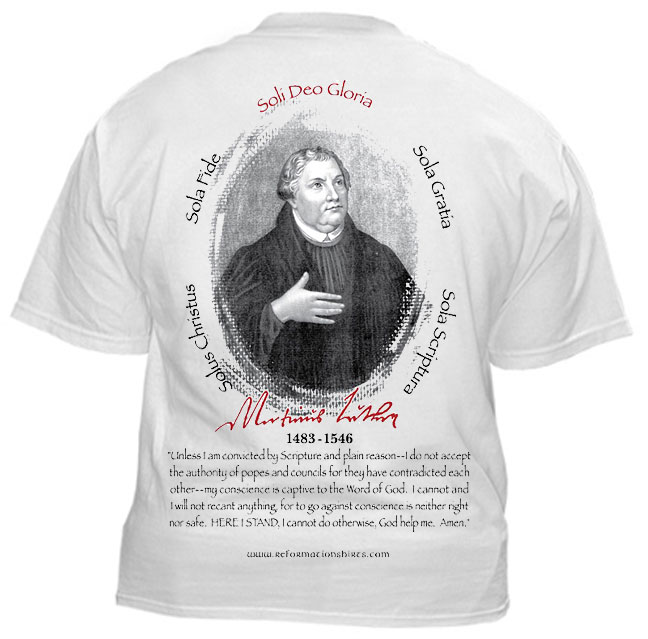
Purchase your Martin Luther T-Shirt from ReformationShirts.com
by Christ for his people. But biblical reformation of soteriology didn’t end with Luther and the Lutherans. The Reformed movement also grew alongside of the Lutheran movement, and while both were co-belligerents against the Roman doctrines of justification and the other benefits of redemption in Christ, they differed on the most biblical way to systematize these truths.
Friday on the Reformed Forum’s podcast, Christ the Center, Camden Bucey, Jim Cassidy and Jeff Waddington interviewed Dr. Lane Tipton, the new Charles Khrae Professor of Biblical and Systematic Theology at Westminster Theological Seminary in Philadelphia, Pennsylvania. Dr. Tipton was allowed two hours to spell out the differences between the Lutheran and Reformed approaches to justification and many current issues related to this essential aspect of Protestant theology, such as whether Dr. Michael Horton’s academic work on the subject is moving Reformed theology toward a more Lutheran, and therefore,according to Dr. Tipton, semi-Pelagian doctrine of justification. Listen to the podcast at this link.
I was introduced to Reformed theology by Michael Horton’s materials and the Lord used his parachurch ministries Christian United for Reformation (CURE) and the Alliance of Confessing Evangelicals (ACE) and the White Horse Inn radio show to gradually bring me around to embrace it. I will certainly be looking forward to a future Christ the Center program in which Dr. Horton responds to Dr. Tipton’s characterization of his work on justification and the other benefits of redemption in Christ. More public dialogue on this ought to take place, IMHO. At this point, Dr. Tipton’s case sounds convincing and more in line with the Reformed confessions and catechisms, as opposed to Dr. Horton’s efforts to, as I once heard him state on the air, build a kind of ecumenism between Reformed, Lutheran and Anglican traditions. I can see how some synthesis may be taking place in that effort. But what do I know?
Reformata, Semper Reformanda!
My Favorite Sport!

Rangers Ballpark in Arlington, home of the Texas Rangers
I’m one of those especially unfortunate fellows who grew up with a love-hate relationship with sports. I played several sports on several little league teams as a child, and played plenty of sports in the streets of my neighborhood. My lack of skill then is probably the chief reason I do not follow sports today, although I do tend to catch the Super Bowl, mostly for the commercials. My new membership in a Reformed church and their biblical and confessional (we view these two adjectives as synonymous) emphasis on delighting in the Lord on the Lord’s Day may have implications for the Super Bowl in the future. All I can say is, thanks be to God for digital video recording.
In light of my lack of interest in sports, I am fond of informing folks that “my sports are politics and religion,” which probably tells people I can relate even less to them, when they may already see me as a socially challenged individual who doesn’t follow sports. It is for this reason that you may not be surprised by my interest in the following lecture series that was held at Christ Reformed Church (URCNA) in Washington, D.C., called “Christianity & Politics,” which is yet another venue for the Westminster Seminary California faculty and alumni, among others, to focus our attention on their attempt at recovering the Reformed notion of the Two Kingdoms approach to the relationship between “Christ and Culture.” A timely offering in this year of presidential politics.
Here’s their introduction to the series, speaker bios and links to the lectures:
Why We Confuse Church & State
Separation of church and state?
Whatever you may think of the contemporary application of our first amendment freedom of religion, Christianity and politics are ever confused in our national consciousness. Preachers seek influence in the political sphere; politicians manipulate and calculate the faithful in their constituencies.
What are the faithful to do? How should we understand our callings as citizens, both on earth below and in heaven above?
Christianity & Politics presents a range of speakers approaching this topic from a range of perspectives while discussing topics as diverse as the mission of the church, the place of evangelicals in American political culture, natural law, and the spirituality of the church.…
Lectures [were] sponsored by Christ Reformed Church, and [took] place in our place of worship, historic Grace Reformed Church, home of President Theodore Roosevelt….
Speakers
MICHAEL HORTON is the J. Gresham Machen Professor of Systematic Theology and Apologetics at Westminster Seminary California, Host of the White Horse Inn radio program and Editor-in-Chief of Modern Reformation magazine. He is a minister in the United Reformed Church.
MICHAEL GERSON is an opinion writer for the Washington Post and former head speech writer and senior policy advisor to President George W. Bush.
DARRYL HART is Assistant Professor of History at Hillsdale College, author of numerous books, and blogs on religion and public life at oldlife.org.
TERRY EASTLAND is the Publisher of The Weekly Standard and an elder at Fourth Presbyterian Church in Bethesda, Maryland.
BRIAN LEE is the pastor of Christ Reformed Church in Washington, DC (United Reformed Church). He is a Guest Faculty at Reformed Theological Seminary and formerly worked on Capitol Hill, the National Endowment for the Humanities, and the Department of Defense.
DAVID VAN DRUNEN is the Robert B. Strimple Professor of Systematic Theology and Christian Ethics at Westminster Seminary California. He is a minister in the Orthodox Presbyterian Church and holds a Law Degree from Northwestern University School of Law.
DAVID COFFIN is the Senior Pastor at New Hope Presbyterian Church in Fairfax, Virginia.
Audio
Michael Horton
The Great Commission (Sermon on Matthew 28)
The Great Commission and Social Justice — (Q&A Session)
Michael Gerson, Darryl Hart, Terry Eastland
The Future of Evangelical Politics (roundtable discussion)
Brian Lee
The Primacy of “Church” in “Church & State” (Sermon on Romans 12)
“Govern Well?” or “Be Governed”? — (Q&A Session)
David VanDrunen
Natural Law and Christian Politics — (Q&A Session)
David Coffin
The Biblical Doctrine of the Spirituality of the Church (Sermon on John 18)
The Historical Doctrine of the Spirituality of the Church — (Q&A Session)
Activism or Confessionalism?

Ever watched Adult Swim’s Moral Orel? It’s like a spoof of Davey and Goliath, and serves as a platform for heavy-handed satire of the moralistic idiosyncrasies of some Christians. Most Christians would find it distasteful to watch, although it probably reflects more truth than our kind are willing to admit—when it isn’t’ caricaturing moralistic Christianity.
Upon watching a few clips of this show and seeing just how much they make it look like an edgy version of Davey and Goliath, I was reminded that this show isn’t only a satire of politically Right-wing Christians, but can step on the toes of liberal Christians as well. The fact is that Davey and Goliath was a production of the Evangelical Lutheran Church in America, a theologically liberal denomination of Lutherans despite the presence of the word “Evangelical” in their name. But it is also true that a generation or more of conservative fundamentalists and evangelicals were raised loving Davey and Goliath and being conditioned to liberal forms of moralism. This must be a small reason why moral and social do-good-ism is an example of common ground shared by today’s conservative culture warriors and liberal progressives. The development of the contemporary political spectrum among Western Christians has a long and storied past, involving the influence of eschatology, pietism and revivalism among other things. These influences raise a question, the answer to which we may find instructive.
“On which is it better for the Christian church to focus her efforts:
civic moral activism, or her own doctrine and practice?”
I submit the following:
- Organized religious efforts toward civic moral activism are derived from a fundamentally utopian vision of eschatology and therefore society, and generally tends to minimize doctrine and practice.
- Organized religious efforts to maintain the purity of each denomination’s own doctrine and practice are drawn from a fundamentally realistic vision of eschatology and therefore society, and generally tends to minimize organized religious civic moral activism.
What’s eschatology got to do with it?
- An Augustinian interpretation of the millennium shared in its broadly among Roman Catholic, Lutheran and Reformed branches of Christendom
- The Roman Catholic version promoted medieval Constantinianism (church over state).
- Lutheran and Reformed reformed amillennialism, tended to focus on doctrine and practice (confessionalism), but had little opportunity to engage in organized religious civic moral activism as we know it today.
- Post-Reformation Protestant Europe replaced Constantinism with ecclesiastical establishmentarianism (state over church); Confessional Protestants complied, affirmed the state’s role in defending the church from heresy, and theoretically denied the state’s right to affect church’s doctrine.
- Twentieth/Twenty-first century Reformed Amillennialism of three varieties (at least): Kuyperian, Two-Kingdom and Theonomic (aka, “Dominionist”)
- An “over-realized” (or utopian) form of amillennial eschatology
- Tended to engage in organized religious civic moral activism
- Held by theologically liberal progressives as well as fundamentalists in the early 20th century.
- Twentieth/twenty-first century Reformed Postmillenialists of two varieties (at least): Kuyperian and Theonomic.
Premillennialism
- Anabaptist eschatology (Anabaptism a non-Roman Catholic version of medieval monastic mysticism)
- Tended to retreat from society and thus avoided both organized religious and individual civic moral activism.
- Adopted by fundamentalist Protestants during the bulk of the 20th century in reaction against theologically liberal Postmillennialists.
Two religious trends add complexity to the preceding eschatological and social tendencies: Pietism and Revivalism:
- Lutheran deviation
- Focused on personal piety, neglected doctrine and practice
- An essentially Wesleyan trend adapted by Calvinists (Reformed); partly inspired by Pietism.
- Focused on individual conversion and piety and promoted organized religious civic moral activism.
Conclusion
- It is better for the church to focus on maintaining the purity of her own doctrine, piety and practice, and to leave civic activism (moral or otherwise) to the individual.
- Thus, I find that an Amillennial, Confessional Protestantism that is relatively uninfluenced by pietism and revivalism is the ideal approach for the Christian church.
The preceeding is my attempt to organize the many things I’ve been learning over the years regarding the development of modern American Protestant confessionalism, liberalism, fundamentalism and evangelicalism. This being merely a blog post, and not an academic essay, those of you who are more informed on these issues are invited to critique my bullet points for the sake of accuracy. Those readers for whom the above raises questions or critical comments, these are especially welcome. You sharpen my iron, I’ll sharpen yours!
The Problem of “Head Knowledge”

Image via Wikipedia
One topic I haven’t treated nearly enough lies ironically at the heart of the underlying theme of my blog, which theme is an expression of my experience as a fundamentalist turned confessional Reformed Protestant. The topic is the tension in the fundamentalist and evangelical movements between so-called “head knowledge” and “heart knowledge.” Having been too busy living amidst that tension for the past couple of decades, I haven’t done a great deal of blogging about it since I started this blog.
To be truthful, this blog’s title and theme, “The Misadventures of Captain Headknowledge” is both an indictment and a confession. It’s an indictment for the kind of reason that you may have already read about on my “About Me” page. The confession lies in my honest recognition that I am the sort who has the tendency to, as it is sometimes put, read about the Bible, rather than actually take time to read the Bible.” This is certainly a flaw which stunts my spiritual growth in sanctification and the grace and knowledge of the Lord Jesus Christ. To the extent that my blog is a personal confession, it reminds me to cultivate my own spiritual growth. In the past, I was made to feel that many think this means I must therefore utterly repent of and entirely forsake my tendency to “read about the Bible.” But I disagree, and this is where the indictment part comes in. I regard that attitude to be an overreaction to an otherwise valuable gift of God. A love for reading theology and related Christian literature must not supersede my personal study and application of Scripture, but it needn’t be excluded from my life, either. Old Princeton scholar, Benjamin Breckenridge (B.B.) Warfield has the ultimate quote on this issue, from his book, The Religious Life of Theological Students (P & R Publishing Co.):
Nothing could be more fatal, however, than to set these two things over against one another. Recruiting officers do not dispute whether it is better for soldiers to have a right leg or a left leg: soldiers should have both legs. Sometimes we hear it said that ten minutes on your knees will give you a truer, deeper, more operative knowledge of God than ten hours over your books. “What!” is the appropriate response, “than ten hours over your books, on your knees?” Why should you turn from God when you turn to your books, or feel that you must turn from your books in order to turn to God? If learning and devotion are as antagonistic as that, then the intellectual life is in itself accursed, and there can be no question of a religious life for a student, even of theology. HT: Hot Orthodoxy
Such an imbalanced rejection of academic theology as unnecessary or unhelpful “head knowledge” in favor of so-called “heart knowledge” in its extreme forms often seems little more than an individualistic, experiential mysticism. In his book, What is Faith?, J. Gresham Machen writes on the question of anti-intellectualism and the resultant mysticism against which this blog is in part an indictment:
The depreciation of the intellect, with the exaltation in the place of it of the feelings or of the will, is, we think, a basic fact in modern life, which is rapidly leading to a condition in which men neither know anything nor care anything about the doctrinal content of the Christian religion, and in which there is in general a lamentable intellectual decline. (What is Faith?, p.28)
But if theology be thus abandoned, or if rather (to ease the transition) it be made merely the symbolic expression of religious experience, what is to be put into its place?… Mysticism unquestionably is the natural result of the anti-intellectual tendency which now prevails; for mysticism is the consistent exaltation of experience at the expense of thought. (p.35)
The Son of Man Coming on the Clouds
When I was a child, and a member of a Dispensational Premillennial IFB church, I would often hear my pastor commenting on any given Sunday, “It’s cloudy today—this might just be the day the Lord returns.” At other times, he would conclude the opposite: “I didn’t notice any clouds in the sky, so I guess the Lord may not return today. But this is Texas, and the weather could change at any moment.” The literal presence of clouds in the sky was seen as a necessary condition of Christ’s Second Coming. Why is this? It’s because of the Lord’s words in Matthew 24:30.
Then will appear in heaven the sign of the Son of Man, and then all the tribes of the earth will mourn, and they will see the Son of Man coming on the clouds of heaven with power and great glory.
(Matthew 24:30 ESV)
Was Jesus predicting that on the day of his return, it will literally be cloudy? No, Jesus was alluding to a prophecy by Daniel of the coming of “one like a son of man” who comes “with the clouds of heaven.” What would be the point of predicting whether it would be cloudy on the day of the coming of the Son of Man? Let’s look at Daniel’s prophecy to which Christ alludes (the key phrases will be highlighted):
“I saw in the night visions,
and behold, with the clouds of heaven
there came one like a son of man,
and he came to the Ancient of Days
and was presented before him.
And to him was given dominion
and glory and a kingdom,
that all peoples, nations, and languages
should serve him;
his dominion is an everlasting dominion,
which shall not pass away,
and his kingdom one
that shall not be destroyed.
(Daniel 7:13-14 ESV)
The first thing to notice is the fact that this prophecy contains poetic language. That’s why the ESV editors (and those of most modern English versions) format the prophecy in a poetic style. Ancient Hebrew poetry does not have the same standards for literalism as historical narrative does. It is true that the Gospel of Matthew is a historical narrative, and so it is literally true that Jesus quoted Daniel’s prophecy, but the prophecy Jesus quoted in this historical narrative Gospel account is still a poetic reference.
If the reference to clouds in association with the coming of the Son of Man bears poetic, symbolic meaning, then what might that meaning be? Let’s look at a few other poetic Old Testament passages that similarly associate clouds with the activity of Yahweh.
He lays the beams of his chambers on the waters;
he makes the clouds his chariot;
he rides on the wings of the wind;
(Psalm 104:3)
If we are to take Christ’s reference to coming with clouds literally, then are we also to take Psalm 104’s statement that the LORD makes the clouds his chariot literally? Does an infinite, omnipresent Spirit need to stand on a cloud, hold a set of reins and be transported by means of atmospheric water vapor? Well, has he also literally laid giant wooden beams across a body of water and built chambers in which he might dwell? Does wind literally have wings? Of course it doesn’t. This is nothing but poetic imagery. So, what idea does this imagery of clouds convey? Basically, it conveys the idea of God’s terrifying power and authority. Notice how the Egyptians and their idols react to the image of the LORD riding on a cloud in Isaiah 19:
An oracle concerning Egypt.
Behold, the LORD is riding on a swift cloud
and comes to Egypt;
and the idols of Egypt will tremble at his presence,
and the heart of the Egyptians will melt within them.
(Isaiah 19:1)
With these things in mind, let’s go back and take another look at Matthew 24:30: “Then will appear in heaven the sign of the Son of Man, and then all the tribes of the earth will mourn, and they will see the Son of Man coming on the clouds of heaven with power and great glory (Matthew 24:30).
I hope we can more clearly see now, that the significance of the coming of the Son of Man “on the clouds of heaven” lies in the fact of his terrifying power and great glory whose appearing will make all the tribes of the earth mourn, and at which time will occur the Last Judgment and the ultimate consummation of his Kingdom. This is just one of many examples of the need to genuinely take into account the literary structure of a passage in order to determine its proper interpretation.


 The Misadventures of Captain Headknowledge
The Christ of the Bible
HT: Cado Odac
Share this: