Persecution and Slander: Both Inexcusable
One of the most effective ploys to scare Arminians and moderate Calvinists away from Calvinism is to paint John Calvin as some evil, persecuting tyrant who reigned over a theocracy of his own making in Geneva, Switzerland–twisting the facts, and omitting many other facts relevant to the unfortunate episode that was the burning of anti-trinitarian heretic, Miguel Servetus. In the following video, Reformed apologist James White sets the historical record straight by simply listing related facts that Calvin’s critics never get around to presenting which sheds a whole new light on the incident.
Yes, Calvin was a man of his times, and the part he played in the execution of Servetus is not to be excused, however, Calvin’s 21st century critics are also men of their time, and it’s equally inexcusable to slander dead Reformers (or anyone else, for that matter).
YouTube Fundy vs. Calvinism
Steven L. Anderson, pastor of Faithful Word Baptist Church in Pheonix, AZ, has a very full YouTube page of videos featuring his preaching and teaching ministry. Some of the arguments made in some of the videos, it must be said, range from the average, to the illogical, to the hilariously absurd. StuffFundiesLike featured one of the more amusing ones (view it here), but Fundamentally Reformed once posted on one I’ve yet to see topped (view it here)! Compared to these two, the one I’m posting and commenting on today is rather ho-hum.
In this video, Pastor Anderson presents a few arguments from John 6 and John 15 against the doctrines of God’s foreordination of all things (Ephesians 1:11), predestination to salvation (Ephesians 1:5; Romans 9:23) and reprobation to condemnation (2 Peter 2; Romans 9:22).
Watch the video and interact with his arguments. I’m going to be out of town over the weekend and probably have little access to the internet. If you’re not familiar with the doctrines of Calvinism regarding the sovereignty of God over all things, even the salvation of sinners, feel free to ask questions. They’ll be welcomed and answered with gentleness and respect when I return, unless one of my Calvinist commenters is pleased to interact with you over the weekend (you know who you are–this is your cue!).
Here are the passages Pastor Anderson dealt with. View them for yourself and prayerfully examine their contexts and see the sovereign hand of a God who is not merely a one-dimensional “God of love” who is passive in the face of your sovereign self-determination, but “is love” and just at the same time.
“You did not choose me, but I chose you and appointed you that you should go and bear fruit and that your fruit should abide, so that whatever you ask the Father in my name, he may give it to you” (John 15:16)
“Jesus answered them, “Did I not choose you, the Twelve? And yet one of you is a devil.” He spoke of Judas the son of Simon Iscariot, for he, one of the Twelve, was going to betray him” (John 6:70-71; cf. Acts 1:16–indicating what Judas was actually chosen for).
“On” or “After”? Defending the Friday Crucifixion

Shrine in Church of the Holy Sepulchre
In case you didn’t perceive it in the light of my series on St. Patrick (which is still ongoing–stay tuned, true believer!), one of my pet peeves about the anti-traditional wing of Christianity is that they will deny the established, sound views on things seemingly for the sole reason of not being in agreement with Roman Catholicism. It may just be me, but that’s the way things look to me. One example of this is the two competing sites in Israel for which the claim is made that it is the genuine site of Calvary and Christ’s tomb. The Church of the Holy Sepulchre has the vote of all the ancient churches, be they Roman Catholic, Eastern Orthodox, Coptic, what have you. Then there’s the Garden Tomb (formerly Gordon’s tomb), for which the claim was not made until a nineteenth century Protestant made it against the prevailing established evidence which overwhelmingly supports the validity of the Church of the Holy Sepulchre. Speaking generally, many Protestants tend to prefer the Garden tomb because it doesn’t have a big, old medieval or Crusader-era church built on top of it, ruining the view.
In the realm of traditional biblical claims, the question of on which day of the week Christ died is divided between those who aren’t uncomfortable with historic, established, orthodox traditional views and those who are. I was reading the Wikipedia article on Good Friday yesterday (here’s the link), in which the Good Friday customs of various groups are outlined. After the ancient Eastern and Western groups are treated, naturally the historic Protestant customs are described, followed by a section entitled, “Other Protestant Traditions.” The second paragraph of this section reflects the tendency I’m addressing:
Some Baptist, Pentecostal and many Sabbatarian and non-denominational churches oppose the observance of Good Friday, instead observing the Crucifixion on Wednesday to coincide with the Jewish sacrifice of the Passover Lamb (which Christians believe is an Old Testament pointer to Jesus Christ). A Wednesday Crucifixion of Jesus Christ allows for Christ to be in the tomb (heart of the earth) for three days and three nights as he told the Pharisees he would be (Matthew 12:40), rather than two nights and a day if he died on Friday.
I think this paragraph does a good job of highlighting part of the reason for the debate: wooden literalism. Firstly, the desire is to make sure the crucifixion of the Lamb of God takes place at the precise moment the copies and shadows of the heavenly things are offered, as if it just couldn’t happen at any other moment. Secondly, just because Jesus used the language in this one exchange that in modern English vernacular corresponds literally to a seventy-two hour period, the rest of the Gospel references to when Christ rose must be interpreted in the light of this verse understood this particular way. Anything else is unacceptable to such interpreters. Again, the fear being agreement with Rome on something. The net result becomes that Jesus couldn’t have died on Friday because it wasn’t a “literal” three days and three nights. Only Catholics and those other denominations that retain more Roman Catholic like practices than we do would be so gullible as to agree with the Friday view of the crucifixion.
One of the most popular denials the anti-traditional interpreters make is the traditional appeal to the fact that in the first century Jewish idiom a “day” can refer to either part of a day, or the entire day. I’ve yet to hear a persuasive argument against this linguistic phenomenon out of those who hold the Wednesday view, I just hear the unbroken mantra of “three days and three nights.” In other words, it seems to me those who hold this view simply don’t want to be confused by facts because they’ve got their proof text and they’re sticking with it.
All I’d like to do is focus on the other Gospel passages that refer to when Christ would rise from the dead. They tend to fall into two categories: those that have Christ rising “on the third day,” and those that have Christ rising “after three days.”
If the Wednesday crucifixion were true, and Christ did lie in the tomb for a literal seventy-two hour period, then perhaps the “after three days” verses are preferable. These passages are Matthew 27:63; Mark 8:31; 9:31; 10:34. Here’s the first of Mark’s references, Mark 8:31–
“And he began to teach them that the Son of Man must suffer many things and be rejected by the elders and the chief priests and the scribes and be killed, and after three days rise again” (emphasis mine).
On the other hand, if Christ did die on Friday, spend Saturday in the tomb and rise before sunrise on Sunday morning, then this scenario is more easily reflected by the “on the third day” verses. These passages are Matthew 16:21; 17:23; 20:19; 27:64; Luke 9:22; 18:33; 24:7, 21, 46. Let’s use Luke’s final verse as an example, Luke 24:46–
“and said to them, ‘Thus it is written, that the Christ should suffer and on the third day rise from the dead . . . . ‘”
If life were simple and we could resort to a majority vote, the traditional view wins. But I know it’s not that easy. However, it is worthy of note that the time frame references that don’t explicitly reveal a seventy-two hour period outnumber the ones more favorable to the Wednesday crucifixion view. No wonder when the early church compiled the New Testament teachings of the apostles into creedal form, they used the language that favors the Friday crucifixion view:
I believe in God, the Father Almighty,
the Maker of heaven and earth,
and in Jesus Christ, His only Son, our Lord:
Who was conceived by the Holy Ghost,
born of the virgin Mary,
suffered under Pontius Pilate,
was crucified, dead, and buried;
He descended into hell.
The third day He arose again from the dead;
He ascended into heaven,
and sitteth on the right hand of God the Father Almighty;
from thence he shall come to judge the quick and the dead.
I believe in the Holy Ghost;
the holy catholic church;
the communion of saints;
the forgiveness of sins;
the resurrection of the body;
and the life everlasting.
Amen.
Love or Apostasy?

"Extra! Extra! Read all about it!"
Today’s headlines from the Daily Evangel, in the Evangelical News & Views section, includes Christianity Today’s interview with Rick Warren in which he clarifies some of the comments he made during his interview with Larry King on CNN Monday night (click on “Q & A: Rick Warren” in the sidebar). In my last post, I introduced the topic with the statement that “a couple of pastor Warren’s comments troubled me,” then I only blogged on one of them. The second thing was his announcement, as an example of what he calls “interfaith projects” (which he finds far superior to “interfaith dialogue”), that he would attend a Jewish Passover seder hosted by a rabbi friend of his, Elie Spitz. Spitz’s congregation is hosting a “community seder” (see this advertisement).
Larry King had sought a comment from Warren about President Obama’s recent comments regarding Islam in Turkey. Here’s the exchange:
KING: Obama has traveled to Turkey, first president to visit a Muslim country. He had this to say about the United States and Islam in a speech to Turkish parliament. Watch. I’d like you to comment.
(BEGIN VIDEO CLIP)
OBAMA: The United States is not and will never be at war with Islam. In fact, our partnership with the Muslim world is critical, not just in rolling back the violent ideologies that people of all faiths reject, but also to strengthen opportunity for all people.
(END VIDEO CLIP)
KING: What do you think of that?
WARREN: You know, I think that’s the exact right tone, Larry. There are 600,000 Buddhists in the world. There are 800,000 Hindus in the world. There are a billion Muslims in the world. There are 2.3 billion Christians in the world. You have to get along together. That’s why I speak with Jewish groups. I speak to Muslim groups.
We’re all human beings. We have to work on issues we don’t always agree on. I’m not really into what I call inter-faith dialogue. I think that’s a lot of wasted time. I’m interested in what I call inter-faith projects. In other words, I’m not going to convince a lot of people who have other beliefs to change their beliefs and vice versa. But we can work together on issues like poverty, disease, illiteracy and things that — problems common to all humanity.
This week, for instance, tomorrow night, I’m going to a Seder dinner with my dear friend Elie Spitz (ph), who is a local rabbi. We’ll celebrate Passover together. And then later in the work [week? jdc], I’ll do Easter, which is — they’re both all about redemption. My next door neighbor is Muslim. I traveled with him to the Middle East. We’re dear, dear friends. And there’s no reason — what people don’t seem to understand is that you don’t have to agree with everybody in order to love them.
In the CT interview, Warren elaborates on these remarks:
People see me out there — I speak to Muslim groups and Jewish groups, I’m actually having a Passover Seder tomorrow night. People never need to doubt why I do what I do, even when associating with people gets me in all kinds of hot water. Jesus got into hot water for the people he associated with. Fundamentalist groups say Warren hangs out with Jews and Muslims and gays and on and on. The point is, I’m not allowed to not love anybody.
With these words, Warren blurs the lines between loving people regardless of religion or lack thereof, which is of course appropriate, and worshiping with them. It’s not hard to distinguish between the two, yet Warren seems to see no distinction. The apostle Paul wrote in Romans 13:10, “Love does no wrong to a neighbor; therefore love is the fulfilling of the law.” However, in the book of Hebrews, the author of that letter warns Christians against engaging in the worship of unbelieving Jews (Hebrews 5:11-6:8). To do so, according to the author of Hebrews, is tantamount to apostasy. The elements of the Passover seder, like the Old Testament temple worship, are a “copy” and “shadow of the heavenly things” (Hebrews 8:5).
I submit that it is not unloving to refrain from worshiping with those who reject the gospel, while still living a life that does no harm to them. At the same time, I find that this announcement of participating in the copies and shadows of things fulfilled by the Lord Jesus Christ, in the context and company of those who deny his fulfillment of them, is just the logical conclusion of the kind of fuzzy thinking Warren engages in when he calls Roman Catholics and others who distort the gospel, “brothers and sisters in God’s family” (see my previous post).
 Dearly beloved, this type of activity on the part of Protestant (yes, I said “Protestant”) leaders is indicative of the spiritual decline in Christianity that I believe is linked to the kind of sociological decline reported on by Newsweek magazine. What American Christianity needs is a revival and a Reformation. It needs to regain the courage to be Protestant. I would ask you to consider the words of the Cambridge Declaration, a recent statement and call to reformation and revival prepared by the Alliance of Confessing Evangelicals. This statement is found on my “Creeds, Confessions, Catechisms and Statements” page, but here’s the link for your convenience.
The introduction to the Cambridge Declaration describes well the state of affairs and the need of the hour. Please consider them seriously:
Evangelical churches today are increasingly dominated by the spirit of this age rather than by the Spirit of Christ. As evangelicals, we call ourselves to repent of this sin and to recover the historic Christian faith.
In the course of history words change. In our day this has happened to the word “evangelical.” In the past it served as a bond of unity between Christians from a wide diversity of church traditions. Historic evangelicalism was confessional. It embraced the essential truths of Christianity as those were defined by the great ecumenical councils of the church. In addition, evangelicals also shared a common heritage in the “solas” of the sixteenth century Protestant Reformation.
Today the light of the Reformation has been significantly dimmed. The consequence is that the word “evangelical” has become so inclusive as to have lost its meaning. We face the peril of losing the unity it has taken centuries to achieve. Because of this crisis and because of our love of Christ, his gospel and his church, we endeavor to assert anew our commitment to the central truths of the Reformation and of historic evangelicalism. These truths we affirm not because of their role in our traditions, but because we believe that they are central to the Bible.
If not a Protestant, then what?
 Last night, Saddleback Church pastor, Rick Warren, was interviewed on CNN’s Larry King Live. A couple of pastor Warren’s comments troubled me. Here’s one them.
KING: OK. Do you think Christianity is slipping in America? That’s the front cover of “Newsweek,” out today. Quite a loss occurring in the Christian community. There you see the headline.
WARREN: Well, I would say it’s the best of times and the worst of times. First place, I don’t think that all of the questions that are asked in surveys are always as objective as they could be. For instance, if you ask people, are you a Protestant — and the number of Protestants has gone down dramatically in the last 30 years. I don’t even call myself a Protestant. (emphasis mine) (read the transcript here)
Rick Warren is not a Protestant? What in the world is he? I didn’t think he was the sort that claimed to be “post-evangelical” like the Internet Monk, or a proponent of the “emerging church.” Even though I spent over twenty years in Baptist fundamentalism which denied being Protestants (even though they really are) because of their commitment to a view of Baptist history called “Landmarkism” or Baptist Successionism, I seriously doubt this is the case with Rick Warren.
I searched around the web looking for an answer and the only real lead I could find was found at Apprising Ministries, a discernment ministry blog. One post carries the title, “Southern Baptist Pastor Rick Warren Corrects Martin Luther.” In this post, Warren is quoted as saying:
“Now I don’t agree with everything in everybody’s denomination, including my own. I don’t agree with everything that Catholics do or Pentecostals do, but what binds us together is so much stronger than what divides us,” he said. “I really do feel that these people are brothers and sisters in God’s family. I am looking to build bridges with the Orthodox Church, looking to build bridges with the Catholic Church,….”
It appears he’s willing to seek common ground with other segments of “Christendom” which deny the gospel of justification by grace alone through faith alone, because of Christ alone, according to Scripture alone, to the glory of God alone–the gospel of the Protestant Reformation. I’m sure Warren affirms this gospel personally, I’m sure he’s aware the Roman Catholic Church anathematized this very gospel at the Council of Trent and has never rescinded such a blasphemous stance. I wonder, however, if Pastor Warren cares. Here’s the link to Apprising Ministries’ category of posts on Rick Warren, if you desire to read more about his activity regarding the relationship between Protestantism and Catholicism.
Do any of my readers know any more about Rick Warren’s stance on Protestant identity? Has anyone ever heard him deny that he’s a Protestant before? I’m interested to learn more about how he categorizes himself.
Why Saint Patrick Was NOT a Baptist, part 3: Catholic Associations
 “Successionists admit, of course, that the name “Baptist” cannot be found in every period of the Christian era, but if a group dissented from the Roman Catholic Church and suffered for its nonconformity, successionists have been quick to cite such groups as baptistic proponents of biblical Christianity. In this way, ancient and medieval religious movements such as the Montanists, Novations, Patarenes, Bogomils, Paulicians, Arnoldists, Henricians, Albigenses, and Waldenses have been inducted into the line of “Baptist” succession. A few successionists have claimed that even St. Patrick was a Baptist” [McGoldrick, Baptist Successionism: A Crucial Question in Baptist History, (1994, Scarecrow Press), page 2].
Attempting to prove that Saint Patrick was a Baptist involves majoring on the lack of Roman Catholic ecclesiastical terms or references in the two surviving documents that were written by Patrick himself. A critical look at all of the relevant evidence and historical context of Patrick, however, indicates the very thing Baptist Successionists would have their followers deny. In McGoldrick’s words, “Patrick accepted the vocation of a missionary by submitting to the standard ecclesiastical authorities, who invested him with a commission and ordained him a clergyman” (McGoldrick, page 25).
The rest of this post will be McGoldrick’s survey of Patrick’s ecclesiastical associations, his training, ordination and ministerial service that clearly associates him with the Roman Catholic Church, and disassociates him from any notion that he was some sort of dissenter from Roman Catholicism.
“Ordination came in Gaul, where Patrick had gone to receive further instruction to prepare him for his life’s work. Patrick was in Gaul at a time when Bishop Germanus of Auxerre received a plea from Britain to come there to combat the spread of heresy. Germanus’ mission had the approval of Celestine, Bishop of Rome, and it appears that Germanus, with Celestine’s concurrence, dispatched Patrick to Ireland (See St. Patrick : His Writings and Muirchu’s Life, ed. And tr. A. B. E. Hood, [Totowa, NJ: Rowmand & Littlefield, 1978], page 13; John B. Bury, The Life of St. Patrick and His Place in History [Freeport, NY: Books for Libraries, 1971 reprint of 1905 edition], 51-54; cf. John Healy, The Life and Writings of St. Patrick (Dublin: Gill & Son, 1905], 109-16. Bury, a Protestant, and Healy, a Roman Catholic Archbishop, agree that patrick’s commission came through authorized Episcopal channels. Cf. the Venerable Bede, History of the English Church and People, ed. Leo Sherley. Price, rev. R. E. Latham [Baltimore: Penguin Books, 1968], 1. 17).
“Contrary to popular belief, Patrick did not introduce the Christian faith into Ireland. Several Christian communities existed there prior to his arrival, and when Celestine first sent an emissary to the Irish it was not Patrick but the newly consecrated Bishop Palladius. Beyond all doubt, Palladius went forth as a representative of the Roman bishop. However, his ministry in Ireland, was, for reasons not entirely clear, very brief. Patrick followed as the next bishop sent to Ireland, and he too went in the service of Rome ( Bury, Life of St. Patrick, 54-59).
“The occasion for sending a bishop to Ireland appears to have been identical to the reason for sending Germanus to Britain: to combat the heresy of Pelagianism. . . .
“Although the evidence is far from abundant, the documents that remain appear to confirm the view that Patrick ministered in Ireland somewhat in the same way that Germanus served in Britain. That is, he strove to defeat Pelagianism while seeking the conversion of pagans at the same time. Patrick was consecrated a bishop in 432 at the hands of Germanus, and Patrick’s writings contain a few passages that seem to be of an Augustinian character proclaiming salvation by grace.” (pages 25-26).
Equal in Creation and Redemption; Complementary in Role
 Yesterday on the Gender Blog for the Council on Biblical Manhood & Womanhood, Dr. Albert Mohler, president of Southern Baptist Theological Seminary responded to a USA Today op-ed column by Mary Zeiss Stange, professor of Women’s Studies and Religion at Skidmore College in Saratoga Springs, N.Y. The topic: of course, women’s role in church ministry. Considering her credentials, it’s easy to see that Stange is going to be an advocate of egalitarianism (look it up) between the sexes when it comes to church leadership. Dr. Mohler attempts to bring Stange’s, and the modern culture’s, basic worldview into focus, and he contrasts it with some basic comments regarding the biblical, complementarian (look it up), worldview of the roles of men and women in church life.
I realize that the world isn’t consciously fettered to the clear teaching of Scripture, and it should be no surprise that the world would attempt to budge the church from faithfulness thereto. The world does a very good job of it, across the board, when it has to try at all, and doesn’t find a church eager to join the world’s parade regardless of which direction it’s going. But I thought in the light of the present discussion on those other sites, I’d post Paul’s controversial restriction on women in church leadership from 1 Timothy 2. And I mean the whole, short chapter. As you read the chapter, notice first of all the redemptive basis of his restriction, then notice the Old Testament or creational basis of his restriction:
2:1 First of all, then, I urge that supplications, prayers, intercessions, and thanksgivings be made for all people, 2 for kings and all who are in high positions, that we may lead a peaceful and quiet life, godly and dignified in every way. 3 This is good, and it is pleasing in the sight of God our Savior, 4 who desires all people to be saved and to come to the knowledge of the truth. 5 For there is one God, and there is one mediator between God and men, the man Christ Jesus, 6 who gave himself as a ransom for all, which is the testimony given at the proper time. 7 For this I was appointed a preacher and an apostle (I am telling the truth, I am not lying), a teacher of the Gentiles in faith and truth.
8 I desire then that in every place the men should pray, lifting holy hands without anger or quarreling; 9 likewise also that women should adorn themselves in respectable apparel, with modesty and self-control, not with braided hair and gold or pearls or costly attire, 10 but with what is proper for women who profess godliness—with good works. 11 Let a woman learn quietly with all submissiveness. 12 I do not permit a woman to teach or to exercise authority over a man; rather, she is to remain quiet. 13 For Adam was formed first, then Eve; 14 and Adam was not deceived, but the woman was deceived and became a transgressor. 15 Yet she will be saved through childbearing—if they continue in faith and love and holiness, with self-control.
The redemptive basis of Paul’s restrictions on women in church leadership is found in verses five and six. Men and women share the same mediator. Elsewhere, in the context of roles in marriage, Peter instructs husbands to keep in mind that their wives are “heirs with [them] of the grace of life” (1 Peter 3:7). The same is true in this context. Christ died, not only for “kings, and all who are in high positions,” or just for Jews and men (meaning males), but he died for all kinds of people. He died for the powerful and the powerless; for the Jew and for the Gentile; and the Lord Jesus Christ is the sole mediator between God and humans of both sexes. It is instructive to note that the word “man” in verse five translates the same Greek word that is translated people in verses one and four. Christ didn’t just die for males, he died for males and females. It is first in the light of this fact, men’s and women’s equality in redemption, that Paul gives any instruction at all to anyone. For here is the source of life: the message of redemption in Christ. No other message will grant to men or women the grace to serve God according to his will. And any differentiation of roles between the sexes would certainly not last, if not for loving gratitude to the Lord for what he has done for men and women.
Secondly, notice Paul’s Old Testament, or creational, basis for his restriction on women in the church leadership role. This is found in verses thirteen and fourteen. Refer to the passage above for a refresher. Paul states two simple reasons. I might add that they are reasons that were “breathed-out,” or spoken, by God himself. Reason one: Women should not “teach” or “excercise authority over a man,” but are to “remain quiet” because of creational chronology. Adam was created first, and Eve was created second. The simple fact is that the biblical revelation of the creation of men and women included from the very beginning inherent complementarian roles. Moses clearly writes that the woman was created to be “a helper fit (or corresponding) to him” (Genesis 2:18). Paul does not elaborate on this chronology as an excuse to institute complementarian roles in the church, just states it as the reason.
The challenge of competent biblical interpretation is to avoid going beyond what Scripture teaches. Yes, this includes the implicit teaching as well as the explicit, but not all inferences drawn from the text are equally valid or necessary. One must tread with caution when it comes to that. When the interpreter is not cautious in drawing inferences, misinterpretation results, and this misinterpretation will contradict the totality of biblical revelation. So it is in this case. The reason people get offended so easily by this passage is that when they hear that men were created before women, they don’t hear a chronological list, they instinctively hear a qualitative list, for want of a better word (if you’ve got one, submit it in your comment). In other words, they hear something like, men were created first, and therefore they are better than women. This is what I call an invalid, and unnecessary inference drawn from the text. This is not what Paul is saying. It is important to not “go beyond what is written” (compare 1 Corinthians 4:6-7).
Paul’s second Old Testament basis is the fact that Eve became a transgressor by being deceived in the fall, and Paul clarifies that Adam was not deceived. Here again, it is important to reign in our instinctive inferences based on sexual rivalry. Many hear this passage as implying that women should not teach men in church, or serve in the pastoral office, because they are somehow by nature more prone to deception, and that, in order to preserve the truth of Scripture, women should be restricted from the teaching ministry of the church. This, again, is an invalid inference. If this passage does anything, it points out the greater responsibility Adam had in the fall, as compared with Eve. Put simply, the devil tricked Eve into eating the forbidden fruit; Adam ate it, as they say, “of his own free will.” So here again, Eve is subordinate in role (not in inherent worth) not only in her creation, but also in her fall from original righteousness, into original sin. Thus Paul’s second facet of the creational basis of complementarianism in roles in the church.
So Adam and Eve were created and fell with reference to superordinate and subordinate roles. So, where do we find the inherent equality in worth? Genesis 1:26 says, “Then God said, “Let us make man (generic for both sexes) in our image, after our likeness.” Both men and women reflect God in righteousness, knowledge and holiness (compare Ephesians 4:24; Colossians 3:10). Men and women were created equally righteous, but fell from this; they were equally rational–both have the capacity for reason which distinguishes them from the animal kingdom, and so reflect God. Men and women were also created equally “holy” or set apart by God to perform God-given roles. Although these roles differ, the fact that they are set apart for specific roles is equal.
So, in creation and redemption, men and women are equal. In role, men and women complement each other. When tempted to defer to the pressure of the world to conform to its egalitarian expectations, it’s important to recall that Paul quoted Old Testament Scripture as his sole reason for having men and women serve differing roles out of loving gratitude for the mediatorial life, death and resurrection of the Lord Jesus Christ. The roles were not culturally contrived, and therefore dated and obsolete. The roles were built in at creation and are expected in the light of the cross. Paul stood on God’s Word, and so should the 21st century Christian.
Puritan Theology
The progress (or perhaps, regress) of my theological views from independent Baptist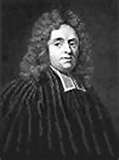 fundamentalism to confessional Reformed theology results from my desire to get to the true roots of the Baptist tradition. Sort of a “back to the basics” quest. Essential in the post-Reformation development of Reformed theology, and even the development of the original Baptist movement, is Puritan theology. As Baptist historian, Leon McBeth, writes at the Baptist History and Heritage Society website, “Our best historical evidence says that Baptists came into existence in England in the early seventeenth century. They apparently emerged out of the Puritan-Separatist movement in the Church of England.” Several notable Puritans, like the great John Owen, renounced their paedobaptistic distinctives in favor of the emerging Baptistic alternatives, which I still contend are due to Anabaptistic, rather than Reformed, influence. But I digress (for more on the ongoing debate about an Anabaptist/Baptist connection, read this article from the Baptist Standard).
One of the Reformed podcasts I follow weekly, “Christ the Center,” by the Reformed Forum, features an interview of Rev. James O’Brien, pastor of Reedy River PCA on the Christ-centered, and piety-enriching benefits of reading the Puritans (listen to the episode here). Puritan literature is available, not only from Banner of Truth Trust, and other Reformed publishers who reprint their works, but a world of Puritan literature is also available at Archive.org, and Google Books. But to get an easy start, you or some Christian you know probably has a copy of Matthew Henry’s commentary. Pull it off the shelf and peruse it. I bet you won’t regret it.
Why Saint Patrick was NOT a Baptist, part 2: Visions vs. Sola Scriptura
On pages 24 and 25 of his book, Baptist Successionism: A Crucial Question in Baptist History, Dr. James E. McGoldrick demonstrates that on the subject of revelation, and the teaching that would, during the Reformation, become known as Sola Scriptura, St. Patrick was not a Baptist:
Although details are lacking, Patrick’s time in slavery seems to have been the occasion for a growing devotion to God and the development of a powerful desire to evangelize the pagan Irish. The conviction that he should embrace the life of a missionary came, Patrick believed, in the form of a vision which included a voice from heaven.
I saw one night a vision, a man coming as it were from Ireland (his name was Victoricus), with countless letters, and I read the heading of the letter, “The Voice of the Irish,” and as I read . . . at that moment I heard voices of those who dwelt beside the wood of the Focluth, which is by the western sea; and thus they cried, as if with one mouth: “We beseech thee, holy youth, to come and work once more among us.” [See St. Patrick: His Writings and Muirchu’s Life, ed. And tr. A. B. E. Hood (Totowa, NJ: Rowman & Littlefield, 1978), 45-46].
This account of his call to the ministry reflects Patrick’s belief in continuing and direct revelations from God apart from scripture. He reported many such experiences and claimed that some of his converts received such revelations as well [Ibid., 50] [Baptist Successionism: A Crucial Question in Baptist History, James Edward McGoldrick (Scarecrow Press, 2000)].
In these three paragraphs, Dr. McGoldrick demonstrates that for St. Patrick to attribute to a supernatural vision his call to return to Ireland as a missionary, and to claim “many such experiences” in his writings, he sets himself at variance with the historic Baptist view of Sola Scriptura it had originally received from the magisterial reformation.
Although in the present day, there are a myriad of emphases among a broad range of movements and denominations which claim the name “Baptist,” including charismatic emphases that would claim unity with St. Patrick on supernatural revelations given directly by the Holy Spirit apart from the written Word of God, this is not the view of the historic Baptist tradition. The teaching of the Calvinistic wing of the historic Baptist tradition is contained in the 1689 Baptist Confession of Faith, which reads in its chapter, “Of the Holy Scriptures”:
Therefore it pleased the Lord at different times, and in various manners to reveal Himself, and to declare that His will unto His church (Heb 1:1); and afterward for the better preserving and propagating of the truth, and for the more sure establishment and comfort of the church against the corruption of the flesh, and the malice of Satan, and of the world, to commit the same wholly unto writing; which makes the Holy Scriptures to be most necessary, those former ways of God’s revealing His will unto His people being now ceased (Pr 22:19-21; Rom 15:4; 2 Pet 1:19,20) (emphasis mine).
These sentences from the Baptist Confession affirm that while God’s revelation of himself used to come in various supernatural manifestations like visions, among others, the Baptist tradition believes that Holy Scripture alone is the source of God’s revelation of himself to his church, precluding, since the completion of the canon, “continuing and direct revelations from God apart from scripture” of the sort St. Patrick claimed for himself and his followers. This is just one way in which St. Patrick was not a Baptist.
Why Saint Patrick was NOT a Baptist, part 1
To most people, this is almost a pointless distinction to make. “Everyone knows that Saint Patrick was a Roman Catholic priest, right?” Not so.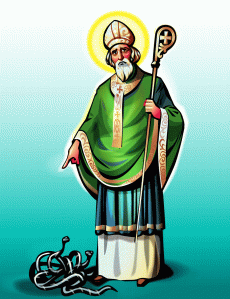 There are some wishful thinkers out there in the realm of Baptist fundamentalism who attempt to annex this 4th to 5th century missionary to Ireland into their pantheon of ancient prototypical “Baptists.” Granted, this is a minority view among Baptists, however, it is the view with which I was raised. This view of Baptist history is called by scholars “Baptist Successionism,” but among its adherents it’s usually known as “Landmarkism.”
As you know St. Patrick’s Day has come and gone two days ago. March 17th is officially recognized by Roman Catholics as the feast day of St. Patrick, commemorating the date of his death. Like most years, about a day before this holiday arrives, I think to myself, I ought to do a little homework to combat this notion that St. Patrick is a Baptist, but I usually run out of time before I can make any headway. So I drop it until about March 16th of the following year. Well, this year, I happened to read a St. Patrick’s Day devotional post by Bob Hayton at Fundamentally Reformed. I commented that I’d intended to post a view contrary to the successionist view of St. Patrick, and missed my “deadline,” but Bob encouraged me to go ahead and do it anyway, so here goes. Looks like this might turn into a series.
I’m by no means a historical scholar, just a Christian who cares to learn the truth about Baptist history, having been burned by so much bad history in the name of promoting the Baptist tradition. A few years ago, I read a book review in the Founders Journal of a book called Baptist Successionism: A Crucial Question in Baptist History, by Dr. James Edward McGoldrick, a professor of church history at Greenville Presbyterian Theological Seminary. I was encouraged by the review, ordered the book, and found that it does a very good job of examining the claims of Baptist Successionism in the light of academic  historical scholarship. Chapter 4 of this book, “St. Patrick: A Baptist?” will serve as the basis of this series.
The only concession one can make about the beliefs and practices of Saint Patrick is the undocumented and therefore uncertain nature of them. This is where Baptist successionists find the wiggle room to make the claims that they make. McGoldrick writes on page 24:
All who have undertaken serious research on the life and thought of Saint Patrick have discovered early that the materials available for the reconstruction of his career are few, and some that have been employed are of dubious reliability. Scholars, both within and without the Roman Catholic Church, have recognized this problem, and, consequently, they have had to admit that their findings are tentative. Only two brief, nontheological writings of Patrick are extant, so interpreters are not in a position to make dogmatic judgments about his doctrinal position. Collateral evidence from the period of Patrick’s life is very scant and does not enlarge our knowledge of his beliefs very much. Moreover, legends abound about practically every phase of Patrick’s life, and separating fact from fiction may, at points, be impossible. The saint’s own works, The Confession and the Letter to Coroticus, are the only unimpeachable sources of information about his views. These, and Muirchu’s monograph on Patrick composed in the seventh century, provide little more than a biographical sketch [see St. Patrick: His Writings and Muirchu’s Life, ed. and tr. A. B. E. Hood (Totowa, NJ: Rowman & Littlefield, 1978)].
So a little biographical material is all we can trust. His theological views, his views on the sacraments (ordinances, for my Baptist readers), his views on church government and ministry, if they are to be known at all, will have to be read carefully between the lines within the context of Patrick’s day and age. By the time this series is finished, I think Dr. McGoldrick will have helped us realize that the Baptist Successionist view is little more than wishful thinking.
Part two will examine Saint Patrick’s probable, or possible, views on revelation, and compare it with the Protestant, Reformed, Evangelical and Baptist view historically known as Sola Scriptura.
update: Dr. Russel Moore at his “Moore to the Point” blog directs us to a more constructive way to benefit from the legacy of St. Patrick (read blog here). He recommends Dr. Philip Freeman’s biography, St. Patrick of Ireland. You can also view a short television interview with Dr. Freeman about St. Patrick (view segment here).
Traveling Light
A friend at work wanted me to read an article from Newsweek magazine today. As I was leaving and he was starting his shift he handed it off to me. It’s about how many of the upcoming generation are adopting a popular new label that doesn’t carry the baggage of the traditional ones. This time, even “Christian” is out. The article is called, “A Christian By Any Other Name.” Suffice it to say, here’s yet another way to minor on the doctrines of the faith and major on outward behavior while claiming you’re not majoring on outward behavior.
This is what Horton and the Modern Reformation gang call “Deeds Not Creeds,” co-opting the phrase from Rick Warren’s desire for a “Reformation of Deeds, Not Creeds.” The fact is that the Scriptural order is that the deeds should flow from the creeds (or doctrines), rather than being focused on at the expense of doctrine (read, “Creeds and Deeds: How Doctrine Leads to Doxological Living“). Reflecting this biblical emphasis, the Heidelberg Catechism organizes its questions and answers in a three part format, which in generations past were titled “The First Part – Of The Misery Of Man”; “The Second Part – Of Man’s Deliverance”; and “The Third Part – Of Thankfulness.” A simplified read of this goes, “Guilt, Grace, Gratitude.” You can access the Heidelberg Catechism from my sidebar by clicking on the “Creeds, Confessions and Catechisms” page. Changing your label won’t help a thing–one day, it’ll accumulate the same baggage all previous labels have. Resistance is futile, you will be assimilated.
Those adopting the new label “follower of Jesus”, like so many other such efforts, will eventually (or sooner) lead to people claiming “unity” with religious people of various false religions at the expense of doctrine (that’s what the parents and grandparents of these original “followers” used to call “ecumenism.” They may not intend to (see this defense of Warren’s focus), but it’s inevitable. Miss the lessons of history, and you’re doomed to repeat it’s mistakes. Folks like this, who are so determined to leave the past behind and strike out on the “road less travelled” will be surprised how many have already gone before them, following, not Jesus, but some blind guide, who will eventually lead them into the “ditch,” as Jesus warned.
Indeed, theological liberalism by any other name stinks just as badly.
“The Bible Kind of Salvation”
Founders Ministries posted a video of a sermon by the late, great Southern Baptist pastor, Dr. W. A. Criswell entitled, “The Bible Kind of Salvation.” In his opening remarks, Dr. Criswell explains clearly that this is a sermon on the election and choosing of God. The fact that Founders Ministries is promoting this sermon says something about on which side of this great debate Dr. Criswell comes down (Who was Dr. Criswell?). Southern Baptists who are reading this blog are urged to consider the remarks that one of your great leaders of the recent past proclaimed as the truth of the matter on what the Bible teaches about the doctrine of election and the so-called “sovereign grace” of God.
In the “about us” page of Founders Ministries, it reads as follows:
Founders Ministries is a ministry of teaching and encouragement promoting both doctrine and devotion expressed in the Doctrines of Grace (what are the doctrines of grace? click here) and their experiential application to the local church, particularly in the areas of worship and witness. Founders Ministries takes as its theological framework the first recognized confession of faith that Southern Baptists produced, The Abstract of Principles. We desire to encourage the return to and promulgation of the biblical gospel that our Southern Baptist forefathers held dear.
As a deacon in a Southern Baptist church, I’m personally convinced that everything that’s right about the Baptist tradition it learned from

Deacon Council, Shady Grove Baptist Church, N. Richland Hills, Texas
Reformed theology, and everything that’s wrong with it was adapted either intentionally or unintentionally from Anabaptism. I further believe that a return to a more consistent application of Reformed theology (aka, the doctrines of grace or Calvinism) is the key that will solve many of the issues that trouble Southern Baptists churches today.
The following is part one of a four part series. If you need help finding parts 2-4, click here.
Christ-Centered Counseling
Along with a local PCA Church, Grace Community Presbyterian in Fort Worth, Texas, I am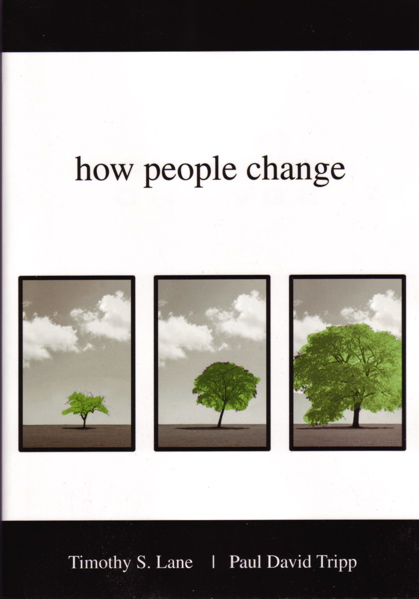 reading through several books this year. For the months of March and April, I’m reading through How People Change by biblical counselors Dr. Timothy Lane, executive director and faculty member of the Christian Counseling and Educational Foundation (CCEF), and Dr. Paul David Tripp, president of Paul Tripp Ministries, pastor, and adjunct professor at Westminster Theological Seminary as well as adjunct faculty member of CCEF. The slogan across the top of the CCEF website (www.ccef.org) is “Restoring Christ to Counseling and Counseling to the Church.” We’re off to a good start.
As you may have guessed, I’m not the sort who naturally gravitates toward such “practical” material. But that’s my own problem. This volume, however, proves promising. I’ve only gotten through chapter one, so far, and it appears to have already gotten my number. The title of chapter one is “the gospel gap” (all titles are in lower case in this book), which the authors summarize in this way:
The good news of the gospel of Jesus Christ is a “then-now-then” gospel…First, there is the “then” of the past. When I embrace Christ by faith, my sins are completely forgiven, and I stand before God as righteous. There is also the “then” of the future, the promise of eternity with the Lord, free of sin and struggle. The church has done fairly well explaining these two “thens” of the gospel, but it has tended to understate or misunderstand the “now” benefits of the work of Christ. What difference does the gospel make in the here and now? How does it help me as a father, a husband, a worker, and a member of the body of Christ? How does it help me respond to difficulty and make decisions? How does it give me meaning, purpose and identity? How does it motivate my ministry to others?
It is in the here and now that many of us experience a gospel blindness. Our sight is dimmed by the tyranny of the urgent, by the siren call of success, by the seductive beauty of physical things, by our inability to admit our own problems, and by the casual relationships within the body of Christ that we mistakenly call fellowship. This blindness is often encouraged by preaching that fails to take the gospel to the specific challenges that people face. People need to see that the gospel belongs in their workplace, their kitchen, their school, their bedroom, their backyard and their van. They need to see the way the gospel makes a connection between what they are doing and what God is doing. They need to understand that their life stories are being lived out within God’s larger story so that they can learn to live each day with a gospel mentality (pages 3-4).
If you’ve been reading my blog for any length of time, you know I’m a big believer in the Christ-centered emphasis of Reformed theology. You may have read previous posts where I’ve recommended books like Christ Centered Preaching and Living the Cross Centered Life. This book on biblical counselling is right up the Christ-centered alley. Here’s a helpful guide for learning to live life in light of the gospel.
Two great passages of Scripture give us a picture of this so-called “then-now-then” application of the gospel to the believer. In his letter to Titus, the apostle Paul writes that the gospel is the basis for the instructions he gives in the first ten verses of chapter two.
11 For the grace of God has appeared, bringing salvation for all people, training us to renounce ungodliness and worldly passions, and to live self-controlled, upright, and godly lives in the present age, waiting for our blessed hope, the appearing of the glory of our great God and Savior Jesus Christ, who gave himself for us to redeem us from all lawlessness and to purify for himself a people for his own possession who are zealous for good works (Titus 2:11-14).
Back “then” the grace of God appeared, bringing salvation for people in every nation (v. 11). “Now,” or as Paul writes, “in the present age” (v. 12), this grace of God trains us to renounce ungodliness and worldly passions, embracing self-control, uprightness, and godliness, “waiting for our blessed hope” (v. 13), in other words, looking forward to “then,” when Christ returns, who, back “then,” gave himself for our redemption from lawlessness to “purify . . . a people for his own posession who are zealous for good works” (v. 14). As you can see, the authors draw directly from Scripture for their approach to counseling, with no modern psychological influences evident. This is Christ-centered counseling if I’ve ever seen it.
Likewise, Peter gives a bit more extensive treatment in his second letter. In fact, in 2 Peter 1:9, the apostle explicitly indicates a professing believer’s tendency to “forget” about what Christ did for him in the gospel. Here is Lane’s and Tripp’s “gospel gap.” Let’s take a look at the passage–2 Peter 1:3-11.
His divine power has granted to us all things that pertain to life and godliness, through the knowledge of him who called us (back “then“) to his own glory and excellence, by which he has granted to us his precious and very great promises (again, past tense), so that through them you may become partakers of the divine nature, having escaped (detecting a pattern yet?) from the corruption that is in the world because of sinful desire.
For this very reason, (“now“) make every effort to supplement your faith with virtue, and virtue with knowledge, and knowledge with self-control, and self-control with steadfastness, and steadfastness with godliness, and godliness with brotherly affection, and brotherly affection with love. For if these qualities are yours and are increasing, they keep you from being ineffective or unfruitful in the knowledge of our Lord Jesus Christ.
For whoever lacks these qualities is so nearsighted that he is blind, having forgotten that he was cleansed from his former sins (here’s the “gospel gap”). Therefore, brothers, be all the more diligent to make your calling and election sure, for if you practice these qualities you will never fall. For in this way there will (“then“) be richly provided for you an entrance into the eternal kingdom of our Lord and Savior Jesus Christ.
For these reasons, and a few others (so far), I’m inclined to believe the promotional synopsis at the Westminster Books website when it claims “This book explains the biblical pattern for change in a clear, practical way that you can apply to the challenges of daily life.”
Changing of the Guard at Coral Ridge
 The news has just reached me that the search for a new pastor has come to an end at Coral Ridge Presbyterian Church, in Fort Lauderdale, Florida. Last year’s loss of Dr. D. James Kennedy has certainly brought much change and transition to the local congregation. It certainly came immediately to the Coral Ridge Hour television show. The formerly hour-long program was immediately reduced to a half hour, cutting out my favorite part of the program, the music. From the exhilerating one verse processional, during which the choir and pastor enter the sanctuary and take their places to open the service, to the choir specials and classical solo features, it was part of my weekly preparation for worship at my own church. As a concession, I noticed that they began to squeeze in the song that is sung after the sermon, for which I was grateful, but it certainly was not the same.
 But I digress. The Session (or, board of Ruling Elders) of Coral Ridge Presbyterian Church, whose concern is to shepherd a large, influential church without a Teaching Elder (Pastor), has recently called a young minister of some noteriety who is building a church which has yet to obtain its own building. In this way, its quite an interesting match–a church without a pastor offers its building to a church with a pastor but not a building. That’s right, they’re not just calling the pastor, they’re negotiating a merger. The name of said minister of note, who has received a call to pastor Coral Ridge, is Tullian Tchividjian (the last name rhymes with “religion”). Rev. Tchividjian is an up-and-coming pastor in the Evangelical Presbyterian Church, (Coral Ridge is in the Presbyterian Church in America) who happens to be the grandson of “America’s Pastor,” Evangelist Billy Graham. But many Reformed believers may know him better as the guy featured in the promotional videos that recently introduced the Bible reading public to the new ESV Study Bible (which study Bible I highly recommend).
You can read the SunSentinel.com report on Rev. Tchividjian’s call and the subsequent merger negotiations here, and you can also keep up with the ongoing process at his New City Presbyterian Church blog (here, here, here, for starters). While this is an interesting event, I must say that in the inevitable changes that will come to the church, especially grievous to me personally will be any metamorphosis of Coral Ridge’s amazing music ministry, which, while it was technically “blended” (combining the singing of traditional hymns with contemporary music), it was effectively presented in a manner that majored on the classical, “traditional,” even the liturgical. One Reformed blog, Green Baggins, expresses concerns (read it here) similar to mine. I share some of this blogger’s concerns, especially about the implications of contemporary worship music, and the possibility of a “seeker sensitive” approach to the church’s ministry, although some of the comments on his post help alleviate my concerns.
Be that as it may, I’m glad to see that a changing of the guard is in the works, and I wish both churches (Coral Ridge and Tchividjian’s New City Pres.) the reformation and revival for which both are praying and working. May the Lord grant it to the advancement of his Kingdom throughout Florida, and, through their various TV and radio ministries, America and the world.
James White on Faithful Scholarship
Here’s the video of Dr. White’s call for “believing Biblical Studies.” In case you had any trouble following my transcription of his monologue in the previous post, now you can watch it and hear it as well. Using as many senses as possible will always help your comprehension. If there were some way we could touch, taste and smell it, I’d post that, too, but for now the technology remains limited. Of course, if you really want to touch your monitor screen be my guest, just don’t press too hard if you’ve got one of those gel screen type set ups.
Also worthy of note is how Dr. White is sporting the sharp “Sola Conference” shirt that he mentioned in the previous video of him I posted. Like the Bible says, “You have not because you ask not.” If you like to see more videos by Dr. James White, Reformed Baptist apologist extraordinaire, you can view his YouTube page here.


 The Misadventures of Captain Headknowledge