The Political Conservative’s Obama-Era Survival Pack
I know many theological and political conservative Christian Republicans (as well as those to their right) are grieving the loss to their dream of rebuilding this “Christian nation.” They’re keeping a stiff upper lip as they say good-bye to the out-going evangelical President George Walker Bush, and endure, not without some respect for the historical nature of the event, the election, and now, inauguration of the first African-American President, Barak Hussein Obama. Hard times are coming to the evangelical dream of “taking America back” for Christ, but things are going well for the pluralistic civil religion.
During the next four to eight years, it may serve you well to think through a little more carefully just what is the Christian’s relationship to his government. What vision ought he to have for his nation? Should it be forced into the mold of Old Testament Israel, should a Christian theocracy be established, or are we to forswear all participation in the public square, and stop polishing the brass on the sinking ship of America?
I submit that a firmer grasp on the classical Christian distinction between what Augustine called the City of God and the City of  Man is in order. How is the Christian to live as citizens of the City of God without molding it into the image of the City of Man, and vice versa? This week’s episode of the White Horse Inn, “The City of God,” will tell you. You can read Michael Horton’s intro to the program here. Also, I found particularly helpful and interesting the programs on “Christianity and Politics,” part one and part two, in which, back in September, Dr. Horton interviewed D.G. Hart (author of A Secular Faith: Why Christianity Favors the Separation of Church & State), Dan Bryant (former Republican Assistant Attorney General for the Department of Justice) and Neil McBride (a strategist for the Democratic Party). Their introductions can likewise be read here.
I think learning a little more about what the Bible really expects of Christian citizens will help us all cope while the party who beat us in the last election has their turn at the helm of the ship of state. We, and our country, might just be the better for it. 
Labels, Labels, Labels!
 Many Christians decry the use of “labels” to identify one’s distinctive beliefs and/or practices. I find this attitude intellectually
  dishonest. Everyone’s belief and practice, or approach to determining his own autonomous belief and practice, is learned either consciously or unconciously from some prior group’s or individual’s belief and practice. Being able to identify these is not some attack on the unity we have in Christ, but when used with a good and accepting attitude, it’s a way to know your brother or sister in Christ. And if you know your friend, you can love him better.
My personal attitude about labels can be likened to the way all you sports fans out there view your teams. Sure, there’s a little competition between teams, and maybe an animated discussion about your team’s strengths and the other teams’ weaknesses, but it’s all in fun. That’s the attitude I like to retain about our various distinctives. Everyone should just relax, and have a good time in the Lord, for cryin’ out loud!
Anyway, I bring all of this up simply to introduce one of R. Scott Clark’s entries in his live blogging of the Calvin’s Legacy Conference from Westminster Seminary California. Dr. Clark answers a question about the difference between the labels “Calvinist” and “Reformed.” You can read his interesting answer here. ” But in the meantime, he shares some history that reveals the origin and significance of other labels like “Lutheran,” “Evangelical,” and “Protestant.” It’s a good, short read.
 Now all you guys who admit to your own labels, remember to play fair! 🙂 If you like what you read, there’s plenty more where that came from. You can subscribe to the Calvin’s Legacy Conference RSS Feed and it’ll come to you, you won’t have to go get it!
’nuff said
I’m planning to join some friends from a local church who are planning to read through a few books in the coming year. Now that the New Year has come around the bend, it’s time for me to be obtaining the first in the series, procrastinator that I am. The first book we’re going to be reading through and blogging about at their church’s blog is called, Jesus: Made In America, by Steve Nichols. The publisher’s description describes the content in the following way:
Beginning with the Puritans, he leads readers through the various cultural epochs of American history, showing at each stage how American notions of Jesus were shaped by the cultural sensibilities of the times, often with unfortunate results. Always fascinating and often humorous, Jesus Made in America offers a frank assessment of the story of Christianity in America, including the present.
Sounds pretty entertaining as well as enlightening. But since I’ve yet to order a copy of the book, I thought I might check the websites of one of the major Christian booksellers who have locations in my area, in case I can just swing by and pick up a copy on my way home from work tonight. I went to the site for Family Christian Stores and entered “jesus made in america” in the search engine to see if they carry it.
You’ll never guess what the top result was:

Need I say more?
Guess I’ll order it from Westminster Seminary’s bookstore anyway.
Does “Every Member Ministry” Contribute to “Christless Christianity”?
An “every member ministry.” The name should be self-explanatory. This is a staple of modern American Evangelical and Fundamentalist discipleship, and likely of the Reformed, as well. We probably all can hear the echoes of pastors past and present who’ve clearly proclaimed that they are not the only “ministers” in the local church. Every member, not just the pastor, is here to exercise his gifts for the building up of the body of Christ. Might this be a “fifth rail” of American Christianity that the believer in his right mind dare not touch, lest he be accused of attempting to take us back to Roman Catholicism with its clearly defined gap between the clergy and the laity? Don’t worry, my personal intention is not to state anything to the contrary of those who believe they are gifted to perform any of a myriad of tasks in the local church. Some of us are gifted to teach, though we’re not ordained pastor/teachers; some are gifted to serve the physical needs of the least of the congregation; some are gifted to aid in the musical operation of the local church; some are gifted to do any myriad of other things that are indded vital activities that ought to take place in the context of the local church, and by the members of the congregation, not just the ordained pastors, elders and deacons. I’m not out to overturn the apple cart of an “every member ministry” as it happens to currently be manifest in American churches. But I would like to address, or rather, cite Michael Horton’s remarks regarding, one passage of Scripture that is famously associated with the idea of an every member ministry, and in fact, serves as part of the Scriptural basis for such activity.
But first, let’s look at the passage: Ephesians 4:1-16, as it is translated in the King James Version. And let us pay special attention to where the punctuation falls in verse twelve, which I’ve highlighted.
1I therefore, the prisoner of the Lord, beseech you that ye walk worthy of the vocation wherewith ye are called, 2With all lowliness and meekness, with longsuffering, forbearing one another in love; 3Endeavouring to keep the unity of the Spirit in the bond of peace.
4There is one body, and one Spirit, even as ye are called in one hope of your calling; 5One Lord, one faith, one baptism, 6One God and Father of all, who is above all, and through all, and in you all. 7But unto every one of us is given grace according to the measure of the gift of Christ.
8Wherefore he saith, When he ascended up on high, he led captivity captive, and gave gifts unto men. 9(Now that he ascended, what is it but that he also descended first into the lower parts of the earth? 10He that descended is the same also that ascended up far above all heavens, that he might fill all things.)
11And he gave some, apostles; and some, prophets; and some, evangelists; and some, pastors and teachers; 12For the perfecting of the saints, for the work of the ministry, for the edifying of the body of Christ: 13Till we all come in the unity of the faith, and of the knowledge of the Son of God, unto a perfect man, unto the measure of the stature of the fulness of Christ: 14That we henceforth be no more children, tossed to and fro, and carried about with every wind of doctrine, by the sleight of men, and cunning craftiness, whereby they lie in wait to deceive; 15But speaking the truth in love, may grow up into him in all things, which is the head, even Christ: 16From whom the whole body fitly joined together and compacted by that which every joint supplieth, according to the effectual working in the measure of every part, maketh increase of the body unto the edifying of itself in love.
Now let us see what Michael Horton has said about this passage in his latest book, Christless Christianity, on pages 248-249, in the final chapter, “A Call to the Resistance.”
And now, as we are reminded in Ephesians 4:8-16, the ascended King moves his gifts of this subversive revolution down to us; we do not have to climb up to him. Here the apostle Paul teaches that the same one who descended to the uttermost depths for us and ascended “far above all the heavens, that he might fill all things” (v. 10), does not keep the treasures of his conquest to himself but liberally distributes them to his liberated captives below. The original Greek emphasizes, “The gifts that he himself gave . . . .” They originate with Christ, not with individual members or the body as a whole. The gifts he gives are apostles, prophets, evangelists, pastors, and teachers (v. 11). They are not given as a hierarchy of control, like “the rulers of the Gentiles” who “lord it over” their subjects instead of serving (Matt. 20:25; see vv. 25-28). Rather, Paul says they are given . . . (here he cites Ephesians 4:12-15, which we’ve just read above). More recent translations typically render the clasuse in verse 12, “to equip the saints for the work of ministry” (e.g., ESV, NRSV, RSV), which has been used as the chief proof-text for every member ministry. For various reasons, I am persuaded that the older translations (especially of verse 12) are more accurate and also capture better the logic of the argument.
This does not mean, of course, that the official ministry of the Word (now exercised by pastors and teachers) is the only gift or that ministers rank higher in the kingdom of Christ than everyone else. Rather, this gift of the ministry of the Word is given so that the whole body may be gifted: brought together in the unity of the faith and of the knowledge of the Son of God. Only then can each member receive the additional gifts that make them function together as one mature body with Christ as its living Head (Eph. 1:15-16). The gifts flow down from Christ; the Great Shepherd serves his flock through undershepherds who minister his gospel through preaching and sacrament. Of course in other places Paul expands the list of gifts that are exercised by the wider body (see Rom. 12:3-8; 1 Cor. 12). A church that is lacking in generosity, hospitality, and other gifts of mutual edification is unhealthy; a church that lacks the Word is not a church. Therefore we come to church first of all to receive these gifts, realizing more and more our communion with Christ and therefore with each other as his body. (emphasis mine)
I always wondered if there was something up with this difference in punctuation between the KJV and many, if not all, modern translations (I haven’t checked). I know just bringing up the matter will draw criticism as if I’m out to tell everyone in the church to stop doing stuff for Christ, and just sit and listen to the preacher. This is the great fear of those who zealously proclaim this passage as it is translated and punctuated in modern translations (even if they’re KJV onlyists!) Rather, the point I want to make is the same simple point I always make. For ministry to be Christ-centered, the cart must not go before the horse. The Law and Gospel preached and the sacraments properly administered is the horse, and this and only this, is what makes the cart of our fruitful service go. The Law and Gospel preached and the sacraments properly administered turns some goats into sheep, and then the same Law and Gospel preached also feeds the sheep and strengthens them to love one another, not only as a congregation, but also as sojourners and strangers among our unbelieving neighbors in the world. Profound in its simplicity; simple in its profundity!
The cart may be getting put before the horse sometimes when our focus on the “priesthood of the believer” somehow turns into the “ministryhood” of the believer, as Horton frequently says. Hear me clearly, brethren: don’t give up your Sunday School class, don’t drop out of the choir or praise band (or whatever your church calls it), don’t stop helping in all the little, unnoticed ways you do. Just don’t make your primary focus–don’t make these activities your main purpose for being there. If you do, you may be living a Christless Christianity, intending to earn God’s grace by your good works. Rather, first look to being served by Christ through the ordained ministry of Word (Law & Gospel! Not just Law and not just Gospel!) and sacrament as your source of grace and faith and strength . . .
13 until we all attain to the unity of the faith and of the knowledge of the Son of God, to mature manhood, to the measure of the stature of the fullness of Christ, 14 so that we may no longer be children, tossed to and fro by the waves and carried about by every wind of doctrine, by human cunning, by craftiness in deceitful schemes. 15 Rather, speaking the truth in love, we are to grow up in every way into him who is the head, into Christ, 16 from whom the whole body, joined and held together by every joint with which it is equipped, when each part is working properly, makes the body grow so that it builds itself up in love. (Ephesians 4:13-16, ESV).
“Those who don’t learn the lessons of history . . . “
Back on December 3rd, Todd Wilken interviewed Dr. Larry Rast, of Concordia Theological Seminary in Fort Wayne, Indiana  on the Lutheran radio show, “Issues, Etc.” Dr. Rast explains that American Evangelicalism ascribes little relevance to the lessons of Church history, or the wisdom of building theologically on the efforts of those who’ve gone before us in the faith. Please listen and consider Dr. Rast’s words, and learn the lessons of history, lest you, too, join the ranks of those who are “doomed to repeat them.” He also reinforces the axiom that is sometimes repeated on this blog: “If you don’t know where you come from, then you don’t know where you are, and you can’t see where you’re going.”
Listen to “American Evangelicalism: Ahistorical.”
Pecuniary Satisfaction and Peculiar People, part 1
A week ago, on Dr. James White’s The Dividing Line webcast, I was listening to his coverage of the SBC’s John 3:16 conference, the effort of “moderate Calvinists” or perhaps more accurately, four point Arminians, to combat the rising tide of five point Calvinists who are graduating from SBC seminaries and ministering in SBC churches. Some discussion was made about a “pecuniary debt” being paid by Christ on the cross for every individual, as distinguished in the lecture being discussed, a “moral debt” which is paid by the believer who receives Christ by his own free will. This is only the second time since I’ve become a five point Calvinist myself, that I’ve heard reference made to this concept of “pecuniary debt.” Previous to this, I had a discussion with a few four-point Calvinists (which are predestinarians who deny that Christ died only for the elect) at Contend Earnestly. The term came up then, too, but, the discussion never moved toward exploring all the ins and outs of the concept. Indeed, the “pecuniary” view of Christ’s atonement, is a concept begging for my attention in the future. The reason I bring it up is to simply point out the fact that the word “pecuniary” was freshly bouncing around in my head before one Southern Baptist Bible study I attended last week.
In this Bible study, we happen to be studying Romans 12. But as is so often the case in Southern Baptist Bible study, the subject at hand often yields to the current events of the church, whether they have any bearing on the passage being studied or not. In this case, the current event under consideration was the semi-contemporary praise chorus, “A Chosen Generation,” which is a musical version of 1 Peter 2:9. This verse is very well-known even among Christians who generally deny the Calvinistic emphasis on God’s sovereign choice in election, or the covenantal unity of Israel and the Gentile Church as one chosen people, contrary to the dispensational “wrongly dividing” of the two groups into two separate chosen peoples. The thing that endears this verse to non-Reformed Southern Baptists is one particular phrase: “a peculiar people.” The King James Version translates the verse this way, and given the tendency to read the KJV in terms of today’s definitions and connotations, rather than remaining carefully on the look-out for archaisms, the phrase, “peculiar people,” lends itslef to a deeply engrained tradition of springboarding past exegetically-informed exposition to practical, relevant application to the Christian life.
I can’t reproduce verbatim what was said about the phrase, but I can characterize it or at least summarize it. God, in calling us a “peculiar people,” is implying that the church is different from the world; indeed, at times, the world may even consider what the church believes and does “peculiar,” or strange. This is the traditional moderate Calvinistic Baptist commentary on this whole verse. Rarely does anyone hear anything different in my experience. As I sat through the recitation of this unwritten creed, it struck me that the root word for “peculiar” is similar, if not the same as, the root for “pecuniary.” If pecuniary is associated with money or commerce, or wealth, it seemed possible that in the KJV of 1 Peter 2:9, we have another case of an archaic word being misread according to the twentieth century meaning of the word “peculiar.”
I held my tongue through the remainder of the class, but raised my hand to comment when so invited to at the end of the hour. I prefaced my concerns in my usual, self-depracating manner, telling the teacher I’m going to “nit pick” the word “peculiar.” Then I stated my concerns that when compared to the modern translation of 1 Peter 2:9, the traditional interpretation and application of “peculiar people” doesn’t seem to be the point of the text. Modern translations render the Greek here, “a people for his own possession,” so it’s not about believers seeming odd to the world, but rather about believers being God’s property. It’s not an imperative to be obeyed, but an indicative to be believed: the church is God’s possession.
. . . to be continued . . .
In Defense of “Xmas”
Last Friday night I went to a sizeable seeker-sensitive church which was hosting an elaborate “Journey to Bethlehem.” It was a really impressive set up. Groups of a couple dozen each would be lead on a journey from Nazareth to Bethlehem by a fictitious Jewish man and his wife and daughter. Along the way were intimidating Roman soldiers (some on horseback), lots of sheep, goats, ponies and even camels on hand. We were even held up by bandits on the road before we reached our destination: the stable offered by the keeper of the already booked “Bethlehem Inn.”
So many people turned out this year to go on the journey, that before we began, we spent a good 30-45 minutes being entertained in the sanctuary of the church–which I suppose they prefer to call the worship center. We enjoyed a Christmas version of “Don’t Forget the Lyrics,” a couple of puppet shows, and a few videos. One of the videos was a kind of spoof of a football player who wanted to make sure everyone around him kept Christ in Christmas–if they didn’t, he’d tackle them! It was a funny video. However, as usual, one of the football players’ poor victims was sporting the widely misunderstood holiday abbreviation, “Xmas.” She got tackled. How many times per Christmas season do you hear Christians around you complain whenever they see or hear someone use the word “Xmas”? I’ve personally lost count.
Noah Webster’s 1828 American Dictionary of the English Language has this short and helpful explanation. Among other uses of the the letter x, it reads, “As an abbreviation, X. stands for Christ, as in Xn. Christian; Xm. Christmas.” Why, you ask, does x stand for Christ? The letter x is not only the third from the last letter of the English alphabet, it is also the Greek letter, chi (pronounced “key”), which corresponds to the English “ch.” Chi is the first letter of the Greek name for Christ. Yes, Virginia, it is that simple. Here’s a simple Greek alphabet for your orientation.
If you’ve ever gotten nervous or felt someone was demeaning Christ by using the abbreviation “Xmas,” may I be the first to reassure you that such is not the case. Wikipedia has a very informative entry about the history of the use of Xmas, as well as the How Stuff Works website. Learn it, love it, live it.
Merry Xmas!!!
Mega-Churches Respond to Reveal Study
This week on the White Horse Inn, the topic is the response of American mega-churches to the survey conducted by Willow Creek’s leadership (REVEAL) which concluded that the solution to dissatisfaction among faithful church members is less dependence on the organized church’s ministries, focusing on making individual Christians self-feeders.
For the record, here and here were my responses back when the survey originally made the headlines.
Listen to The White Horse Inn: learn what you believe and why you believe it.
Baptists & them “Whiskeypalians”
Sorry, Anglicans. Just a little Baptist humor, there. Just wanted to bring to the attention of my readers a couple of interesting psots: one by R. Scott Clark on the fallout from the SBC’s recent “John 3:16 Conference,” and another from Christianity Today with an update on the continuing drama in the schism of the Anglican Communion over the ordination of openly unrepentant “homosexuals.”
FBC Dallas Gets “Politically Incorrect”
Dr. Robert Jeffress is the pastor of the historic First Bapitst Church of Dallas. He has made the news this  week for beginning a sermon series called “Politically Incorrect.” At least the first two sermons will touch on the issue of homosexuality. Last Sunday, Dr. Jeffress corrected some commonly promoted myths that undermine Scripture’s teaching about the subject. Here’s the outline. About 100 protestors gathered outside the building during the three worship services. You can read the report here.
Thank God for the leadership and courage of a local prominent minister in this time when such a controversial topic would be easier to ignore. He provides an example of how believers will begin having to count the cost of faithfulness to Christ in the very forseeable future.
Are you a populist, or cosmopolitan?
Those are the categories utilized by Michael Lindsay, assistant professor of sociology at Rice University,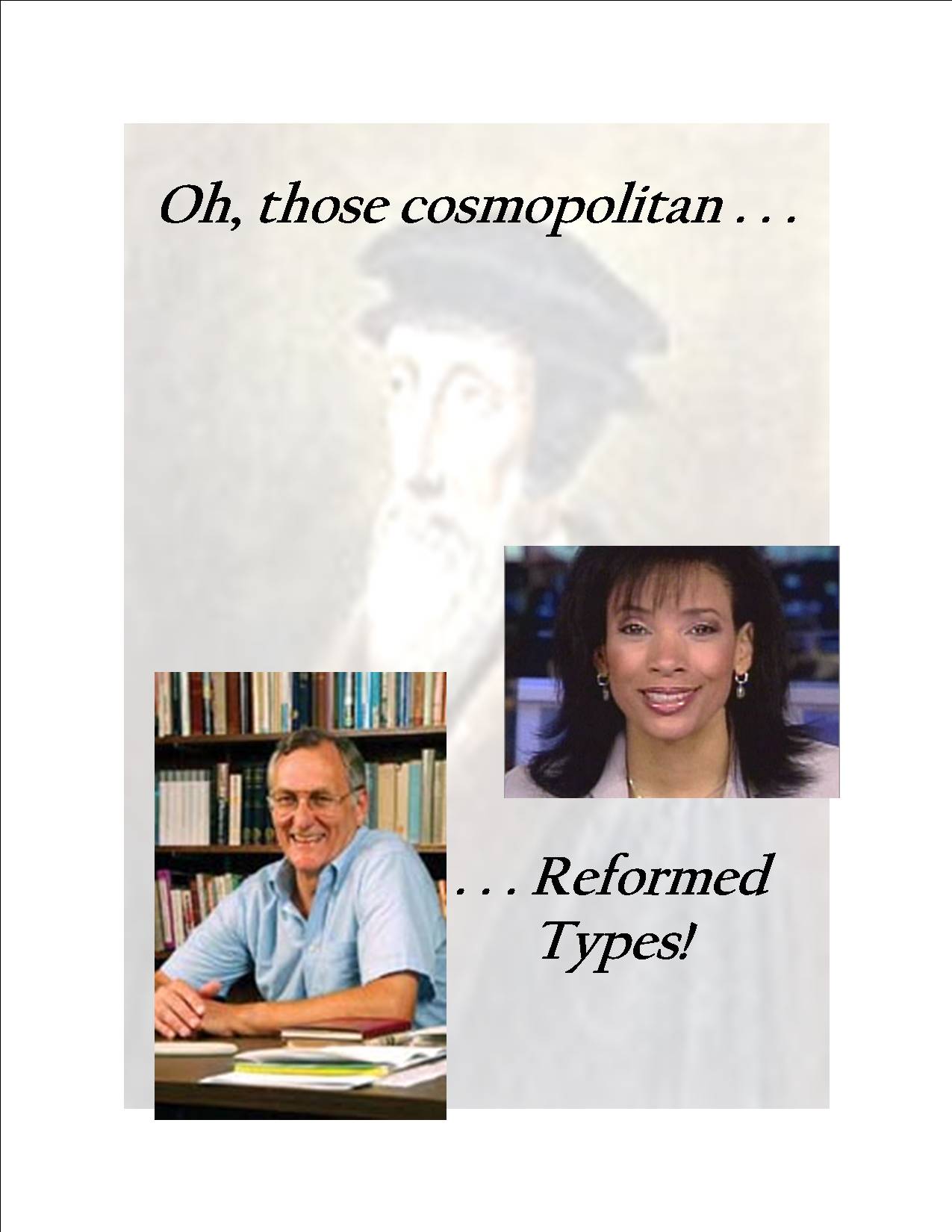 and author of Faith in the Halls of Power: How Evangelicals Joined the American Elite. When Lindsay spoke recently at the Pew Forum’s semi-annual Faith Angle Conference on religion, politics and public life, he used these categories to describe the division in the ranks of politically active American evangelicals.
Lindsay on Populists: “You see, populist evangelicals are what we oftentimes think about evangelicals. These are the folks who are culture warriors, who say that they want to take back the country for their faith. They see themselves as embattled against secular society. They are very much concerned that they are in a minority position, and they’ve got to somehow use very strong-arm tactics to win the day.”
Lindsay on Cosmopolitans: “They are less interested in taking back the country for their faith. They really are more interested in their faith being seen as authentic, reasonable, and winsome. So they still have an evangelistic impulse, but their whole modus operandi looks quite different. Because of that they have different ultimate goals of what they are actually trying to achieve. They want to have a seat at the table. They want to be seen as legitimate. They are concerned about what The New York Times or TIME magazine thinks about evangelicals because they [the cosmopolitan evangelicals] are concerned about cultural elites. They want legitimacy. Legitimacy is actually more important to them than necessarily taking back the country.”
Notable among the cosmopolitan group were Reformed Christians. Here’s what he said about them.
“There are some theologically literate cosmopolitan evangelicals, people who are able to articulate how their faith matters and drives them to particular positions, but the interesting thing about that is that almost all of them come from the Reformed tradition. The rise of Presbyterian kind of theology has been very interesting to observe. Abraham Kuyper has been one of the figures that is oftentimes cited among the people I interviewed.”
Then Lindsay mentions one significant Reformed theologian who is partly to be credited with the emergence of Reformed theology in the American evangelical community. David Wells. “I got in touch with a theologian named David Wells who has just written a book. I’ll promote his book since I don’t have one of my own. His book is The Courage to be Protestant: Truth Lovers, Marketers, and Emergents in the Postmodern World. And he has a different dichotomy of the outlook of the evangelical landscape.” So Lindsay explains Wells’ breakdown. But I don’t want to spoil it for you. I want you to go read the whole transcript. It will give you a good idea of what is going on among us voting evangelicals.
Normally, I don’t post on politics, but politics is only one factor. I’m interested in this also for the historical and theological associations. If you want my views on politics, you’ll have to email me or send me a message at my Facebook page.
Finally, there was another Reformed individual, who, in her vocation, is associated with all of this. The chief religion correspondent from FOXNews Channel, Lauren Green, happened to be in attendance at the conference and piped up with some questions when she heard her church referenced. That church would be Redeemer Presbyterian in New York City. I found that interesting. It’s nice to learn about the faith of the talking heads you listen to. So now Lauren is “outed” if you will as Reformed!
Live Chat with Michael Horton on “Christless Christianity”
 Back on Reformation Day, aka Halloween, aka October 31st, the Washington Post hosted a Live Web Chat with Michael Horton (White Horse Inn, Modern Reformation) helping to promote the release of his new book, Christless Christianity. The title of this book was also the focus of the programs during the past year on the White Horse Inn radio show. Horton attained a bit of media attention because of his recent statements critical of Joel Osteen’s theology, who serves as a good poster boy for what Horton calls “Christless Christianity,” but his book and the topic is far more extensive than a mere attempt to pull Osteen off of his pedastal. According to Horton, we all have the natural bent toward some form of Christless Christianity. We all tend to some degree to focus on ourselves and what we do at the expense of God and what he does for us in Christ. But to paraphrase the emphasis of Horton both on the radio and in his book(s), the grace and faith and love to serve Christ comes from the same source as the grace and faith and love that moved us to receive Christ in the first place: the good news of the sinless life, sacrifical death, glorious resurrection of the Lord Jesus Christ.
Our problem is, we keep falling back on focusing on the Law of God or the various commands of Scripture, to such a degree that we forget it’s primary use is to expose our sin while its secondary use is to only guide believing obedience. It doesn’t impart the grace and faith and love to obey, it merely charts out for the believer what obedience ought to look like. The grace and faith and love to obey, again, comes from the gospel. So any exposition of Scripture that never gets around to the Person and Work of Christ, won’t convey to us the power to live the Christian life by the Spirit.
The Morning After Reformation Day
R. Scott Clark, Professor of Church History and Historical Theology at Westminster Seminary California, and Associate Pastor at Oceanside United Reformed Church, splashes a little water in the faces of those of us who get excited about the Reformation on Halloween. If you want your Reformation myths challenged (if they are myths), then read his post at the Heidelblog entitled, “What Reformation Day Really Is.” But be of good cheer, true believer–the doctor not only invalidates the legends, he bestows a sharper knowledge of the true Reformation! Read, and rejoice in the truth!
You Just Gotta Check Out The ESV Study Bible!
You just gotta see this! If you don’t own a study Bible yet, don’t bother shopping around. The ultimate study Bible is going to be released on October 15, 2008. Many of my Reformed blogging buddies are already aware of this monumental achievement, and most are undoubtedly awaiting it’s arrival as eagerly as I am, even though we’ve already got a shelf full of various study Bibles. But for those of you who are shy of solid resources that can help you understand the meaning of Scripture, the backgrounds of the places in the Bible, even instruction on Christian living, ethics and material that can clue you in on what many of the major world religions believe as compared with what the Bible teaches (and who knows what else?), your search need go no further. The ESV Study Bible will provide all of this for you, and then some, with full color maps and illustrations all over the place!
I just watched some of the promotional videos describing the project, the vision behind it and the contents of the product, and it is intended to be the equivalent of a miniature version of a multi-volume library on a broad cross-section of information vital to not only learning the Word of God, but also to personal growth in grace, and even to aid in the work of gospel ministry. The ESV Study Bible promises to be useful to layman, teacher and pastor alike.
Take a look at the following videos, hosted by PCA pastor and grandson to Billy Graham, Tullian Tchividjian , in which he will introduce the purpose of the ESV Study Bible and then take you on a guided tour of the contents. Seeing is believing . . .
If you’d like to see more of the videos, they are available at the Video Resources page of the ESV Study Bible website, which you can access by clicking on the colorful button near the top of the sidebar, just under the portrait of our blog mascot and namesake.
Even though the ESV Study Bible will come in a variety of bindings including the traditional leather, it’s so chock full of amazing resources that it may prove a bit cumbersome, were one wanting to carry it to church. In my opinion, this isn’t that kind of Bible. It’s a study resource, not a tag along Sunday-go-to-meetin’ Bible. For that reason, I’m getting the hardback edition, which comes with the additional feature of being the least expensive of all the varieties. But I must confess, that when, Lord willing, I obtain my copy, I may not be able to part with it for a few weeks, so it may in fact tag along with me to church now and then. But I’ll try to pay attention to the sermon, anyway. 😉
Calvinism, Coming to a Young Christian Near You!

Click image to purchase at WTS Books
There’s a book out chronicling the resurgence of Calvinism among the, pardon the expression (keep in mind, I’m using it correctly), emerging generation of teens, twenty-, and thirty-somethings (including myself) who are disillusioned with the shallow theology and over-emphasis on you name it, revivalism, pietism, experientialism, commercialism of the twentieth century. As you know, the list of misguided varieties could go on.
So many of us who’ve grown up as a either a fundamentalist or evangelical Christian have come to the conclusion that what is needed is for the church to get back to the basics of what it means to be a Christian. The basics of Christianity as understood in a broader way than just re-examining my Bible and reconstructing my own version of what I think is the clear teaching of Scripture regarding faith and practice (which is what most of the previous generation think it means to get back to the basics).
Such a tactic is part of the problem–it’s too self-centered and individualistic and often far too reductionistic. It’s not a matter of just throwing out current traditions and starting over with a clean slate. It’s not about reinventing the wheel–those are the kinds that never turn out round. What I’m talking about is getting on the right track–yes, the most biblical track, the most Christian track, the most Protestant track, the most truly evangelical track–a track I didn’t lay myself, but was laid by the faithful followers of Christ who genuinely changed the world in their generation as did the first century apostolic generation.
What generation am I talking about? I’m talking about the generation that laid the tracks of conservative evangelical, confessionally Reformed, Christ-centered Protestant theology. The generation identified in the history books as the Reformers.
I read once that Socrates is known for saying, “Sometimes regress is progress.” The bill of goods that we were sold in the 20th century told us that what’s happening now is better than what happened back then. The present is always preferable to the past. The new is more relevant than the old. Well, some of us have learned that sticking “new and improved” on something doesn’t mean a thing. Some of us have learned that if conservative evangelical, or fundamentalist Christianity is going to make any progress, we’re going to have to regress back to a time when things were genuinely being done right and learn from both their successes and mistakes, receiving the faith in tact as handed down by them and not as re-imagined by modern philosophical influences, be they pragmatism, modernism or post-modernism. Progress will only come through this kind of regress.
Second Timothy 2:2 puts it best: “and what you have heard from me in the presence of many witnesses entrust to faithful men who will be able to teach others also.” But lots of people are entrusting lots of things to lots of “faithful men.” Which version of Christianity is best? There’s a number of us in this new generation who are firmly convinced that what the apostolic churches passed on to faithful men who led the post-apostolic generation, got deformed in the medieval era and was reformed in the sixteenth and seventeenth centuries is the “basics” to which the 21st Century generation of Christians needs to get back to. So much that has transpired since the Reformation era leaves so much to be desired that we don’t trust much of it at all. That’s why we’re turning to Calvinism, also known as Reformed theology.
Journalist Collin Hansen has written Young, Restless, Reformed: A Journalist’s Journey with the New Calvinists. It tells our story. Martin Downes has reviewed the book over at Reformation21.org. Read all about it, then find your place in the 21st Century Reformation.


 The Misadventures of Captain Headknowledge