John Calvin’s Theology: The Rest of the Story
Those who disagree with the Calvinist view of election and reprobation,
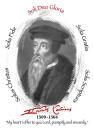
 and object to “Calvinism,” per se, usually seem to not realize just how much more there is to Calvinism than his systematization of the Augustinian (i.e., from the 4th century) doctrine of grace versus the Pelagian notion of free will (which comes complete with its own false gospel of works-righteousness). Baptists in particular, who deny the “doctrines of grace,” don’t realize just how much leftover Calvinism there is in their current theology. Those that do, recognize that they are technically categorized as “moderate Calvinists.” Chief among these is what is nowadays called “eternal security.”
Also, there’s the doctrine of original sin, the Biblical doctrine that Adam’s guilt was imputed to all of his descendants, which sinful condition manifests itself in outward sinful acts. Most Baptists today affirm original sin, and they do so because the Baptists who migrated to America were originally Calvinists. Those “General Baptists,” whom modern anti-Calvinistic Baptists sometimes erroneously look back to as their forefathers in the faith, collectively fell away from the faith, and their theological descendants can be found today among modern Unitarianism.
As a proof for this claim, consider the following words from the Wikipedia entry on the General Baptists, to which I linked above: ” . . . traditionally non-creedal, many General Baptist congregations were becoming increasingly liberal in their doctrine, obliging the more orthodox and the more evangelical among them to reconsider their allegiance during this period of revival (Edward’s, Whitefield’s and Wesley’s 18th century First Great Awakening). Before this re-organisation, the English General Baptists had begun to decline numerically due to several factors linked to non-orthodox ‘Free Christianity’. Early Quaker converts were drawn from the General Baptists, and many other churches moved into Unitarianism. . . “
Those General Baptists denied original sin. For example, John Smyth, (first to pastor a church called “Baptist” shortly before he cast his lot with the Mennonites) wrote in his Confession of Faith in 1609 that, “there is no original sin (lit;, no sin of origin or descent), but all sin is actual and voluntary, viz., a word, a deed, or a design against the law of God; and therefore, infants are without sin.” Modern anti-Calvinistic Baptists generally (no pun intended) affirm original sin, and this is because the Baptists from which you descend were originally Calvinists.
Eternal security and original sin managed to stick around because they weren’t offensive enough to undermine the outward results of mass evangelism, the way the doctrines of grace seem to. We have “revivalism” to thank for that. Read Revival and Revivalism: The Making And Marring of American Evangelicalism, by Iain Murry of Banner of Truth Trust, and you’ll learn how the TULIP got plucked in the wake of the Second Great Awakening as otherwise orthodox Christians began to adopt the methods of arch-Pelagian Charles Finney’s “new measures” in order to maximize the effectiveness of their ginned-up revivals.
But enough introduction. What I wanted to point out was just how pervasive Calvinist theology defines modern Baptist and otherwise Evangelical theology. In my last post, I linked to an essay written by B. B. Warfield entitled “Calvin As A Theologian.” This essay was written to set the record straight about all the common misconceptions that have been fabricated by anti-Calvinists in order to not only disagree with the “five points of Calvinism” (aka, TULIP, the doctrines of grace, etc.) but make those under their spiritual care despise Calvin himself and just about everything he stood for. Read Warfield’s introductory remarks, and then go read the entire article:
I am afraid I shall have to ask you at the outset to disabuse your minds of a very common impression, namely, that Calvin’s chief characteristics as a theologian were on the one hand, audacity—perhaps I might even say effrontery—of speculation; and on the other hand, pitilessness of logical development, cold and heartless scholasticism. We have been told, for example, that he reasons on the attributes of God precisely as he would reason on the properties of a triangle. No misconception could be more gross. The speculative theologian of the Reformation was Zwingli, not Calvin. The scholastic theologian among the early Reformers was Peter Martyr, not Calvin. This was thoroughly understood by their contemporaries.
Among the things that we have inherited from Calvinist theology include the following (as Warfield reports):
-
“In one word, he [Calvin] was distinctly a Biblical theologian, or, let us say it frankly, by way of eminence the Biblical theologian of his age. Whither the Bible took him, thither he went; where scriptural declarations failed him, there he stopped short.”
-
“Calvin marked an epoch in the history of the doctrine of the Trinity, but of all great theologians who have occupied themselves with this soaring topic, none has been more determined than he not to lose himself in the intellectual subtleties to which it invites the inquiring mind; and he marked an epoch i the development of the doctrine precisely because his interest in it was vital (that means “spiritual,” or “devout”) and not merely or mainly speculative.”
-
“The fundamental interest of Calvin as a theologian lay, it is clear, in the region broadly designated soteriological. Perhaps we may go further and add that, within this broad field, his interest was most intense in the application to the sinful soul of the salvation wrought out by Christ, — in a word, in what is technically known as the ordo salutis. . . Its [Calvin’s Institutes]effect, at all events, has been to constitute Calvin pre-eminently the theologian of the Holy Spirit.”
-
“He also marks an epoch in the mode of presenting the work of Christ. The presentation of Christ’s work under the rubrics of the three-fold office of Prophet, Priest and King was introduced by him: and from him it was taken over by the entirety of Christendom, not always, it is true, in his spirit or with his completeness of development, but yet with large advantage.”
-
“In Christian ethics, too, his impulse proved epoch-making, and this great science was for a generation cultivated only by his followers.”
-
“It is probable, however, that Calvin’s greatest contribution to theological science lies in the rich development which he gives–and which he was the first to give–to the doctrine of the work of the Holy Spirit. “
-
Finally, here’s Warfield’s summary of Calvin as a theologian: “It has been common (among academic theologians, not pastors and laity who love to hate Calvin) to say that Calvin’s entire theological work may be summed up in this–that he emancipated the soul from the tyranny of human authority and delivered it from the uncertainties of human intermediation in religious things: that he brought the soul into the immediate presence of God and cast it for its spiritual health upon the free grace of God alone.”
-
And of Calvin’s masterpiece, The Institutes of the Christian Religion, Warfield summarizes: “The Institutes is, accordingly, just a treatise on the work of God the Holy Spirit in making God savingly known to sinful man, and bringing sinful man into holy communion with God.”
Far from being some cold, depressing, rigidly logical and academic murderer (we mustn’t forget Servetus!), Calvin was recognized by his peers and his entire generation as an eminently devout and spiritual biblicist whose development of Protestant theology built on the shoulders of Augustine, Anselm, Hus, Bradwardine, Wycliffe, and Luther and helped make Western Civilization what it became in its historical greatness. All by the grace of God, and for his glory alone!
Reformed Theology Coming to an SBC Church Near You!
On January 11, 2008, the Baptist Press posted a report by Michael Chute, entitled, 
-
“. . . ten percent of Southern Baptist pastors (currently) identify themselves as Calvinists.”
-
“. . . 29 percent of recent SBC seminary graduates espoused Calvinist doctrine.”
-
“. . . a minority of SBC churches are led by Calvinist-leaning pastors, but the number is increasing”
-
“. . . Calvinist-led churches are generally smaller in worship attendance and baptisms than non-Calvinist churches.”
-
“. . . baptism rates between Calvinist and non-Calvinist led churches are virtually identical.”
-
“. . . Calvinistic recent graduates report that they conduct personal evangelism at a slightly higher rate than their non-Calvinistic peers.”
-
A PDF file of the full report is posted here.
Also of interest in the report, Chute quoted Hal Poe, Charles Colson Professor of Faith and Culture at Union University in Jackson, Tennessee, who paints a picture for us of the recent historical trends within the SBC which have led to the current circumstances. “In a broad sense, it’s happening on Christian college campuses too, as Calvinism appeals to young people who are wanting a more intellectual approach to Christianity . . . . Southern Baptists neglected serious Christian education from the early 1960’s, and that’s when all the trouble started. From discipleship training we went to the amorphous youth groups, whose only real good was to keep kids happy until they graduated from high school and graduated from church. Now, you have a generation [of college students] who have come along and want something deeper and they have latched onto Calvinism.”
Poe goes on to site “John Piper, a Reformed Baptist theologian, preacher and author who currently serves as pastor for preaching and vision of Bethlehem Baptist Church in Minneapolis. . . . He’s effective because he’s so passionate. . . He holds huge, stadium-type events that are rip-roaring. There’s nobody else doing anything like this so he becomes [Calvinism’s] expositor. But John Piper’s version of Calvinism is not something John Calvin would espouse, or even that Charles Spurgeon [British reformed Baptist preacher] would espouse.”
It is true that Piper is cut from a different cloth from the great Reformer and the nineteenth-century Puritan “Prince of Preachers.” First of all, it must be noted that Piper is not a Southern Baptist, but a member of the Northern Baptist Convention (Bethlehem Baptist member and Reformed Baptist blogger, Bob Hayton, at Fundamentally Reformed, can correct me on that detail if I’m wrong), where he has been a leader in that denomination’s struggle with the modern heresy known as Open Theism. From my reading of his sermons, Piper may be categorized as a “charismatic Calvinist,” which is more of a doctrinal position than a weekly exhibition of extreme emotionalism in worship, or attempts at exercising the miraculous spiritual gifts of tongues, healing, prophecy, etc., images usually evoked by the term charismatic–though the appeal to emotion seems to be greater in his preaching than in typical Reformed preaching. His experiential emphasis on “desiring God” is in part an application of the answer to the first question in the Westminster Shorter Catechism, which states, “Man’s chief end is to glorify God and enjoy him forever.” But this seems to be little more than a perhaps pietistic reaction against the reputed cold-orthodoxy of many Reformed worship practices.
Another way Calvin would disagree with Piper is in his application of Baptistic principles to Reformed theology, of which, of course, Spurgeon is also guilty. But in this, Piper and Spurgeon are informed by the historic early Baptist confession of faith commonly known as the Second London Baptist Confession of Faith of 1689, which is in large part, a condensing of the Presbyterian Westminster Confession of Faith, with revisions on the statements regarding Baptism. On the other hand, Piper also is embracing the abberant postmodern “emerging” churches–at least the one’s that at least maintain Reformed theology, while seemingly applying seeker-sensitive pragmatic retooling of worship styles to appeal to an “emerging church” demographic. Thus, Piper’s twenty-first century expression of Calvinism does seem to differ from that of Calvin and Spurgeon; however, this Reformed blogger is grateful that such a figure has been able to influence so many Southern Baptists for the doctrines of grace, the biblical emphasis on the sovereignty of God, and his supremacy in all things, including the secular, sacred and even sinful activity of all men.
The Delusion of Extreme KJV Onlyism

In this simple paragraph from the Massachusetts General School Law of 1647, aka “The Old Deluder Satan Law”
Yt being one cheife piect of ye ould deluder, Satan, to keepe men from the knowledge of ye Scriptures, as in formr times by keeping ym in an unknowne tongue, so in these lattr times by pswading from ye use of tongues, yt so at least ye true sense & meaning of ye originall might be clouded by false glosses of saint seeming deceivers, yt learning may not be buried in ye grave of or fathrs in ye church & comonwealth, the Lord assisting or endeavors,—
lt is therefore ordred yt evry towneship in this jurisdiction, aftr ye Lord hath increased ym to ye number of 50 householdrs, shall then forthwth appoint one wthin their towne to teach all such children as shall resort to him to write & reade, whose wages whall be paid eithr by ye parents or mastrs of such children, or by ye inhabitants in genrall, by way of supply, as ye maior pt of those yt ordr ye prudentials of ye towne shall appoint; pvided, those yt send their children be not oppressed by paying much more ytn they can have tm taught for in othr townes; & it is furthr ordered, yt where any towne shall increase to ye numbr of 100 families or househouldrs, they shall set up a gramer schoole, ye mr thereof being able to instruct youth so farr as they may be fited for ye university, pvided, yt if any towne neglect ye pformance hereof above one yeare, yt every such towne shall pay 5 Ito ye next schoole till they shall pforme this order.
Now, let me revise the above highlighted clause in order to make it easier to read.
“. . . so in these latter times by persuading from the use of tongues, that so at least the true sense and meaning of the original [Old Testament Hebrew & New Testament Greek, that is] might be clouded by false glosses of saint-seeming deceivers . . . ”
What is the moral of this story? If you simply prefer the use of the King James Version of the Holy Scriptures for your own personal study and devotional reading, or even if you believe after a considerate examination of the issues of textual criticism, that it is best to retain the Byzantine readings of the New Testament, and therefore ought to not revise the King James Version with a modern, eclectic, critical Greek text, this post does not criticize your view (even though I certainly disagree with your view). But if you believe that the King James Version of the Bible was given by the special inspiration of God, and that it’s English text is superior to the lost original Hebrew and Greek manuscripts for the simple reason that we can hold the KJV in our hands, while we cannot hold the original manuscripts in our hands, and that therefore, we need not bother burdening our congregations with recourse to the original languages to properly interpret the words of the KJV, the Massachusetts General School Law of 1647 identifies those who would undermine the need to understand the Word of God in the original languages as “saint-seeming deceivers” whose efforts would in effect, bury learning in the graves of our fathers in the church. If only you would see the error of your ways, and stop deceiving unlearned believers under your care that it’s dangerous to “correct the King James” with anything, even the sense of the original Hebrew and Greek languages.
New Files Added to My Public Box!
If you’d like a little Audio for Mind and Heart, I’ve just added a song I sang at church a  couple of Sunday mornings ago (you’ll be able to tell I’m not looking for a Dove award!), as well as the sermon preached to me upon my ordination to the office of deacon, just prior to my election to serve in that capacity by Shady Grove Baptist Church. Listen and praise the Lord with me in song and in hearing and heeding his Word preached.
The Connection Between Election And Apostacy
 Here’s my transcription of a listener’s telephone comment on the Sunday, August 12 edition of The White Horse Inn, “Grace & Election in the Book of Ephesians.” On the one hand, the following conversation includes an anecdote which well portrays a “fightin’ fundamentalist” standing his ground against election in a way he may assume is as bold as Paul declaring that if resurrection didn’t really happen, then Christ died in vain and we’re dead in our sins. But on the other hand, it can really make you nervous about the danger to which professing believers expose themselves when they stubbornly deny the Word of God on the doctrines of grace. No, I don’t think dedicated Christians who love and serve Jesus and otherwise believe the Bible and sound conservative theology are apostate if they disagree with election–I mean those who go to the extreme and deny the faith because they refuse to accept the clear teaching of Scripture because of election. The kind to which I’m referring are the kind who understand exactly what the Bible says about election and reject the faith because of it.
Be afraid. Be very afraid.
Horton: Greg in Littleton, Colorado, good evening.
Greg: Hello. This is providential that you’re discussing this tonight, because my uncle who’s an Independent Baptist, to his disappointment, discovered that Spurgeon actually taught this.
Riddlebarger: (while other hosts laugh) Oh boy, did he ever!
Greg: . . . and he really is quite hostile to this teaching, and I really think, for one thing, I said to him, “If I could show you in Scripture where election is clearly taught, wouldn’t you have to give in and believe it?” And I was disappointed at his response–he said, “well, I would have to question the authenticity of the Scriptures.”
Rosenblatt: Holy smokes!
Riddlebarger: Oh, boy!
Horton: Wow. You know, this does bring up an important point. I’ve been in situations where I’ve been talking about this and people have said–even older folks, people who’ve been lifelong Christians, committed to the authority of Scripture, and Bible-believing Christians, and you go through this, and, uh, I remember throwing my Bible across the room when I read Romans 9.
Riddlebarger: Oh, I remember listening to a Donald Grey Barnhouse tape on election, up all night with my Bible going through all the passages he mentioned, just sick in the pit of my stomach. But, you know, that’s just like John chapter 6, when Jesus utters the hard words, “Unless the Father draws you, you can’t come,” and the crowd starts grumbling, so he says it again, and they all walk away.
Horton: Tough words. Even his own disciples: “This is a hard teaching and who can hear it?”
Kingdom Coffers: “Flat Tax” or “Love Offering”? Part 2
 Abram, Melchizedek and “Christian Tithing”
Is it, or is it not, appropriate to call our giving to God in the church “the tithe,” applying Mosaic principles regulating the giving of it (“Will a man rob God?”), and stressing its importance (“The tithe is the LORD’s!!!”), or would it be more biblical to simply “purpose” in one’s own heart how much he ought to give, in order to ensure that it is given with love (1 Corinthians 13:3) or, as Paul wrote in his second letter to the Corinthians, as a “cheerful giver?”
It is held by many that tithing is only a part of the civil/ceremonial aspect of the Mosaic Law and it is, therefore, assumed to be abrogated in the New Testament, in which Paul gives a New Covenant principle of “cheerful giving.” In light of this argument, Christian tithing is defended on the grounds that Abram’s tithing to Melchizedek (Genesis 14:20b) precedes the Mosaic Law and thus ought to be retained after the civil/ceremonial parts of the Mosaic Law are abrogated. For example, consider the Statement of Faith of the World Baptist Fellowship, International. In Section 20 on “The Grace of Giving,” it reads, Under grace we give, and do not pay, the tithe – “Abraham GAVE a tenth part of all” – “Abraham GAVE the tenth of the spoils” – Hebrews 7:2-4 – and this was four hundred years before the law, and is confirmed in the New Testament; Jesus said concerning the tithe, “These ye ought to have done” – Matt. 23:23.
This was the view with which I had been raised. In fact, the Statement of Faith I just cited was the one adopted by the church in which I was saved and baptized. Ever since I’ve been earning money, I’ve been striving to be faithful to this principle. My current church is the first to which I have belonged which specifically denies this concept of some kind of eternal principle about tithing that ought to be retained, even though the civil and ceremonial aspects of the Law have been abrogated. I have been considering the relative merits of both views for the last few years.
If tithing is an eternal principle which transcends the Mosaic administration of the covenant of grace by virtue of Abram’s tithing to Melchizedek, then tithing ought to be retained in Christian worship, further informed, I would say, above and beyond the letter of tithing by Paul’s teaching on evidencing one’s love for the Lord and the people of God by the cheerful giving of that which the believer purposes in his heart in gratitude for the Lord’s blessings (2 Corinthians 8-9).
But if it is a mere aspect of the temporary civil/ceremonial laws, then it is abrogated by Christ and the Pauline giving principle is the only rule for the people of God today. So the challenge for me has been to evaluate whether or not the Abram/Melchizedek tithe in Genesis 14 and Hebrews 7 is a valid basis for the idea that tithing is demanded outside the Mosaic Law.
One of the points that got me thinking about this issue is the claim that the New Testament does not expressly command tithing, therefore it ought not be retained. This argument that there is no explicit New Testament command to tithe was coming off as another application of the same argument invalidly used (in my mind, with all due respect) by Baptists when they argue against pedobaptism. It did not sit well with me to hear pedobaptists using this line of reasoning. So the question is raised in my mind as to just what it is about the New Testament that abrogates the practice of tithing?
There are New Testament Scriptures abrogating everything from sacrificing animals (Hebrews 10:9) to eating unclean animals (Acts 10:9-16); but nothing was surfacing as I searched the Scriptures in my mind that explicitly abrogates the principle of giving ten percent of one’s income to the church. In my mind, this pointed to the perpetuity of tithing as a New Covenant principle.
So that’s what helped me think to scrutinize the Abram/Melchizedek tithing account. How does the New Testament treat this passage? Does its treatment affect the tithing question? Simple answers:
The New Testament treats the Abram/ Melchizedek tithing account as a type fulfilled by Christ. The very same New Testament book which gives the apostolic interpretation also warns us against reinstating Christ-fulfilled types and shadows. So if the account of Abram tithing to Melchizedek typifies the superiority of Christ to the Levitical priesthood, then this Old Testament passage is irrelevant to the question of giving in Christian worship. Therefore, I conclude that the New Testament treatment of that Old Testament account does affect the tithing question by taking this event off the table as a passage to be considered in the context of Christian giving. To do so would be tantamount to returning to Old Testament types and shadows.
Therefore, it is not a misguided baptistic argument to say that New Covenant believers don’t tithe because the new Testament doesn’t command us to tithe but does command us to give cheerfully that which we purpose in our hearts to give as we have been blessed. This is an offering made in the context of New Covenant worship that is pleasing to the Lord!
An IFB associate pastor friend of mine counters this argument with the principle, “There is one interpretation, but there are many applications,” as justification to take this passage about how much greater Christ is than Levi and apply it to the doctrines of giving in New Covenant worship. While it may be true that there are (at least some of them) many applications, those applications are accountable to the one interpretation, rightly exegeted. Does the application of the Abram/Melchizedek type to “Christian tithing” meet this exegetical standard?
Forgive Me

Akin to the preaching of the gospel, we have another help to our faith in the sacraments in regard to which, it greatly concerns us that some sure doctrine should be delivered, informing us both of the end for which they were instituted, and of their present use.
The reason why the ancients used the term in this sense is not obscure. The old interpreter, whenever he wished to render the Greek term “musterion” into Latin, especially when it was used with reference to divine things, used the word sacramentum. Thus in Ephesians, “Having made known unto us the mystery (sacramentum) of his will;” and again, “If ye have heard of the dispensation of the grace of God, which is given me to you-wards, how that by revelation he made known unto me the mystery” (sacramentum,) (Eph. 1: 9; 3: 2.) In the Colossians, “Even the mystery which has been hid from ages and from generations, but is now made manifest to his saints, to whom God would make known what is the riches of the glory of this mystery,” (sacramentum,) (Col. 1: 26.) Also in the First Epistle to Timothy, “Without controversy, great is the mystery (sacramentum) of godliness: God was manifest in the flesh,” (1 Tim. 3: 16.) He was unwilling to use the word arcanum, (secret,) lest the word should seem beneath the magnitude of the thing meant. When the thing, therefore, was sacred and secret, he used the term sacramentum. In this sense it frequently occurs in ecclesiastical writers. And it is well known, that what the Latins call sacramental the Greeks call “musteria” (mysteries.) The sameness of meaning removes all dispute. Hence it is that the term was applied to those signs which gave an august representation of things spiritual and sublime. This is also observed by Augustine, “It were tedious to discourse of the variety of signs; those which relate to divine things are called sacraments,” (August. Ep. 5. ad Marcell.)
Misadventures in Anti-Catholicism

P&W Music

Pet Peeves and Political Preachers

Heartknowledge vs. Headknowledge and Youth Ministry

Horton: One of the justifications for laziness is often to say, “I want heart knowledge, not head knowledge.” “Oh, I don’t want to know about Jesus, I want to know Jesus.” Why is that a cop out?
Riddlebarger: Well, it’s a cop out because Jesus reveals himself to us in his Word, which requires understanding subjects, verbs and objects. It requires reading and studying. And this whole experiential thing is just a Gnostic shortcut to truth and information.
Jones: And I think it’s a false dichotomy. When we talk about the gospel message, we talk about the whole person. Redemption is the redemption of our total being. It includes emotions, but the problem is, our emotions are not just free to go hither and thither, they are governed by the Word of God. I love what Paul says in 2 Corinthians 10: “ . . . bringing every thought into captivity, and casting down every high thing and vain thing that exalts itself against the knowledge of God and bringing every thought into captivity and into the obedience to Christ.” And so, therefore, even my emotions are governed by the Spirit, and that’s part of Paul’s argument in 1 Corinthians, you can’t just go your own way and label that “the Spirit,” because he’s the Spirit of order as well.
Horton: I can’t say, “I have this wonderful emotional experience with my wife but I’ve studiously avoided knowing anything about her. If you claim to have a personal relationship with someone, about whom you don’t invest time to learn, then you can’t really pass off to many people in the room your interest in that person.
Jones: Isn’t that what Jesus illustrates in the parable of the talents? The servant that had so many talents, he says, “Knowing that you were this, that or the other, I did nothing with the talents.” But the master comes back and says, “If you had known me, you would have put my talents to use.” So, you thought you knew Me. And when Jesus comes back and many will say, “We did this in your name,” and Jesus will say, “Depart from me, I never knew you.” Or the Samaritan woman, “You worship what you do not know.”
Riddlebarger: Mike, you may remember this category, we had it growing up in fundamentalism, where we would kind of belittle the mainliners because they would go to church to become better people. So when you asked them questions about Christianity, their default setting was always, “Well, it’ll make me a better person.” Or, “I’ll learn to get along with others better.” The kind of answer that kid gave us is a modern version of that same thing: “I just go to experience God—I’m not beholden to anybody, I don’t have to do anything, it’s that cop out answer that basically lets him off the hook and doesn’t say a darn thing.
Rosenblatt: I think there are a lot of youth leaders that desperately need firing. Now, I know the parents aren’t doing their part behind it, but I’d start by firing the youth leaders. In other words, you want somebody who’s going to, because of his talents, he can do some of this, to instill the content of the Faith, slowly, methodically, however he does it, into the kids during the time he has them. I don’t mean that it turns into a monestary, I mean that’s part of what he himself sees as part of his calling. I remember when Francis Schaeffer was almost an unknown, there was a youth leaders thing at Mission Bay, and I went, and if I remember nothing else from that conference, I remember Schaeffer looking out over all these youth leaders from all over America, and saying, “I plead with you, I plead with you, when you present the gospel, present it first of all as true, not as helpful.”
“The Baptist Version of Sola Scriptura” Revisited

Following are a few excerpts which will give you an idea of Mathison’s treatment of the subject of Solo Scriptura:
“The twentieth century could, with some accuracy, be called a century of theological anarchy. Liberals and sectarians have long rejected outright many of the fundmanetal tenets of Christian orthodoxy. But more recently professing evangelical scholars have advocated revisionary versions of numerous doctrines. A revisionary doctrine of God has been advocated by proponents of “openness theology.” A revisionary doctrine of eschatology has been advocated by proponents of full-preterism. Revisionary doctrines of justification sola fide have been advocated by proponents of various “new perspectives” on Paul. Often the revisionists will claim to be restating a more classical view. Critics, however, have usually been quick to point out that the revisions are actually distortions.
Ironically, a similarly revisionist doctrine of sola Scriptura has arisen within Protestantism, but unlike the revisionist doctrine of sola fide, the revisionist doctrine of sola Scriptura has caused very little controversy among the heirs of the Reformation. One of the reasons there has been much less controversy over the revisionist doctrine of sola Scriptura is that this doctrine has been gradually supplanting the Reformation doctrine for centuries. In fact, in many segments of the evangelical world, the revisionist doctrine is by far the predominant view now. Many claim that this revisionist doctrine is the Reformation doctrine. However, like the revisionist doctrines of sola fide, the revisionist doctrine of sola Scriptura is actually a distortion of the Reformation doctrine.”
“Part of the difficulty in understanding the Reformation doctrine of sola Scriptura is due to the fact that the historical debate is often framed simplistically in terms of “Scripture versus tradition.” Protestants are said to teach “Scripture alone,” while Roman Catholics are said to teach “Scripture plus tradition.” This, however, is not an accurate picture of the historical reality. The debate should actually be understood in terms of competing concepts of the relationship between Scripture and tradition, and there are more than two such concepts in the history of the church. In order to understand the Reformation doctrine of sola Scriptura we must understand the historical context more accurately.”
Here Mathison begins to summarize three views on the relationship between Scripture and tradition, borrowing clever labels from Heiko Oberman:
Tradition 1: “In the first three to four centuries of the church, the church fathers had taught a fairly consistent view of authority. The sole source of divine revelation and the authoritative doctrinal norm was understood to be the Old Testmanet together with the Apostolic doctrine, which itself had been put into writing in the New Testament. The Scripture was to be interpreted in and by the church within the context of the regula fidei (“rule of faith”), yet neighter the church nor the regula fidei were considered second supplementary sources of revelation. The church was the interpreter of the divine revelation in Scripture, and the regula fidei was the hermeneutical context, but only Scripture was the Word of God.”
Tradition 2: “The first hints of a two-source concept of tradition, a concept in which tradition is understood to be a second source of revelation that supplements biblical revelation, appeared in the fourth century in the writings of Basil and Augustine. . . It is not absolutely certain that either Basil or Augustine actually taught the two-source view, but the fact that it is hinted at in their writings ensured that it would eventually find a foothold in the Middle Ages. This would take time, however, for throughout most of the Middle Ages, the dominant view was Tradition1, the position of the early church. The beginnings of a strong movement toward Tradition 2 did not begin in earnest until the twelfth century.” Willaim of Ockham was one of the first medieval theologians to officially adopt this two-source view of revelation in the fourteenth century.
Mathison shows how the Reformation, in part, was a move back to “Tradition 1,” the view that Scripture was the sole source of divine revelation, to be interpreted by the church within the context of the regula fidei, the hermeneutical tradition, if you will.
“To summarize the Reformation doctrine of sola Scriptura, or the Reformation doctrine of the relation between Scripture and tradition, we may say that Scripture is to be understood as the sole source of divine revelation; it is the only inspired, infallible, final and authoritative norm of faith and practice. It is to be interpreted in and by the church; and it is to be interpreted within the hermeneutical context of the rule of faith.”
I, myself, wrote on the Reformation of Tradition 2 once.
Now here’s where the trouble starts in relation to misunderstanding the idea of Sola Scriptura:
Tradition 0?: “At the same time the magisterial reformers were advocating a return to Tradition 1 (sola Scriptura), several radical reformers were calling for the rejection of both Tradition 1 and Tradition 2 and the adoption of a completely new understanding of Scripture and tradition. They argued that Scripture was not merely the only infallible authority but that it was the only authority altogether. The true but subordinate authority of the church and the regula fidei were rejected altogether. According to this view, there is no real sense in which tradition has any authority. Instead, the individual believer requires nothing more than the Holy Spirit and the Bible.”
Is this beginning to sound familiar? I thought so.
Now, back to my own opinion, and application of these historical matters. It was the 1644 edition of the London Baptist Confession of Faith that complains that their movement is “commonly (though falsely) called Anabaptists.” Having adopted fully Reformed theology, including the doctrine of paedobaptism, when I compare how the Baptist tradition from its very inception, so completely embraced Reformed theology with the full scope of understanding of these doctrines in accord with “Tradition 1,” the ancient view that Scripture alone is divine revelation, to be interpreted within the traditional hermeneutic of the regula fidei. But then, when one examines the teaching of these otherwise Reformed Christians on baptism, hints of tendency toward “Tradition 0,” the Anabaptist view of the relationship between Scripture and tradition, begin to emerge.
This is what I meant by “The Baptist Version of Sola Scriptura.” I don’t “falsely” claim that Baptists are Anabaptists, I just think they took baby steps away from Reformation and toward Anabaptism on baptism (and maybe congregationalism?). That’s all. But rank and file Baptists, like many otherwise evangelical paedobaptists, have moved with the spirit of the age to embrace the modern revisionist tendency toward “Solo Scriptura.” And I think that’s a problem. Work must be, and is being, done to correct this problem here and there. That’s why I like to publicize the Cambridge Declaration of the Alliance of Confessing Evangelicals.
Dear Bloggers, You’ve Got a “Llove” Letter!

Check out my pastor’s new website! www.lloveletters.com. Notice that he’s got a book for sale, too!
Blogging under the identity of “Christian West,” my pastor will be regularly attempting to encourage believers who read his blog to “excercise the Disciplines of Llove.” Click here to read his first post on his blog. . .Failure Is Underrated.
The KJV Code Revisited

What precedent is there in Scripture, history or the disciplines of textual criticism or translation theory/practice for demanding a static translated text? There is none. There are anecdotal cases to which KJV onlyists could appeal, like the superstitious exaltation of the Septuagint, but these are erroneous and would prove utterly ineffective to persuade the bulk of orthodox scholarship to adapt everything to this invalid line of reasoning. Besides, radical KJV onlyists deny the validity of the Septuagint, and wouldn’t want to go there. This leaves them all alone with their novel theory.
Fundamentalists Contra Mundum!

 That’s when it hit me! Fundamentalists contra mundum! Fundamentalists who seem to be against everything that’s going on in the broader Christian world except what’s going on within the four walls of their own churches, and the small group of churches with whom they are willing to extend genuine fellowship are like a photographic negative of the man for whom this Latin nickname was coined. There for a minute I considered telling my friend the story of Athanasius, who famously stood “against the world” (contra mundum) to defend the orthodox view of the Trinity and the deity of Christ during the Council of Nicea, but he had plenty of other things on his mind so before I had another chance to speak, the thought had escaped me. But now it’s back, and I thought it was a cute enough little association that serves to underscore the hyper-separatism of fundamentalism, that I just had to share it with you.

 The Misadventures of Captain Headknowledge