The Arian Heresy and Nicene Orthodoxy
“Arianism–Arianism was a 4th-century Christian heresy named for Arius (c. 250-c. 336), a priest in Alexandria [Egypt]. Arius denied the full deity of the preexistent Son of God who became incarnate in Jesus Christ. He held that the Son, while divine and like God (“of like substance”), was created by God as the agent through whom he created the universe. Arius said of the Son, “there was a time when he was not.” Arianism became so widespread in the Christian church and resulted in such disunity that the emperor Constantine convoked a church council at Nicaea in [A.D.] 325.” (from Class Handout)
Hear, O Israel (John 10:22-30)
At that time the Feast of Dedication took place at Jerusalem. It was winter, and Jesus was walking in the temple, hin the colonnade of Solomon. So the Jews gathered around him and said to him, “How long will you keep us in suspense? If you are ithe Christ, jtell us plainly.” Jesus answered them, “I told you, and you do not believe. The works that I do lin my Father’s name bear witness about me, but myou do not believe because you are not among my sheep. My sheep hear my voice, and I know them, and they follow me. I give them eternal life, and pthey will never perish, and no one will snatch them out of my hand. My Father, who has given them to me, is greater than all, and no one is able to snatch them out of tthe Father’s hand. I and the Father are one.” (John 10:22-30)
Gnosticism and Docetism
“[T]he idea of the presence in man of a divine “spark”…, which has proceeded from the divine world and has fallen into this world of destiny, birth and death and which must be reawakened through its own divine counterpart in order to be finally restored. This idea…is ontologically based on the conception of a downward development of the divine whose periphery (often called Sophia or Ennoia) has fatally fallen victim to a crisis and must–even if only indirectly–produce this world, in which it then cannot be disinterested, in that it must once again recover the divine “spark” (often designated as pneuma, “spirit”).”
–Congress on the Origins of Gnosticism in Messina, 1966 (cited in Rudolph, Kurt; Gnosis: The Nature & History of Gnosticism. Harper & Row, 1987. Page 57)
The Good Shepherd (John 10:1-21)
“Truly, truly, I say to you, he who does not enter the sheepfold by the door but climbs in by another way, that man is a thief and a robber. But he who enters by the door is the shepherd of the sheep. To him the gatekeeper opens. The sheep hear his voice, and he calls his own sheep by name and leads them out. When he has brought out all his own, he goes before them, and the sheep follow him, for they know his voice. A stranger they will not follow, but they will flee from him, for they do not know the voice of strangers.” This figure of speech Jesus used with them, but they did not understand what he was saying to them.
So Jesus again said to them, “Truly, truly, I say to you, I am the door of the sheep. All who came before me are thieves and robbers, but the sheep did not listen to them. I am the door. If anyone enters by me, he will be saved and will go in and out and find pasture. The thief comes only to steal and kill and destroy. I came that they may have life and have it abundantly. I am the good shepherd. The good shepherd lays down his life for the sheep. He who is a hired hand and not a shepherd, who does not own the sheep, sees the wolf coming and leaves the sheep and flees, and the wolf snatches them and scatters them. He flees because he is a hired hand and cares nothing for the sheep. I am the good shepherd. I know my own and my own know me, just as the Father knows me and I know the Father; and I lay down my life for the sheep. And I have other sheep that are not of this fold. I must bring them also, and they will listen to my voice. So there will be one flock, one shepherd. For this reason the Father loves me, because I lay down my life that I may take it up again. No one takes it from me, but I lay it down of my own accord. I have authority to lay it down, and I have authority to take it up again. This charge I have received from my Father.”
There was again a division among the Jews because of these words. Many of them said, “He has a demon, and is insane; why listen to him?” Others said, “These are not the words of one who is oppressed by a demon. Can a demon open the eyes of the blind?”
(John 10:1-21 ESV)
While I AM is Still Near (John 9:1-7)
As he passed by, he saw a man blind from birth. And his disciples asked him, “Rabbi, who sinned, this man or his parents, that he was born blind?” Jesus answered, “It was not that this man sinned, or his parents, but that the works of God might be displayed in him. We must work the works of him who sent me while it is day; night is coming, when no one can work. As long as I am in the world, I am the light of the world.” Having said these things, he spit on the ground and made mud with the saliva. Then he anointed the man’s eyes with the mud and said to him, “Go, wash in the pool of Siloam” (which means Sent). So he went and washed and came back seeing. (John 9:1-7 ESV)
Craig Troxel on Trends and Biblical Reformation of the Church

Bethel OPC Wheaton Pastor and Author Craig Troxel
Craig Troxel, Pastor of Bethel Presbyterian Church (OPC) in Wheaton, Illinois, will be speaking at Mid-Cities Presbyterian Church’s 2015 DFW Reformation Conference (Nov. 13-14, 2015) on the subject of “With All Your Heart: Thinking (again) About What We Think, Love and Choose.”
Pastor Troxel has spoken on Reformed theology in Texas previously down in Pflugerville, Texas, at our sister congregation, Providence Presbyterian Church at their 2009 Calvin Conference.
 Perhaps a few of you who are thinking about attending this year’s conference in Bedford would enjoy sampling Pastor Troxel’s work.
Semper Reformanda: Under Renovation or Seeking
The Emerging Church: The New Voice in the Conversation
Every Member Matters: The Priesthood of All Believers
Presbyterian Salsa: Westminster Calvinism’s Recipe for “The Communion of the Saints”
Register for the 2015 DFW Reformation Conference (Nov. 13-14, 2015) at Mid-Cities Presbyterian Church (1810 Brown Trail, Bedford, TX 76021).
Westminster West–Texas, that is!
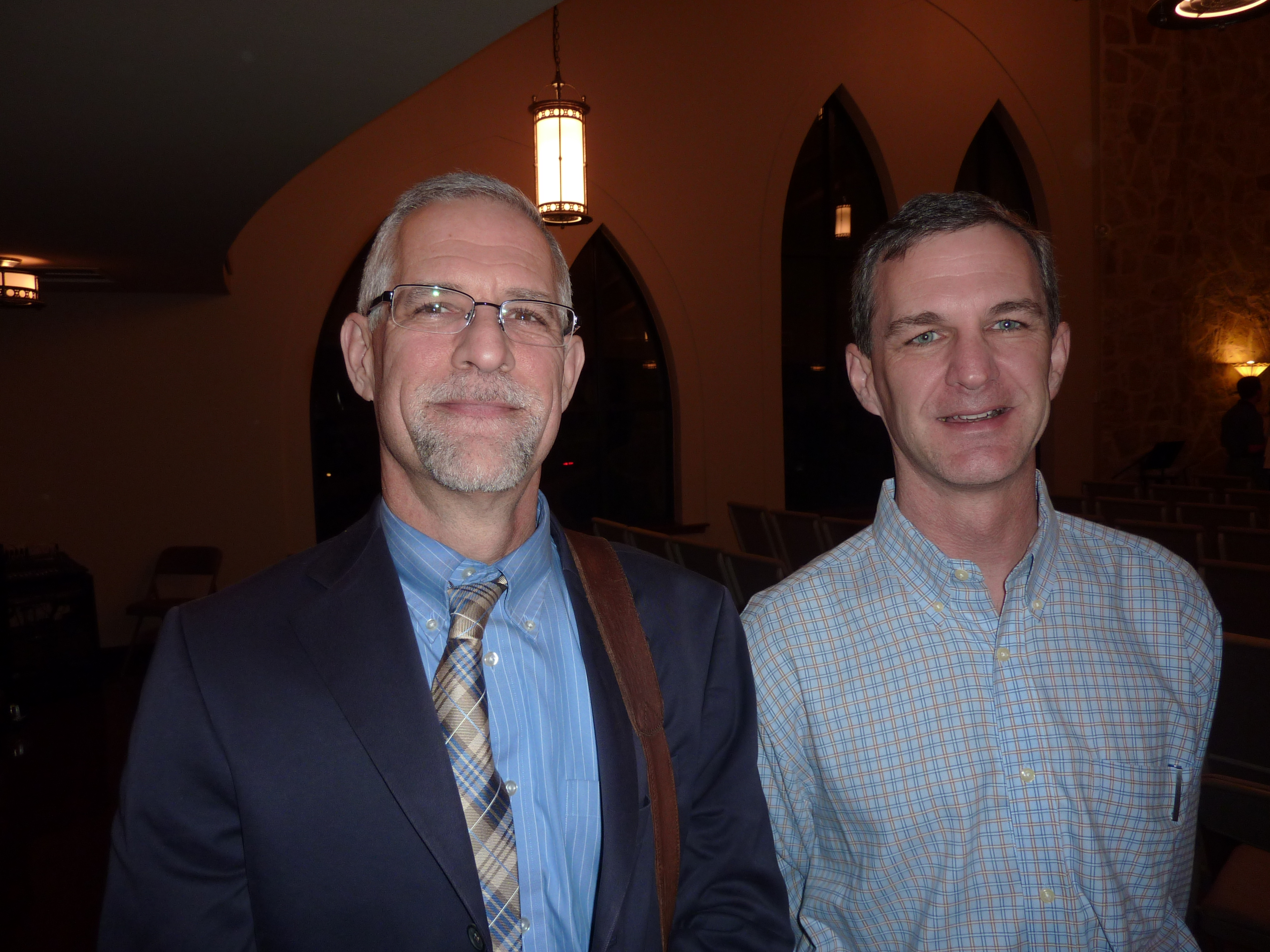
K. Scott and Kyle Oliphint
Congratulations to Rev. Jeremy Boothby, the newly ordained and installed pastor of Christ Covenant OPC in Amarillo, Texas. This is a sister church in my church’s Presbytery of the Southwest, which facilitates the connectedness of our Orthodox Presbyterian congregations located in Texas, Oklahoma and New Mexico. Last Friday was the day of the installation service, where Drs. Lane Tipton and K. Scott Oliphint both spoke. Amarillo is the hometown of Dr. Oliphint, along with his brother, Rev. Kyle Oliphint, who is now pastor of Grace Community PCA on the north side of Fort Worth, near Keller, Texas. I decided to post this playlist because I knew there would be a few of you out there who just have to see Lane Tipton and Scott Oliphint doing what they do. I can’t say that I blame you. The videos are courtesy of Pastor Andrew Moody of San Antonio Reformed Church. Don’t let the YouTube channel confuse you, the events in the videos take place in Amarillo, even though they are posted by a guy from San Antonio.
I got to know Pastor Boothby when my wife and I were counselors at camp down in Leakey, Texas. Jeremy and I led a team of campers in putting together a skit featuring the camp’s theme. Jeremy had the idea to imitate those commercials with the guy sitting at a table asking a group of kids “Which is better?” in which hilarity ensued. We had a unique combination of personalities on our team, which gave us some good “Kids Say the Darnedest Things” moments. I also got to see what a capable athlete he was on the basketball court, which I suppose is why I commented on the video of the newly installed Pastor Boothby giving his first real live benediction that his smile looks like he’s repressing the urge to dance in the end zone or something. I wish I could find those camp pictures but we’ve been slowly transferring files from an old computer to a new one and I haven’t been able to locate them, not even on our Carbonite account. If I find them soon, maybe I’ll update the post.
May Pastor Jeremy Boothby enjoy many fruitful and happy years pastoring Christ Covenant OPC in Amarillo, Texas!


 The Misadventures of Captain Headknowledge
For God’s Glory, and for Our Good (John 11:1-16)
Now a certain man was ill, Lazarus of Bethany, the village of Mary and her sister Martha. It was Mary who anointed the Lord with ointment and wiped his feet with her hair, whose brother Lazarus was ill. So the sisters sent to him, saying, “Lord, he whom you love is ill.” But when Jesus heard it he said, “This illness does not lead to death. It is for the glory of God, so that the Son of God may be glorified through it.”
Now Jesus loved Martha and her sister and Lazarus. So, when he heard that Lazarus was ill, he stayed two days longer in the place where he was. Then after this he said to the disciples, “Let us go to Judea again.” The disciples said to him, “Rabbi, the Jews were just now seeking to stone you, and are you going there again?” Jesus answered, “Are there not twelve hours in the day? If anyone walks in the day, he does not stumble, because he sees the light of this world. But if anyone walks in the night, he stumbles, because the light is not in him.” After saying these things, he said to them, “Our friend Lazarus has fallen asleep, but I go to awaken him.” The disciples said to him, “Lord, if he has fallen asleep, he will recover.” Now Jesus had spoken of his death, but they thought that he meant taking rest in sleep. Then Jesus told them plainly, “Lazarus has died, and for your sake I am glad that I was not there, so that you may believe. But let us go to him.” So Thomas, called the Twin, said to his fellow disciples, “Let us also go, that we may die with him.”
(John 11:1-16 ESV)
Share this: