The Reformed Approach to Holidays
As my family experiences its first Easter together as regular attenders of a Reformed church, we are experiencing a distinct difference from the approach our former non-Reformed fundamentalist and evangelical churches have approached it. Following is a couple of paragraphs from an entry on Calvinism from the Encyclopedia of the Early Modern World, by the Gale Group, Inc. This should help us (and you) put the Reformed approach to holidays in general into historical context.
This morning our family is celebrating the resurrection of the Lord Jesus Christ. May this Easter Sunday find you worshiping the risen Lord in your house of worship.
Another distinctive feature of Reformed Protestantism was its remarkably small number of official holidays. Calvin himself saw no need and no scriptural basis for any holiday other than Sunday, and Reformed Protestants usually celebrated extremely few of them. Their most austere churches,GenevaandScotland(or seventeenth-centuryNew England), observed none at all—not untilGeneva’s magistrates overruled their pastors and finally declared Christmas an official holiday in 1694. Such situations were, however, exceptional. The mainstream of established Calvinism, the Reformed churches ofZurich,Bern,France, theNetherlands, and thePalatinate, celebrated four holidays besides Sundays: Christmas, Easter, Ascension Day, and Pentecost; the Dutch and thePalatinatealso added New Year’s Day. Keeping only a handful of holy days marked an enormous departure from Catholic practices, which in most places celebrated anywhere from forty to sixty holidays each year. Other mainstream Protestants were far less radical than Calvinists: Lutherans kept a large number of holy days, while the Church of England became a target for Puritan scorn by observing a total of twenty-seven holidays. Early Massachusetts went further and took the most extreme Calvinist position about the Christian calendar: not only did the colony ban all holidays, but its General Court briefly reformed the “pagan” names of the months as well, dating by “first month,” “second month,” and so forth.
Many Calvinists compensated for this paucity or absence of other holidays with a strict observance of Sunday, almost in an exact correlation.ScotlandbecameEurope’s most notorious example in 1579, when serious punishments were first threatened for Sabbath-breakers; by 1649, they had forbidden such practices as fishing on Sunday.Scotland’s extremely rigid taboos about Sabbath observance lasted far into modern times; it has been suggested that “Thou Shalt Not” made the best title for a history ofScotland, with its longest chapter called “Never on Sunday.” Another specifically Calvinist ritual was the special day of community fasting, proposed by pastors and decreed by secular authorities, usually intended to divert God’s wrath at times of extraordinary danger. We find fast days observed as early as the 1560s by the beleaguered churches of theLow CountriesorFrance, and later in seventeenth-centuryNew England; they remained a feature of Genevan life until the nineteenth century.
Should We “Pass Over” Easter?
“And when he had apprehended him, he put him in prison, and delivered him to four quaternions of soldiers to keep him; intending after Easter to bring him forth to the people” (Acts 12:4 KJV—emphasis mine).
Is Easter a valid translation of pascha in Acts 12:4? It is according to Nick Sayers in his video and companion two-part article, “Why We Should Not Passover Easter.” Sayers points to the presence of early forms of the word Easter in pre-KJV translations of the New Testament. He shows how from Tyndale’s use of ester and esterlambe (haven’t taken the time to check the spelling) and his coining of the English word “Passover” there is a transitional pattern in the intervening translations of the New Testament between Tyndale’s and King James’. Sayers’ ultimate point is that, if you look at Acts 12:4 in context, it would be clear that Herod had the Jewish Passover in mind, but that the KJV translators retained Easter as their translation of pascha because they believed Luke’s pointing out that the events in the passage took place during the days of unleavened bread that his use of the word pascha was also an allusion to the supposed apostolic practice of an annual commemoration of Christ’s resurrection, which in the seventeenth as well as the twenty-first centuries, is called Easter. Ironically, Sayers links to a Trinitarian Bible Society article on Easter in the KJV which states unequivocally that there was no apostolic annual commemoration of Christ’s resurrection, only the weekly Lord’s Day.
There is much I find compelling about the presentation in this video, yet I still have some lingering doubts. I do agree with modern version proponents that “Passover” is still the better translation of pascha in Acts 12:4, but given some of the information in Sayers’ video, coupled with the fact that the Venerable Bede is the uncorroborated source of the claim that the word Easter is derived from an ancient pagan goddess, I can see how it may have been that the KJV translators had some decent reasons for wanting to retain the use of the word Easter, if only once, in their version.
One thing that I appreciate most about the presentation in the video, is that it does a good job of demonstrating the flaws in Alexander Hislop’s claim that the word Easter comes from ancient Phoenician worship of Ishtar on phonetic grounds (“Easter sounds like Ishtar”). Another helpful expression of critical thinking skills is how Sayers points out early in his video that cultists are drawn to old wive’s tales like Hislop’s treatment of Easter in his widely read (among fundamentalists) book, The Two Babylons. A great take-away quote from Sayer is, “If you are a Bible believer, you believe the Bible; if you are superstitious, you will believe Hislop.” Amen!
I find myself hesitant to latch on to Sayers’ attempt to demonstrate that due to its etymology in the German word oster, Easter basically means “resurrection.” Until I see more authoritative evidence of this, I think it’s safest to say that this is just a little too good to be true, as much as I would like for it to be. If any of my readers have done some homework on this topic, and is able to correct or corroborate Sayers’ claims in his video and articles, please share your findings with me in the comments. My mind is open regarding these things, and I solicit your input.
I’m afraid, however, I’m drawn to this line of argumentation because I’m personally so eager to encourage those who think Easter really is an allusion to a pagan goddess to embrace the very real possibility that it actually springs from a Christian source of origin rather than pagan (see my post “Treating Easterphobia“). This just goes to show that I may not be quite as Reformed as I’d like to be. Help me, dear readers, and may you have an edifying Lord’s Day and a happy Easter.
Divine Inspiration Required by the Character of the Penmen of the Scriptures

Lithograph of the Reverend John Brown of Haddington
The following continues a series of excerpts from “An Introduction to the Right Understanding of the Oracles of God,” by the Rev. John Brown of Haddington, as published in his Self-Intepreting Bible (1859 edition).
V. The manifest CHARACTER OF THE PENMEN further evinces the divine original of the Scriptures.
They everywhere discover the utmost candour and disinterestedness: they everywhere candidly publish the infirmities, or even faults of themselves, their friends, and nation. None of them ever gained anything in this world by their work but trouble and vexation; and, according to their own principles, they could obtain nothing in the next but everlasting destruction, if they indulged themselves in any imposture.
The matter and mannerof their work infinitely transcended their abilities. Setting their predictions aside for a moment, how could men of the best education, and especially men of no education, form such exalted schemes of sense, piety, and virtue? Or how could wicked men, inspired by Satan, publish and prosecute such a scheme of mystery, holiness, and morality?
Such is the character of Jesus Christ, drawn by the four evangelists, with every mark of simplicity and candour, and in which ignominious suffering is made a leading article, that the delineation thereof—and that too by persons of no uncommon knowledge—without a real and exactly answerable model, would, to every unbiased free-thinker, appear more incredible and impossible than even the incarnation, obedience, and death of the Son of God, therein attested, however astonishing. (emphasis mine)
Divine Inspiration Required by the Manner, Scope and Harmony of the Scriptures

Self-Interpreting Bible (1859 edition), Rev. John Brown of Haddington, original editor
The following continues a series of excerpts from “An Introduction to the Right Understanding of the Oracles of God,” by the Rev. John Brown of Haddington, as published in his Self-Intepreting Bible (1859 edition).
II. The MANNER in which these subjects are exhibited in the Scriptures is evidently divine; –wise, condescending, and yet majestic. The discoveries have been gradual, as men stood in need of them or were in a proper condition to receive them (Gen. 3,9,12,17 & c.; Heb. 1:1). The principal points; as of God’s new-covenant grant of himself to sinful men; his full satisfaction in and with Christ as our Mediator; and the law of the ten commandments; were declared from heaven with uncommon solemnity (Mat. 3:17; 17:5; Ex. 20:1-18, &c.). And, while these and other similar truths are announced in a style the most plain and simple, there appears therein something astonishingly sublime and majestic. While the dictates are authorized with a THUS SAITH THE LORD, the very style, particularly in Scripture songs, Job, Psalms, Lamentations, and Isaiah, and in our Saviour’s discourses, &c., is at once surprisingly suited to the dignity of the Author, the nature of the subject, and the condition of the persons addressed.
III. The manifest SCOPE of the Scriptures is to render sin loathsome and hated, and to promote holiness and virtue; to humble men, and reform them from their beloved lusts and sinful practices, and to exalt and glorify God to the highest. No good angel or man could dare to personate God in the manner of the Scriptures; nor could bad angels or men publish, and so warmly inculcate, what is so remarkably contrary to their own vicious inclinations and honour. It therefore remains that God alone must be the author and inditer of them.
IV. Notwithstanding the dictates of Scripture are so extremely contrary to the natural inclinations of mankind, and were published without any concert by various persons, of very different conditions, and in different ages and places, yet such is the marvellous HARMONY of all the parts, in their whole matter and scope, as irrefragably demonstrates that these penmen must all have been directed by the same Spirit of God. One part of our Bible is so connected with, and tends to the establishment of another, that we cannot reasonably receive any part without receiving the whole. In the New Testament we have the historical narrative of the fulfillment of the typical and verbal predictions of the Old. In both Testaments the subsequent books, or subsequent parts of a book, are connected with that which went before, as a narrative of the execution of a scheme begun, or of the fulfillment of a prophecy declared. If we receive the history, we must also receive the prediction. If we admit the prediction, we must believe the history. To a diligent searcher of the Scriptures, it cannot fail to occasion a most pleasant astonishment, to find everywhere the same facts supposed, related or prepared for; the same doctrines of a gracious redemption through Jesus Christ exhibited, or supposed to be true; the same rules or exemplifications of piety and virtue, and motives thereto; the same promises of mercy, or threatenings of just misery, to persons, societies, or nations, exhibited without a single contradiction. When there is an appearance of contradiction, it will be found that the different passages do not respect the same thing or person, in the same respect, and in the same circumstances of time, place, or manner; and so there is no contradiction at all.
Divine Inspiration Required by the Subject Matter of the Scriptures

John Brown’s Self-Interpreting Bible (1859)
The following continues a series of excerpts from “An Introduction to the Right Understanding of the Oracles of God,” by the Rev. John Brown of Haddington, as published in his Self-Intepreting Bible (1859 edition).
I. The subject MATTER of them requires a divine inspiration. The history of the creation, and part of that of the flood, &c., therein related, were known only to God. Mysteries relative to the Trinity of persons in the Godhead; the covenant of grace; the incarnation of the Son of God; his undertaking, offices, and states, and our union with him; justification, adoption, sanctification, spiritual comfort, and eternal blessedness, in him, are therein declared;–which God only could comprehend or discover.
The scheme of religion therein prescribed is so pure and benevolent, that God alone could devise or appoint it. While it represents the Most High as everywhere present—as infinitely perfect, powerful, wise, and good—holy, just, and true—an infinitely gracious lover of righteousness, and hater of iniquity,–as our bountiful Creator and Preserver, and as the infinitely merciful Redeemer of our souls, by the obedience and death of his only begotten Son,–it requires us to know, believe in, and revere him with our whole heart, soul, mind and strength, as our Father, Friend, Husband, Saviour, and Portion in Christ; and confidently to depend on him, and ask from him whatever we need in time or eternity; and to obey him in all that he commands, as children whom he hath begotten again to a lively hope, and established as the heirs of his everlasting inheritance.
We are here taught how human nature may be truly improved and perfected, by our receiving Jesus Christ as made of God unto us wisdom, righteousness, sanctification, and redemption,–as an effectual principle and root of true holiness;–and by our walking in him by faith, denying ungodliness and worldly lusts, and living soberly, righteously, and godly, patiently, contentedly, and cheerfully,–setting our affections upon things above, where Christ is, and through the Spirit mortifying every sinful and selfish inclination. We are taught to love our neighbours as ourselves, perfectly fulfilling the particular duties of every relative station; and to lay aside all malice, envy, hatred, revenge, or other malevolent dispositions or passions; to love our enemies; to render good for evil, blessing for cursing; and to pray for them that despitefully use us. These laws of universal purity and benevolence are prescribed with an authority proper only to God, and extended to such a compass and degree as God alone can demand: and those sins are forbidden which God alone can observe or prohibit.
The most powerful motives to duty, and dissuasives from vice, are here most wisely proposed, and powerfully urged; motives drawn from the nature, the promises, the threatenings, the mercies, and the judgments of God; particularly from his kindness in the work of our redemption, and his new-covenant relations to us in Christ; and from advantages or disadvantages, temporal, spiritual, and eternal. And, while the most excellent means of directing and exciting to, and of exercising piety and virtue, are established on the most prudent forms and authoritative manner, the most perfect and engaging patterns of holiness and virtue are set before us in the example of Jesus Christ our Redeemer, and of God as reconciled in him, and reconciling the world to himself (Ex. 21:1-17; Lev. 18-20; Deut. 4-25; Mat. 5—7; Rom. 6:12—15; Gal. 5-6; Eph. 4—6; Col. 3:4; 1 Thes. 5; Tit. 2; Jam. 1-5; 1 Pet. 1-5; 2 Pet. 1; 1 John 1—5, &c., &c).
Interviewing the Interviewer and “Heaven & Hell”

Martin Bashir
You just have to listen to this program. Martin Bashir, the MSNBC journalist who gave Rob Bell a challenging interview about the contents of his new book Love Wins, was interviewed himself on the Paul Edwards Program about that interview. Edwards not only wanted to know how Bashir prepared for his interview with Bell, but also wanted him to confirm or squash the rumor that’s been going around that he is himself a Christian and a member of Redeemer PCA in New York City. Bashir explains his own motives and methods for his Bell interview.
It’s an awesome program! Gene Veith or someone else well versed in the Protestant doctrine of vocation should interview him further as an example of a Christian pursuing excellence in his journalistic vocation for the glory of God. I think that would be an interesting discussion.
Listen to “MSNBC’s Martin Bashir on the Paul Edwards Program.”
Also listen to this special episode of the White Horse Inn, “Heaven and Hell,” in which the “usual cast of characters” discuss Rob Bell and Love Wins with Kevin DeYoung, a leader of the so-called “New Calvinism,” or “The Young, Restless and Reformed” movement, the orthodox alternative to the postmodern liberalism of Rob Bell, Brian McLaren, Doug Pagitt, etc.
The Divine Inspiration of Scripture Demonstrated
Lithograph of the Reverend John Brown of Haddington
Here’s part two of my planned, looong series of consecutive excerpts from “An Introduction to the Right Understanding of the Oracles of God” from the Self-Interpreting Bible (1859 edition), edited by Rev. John Brown of Haddington. You’ll always be able to access each post in this series by clicking on the category “An Introduction to the Right Understanding of the Oracles of God” in the sidebar or at the bottom of any of the posts in this series.
While reason, then, plainly suggests the possibility, the desirableness, and the necessity of a revelation from God, adapted to our circumstances, the books of the Old and New Testament manifest themselves reasonable, credible, and divinely inspired: It is their DIVINE INSPIRATION (which indeed supposes them reasonable and credible) that we now attempt to demonstrate. In what manner the influence, by which the penmen of the Scriptures were directed, affected them, we pretend not fully to explain. It is enough for us to know, that thereby they were infallibly guided and determined to declare what they did not formerly know; to conceive properly of what they had formerly known; and to express their subject in terms absolutely just in themselves, and calculated to convey the truths represented to others. But so far we may conclude, that, while the penmen exercised their own reason and judgment (Ps. 45:1; Mark 12:36; Luke 1:3; Acts 1:1; 1 Pet. 1:11) the Holy Ghost:
(1) Effectually stirred them up to write (2 Pet. 1:21);
(2) Appointed to each his proper share or subject correspondent with his natural talents, and the necessities of the church in his time (Mat. 25:15; 2 Pet. 1:21);
(3) Enlightened their minds, and gave them a duly distinct view of the truths which they were to deliver (Jer. 1:11-16; 13:9-14; Ezek. 4:4-8; Dan. 10:1,14; 9:22-27; 8:15-19; 12:8; Amos 7:7,8; 8:2; Zec. 1:19, 21; 4:11-14; 5:6; John 16:13; Eph. 3:3,4; 1 Pet. 1:10,11). Perhaps this illumination was given all at once to Paul, when caught up to the third heaven, but was bestowed gradually on the other apostles (Mark 4:34; Luke 24:17,45; John 20:22; Acts 2:4; 10:9-15,28,34).
(4) He strengthened and refreshed their memories to recollect whatever they had seen or heard, which he judged proper to be inserted in their writings (Jer. 31:3; Luke 1:3; John 14:26).
(5) Amidst a multitude of facts, he directed them to write precisely what was proper for the edification of the church, and neither more nor less (John 20:30, 31; 21:25; Rom. 4:23, 24; 15:4; 1 Cor. 10:6-11).
(6) He excited in their minds such images and ideas as had been treasured up in their memories, and directed them to other ends and purposes than themselves would ever have done of their own accord. Thus, under inspiration, Amos draws his figures from herds, flocks, and fields; Paul makes use of his classical learning (Amos 1, 9; Acts 17:28; 1 Cor. 15:33; Tit. 1:2).
(7) He immediately suggested and imprinted on their minds such things as could not be known by reason, observation or information, but were matters of pure revelation (Is. 46:9, 10; 41:22,23; 45:21) whether they respected doctrines (1 Tim. 3:16), or facts past or future (Gen. 1:2,3; Lev. 26 &c).
(8) He so superintended every particular writer, as to render him infallible in his matter, words, and arrangement; and by his superintending influence, made them all in connexion so to write, as to render the whole Scripture, at any given period, a sufficient infallible rule to direct men to true holiness and everlasting happiness (Deut. 8:4; Ps. 1:2; 19:7-11; 119:105; Mat. 22:29; Luke 16:29,31; John 5:39; Rom. 15:4; 2 Tim. 3:15-17; 2 Pet. 1:19). Many of the sentences recorded in Scripture are not inspired in themselves, being the words of Satan or of wicked men; but the Scripture report relative to these expressions is directed by divine inspiration. –That our books of the Old and New Testament, the APOCRYPHAL TRACTS being excluded from both, are of an INFALLIBLE and DIVINE original, is thus evident.
Rev. John Brown on the Inabilities of Natural Reason
John Brown’s Self-Interpreting Bible (1859)
The recent unpleasantness regarding Rob Bell’s rejection of orthodox thinking and teaching is sparking a concerted effort among my fellow Reformed bloggers and other online ministries to raise awareness that evangelicalism has been in decline for many years, and it is only accelerating. Bible believing Christians need to get back to the basics of what it means to believe the Bible.
To that end, I will begin a new series of excerpts from my antiquarian Self-Interpreting Bible, by the Rev. John Brown of Haddington, Scotland. One of his numerous helps in highlighting the Bible’s self-attestation to it’s inspiration as well as its self-interpretation, is an essay entitled, “An Introduction to the Right Understanding of the Oracles of God.” Chapter one of this lengthy introduction is called, “Of the Divine Authority of the Scriptures of the Old and New Testament.”
In this chapter, Rev. Brown begins by demonstrating that there are some things which natural reason is unable to accomplish on its own. Such things are impossible to it without the aid of divine revelation. This fact is often something that even the most devout believer of the Bible forgets, and in such cases, the faith and practice of the church are undermined. Such is undoubtedly the case in the present controversy that has been sparked by natural reason in the form of Rob Bell’s postmodern liberalism.
No man, who is an unbiased free-thinker, can soberly hearken to the dictates of his natural reason, and seriously ponder the absurd and contradictory principles and practices which have been or are prevalent among mankind, without perceiving that the light, or even the law of nature, is altogether insufficient to direct us to true holiness, or lasting happiness, in our present lapsed condition.
It can give us no plain, distinct, convincing, pleasant, powerful, and lasting ideas of God. It cannot direct us in the right manner of worshipping him with due love, resignation, humility, self-denial, zeal, wisdom, sincerity, and fervent desire of the eternal enjoyment of him. It cannot show us our true happiness, which is suited to our highest powers, which may always be enjoyed without shame, suspicion, fear, or dread of loss or danger, and which will in every situation support and comfort us.
It can discover no true system of morality, perfect in its rules, means, and motives. It can discover no effectual incitements to virtue, drawn from the excellency and presence of God the law-giver, from the authority of his law, or from his discovering a proper regard to it in rewarding virtue and punishing vice. It cannot manifest in a striking manner the certainty, excellence, pleasure, and allurement of virtue in our heart, which will ripen us to that proper pitch of religion and virtue in our heart, which will ripen us for the full and immediate enjoyment of God. It cannot show us one perfect example of virtue, either among learned or unlearned heathens; nor give us any promise of God’s assisting us in the study of it.
It can discover no certainty that God will pardon our sins;
no proper atonement;
no actually pardoned sinner;
no happy soul, praising God for his pardoning mercy;
no spiritual worship, appointed by God for rebellious sinners;
no purpose, promise, perfection, or name of God, that his honour, or is intended in his patient bearing with sinners on earth;
nor does it afford any divine proclamation of pardon, nor even any incitement to us to forgive our injurers;
and, in fine, it cannot effectually sanctify our heart, nor produce that bent of will and affection, that inward peace with God, that sufficiency of light and strength from God, or that solid hope of eternal happiness, which is necessary to produce true holiness and virtue.
It cannot support us under heavy and bitter afflictions, by showing us God’s fatherly care of us, his promises to us, or his making all things to work together for our good; nor can it comfort us against death by certain views of his love to us, and providing everlasting life and happiness for us.
Ask RC: Can a person be evangelical and not believe in hell?
Dr. R. C. Sproul, Sr., founder of Ligonier Ministries and pastor of St. Andrews Chapel, Sanford, Florida.
The following was posted today on R. C. Sproul, Jr.’s Facebook page. Presumably motivated by the current controversy over Rob Bell’s upcoming book, in which he teaches “universal reconciliation,” a doctrine first put on the theological map by the ancient church father, Origen, who suffered from many theological maladies, it is crucial that more self-identified “evangelicals” got back in touch with the true heritage associated with being evangelical, lest the wolves in sheep’s clothing arise, not sparing the flock of the Lord (Matthew 7:15).
The difficult truth of the matter is that language, while actually having the ability to communicate, is not static. Words have real meanings, but those meanings are grounded both in history and in usage. Sometimes those two come apart, and a word is caught in the tension. “Evangelical” is just one of those words.
Historically speaking evangelical was a redundant term for Protestant. In both cases the term referred to those who affirmed the binding authority of the Bible alone and that one could have peace with God only by trusting in the finished work of Christ alone. Contra Rome then the term affirmed sola scriptura and sola fide.
Three hundred years after the Reformation, however, the term took a small turn, a tiny nuance was added by the beginnings of theological liberalism. Institutionally theological liberalism was found within Protestant churches. Its defining qualities, however, were a denial of the truthfulness and authority of the Bible and a denial of the substitutionary atonement of Jesus Christ. Evangelical suddenly became not a synonym for Protestant, but a sub-category. It was how we distinguished actual Christians from liberal “Christians.” Thus Machen’s later great work, Christianity and Liberalism affirmed that the two were utterly distinct.
One hundred years ago there was yet another shift.The evangelical wing of the Protestant church offered competing strategies for dealing with the liberal wing. One side was slightly less sophisticated, slightly less academic, and, given its accompanying pessimistic eschatology, more retreatist. They, distinguishing themselves from evangelicals, called themselves fundamentalists. On the fundamentals both fundamentalists and evangelicals agreed. Evangelicals, sadly, were slightly more accommodating of theological liberalism, slightly less ardent in denouncing it.
Dr. R. C. Sproul, Jr.
Over the last thirty years that spirit of accommodation has mushroomed inside the evangelical church. Indeed if evangelical has any meaning at all in current usage, it is far more about a mood, a posture, than it is about an affirmation of cardinal doctrines. Evangelicals, on the whole, do not scoff at the Bible like theological liberals. They are willing to affirm, at least in principle, biblical miracles. They are even willing, in a nuanced way that ultimately neuters that authority, to affirm the authority of the Bible, at least parts of it. That nuance typically softens the edges of the Bible by interpreting it in light of our post-modern wisdom. Suddenly the “clear” passages by which we must interpret the less clear are those passages that best reflect current common wisdom. “God is love,” which the Bible clearly teaches, suddenly means that its condemnation of homosexual behavior, or women ruling over men in the church, are suddenly open to re-interpretation.
More important, however, is the notion that “God is love” undoes the necessity of trusting in the finished work of Christ for salvation. Now, either due to a generous inclusiveness that welcomes Romanists, Mormons, Hindus, Muslims, ad nauseum, or a denial of the reality of hell, we no longer must embrace the work of Christ to be with Him forever. This, historically, is nothing like evangelicalism. It is a denial of the most basic element of the word’s historical and etymological root- the evangel.
If current trends continue, evangelical will no longer be a synonym for Protestant, because there is no error so grievous that it must be protested. It will instead become a synonym for liberal. To be acceptable, respectable, we now must give up our narrow evangel. Will we, no are we willing to confess this hard truth- we are all fundamentalists now?
Please pray for reformation and revival in American evangelicalism, and that throughout the world.
Emerging Monastic Transformationalism versus Biblical Christianity

How timely. The March/April 2011 issue of Modern Reformation magazine has arrived, featuring an article related to the postmodern liberal (aka, “emerging”) emphasis on being “missional.” Editor-in-Chief Dr. Michael Horton attempts to demonstrate how this emphasis tends to emphasize certain aspects of medieval monasticism in his piece called, “Missional Church or New Monasticism?“.
Medieval monasticism was divided between those who prized the contemplative life (spiritual ascent to heaven through private disciplines of the mind) and those who gave priority to the active life (spiritual ascent through good works, especially for the poor). Francis of Assisi–and the Franciscan Order named after him–emphasized the latter.
First, today we see a revival of contemplative spirituality. It is a traditional evangelical emphasis on personal piety: discipleship as inner transformation through spiritual disciplines. Richard Foster’s Celebration of Discipline (1979) introduced many evangelicals to the medieval mystics and contemplative writers. From The Divine Conspiracy (1998) to The Great Omission: Reclaiming Jesus’ Essential Teachings on Discipleship (2006), Dallas Willard has repeated this call to discipleship: inner transformation through the spiritual disciplines.
Next, Horton explains how contemplative and postmodern liberal writers tend to confuse Scriptural gospel indicatives with sin-exposing legal imperatives of Scripture, tending to warp the gospel into how one lives, rather than the message Christ sent ambassadors to proclaim.
Both contemplative (“spiritual disciplines”) and active (Emergent) writers tend to blur and merge commands and promises, indicativees and imperatives. That is, there is a strong tendency to identify the gospel with what we do rather than with what God has done for us–and the world–in Jesus Christ. We are active agents more than beneficiaries and witnesses of God’s reconciling work, building his kingdom through our efforts more than receiving a kingdom that expands through preaching and Sacrament. . . . (emphasis mine)
Although the Emergent movement reflects a more communal emphasis on social transformation, it shares the medieval, Anabaptist, and Pietist emphasis on deeds over creeds. Brian McLaren explains, “Anabaptists see the Christian faith primarily as a way of life,” focusing on Jesus’ Sermon on the Mount rather than on Paul and doctrines concerning personal salvation [Brian McLaren, A Generous Orthodoxy (Grand Rapids: Zondervan: 2004), 206.] More than proclaiming Christ’s finished work of reconciling sinners to the Father, the focus is on completing Christ’s redeeming work of social transformation. Tony Jones, another leader in this movement, relates: “In an emergent church, you’re likely to hear a phrase like ‘Our calling as a church is to partner with God in the work that God is already doing in the world–to cooperate in the building of God’s Kingdom.'” Trying to anticipate Reformed objections he notes, “Many theological assumptions lie behind this statement,” although “the idea that human beings con ‘cooperate’ with God is particularly galling to conservative Calvinists, who generally deny the human ability to participate with God’s work” [Tony Jones, The New Christian: Dispatches from the Emergent Frontier (New York: Jossey-Bass, 2009), 72].
According to McLaren, being “missional” means that we encourage Buddhists, Muslims, and Jews to become better Buddhists, Muslims, and Jews to become better Buddhists, Muslims, and Jews as followers of Jesus’ example. It is not what we proclaim but how we live that transforms the world. McLaren writes, “To say that Jesus is Savior is to say that in Jesus, God is intervening as Savior in all of these ways, judging (naming evil as evil), forgiving (breaking the vicious cycle of cause and effect, making reconciliation possible), and teaching (showing how to set chain reactions of good in motion)” [McLaren, 96]. There is no mention of Christ bearing God’s wrath in our place–in fact, no mention of the cross having any impact on the vertical (God-human) relationship. “Then, because we are so often ignorantly wrong and stupid, Jesus comes with saving teaching, profound yet amazingly compact: Love God with your whole heart, soul, mind, and strength, Jesus says, and love your neighbor as yourself, and that is enough.” This is what it means to say that “Jesus is saving the world” [McLaren, 97]. Although Jesus called this the summary of the law (Matt. 22:37-40, citing Deut. 6:5) for McLaren it becomes the summary of the gospel.
Horton then goes on to constructively explain the proper distinction between law and gospel:
First, “living the gospel” is a category mistake. By definition, the gospel is news (euangelion, “good news”). You don’t “do” news: you do law and you hear gospel. Second, the specific content of this good news is the forgiveness of sins through faith in Christ’s saving life, death, and resurrection. We are beneficiaries of this action, not active participants. Scripture certainly teaches that we live in view of God’s mercies, in a manner worthy of the gospel we profess, and so forth. However, it represents our lives and good works as the fruit of the faith created by the gospel, not as part of the gospel itself. (emphasis mine)
Third, the Scriptures teach consistently that faith comes through the proclamation of the gospel, not through good works. Christ himself was not arrested and arraigned because he was trying to restore family values or feed the poor. Even his miraculous signs were not by themselves offensive, except as they were signs testifying to his claims about himself. The mounting ire of the religious leaders toward Jesus coalesced around him making himself equal with God (John 5:18) and forgiving sins in his own person, directly, over against the temple and its sacrificial system (Mark 2:7). In fact, at his trial he was chared by the Jewish Council with announcing the destruction of the temple. When the high priest asked, “Are you the Christ, the Son of the Blessed?” Jesus answered: “I am, and you will see the Son of Man seated at the right hand of Power, and coming with the clouds of heaven.” With that, “the high priest tore his garments and said, ‘What further witnesses do we need? You have heard his blasphemy. What is your decision?” And they all condemned him as deserving death” (Mark 14:53-64).
Jesus was never charged on the grounds of trying to bring world peace: quite the contrary (Matt. 10:34-37). Jesus’ opponents never included a revolutionary blueprint for improving world conditions among the indictments against him. In fact, his mission was an utter failure for those who saw him as a leader of political revolution. He will return in glory to judge, to deliver, and to make all things new in a global political kingdom of righteousness and blessing. However, between his advents is the space in history for repentance and faith.
Thus, Horton contrasts the Jesus of the Bible and the Christianity of the Bible with the Jesus of postmodern liberalism and it’s appropriation of medieval contemplative spiritual disciplines and politically liberal social justice activism. The simple fact is that the Christian is not the gospel, and his Christian obedience is not the gospel (but rather its result)–the gospel of Jesus Christ will be heard each Lord’s Day at a church that is committed to proclaiming it, and that is likewise committed to doctrinal (doctrines like the deity of Christ, his virgin birth, his penal-substitutionary atonement, etc.) as well as practical discipleship in Christian obedience that leaves Christians to work this out in the various vocations to which the Lord may call his people, not specifically the favored social agenda of any local church, be it a liberal or conservative agenda. Here is the context in which true liberty in Christ will emerge, in a spirituality that will gradually, neither instantaneously nor holistically (in this age before Christ’s return to glorify his people) see Christians growing in love for God and neighbor in response to the preached gospel of the grace and forgiveness of God in the Lord Jesus Christ.
The Words of Life
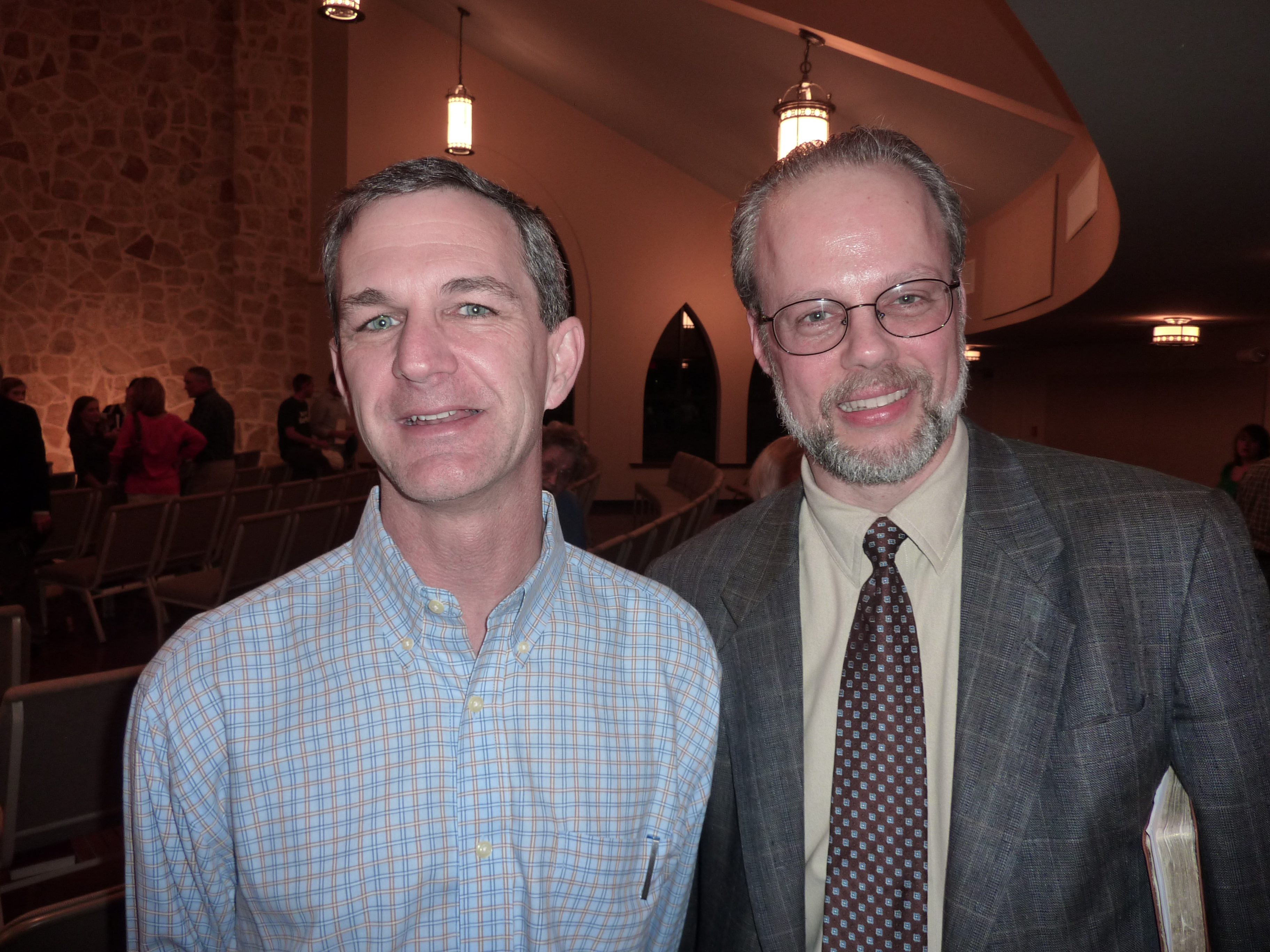
GCPC Pastor Kyle Oliphint (left) with Dr. David Garner (right)
Thought I’d tease you with a Luther quote given by Dr. David Garner in his message, “The Gospel From Above,” last night at the Full Confidence Conference at Grace Community Presbyterian Church in Ft. Worth, Texas. The highlighted portion is the portion to which Dr. Garner made reference, the rest shows a little context of what Luther was discussing:
“The neglect of Scripture, even by spiritual leaders, is one of the greatest evils in the world. Everything else, arts or literature, is pursued and practiced day and night, and there is no end of labor and effort; but Holy Scripture is neglected as though there were no need of it. Those who condescend to read it want to absorb everything at once. There has never been an art or a book on earth that everyone has so quickly mastered as the Holy Scriptures. But its words are not, as some think, mere literature (Lesewort); they are words of life (Lebewort), intended not for speculation and fancy but for life and action. By why complain? No one pays any attention to our lament. May Christ our Lord help us by His Spirit to love and honor His holy Word with all our heart. Amen.” (LW 14:46)
More to come next week…
David Prays Like a Calvinist
“What do you have that you did not receive? If then you received it, why do you boast as if you did not receive it?” 1Corinthians 4:7
Since the turn of the New Year, our family decided to work our way together through the ESV Study Bible reading plan. Each night, we stop what we’re doing for a good half hour or so, and take turns reading aloud each of the four sections of Scripture, as divided up in the plan. A few days ago, we finished the book of 1 Chronicles, and this prayer of David’s caught my attention:
Therefore David blessed the LORD in the presence of all the assembly. And David said: “Blessed are you, O LORD, the God of Israel our father, forever and ever. Yours, O LORD, is the greatness and the power and the glory and the victory and the majesty, for all that is in the heavens and in the earth is yours. Yours is the kingdom, O LORD, and you are exalted as head above all. Both riches and honor come from you, and you rule over all. In your hand are power and might, and in your hand it is to make great and to give strength to all. And now we thank you, our God, and praise your glorious name.
“But who am I, and what is my people, that we should be able thus to offer willingly? For all things come from you, and of your own have we given you. For we are strangers before you and sojourners, as all our fathers were. Our days on the earth are like a shadow, and there is no abiding. O LORD our God, all this abundance that we have provided for building you a house for your holy name comes from your hand and is all your own. I know, my God, that you test the heart and have pleasure in uprightness. In the uprightness of my heart I have freely offered all these things, and now I have seen your people, who are present here, offering freely and joyously to you. O LORD, the God of Abraham, Isaac, and Israel, our fathers, keep forever such purposes and thoughts in the hearts of your people, and direct their hearts toward you. Grant to Solomon my son a whole heart that he may keep your commandments, your testimonies, and your statutes, performing all, and that he may build the palace for which I have made provision.”(1 Chronicles 29:10-19 ESV, emphasis mine)
When reading through the passage above, I had to chuckle a little, as I was reminded of this passage from Charles Spurgeon’s sermon, “Free Will—A Slave.”
Your fallen nature was put out of order; your will, amongst other things, has clean gone astray from God. But I tell you what will be the best proof of that; it is the great fact that you never did meet a Christian in your life who ever said he came to Christ without Christ coming to him. You have heard a great many Arminian sermons, I dare say; but you never heard an Arminian prayer—for the saints in prayer appear as one in word, and deed and mind. An Arminian on his knees would pray desperately like a Calvinist. He cannot pray about free-will: there is no room for it. Fancy him praying, “Lord,I thank thee I am not like those poor presumptuous Calvinists. Lord, I was born with a glorious free-will; I was born with power by which I can turn to thee of myself; I have improved my grace. If everybody had done the same with their grace that I have, they might all have been saved. Lord, I know thou dost not make us willing if we are not willing ourselves. Thou givest grace to everybody; some do not improve it, but I do. There are many that will go to hell as much bought with the blood of Christ as I was; they had as much of the Holy Ghost given to them; they had as good a chance, and were as much blessed as I am. It was not thy grace that made us to differ; I know it did a great deal, still I turned the point; I made use of what was given me, and others did not—that is the difference between me and them.” That is a prayer for the devil, for nobody else would offer such a prayer as that. Ah! when they are preaching and talking very slowly, there may be wrong doctrine; but when they come to pray, the true thing slips out; they cannot help it. If a man talks very slowly, he may speak in a fine manner; but when he comes to talk fast, the old brogue of his country, where he was born, slips out. I ask you again, did you ever meet a Christian man who said, “I came to Christ without the power of the Spirit?” If you ever did meet such a man, you need have no hesitation in saying, “My dear sir, I quite believe it—and I believe you went away again without the power of the Spirit, and that you know nothing about the matter, and are in the gall of bitterness and the bond of iniquity.” Do I hear one Christian man saying, “I sought Jesus before he sought me; I went to the Spirit, and the Spirit did not come to me”? No, beloved; we are obliged, each one of us, to put our hands to our hearts and say—
“Grace taught my soul to pray,
And made my eyes to o’erflow;
‘Twas grace that kept me to this day,
And will not let me go.”
Is there one here—a solitary one—man or woman, young or old, who can say, “I sought God before he sought me?” No; even you who are a little Arminian, will sing—
“O yes! I do love Jesus—
Because he first loved me.”
So you see, that in attributing to the LORD himself all that David and the people freely and willingly did, David betrays a theology that is not unlike that theology which has been derived from Scripture from the earliest days of the church, against which the ungrateful and self-sufficient regularly hurl accusations. Augustine’s prayerful confession of God’s absolute sovereignty and grace to empower the believer’s very obedience provoked Pelagius to twist Scripture to his own destruction in order to make man the source of his own salvation; Calvin’s systematization of this Biblical and Augustinian faith entrusted to him by his fathers in the faith provoked, after his death, a Dutch Reformed theologian named Jakob Hermanszoon, that is, Jacob Arminius (in Latin), to, if not distort the Word as devastatingly as Pelagius had before him, so distort the doctrines of grace that his followers would later remonstrate against them, creating the need for the Synod of Dort, which produced the world famous Canons of Dort (find them at my Creeds, etc. page) which serve as the source and inspiration of the infamous, yet Biblical acronym, TULIP. Even Great Awakening revivalist, George Whitefield endured the fiery darts of his beloved friend and fellow revivalist, John Wesley. How gracious is the Lord, who generously grants salvation to even those who do not properly recognize his absolute sovereignty, suffering the remaining sin within them which persists in grasping for some way to have a hand in his own eternal salvation.
Praise the Lord that King David’s eyes were clear in this regard as he lead the people of Israel in freely and willingly making generous donations toward the planned building of the temple in Jerusalem, which was entrusted to David’s son, Solomon. King David’s public confession of their unworthiness to even do so at all, and acknowledgement of the LORD’s gracious provision of the very materials which they would freely and willingly offer, contrasts sharply with the self-congratulatory words of that proto-Pelagian king, Nebuchadnezzar, who would one day take David’s kingdom into the original Babylonian captivity (see Daniel 4:28-33).
How beautiful is the corporate confession of the Reformed in this regard! In the words of the Belgic Confession (also linked to from the Creeds, etc. page), the Reformed confess the teaching of the Scriptures that “’A person cannot receive even one thing unless it is given him from heaven(John 3:27’” and so confess:
Therefore we reject everything taught to the contrary concerning man’s free will, since man is nothing but the slave of sin and cannot do a thing unless it is “given him from heaven.”
For who can boast of being able to do anything good by himself, since Christ says, “No one can come to me unless my Father who sent me draws him”? (John 6:44)
Who can glory in his own will when he understands that “the mind of the flesh is enmity against God”? (Romans 8:7) Who can speak of his own knowledge in view of the fact that “the natural man does not understand the things of the Spirit of God”? (1 Cor. 2:14)
In short, who can produce a single thought, since he knows that we are “not able to think a thing” about ourselves, by ourselves, but that “our ability is from God”? (2 Corinthians 3:5)
And therefore, what the apostle says ought rightly to stand fixed and firm: “God works within us both to will and to do according to his good pleasure.” (Philippians 2:13)
For there is no understanding nor will conforming to God’s understanding and will apart from Christ’s involvement, as he teaches us when he says, “Without me you can do nothing.” (John 15:5)
In this way it is clear that the content of King David’s “Calvinist” prayer demonstrates how consistent with Scripture is the Reformed confession of faith.
A Review of Dr. John Fesko’s Lecture on Word, Water and Spirit, part 2
 In an attempt to explain why he wrote such an extensive presentation of the development of the doctrine of baptism in Word, Water and Spirit: A Reformed Perspective on Baptism, Dr. John Fesko paints a picture of a pair of believers who begin discussing their differences on a given theological issue, and the lively conversation lasts a number of hours. When a third party approaches and asks what they’ve been talking about, they are faced with the daunting task of rehearsing the entire track of the conversation. On a broader scale, just such a conversation has been going on, not just for a few hours, but for nearly two thousand years. Getting his readers caught up on this conversation was Dr. Fesko’s goal for the historical-theological section of his book, which makes up roughly half of the book. This is intended to help the reader see that what the Roman Catholic believes about baptism differs from what the Reformed Protestant believes and teaches, and also the differences between Reformed and Lutheran, as well as Anabaptist and Baptist.
In Part I: “The History of the Doctrine,” Dr. Fesko covers early church witnesses such as Augustine and what the medieval church thought about Augustine’s doctrine of baptism. There is also a presentation of medieval theologians such as Bonaventure, Peter Lombard, and Thomas Aquinas. The bulk of the historical section covers Reformation views, with a chapter on the view of Luther and the later Lutherans. He also brings us through the developments of figures like John Calvin and Ursinus, with the contributions of the venerable Three Forms of Unity. His description of this development progresses on from the writers between the time of the Reformation and the production of the Westminster Confession of Faith, through the later development of the London Baptist Confession. Sketching the history up to the present day, theologians such as Moltmann and Karl Barth are treated.
Dr. Fesko introduces the Roman Catholic teaching that baptism literally cleanses the recipient of sin, introducing what is known as the “created grace” of God into him. He explains that uncreated grace is the Holy Spirit’s incommunicable power; created grace is created by God and infused into the recipient at baptism. This is said to then create a “habit,” the newly formed ability to do good works.
On the other end of the spectrum, Dr. Fesko describes how that the Anabaptists in Zurich, Switzerland developed the unintended consequences of Ulrich Zwingli’s doctrine of baptism. Zwingli did accept the term sacrament, but he emphasized the term’s patristic-era usage as an oath taken by a Roman soldier who swears loyalty to his commanding officer. From this, he concluded that baptism was no more than one’s pledge of allegiance to the Lord. While Zwingli did include more nuance than this in his own teaching, the first Anabaptists reduced his argument and developed a doctrine that featured exclusively this oath-taking emphasis. For the Anabaptists, baptism became no more than the believer’s pledge of fidelity to the Lord. In this view, there was no grace attached at all to the rite.
Thus, whereas the Roman Catholic formulates an undue admixture of grace and the water of baptism, the Anabaptist radically separates the water of baptism from almost any reference to the grace of God, making it merely a believer’s pledge and in no way God’s pledge. Insofar as modern Baptists generally tend to appear to hold a view that appears to broadly coincide with this Anabaptistic kind of emphasis, Dr. Fesko assures his Baptist friends that he understands that they teach what man is doing in baptism, but he would ask them what they believe that God is dong in baptism, if anything. Why water? Why not some other substance? Or, why not some other ceremony? Even Charles Ryrie, he indicates, suggested a non-water ceremony would be just as acceptable. Maybe this could be a viable option, if baptism is all about what the believer is doing, but the historical Reformed tradition calls baptism a sign and a seal. It signifies Christ, not a thing or a substance, but Christ himself. Dr. Fesko says that what he likes about the historical Reformed view is that it reflects the ancient view that baptism is the visible Word: that which is heard in preaching is seen, felt and tasted in the sacraments—baptism, no less than the Lord’s Supper—making them what some have called “the double preaching of the Word.” In this regard, the sacrament is dependant upon the presence of the Word preached for its efficacy. The Word preached may stand alone and retain its efficacy apart from the sacrament, but the sacrament has no efficacy apart from the Word preached and so cannot stand alone.
According to Dr. Fesko, contemporary theologians are trying to run as far away from tradition as fast as they possibly can. They’ll claim that previous ages engaged too much in bad philosophy, and simply desired to defend “the traditional view.” But to these innovators, Dr. Fesko says our generation was not the first to open the Bible. For example, the middle ages are maligned as always and only engaged in extra-biblical, or even unbiblical philosophical speculation. But consider, for example, the case of Aquinas, who, before he taught theology, was first required to teach exegesis, and wrote a number of Biblical commentaries. This does not mean we must uncritically accept everything he wrote, but it at least indicates that medieval theologians were not utterly disengaged from the text of Scripture, and many of their writings do contain Scripturally-based insights from which the church in all ages can benefit.
Next time, we’ll review Dr. Fesko’s description of Part II: Biblical-Theological Survey of the Doctrine.
Listen to This. . .
Cover of Herman Bavink: Pastor, Churchman, Statesman, and Theologian by Ron Gleason
Don’t miss these great podcasts this week.
- The White Horse Inn— “Exile, Exodus and Conquest“: On this program the hosts will explore the themes of exile, exodus and conquest showing how they each culminate in the great announcement that Jesus Christ has been given “all authority in heaven and earth” to judge, to save, and to reign forever.
- Christ the Center— “The Life and Thought of Herman Bavink“: Dr. Ron Gleason discusses his new intellectual biography, Herman Bavink: Pastor, Churchman, Statesman, and Theologian.
- Mid-Cities OPC Sermon—“Cleaning House in the Family of God” (Matthew 12:43-50). Preached by Pastor Joe Troutman on January 16, 2011. This is the church plant my family is visiting. I think you’ll appreciate Rev. Troutman’s preaching.


 The Misadventures of Captain Headknowledge
Finding Your Way
I’ve frequently repeated the saying of apparently unknown origin, “you can’t know where you’re going until you know where you’ve been.” I, however, usually modify it this way: “When you learn where you’ve been, you can see where you are, and know where you’re going.” In other words, as this applies to the visible church, when we’re informed by church history, we learn from many of the valuable lessons learned in the past, and it helps us figure out how to avoid those mistakes in the future. But if we ignore the past lessons learned, we in the present are doomed to repeat the mistakes of the past (an allusion to a better known saying). Dr. Riddlebarger assists us by appropriately moving us further back into our formative collective past by summarizing the history of redemption as progressively revealed in the Bible. His article helps us see where the church has been from the very beginning, the book of Genesis, and the promise and fulfillment of redemption in the Person and Work of Christ. But especially, we learn how to better interpret those signs of the times which we recognize in the present, and the portions of Scripture that reveal them, and how they point forward to the future coming of the Lord Jesus Christ. If you want the theological terminology, Dr. Riddlebarger helps the Dispensational-Premillennialist see how the Amillennial view of eschatology interprets end-times prophecy. If you’d like to learn more about Amillennial eschatology, I’d like to recommend Dr. Riddlebarger’s audio series “Amillennialism 101” located in the sidebar of his Riddleblog, and his books, A Case for Amillennialism, and Man of Sin. If you give this position some thought, I think you’ll find it makes clear some things that remain fuzzy for the average Dispensationalist.
In “You Are Here,” His synopsis of the article is as follows:
Dr. Kim Riddlebarger (Left) and myself (Right) after services at Christ Reformed Church, Anaheim, CA.
Dr. Riddlebarger illustrates the history of redemption and the end times by the image of a Mall Directory with it’s “You Are Here” sign. He writes:
We are also introduced to the so-called “Already/Not Yet” approach to the Kingdom of God in the New Testament:
But what about the signs of the times? Here’s an excerpt of Dr. Riddlebarger’s treatment of them:
Although it would behoove you to invest in a subscription to Modern Reformation Magazine to read the entire article for yourself, and benefit from the other helpful features, I’ve pretty much given you the heart of the article. I don’t want you to wonder as you wander, unnecessarily fearing things you shouldn’t as you look forward to the return of Christ. Reformed theology in general, and Reformed Amillennial eschatology in particular, is a liberating, comforting and most importantly, Biblical approach to our redemption in Christ from “In” (see Genesis 1:1) to “Amen” (see Revelation 22:21).
Share this: