The Masculine Mandate, part 2
The following is Q&A #2 from Christ the Center, episode 87 on Richard Phillips’ soon-to-be-released title The Masculine Mandate, published by Reformation Trust. In this discussion, Phillips explains the difference between his approach to applying Genesis 2:15 and that of John Eldridge in his best-selling book, Wild at Heart.
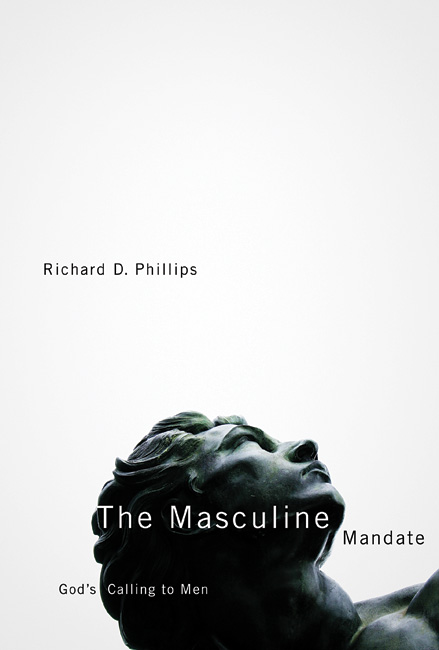 Host: I was intrigued by how you unpacked the mandate given to Adam to dress and keep the garden and how they work out in the physical realm of work and whatever labor you’re doing and in regard to your wife and children. It reminded me of the way Murray goes back in Principles of Conduct and roots everything in the creation ordinance. I had never heard that developed as much. Were these things you were reading, or was it just from your own study of Scripture that you were thinking about what was the principal work–what made a man a man, out of Genesis?
Richard Phillips: Well, you know, I mean, for the sake of the people who haven’t read the unpublished book, in Genesis 2:15, God says he placed Adam in the garden, and charged him to work it and keep it, and this book is an exposition of Genesis 2:15, which I’m describing as the masculine mandate. God put him in the garden to work it and keep it.
You know, what got me going on this was the book Wild at Heart. Because the first time I was asked to speak on this stuff, I got a copy of Wild at Heart, because I knew it was a massive best-seller, and I was absolutely mortified to read the first couple of chapters. He actually makes the statement that man was made out of the garden, and so he is undomesticated, and a male’s life is a life long quest to get in touch with your masculine side. Can you imagine Ronald Reagan making a statement like that?
No real men talk that way! “I’m on a quest for my masculinity.” That what life is, because Genesis 2:15 says–this is what he actually says–it’s a classic example of Bizarro hermeneutics–dominating today: God placed him in the garden, therefore he belongs out of the garden! And the way to get in touch with your masculine self is to get out of the place where God put you, and, as I put it in the book–I think you gotta think in these terms–you know, God placed Adam in the created, covenantal world with God-given relationships, duties and obligations. And Eldridge says, no no, you gotta go on a wilderness quest–ego trips, basically–self-quest. He actually goes so far as to say that Jesus’ forty days’ fast in the wilderness was Jesus seeking his masculine identity. I was just utterly horrified!
Well, I started reflecting on it, and I started thinking well he is right that this verse is paradigmatic. But it’s the exact opposite of what he’s teaching.
And I think, you know, two or three years ago, I did some men’s conferences, I just said, “Hey, let’s look at Genesis 2:15.” And I’m well aware that people are reading this book. I got my first copy of Wild at Heart, when an elder at my church (not this church) handed me a copy–how great the book was, and we need to buy the DVD curriculum of Wild at Heart to show all of our men.
Well, I read the book, and I go ballistic! But it occurs to me that he’s right that Genesis 2:15 is a very important statement. That’s what got me going in this direction. . .
. . . to be continued.
The Masculine Mandate, part 1
Episode #87 of Christ the Center, podcast by the Reformed Forum featured an interview with Dr. Richard Phillips regarding his new book The Masculine Mandate. Dr. Phillips says it’s primarily an exposition and application of Genesis 2:15, which reads, “The LORD God took the man and put him in the Garden of Eden to work it and keep it.” This verse, he says, is the foundational paradigm of the Scripture’s entire revelation of the male’s, or husband’s, role.
Since whenever I link to programs such as this, almost no one takes the time to go and listen, I’m transcribing the interview in a series of blog posts because I find this material to be especially needful for everyone. In this first post in the series, Dr. Phillips explains his reasons for writing the book.
Host: What did you see in men’s lives that needed to be addressed, which lead you to write this book? (Summary of the host’s actual wording)
Dr. Phillips: As is usually the case with books, there are several reasons why I wrote this book: one is, I was frustrated by the low quality of many evangelical books dealing with masculinity. Most especially, John Eldridge’s mega best-seller Wild at Heart, which is just unbiblical.
I was actually having dinner with Jerry Bridges, probably three or four years ago—and he lives out there in Colorado Springs—and we were lamenting this. I said, “Jerry, you ought to write a book on this.” And he didn’t have time, or whatever.
Meanwhile, I was asked by several conferences to speak on things like this. There was a group in Georgia two years ago who asked me to do a multi-day men’s conference.
Lig Duncan had me out to Jackson last year, to the Mid-South Men’s Rally. And so I was needing just for ministry requests, to put together biblical material. My own approach is always to exposit the Word, so if I’m asked to do a men’s conference, I’m going to exposit the Word. That got me dealing with these things.
And also, just as a pastor, I’m well aware, just as everybody is, today we’ve got a real masculinity problem in the culture and in the church. I mean, it is my view that, we talk about feminism, and all of those problems—look, we’ve got a far bigger problem with godly masculinity. In many of our churches we’ll have tlots more available, godly, marriageable women. Then we have . . . men in the church, but they’re not as mature so often. And I do believe that we have a great need for biblical instruction on masculinity.
Now, you start working on this stuff, and you start thinking about it, and you start becoming very impressed with the power of what the Bible says. As I say early on in the book, we know that when it comes to marriage and men in ministry and these sorts of things, that the New Testament directs us back to the early chapters of Genesis. If we’re going to say, “What does it mean to be a man? What is my calling as a man? What am I supposed to do to be a godly man? The answer is, go back and read Genesis 2. And what we’ll find is biblical teaching that is, in fact, a biblical paradigm.
What we read in Genesis 2 about God’s calling to Adam as the man, does in fact, have a paradigmatic influence that we will see pervading all of Scripture. And yet there’s very little teaching about the masculine mandate—that’s what I call Genesis 2:15. That there is a clear calling given to men, that will be seen playing out through the book of Proverbs, playing out through biblical examples of fatherhood, husband and Christian leadership. And it plays straight into the New Testament teaching. And I just came to believe that there is a need for some clear biblical teaching on this.
To be honest with you, it was a hard book to write, because most of my books will come out of my pulpit ministry. My working life is geared that way. I do a sermon on Sunday morning, I preach Sunday evening, I teach Wednesday night. I don’t have a lot of free time beyond that. So this book killed me. I mean, to write a book on the side—most of my books are biblical exposition flowing out of my pulpit ministry-but this one was a labor of love, because I just felt I had to get it done. Not that the world needs my book, but, I just felt an obligation to write this book.
It was not a book that I had time to do, but I just felt that there’s a great need for this, and I’m hopeful the Lord will bless it. You know, I ended up getting in about a year late, because you want to do it right.
But that’s why I wrote the book, just out of my own experiences, being asked to do work in it, and a profound sense that this material has to get out there.
The Outlined Book of Daniel
3. The book is generally divided into two nearly equal parts. The first of these (1-6) contains chiefly historical incidents, while the second (7-12) is entirely apocalyptic. This division is further supported by the fact that the details of the two sections are arranged in order of time, and that the commencement of the second section falls earlier than the close of the first, as if the writer himself wished to mark the division of suject. But on the other hand this division takes no account of the difference of language, nor of the change of person at the beginning of chapter 8. And though the first section is mainly historical, yet the vision of chapter 7 finds its true foundation and counterpart in chapter 2.
From these circumstances it seems better to divide the book (Auberlen, p. 36 ff.) into three parts. The first chapter forms an introduction. The next six chapters (2-7) give a general view of the progressive history of the powers of the world, and of the principles of the divine government as seen in events of the life of Daniel. The remainder of the book (8-12) traces in minuter detail the fortunes of the people of God, as typical of the fortunes of the Church in all ages.
The second section (2, 7) is distinguished by a remarkable symmetry. It opens (in chapter 2) with a view of the great kingdoms of the earth revealed to a heathen sovereign, to whom they appeared in their outward unity and splendor, and yet devoid of any true life (a metal colossus); it closes (in chapter 7) with a view of the same powers as seen by a prophet of God, to whom they were displayed in their distinct characters, as instinct with life, though of a lower nature, and displaying it with a terrible energy of action (thuria, four beasts). The image under which the manifestation of God’s kingdom is foreshown corresponds exactly with this twofold exhibition of the worldly powers. “A stone cut without hands,” “becoming a great mountain and filling the whole earth” (Dan. 2:34, 35)–a rock and not a metal–is contrasted with the finite proportions of a statue moulded by man’s art, as “the Son of man,” the representative of humanity, is the true Lord of that lower creation (Gen. 1:30) which symbolizes the spirit of mere earthly dominions (Dan. 7:13, 14).
The intermediate chapters (3-6) exhibit a similar correspondence, while setting forth the action of God among men. The deliverance of the friends of Daniel from the punishment to which they were condemned for refusing to perform an idolatrous act at the command of Nebuchadnezzar (ch. 3), answers to the deliverance of Daniel from that to which he was exposed by continuing to serve his God in spite of the edict of Darius (ch. 6); and in the same way the degradation, the repentance, and the restoration of Nebuchadnezzar (ch. 4), forms a striking contrast to the sacrilegious pride and death of Belshazzar (ch. 5:23-31).
The arrangement of the last section (8-12) is not equally distinct, though it offers traces of a similar disposition. The description of the progress of the Grecian power in ch. 8 is further developed in the last vision (10-12), while the last chapter appears to carry on the revelation to the first coming of Messiah in answer to the prayer of Daniel.
In summary, in this portion of the entry on the Book of Daniel from Smith’s Dictionary of the Bible, Bishop Westcott has suggested two ways to outline the material in the Book of Daniel. The first, and simpler, outline is something like as follows:
1. Historical Narratives of Daniel (1-6)
2. Apocalyptic Visions of Daniel (7-12)
In terms of chronology, according to Westcott, this two point outline works (see first paragraph above), but in terms of language and author, a more sophisticated outline seems in order. In this effort, Westcott follows the lead of Dr. Karl August Auberlen (I’ve linked to an online text of Auberlen’s book which seems to be the very one Westcott cites above) in dividing the book into a three point outline with several subpoints as follows:
1. Introduction (1:1-21)
2. Progressive History of World Powers and Principles of Divine Government (2-7)
A. Great Kingdoms of the Earth Revealed to a Heathen Sovereign (2)
B. Daniel’s Friends Delivered from Fiery Furnace (3)
C. Degredation, Repentance and Restoration of Nebuchadnezzar (4)
D. Handwriting on the Wall for Belshazzar (5)
E. Daniel Delivered from Lion’s Den (6)
3. Fortunes of the People of God, as Typical of the Fortunes of the Church in All Ages (8-12)
A. ( See paragraph 5 above for topical breakdown)
Also, don’t miss Pastor Kyle Oliphint’s exposition of Daniel Chapter 2 entitled, “A Bad Dream for a King, and Wisdom Sought from the King“
The Multilingual Book of Daniel
 2. The language of the book, no less than its general form, belongs to an era of transition. Like the book of Ezra, Daniel is composed partly in the vernacular Aramaic (Chaldee), and partly in the sacred Hebrew. The introduction (1-2:4a) is written in Hebrew. On the occasion of the “Syriac” answer of the Chaldaeans, the language changes to Aramaic, and this is retained till the close of the seventh chapter (2:4b–7:28).
The personal introduction of Daniel as the writer of the text (8:1) is marked by the resumption of the Hebrew, which continues to the close of the book (8-12). The character of the Hebrew bears the closest affinity to that of Ezekiel and Habakkuk, or in other words to those prophets who lived nearest to the assumed age of Daniel; but it is less marked by peculiar forms and corruptions than that of Ezekiel.
The Aramaic, like that of Ezra, is also of an earlier form (cf. Maurer, Comm. in Dan. p. 87) than exists in any other Chaldaic document, but as the Targums–the next most ancient specimens of the language–were not committed to writing till about the Christian era, this fact cannot be insisted on as a proof of remote antiquity. It is, however, worthy of notice that J. D. Michaelis affirmed, on purely linguistic grounds, that the book was no late compilation though he questions the authenticity of some part of it (c. 3-7, cf. Keil, Lehr. d. Einl. §135, n. 4).
In addition to these two great elements–Aramaic and Hebrew–the book of Daniel contains traces of other languages which indicate the peculiar position of the writer. The use of Greek technical terms (cf. § 10) marks a period when commerce had already united Persia and Greece; and the occurrence of peculiar words which admit of an explanation by reference to Aryan and not to Semitic roots (Delitzsch, p. 274) is almost inexplicable on the supposition that the prophecies are a Palestinian forgery of the Maccabaean age.
Pastor Kyle Oliphint’s second sermon in his exposition of Daniel was preached last Sunday. The sermon title is “Life in Exile” based on Daniel 1:1-21. You can listen to it here. Here’s an excerpt:
“Daniel knew his God. And Daniel knew that his God was a God of grace. In the midst of circumstances that may beto the common observer look like God had abandoned him altogether. But Daniel knew that God had promised mercy and grace to a thousand generations. He had giant faith, even while feeling the discipline from his heavenly Father. Daniel knew he was loved; Daniel knew he was being cared for; Daniel knew that God was at work, even in the midst of not being able to point to evidence for it.
You remember when I said a minute ago that God is intricately and intimately involved in every aspect of our lives. I say that because I believe that’s what the Bible teaches. Now I wonder if we together know what that means. It means that those of us in this room, like me, who do not have the giant faith of Daniel–those of us in this room who can make a list of where and how we have lacked faith–and how that list, like mine, would be miles and miles long–those of us who fit in this category, have a God who is a part of your life, and determined through your life to bringing himself glory and to doing you good, even in the midst of your weak faith.”
The Apocalyptic Book of Daniel
The following is from Smith’s Dictionary of the Bible. I have supplied links to Scripture references, and highlighted key words, phrases and ideas to help catch the various points made by the scholar who penned this particular entry, Rev. B. F. Westcott. I’m posting on this, first, because I’m interested in learning more about the genre of apocalyptic literature, and this excerpt does a good job of presenting a few basics; second, because I’ll be following an expository series of sermons on Daniel by Kyle Oliphint (for you Westminster Seminary fans, yes, he’s K. Scott Oliphint’s brother–can’t you see the resemblance?), and third because the four-volume set of Smith’s Dictionary of the Bible which I had the privilege of discovering at a local antique mall several years ago is apparently a facsimile edition of the original dictionary set from which all modern editions of Smith’s Bible Dictionary have been condensed. It goes into detail I’ve rarely found in more recent editions. It’s a fascinating read in and of itself. Whichever of these three reasons may compel you to join me as I learn about the apocalypse of Daniel matter not to me, but you are certainly invited all the same. I don’t know how much I’ll be posting, but I may wind up simply transcribing the present entry in a series of several posts for your further study. You’ll be able to listen along to Kyle’s expositions every week if you like at the Grace Community Presbyterian Church website’s Online Sermons page, or you can subscribe to the podcast on iTunes. The first sermon is entitled “God and Men at Work” based on verses one and two of Daniel 1.
DANIEL, THE BOOK OF, is the earliest example of apocalyptic literature, and in a great degree the model, according to which all later apocalypses were constructed. In this aspect it stands at the head of a series of writings in which the deepest thoughts of the Jewish people found expression after the close of the prophetic era. The book of Enoch, the Jewish Sibyllines, and the fourth book of Ezra [2 Esdras], carry out with varied success and in different directions, the great outlines of universal history which it (Daniel) contains; and the “Revelation” of Daniel received at last its just completion in the Revelation of St. John. Without an inspired type it is difficult to conceive how the later writings could have been framed; and whatever judgment be formed as to the composition of the book, there can be no doubt that it exercised a greater influence upon the early Christian Church than any other writing of the Old Testament, while in the Gospels it is specially distinguished by the emphatic quotation of the Lord (Matt. 24:15).
- In studying the book of Daniel it is of the utmost importance to recognize its apocalyptic character. It is at once an end and a beginning, the last form of prophecy and the first “philosophy of history.” The nation is widened into the world: the restored kingdom of Judah into a universal kingdom of God. To the old prophets Daniel stands, in some sense, as a commentator (Dan. 9:2-19): to succeeding generations, as the herald of immediate deliverance. The form, the style, and the point of sight of prophecy, are relinquished upon the verge of a new period in the existence of God’s people, and fresh instruction is given to them suited to their new fortunes. The change is not abrupt and absolute, but yet it is distinctly felt. The eye and not the ear is the organ of the Seer: visions and not words are revealed to him. His utterance is clothed in a complete and artificial shape, illustrated by symbolic imagery and pointed by a specific purpose. The divine counsels are made known to him by the ministry of angels (7:16; 8:16; 9:21), and not by “the Word of the Lord.” The seer takes his stand in the future rather than in the present, while the prophet seized on the elements of good and evil which he saw working around him and traced them to their final issue. The one (the seer) looked forward from the present to the great “age to come”; the other (the prophet) looked backward from “the last days” to the trials in which he is still placed. In prophecy the form and the essence, the human and divine were inseparably interwoven; in revelation the two elements can be contemplated apart, each in its greatest vigor,–the most consummate art, and the most striking predictions. The Babylonian exile supplied the outward training and the inward necessity for this last form of divine teaching; and the prophetic visions of Ezekiel form the connecting link between the characteristic types of revelation and prophecy.
Jesus Christ: Sinless Man/Eternal God
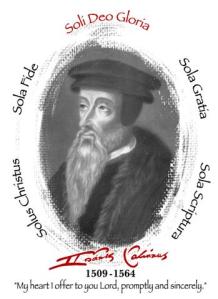
Get this on a t-shirt from reformationshirts.com!
Here’s a follow-up on my series of posts on “Compromising the Full Humanity of Christ” which dealt with the “heavenly flesh of Christ” heresy. In my reading through Calvin’s Institutes in commemoration of his quincentenary, I recently got to a passage in which he deals with this very issue, which he indicates that it predates Anabaptism, tying it to Manichaeism. Let’s read Calvin himself on this . . .
Indeed, the genuineness of his human nature was impugned long ago by both the Manichees and the Marcionites. The Marcionites fancied Christ’s body a mere appearance, while the Manichees dreamed that he was endowed with heavenly flesh. But many strong testimonies of Scripture stand against both (Book 2, chapter 13, section 1)…Marcion imagines that Christ put on a phantasm instead of a body because Paul elsewhere says that Christ was “made in the likeness of man . . . . being found in fashion as a man” (Phil. 2:7-8)…Mani forged him a body of air, because Christ is called “the Second Adam of heaven, heavenly” (1 Cor. 15:47) (Book 2, chapter 13, section 2).
You can read summaries of both of these sections at “Blogging the Institutes” from Reformation21.org, just follow the links in the two parenthetical references in the excerpt above.
Finally, in section 4, Calvin concludes his defense of the biblically orthodox view of Christ’s full humanity (which accords with the Definition of Chalcedon), explaining how it is that Christ’s human nature could be identical to our human nature without original sin–for Calvin, it’s simple, the Holy Spirit sanctified his human nature:
The absurdities with which they wish to weigh us down are stuffed with childish calumnies. They consider it shameful and dishonorable to Christ if he were to derive his origin from men, for he could not be exempted from the common rule, which includes under sin all of Adam’s offspring without exception. But the comparison that we read in Paul readily disposes of this difficulty: “As sin came in . . . through one man, and death through sin . . . so through the righteousness of one man grace abounded” (Rom. 5:12, 18). Another comparison of Paul’s agrees with this: “The first Adam was of the earth, and earthly and natural man, the Second of the heaven, heavenly” (1 Cor. 15:47). The apostle teaches the same thing in another passage, that Christ was sent “in the likeness of sinful flesh” to satisfy the law (Rom. 8:3-4). Thus, so skillfully does he distinguish Christ from the common lot that he is true man but without fault and corruption. But they babble childishly: if Christ is free from all spot, and through the secret working of the Spirit was begotten of the seed of Mary, then woman’s seed is not unclean, but only man’s (you can hear that from many independent Baptist fundamentalists in the 21st century–I heard it all my life.) For we make Christ free of all stain not just because he was begotten of his mother without copulation with man, but because he was sanctified by the Spirit that the generation might be pure and undefiled as would have been true before Adam’s fall. And this remains for us an established fact: whenever Scripture calls our attention to the purity of Christ, it is to be understood of his true human nature, for it would have been superfluous to say that God is pure. Also, the sanctification of which John, ch. 17, speaks would have no place in divine nature (John 17:19). Nor do we imagine that Adam’s seed is twofold, even though no infection came to Christ. For the generation of man is not unclean and vicious of itself, but is so as an accidental quality arising from the Fall. No wonder, then, that Christ, through whom integrity was to be restored, was exempted from common corruption! They thrust upon us as something absurd the fact that if the Word of God became flesh, then he was confined within the narrow prison of an earthly body. This is mere impudence! For even if the Word in his immeasurable essence united with the nature of man into one person, we do not imagine that he was confined therein. Here is something marvelous: the Son of God descended from heaven in such a way that, without leaving heaven, he willed to be borne in the virgin’s womb, to go about the earth, and to hang upon the cross; yet he continuously filled the world even as he had done from the beginning!
That Christ’s human nature is equally sinless and at the same time the product of Mary’s reproductive system is easily seen in Scripture. The Spirit illumined this to my understanding by a simple reading of Luke 1:35 once I came to realize the modern fundamentalist heavenly flesh view with which I was raised had to be wrong:
And the angel answered her, “The Holy Spirit will come upon you, and the power of the Most High will overshadow you; therefore the child to be born will be called holy—the Son of God.”
See the word “therefore” in this verse? The former activity is the reason for the latter condition; the Holy Spirit’s overshadowing Mary in Jesus’ conception is the reason for his holiness. It’s as simple as that! Long ago, I got a grasp of the fact that names in Scripture usually reflect something of the nature or behavior of the people who bear them. In this case, the Spirit’s name is “Holy Spirit.” In short, he’s the Spirit who makes people holy. The human nature of Jesus was holy because of his conception via the Holy Spirit. And believers today are being sanctified (being made holy) by the Holy Spirit through the ordinary means of the preaching of Law and Gospel, signified and sealed to them in the sacraments of baptism and the Lord’s Supper.
YouTube Fundy vs. Calvinism
Steven L. Anderson, pastor of Faithful Word Baptist Church in Pheonix, AZ, has a very full YouTube page of videos featuring his preaching and teaching ministry. Some of the arguments made in some of the videos, it must be said, range from the average, to the illogical, to the hilariously absurd. StuffFundiesLike featured one of the more amusing ones (view it here), but Fundamentally Reformed once posted on one I’ve yet to see topped (view it here)! Compared to these two, the one I’m posting and commenting on today is rather ho-hum.
In this video, Pastor Anderson presents a few arguments from John 6 and John 15 against the doctrines of God’s foreordination of all things (Ephesians 1:11), predestination to salvation (Ephesians 1:5; Romans 9:23) and reprobation to condemnation (2 Peter 2; Romans 9:22).
Watch the video and interact with his arguments. I’m going to be out of town over the weekend and probably have little access to the internet. If you’re not familiar with the doctrines of Calvinism regarding the sovereignty of God over all things, even the salvation of sinners, feel free to ask questions. They’ll be welcomed and answered with gentleness and respect when I return, unless one of my Calvinist commenters is pleased to interact with you over the weekend (you know who you are–this is your cue!).
Here are the passages Pastor Anderson dealt with. View them for yourself and prayerfully examine their contexts and see the sovereign hand of a God who is not merely a one-dimensional “God of love” who is passive in the face of your sovereign self-determination, but “is love” and just at the same time.
“You did not choose me, but I chose you and appointed you that you should go and bear fruit and that your fruit should abide, so that whatever you ask the Father in my name, he may give it to you” (John 15:16)
“Jesus answered them, “Did I not choose you, the Twelve? And yet one of you is a devil.” He spoke of Judas the son of Simon Iscariot, for he, one of the Twelve, was going to betray him” (John 6:70-71; cf. Acts 1:16–indicating what Judas was actually chosen for).
“On” or “After”? Defending the Friday Crucifixion

Shrine in Church of the Holy Sepulchre
In case you didn’t perceive it in the light of my series on St. Patrick (which is still ongoing–stay tuned, true believer!), one of my pet peeves about the anti-traditional wing of Christianity is that they will deny the established, sound views on things seemingly for the sole reason of not being in agreement with Roman Catholicism. It may just be me, but that’s the way things look to me. One example of this is the two competing sites in Israel for which the claim is made that it is the genuine site of Calvary and Christ’s tomb. The Church of the Holy Sepulchre has the vote of all the ancient churches, be they Roman Catholic, Eastern Orthodox, Coptic, what have you. Then there’s the Garden Tomb (formerly Gordon’s tomb), for which the claim was not made until a nineteenth century Protestant made it against the prevailing established evidence which overwhelmingly supports the validity of the Church of the Holy Sepulchre. Speaking generally, many Protestants tend to prefer the Garden tomb because it doesn’t have a big, old medieval or Crusader-era church built on top of it, ruining the view.
In the realm of traditional biblical claims, the question of on which day of the week Christ died is divided between those who aren’t uncomfortable with historic, established, orthodox traditional views and those who are. I was reading the Wikipedia article on Good Friday yesterday (here’s the link), in which the Good Friday customs of various groups are outlined. After the ancient Eastern and Western groups are treated, naturally the historic Protestant customs are described, followed by a section entitled, “Other Protestant Traditions.” The second paragraph of this section reflects the tendency I’m addressing:
Some Baptist, Pentecostal and many Sabbatarian and non-denominational churches oppose the observance of Good Friday, instead observing the Crucifixion on Wednesday to coincide with the Jewish sacrifice of the Passover Lamb (which Christians believe is an Old Testament pointer to Jesus Christ). A Wednesday Crucifixion of Jesus Christ allows for Christ to be in the tomb (heart of the earth) for three days and three nights as he told the Pharisees he would be (Matthew 12:40), rather than two nights and a day if he died on Friday.
I think this paragraph does a good job of highlighting part of the reason for the debate: wooden literalism. Firstly, the desire is to make sure the crucifixion of the Lamb of God takes place at the precise moment the copies and shadows of the heavenly things are offered, as if it just couldn’t happen at any other moment. Secondly, just because Jesus used the language in this one exchange that in modern English vernacular corresponds literally to a seventy-two hour period, the rest of the Gospel references to when Christ rose must be interpreted in the light of this verse understood this particular way. Anything else is unacceptable to such interpreters. Again, the fear being agreement with Rome on something. The net result becomes that Jesus couldn’t have died on Friday because it wasn’t a “literal” three days and three nights. Only Catholics and those other denominations that retain more Roman Catholic like practices than we do would be so gullible as to agree with the Friday view of the crucifixion.
One of the most popular denials the anti-traditional interpreters make is the traditional appeal to the fact that in the first century Jewish idiom a “day” can refer to either part of a day, or the entire day. I’ve yet to hear a persuasive argument against this linguistic phenomenon out of those who hold the Wednesday view, I just hear the unbroken mantra of “three days and three nights.” In other words, it seems to me those who hold this view simply don’t want to be confused by facts because they’ve got their proof text and they’re sticking with it.
All I’d like to do is focus on the other Gospel passages that refer to when Christ would rise from the dead. They tend to fall into two categories: those that have Christ rising “on the third day,” and those that have Christ rising “after three days.”
If the Wednesday crucifixion were true, and Christ did lie in the tomb for a literal seventy-two hour period, then perhaps the “after three days” verses are preferable. These passages are Matthew 27:63; Mark 8:31; 9:31; 10:34. Here’s the first of Mark’s references, Mark 8:31–
“And he began to teach them that the Son of Man must suffer many things and be rejected by the elders and the chief priests and the scribes and be killed, and after three days rise again” (emphasis mine).
On the other hand, if Christ did die on Friday, spend Saturday in the tomb and rise before sunrise on Sunday morning, then this scenario is more easily reflected by the “on the third day” verses. These passages are Matthew 16:21; 17:23; 20:19; 27:64; Luke 9:22; 18:33; 24:7, 21, 46. Let’s use Luke’s final verse as an example, Luke 24:46–
“and said to them, ‘Thus it is written, that the Christ should suffer and on the third day rise from the dead . . . . ‘”
If life were simple and we could resort to a majority vote, the traditional view wins. But I know it’s not that easy. However, it is worthy of note that the time frame references that don’t explicitly reveal a seventy-two hour period outnumber the ones more favorable to the Wednesday crucifixion view. No wonder when the early church compiled the New Testament teachings of the apostles into creedal form, they used the language that favors the Friday crucifixion view:
I believe in God, the Father Almighty,
the Maker of heaven and earth,
and in Jesus Christ, His only Son, our Lord:
Who was conceived by the Holy Ghost,
born of the virgin Mary,
suffered under Pontius Pilate,
was crucified, dead, and buried;
He descended into hell.
The third day He arose again from the dead;
He ascended into heaven,
and sitteth on the right hand of God the Father Almighty;
from thence he shall come to judge the quick and the dead.
I believe in the Holy Ghost;
the holy catholic church;
the communion of saints;
the forgiveness of sins;
the resurrection of the body;
and the life everlasting.
Amen.
Equal in Creation and Redemption; Complementary in Role
 Yesterday on the Gender Blog for the Council on Biblical Manhood & Womanhood, Dr. Albert Mohler, president of Southern Baptist Theological Seminary responded to a USA Today op-ed column by Mary Zeiss Stange, professor of Women’s Studies and Religion at Skidmore College in Saratoga Springs, N.Y. The topic: of course, women’s role in church ministry. Considering her credentials, it’s easy to see that Stange is going to be an advocate of egalitarianism (look it up) between the sexes when it comes to church leadership. Dr. Mohler attempts to bring Stange’s, and the modern culture’s, basic worldview into focus, and he contrasts it with some basic comments regarding the biblical, complementarian (look it up), worldview of the roles of men and women in church life.
I realize that the world isn’t consciously fettered to the clear teaching of Scripture, and it should be no surprise that the world would attempt to budge the church from faithfulness thereto. The world does a very good job of it, across the board, when it has to try at all, and doesn’t find a church eager to join the world’s parade regardless of which direction it’s going. But I thought in the light of the present discussion on those other sites, I’d post Paul’s controversial restriction on women in church leadership from 1 Timothy 2. And I mean the whole, short chapter. As you read the chapter, notice first of all the redemptive basis of his restriction, then notice the Old Testament or creational basis of his restriction:
2:1 First of all, then, I urge that supplications, prayers, intercessions, and thanksgivings be made for all people, 2 for kings and all who are in high positions, that we may lead a peaceful and quiet life, godly and dignified in every way. 3 This is good, and it is pleasing in the sight of God our Savior, 4 who desires all people to be saved and to come to the knowledge of the truth. 5 For there is one God, and there is one mediator between God and men, the man Christ Jesus, 6 who gave himself as a ransom for all, which is the testimony given at the proper time. 7 For this I was appointed a preacher and an apostle (I am telling the truth, I am not lying), a teacher of the Gentiles in faith and truth.
8 I desire then that in every place the men should pray, lifting holy hands without anger or quarreling; 9 likewise also that women should adorn themselves in respectable apparel, with modesty and self-control, not with braided hair and gold or pearls or costly attire, 10 but with what is proper for women who profess godliness—with good works. 11 Let a woman learn quietly with all submissiveness. 12 I do not permit a woman to teach or to exercise authority over a man; rather, she is to remain quiet. 13 For Adam was formed first, then Eve; 14 and Adam was not deceived, but the woman was deceived and became a transgressor. 15 Yet she will be saved through childbearing—if they continue in faith and love and holiness, with self-control.
The redemptive basis of Paul’s restrictions on women in church leadership is found in verses five and six. Men and women share the same mediator. Elsewhere, in the context of roles in marriage, Peter instructs husbands to keep in mind that their wives are “heirs with [them] of the grace of life” (1 Peter 3:7). The same is true in this context. Christ died, not only for “kings, and all who are in high positions,” or just for Jews and men (meaning males), but he died for all kinds of people. He died for the powerful and the powerless; for the Jew and for the Gentile; and the Lord Jesus Christ is the sole mediator between God and humans of both sexes. It is instructive to note that the word “man” in verse five translates the same Greek word that is translated people in verses one and four. Christ didn’t just die for males, he died for males and females. It is first in the light of this fact, men’s and women’s equality in redemption, that Paul gives any instruction at all to anyone. For here is the source of life: the message of redemption in Christ. No other message will grant to men or women the grace to serve God according to his will. And any differentiation of roles between the sexes would certainly not last, if not for loving gratitude to the Lord for what he has done for men and women.
Secondly, notice Paul’s Old Testament, or creational, basis for his restriction on women in the church leadership role. This is found in verses thirteen and fourteen. Refer to the passage above for a refresher. Paul states two simple reasons. I might add that they are reasons that were “breathed-out,” or spoken, by God himself. Reason one: Women should not “teach” or “excercise authority over a man,” but are to “remain quiet” because of creational chronology. Adam was created first, and Eve was created second. The simple fact is that the biblical revelation of the creation of men and women included from the very beginning inherent complementarian roles. Moses clearly writes that the woman was created to be “a helper fit (or corresponding) to him” (Genesis 2:18). Paul does not elaborate on this chronology as an excuse to institute complementarian roles in the church, just states it as the reason.
The challenge of competent biblical interpretation is to avoid going beyond what Scripture teaches. Yes, this includes the implicit teaching as well as the explicit, but not all inferences drawn from the text are equally valid or necessary. One must tread with caution when it comes to that. When the interpreter is not cautious in drawing inferences, misinterpretation results, and this misinterpretation will contradict the totality of biblical revelation. So it is in this case. The reason people get offended so easily by this passage is that when they hear that men were created before women, they don’t hear a chronological list, they instinctively hear a qualitative list, for want of a better word (if you’ve got one, submit it in your comment). In other words, they hear something like, men were created first, and therefore they are better than women. This is what I call an invalid, and unnecessary inference drawn from the text. This is not what Paul is saying. It is important to not “go beyond what is written” (compare 1 Corinthians 4:6-7).
Paul’s second Old Testament basis is the fact that Eve became a transgressor by being deceived in the fall, and Paul clarifies that Adam was not deceived. Here again, it is important to reign in our instinctive inferences based on sexual rivalry. Many hear this passage as implying that women should not teach men in church, or serve in the pastoral office, because they are somehow by nature more prone to deception, and that, in order to preserve the truth of Scripture, women should be restricted from the teaching ministry of the church. This, again, is an invalid inference. If this passage does anything, it points out the greater responsibility Adam had in the fall, as compared with Eve. Put simply, the devil tricked Eve into eating the forbidden fruit; Adam ate it, as they say, “of his own free will.” So here again, Eve is subordinate in role (not in inherent worth) not only in her creation, but also in her fall from original righteousness, into original sin. Thus Paul’s second facet of the creational basis of complementarianism in roles in the church.
So Adam and Eve were created and fell with reference to superordinate and subordinate roles. So, where do we find the inherent equality in worth? Genesis 1:26 says, “Then God said, “Let us make man (generic for both sexes) in our image, after our likeness.” Both men and women reflect God in righteousness, knowledge and holiness (compare Ephesians 4:24; Colossians 3:10). Men and women were created equally righteous, but fell from this; they were equally rational–both have the capacity for reason which distinguishes them from the animal kingdom, and so reflect God. Men and women were also created equally “holy” or set apart by God to perform God-given roles. Although these roles differ, the fact that they are set apart for specific roles is equal.
So, in creation and redemption, men and women are equal. In role, men and women complement each other. When tempted to defer to the pressure of the world to conform to its egalitarian expectations, it’s important to recall that Paul quoted Old Testament Scripture as his sole reason for having men and women serve differing roles out of loving gratitude for the mediatorial life, death and resurrection of the Lord Jesus Christ. The roles were not culturally contrived, and therefore dated and obsolete. The roles were built in at creation and are expected in the light of the cross. Paul stood on God’s Word, and so should the 21st century Christian.
The Devil is a Degenerate Creation of God
The following is from Institutes of the Christian Religion by John Calvin, published in its final form in 1559 (for more on Calvin and the Institutes, read this). In his summary of the origin of Satan, see if you can tell what’s conspicuous by its absence, and what Calvin writes that has some bearing on what 21st century Christians generally would expect to see here. This passage is from Book 1, chapter 14, section 16.
Yet, since the devil was created by God, let us remember that this malice, which we attribute to his nature, came not from his creation but from his perversion. For, whatever he has that is to be condemned he has derived from his revolt and fall. For this reason, Scripture warns us lest, believing that he has come forth in his present condition from God, we should ascribe to God himself what is utterly alien to him. For this reason, Christ declares that “when Satan lies, he speaks according to his own nature” and states the reason, because “he abode not in the truth” [John 8:44 p.]. Indeed, when Christ states that Satan “abode not in the truth,” he hints that he was once in it, and when he makes him “the father of lies,” he deprives him of imputing to God the fault which he brought upon himself.
But although these things are briefly and not very clearly stated, they are more than enough to clear God’s majesty of all slander. And what concern is it to us to know anything more about devils or to know it for another purpose? Some persons grumble that Scripture does not in numerous passages set forth systematically and clearly that fall of the devils, its cause, manner, time, and charater. But because this has nothing to do with us, it was better not to say anything, or at least to touch upon it lightly, because it did not befit the Holy Spirit to feed our curiosity with empty histories to no effect. And we see that the Lord’s purpose was to teach nothing in his sacred oracles except what we should learn to our edification. Therefore, lest we ourselves linger over superfluous matters, let us be content with this brief summary of the nature of devils: they were when first created angels of God, but by degeneration they ruined themselves, and became the instruments of ruin for others. Because this is profitable to know, it is plainly taught in Peter and Jude. God did not spare those angels who sinned [2 Peter 2:4] and kept not their original nature, but left their abode [Jude 6]. And Paul, in speaking of the “elect angels” [1 Timothy 5:21], is no doubt tacitly contrasting them with the reprobate angels.
Give up? Calvin didn’t identify the pre-fallen Satan as bearing the name Lucifer, based on Isaiah 14:12! That would be because the word Lucifer is used to translate the Hebrew word for “morning star” or “day star” in the King James Version. This was carried over from the Latin Vulgate by the King James translators. “Lucifer” was historically a name for the planet Venus, which happens to be the morning star. Besides, the passage in Isaiah is a prophecy of judgment against the King of Babylon. It’s use in reference to the chief fallen angel is allegorical at best and simply out of context at worst. Before he fell, the Lord and his angels up in heaven did not call him Lucifer as if it were his name. This was popularized in Dante’s Inferno, and Milton’s Paradise Lost. See this Wikipedia article on Lucifer, and this one on Venus for more information.
Furthermore, our eagerness to derive a portrayal of the fall of Satan in Isaiah’s passage is just the kind of “lingering over superfluous matters” that “feed our curiosity with empty histories to no effect.” Calvin writes that things like this have “nothing to do with us” and that “the Lord’s purpose was to teach nothing in his sacred oracles except what we should learn to our edification.” Justin Taylor’s post at “Blogging the Institutes” summarizes Calvin’s remarks well (read Justin’s post here).
Therefore, class, your homework assignment is to memorize what the Bible explicitly (and actually), albeit sketchily, teaches about the fall of Satan and his angels–Jude 6. “And the angels who did not stay within their own position of authority, but left their proper dwelling, he has kept in eternal chains under gloomy darkness until the judgment of the great day—”
Class dismissed.
(Deaf) & Dumb?
My wife and I teach a third & fourth grade Sunday School class at my local church.  Yesterday, it was my week to teach the lesson, which concerned the birth of John the Baptist and the prophecy of Zechariah from Luke 1:57-80. So having explained the activity in verses 59-63, where the neighbors and relatives assume the infant will be named after his father, and Elizabeth tells them his name is John “And they made signs to his father, inquiring what he wanted him to be called. And he asked for a writing tablet and wrote, ‘His name is John.’ And they all wondered” (vv. 62-63), one of my students immediately raised his hand and asked, “If his only problem was that he couldn’t speak, then why did they have to use sign language to talk to him?”
(gulp)?
Did you ever wonder about that? It never once crossed my mind. Are you as smart as a third grader?
Today, I looked it up at the online ESV Study Bible. Here’s what I learned.
They made signs to his father indicates that Zechariah was deaf as well as mute, or else they would simply have spoken to him (see note on v. 22). This is confirmed by the people’s amazement (v. 63) that he chose the same name as Elizabeth chose, something that would not have been surprising if he had been able to hear her.
So naturally I also checked out the note at verse 22, which explicitly states that Zechariah was “mute”. Here’s what that note reveals:
Mute (Gk. kōphos) can mean either “mute” or “deaf,” depending on the context, and there is some evidence that it can at times mean “deaf and mute” (see note on vv. 62-63).
So, once again, you learn something new every day. Are you smarter than a third grader? I’m not!
Does “Every Member Ministry” Contribute to “Christless Christianity”?
An “every member ministry.” The name should be self-explanatory. This is a staple of modern American Evangelical and Fundamentalist discipleship, and likely of the Reformed, as well. We probably all can hear the echoes of pastors past and present who’ve clearly proclaimed that they are not the only “ministers” in the local church. Every member, not just the pastor, is here to exercise his gifts for the building up of the body of Christ. Might this be a “fifth rail” of American Christianity that the believer in his right mind dare not touch, lest he be accused of attempting to take us back to Roman Catholicism with its clearly defined gap between the clergy and the laity? Don’t worry, my personal intention is not to state anything to the contrary of those who believe they are gifted to perform any of a myriad of tasks in the local church. Some of us are gifted to teach, though we’re not ordained pastor/teachers; some are gifted to serve the physical needs of the least of the congregation; some are gifted to aid in the musical operation of the local church; some are gifted to do any myriad of other things that are indded vital activities that ought to take place in the context of the local church, and by the members of the congregation, not just the ordained pastors, elders and deacons. I’m not out to overturn the apple cart of an “every member ministry” as it happens to currently be manifest in American churches. But I would like to address, or rather, cite Michael Horton’s remarks regarding, one passage of Scripture that is famously associated with the idea of an every member ministry, and in fact, serves as part of the Scriptural basis for such activity.
But first, let’s look at the passage: Ephesians 4:1-16, as it is translated in the King James Version. And let us pay special attention to where the punctuation falls in verse twelve, which I’ve highlighted.
1I therefore, the prisoner of the Lord, beseech you that ye walk worthy of the vocation wherewith ye are called, 2With all lowliness and meekness, with longsuffering, forbearing one another in love; 3Endeavouring to keep the unity of the Spirit in the bond of peace.
4There is one body, and one Spirit, even as ye are called in one hope of your calling; 5One Lord, one faith, one baptism, 6One God and Father of all, who is above all, and through all, and in you all. 7But unto every one of us is given grace according to the measure of the gift of Christ.
8Wherefore he saith, When he ascended up on high, he led captivity captive, and gave gifts unto men. 9(Now that he ascended, what is it but that he also descended first into the lower parts of the earth? 10He that descended is the same also that ascended up far above all heavens, that he might fill all things.)
11And he gave some, apostles; and some, prophets; and some, evangelists; and some, pastors and teachers; 12For the perfecting of the saints, for the work of the ministry, for the edifying of the body of Christ: 13Till we all come in the unity of the faith, and of the knowledge of the Son of God, unto a perfect man, unto the measure of the stature of the fulness of Christ: 14That we henceforth be no more children, tossed to and fro, and carried about with every wind of doctrine, by the sleight of men, and cunning craftiness, whereby they lie in wait to deceive; 15But speaking the truth in love, may grow up into him in all things, which is the head, even Christ: 16From whom the whole body fitly joined together and compacted by that which every joint supplieth, according to the effectual working in the measure of every part, maketh increase of the body unto the edifying of itself in love.
Now let us see what Michael Horton has said about this passage in his latest book, Christless Christianity, on pages 248-249, in the final chapter, “A Call to the Resistance.”
And now, as we are reminded in Ephesians 4:8-16, the ascended King moves his gifts of this subversive revolution down to us; we do not have to climb up to him. Here the apostle Paul teaches that the same one who descended to the uttermost depths for us and ascended “far above all the heavens, that he might fill all things” (v. 10), does not keep the treasures of his conquest to himself but liberally distributes them to his liberated captives below. The original Greek emphasizes, “The gifts that he himself gave . . . .” They originate with Christ, not with individual members or the body as a whole. The gifts he gives are apostles, prophets, evangelists, pastors, and teachers (v. 11). They are not given as a hierarchy of control, like “the rulers of the Gentiles” who “lord it over” their subjects instead of serving (Matt. 20:25; see vv. 25-28). Rather, Paul says they are given . . . (here he cites Ephesians 4:12-15, which we’ve just read above). More recent translations typically render the clasuse in verse 12, “to equip the saints for the work of ministry” (e.g., ESV, NRSV, RSV), which has been used as the chief proof-text for every member ministry. For various reasons, I am persuaded that the older translations (especially of verse 12) are more accurate and also capture better the logic of the argument.
This does not mean, of course, that the official ministry of the Word (now exercised by pastors and teachers) is the only gift or that ministers rank higher in the kingdom of Christ than everyone else. Rather, this gift of the ministry of the Word is given so that the whole body may be gifted: brought together in the unity of the faith and of the knowledge of the Son of God. Only then can each member receive the additional gifts that make them function together as one mature body with Christ as its living Head (Eph. 1:15-16). The gifts flow down from Christ; the Great Shepherd serves his flock through undershepherds who minister his gospel through preaching and sacrament. Of course in other places Paul expands the list of gifts that are exercised by the wider body (see Rom. 12:3-8; 1 Cor. 12). A church that is lacking in generosity, hospitality, and other gifts of mutual edification is unhealthy; a church that lacks the Word is not a church. Therefore we come to church first of all to receive these gifts, realizing more and more our communion with Christ and therefore with each other as his body. (emphasis mine)
I always wondered if there was something up with this difference in punctuation between the KJV and many, if not all, modern translations (I haven’t checked). I know just bringing up the matter will draw criticism as if I’m out to tell everyone in the church to stop doing stuff for Christ, and just sit and listen to the preacher. This is the great fear of those who zealously proclaim this passage as it is translated and punctuated in modern translations (even if they’re KJV onlyists!) Rather, the point I want to make is the same simple point I always make. For ministry to be Christ-centered, the cart must not go before the horse. The Law and Gospel preached and the sacraments properly administered is the horse, and this and only this, is what makes the cart of our fruitful service go. The Law and Gospel preached and the sacraments properly administered turns some goats into sheep, and then the same Law and Gospel preached also feeds the sheep and strengthens them to love one another, not only as a congregation, but also as sojourners and strangers among our unbelieving neighbors in the world. Profound in its simplicity; simple in its profundity!
The cart may be getting put before the horse sometimes when our focus on the “priesthood of the believer” somehow turns into the “ministryhood” of the believer, as Horton frequently says. Hear me clearly, brethren: don’t give up your Sunday School class, don’t drop out of the choir or praise band (or whatever your church calls it), don’t stop helping in all the little, unnoticed ways you do. Just don’t make your primary focus–don’t make these activities your main purpose for being there. If you do, you may be living a Christless Christianity, intending to earn God’s grace by your good works. Rather, first look to being served by Christ through the ordained ministry of Word (Law & Gospel! Not just Law and not just Gospel!) and sacrament as your source of grace and faith and strength . . .
13 until we all attain to the unity of the faith and of the knowledge of the Son of God, to mature manhood, to the measure of the stature of the fullness of Christ, 14 so that we may no longer be children, tossed to and fro by the waves and carried about by every wind of doctrine, by human cunning, by craftiness in deceitful schemes. 15 Rather, speaking the truth in love, we are to grow up in every way into him who is the head, into Christ, 16 from whom the whole body, joined and held together by every joint with which it is equipped, when each part is working properly, makes the body grow so that it builds itself up in love. (Ephesians 4:13-16, ESV).
Pecuniary Satisfaction and Peculiar People, part 2
All I want to do today to complete this focus on the contrivance of “applications” based on the misinterpretation of an archaic translation of a Scriptural word is to show the definition of “peculiar” as presented in Noah Webster’s 1828 American Dictionary of the English Language. The choice of this dictionary is significant in that it is this volume which is recommended to advocates of the superiority of the King James Version of the Bible to all modern translations. It often features the biblical usage of words, with numerous quotations from Scripture as well as classic English literature. You’d think such a resource would irradicate foibles like the one under consideration, but tradition dies hard!
PECU’LIAR, a. [L. peculiaris, from peculium, one’s own property, from pecus, cattle.]
- Appropriate; belonging to a person and to him only. Almost every writer has a peculiar style. Most men have manners peculiar to themselves.
- Singular; particular. The man has something peculiar in his deportment.
- Particular; special. “My fate is Juno’s most peculiar care.” Dryden.
Definition 1 is the relevant definition. Considering the given usages, when it comes to 1 Peter 2:9, God has a people that is peculiar to himself, as opposed to being the people of any other god or ruler. I repeat, the church is to be peculiar to God, not peculiar to the world. That means we are his and only his. This simply cannot legitimately “apply” to how strange believers ought to seem to the world. Granted, the immediate context of the passage does explicitly include some imperatives (that is, “applications”) that are to be performed because of the fact that we are peculiarly the Lord’s people, and I submit these are the imperatives intended by the human and divine authors of Scripture to be applied to believers.
“They stumble because they disobey the word, as they were destined to do. (Notice the reference to God’s sovereign reprobation of those who never come to faith–that was for free!)
“9 But you are a chosen race, a royal priesthood, a holy nation,a people for his own possession, that you may proclaim the excellencies of him who called you out of darkness into his marvelous light. 10 Once you were not a people, but now you are God’s people; once you had not received mercy, but now you have received mercy.
“11 Beloved, I urge you as sojourners and exiles to abstain from the passions of the flesh, which wage war against your soul. 12 Keep your conduct among the Gentiles honorable, so that when they speak against you as evildoers, they may see your good deeds and glorify God on the day of visitation.” 1 Peter 2:8b-12.
The imperatives we have are based on the indicative of believers in Christ being a people who are peculiarly God’s, as opposed to any other god or ruler. Here’s where Christ-centeredness enters the picture. No exposition of the text is genuinely made in light of the full context, if the work of Christ for sinners is passed over and given little attention. It’s the indicatives of the Gospel, what God says about what he’s done for us in the death, burial and resurrection of the Lord Jesus Christ, and about how it has affected us by his grace alone, that contains the power to call people out of darkness into his marvelous light. To focus the majority of our attention on the behavior that is to result from Scripture’s Christ-centered, Gospel cause is to miss the power to live out the behavior and actually perform the “application.”
So here are the results of God’s showing mercy to us, calling sinners from every nation, race and class out of the darkness and into the marvelous light, making us who were not a people a chosen generation and a holy nation and a people for his own possession–a people who are peculiarly his and no one else’s:
- proclaim the excellencies of him who brought us out of darkness into his marvelous light. Then Peter inserts another indicative statement that builds on and emphasizes on our being peculiarly God’s–once we weren’t a people, but now we are God’s people by virtue of his having shown us his mercy.
- Therefore, since we are citizens of God’s nation, we should view ourselves as exiles who are merely sojourning through this world (in the world, not of it), and we should abstain from fleshly passions, which wage war against our souls.
- In addition, since we are God’s people, our conduct (behavior) should be honorable (not “peculiar” or strange or goofy) as we sojourn among the “Gentiles” (unbelievers who are citizens of the world, rather than citizens of God’s kingdom), our motive being that when we are falsely accused of evil-doing, others will realize the falsity of such accusations and God will be glorified.
See? There’s plenty of application, explicitly given by the apostle. There’s no call for intentionally misinterpreting one word in the indicative portion of the passage in order to turn it into an imperative to “look goofy to the world.” Rather, proclaim the excellency of Christ as you abstain from fleshly passions and otherwise conduct yourself in an honorable manner as you continue to sojourn in this lost and dying world for the glory of God. Now that’s preaching that will strengthen the faith of believers! Thanks for spelling it out for us, Peter!
Now, going back to the Bible study at which I originally brought up this topic. You know how after you have a conversation, you think of things you should have, or could have said? Well, after I made my comments in the Q&A session after the lesson, the teacher thanked me for “showing us how much smarter I am than the rest of us.” If I’d had the presence of mind at the time, I would have, or could have, and indeed, should have, replied that it’s not about how smart I am; it’s about whether or not the minister of the Word is actually communicating what God is saying in the text.
Pecuniary Satisfaction and Peculiar People, part 1
A week ago, on Dr. James White’s The Dividing Line webcast, I was listening to his coverage of the SBC’s John 3:16 conference, the effort of “moderate Calvinists” or perhaps more accurately, four point Arminians, to combat the rising tide of five point Calvinists who are graduating from SBC seminaries and ministering in SBC churches. Some discussion was made about a “pecuniary debt” being paid by Christ on the cross for every individual, as distinguished in the lecture being discussed, a “moral debt” which is paid by the believer who receives Christ by his own free will. This is only the second time since I’ve become a five point Calvinist myself, that I’ve heard reference made to this concept of “pecuniary debt.” Previous to this, I had a discussion with a few four-point Calvinists (which are predestinarians who deny that Christ died only for the elect) at Contend Earnestly. The term came up then, too, but, the discussion never moved toward exploring all the ins and outs of the concept. Indeed, the “pecuniary” view of Christ’s atonement, is a concept begging for my attention in the future. The reason I bring it up is to simply point out the fact that the word “pecuniary” was freshly bouncing around in my head before one Southern Baptist Bible study I attended last week.
In this Bible study, we happen to be studying Romans 12. But as is so often the case in Southern Baptist Bible study, the subject at hand often yields to the current events of the church, whether they have any bearing on the passage being studied or not. In this case, the current event under consideration was the semi-contemporary praise chorus, “A Chosen Generation,” which is a musical version of 1 Peter 2:9. This verse is very well-known even among Christians who generally deny the Calvinistic emphasis on God’s sovereign choice in election, or the covenantal unity of Israel and the Gentile Church as one chosen people, contrary to the dispensational “wrongly dividing” of the two groups into two separate chosen peoples. The thing that endears this verse to non-Reformed Southern Baptists is one particular phrase: “a peculiar people.” The King James Version translates the verse this way, and given the tendency to read the KJV in terms of today’s definitions and connotations, rather than remaining carefully on the look-out for archaisms, the phrase, “peculiar people,” lends itslef to a deeply engrained tradition of springboarding past exegetically-informed exposition to practical, relevant application to the Christian life.
I can’t reproduce verbatim what was said about the phrase, but I can characterize it or at least summarize it. God, in calling us a “peculiar people,” is implying that the church is different from the world; indeed, at times, the world may even consider what the church believes and does “peculiar,” or strange. This is the traditional moderate Calvinistic Baptist commentary on this whole verse. Rarely does anyone hear anything different in my experience. As I sat through the recitation of this unwritten creed, it struck me that the root word for “peculiar” is similar, if not the same as, the root for “pecuniary.” If pecuniary is associated with money or commerce, or wealth, it seemed possible that in the KJV of 1 Peter 2:9, we have another case of an archaic word being misread according to the twentieth century meaning of the word “peculiar.”
I held my tongue through the remainder of the class, but raised my hand to comment when so invited to at the end of the hour. I prefaced my concerns in my usual, self-depracating manner, telling the teacher I’m going to “nit pick” the word “peculiar.” Then I stated my concerns that when compared to the modern translation of 1 Peter 2:9, the traditional interpretation and application of “peculiar people” doesn’t seem to be the point of the text. Modern translations render the Greek here, “a people for his own possession,” so it’s not about believers seeming odd to the world, but rather about believers being God’s property. It’s not an imperative to be obeyed, but an indicative to be believed: the church is God’s possession.
. . . to be continued . . .


 The Misadventures of Captain Headknowledge
Daniel’s Place in the Canon and Among the Prophets
4. The position which the book of Daniel occupies in the Hebrew Canon seems at first sight remarkable. It is placed among the Holy writings between Esther and Ezra, or immediately before Esther (cf. Hody, De Bibl. Text. p. 614, 645), and not among the prophets. This collocation, however, is a natural consequence of the right apprehension of the different functions of the prophet and seer. It is not, indeed, certain at what time the triple division of the Scriptures which is preserved in the Hebrew Bibles was first made; but the characteristics of the classes show that it was not based on the supposed outward authority, but on the inward composition of the books. Daniel, as the truth has been well stated, had the spirit but not the work of a prophet; and as his work was a new one, so was it carried out in a style of which the Old Testament offers no other example. His Apocalypse is as distinct from the prophetic writings as the Apocalypse of St. John from the apostolic epistles. The heathen court is to the one seer what the isle of Patmos is to the other, a place of exile and isolation, where he stands alone with his God, and is not like the prophet active in the midst of a struggling nation (Auberlen, p. 34).
From, Daniel, Book of.
Dr. William Smith’s Dictionary of the Bible (Link on editor; Link on Dictionary)
Comprising its
ANTIQUITIES, BIOGRAPHY, GEOGRAPHY, AND NATURAL HISTORY.
Revised and Edited by Professor H. B. Hackett, D. D.
with the cooperation of Ezra Abbot, LL. D., Assistant Librarian of Harvard College
Copyright, 1868 and 1896, by HURD AND HOUGTON and HOUGHTON, MIFFLIN & CO.
Reprinted 1981 by Baker Book House Company
Four-volume Set ISBN: 0-8010-8211-0
Share this: