How to Draw Distinctions

There are a number of especially common and compelling misconceptions about the Bible which are held by the unbelieving world. One of the more popular ones is using nonmoral Old Testament laws against the eternally binding moral laws. For instance, in arguing against the Christian’s appeal to the Old Testament’s prohibition of homosexuality, many will accuse us of inconsistency since we don’t also equally observe the Mosaic Laws against eating unclean animals like shellfish, or meat with blood in it. From my standpoint as one who grew up being instructed that there are distinctions between moral, civil and ceremonial laws, it looks like those not so informed don’t know how to draw simple distinctions. But the apostle Peter once wrote about the fact that uninformed people twist Scripture to their own destruction (2 Peter 3:16), so I guess it’s not uncommon for unbelievers to have such trouble with handling the Word of God correctly (2 Timothy 2:15).
URCNA Associate Pastor, WSC Professor of Systematic Theology and Apologetics, prolific author and host of The White Horse Inn radio show, Dr. Michael Horton has written an informative explanation of this distinction between Old Testament laws. He shows why and how some were typological and thus temporary, associated with the ancient Israelite theocracy until their fulfillment in the redemptive life and ministry of Israel’s Messiah, the Lord Jesus Christ. He also explains that others are eternally and universally binding on all people at all times and in all places as part of God’s way of informing the world of their common need for redemption in the same Messiah of Israel, the Lord Jesus Christ, since the Bible teaches that the wages of sin is death, but the free gift of God is eternal life in Christ Jesus our Lord (Romans 6:23). After his sacrificial death and miraculous resurrection, Christ has ascended to the right hand of God the Father enthroned in heaven to rule over all the nations spiritually, not geo-politically (John 18:36), through the preaching of the Law and the Gospel by calling out a people for his name (Acts 15:14) from every tongue, tribe and nation (Revelation 14:6).
In “Why Can’t I Own Canadians? Rightly Dividing the Word of Truth,” Horton writes (read the rest here):
The commands in the old covenant law (viz., Leviticus and Deuteronomy) are specific to that remarkable geo-political theocracy that foreshadowed the universal kingdom of Christ. The deliverance of Israel in the exodus anticipates a far greater exodus through the waters of death and hell in Christ. The holy wars pale in comparison with the judgment of the nations that Christ will execute at the end of the age. Even if Israel had been faithful to this covenant, Canaan would have only been a type or small-scale model of the extensiveness and intensiveness of God’s reign at the end of the age. Moses could not give God’s people rest in the land of everlasting Sabbath. As the prophets proclaim, this would only come when one greater than Moses would rescue his people and lead them victoriously into the perfect peace, love, and joy that he would win for his co-heirs.
Walking By Faith, Not By Sight (Matthew 20:29-34)

My daughter, Abigail, frequently announces that our pastor at Mid-Cities Presbyterian Church (OPC), Rev. Joe Troutman, is her favorite preacher. Mine, too, Abigail! I think I’ll begin posting links to his sermons so his exposition and application of God’s Word can build you up in your faith, or grant saving faith to those of you who may not already have it. I’ll include my notes of his remarks and sometimes will include a few of my own. Sunday, October 2, 2011, the text was Matthew 20:29-34 and the sermon was entitled, “Walking By Faith, Not By Sight.” (Listen here)
The Son of David, our Lord Jesus Christ, opens the eyes of the blind and sets his people free.
Blind Men Who Could See “And as they went out of Jericho, a great crowd followed him. And behold, there were two blind men sitting by the roadside, and when they heard that Jesus was passing by, they cried out, ’Lord, have mercy on us, Son of David!’” (Matthew 20:29-30 ESV)
- “Lord, have mercy!” This phrase was adapted and sung as Kyrie Eleison in Eastern Orthodox, Roman Catholic, Lutheran and Anglican liturgies, but according to church historian, Philip Schaff, “The Reformed liturgies dropped it altogether” (The New Schaff-Hertzog Encyclopedia of Religious Knowledge, “Liturgics,” page 503).
- Jesus approaches Jerusalem in military procession in anticipation of his triumphal entry. Blind men are bold to call out for him to stop. We are given such boldness by in faith in Christ, to call on God with our requests.
Lord Have Mercy “The crowd rebuked them, telling them to be silent, but they cried out all the more, ‘Lord, have mercy on us, Son of David!’ And stopping, Jesus called them and said, ‘What do you want me to do for you?’ They said to him, ‘Lord, let our eyes be opened’” (Matthew 20:31-33 ESV).
- How persistent are you in your prayers? If God will listen to a couple of blind beggars, he will certainly listen to his children who believe, worship and glorify him. These blind men have literally “walked by faith, not by sight.”
Mercy “And Jesus in pity touched their eyes, and immediately they recovered their sight and followed him” (Matthew 20:34 ESV).
- “Therefore the LORD waits to be gracious to you, and therefore he exalts himself to show mercy to you. For the LORD is a God of justice; blessed are all those who wait for him” (Isaiah 30:18 ESV).
- Healing these blind men was part of Christ’s mission; he was not sidetracked by their bold request.
- Christ’s touching the blind men to heal them was not necessary, but rather a benedictory laying on of hand.
- “[T]he LORD opens the eyes of the blind. The LORD lifts up those who are bowed down; the LORD loves the righteous” (Psalm 146:8 ESV).
- Their calling Christ the Son of David indicates their confession of faith in him as the Messiah who has come to save them. Healing is a sign of the deity of Christ who came so sinners who believe will have eternal life.
- The Lord Jesus Christ, the true King of Israel, does what we cannot: he gives spiritual sight to us who are spiritually blind, that we may see him as the coming Messiah who was born to die for our sins. May your eyes be opened, and may the Lord graciously grant you such saving faith!
This Just In! Blind Squirrel Finds Nut!
Then God said, “Let us make man in our image, after our likeness. And let them have dominion over the fish of the sea and over the birds of the heavens and over the livestock and over all the earth and over every creeping thing that creeps on the earth.”
So God created man in his own image,
in the image of God he created him;
male and female he created them.
And God blessed them. And God said to them, “Be fruitful and multiply and fill the earth and subdue it, and have dominion over the fish of the sea and over the birds of the heavens and over every living thing that moves on the earth.” And God said, “Behold, I have given you every plant yielding seed that is on the face of all the earth, and every tree with seed in its fruit. You shall have them for food. And to every beast of the earth and to every bird of the heavens and to everything that creeps on the earth, everything that has the breath of life, I have given every green plant for food.” And it was so. And God saw everything that he had made, and behold, it was very good. And there was evening and there was morning, the sixth day.
(Genesis 1:26-31 ESV)

To fully understand this passage, one must read the entirety of chapter one. The literary structure can be summarized simply using our key term “dominion.” God created kingdoms: outer space, the sky, the sea, and the land; then God created three kings to exercise “dominion” in each “kingdom”: celestial bodies, birds, sea life of every kind, and the race of Man. There is a progressive significance in this creation week, with the creation of Man as the climax.
With God’s creation of Man, he gives him a vocation: fill the earth, subdue it, and take dominion over the lesser forms of life. Man lives on the earth as a kind of vice-regent of God.
This passage is applied in many ways by many people, but it can be reduced to something more or less like this. God created Man, then he gave him something to do. How this idea has been applied varies according to the theological tradition to which the believer subscribes.
Throughout the middle ages, Roman Catholic traditions drove a wedge between the sacred and the secular in such a way that those who were inclined to a vocation of church ministry were seen as inherently superior to everyone else in the ordinary, profane occupations that seemed anything but spiritual. There were priests who worked for God (good), everyone else worked for the world (not so good).
In the sixteenth century, the Protestant Reformers recovered the biblical truth which they called “the priesthood of the believer.” This doctrine emphasized the fact that Christ was the High Priest who mediates between God and Man, and all believers, ordained minister or not, are priests who may now approach God and offer spiritual sacrifices on the basis of Christ’s mediation and intercession. But the Reformers didn’t leave this truth at this point. Application of the priesthood of the believer was made to every aspect of his life. In short, what are his responsibilities? That is his ministry. This idea brought a renewed dignity to labor and developed what is known as the Protestant work ethic. This work ethic taught each believer-priest to work for the glory of God and the good of his neighbor in whatever way his interests, skills and opportunities allow. Much of the productive, technological and industrial development in the modern world finds part of its roots in this Protestant work ethic, which influenced Western culture for the better.
As the centuries wore on, this truth became less and less clear, and Christians became less aware of the spiritual significance of their secular vocations, and the work ethic largely fell by the way side. While historic orthodox Protestants retained this doctrine at least in their theological volumes, if not always preached and lived in their lives, but others kept it in mind, working for the glory of God in their own personal way as the Reformation doctrine of vocation went largely neglected.
In the great cultural shift that took place in the 1960’s, some Protestant ministers, notable among them, Francis Schaeffer, sought ways to recover this truth by encouraging Christians to “engage the culture,” in order to be used by God to once again be the “Light of the World” and “The Salt of the Earth,” in other words, Christians whom God may use to bring glory to God by enlightening their neighbors to the Light of the truth which is in Christ, as well as by being a benefit to their neighbors in their work and their service.
In the decade of the seventies, a few ministers in the charismatic movement had a similar desire to encourage their congregants and the church at large to live more consistently and more visibly as Christians in a sinful world. They, too, had a sense that evangelical Christians had largely ceased being influential members of society, and wanted to do something about it in their way, according to the understanding of their theological tradition. To put it inelegantly, I consider these efforts by Schaeffer and these charismatics, among others as blind squirrels who found a nut, as the old saying goes. The “nut” being some concept of the historic doctrine of vocation.
Fast forward to 2011. This desire to glorify God and serve and evangelize their neighbors becomes misinterpreted by the Left Wing of the American political system as efforts to “take dominion” over the federal government of the United States and establish a theocratic form of government. Looked at in this light, now, doesn’t it sound silly?
Now let’s engage in a comparative study. First read Lutheran journalist and blogger, Edward Gene Veith’s blog post “Vocation as the Christian Life,” and learn more about Luther’s doctrine of vocation and how it ought to be applied in this generation. Then watch the following video posted at www.the7mountains.com and see if you can detect similar motives. Then stop listening to reactionary political Leftists who think those crazy extremist Right Wing Christians are out to overthrow the government and start stoning adulterers and burning witches.
A Case Study in Sin

The following long, tedious post is a small way of demonstrating just how comprehensively God’s law condemns the sin of man. It highlights the depth and breadth of our fallen nature that is bent on violating God’s law in every conceivable manner, and shows just how much we all, believer and unbeliever alike, deserve God’s eternal anger and torment.
The following extensive description of what it means to keep God’s law also shows us just how thoroughly successful the Lord Jesus Christ was in keeping God’s law in every conceivable manner for his elect—those who come to believe.
Finally, it shows the many-faceted way in which we who believe and have been forgiven for such egregious, heinous sin, can express our gratitude for the active obedience of Christ in perfectly keeping God’s law for us, and for his passive obedience in suffering the penalty of divine wrath which such deep, dark, extensive sin deserves.
The church my family has been attending for the past year or more, has recently been going through the Heidelberg Catechism. Last Lord’s Day evening we recited, received instruction on, and discussed Lord’s Day 40, which consists of Question & Answer numbers 105-107, regarding what is required in the sixth commandment, “You shall not murder.”
Last night, the Lord showed me just how easy it is to violate the spirit of God’s command against murder. Several ladies converged on my house to carpool to a ladies meeting. One of those ladies brought her husband with her to stay with me and share a pizza and a movie while they are away. My wife and I used to attend another church with this couple, which church has a distinct reputation for hurting many of its members, and used to be a little more legalistic than it is today. In fact, in some ways, it appears to be changing into the very kind of church it used to stand against. Being a wounded former member of such a church provides many temptations to violate the spirit of God’s command against murder, namely by “dishonoring” and “hating” it in our “thoughts,” “words,” and “gestures” and “deeds,” as we neglect to “lay aside all desire of revenge.”
This kind of sin has become such a habit for me, in particular, that it didn’t dawn on me that this was what we were doing, not even when one of the other members who were in attendance last Sunday evening during the catechism discussion walked in, and I felt compelled to jokingly explain that we were having a little fun at our former church’s expense. It didn’t dawn on me until several hours later. Hence the occasion for the following post.
While it may appear so, this is not an exercise in self-flagellation, but, as I explained above, an amplification of the Heidelberg Catechism’s explanation of what the Bible teaches about what all God requires of us in the sixth commandment. May it open your eyes to the depth of your sin, the extent of Christ’s righteousness and grace, and may it guide you in expressing your loving gratitude for his free gift of righteousness which can only be received by faith in Christ.
Question 105. What does God require in the sixth commandment?
Answer: That neither in thoughts, nor words, nor gestures, much less in deeds, I dishonour, hate, wound, or kill my neighbour, by myself or by another: (Matt. 5:21-22;26:52; Gen. 9:6) but that I lay aside all desire of revenge: (Eph. 4:26; Rom. 12:19; Matt. 5:25; 18:35) also, that I hurt not myself, nor wilfully expose myself to any danger. (Rom. 13:14; Col. 2:23; Matt. 4:7) Wherefore also the magistrate is armed with the sword, to prevent murder. (Gen. 9:6; Ex. 21:14; Matt. 26:52; Rom. 13:4)
Question 106. But this commandment seems only to speak of murder?
Answer: In forbidding murder, God teaches us, that he abhors the causes thereof, such as envy, (Pr. 14:30; Rom. 1:29) hatred, (1 John 2:9,11) anger, (James 1:20; Gal. 5:19-21) and desire of revenge; and that he accounts all these as murder. (1 John 3:15)
Question 107. But is it enough that we do not kill any man in the manner mentioned above?
Answer: No: for when God forbids envy, hatred, and anger, he commands us to love our neighbour as ourselves; (Matt. 7:12; 22:39; Rom. 12:10) to show patience, peace, meekness, mercy, and all kindness, towards him, (Eph. 4:2; Gal. 6:1-2; Matt. 5:5,7,9; Rom. 12:18; Luke 6:36; 1 Peter 3:8; Col. 3:12; Rom. 12:10,15) and prevent his hurt as much as in us lies; (Ex. 23:5) and that we do good, even to our enemies. (Matt. 5:44-45; Rom. 12:20-21)
What does God require in the sixth commandment?
In the sixth commandment, God requires that I not dishonor my neighbor in my thoughts, but that I rather lay aside all desire of revenge;
In the sixth commandment, God requires that I not hate my neighbor in my thoughts, but that I rather lay aside all desire of revenge;
In the sixth commandment, God requires that I not wound my neighbor in my thoughts, but that I rather lay aside all desire of revenge;
In the sixth commandment, God requires that I not murder my neighbor in my thoughts, but that I rather lay aside all desire of revenge;
In the sixth commandment, God requires that I not dishonor my neighbor in my words, but that I rather lay aside all desire of revenge;
In the sixth commandment, God requires that I not hate my neighbor in my words, but that I rather lay aside all desire of revenge;
In the sixth commandment, God requires that I not wound my neighbor in my words, but that I rather lay aside all desire of revenge;
In the sixth commandment, God requires that I not murder my neighbor in my words, but that I rather lay aside all desire of revenge;
In the sixth commandment, God requires that I not dishonor my neighbor in my gestures, but that I rather lay aside all desire of revenge;
In the sixth commandment, God requires that I not hate my neighbor in my gestures, but that I rather lay aside all desire of revenge;
In the sixth commandment, God requires that I not wound my neighbor in my gestures, but that I rather lay aside all desire of revenge;
In the sixth commandment, God requires that I not murder my neighbor in my gestures, but that I rather lay aside all desire of revenge;
In the sixth commandment, God requires that I not dishonor my neighbor in my deeds, but that I rather lay aside all desire of revenge;
In the sixth commandment, God requires that I not hate my neighbor in my deeds, but that I rather lay aside all desire of revenge;
In the sixth commandment, God requires that I not wound my neighbor in my deeds, but that I rather lay aside all desire of revenge;
In the sixth commandment, God requires that I not murder my neighbor in my deeds, but that I rather lay aside all desire of revenge;
In the sixth commandment, God requires that I not be a party to another who would dishonor my neighbor in his thoughts, but that I rather lay aside all desire of revenge;
In the sixth commandment, God requires that I not be a party to another who would hate my neighbor in his thoughts, but that I rather lay aside all desire of revenge;
In the sixth commandment, God requires that I not be a party to another who would wound my neighbor in his thoughts, but that I rather lay aside all desire of revenge;
In the sixth commandment, God requires that I not be a party to another who would murder my neighbor in his thoughts, but that I rather lay aside all desire of revenge;
In the sixth commandment, God requires that I not be a party to another who would dishonor my neighbor in his words, but that I rather lay aside all desire of revenge;
In the sixth commandment, God requires that I not be a party to another who would hate my neighbor in his words, but that I rather lay aside all desire of revenge;
In the sixth commandment, God requires that I not be a party to another who would wound my neighbor in his words, but that I rather lay aside all desire of revenge;
In the sixth commandment, God requires that I not be a party to another who would murder my neighbor in his words, but that I rather lay aside all desire of revenge;
In the sixth commandment, God requires that I not be a party to another who would dishonor my neighbor in his gestures, but that I rather lay aside all desire of revenge;
In the sixth commandment, God requires that I not be a party to another who would hate my neighbor in his gestures, but that I rather lay aside all desire of revenge;
In the sixth commandment, God requires that I not be a party to another who would wound my neighbor in his gestures, but that I rather lay aside all desire of revenge;
In the sixth commandment, God requires that I not be a party to another who would murder my neighbor in his gestures, but that I rather lay aside all desire of revenge;
In the sixth commandment, God requires that I not be a party to another who would dishonor my neighbor in his deeds, but that I rather lay aside all desire of revenge;
In the sixth commandment, God requires that I not be a party to another who would hate my neighbor in his deeds, but that I rather lay aside all desire of revenge;
In the sixth commandment, God requires that I not be a party to another who would wound my neighbor in his deeds, but that I rather lay aside all desire of revenge;
In the sixth commandment, God requires that I not be a party to another who would murder my neighbor in his deeds, but that I rather lay aside all desire of revenge;
In the sixth commandment, God requires that I not hurt myself;
In the sixth commandment, God requires that I not willfully expose myself to any danger;
For this reason, God has granted the right to human government alone to put murderers to death, as the just punishment of murder, and as a deterrent to murder by others.
But this commandment seems only to speak of murder?
In forbidding murder, God teaches us that he abhors envy as the cause of murder, and that he accounts it as murder;
In forbidding murder, God teaches us that he abhors hatred as the cause of murder, and that he accounts it as murder;
In forbidding murder, God teaches us that he abhors anger as the cause of murder, and that he accounts it as murder;
In forbidding murder, God teaches us that he abhors desire of revenge as the cause of murder, and that he accounts it as murder;
But is it enough that we do not kill any man in the manner mentioned above?
No: for when God forbids envy, he commands us to love our neighbor as ourselves;
No: for when God forbids envy, he commands us to to show patience towards our neighbor;
No: for when God forbids envy, he commands us to to show peace towards our neighbor;
No: for when God forbids envy, he commands us to to show meekness towards our neighbor;
No: for when God forbids envy, he commands us to to show mercy towards our neighbor;
No: for when God forbids envy, he commands us to to show all kindness towards our neighbor;
No: for when God forbids envy, he commands us to to prevent his hurt as much as lies in us;
No: for when God forbids envy, he commands us to to do good to our neighbor, even to our enemy;
No: for when God forbids hatred, he commands us to love our neighbor as ourselves;
No: for when God forbids hatred, he commands us to to show patience towards our neighbor;
No: for when God forbids hatred, he commands us to to show peace towards our neighbor;
No: for when God forbids hatred, he commands us to to show meekness towards our neighbor;
No: for when God forbids hatred, he commands us to to show mercy towards our neighbor;
No: for when God forbids hatred, he commands us to to show all kindness towards our neighbor;
No: for when God forbids hatred, he commands us to to prevent his hurt as much as lies in us;
No: for when God forbids hatred, he commands us to to do good to our neighbor, even to our enemy;
No: for when God forbids anger, he commands us to love our neighbor as ourselves;
No: for when God forbids anger, he commands us to to show patience towards our neighbor;
No: for when God forbids anger, he commands us to to show peace towards our neighbor;
No: for when God forbids anger, he commands us to to show meekness towards our neighbor;
No: for when God forbids anger, he commands us to to show mercy towards our neighbor;
No: for when God forbids anger, he commands us to to show all kindness towards our neighbor;
No: for when God forbids anger, he commands us to to prevent his hurt as much as lies in us;
No: for when God forbids anger, he commands us to to do good to our neighbor, even to our enemy.
Horton on Modern Israel

Don’t miss Dr. Michael Horton’s great blog post responding to many Evangelicals’ negative reaction to President Obama’s recent comments about the borders of Israel. Many Evangelicals react negatively because, due to a largely Dispensationalist method of interpreting Scripture, they see the modern state of Israel in identical terms as the Bible views ancient Israel back when they were actually in covenant with God. Dr. Horton presents a more biblical approach to what happened with ancient Israel and the Mosaic covenant, and applies it to how we ought to view modern Jews in modern Israel in light of the cross of Christ. Read, “Biblical Foreign Policy?“
By the way, I dug Benjamin Netanyahu’s speech before both houses of Congress yesterday!
Harold Camping Preached Judgment, Not Christ
This is the day proclaimed by false teacher Harold Camping as the beginning of Judgment Day. According to him, May 21, 2011 begins a five month period in which earthquakes will destroy those of us who do not believe his false gospel of God’s wrath. But God will rapture those, and only those, believers in him who have believe that Satan is in control of all the churches (and has been since 1988), have left them and have embraced the message, not of Christ’s sinless life, propitiatory death and glorious resurrection for sinners, but of the coming of Judgment Day on this day, May 21, 2011. Camping and his followers see themselves, not as the apostles bearing witness to the death and resurrection of Christ and proclaiming the forgiveness of sins through repentance and faith in his name, but as the Old Testament prophets, principally like Jonah, who are sent with a message of impending judgment, calling on all to “cry mightily unto God for mercy.”
This is nothing but a simple case of losing focus on the centrality of the cross of Christ in Christian proclamation. The apostle Paul writes that the gospel is “the power of God for salvation to everyone who believes” (Romans 1:16). Elsewhere, he writes, “But what does it say? “The word is near you, in your mouth and in your heart” (that is, the word of faith that we proclaim); because, if you confess with your mouth that Jesus is Lord and believe in your heart that God raised him from the dead, you will be saved. For with the heart one believes and is justified, and with the mouth one confesses and is saved. For the Scripture says, “Everyone who believes in him will not be put to shame” (Romans 10:8-11). What is the principal work of Christ in focus in this call to faith? His resurrection on the third day after his death for sinners. Verse seventeen of this very passage points out that it this word of Christ, his death and resurrection for sinners, through which faith comes, and no other. If we lose focus on the cross of Christ, even in favor of his other works, like his promised return in glory, we will not be preaching the message through which the Holy Spirit will impart faith, and those to whom we preach will not be saved. This is just one of Harold Camping’s numerous errors, not to mention heresies, in his so-called “radio ministry.”
For this reason, I want to survey the Acts of the Apostles and see how that they who were called to lay the foundation of the church (see Eph. 2:20) bore witness to Christ throughout the world in order to be reminded of the centrality of the cross in our testimony before the lost world.
In the first book [The Gospel According to Luke], O Theophilus, I have dealt with all that Jesus began to do and teach, until the day when he was taken up, after he had given commands through the Holy Spirit to the apostles whom he had chosen. He presented himself alive to them after his suffering by many proofs, appearing to them during forty days and speaking about the kingdom of God.
And while staying with them he ordered them not to depart fromJerusalem, but to wait for the promise of the Father, which, he said, “you heard from me; for John baptized with water, but you will be baptized with the Holy Spirit not many days from now.”
So when they had come together, they asked him, “Lord, will you at this time restore the kingdom to Israel?” He said to them, “It is not for you to know times or seasons that the Father has fixed by his own authority. But you will receive power when the Holy Spirit has come upon you, and you will be my witnesses in Jerusalem and in all Judea and Samaria, and to the end of the earth.” And when he had said these things, as they were looking on, he was lifted up, and a cloud took him out of their sight. And while they were gazing into heaven as he went, behold, two men stood by them in white robes, and said, “Men of Galilee, why do you stand looking into heaven? This Jesus, who was taken up from you into heaven, will come in the same way as you saw him go into heaven.” (Acts 1:1-11; emphasis mine)
With this introduction of Christ’s call to bear witness to him throughout the world to an ever-widening extent, our focus in this survey will be upon a selected few of the ten major speeches recorded in the Acts. Three are preached by Peter, one by Stephen, and six by Paul, of whose consist of one from each of his missionary journeys (the first addressing Jews, the second Gentiles, the third Christians, followed by three defense speeches before authorities).
Peter’s Witness (Acts 2:14-36)
In Peter’s sermon on the Day of Pentecost after Christ’s Ascension, he first explains how that the disciples’ speaking in tongues is a fulfillment of Joel’s apocalyptic prophecy (Joel 2:28-32) emphasizing not the coming of Judgment Day, but salvation through faith (Acts 2:14-21). In verse 22, he transitions from the miraculous to the subject of his sermon by the fact that Jesus’ miracles attested to his divine sanction, and immediately proclaims the death of Christ as being the predetermined plan of God (v. 23), and proclaims his resurrection, explicitly stating that it is this to which they bear witness: “This Jesus God raised up, and of that we all are witnesses” (Acts 2:32).
Stephen’s Witness (Acts 7:1-53)
After preaching Christ as the promised prophet who is like Moses in that he would mediate a better covenant than that which Moses mediated (Acts 7:37; cf. 2 Cor. 3), although explicit reference is not made to Christ’s death and resurrection, it is at least assumed (his audience were Jews who were well aware of the death of Jesus), and his resurrection and ascension are implied by his declaring his vision of the exalted Christ, sitting on the right hand of God the Father (Acts 7:56). Then Luke, the human author of Acts, portrays Stephen’s death as an allusion to the propitiatory nature of Christ’s crucifixion (that it renders God favorable toward sinners) as the martyr prays that his executioners’ sins would be forgiven, just as Christ also prayed (see Luke 23:34), and his very death is thus a testimony to the cross of Christ itself (cf. Col. 1:24). The word “martyr” in fact means “witness,” and such witness Stephen indeed bears to his death. Saul of Tarsus held the coats of those who stoned Stephen, but he would not come to faith until he himself would come face to face with the risen Christ.
Paul’s Witness (Acts 17:22-31)
Contrary to Harold Camping’s emphasis that the cross and resurrection need not be preached, but exclusively the coming judgment, Paul preaches God’s judgment as signified and assured to come due to Christ’s resurrection from death (v. 31). The response of the Athenians to Paul’s preaching of the resurrection shows its central character in his sermon (v.32) and we see that as a result of such preaching, faith was granted to Dionysius the Areopagite and Damaris (v.34).
Conclusion
If I’ve learned one thing in my past teaching ministry, it is that the easiest thing in the world to do is to forget to tie that which you teach or apply to the cross and resurrection of Christ. We must redouble our efforts to make sure the gospel is kept central in all of our preaching and teaching because it, and only it is the message by which God promises to save those who believe (1 Peter 1:25; James 1:21). If we learn anything from the tragedy playing out before our eyes this weekend, let it be the importance of the cross of Christ. Pray for your friends and loved ones who may have been deceived by Camping’s false gospel of Judgment Day that they might lose faith in Camping, but that their faith in Christ crucified and risen for them may not fail.
Sodomites Seek “Uber-Rights”

Listen to this fascinating discussion on The Dividing Line of Michael Brown’s new book, A Queer Thing Happened To America, which chronicles the efforts of the last forty years in which unrepentant sodomites have managed to rehabilitate their image in America and politically pressure everyone else to affirm them not only as socially acceptable, but a positive and healthy lifestyle suitable for raising children, and their efforts to redefine marriage while helping slander true, biblical marriage between males and females. You can link to the program from this post.
If that isn’t enough, Dr. James White also expounded Genesis chapter 19 at Phoenix Reformed Baptist Church, reminding us all of many important truths about how it was the abomination of sodomy that brought judgment on Sodom and Gomorrah, not a mere violation of cultural norms regarding hospitality toward travellers, as sodomite apologists argue today. Listen to this eye-opening study. By the way, the title for this post is taken from White’s comments.
Behold, this was the guilt of your sister, Sodom: she and her daughters had pride, excess of food, and prosperous ease, but did not aid the poor and needy. They were haughty and did an abomination before me. So I removed them when I saw it. Ezekiel 16:49-50 (emphasis mine)
You shall not lie with a male as with a woman; it is an abomination. Leviticus 18:22 (emphasis mine)
Don’t Engage in Anabaptist Handwringing Over Osama bin Laden
There is quite a debate underway online regarding how Christians should respond to the death of Osama bin Laden. Are we to rejoice over the justice in the death of one who is responsible for the deaths of tens of thousands, most notably the three thousand souls lost on September 11, 2001? Or are we supposed to so major on the fact that “God is not pleased by the death of the wicked” (Ezekiel 33: 11 ) that we should stoically stand by and not “rejoice with those who rejoice,” even though we’ve been previously weeping with them (Romans 12:15)?
The book of Proverbs does read, “When it goes well with the righteous, the city rejoices, and when the wicked perish there are shouts of gladness” (Proverbs 11:10). Furthermore, “When justice is done, it is a joy to the righteous, but a terror to evildoers” (Proverbs 21:15). Methinks the instinct to worry about being too happy over Osama bin Laden’s death is a reflection of the influence of Anabaptist pacifism. It’s pervasive in Western Christianity nowadays. Try not to let it unduly influence you. For an example of what I mean, compare this blogger’s dilemma over how to react. Should he listen to the Anabaptist on the one shoulder, or the red-blooded American patriot chanting “U-S-A!” on the other? That he attributes his angst over the death of a mass-murdering terrorist to Anabaptism shows how this is the application of Anabaptist pacifism. For you Star Wars fans, remember Alderaan? They were a peaceful planet with no weapons, weren’t they? Look what happened to them.
While it is regrettable that Osama bin Laden never repented of his sins and trusted Christ for salvation from sin and the wrath of God—none of us are glad because he’s now suffering eternal conscious torment in hell. We’re relieved with the loved-ones of bin Laden’s and al Qaida’s victims that justice is served. There is no contradiction here.
At Underdog Theology, Warren Cruz takes the approach that our deceitfully depraved hearts may take us down the slippery slope of rejoicing in bin Laden’s eternal destiny though we intended to only rejoice in the temporal justice in his demise. Be that as it may, I’m inclined to take Luther’s approach (HT: Wikiquote):
If you are a preacher of mercy, do not preach an imaginary but the true mercy. If the mercy is true, you must therefore bear the true, not an imaginary sin. God does not save those who are only imaginary sinners. Be a sinner, and let your sin be strong (sin boldly), but let your trust in Christ be stronger and rejoice in Christ who is the victor over sin, death and the world. We commit sins while we are here, for this life is not a place where justice resides. We however, says Peter (2 Peter 3:13), are looking forward to a new heaven and a new earth where justice will reign.
Letter 99, Paragraph 13. Erika Bullmann Flores, Tr. from:Dr. Martin Luther’s Saemmtliche Schriften Dr. Johann Georg Walch Ed. (St. Louis: Concordia Publishing House, N.D.), Vol. 15, cols. 2585-2590
In other words, don’t let the fact that you may imperfectly rejoice in the justice of bin Laden’s death keep you from so rejoicing. Christ’s perfect righteousness covers the imperfect righteousness of those who trust him.
U-S-A! U-S-A!
Update: For a tad more balanced and scholarly approach to making the same point, try Michael Horton writing for Christianity Today today in “The Death of Osama bin Laden: What Kind of Justice Has Been Done?” Here’s the second of Horton’s three implications of the so-called Reformation doctrine of the Two Kingdoms as it relates to the only event in today’s headlines:
Second, it means that we cannot rejoice in the death of the wicked any more than does God (Ezek. 18:23). We may take satisfaction that temporal justice has been served, but Christians should display a sober restraint. When Christ returns, bringing infinite justice in his wake, his saints will rejoice in the death of his enemies. For now, however, he calls us to pray for our enemies, even for those who persecute us (Matt. 5:44). This is the day of salvation, calling sinners to repent and believe the gospel. We may delight in the temporal justice shown to evildoers, but leave the final justice to God. (HT: Riddleblog).
John D. Davis on the “Sons of God”

A Dictionary of the Bible, 2nd Edition (1903), John D. Davis, editor
The following is a fascinating Bible Dictionary entry of the biblical useage of the phrase “Sons of God,” with a special treatment on the various interpretations thereof in Genesis 6. The editor of this Bible Dictionary, John D. Davis, was a member of the faculty of the “Old Princeton.” B.B. Warfield himself even contributed a few of the entries in this dictionary as well. It’s written on a very accessible level for laymen to grasp, and now that I have an antiquarian copy of the 1903 Second edition, I’ll be consulting it in my own Bible study, and most likely, this will not be the last you read from it on this blog, as well.
Sons of God
A Dictionary of the Bible by John D. David, Ph.D. D.D., LL.D.
Professor of Oriental and Old Testament Literature in the Theological Seminary, Princeton, N. J.
1898, 1903 by The Trustees of the Presbyterian Board of Publication and Sabbath-School Work.
Pages 701-702
Worshipers and beneficiaries of God…Such was its common Semitic meaning in early times. There is abundant reason to believe that this is its signification in the celebrated passage where it first appears in the Bible. “It came to pass, when men began to multiply on the face of the ground, and daughters were born unto them, that the sons of God saw the daughters of men that they were fair; and they took them wives of all that they chose” (Gen. 6:1-2).
Three interpretations have been proposed. The Sons of God are:
- The great and noble of the earth, and the daughters of men are women of inferior rank (Samaritan version; Greek translation of Symmachus; Targums of Onkelos and Jonathan).
- Angels, who left their first estate and took wives from among the children of men (Book of Enoch, Philo, Josephus, Justin Martyr, Clement of Alexandria, Tertullian).
- Pious men, worshipers of God, who were especially represented by the descendants of Seth. They were attracted by the beauty of women who did not belong to the godly line, married with them, and became secularized (Julius Africanus, Chrysostom, Cyril of Alexandria, Augustine, Jerome).
The first interpretation has no longer any advocates.
In favor of the second, it is asserted that the term denotes angels everywhere else in the O.T. (Job 1:6; 2:1; 38:7; cf. a similar expression Ps. 29:1; 89:6; RV margin; but not Dan. 3:25); that the designation describes angels according to their nature, whereas the ordinary word for angels,mal’akim, messengers, refers to their official employment; and that this interpretation is confirmed by Jude 6 and 2 Pet. 2:4. But that the term relates to the nature of angels lacks proof; it is quite as natural that it should describe angels as worshipers of God. As to the passages in Jude and Peter, to cite them is begging the question, since exegetes point out other references, as Is. 24:21-23. And unless the title be restricted to the special form which it has in the passage under discussion, it is not true that the term denotes angels in all other places where it occurs in the O.T.
- The worshipers of the heathen deity Chemosh are called the people of Chemosh, and his sons and daughters (Num. 21:29; Jer. 48:46).
- When the men of Judah, professed worshipers of Jehovah, took heathen women to wife, Judah was said to have married the daughter of a strange god (Mal. 2:11).
- Moses was directed to say to Pharaoh: “Thus saith the Lord, Israel is my son . . . . . Let my son go” (Ex. 4:22-23).
- “Ye are the children [or sons] of the Lord your God” (Deut. 14:1).
- “They have dealt corruptly with him, they are not his children.” (Deut. 32:5)
- “Is not he [the Lord] thy father?” (Deut. 32:6)
- “The Lord saw it, and abhorred them, because of the provocations of his sons and his daughters” (Deut. 32:19)
- “Ye are the sons of the living God” (Hos. 1:10).
- “When Israel was a child …I…called my son out of Egypt” (Hos. 10:1).
- “Bring my sons from far, and my daughters from the end of the earth; every one that is called by my name, and whom I have created for my glory” (Is. 43:6-7).
- The pious are the generation of God’s children (Ps. 73:15), and Ephraim is his dear son (Jer. 31:20).
Taking a broader survey, and examining Semitic literature other than Hebrew, one observes the same fact. Many a Babylonian styled himself the son of the god whom he worshiped and upon whom he relied for protection and care.
Furthermore, the opinion that the title in Gen. 6:2 means angels is not the earliest view, so far as the records go. The earliest attested interpretation, that of the Samaritan version, regarded the sons of God as men; and later when the angelic theory arose, it was the opinion of a particular school among the Jews, while the more influential party in religious matters still taught that the sons of God were men.
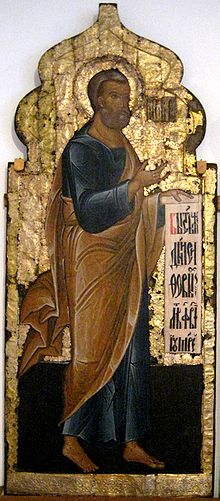
Icon of Seth
The interpretation that the sons of God in Gen. 6:2 were pious people, the worshipers of the true God, more especially that they were the godly descendants of Adam through Seth, whose genealogy is given in Gen. 5, is not only in accordance with Semitic, and particularly biblical, usage of the designation, as already shown, but it is consistent with the context. The sons of God are contrasted with the daughters of men, that is of other men. So Jeremiah says, “God did set signs in Israel and among men;” and the English version supplies the word other before men, in order to bring out the sense (Jer. 32:20). Likewise the psalmist says that the wicked “are not in trouble as men; neither are they plagued like men;” and again the English version supplies the word other (Ps. 73:5). After the same manner Gen. 6:1-2 may be read: “When mankind began to multiply on the face of the ground, and daughters of other men that they were fair; and they took them wives of all that they chose.” The meaning of the writer is that when men began to increase in number, the worshipers of God so far degenerated that in choosing wives for themselves they neglected character, and esteemed beauty of face and form above piety. The offspring of these marriages were perhaps stalwart and violent. Mixture of race in marriage often produces physical strength in the descendants, and lack of religion in the parents is apt to be reproduced in the children. The intermarriage of the sons of God and the daughters of men was offensive in the sight of God. Sentence was pronounced against the wrongdoers. The penalty is not denounced on angels, who were not only implicated, but were the chief sinners, if the sons of God were angels. The punishment is pronounced against man only. Man, not angels, had offended.
Sons of God everywhere in Scripture, from the earliest to the latest times, means the worshipers and beneficiaries of God, both among mortal in immortal beings. But the content of this idea did not remain the same through the ages. It became larger with increasing knowledge of the riches of God. It enlarged, for example, at the time when the Israelites were delivered from Egypt.
- God said: “I have seen the affliction of my people” (Ex. 3:7);
- and again: “Say unto Pharaoh, Israel is my son, my firstborn; who is as dear to me,” so the following words imply, “as Pharaoh’s firstborn is to him” (Ex. 4:22 with 23);
- and again: “I will take you to me for a people, and I will be to you a God” (Ex. 4:7).
Heretofore the title had emphasized a filial relation of men to God, their dependence upon him for protection and care, and their duty of reverence and obedience. Now God formally accepts the obligations which implicitly devolve on him. The content of the title was further enlarged through the teaching of Jesus Christ. He took truths already known, shed light on them, and connected them with this designation.
- He exhibited the fact that God is an actual father and that his people are actual children of God. They are such by the new birth (John3:3,5-6,8; cf. Rev. 11:11),
- begotten of God (John 1:12-13; v.21; and so Eph. 2:5; Jas. 1:18; 1 Pet. 1:23),
- made partakers of the divine nature through the mediation of the indwelling Spirit (John6:48-51; 15:4-5; and so 1 John 3:9),
- and possessing a like character with God, resembling him in holiness, love and elevation above the illusions of earth (1 John 3:9; 4:7; 5:4),
- although falling far short of the divine character in this life (I John 1:8,10).
- They have been adopted as sons (Gal. 4:5), are taught by the Spirit to say Abba, Father (Gal. 6; Rom 8:15), and are led by the Spirit (Rom. 8:14).
Machen “Concerning the Times and Seasons”

Notice the similar color schemes? Interesting match!
I just finished reading “Encouragement for New Converts,” chapter 17 of The New Testament: An Introduction to its Literature and History (1976, 2009 Banner of Truth Trust) by J. Gresham Machen. This book makes a concise introduction to the major themes in the New Testament and clearly and effectively makes a positive presentation of orthodox New Testament scholarship, while at the same time providing textually based correctives to the academically popular theories of modernist liberal scholarship. Dr. Machen was, above all else, a New Testament scholar. While most known for both his New Testament Greek for Beginners, which is still used in many seminaries, and his popularly written Christianity and Liberalism, New Testament scholarship is his specialty.
Each chapter in Machen’s New Testament Introduction first assigns a selection of New Testament readings on which the following chapter is based. In this case, I read both 1 and 2 Thessalonians out of my ESV Study Bible before taking in Machen’s seven-page chapter on both books. While reading this chapter, which summarized the occasion, contents and issues related to the these earliest of Paul’s epistles, I was struck while reading the section on “The Second Coming of Christ,” in which he expounds “the second advent, with the events which are immediately to precede it” (p. 119). Machen interacts with the dominant modernist theory that Paul actually expected Christ to return during his lifetime.

Date-Setter, Harold Camping
But there is also a bit of timeliness to Machen’s exposition of 1 Thessalonians 5:1-11, specifically in the light of the current prediction by Harold Camping that Judgment Day has been calculated by him to be soon to occur on May 21, 2011. That’s 51 days and counting! Despite the fact that Jesus himself said, “But concerning that day and hour no one knows, not even the angels of heaven, nor the Son, but the Father only” (Matthew 24:36 ESV), Camping, not to mention all other date-setters, appeal to verses such as 1 Thessalonians 5:4-6, which read, “But you are not in darkness, brothers, for that day to surprise you like a thief. For you are all children of light, children of the day. We are not of the night or of the darkness. So then let us not sleep, as others do, but let us keep awake and be sober.” Machen’s introductory commentary also puts these words in perspective for us in the light of Camping’s millennial madness. Following is Machen’s section on “The Second Coming of Christ,” from pages 119-121 in The New Testament: An Introdcution to its Literature and History. Enjoy!
The Second Coming of Christ
Undoubtedly the second advent, with the events which are immediately to precede it, occupies a central position in the Thessalonian Epistles. Evidently the expectation of Christ’s coming was a fundamental part of Paul’s belief, and had a fundamental place in his preaching. ‘Ye turned unto God from idols, to serve a living and true God, and to wait for his Son from heaven’–these words show clearly how the hope of Christ’s appearing was instilled in the converts from the very beginning, I Thess. 1.9, 10. To serve the living God and to wait for his Son–that is the sum and substance of the Christian life. All through the Epistles the thought of the Parousia–the ‘presence’ or ‘coming’–of Christ appears as a master motive. I Thess. 2.19; 3.13; 4.13 to 5.11, 23, 24; II Thess. 1.5 to 2.12.
This emphasis upon the second coming of Christ is explained if Paul expected Christ to come in the near future. The imminence of the Parousia for Paul appears to be indicated by I Thess. 4.15: ‘For this we say unto you by the word of the Lord, that we that are alive, that are left unto the coming of the Lord, shall in no wise precede them that are fallen asleep.’ This verse is often thought to indicate that Paul confidently expected before his death to witness the coming of the Lord. Apparently he classes himself with those who ‘are left unto the coming of the Lor’ as over against those who will suffer death. In the later epistles, it is further said, Paul held a very different view. From Second Corinthians on, he faced ever more definitely the thought of death, II Cor. 5.1, 8; Phil. 1.20-26. A comparison of I Cor. 15.51 with II Cor 5.1, 8 is thought to indicate that the deadly peril which Paul incurred between the writing of the two Corinthian Epistles, II Cor. 1.8, 9, had weakened his expectation of living until Christ should come. After he had once despaired of life, he could hardly expect with such perfect confidence to escape the experience of death. The possibility of death was too strong to be left completely out of sight.
Plausible as such a view is, it can be held only with certain reservations.
In the first place, we must not exaggerate the nearness of the Parousia according to Paul, even in the earliest period; for in II Thess. 2.1-12 the Thessalonians are reminded of certain events that must occur before Christ would come. The expression of the former Epistle, I Thess. 5.2, that the day of the Lord would come as a thief in the night, was to be taken as a warning to unbelievers to repent while there was yet time, not as a ground for neglecting ordinary provision for the future. In Second Thessalonians Paul finds it necessary to calm the overstrained expectations of the Thessalonian Christians.
Furthermore, it is not only in the earlier epistles that expressions occur which seem to suggest that the Parousia is near: Rom. 13.11; Phil. 4.5. And then it is evident from II Cor. 11.23-29 and from I Cor. 15.30-32 that Paul had undergone dangers before the one mentioned in II Cor. 1.8,9, so that there is no reason to suppose that that one event caused any sudden change in his expectations.
Lastly, in I Cor. 6.14 Paul says that ‘God both raised the Lord, and will raise up us throught his power.’ If that refers to the literal resurrection, then here Paul classes himself among those who are to die; for if he lived to the Parousia, then there would be no need for him to be raised up.
It is therefore very doubtful whether we can put any very definite change in the apostle’s expectations as to his living or dying between First Corinthians and Second Corinthians. A gradual development in his feeling about the matter there no doubt was. During the early part of his life his mind dwelt less upoon the prospect of death than it did after perils of all kinds had made that prospect more and more imminent. But at no time did the apostle regard the privilege of living until the Parousia as a certainty to be put at all in the same category with the Christian hope itself. Especially the passage in First Thessalonians can be rightly interpreted only in the light of the historical occasion for it. Until certain members of the church had died, the Thessalonian Christians had never faced the possibility of dying before the second coming of Christ. Hence they were troubled. Would the brethren who had fallen asleep miss the benefits of Christ’s kingdom? Paul writes to reassure them. He does not contradict their hope of living till the coming of Christ, for God had not revealed to him that that hope would not be realized. But he tells them that, supposing that hope to be justified, even then they will have no advantage over their dead brethren. He classes himself with those who were still alive and might therefore live till Christ should come, as over against those who were already dead and could not therefore live till Christ should come.
Certain passages in the epistles of Paul, which are not confined to any one period of his life, seem to show that at any rate he did not exclude the very real possibility that Christ might come in the near future. But such an expectation of the early coming of Christ was just as far removed as possible from the expectations of fanatical chiliasts. It did not lead Paul to forget that the times and the seasons are entirely in the hand of God. It had no appreciable effect upon his ethics, except to make it more intense, more fully governed by the thought of the judgment seat of Christ. It did not prevent him from laying far-reaching plans, it did not prevent his developing a great philosophy of future history in Romans, chapters 9 to 11. How far he was from falling into the error he combated in Second Thessalonians! Despite his view of the temporary character of the things that are seen, how sane and healthy was his way of dealing with practical problems! He did his duty, and left the details of the future to God. Hence it is hard to discover what Paul thought as to how soon Christ would come–naturally so, for Paul did not try to discover it himself. [emphasis mine, highlighting Machen’s correction of Camping-like date-setting].
The “Origen” of Rob Bellion

HT: Sola Sisters
Bound up in the recent controversy over Rob Bell’s popularization of universal reconciliation is the New Testament term, apokatastasis. This word is found in Acts 3:21:
whom heaven must receive until the time for restoring (apokatastasis) all the things about which God spoke by the mouth of his holy prophets long ago (Acts 3:21 ESV).
Orthodoxy defines this term in accordance with the context of the word in its passage, its book, and the broader context of the Bible’s history of the redemptive work of God. The ESV Study Bible, therefore, illuminates this usage of the word in the following way:
the time for restoring all the things looks forward to when Christ will return and his kingdom will be established on earth, and the earth itself will be renewed even beyond the more abundant and productive state it had before Adam and Eve’s fall (see note on Rom. 8:20–21).
Universalists like Origen and those who buy into his notion of universal reconciliation, however, prefer to read ancient Hellenistic philosophy into the term in order to wrest it from its biblical context. In Quodlibet Journal, an apparent proponent of Origen’s view, Edward Moore, writes in “Origen of Alexandria and apokatastasis: Some Notes on the Development of a Noble Notion“,
This term occurs in only a single New Testament passage; its provenance is not intrinsically Christian or even Jewish, but Hellenistic, and bound up with the cosmology and anthropology of the era–a system of belief which Origen, in his day, was obliged to undermine in the interest of Christian teaching.

In my humble opinion, Origen wasn’t terribly successful at undermining the Hellenistic associations of the word. It would be more accurate to conclude that what he actually did was reconcile the Bible’s usage with its prior usage by pagan Greek philosophers (that went on a lot in the ancient church, with greater and lesser degrees of success). Origen basically (and I do mean basic) believed in the pre-existence of absolutely free souls as springing originally from God, freely falling into our current state of relative goodness or its antithesis (see Moore’s article), being guided by the instructive providence of God to relearn how to embrace “the Good,” even if this means some time in hell under God’s pedagogical judgment until such a time in the distant future, in which that free soul ultimately embraces the Good and is finally reconciled, or returned to the deified state from which he fell. As I read the many reviews of Rob Bell’s book (here’s Kevin DeYoung’s review, for example) that are now all over the interwebs, I couldn’t help but recognize some of these themes as being reflected in their citations of Bell’s teaching. It was kind of creepy.
I wonder how long it’ll take for the rest of Origen’s views regarding apokatastasis to be released by HarperOne under Bell’s name.
Remember, students, “Rob Bellion is as the sin of witchcraft.”
Michael Card on the Misadventure of Mere Head Knowledge

Michael Card‘s latest album, Luke: A World Turned Upside Down, features a song called “The Bridge,” based on the parable of the Good Samaritan, demonstrating just what kind of misadventure mere head knowledge of the Word of God can be. I just heard last night that he’ll be conducting his current Biblical Imagination Conference an hour away from my home, down at Waxahachie Bible Church on April 8-9. Don’t know if I can make Friday, don’t know if I can make the conference all day Saturday, but some of us may attend the concert Saturday night. I’ll keep you posted if it does happen. Anyway, I wanted to share this song with you, since it’s so consistent with the theme of this blog. But first, the passage from God’s Word which inspired the song:
And behold, a lawyer stood up to put him to the test, saying, “Teacher, what shall I do to inherit eternal life?”
He said to him, “What is written in the Law? How do you read it?”
And he answered, “You shall love the Lord your God with all your heart and with all your soul and with all your strength and with all your mind, and your neighbor as yourself.”
And he said to him, “You have answered correctly; do this, and you will live.”
But he, desiring to justify himself, said to Jesus, “And who is my neighbor?”
Jesus replied, “A man was going down from Jerusalem to Jericho, and he fell among robbers, who stripped him and beat him and departed, leaving him half dead. Now by chance a priest was going down that road, and when he saw him he passed by on the other side. So likewise a Levite, when he came to the place and saw him, passed by on the other side. But a Samaritan, as he journeyed, came to where he was, and when he saw him, he had compassion. He went to him and bound up his wounds, pouring on oil and wine. Then he set him on his own animal and brought him to an inn and took care of him. And the next day he took out two denarii and gave them to the innkeeper, saying, ‘Take care of him, and whatever more you spend, I will repay you when I come back.’ Which of these three, do you think, proved to be a neighbor to the man who fell among the robbers?”
He said, “The one who showed him mercy.”
And Jesus said to him, “You go, and do likewise.”
(Luke 10:25-37 ESV)
THE BRIDGE (click here to listen to song)
Michael Card
There was a legal-minded man
Intellectually inclined
But the facts just seemed to pile up
And fester in his mind
So he asked a twisted question
“What am I supposed to do?”
His heart said he should love
But his mind still wondered, “who?”
From the head to the heart
From the heart to the mind
The Truth must make a journey
If we ever hope to find
You can see it as a bridge
Or as a narrow, winding road
The fact is Truth must travel
If it ever will be told
Then the answer came concealed
In the story Jesus told
Of a lonely, outcast traveler
Upon a dangerous road
When men with all the answers
Left the wounded man to die
While the lonely clueless stranger
Refused to pass him by
The answer’s not an answer
If it’s for the mind alone
It’s the orchard in the apple seed
It’s the seed that must be sown
It has to do with loving
And giving all you have to give
But only those who cross the bridge
Can ever hope to live.
2010 Covenant Artists ASCAP
piano, Vance Taylor
bass, Norbert Putnam
drums, Chester Thompson
vocals, Scott Roley, Michael Card
percussion, Ken Lewis
The Bible’s Inconvenient Truth

Dr. K. Scott Oliphint (left) with Rev. Joe Troutman (right)
The following was preached on March 6, 2011 by Rev. Joe Troutman, pastor of Mid Cities Presbyterian Church, in Bedford, Texas. This just happened, in the providence of God, to be the weekend after the controversy about which I’ve been posting for the past couple of weeks. The heresy of some becomes an opportunity for the orthodox to proclaim the truths of the Bible with all the more clarity. I hope you find the following words at the same time edifying and challenging.
“Again, the kingdom of heaven is like a net that was thrown into the sea and gathered fish of every kind. When it was full, men drew it ashore and sat down and sorted the good into containers but threw away the bad. So it will be at the close of the age. The angels will come out and separate the evil from the righteous and throw them into the fiery furnace. In that place there will be weeping and gnashing of teeth.” (Matthew 13:47-50 ESV)
The third parable, which is found in verses 47-50, is the longest of the four. There is some similarity here to the first two, but overall it is different. Some commentators group it with the parable of the wheat and the tares because it describes a harvest–a harvest of the sea, as opposed to a harvest of the field. In this parable, Jesus says again, “The Kingdom of heaven is like a net that was thrown into the sea, and gathered fish of every kind. Like the second parable, there is a great search taking place. But instead of a search for a precious pearl, it is a search for fish. This search is being done, it says, by angels.
The first two parables describe men who find the Kingdom, but this parable is about the Kingdom finding men. We may think we found God. We may think that in some way we stumbled across him; that in our search in the marketplace, we have found the pearl of great price. But in reality, the parable shows, Jesus is continuing to tell us that it is God who found us. It is God, the Lord Jesus Christ himself—who sought us out. Jesus said in Luke 19:10, “The Son of Man came to seek and to save the lost.” The value of God’s Kingdom, and the place of God’s elect in it, are so great that the purchase price was nothing less than Jesus Christ himself. It is, in fact, more than you and I could pay. More than we could ever pay. It is a debt that is too great for us. Because God made a covenant with himself to save a people for himself, he was willing to go to any length to procure his people’s salvation. He was willing to give his Son as a ransom for lost sinners like you and me. This is what the Lord was willing to do for all who truly believe.
In this parable, the Kingdom of heaven is compared to a net. Don’t think of a fishing net, don’t think of a net that’s at the end of a pole, that people use to scoop up a fish at the end of a fishing line. Don’t necessarily even think of a net that is cast out into the water. This is a large net. This is a dragnet. This is what may be termed a seine. One of the things my dad, my grandfather, my brother and I would do when we were younger, we had a creek running through the property of our farm, and every so often we would take a seine and we would go, men on one side and men on the other, and go up the creek and catch whatever we could find–turtles, snakes, fish–whatever it was, we would try to catch it. This is the kind of thing that Jesus is describing here in this parable. The angels, the reapers, are catching whatever they can get, and the sorting of the good fish from the bad ones would take place on the shore, which is what Jesus says in verse 48. He says, “When it was full, men drew it ashore, and sat down and sorted the good into containers, and threw away the bad.”
Then he explains this part of the parable in verses 49-50. He says, “So it will be at the close of the age. The angels will come out and separate the evil from the righteous, and throw them into the fiery furnace. In that place there will be weeping and gnashing of teeth.” What is Jesus talking about? He’s talking about the final judgment. He’s talking about when he returns; when he returns as the Savior of his people and the Judge of those who have rejected him. What is he saying will happen? He is saying that some will be kept, and some will be thrown away. There will be a final sorting that takes place: some will be welcomed into glory by their Savior, and others will be cast into hell by their Judge.
This is what Jesus is teaching. Yet if we affirm this, we are in danger, we need to know, as being regarded as radical fundamentalists by most of the people in our society–even by fellow evangelicals. Yet there is an inconvenient truth for those who would deny the existence of hell and eternal punishment in it by the Lord. And this is it: Scripture says it exists! Scripture repeatedly talks about the existence of hell. The weeping and the gnashing of teeth, the casting of those who refuse to believe into hell, Jesus himself–regarded by many on the more liberal side of the church as just a friendly and nice guy, a lovable teddy-bear type of Savior–Jesus himself talks about hell. It is inescapable.
Now we are not to revel in it; it should sadden us that some are lost. And yet, in God’s casting unbelievers into hell, he is glorified. This may be difficult for us, but just because it is difficult does not give us the right to throw this doctrine away. In so doing, we are throwing portions of Scripture away. In Matthew 10:28, Jesus warned his followers not to fear someone who could kill the body but not the soul; he says instead to fear him who can destroy both the body and the soul in hell. In other words, fear God.
The book of Revelation also has something to say about that. It is the place where Satan and his angels and everyone whose name is not written in the Lamb’s Book of Life. It is described in Revelation 21:8 as the lake that burns with fire and sulfur, which is the Second Death. There are many today who are challenging Jesus’ teaching in our passage, and many others that say he will save some and send others to hell, but they are denying God’s Word. If they’re denying that he sends some to hell, they are denying his Word, and they have nothing left to stand on when they make their own pronouncements.
In the photo above, Rev. Troutman is posing with Dr. K. Scott Oliphint, professor of Apologetics and Systematic Theology at Westminster Theological Seminary in Philadelphia, Pennsylvania. He came to town as a speaker at the recent Full Confidence Conference, about which I posted a few weeks ago. In the Q & A Session at the end of the conference, Dr. Oliphint concludes the entire event with some very compelling words on the nature of hell as eternal, conscious torment. I highly recommend you give it a listen as well.
The Scriptures’ Guardrails on Divine Sovereignty, Human Responsibility, etc.

Westminster Seminary California has posted what is probably my favorite article by Dr. Michael Horton, their J. Gresham Machen professor of apologetics and systematic theology. The title is “Reformed Theology vs. Hyper-Calvinism.” It deals with how Scripture presents passages that relate both concepts. The great contribution of Reformed theology has been to attempt to properly interpret each in the light of the other, allowing, for example, the passages on the sovereignty of God to prevent us from falling off one side into sheer Pelagianism, and the passages on human responsibility from falling off into Hyper-Calvinism.
Many foes of Reformed theology are guilty of mis-characterizing it in terms of what is formally classified as Hyper-Calvinism. They refuse to notice that Calvinists are just as critical of Hyper-Calvinism as moderate Calvinists and Arminians are. This article helps the reader see the difference between the two.


 The Misadventures of Captain Headknowledge
The Once and Future King (Matthew 21:1-11)
Sermon Notes from Sunday, October 9, 2011. Delivered by Rev. Joe Troutman at Mid-Cities Presbyterian Church (OPC). Listen online.
Jesus comes into Jerusalem as king, but in a week’s time he will have been crucified and raised from the dead for sinners like you and me.
“The Lord Has Need of Them” (Matthew 21:1-5) Now when they drew near to Jerusalem and came to Bethphage, to the Mount of Olives, then Jesus sent two disciples, saying to them, “Go into the village in front of you, and immediately you will find a donkey tied, and a colt with her. Untie them and bring them to me. If anyone says anything to you, you shall say, ‘The Lord needs them,’ and he will send them at once.” This took place to fulfill what was spoken by the prophet, saying, “Say to the daughter of Zion, ‘Behold, your king is coming to you, humble, and mounted on a donkey, on a colt, the foal of a beast of burden.’”
“Hosanna” (Matthew 21:6-9) The disciples went and did as Jesus had directed them. They brought the donkey and the colt and put on them their cloaks, and he sat on them. Most of the crowd spread their cloaks on the road, and others cut branches from the trees and spread them on the road. And the crowds that went before him and that followed him were shouting, “Hosanna to the Son of David! Blessed is he who comes in the name of the Lord! Hosanna in the highest!”
“The King Enters His City” (Matthew 21:10-11) And when he entered Jerusalem, the whole city was stirred up, saying, “Who is this?” And the crowds said, “This is the prophet Jesus, from Nazareth of Galilee.”
Everyone who believes in the Lord Jesus Christ will bow his knee willingly, lovingly, obediently and instantly. Repent, believe in him—today—now!—while it’s still called today (see Hebrews 3:13), so that when he comes in glory he will know you as his own and you will rejoice at his coming and not be fearful.
Share this: