Taking the Bible “Seriously,” Not Literally
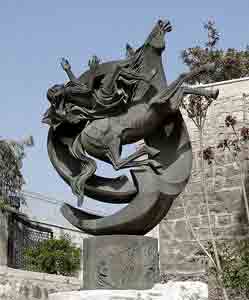
Syrian statue of Saul of Tarsus falling from his horse at the appearance of Jesus
Here’s another example of how people are incapable of absolute objectivity. As you know, I’m currently reading Oxford Church Historian, Diarmaid MacCulloch’s 2009 book, Christianity: The First Three Thousand Years (© 2009, Viking). Fortunately, the author makes no pretense to absolute objectivity. In his telling of the history of Christianity (or, more fashionably, “Christianities”), he explains that at times his own opinion will show through. Boy, does it ever! In some cases, these opinions appear in the form of his own imaginative theory for how something fundamental to Christianity may have developed in a way other than how the Bible explicitly states that it did. What scholar worth his salt is going to take the Bible’s historical claims at face value? Especially those involving supernatural experiences.
In his introduction, MacCulloch calls “modern neurosis” the presupposition that the Bible is authoritative. The “scholarly” approach is to take the Bible “seriously” in a way that disregards the literal interpretation of the Bible.
“The Bible’s authority for Christians lies in the fact they have a special relationship with it that can never be altered, like the relationship of parent and child. This does not deny relationships with other books which may be both deep and long-lasting, and it does not necessarily make the parental relationship easy or pleasant. It is simply of a different kind, and can never be abrogated. Once we see this, much modern neurosis about the authority of the Bible can be laid aside. Maybe the Bible can be taken seriously rather than literally” (MacCulloch, page 8).
In what way might we take the Bible seriously without taking it literally? I suppose the answer is to simply admire and attempt to follow the Bible’s moral teachings, receiving them as wrenched from their presumably mythological context. In other words, orthodox Christians need to become theological liberals. We should bravely affirm that the Bible can be wrong about history, but right about morality and spirituality. In other endeavors, if one is wrong in one area, it undermines his credibility in other areas. If the Bible is historically untenable, then it is spiritually untenable. Why, then, bother with the Bible’s morality, when we can change our morals with the times—which is precisely what theological liberals do with biblical morality. They lay it aside, along with their neurosis about the authority of the Bible. MacCulloch’s own unrepentant homosexuality is a prime example of this fact.
In chapter one, “Greece and Rome (c. 1000 BCE-100 CE),” MacCulloch gives us an example of how he takes the Bible seriously, though not literally. In his description of imperial Rome’s racial inclusivity, and generous granting of citizenship to foreigners of all kinds, he finds the possible origin of the preaching of the Christian gospel among Gentiles. MacCulloch suggests that “pride” in Paul’s own Roman citizenship could have been the real source of his desire to invite Gentiles into the number of God’s chosen people. If we took the Bible seriously, then we, too, could confidently make up our own reasons to explain away the Bible’s historical narratives! MacCulloch leads by example:
Why was Rome’s expansion so remarkably successful? Plenty of other states produced dramatic expansion, but survived for no more than a few generations or a couple of centuries at most. The western part of the Roman state survived for twelve hundred years, and in its eastern form the Roman Empire had a further thousand years of life after that. The answer probably lies in another contrast with Greece: the Romans had very little sense of racial exclusiveness. They gave away Roman citizenship to deserving foreigners—by deserving, they would mean those who had something to offer them in return, if only grateful collaboration. Occasionally whole areas would be granted citizenship. It was even possible for slaves to make the leap from being non-persons to being citizens, simply by a formal ceremony before a magistrate, or by provision in their owners’ wills.32
Where this highly original view of citizenship came from is not clear; it must have evolved during the struggle for power between the patricians and the plebeians after the fall of the kings. In any case, the effect was to give an ever-widening circle of people a vested interest in the survival of Rome. That became clear in one dramatic case in the first century of the Common Era, when a Jewish tent-maker called Paul, from Tarsus, far away from Rome in Asia Minor, could proudly say that he was a Roman citizen, knowing that this status protected him against the local powers threatening him. It might have been his pride in this status of universal citizen which first suggested to Paul that the Jewish prophet who had seized his allegiance in a vision had a message for all people and not just the Jews (MacCulloch, p. 42).
If we only had the scholarly authority to associate things that are historically verifiable–like the extent of Roman citizenship–with fundamental elements of Christianity–like their proclaiming to Gentiles the life, death, resurrection and royal ascension of the Jewish Messiah–then we wouldn’t have to suspend our disbelief enough to take the Bible literally when Paul’s physician-associate, Luke–himself a careful historian (cf. Luke 1:1-3)–records in the sequel to his gospel, The Acts of the Apostles, Paul’s conversion on his way to Damascus, and divine calling to be the apostle to the Gentiles:
[9:1] But Saul, still breathing threats and murder against the disciples of the Lord, went to the high priest [2] and asked him for letters to the synagogues at Damascus, so that if he found any belonging to the Way, men or women, he might bring them bound to Jerusalem. [3] Now as he went on his way, he approached Damascus, and suddenly a light from heaven shone around him. [4] And falling to the ground he heard a voice saying to him, “Saul, Saul, why are you persecuting me?” [5] And he said, “Who are you, Lord?” And he said, “I am Jesus, whom you are persecuting. [6] But rise and enter the city, and you will be told what you are to do.” [7] The men who were traveling with him stood speechless, hearing the voice but seeing no one. [8] Saul rose from the ground, and although his eyes were opened, he saw nothing. So they led him by the hand and brought him into Damascus. [9] And for three days he was without sight, and neither ate nor drank.
[10] Now there was a disciple at Damascus named Ananias. The Lord said to him in a vision, “Ananias.” And he said, “Here I am, Lord.” [11] And the Lord said to him, “Rise and go to the street called Straight, and at the house of Judas look for a man of Tarsus named Saul, for behold, he is praying, [12] and he has seen in a vision a man named Ananias come in and lay his hands on him so that he might regain his sight.” [13] But Ananias answered, “Lord, I have heard from many about this man, how much evil he has done to your saints at Jerusalem. [14] And here he has authority from the chief priests to bind all who call on your name.” [15] But the Lord said to him, “Go, for he is a chosen instrument of mine to carry my name before the Gentiles and kings and the children of Israel. [16] For I will show him how much he must suffer for the sake of my name.” [17] So Ananias departed and entered the house. And laying his hands on him he said, “Brother Saul, the Lord Jesus who appeared to you on the road by which you came has sent me so that you may regain your sight and be filled with the Holy Spirit.” [18] And immediately something like scales fell from his eyes, and he regained his sight. Then he rose and was baptized; [19] and taking food, he was strengthened.
For some days he was with the disciples at Damascus. (See also Acts 22:1-21)
I mean, seriously!
The Instrument of Faith

73. Q. How doth faith justify a sinner in the sight of God?
A. Faith justifies a sinner in the sight of God, not because of those other graces which do always accompany it, or of good works that are the fruits of it, nor as if the grace of faith, or any act thereof, were imputed to him for his justification, but only as it is an instrument by which he receiveth and applieth Christ and his righteousness (John 1:12; Philippians 3:9; Galatians 2:16).
Who will become a child of God? The one who is “in Christ.” Who will get “into Christ”? The one who receives Christ by faith, or, according to the original Greek, believing “into” him. John writes, “But to all who did receive him, who believed in (literally, “into”) his name, he gave the right to become children of God” (John 1:12).
Faith which places the sinner “in Christ” is not merely an acknowledgment that there was a historical figure named Jesus of Nazareth who embarked on an itinerant ministry which lead many first century Jews to conclude that he was the Anointed One (“Christ”) proclaimed by the Old Testament prophets. Faith in Christ does begin with such knowledge, even assenting to the truthfulness of such a proposition, but it must also result in a willingness to rest on the righteousness which Christ is proclaimed in the gospel message to have earned by his flawless observance of the law of Moses which has at its heart the moral law of God, confessing that by one’s own observance of God’s law he will not be able to earn for himself the same kind of inherent righteousness. As Paul writes in Galatians 2:16:
“yet we know that a person is not justified by works of the law, but through faith in Jesus Christ. So we also have believed in (again, “into”) Christ Jesus in order to be justified by faith in Christ, and not by works of the law, because by works of the law no one will be justified.”
So being found in Christ depends on having the righteousness of Christ which comes from God, and having the righteousness which comes from God depends on faith. In Philippians 3:9 it is written, “and be found in him, not having a righteousness of my own that comes from the law, but that which comes through faith in Christ, the righteousness from God that depends on faith.” So we see that when faith is imputed as righteousness, faith is not the thing that makes a person inherently righteous, but rather it is simply what the Westminster Divines call in Q&A #73 of the Larger Catechism, “an instrument by which he receiveth and applieth Christ and his righteousness.”
God Imputes Righteousness, Not Faith
Q. 73. How doth faith justify a sinner in the sight of God?
A. Faith justifies a sinner in the sight of God, not because of those other graces which do always accompany it, or of good works that are the fruits of it, nor as if the grace of faith, or any act thereof, were imputed to him for his justification (Romans 4:5; 10:10); but only as it is an instrument by which he receiveth and applieth Christ and his righteousness.
Believing is not a good work. It earns nothing. If there were such a thing as a righteous person other than Jesus Christ, there would be no need to impute his righteousness to him. For this hypothetical person who earns righteousness by his own good works, having Christ’s righteousness imputed or credited to him would be superfluous, redundant, and unnecessary.
Christ did not come to call those who think their righteousness is good enough. God did not send his Son to die for those who never come to admit that they deserve to die because of their sin. In Romans 4:5, Paul describes God as “him who justifies the ungodly.” The ungodly one who despairs of his inability to earn righteousness by his good works is the kind of person whom God justifies, or declares righteous in his sight.
In this same passage, Paul explains that “his [the ungodly person’s] faith is counted as righteousness.” This is the biblical doctrine of imputation, and Paul elaborates on it in the rest of his sentence which concludes in verses 6 -8: “… just as David also speaks of the blessing of the one to whom God counts [imputes] righteousness apart from works: ‘Blessed are those whose lawless deeds are forgiven, and whose sins are covered; blessed is the man against whom the Lord will not count [impute, KJV] his sin.’” As you see, the Bible teaches that while a man’s faith may in one sense be “imputed,” or “counted” as righteousness, in a greater sense, what is really going on is that Christ’s righteousness is being imputed to the ungodly believer–the righteousness of Christ is counted as the righteousness of the ungodly believer. It is a careless misreading to interpret the Bible as teaching that God imputes faith to the ungodly; rather, God imputes the righteousness of Christ to him.
What, then, is the source of this faith by which we are justified by the imputed righteousness of Christ? “For with the heart one believes and is justified, and with the mouth one confesses and is saved” (Romans 10:10). In the song, “Rock of Ages,” Christians sing, “Nothing in my hand I bring/Simply to the cross I cling.” It is not the work of our hands by which we are justified, but the gracious gift of faith which emerges from a regenerate, spiritually living heart which has been newly freed from sin and empowered to rest on the finished work of his righteous Savior who has been crucified and risen for him. We may be justified by a righteousness that is not our own, but that righteousness is received by a faith that is very much our own, graciously enabled by the power of the Holy Spirit.
Answer #73 of the Westminster Larger Catechism, then, further denies that the faith by which he is justified was not imputed to him—it was not the faith of another, but his own faith which arises by God’s grace from his own regenerate heart. His faith is the fruit grown on the good tree of his own regenerate heart.
How Faith Does NOT Justify
Q. 73. How doth faith justify a sinner in the sight of God?
A. Faith justifies a sinner in the sight of God, not because of those other graces which do always accompany it, or of good works that are the fruits of it (Gal. 3:11; Rom. 3:28), nor as if the grace of faith, or any act thereof, were imputed to him for his justification; but only as it is an instrument by which he receiveth and applieth Christ and his righteousness.
Faith is the means which God has ordained for the elect in order that he may declare them righteous in his sight. Man, unfortunately, assumes he must perform, to achieve a perfect score when it comes to keeping God’s moral law. In this assumption, he is sadly mistaken. Paul writes in Galatians 3:11, “no one is justified before God by the law, for ‘The righteous shall live by faith.’” Later in his great exposition of the gospel in his epistle to the Romans, Paul echoes this truth when he writes, “For we hold that one is justified by faith apart from works of the law” (Romans 3:28).
In keeping with this Pauline distinction between faith and the law, the framers of the Westminster Standards of 1649 write in their Larger Catechism, “Faith justifies a sinner in the sight of God, not because of those other graces which do always accompany it, or of good works that are the fruits of it…” (Westminster Larger Catechism, Q&A #73). Here they write that good works are the fruit of faith, not the condition the elect must meet so God will declare them righteous in his sight (justify them). The catechism answer also denies that the other graces that accompany faith are the way we receive God’s justifying declaration of righteousness. For example, graces such as hope, love, joy, or any others are excluded, along with good works, as the basis on which faith justifies the sinner.
In short, faith does not justify because of good works; rather, good works are the result of justification by faith alone.
The Biblical Basis of the Reformed Confessions and Catechisms
As a member of a local confessional Presbyterian church and coming from my background as an Independent Baptist, I can’t help but notice how easy it is to confirm the common accusation that “Presbyterians often seem to cite the Confession more readily than they do the Bible.” As I listen to teaching (that of no one in particular, and this is not restricted to my own congregation), I often find myself listening to it as if I were a Baptist who was hearing this presentation for the first time. It doesn’t take long before all the biblicist defenses go up. A Reformed teacher will teach a vital biblical truth and then they will cite the Westminster Standards or something from the Three Forms of Unity (click on the “Creeds, Etc.” link at the top of this webpage for more information on these Reformed doctrinal standards). The response a self-respecting biblicist is trained to make to a presentation like this is, “That’s nice, now what does the Bible say about it?” or, more boldly, they might declare, “I don’t care what your confession or catechism says, what does the Bible say?”
It occurs to me that if Presbyterians and those of other confessional Reformed denominations want to persuade those from outside their tradition, like Baptists, to believe that what Reformed confessions and catechisms teach is based on the Bible, then perhaps it would be time well spent to express their biblically based confessional statements by first disclosing what the Bible says and working from this to showing how what the confession or catechism says is solidly based on what the Bible says.
After all, a “Confession” is not intended to be a rival for the Bible, but an expression of what Reformed churches believe the Bible teaches. To use the word “Confession” alone does not necessarily communicate this ultimate point to those from outside the tradition. That’s why when I personally explain things related to the Confession of Faith, I will put the word “Confession” in a sentence that attempts to fully express what a Confession of Faith is. For example, “This biblical truth (whatever it may be) is worded this way, or that way, in the Confession of what Reformed churches believe best summarizes the teaching of the Bible.”
Now I realize there are many good Reformed teachers who are careful to base their arguments on Scripture, but the stereotype that the Reformed in general have a bad habit of quoting the confession more than they do the Bible is grounded in verifiable reality. I love hearing an explanation of what the Confession teaches, but then, I have already gotten over the hurdle of being persuaded that what the Confession teaches is what the Bible teaches, although not infallibly, of course.
For this reason, I have decided to engage in a little exercise for a while, which I will share with my readers. In the spirit of how I would like to hear the teaching of the Reformed confessions and catechisms expressed, I’m simply going to take the Scripture Proofs cited for almost any given phrase in the Westminster Larger Catechism (which my church currently happens to being going through), summarize the point being highlighted in the verses, cite the verses themselves, then explain that this is the reason the Catechism reads the way it reads.
Sound like fun? I hope you’ll join me! In the following post, I will give this treatment to the first clause in Question and Answer #73 of the Westminster Larger Catechism.
To the fast or to the wedding feast?
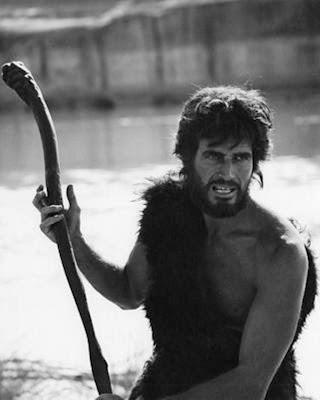
Charlton Heston as John the Baptist as seen in “The Greatest Story Ever Told” (1965).
Why does the Gospel According to John have Jesus calling three disciples and attending the wedding at Cana after his baptism, when the synoptic Gospels according to Matthew, Mark and Luke all have Jesus “immediately” being driven by the Spirit into the desert to be tempted by the devil (Matthew 3:1-4:11; Mark 1-13; Luke 3:1-4:12)? This seeming discrepancy was recently brought to my attention. After a little homework, I’d like to share with you what I discovered about John 1:19-2:25 and how this pericope is reconciled with the synoptic narratives of Jesus’ baptism and temptation. First, let’s read the passage in question. Passages relevant to chronology or paralleling the synoptic narratives are highlighted either in bold or italics:
And this is the testimony of John, when the Jews sent priests and Levites from Jerusalem to ask him, “Who are you?” He confessed, and did not deny, but confessed, “I am not the Christ.” And they asked him, “What then? Are you Elijah?” He said, “I am not.” “Are you the Prophet?” And he answered, “No.” So they said to him, “Who are you? We need to give an answer to those who sent us. What do you say about yourself?” He said, “I am the voice of one crying out in the wilderness, ‘Make straight the way of the Lord,’ as the prophet Isaiah said.”
(Now they had been sent from the Pharisees.) They asked him, “Then why are you baptizing, if you are neither the Christ, nor Elijah, nor the Prophet?” John answered them, “I baptize with water, but among you stands one you do not know, even he who comes after me, the strap of whose sandal I am not worthy to untie.” These things took place in Bethany across the Jordan, where John was baptizing.
The next day he saw Jesus coming toward him, and said, “Behold, the Lamb of God, who takes away the sin of the world! This is he of whom I said, ‘After me comes a man who ranks before me, because he was before me.’ I myself did not know him, but for this purpose I came baptizing with water, that he might be revealed to Israel.” And John bore witness: “I saw the Spirit descend from heaven like a dove, and it remained on him. I myself did not know him, but he who sent me to baptize with water said to me, ‘He on whom you see the Spirit descend and remain, this is he who baptizes with the Holy Spirit.’ And I have seen and have borne witness that this is the Son of God.”
The next day again John was standing with two of his disciples, and he looked at Jesus as he walked by and said, “Behold, the Lamb of God!” The two disciples heard him say this, and they followed Jesus. Jesus turned and saw them following and said to them, “What are you seeking?” And they said to him, “Rabbi” (which means Teacher), “where are you staying?” He said to them, “Come and you will see.” So they came and saw where he was staying, and they stayed with him that day, for it was about the tenth hour. One of the two who heard John speak and followed Jesus was Andrew, Simon Peter’s brother. He first found his own brother Simon and said to him, “We have found the Messiah” (which means Christ). He brought him to Jesus. Jesus looked at him and said, “You are Simon the son of John. You shall be called Cephas” (which means Peter).
The next day Jesus decided to go to Galilee. He found Philip and said to him, “Follow me.” Now Philip was from Bethsaida, the city of Andrew and Peter. Philip found Nathanael and said to him, “We have found him of whom Moses in the Law and also the prophets wrote, Jesus of Nazareth, the son of Joseph.” Nathanael said to him, “Can anything good come out of Nazareth?” Philip said to him, “Come and see.” Jesus saw Nathanael coming toward him and said of him, “Behold, an Israelite indeed, in whom there is no deceit!” Nathanael said to him, “How do you know me?” Jesus answered him, “Before Philip called you, when you were under the fig tree, I saw you.” Nathanael answered him, “Rabbi, you are the Son of God! You are the King of Israel!” Jesus answered him, “Because I said to you, ‘I saw you under the fig tree,’ do you believe? You will see greater things than these.” And he said to him, “Truly, truly, I say to you, you will see heaven opened, and the angels of God ascending and descending on the Son of Man.”
On the third day there was a wedding at Cana in Galilee, and the mother of Jesus was there. Jesus also was invited to the wedding with his disciples. When the wine ran out, the mother of Jesus said to him, “They have no wine.” And Jesus said to her, “Woman, what does this have to do with me? My hour has not yet come.” His mother said to the servants, “Do whatever he tells you.”
Now there were six stone water jars there for the Jewish rites of purification, each holding twenty or thirty gallons. Jesus said to the servants, “Fill the jars with water.” And they filled them up to the brim. And he said to them, “Now draw some out and take it to the master of the feast.” So they took it. When the master of the feast tasted the water now become wine, and did not know where it came from (though the servants who had drawn the water knew), the master of the feast called the bridegroom and said to him, “Everyone serves the good wine first, and when people have drunk freely, then the poor wine. But you have kept the good wine until now.” This, the first of his signs, Jesus did at Cana in Galilee, and manifested his glory. And his disciples believed in him.
After this he went down to Capernaum, with his mother and his brothers and his disciples, and they stayed there for a few days.
The Passover of the Jews was at hand, and Jesus went up to Jerusalem. In the temple he found those who were selling oxen and sheep and pigeons, and the money-changers sitting there. And making a whip of cords, he drove them all out of the temple, with the sheep and oxen. And he poured out the coins of the money-changers and overturned their tables. And he told those who sold the pigeons, “Take these things away; do not make my Father’s house a house of trade.” His disciples remembered that it was written, “Zeal for your house will consume me.”
So the Jews said to him, “What sign do you show us for doing these things?” Jesus answered them, “Destroy this temple, and in three days I will raise it up.” The Jews then said, “It has taken forty-six years to build this temple, and will you raise it up in three days?” But he was speaking about the temple of his body. When therefore he was raised from the dead, his disciples remembered that he had said this, and they believed the Scripture and the word that Jesus had spoken.
Now when he was in Jerusalem at the Passover Feast, many believed in his name when they saw the signs that he was doing. But Jesus on his part did not entrust himself to them, because he knew all people and needed no one to bear witness about man, for he himself knew what was in man. (John 1:19-2:25 ESV)
You see? It seems upon a quick reading of this passage that after Jesus’ baptism, instead of immediately being driven into the desert to be tempted by the devil, John rather has Jesus calling disciples, attending a wedding, cleansing the Temple and keeping the feast of Passover. But is this really what is going on? Look at John 1:19-34 a little more carefully…
John and the Synoptics Reconciled
It is true that the three synoptic gospels contain the narrative of Jesus’ baptism “immediately” followed by his departing for the wilderness to be tempted by the devil. It is also true that John chapter one contains some language shared by the synoptics’ baptism narratives, and it even contains a reference to the Spirit in the form of a dove descending and remaining on Jesus, which is what happened upon his baptism at the hands of John. But the big difference between the John narrative and those of the synoptics is the fact that in John’s gospel, the account of Jesus’ baptism is not given.
John 1:19-28 is John testifying to the priests and Levites sent by the Pharisees, which testimony contains some of the same language as is found in the synoptic baptism accounts. Then John 1:29-34 present the events of the day after John the Baptist’s testimony to the leaders from Jerusalem. Watch the action carefully: Jesus approaches, John announces his Messianic identity and then he “bears witness” that he saw the Spirit like a dove descend on him.
Nowhere does it say that it was on this day that John baptized him, nor does it say that John saw the Spirit descend on him on that very day, but in his dramatic announcement to his followers upon Jesus’ arrival, he informed them that he had seen the Spirit descend on him when he had baptized him in the past. This means that Jesus had been baptized by John some 40+ days prior to this. So the baptism and temptation in the wilderness takes place prior to John’s opening narrative which begins in John 1:19 (verses 1-18 are simply introduction).
Therefore, the days which follow this account—calling disciples for two days and the third day going to the wedding at Cana—do not contradict the eyewitness accounts contained in the synoptic gospels.
The Christ of the Bible
HT: Cado Odac
“Fundamental of all true religion”

“Master, which is the great commandment in the law? Jesus said unto him, Thou shalt love the Lord thy God with all thy heart, and with all thy soul, and with all thy mind. This is the first and great commandment. And the second is like unto it, Thou shalt love thy neighbour as thyself. On these two commandments hang tall the law and the prophets” (Matthew 22:36-40 KJV).
“These two commandments include the substance of the whole moral law, which is fundamental to all true religion. They include the whole natural law, which was originally written in the heart of man; the obligation of which can never be dissolved, and which all the revelations of God are founded on, and designed to enforce.”
Commentary by Rev. John Brown of Haddington from The Self-Interpreting Bible 1859.
Sermon Notes: “Invited to the Supper” (Matthew 22:1-14)

The following sermon was preached by Rev. Joe Troutman at Mid-Cities Presbyterian Church in Bedford, Texas. Listen online or subscribe to the podcast.
God calls all to repent and believe and many refuse, but others believe and are welcome to the feast.
The parable of the wedding feast is the third parable of judgment spoken by Jesus on the week leading to his crucifixion. While the first two primarily targeted the Pharisees, Saducees and Jewish priesthood, this parable applies to all in the nation of Israel who do not follow Christ in faith, but are guilty of rebellion against God.
God will judge everyone who refuses to repent and believe, but will show mercy by bringing to himself repentant believers who had not previously been associated with his covenant people.
Rejection of the Call (Matthew 22:1-7) And again Jesus spoke to them in parables, saying, “The kingdom of heaven may be compared to a king who gave a wedding feast for his son, and sent his servants to call those who were invited to the wedding feast, but they would not come. Again he sent other servants, saying, ‘Tell those who are invited, “See, I have prepared my dinner, my oxen and my fat calves have been slaughtered, and everything is ready. Come to the wedding feast.”’ But they paid no attention and went off, one to his farm, another to his business, while the rest seized his servants, treated them shamefully, and killed them. The king was angry, and he sent his troops and destroyed those murderers and burned their city.
- The setting of the parable of the wedding feast is a feast thrown in a kingdom by the king for his son.
- It was customary to send invitations with the expectation of a response of intention to attend, followed by a second call—an announcement that the meal is now ready, and that those invited are to now come to the feast.
- Historically it was often a crime for those who promise to attend to then refuse to do so.
- Jesus’ parable portrays an absurd exaggeration of this scenario.
- In verses 5 and 6, the rejection of the invited guests evidences their ingratitude: some ignored the servant sent to call them, others mistreated and killed him, just as the Israelites always did the Old Testament prophets.
- In verse 7, the king is rightfully angry and sends troops to kill the invited guests and burns down their city.
- The guests reflect what Israel had been doing to God for generations. The king’s judgment in the parable reflects the wrath to come both in AD 70 and the Final Judgment upon Christ’s return.
Invitation to All (Matthew 22:8-10) Then he said to his servants, ‘The wedding feast is ready, but those invited were not worthy. Go therefore to the main roads and invite to the wedding feast as many as you find.’ And those servants went out into the roads and gathered all whom they found, both bad and good. So the wedding hall was filled with guests.
- In verse 8, the food is made ready.
- In verse 9, the servants are sent to anyone who will come, who demonstrate a faith not found among the invited guests, as the Centurion whose servant Jesus healed in Matthew 8, of which Jesus said “Truly, I tell you, with no one in Israel have I found such faith I tell you, many will come from east and west and recline at table with Abraham, Isaac, and Jacob in the kingdom of heaven, while the sons of the kingdom will be thrown into the outer darkness. In that place there will be weeping and gnashing of teeth” (Matthew 8:10-12).
- Throughout all of the Scriptures, one plan of salvation is revealed: both Jew and Gentile must have faith in the Messiah of Israel. Just as Old Testament Judaism sometimes included Gentiles, so Christianity does not exclude all Jews—for example, first century Christianity was largely Jewish—but all who respond to the invitation are welcome to the wedding feast.
- Thus the invitation in the parable is what is expressed in the Westminster Shorter Catechism (Q&A 31) as “the free offer of the gospel.”
- The church offers salvation to all—God sorts out those who respond from those who do not respond. The church gives a general call which may be rejected or falsely received. The Holy Spirit gives an effectual call by which those who respond will necessarily be saved.
Responsibiltiy (11-14) “But when the king came in to look at the guests, he saw there a man who had no wedding garment. And he said to him, ‘Friend, how did you get in here without a wedding garment?’ And he was speechless. Then the king said to the attendants, ‘Bind him hand and foot and cast him into the outer darkness. In that place there will be weeping and gnashing of teeth.’ For many are called, but few are chosen.”
- The king of the parable goes in disguise to inquire of one who attends the wedding feast without a wedding garment, and throws him out into outer darkness.
- The wedding garment represents the fruit of faith: grateful, obedient works.
- In the local church, all respond to the call to worship, but not all truly believe, evidenced by a life of unrepentant disobedience. Thus, some in the local church will be found to be without their “wedding garment.”
- In verse 14, God’s choice is shown to be the ultimate factor. If God doesn’t effectually call his chosen, all would refuse to come as the invited guests at the beginning of the parable, and as the citizens of Israel who will not have Jesus to be their Messiah.
- Though many be called, few are chosen. True believers must humbly and charitably receive all who profess faith in Christ, they must not proudly exclude those who differ on non-essentials, as if they belonged to the one true church.
- There is a visible church comprised of all professing believers (all who have responded to the general call), and there is an invisible church comprised of the elect (all brought effectively to Christ by the Holy Spirit’s effectual call).
- Thus, church membership alone is not saving; renewal of the heart by the Holy Spirit to repent and believe is necessary.
- Without faith, there is no hope. With faith comes true membership in the invisible church, which the parable portrays by those who come to the wedding feast wearing their wedding garment.
Sermon Notes: A Tale of Two Sons (Matthew 21:23-32)
The following sermon was preached on October 30, 2011 by Rev. Joe Troutman at Mid-Cities Presbyterian Church in Bedford, Texas. Listen to the sermon at this link, or subscribe to the podcast.
In fulfillment of the old Testament Scriptures, Jesus Christ came to bring salvation to every sinner who repents and believes in him.
A Question of Authority (Matthew 21:23) And when he entered the temple, the chief priests and the elders of the people came up to him as he was teaching, and said, “By what authority are you doing these things, and who gave you this authority?”
- The beginning of a long series of exchanges between Jesus and the Temple leaders which culminates in the seven woes pronounced upon their hypocrisy in Matthew 23.
- The leaders should have known Jesus’ authority was from heaven.
A Question in Response (Matthew 21:24-27) Jesus answered them, “I also will ask you one question, and if you tell me the answer, then I also will tell you by what authority I do these things. The baptism of John, from where did it come? From heaven or from man?” And they discussed it among themselves, saying, “If we say, ‘From heaven,’ he will say to us, ‘Why then did you not believe him?’ But if we say, ‘From man,’ we are afraid of the crowd, for they all hold that John was a prophet.” So they answered Jesus, “We do not know.” And he said to them, “Neither will I tell you by what authority I do these things.
- Jesus demonstrates his authority by asking a question of the chief priests.
- Jesus’ question makes them weigh the politics of their answer. They want to admit John’s authority from heaven, but knew doing so would be to regard Jesus as something more than just a rabble rouser.
- The leaders lie when they claim to not know the source of John’s authority, and Jesus, knowing this, refuses to answer them.
The Answer (Matthew 21:28-32) “What do you think? A man had two sons. And he went to the first and said, ‘Son, go and work in the vineyard today.’ And he answered, ‘I will not,’ but afterward he changed his mind and went. And he went to the other son and said the same. And he answered, ‘I go, sir,’ but did not go. Which of the two did the will of his father?” They said, “The first.” Jesus said to them, “Truly, I say to you, the tax collectors and the prostitutes go into the kingdom of God before you. For John came to you in the way of righteousness, and you did not believe him, but the tax collectors and the prostitutes believed him. And even when you saw it, you did not afterward change your minds and believe him.
- Jesus’ parable illustrates the chief priests’ weakness and inability which comes from unbelief.
- Neither the first nor the second son were honorable in their response to the command of their father.
- The tax collectors and prostetutes represent the first son of the parable.
- The chief priests and elders represent the second son who professes faith and obedience yet fails in both regards. They should have known
- Christian churches are full of unbelieving, unrepentant sinners who profess faith but do not demonstrate this faith in their walk.
- It is often asked how can we hold accountable to God those who never hear about Jesus? But this parable, and Jesus’ encounter with the chief priests and elders of Israel show us that knowing about Jesus is no guarantee of faith and repentance.
- Without God working in your heart, you will not be able to believe but God is working, using his Word, calling each of us, believer and unbeliever, to repentance and faith.
- Christ suffered the consequences of the sins of the first son in the parable, and likewise those of sinners today who come to Christ in faith. Repent of your sins and trust Christ today, and you will be forgiven of your sins, and you will have done the will of your Father in heaven.
Union with Christ and Justification
Happy Reformation Day! October 31, 2011 marks the 494th anniversary of the legendary event considered the spark that ignited the Protestant Reformation when Augustinian monk, Martin Luther, nailed the Disputation on the Power and Efficacy of Indulgences(commonly known as the 95 Theses) to the door of the castle church in Wittenberg, Germany in 1517. In the years that followed, Luther lead the movement to reform the church’s understanding of what the Bible teaches about the doctrine of justification by God’s grace alone, received through faith alone, in Christ alone, according to Scripture alone, to the glory of God alone. The Lutheran tradition would build on Luther’s work on justification, and they placed it at the center and starting point of all of the benefits of the redemption purchased
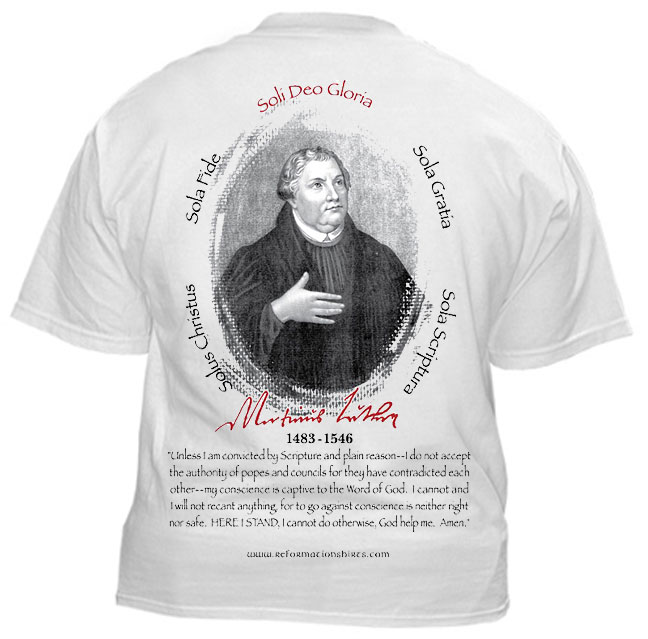
Purchase your Martin Luther T-Shirt from ReformationShirts.com
by Christ for his people. But biblical reformation of soteriology didn’t end with Luther and the Lutherans. The Reformed movement also grew alongside of the Lutheran movement, and while both were co-belligerents against the Roman doctrines of justification and the other benefits of redemption in Christ, they differed on the most biblical way to systematize these truths.
Friday on the Reformed Forum’s podcast, Christ the Center, Camden Bucey, Jim Cassidy and Jeff Waddington interviewed Dr. Lane Tipton, the new Charles Khrae Professor of Biblical and Systematic Theology at Westminster Theological Seminary in Philadelphia, Pennsylvania. Dr. Tipton was allowed two hours to spell out the differences between the Lutheran and Reformed approaches to justification and many current issues related to this essential aspect of Protestant theology, such as whether Dr. Michael Horton’s academic work on the subject is moving Reformed theology toward a more Lutheran, and therefore,according to Dr. Tipton, semi-Pelagian doctrine of justification. Listen to the podcast at this link.
I was introduced to Reformed theology by Michael Horton’s materials and the Lord used his parachurch ministries Christian United for Reformation (CURE) and the Alliance of Confessing Evangelicals (ACE) and the White Horse Inn radio show to gradually bring me around to embrace it. I will certainly be looking forward to a future Christ the Center program in which Dr. Horton responds to Dr. Tipton’s characterization of his work on justification and the other benefits of redemption in Christ. More public dialogue on this ought to take place, IMHO. At this point, Dr. Tipton’s case sounds convincing and more in line with the Reformed confessions and catechisms, as opposed to Dr. Horton’s efforts to, as I once heard him state on the air, build a kind of ecumenism between Reformed, Lutheran and Anglican traditions. I can see how some synthesis may be taking place in that effort. But what do I know?
Reformata, Semper Reformanda!
My Favorite Sport!

Rangers Ballpark in Arlington, home of the Texas Rangers
I’m one of those especially unfortunate fellows who grew up with a love-hate relationship with sports. I played several sports on several little league teams as a child, and played plenty of sports in the streets of my neighborhood. My lack of skill then is probably the chief reason I do not follow sports today, although I do tend to catch the Super Bowl, mostly for the commercials. My new membership in a Reformed church and their biblical and confessional (we view these two adjectives as synonymous) emphasis on delighting in the Lord on the Lord’s Day may have implications for the Super Bowl in the future. All I can say is, thanks be to God for digital video recording.
In light of my lack of interest in sports, I am fond of informing folks that “my sports are politics and religion,” which probably tells people I can relate even less to them, when they may already see me as a socially challenged individual who doesn’t follow sports. It is for this reason that you may not be surprised by my interest in the following lecture series that was held at Christ Reformed Church (URCNA) in Washington, D.C., called “Christianity & Politics,” which is yet another venue for the Westminster Seminary California faculty and alumni, among others, to focus our attention on their attempt at recovering the Reformed notion of the Two Kingdoms approach to the relationship between “Christ and Culture.” A timely offering in this year of presidential politics.
Here’s their introduction to the series, speaker bios and links to the lectures:
Why We Confuse Church & State
Separation of church and state?
Whatever you may think of the contemporary application of our first amendment freedom of religion, Christianity and politics are ever confused in our national consciousness. Preachers seek influence in the political sphere; politicians manipulate and calculate the faithful in their constituencies.
What are the faithful to do? How should we understand our callings as citizens, both on earth below and in heaven above?
Christianity & Politics presents a range of speakers approaching this topic from a range of perspectives while discussing topics as diverse as the mission of the church, the place of evangelicals in American political culture, natural law, and the spirituality of the church.…
Lectures [were] sponsored by Christ Reformed Church, and [took] place in our place of worship, historic Grace Reformed Church, home of President Theodore Roosevelt….
Speakers
MICHAEL HORTON is the J. Gresham Machen Professor of Systematic Theology and Apologetics at Westminster Seminary California, Host of the White Horse Inn radio program and Editor-in-Chief of Modern Reformation magazine. He is a minister in the United Reformed Church.
MICHAEL GERSON is an opinion writer for the Washington Post and former head speech writer and senior policy advisor to President George W. Bush.
DARRYL HART is Assistant Professor of History at Hillsdale College, author of numerous books, and blogs on religion and public life at oldlife.org.
TERRY EASTLAND is the Publisher of The Weekly Standard and an elder at Fourth Presbyterian Church in Bethesda, Maryland.
BRIAN LEE is the pastor of Christ Reformed Church in Washington, DC (United Reformed Church). He is a Guest Faculty at Reformed Theological Seminary and formerly worked on Capitol Hill, the National Endowment for the Humanities, and the Department of Defense.
DAVID VAN DRUNEN is the Robert B. Strimple Professor of Systematic Theology and Christian Ethics at Westminster Seminary California. He is a minister in the Orthodox Presbyterian Church and holds a Law Degree from Northwestern University School of Law.
DAVID COFFIN is the Senior Pastor at New Hope Presbyterian Church in Fairfax, Virginia.
Audio
Michael Horton
The Great Commission (Sermon on Matthew 28)
The Great Commission and Social Justice — (Q&A Session)
Michael Gerson, Darryl Hart, Terry Eastland
The Future of Evangelical Politics (roundtable discussion)
Brian Lee
The Primacy of “Church” in “Church & State” (Sermon on Romans 12)
“Govern Well?” or “Be Governed”? — (Q&A Session)
David VanDrunen
Natural Law and Christian Politics — (Q&A Session)
David Coffin
The Biblical Doctrine of the Spirituality of the Church (Sermon on John 18)
The Historical Doctrine of the Spirituality of the Church — (Q&A Session)
Sermon Notes: “The Fruit of Faith” (Matthew 21:17-22)
The following sermon notes summarize “The Fruit of Faith,” preached on Sunday, October 23, 2011 by Rev. Joe Troutman at Mid-Cities Presbyterian Chruch (OPC) in Bedford, Texas (listen online or subscribe to the podcast). My apologies for not posting last week’s sermon on the cleansing of the Temple, on which this sermon builds. I’ll try to post it at a later date. In the meantime, you can listen to that sermon, “The King Comes Home” (Matthew 21:12-17) at this link.
Text of Preparation: John 15:1-17
“I am the true vine, and my Father is the vinedresser. Every branch in me that does not bear fruit he takes away, and every branch that does bear fruit he prunes, that it may bear more fruit. Already you are clean because of the word that I have spoken to you. Abide in me, and I in you. As the branch cannot bear fruit by itself, unless it abides in the vine, neither can you, unless you abide in me. I am the vine; you are the branches. Whoever abides in me and I in him, he it is that bears much fruit, for apart from me you can do nothing. If anyone does not abide in me he is thrown away like a branch and withers; and the branches are gathered, thrown into the fire, and burned. If you abide in me, and my words abide in you, ask whatever you wish, and it will be done for you. By this my Father is glorified, that you bear much fruit and so prove to be my disciples. As the Father has loved me, so have I loved you. Abide in my love. If you keep my commandments, you will abide in my love, just as I have kept my Father’s commandments and abide in his love. These things I have spoken to you, that my joy may be in you, and that your joy may be full.
“This is my commandment, that you love one another as I have loved you. Greater love has no one than this, that someone lay down his life for his friends. You are my friends if you do what I command you. No longer do I call you servants, for the servant does not know what his master is doing; but I have called you friends, for all that I have heard from my Father I have made known to you. You did not choose me, but I chose you and appointed you that you should go and bear fruit and that your fruit should abide, so that whatever you ask the Father in my name, he may give it to you. These things I command you, so that you will love one another.
Introduction
Jewish worship was coming to an end. The Temple gave the appearance of worship as the leaves on the fig tree in today’s text give the appearance of fruitfulness. In their Temple worship, the Jews honored God with their lips, but their heart was far from him. Christ’s cleansing of the Temple in the previous passage was a judgment against their worship, not their commercialism.
Matthew 21:17-22 illustrates the importance of context. In his cursing of the fig tree, Jesus was not being vindictive, but performing a prophetic act against the nation of Israel as a whole: Those who don’t bear fruit will be cursed like the fig tree, but those who believe will bear the good fruit of true worship and righteousness.
In Search of Fruit (Matthew 21:17-19) And leaving them, he went out of the city to Bethany and lodged there. In the morning, as he was returning to the city, he became hungry. And seeing a fig tree by the wayside, he went to it and found nothing on it but only leaves. And he said to it, “May no fruit ever come from you again!” And the fig tree withered at once.
- The glory of God having departed the Temple, Christ returns to Bethany. Matthew and Mark use differing chronologies in their accounts of the cleansing of the Temple and the cursing of the fig tree. But both show the relationship between both events. One cannot be understood apart from the other.
- The fig tree was a symbol of the nation of Israel. “Woe is me! For I have become as when the summer fruit has been gathered, as when the grapes have been gleaned: there is no cluster to eat, no first-ripe fig that my soul desires (Micah 7:1).
- Jesus went to the tree in search of fruit, just as he went to the Temple in search of true worship. Neither provided what he sought.
- Professed faith is unfruitful for those who do not truly abide in Christ by faith (see John 15 above). As John the Baptist warned, the tree that does not bear fruit will be cut down and thrown into the fire. “’Bear fruit in keeping with repentance. And do not presume to say to yourselves, ‘We have Abraham as our father,’ for I tell you, God is able from these stones to raise up children for Abraham. Even now the axe is laid to the root of the trees. Every tree therefore that does not bear good fruit is cut down and thrown into the fire’” (Matthew 3:8-10).
- Thus Christ’s cursing of the fig tree as a prophetic warning was an act of mercy and a call to repentance. May believers never depart into false worship—we must trust the Lord to instruct us in the true worship of God, not our own wisdom.
Faith Yields Fruit (Matthew 21:20-22) When the disciples saw it, they marveled, saying, “How did the fig tree wither at once?” And Jesus answered them, “Truly, I say to you, if you have faith and do not doubt, you will not only do what has been done to the fig tree, but even if you say to this mountain, ‘Be taken up and thrown into the sea,’ it will happen. And whatever you ask in prayer, you will receive, if you have faith.”
- Christ’s reference to the moving of a mountain by faith seems to allude to Zechariah 4:6-9, in which Zerubbabel’s obstacles to rebuilding the Temple after Israel’s return from Babylonian captivity are compared to a mountain being made a plain. “Then he said to me, “This is the word of the LORD to Zerubbabel: Not by might, nor by power, but by my Spirit, says the LORD of hosts. Who are you, O great mountain? Before Zerubbabel you shall become a plain. And he shall bring forward the top stone amid shouts of ‘Grace, grace to it!’” Then the word of the LORD came to me, saying, “The hands of Zerubbabel have laid the foundation of this house; his hands shall also complete it. Then you will know that the LORD of hosts has sent me to you.
- The marveling of the disciples evidenced their lack of faith. Had they the faith of a mustard seed, they would have understood that nothing is impossible for God, be it the withering of a tree, the moving of a mountain or the production of the fruit of true worship and righteousness.
- True worship is impossible “in the flesh,” that is, apart from faith in Christ, but is possible “in Christ,” that is, through saving faith in him. The corporate worship of God is an amazing event: believers stand on holy ground in God’s presence. Unbelievers who presume to worship will prove unfruitful in the worship of God, and they will be judged by Christ as were the fig tree and the Temple.
- The promise in verse 22, “And whatever you ask in prayer, you will receive, if you have faith,” is simply an encouragement to come to God in faith by prayer in acknowledgement of our utter dependence on him. Lack of prayer is the result of self-sufficiency. Christians depend on the outpouring of God’s grace upon them, as a tree is dependent on the rain for life and fruitfulness. Faith in Christ will bear the fruit of the Spirit as described in Galatians 5:22-23, which reads, “But the fruit of the Spirit is love, joy, peace, patience, kindness, goodness, faithfulness, gentleness, self-control; against such things there is no law.”
The Son of Man Coming on the Clouds
When I was a child, and a member of a Dispensational Premillennial IFB church, I would often hear my pastor commenting on any given Sunday, “It’s cloudy today—this might just be the day the Lord returns.” At other times, he would conclude the opposite: “I didn’t notice any clouds in the sky, so I guess the Lord may not return today. But this is Texas, and the weather could change at any moment.” The literal presence of clouds in the sky was seen as a necessary condition of Christ’s Second Coming. Why is this? It’s because of the Lord’s words in Matthew 24:30.
Then will appear in heaven the sign of the Son of Man, and then all the tribes of the earth will mourn, and they will see the Son of Man coming on the clouds of heaven with power and great glory.
(Matthew 24:30 ESV)
Was Jesus predicting that on the day of his return, it will literally be cloudy? No, Jesus was alluding to a prophecy by Daniel of the coming of “one like a son of man” who comes “with the clouds of heaven.” What would be the point of predicting whether it would be cloudy on the day of the coming of the Son of Man? Let’s look at Daniel’s prophecy to which Christ alludes (the key phrases will be highlighted):
“I saw in the night visions,
and behold, with the clouds of heaven
there came one like a son of man,
and he came to the Ancient of Days
and was presented before him.
And to him was given dominion
and glory and a kingdom,
that all peoples, nations, and languages
should serve him;
his dominion is an everlasting dominion,
which shall not pass away,
and his kingdom one
that shall not be destroyed.
(Daniel 7:13-14 ESV)
The first thing to notice is the fact that this prophecy contains poetic language. That’s why the ESV editors (and those of most modern English versions) format the prophecy in a poetic style. Ancient Hebrew poetry does not have the same standards for literalism as historical narrative does. It is true that the Gospel of Matthew is a historical narrative, and so it is literally true that Jesus quoted Daniel’s prophecy, but the prophecy Jesus quoted in this historical narrative Gospel account is still a poetic reference.
If the reference to clouds in association with the coming of the Son of Man bears poetic, symbolic meaning, then what might that meaning be? Let’s look at a few other poetic Old Testament passages that similarly associate clouds with the activity of Yahweh.
He lays the beams of his chambers on the waters;
he makes the clouds his chariot;
he rides on the wings of the wind;
(Psalm 104:3)
If we are to take Christ’s reference to coming with clouds literally, then are we also to take Psalm 104’s statement that the LORD makes the clouds his chariot literally? Does an infinite, omnipresent Spirit need to stand on a cloud, hold a set of reins and be transported by means of atmospheric water vapor? Well, has he also literally laid giant wooden beams across a body of water and built chambers in which he might dwell? Does wind literally have wings? Of course it doesn’t. This is nothing but poetic imagery. So, what idea does this imagery of clouds convey? Basically, it conveys the idea of God’s terrifying power and authority. Notice how the Egyptians and their idols react to the image of the LORD riding on a cloud in Isaiah 19:
An oracle concerning Egypt.
Behold, the LORD is riding on a swift cloud
and comes to Egypt;
and the idols of Egypt will tremble at his presence,
and the heart of the Egyptians will melt within them.
(Isaiah 19:1)
With these things in mind, let’s go back and take another look at Matthew 24:30: “Then will appear in heaven the sign of the Son of Man, and then all the tribes of the earth will mourn, and they will see the Son of Man coming on the clouds of heaven with power and great glory (Matthew 24:30).
I hope we can more clearly see now, that the significance of the coming of the Son of Man “on the clouds of heaven” lies in the fact of his terrifying power and great glory whose appearing will make all the tribes of the earth mourn, and at which time will occur the Last Judgment and the ultimate consummation of his Kingdom. This is just one of many examples of the need to genuinely take into account the literary structure of a passage in order to determine its proper interpretation.


 The Misadventures of Captain Headknowledge
Christian Knowledge | East of Eden
Jonathan Edwards Tee by ReformationShirts.com (click image to see more)
The following episode of the Reformed Forum’s new podcast, East of Eden, was tailor-made for the readers of this blog! East of Eden is a podcast devoted to discussing all things Jonathan Edwards. Not the recent politician with good hair and a bad reputation, but the eighteenth century preacher of the First Great Awakening who became known as the theologian of revival. In this week’s episode, the co-hosts interview a guest to be named below as they discuss Edwards’ sermon on “The Importance and Advantage of a Thorough Knowledge of Divine Truth.” One comment made by Nick Batzig sums up nicely both the sermon and the theme of this blog: “You can have truth in the mind without godliness in the heart, but you can’t have godliness in the heart without truth in the mind.”
Later, I will update this post with a transcript of the context of the preceding quote. In the meantime, listen to the entire episode, “Christian Knowledge,” to be challenged to inform your godliness with a thorough understanding of the truth which accords with godliness (Titus 1:1).
Share this: