Does “Every Member Ministry” Contribute to “Christless Christianity”?
An “every member ministry.” The name should be self-explanatory. This is a staple of modern American Evangelical and Fundamentalist discipleship, and likely of the Reformed, as well. We probably all can hear the echoes of pastors past and present who’ve clearly proclaimed that they are not the only “ministers” in the local church. Every member, not just the pastor, is here to exercise his gifts for the building up of the body of Christ. Might this be a “fifth rail” of American Christianity that the believer in his right mind dare not touch, lest he be accused of attempting to take us back to Roman Catholicism with its clearly defined gap between the clergy and the laity? Don’t worry, my personal intention is not to state anything to the contrary of those who believe they are gifted to perform any of a myriad of tasks in the local church. Some of us are gifted to teach, though we’re not ordained pastor/teachers; some are gifted to serve the physical needs of the least of the congregation; some are gifted to aid in the musical operation of the local church; some are gifted to do any myriad of other things that are indded vital activities that ought to take place in the context of the local church, and by the members of the congregation, not just the ordained pastors, elders and deacons. I’m not out to overturn the apple cart of an “every member ministry” as it happens to currently be manifest in American churches. But I would like to address, or rather, cite Michael Horton’s remarks regarding, one passage of Scripture that is famously associated with the idea of an every member ministry, and in fact, serves as part of the Scriptural basis for such activity.
But first, let’s look at the passage: Ephesians 4:1-16, as it is translated in the King James Version. And let us pay special attention to where the punctuation falls in verse twelve, which I’ve highlighted.
1I therefore, the prisoner of the Lord, beseech you that ye walk worthy of the vocation wherewith ye are called, 2With all lowliness and meekness, with longsuffering, forbearing one another in love; 3Endeavouring to keep the unity of the Spirit in the bond of peace.
4There is one body, and one Spirit, even as ye are called in one hope of your calling; 5One Lord, one faith, one baptism, 6One God and Father of all, who is above all, and through all, and in you all. 7But unto every one of us is given grace according to the measure of the gift of Christ.
8Wherefore he saith, When he ascended up on high, he led captivity captive, and gave gifts unto men. 9(Now that he ascended, what is it but that he also descended first into the lower parts of the earth? 10He that descended is the same also that ascended up far above all heavens, that he might fill all things.)
11And he gave some, apostles; and some, prophets; and some, evangelists; and some, pastors and teachers; 12For the perfecting of the saints, for the work of the ministry, for the edifying of the body of Christ: 13Till we all come in the unity of the faith, and of the knowledge of the Son of God, unto a perfect man, unto the measure of the stature of the fulness of Christ: 14That we henceforth be no more children, tossed to and fro, and carried about with every wind of doctrine, by the sleight of men, and cunning craftiness, whereby they lie in wait to deceive; 15But speaking the truth in love, may grow up into him in all things, which is the head, even Christ: 16From whom the whole body fitly joined together and compacted by that which every joint supplieth, according to the effectual working in the measure of every part, maketh increase of the body unto the edifying of itself in love.
Now let us see what Michael Horton has said about this passage in his latest book, Christless Christianity, on pages 248-249, in the final chapter, “A Call to the Resistance.”
And now, as we are reminded in Ephesians 4:8-16, the ascended King moves his gifts of this subversive revolution down to us; we do not have to climb up to him. Here the apostle Paul teaches that the same one who descended to the uttermost depths for us and ascended “far above all the heavens, that he might fill all things” (v. 10), does not keep the treasures of his conquest to himself but liberally distributes them to his liberated captives below. The original Greek emphasizes, “The gifts that he himself gave . . . .” They originate with Christ, not with individual members or the body as a whole. The gifts he gives are apostles, prophets, evangelists, pastors, and teachers (v. 11). They are not given as a hierarchy of control, like “the rulers of the Gentiles” who “lord it over” their subjects instead of serving (Matt. 20:25; see vv. 25-28). Rather, Paul says they are given . . . (here he cites Ephesians 4:12-15, which we’ve just read above). More recent translations typically render the clasuse in verse 12, “to equip the saints for the work of ministry” (e.g., ESV, NRSV, RSV), which has been used as the chief proof-text for every member ministry. For various reasons, I am persuaded that the older translations (especially of verse 12) are more accurate and also capture better the logic of the argument.
This does not mean, of course, that the official ministry of the Word (now exercised by pastors and teachers) is the only gift or that ministers rank higher in the kingdom of Christ than everyone else. Rather, this gift of the ministry of the Word is given so that the whole body may be gifted: brought together in the unity of the faith and of the knowledge of the Son of God. Only then can each member receive the additional gifts that make them function together as one mature body with Christ as its living Head (Eph. 1:15-16). The gifts flow down from Christ; the Great Shepherd serves his flock through undershepherds who minister his gospel through preaching and sacrament. Of course in other places Paul expands the list of gifts that are exercised by the wider body (see Rom. 12:3-8; 1 Cor. 12). A church that is lacking in generosity, hospitality, and other gifts of mutual edification is unhealthy; a church that lacks the Word is not a church. Therefore we come to church first of all to receive these gifts, realizing more and more our communion with Christ and therefore with each other as his body. (emphasis mine)
I always wondered if there was something up with this difference in punctuation between the KJV and many, if not all, modern translations (I haven’t checked). I know just bringing up the matter will draw criticism as if I’m out to tell everyone in the church to stop doing stuff for Christ, and just sit and listen to the preacher. This is the great fear of those who zealously proclaim this passage as it is translated and punctuated in modern translations (even if they’re KJV onlyists!) Rather, the point I want to make is the same simple point I always make. For ministry to be Christ-centered, the cart must not go before the horse. The Law and Gospel preached and the sacraments properly administered is the horse, and this and only this, is what makes the cart of our fruitful service go. The Law and Gospel preached and the sacraments properly administered turns some goats into sheep, and then the same Law and Gospel preached also feeds the sheep and strengthens them to love one another, not only as a congregation, but also as sojourners and strangers among our unbelieving neighbors in the world. Profound in its simplicity; simple in its profundity!
The cart may be getting put before the horse sometimes when our focus on the “priesthood of the believer” somehow turns into the “ministryhood” of the believer, as Horton frequently says. Hear me clearly, brethren: don’t give up your Sunday School class, don’t drop out of the choir or praise band (or whatever your church calls it), don’t stop helping in all the little, unnoticed ways you do. Just don’t make your primary focus–don’t make these activities your main purpose for being there. If you do, you may be living a Christless Christianity, intending to earn God’s grace by your good works. Rather, first look to being served by Christ through the ordained ministry of Word (Law & Gospel! Not just Law and not just Gospel!) and sacrament as your source of grace and faith and strength . . .
13 until we all attain to the unity of the faith and of the knowledge of the Son of God, to mature manhood, to the measure of the stature of the fullness of Christ, 14 so that we may no longer be children, tossed to and fro by the waves and carried about by every wind of doctrine, by human cunning, by craftiness in deceitful schemes. 15 Rather, speaking the truth in love, we are to grow up in every way into him who is the head, into Christ, 16 from whom the whole body, joined and held together by every joint with which it is equipped, when each part is working properly, makes the body grow so that it builds itself up in love. (Ephesians 4:13-16, ESV).
Pecuniary Satisfaction and Peculiar People, part 2
All I want to do today to complete this focus on the contrivance of “applications” based on the misinterpretation of an archaic translation of a Scriptural word is to show the definition of “peculiar” as presented in Noah Webster’s 1828 American Dictionary of the English Language. The choice of this dictionary is significant in that it is this volume which is recommended to advocates of the superiority of the King James Version of the Bible to all modern translations. It often features the biblical usage of words, with numerous quotations from Scripture as well as classic English literature. You’d think such a resource would irradicate foibles like the one under consideration, but tradition dies hard!
PECU’LIAR, a. [L. peculiaris, from peculium, one’s own property, from pecus, cattle.]
- Appropriate; belonging to a person and to him only. Almost every writer has a peculiar style. Most men have manners peculiar to themselves.
- Singular; particular. The man has something peculiar in his deportment.
- Particular; special. “My fate is Juno’s most peculiar care.” Dryden.
Definition 1 is the relevant definition. Considering the given usages, when it comes to 1 Peter 2:9, God has a people that is peculiar to himself, as opposed to being the people of any other god or ruler. I repeat, the church is to be peculiar to God, not peculiar to the world. That means we are his and only his. This simply cannot legitimately “apply” to how strange believers ought to seem to the world. Granted, the immediate context of the passage does explicitly include some imperatives (that is, “applications”) that are to be performed because of the fact that we are peculiarly the Lord’s people, and I submit these are the imperatives intended by the human and divine authors of Scripture to be applied to believers.
“They stumble because they disobey the word, as they were destined to do. (Notice the reference to God’s sovereign reprobation of those who never come to faith–that was for free!)
“9 But you are a chosen race, a royal priesthood, a holy nation,a people for his own possession, that you may proclaim the excellencies of him who called you out of darkness into his marvelous light. 10 Once you were not a people, but now you are God’s people; once you had not received mercy, but now you have received mercy.
“11 Beloved, I urge you as sojourners and exiles to abstain from the passions of the flesh, which wage war against your soul. 12 Keep your conduct among the Gentiles honorable, so that when they speak against you as evildoers, they may see your good deeds and glorify God on the day of visitation.” 1 Peter 2:8b-12.
The imperatives we have are based on the indicative of believers in Christ being a people who are peculiarly God’s, as opposed to any other god or ruler. Here’s where Christ-centeredness enters the picture. No exposition of the text is genuinely made in light of the full context, if the work of Christ for sinners is passed over and given little attention. It’s the indicatives of the Gospel, what God says about what he’s done for us in the death, burial and resurrection of the Lord Jesus Christ, and about how it has affected us by his grace alone, that contains the power to call people out of darkness into his marvelous light. To focus the majority of our attention on the behavior that is to result from Scripture’s Christ-centered, Gospel cause is to miss the power to live out the behavior and actually perform the “application.”
So here are the results of God’s showing mercy to us, calling sinners from every nation, race and class out of the darkness and into the marvelous light, making us who were not a people a chosen generation and a holy nation and a people for his own possession–a people who are peculiarly his and no one else’s:
- proclaim the excellencies of him who brought us out of darkness into his marvelous light. Then Peter inserts another indicative statement that builds on and emphasizes on our being peculiarly God’s–once we weren’t a people, but now we are God’s people by virtue of his having shown us his mercy.
- Therefore, since we are citizens of God’s nation, we should view ourselves as exiles who are merely sojourning through this world (in the world, not of it), and we should abstain from fleshly passions, which wage war against our souls.
- In addition, since we are God’s people, our conduct (behavior) should be honorable (not “peculiar” or strange or goofy) as we sojourn among the “Gentiles” (unbelievers who are citizens of the world, rather than citizens of God’s kingdom), our motive being that when we are falsely accused of evil-doing, others will realize the falsity of such accusations and God will be glorified.
See? There’s plenty of application, explicitly given by the apostle. There’s no call for intentionally misinterpreting one word in the indicative portion of the passage in order to turn it into an imperative to “look goofy to the world.” Rather, proclaim the excellency of Christ as you abstain from fleshly passions and otherwise conduct yourself in an honorable manner as you continue to sojourn in this lost and dying world for the glory of God. Now that’s preaching that will strengthen the faith of believers! Thanks for spelling it out for us, Peter!
Now, going back to the Bible study at which I originally brought up this topic. You know how after you have a conversation, you think of things you should have, or could have said? Well, after I made my comments in the Q&A session after the lesson, the teacher thanked me for “showing us how much smarter I am than the rest of us.” If I’d had the presence of mind at the time, I would have, or could have, and indeed, should have, replied that it’s not about how smart I am; it’s about whether or not the minister of the Word is actually communicating what God is saying in the text.
Pecuniary Satisfaction and Peculiar People, part 1
A week ago, on Dr. James White’s The Dividing Line webcast, I was listening to his coverage of the SBC’s John 3:16 conference, the effort of “moderate Calvinists” or perhaps more accurately, four point Arminians, to combat the rising tide of five point Calvinists who are graduating from SBC seminaries and ministering in SBC churches. Some discussion was made about a “pecuniary debt” being paid by Christ on the cross for every individual, as distinguished in the lecture being discussed, a “moral debt” which is paid by the believer who receives Christ by his own free will. This is only the second time since I’ve become a five point Calvinist myself, that I’ve heard reference made to this concept of “pecuniary debt.” Previous to this, I had a discussion with a few four-point Calvinists (which are predestinarians who deny that Christ died only for the elect) at Contend Earnestly. The term came up then, too, but, the discussion never moved toward exploring all the ins and outs of the concept. Indeed, the “pecuniary” view of Christ’s atonement, is a concept begging for my attention in the future. The reason I bring it up is to simply point out the fact that the word “pecuniary” was freshly bouncing around in my head before one Southern Baptist Bible study I attended last week.
In this Bible study, we happen to be studying Romans 12. But as is so often the case in Southern Baptist Bible study, the subject at hand often yields to the current events of the church, whether they have any bearing on the passage being studied or not. In this case, the current event under consideration was the semi-contemporary praise chorus, “A Chosen Generation,” which is a musical version of 1 Peter 2:9. This verse is very well-known even among Christians who generally deny the Calvinistic emphasis on God’s sovereign choice in election, or the covenantal unity of Israel and the Gentile Church as one chosen people, contrary to the dispensational “wrongly dividing” of the two groups into two separate chosen peoples. The thing that endears this verse to non-Reformed Southern Baptists is one particular phrase: “a peculiar people.” The King James Version translates the verse this way, and given the tendency to read the KJV in terms of today’s definitions and connotations, rather than remaining carefully on the look-out for archaisms, the phrase, “peculiar people,” lends itslef to a deeply engrained tradition of springboarding past exegetically-informed exposition to practical, relevant application to the Christian life.
I can’t reproduce verbatim what was said about the phrase, but I can characterize it or at least summarize it. God, in calling us a “peculiar people,” is implying that the church is different from the world; indeed, at times, the world may even consider what the church believes and does “peculiar,” or strange. This is the traditional moderate Calvinistic Baptist commentary on this whole verse. Rarely does anyone hear anything different in my experience. As I sat through the recitation of this unwritten creed, it struck me that the root word for “peculiar” is similar, if not the same as, the root for “pecuniary.” If pecuniary is associated with money or commerce, or wealth, it seemed possible that in the KJV of 1 Peter 2:9, we have another case of an archaic word being misread according to the twentieth century meaning of the word “peculiar.”
I held my tongue through the remainder of the class, but raised my hand to comment when so invited to at the end of the hour. I prefaced my concerns in my usual, self-depracating manner, telling the teacher I’m going to “nit pick” the word “peculiar.” Then I stated my concerns that when compared to the modern translation of 1 Peter 2:9, the traditional interpretation and application of “peculiar people” doesn’t seem to be the point of the text. Modern translations render the Greek here, “a people for his own possession,” so it’s not about believers seeming odd to the world, but rather about believers being God’s property. It’s not an imperative to be obeyed, but an indicative to be believed: the church is God’s possession.
. . . to be continued . . .
Commentary on “The First Prohibition”
The following is an addendum to Theological & Doxological Meditation #47, containing commentary on the Scripture proofs which provide the basis for the answers to the questions of the Westminster Shorter Catechism. From now on, each Theological & Doxological Meditation will contain such commentary. They are offered with a view to the edification and instruction of believers and the calling of unbelievers to repentance and faith.
47. Q. What is forbidden in the first commandment?
A. The first commandment forbids the denying (Psalm 14:1), or not worshiping and glorifying the true God as God (Romans 1:21), and our God (Psalm 81:10-11); and the giving of that worship and glory to any other, which is due to him alone (Romans 1:25-26).
Question #47 of the Westminster Shorter Catechism focuses on the prohibitions implied by the first commandment, “You shall have no other gods before me.” Here’s what answer #47 looks like when you break down the various concepts and pair them up with the Scripture proofs provided, on which the language is based:
1. The first commandment forbids the denying . . . the true God . . . . (Psalm 14:1);
2. The first commandment forbids not worshiping and glorifying the true God as God (Romans 1:21);
3. The first commandment forbids the denying, or not worshipping the true God as God, and our God (Psalm 81:10-11);
4. The first commandment forbids . . . the giving of that worship and glory to any other, which is due to him alone (Romans 1:25-26)
Denying the True God
Psalm 14:1 – “The fool says in his heart, ‘There is no God.’ They are corrupt, they do abominable deeds, there is none who does good.”
The fool of verse one is the one who not only does not call upon the Lord (v.4), but he is also an “evildoer” who actively opposes those who do acknowledge the only true God. The fuller description of the fool of verse one is contained in verses two and three, which the Apostle Paul would quote in Romans 3 as a general description of all, whether Jew or Gentile, who are “under sin” (Romans 3:9), having not been justified by God’s grace alone, through faith alone, because of Christ alone to the glory of God alone.
Not Worshiping and Glorifying the True God as God
Romans 1:21 – “For although they knew God, they did not honor him as God or give thanks to him, but they became futile in their thinking, and their foolish hearts were darkened.”
Fools who deny and refuse to worship and glorify the true God know that he exists, and that they ought to worship and glorify him; but knowing this with futile minds and darkened hearts, they were unwilling and unable to express gratitude and honor to him. This is what happens when “head knowledge” and “heart knowledge” are not informed by, and obediently mindful of, God’s revelation. God reveals himself in the world and in his Word, and with darkened hearts and futile minds, Jew and Gentile alike does that which is prohibited by the first commandment—he does not worship and glorify the true God as God.
Our God
Psalm 81:10 – “I am the Lord your God, who brought you up out of the land of Egypt . Open your mouth wide, and I will fill it. 11 “But my people did not listen to my voice; Israel would not submit to me.”
As initiator of the covenant, God embraces the Israelites as “his people” and calls on them to “receive the covenant as an expression of his grace, believe in him and live as he directs (ESV Study Bible note on Ps. 81:8-10), embracing him as “our God.” This clearly implies the exclusivity which is so unpopular in pluralistic societies such as ours—such exclusivity is the solemn command of God. As Christians, if the Lord is our God, then the gods of non-Christian religions are to be excluded as “legitimate object(s) of worship” (Williamson, The Westminster Confession of Faith; Presbyterian & Reformed Publishers).
The Worship and Glory of Other Gods
Romans 1:25 – “because they exchanged the truth about God for a lie and worshiped and served the creature rather than the Creator, who is blessed forever! Amen. 26 For this reason God gave them up to dishonorable passions. For their women exchanged natural relations for those that are contrary to nature;”
Finally, the crass outward exchanging of the only true God for false gods, or rather, in the terms of the catechism, “the giving of that worship and glory to any other, which is due to him alone.” Each command of the Decalogue (the “Ten Words”, aka, Ten Commandments) is written in terms of the most harmful outward expression of a whole range of sins, all of which are violations of the spirit, if not the letter, of the Law. Such a range is partly what the Westminster Shorter Catechism seems intending to convey in its repeated examination (as we shall notice in the weeks to come)of that which each command prescribes and prohibits.
As our Lord demonstrates in his commentary regarding some of God’s commands in the Sermon on the Mount, there are more ways than one to violate the commandments of God. Reformed theologians tend to categorize these ways in the following terms: each command implies the opposite prohibition, and vice versa (which the catechism expressly spells out); and every day we break God’s Law in thought, word and deed. Truly, God’s commands condemn us all in ways we will never be able to fully comprehend.
This is the reason it was necessary for God to take on a human nature untainted by the curse of original sin, that he might keep all of the commands and their implied prohibitions (and vice versa) in thought, word and deed perfectly every day of his life. This is called “the active obedience of Christ.” Christ obeyed the Law perfectly, which the first man, Adam, failed to do, and thus Christ earned eternal life by his flawless works. The righteousness accrued by the active obedience of Christ is freely available and offered to all who will believe, for when Christ was crucified, his unjust death was a sacrifice that propitiated, or turned away God’s furious wrath onto himself from the sins of all those God the Father gave to him before the world was made.
“So then, the law was our guardian until Christ came, in order that we might be justified by faith” (Galatians 3:24). Trust Christ today, and be saved from God’s wrath against all sins, chief among them being the giving of worship and glory to any other, that is due to him alone!
Misadventures Around the Blogosphere
 Attention: Commenter Kevin Moon–You’ve recently been expressing a serious desire (here and here)to observe me handle a blog topic with Scripture. Well, here you go, Brother! Whaddaya think?
In other news, I had a thing or two to say about the validity, or lack thereof, of Henry Morris’ brand of evangelical scientific creationism over at Fundamentally Reformed. Some of you may find this exchange challenging. If so, be sure to let me hear about it.
Does Lack of Perseverance Imply Limited Atonement?
21 And you, who once were alienated and hostile in mind, doing evil  deeds, 22 he has now reconciled in his body of flesh by his death, in order to present you holy and blameless and above reproach before him, 23 if indeed you continue in the faith, stable and steadfast, not shifting from the hope of the gospel that you heard, which has been proclaimed in all creation [1] under heaven, and of which I, Paul, became a minister. (Colossians 1:21-23)
This passage clearly implies the doctrine of the Perseverance of the Saints, or as I renamed it, Persevering Grace for the Saints. It basically says that Jesus actually reconciled a professing believer if he continues, or perseveres, in the faith. Simple enough, those who persevere are the ones who were truly reconciled to the Father in Christ’s death on the cross.
But look what happens when you read its opposite:
if you shift from the hope of the gospel that you heard, are unstable, waver and do not continue in the faith, then Christ has not reconciled you in his body of flesh by his death in order to present you holy and blameless and above reproach before him.
Do you read what I read? When I think of it in this way, my logic tells me that lack of perseverance may be evidence for limited atonement. In other words, if you don’t persevere in the faith, then Jesus didn’t die for you.
What say you? Am I reading limited atonement into this passage, or am I properly drawing limited atonement out of the text? Eisegesis or exegesis? You be the judge (That means post your opinion!).
John MacArthur Makes the Rounds
Last year I heard John MacArthur on his radio show, Grace to You, talk about his philosophy of preaching. He believes that the deeper he goes in exposition, the higher it can lift up the hearers in worship of God. MacArthur has dug until he hit paydirt in his latest book, A Tale of Two Sons: The Inside Story of a Father, His Sons, and a Shocking Murder. This book is an exposition of the most famous of Jesus’ parables: The Prodigal Son (Luke 15:11-32). In his exposition, MacArthur goes into the background cultural implications of the words of the parable to show that at every point in the action, the story is geared to offend the sensibilities of the original Jewish hearers. Being a culture steeped in their focus on honor and shame, this parable stirs up the Jews, interrupts them in their honorable comfort zones and forces them to grapple with a concept of God that is willing to suffer the shame of filthy, worthless sinners who come to repentance. In fact, he takes great joy in doing so!
To make the long story short, MacArthur points out that the Father represents Jesus in the parable, the Prodigal Son represents the tax collectors and sinners who’d just gathered to hear Jesus speak (Luke 15:1), and the older brother represents the Pharisees (v. 2). In the two parables preceding that of the Prodigal Son, Jesus highlights the joy God takes in recovering lost sinners. MacArthur points out that Pharisees, by contrast, take no joy in the repentance of shameful sinners, but rather, take joy in the recovery of lost sheep and coins ($$$!). These themes show up in spades in Jesus’ “Inside Story of a Father, [and] His Sons.”
The worship begins when, after hearing how the son’s shameful demad for his inheritance, his subsequent prodigal living and his rock bottom experience communing with shameful swine and his eventual determination to return to his Father, MacArthur compares the compassionate, watchful father who runs through the village in the most shameful way possible [by (1) lifting his robe so he can (2) run (!)] to protect his repentant son from the violent mistreatment he would have certainly received from the honorable local citizenry, to Jesus, who, being the most Honorable of them all, suffered the shame which my shameful behavior has incurred, so he could rejoice over my repentance and return to his loving embrace! You gotta read this book, or at least look up the series on the radio show, repent of your sins and worship Christ who has given and suffered so much for you.
Now that this book is available, naturally, MacArthur has to promote the book. That’s what brought him last Friday to Crossroads Christian Church in Grand Prairie, Texas. I took the opportunity of accompanying my wife to the event to hear him preach all of the above, and then some, for just over an hour (as is his usual habit). Following, are a few pictures from the event:




“Foundational” Headknowledge
 Don’t you love all those tricky things everyone ought to memorize in the Bible? The three big lists that ought to be memorized include the Ten Commandments, the Beatitudes, and perhaps most elusive of all (it has been for me), the Twelve Apostles. But these twelve elusive guys have just been apprehended. I’ll never have trouble again remembering their names. As I studied for this week’s Sunday School lesson from Acts one on The Great Commission, Christ’s Ascension and what I’m calling “Foundation Repair” (replacing Judas Iscariot with Matthias), I noticed some things that will help me remember their names forever. Perhaps one flaw is that the replacement, Matthias, isn’t listed, but it’s a mnemonic device which includes Judas Iscariot. Since we hear more in the Bible about Judas than Matthias, I think it’s appropriate to keep him in mind, even though his office was given to another.
The thing I noticed in the list of apostles in Acts chapter one is that half of the list is taken care of with three names. There are two Simons, Peter and the Zealot; there are two Judases, Isacariot and the Son of James (notice this helpful transition); and there are two Jameses, the son of Alphaeus and the brother of John. Six down, only six to go. But how do we simplify these?
Half of the remaining six end with a “u” sound: Matthew, Andrew, Bartholomew. These, we’ll lump together, and the rest are easy: John, Thomas and Phillip. But did you notice that if you insert these last three after the first six, it provides another memorable link. Since the second James listed is the brother of John, that should help you remember that the next name in the list is John, who are bundled with Thomas and Phillip. Then all you have to remember is the “-ew” names: Matthew, Andrew, Bartholomew.
So, there you have it. A mnemonic device to help us all memorize the names of the Twelve Apostles! I have provided a visual aid that you could perhaps download for your own personal use, or go ahead and make another for yourself, if you prefer. I hope this helps with your biblical headknowledge!
Jesus, the First Resurrection!
We interrupt the mundane theological debates at hand to proclaim to you Jesus, Our Resurrection! Those who believe will share, not only in his death, but also in his resurrection! Jesus is the First Resurrection (Revelation 20:4-5)! For more on this odd refernce, see Kim Riddlebarger’s sermon, “They Came To Life And Reigned With Christ For A Thousand Years”
Don’t forget, Easter–or “Resurrection Sunday,” if you prefer–is only two weeks away!
Christ is Risen!!! In John 11, we learn about Jesus our resurrection: let’s read about it together . . .
The Death of Lazarus
· Jesus’ ministry coming to an end; his greatest sign about to be given by which Jesus revealed the glory of God the Father (see John 17:1-6).
· Jesus and his disciples are on their way to Jerusalem for the last time, to keep Jesus’ last Passover feast, the meal in which the Jews took part in the great work of redemption in the Old Testament, the exodus from bondage in Egypt. This last Passover will become Jesus’ Last Supper where he will update some of the symbols in the meal to communicate his ultimate work of redemption for not only Jews, but also for Gentiles from every nation.
11:1 Now a certain man was ill, Lazarus of Bethany, the village of Mary and her sister Martha. 2 It was Mary who anointed the Lord with ointment and wiped his feet with her hair, whose brother Lazarus was ill. 3 So the sisters sent to him, saying, “Lord, he whom you love is ill.” 4 But when Jesus heard it he said, “This illness does not lead to death. It is for the glory of God, so that the Son of God may be glorified through it.”
· Jesus had some friends in Bethany, where Mary and Martha would take care of Jesus whenever he came that way. Mary will become famous for how she prepares Jesus for his burial in chapter 12.
· The sisters send word that their brother is sick, but Jesus, by the Holy Spirit, knows that this is not the last anyone will see of Lazarus. But that what is about to happen will help Jesus glorify his Father in heaven.
5 Now Jesus loved Martha and her sister and Lazarus. 6 So, when he heard that Lazarus was ill, he stayed two days longer in the place where he was. 7 Then after this he said to the disciples, “Let us go to Judea again.” 8 The disciples said to him, “Rabbi, the Jews were just now seeking to stone you, and are you going there again?” 9 Jesus answered, “Are there not twelve hours in the day? If anyone walks in the day, he does not stumble, because he sees the light of this world. 10 But if anyone walks in the night, he stumbles, because the light is not in him.” 11 After saying these things, he said to them, “Our friend Lazarus has fallen asleep, but I go to awaken him.” 12 The disciples said to him, “Lord, if he has fallen asleep, he will recover.” 13 Now Jesus had spoken of his death, but they thought that he meant taking rest in sleep. 14 Then Jesus told them plainly, “Lazarus has died, 15 and for your sake I am glad that I was not there, so that you may believe. But let us go to him.” 16 So Thomas, called the Twin, said to his fellow disciples, “Let us also go, that we may die with him.”
· (5-6) Normally, if we call for someone to help, and if they are slow to come, we think they don’t like us much; but John wrote that because Jesus loved Lazarus and his sisters, he put off showing up for two days! That means God has a plan!
· (7-10) When Jesus is ready he calls his disciples to follow him to Judea. Bethany is in Judea, as is Jerusalem, where the Jews wait to kill Jesus. The disciples fear the danger and remind Jesus, hoping he’ll just let Lazarus recover on his own, so they can stay safe. But Jesus tells them plainly that Lazarus is dead and Jesus is to go raise him to give them a sign that will strengthen their faith in him. Finally, Thomas speaks for the whole group when he resolves to follow Jesus even to the cross! This is how far God calls us to follow Jesus, too, and when that time comes, he gives us the grace to be willing to do so, if we believe (Hebrews 12:1-4).
I Am the Resurrection and the Life
17 Now when Jesus came, he found that Lazarus had already been in the tomb four days. 18 Bethany was near Jerusalem, about two miles off (15 stadia), 19 and many of the Jews had come to Martha and Mary to console them concerning their brother. 20 So when Martha heard that Jesus was coming, she went and met him, but Mary remained seated in the house. 21 Martha said to Jesus, “Lord, if you had been here, my brother would not have died. 22 But even now I know that whatever you ask from God, God will give you.” 23 Jesus said to her, “Your brother will rise again.” 24 Martha said to him, “I know that he will rise again in the resurrection on the last day.” 25 Jesus said to her, “I am the resurrection and the life. [4] Whoever believes in me, though he die, yet shall he live, 26 and everyone who lives and believes in me shall never die. Do you believe this?” 27 She said to him, “Yes, Lord; I believe that you are the Christ, the Son of God, who is coming into the world.”
· (17-22) When Jesus and the disciples get to Bethany, they find that dead Lazarus has been buried for four days, and many people from Jerusalem had come to console Martha and Mary. When the sisters hear of Jesus’ arrival, Martha hurries to greet Jesus and reaffirm her faith in him, even though he didn’t do what she had originally asked for. We can rest assured that when we pray for something, if we don’t get it, we can know that it’s only because God plans to do something even better for your good and his glory (Romans 8:26-30)!
· (23-27) When Jesus promises Lazarus will rise from the dead, Martha misunderstands, thinking that Jesus is talking about the end of the world when everyone will rise from the dead. But, again, Jesus plans to do something better than we expect! Jesus proclaims that he is resurrection himself, and we who believe in him will experience a spiritual resurrection, because of which, though we may die physically one day, we can be sure we will live in God’s presence forever (Romans 6:5)! Now I ask you what Jesus asked Martha: “Do you believe this?” Do you believe that Jesus is the Christ, whom God sent to die because of your sins and to rise from the dead that you may live forever because God has justified you by giving you Jesus’ rigteousness?
Jesus Weeps
28 When she had said this, she went and called her sister Mary, saying in private, “The Teacher is here and is calling for you.” 29 And when she heard it, she rose quickly and went to him. 30 Now Jesus had not yet come into the village, but was still in the place where Martha had met him. 31 When the Jews who were with her in the house, consoling her, saw Mary rise quickly and go out, they followed her, supposing that she was going to the tomb to weep there. 32 Now when Mary came to where Jesus was and saw him, she fell at his feet, saying to him, “Lord, if you had been here, my brother would not have died.” 33 When Jesus saw her weeping, and the Jews who had come with her also weeping, he was deeply moved in his spirit and greatly troubled. 34 And he said, “Where have you laid him?” They said to him, “Lord, come and see.” 35 Jesus wept. 36 So the Jews said, “See how he loved him!” 37 But some of them said, “Could not he who opened the eyes of the blind man also have kept this man from dying?”
· Now Martha fetches Mary so she may greet Jesus and be comforted by her. Jesus felt sorry for Mary when she came and complained to him in tears. Jesus asks to see Lazarus’ tomb, and when he sees it, he weeps with Mary (Romans 12:15) over Lazarus’ death. This, as usual, serves to divide the people who witness Jesus’ works: some admire his love for Lazarus, while others complain that Jesus’ tears aren’t good enough.
Jesus Raises Lazarus
38 Then Jesus, deeply moved again, came to the tomb. It was a cave, and a stone lay against it. 39 Jesus said, “Take away the stone.” Martha, the sister of the dead man, said to him, “Lord, by this time there will be an odor, for he has been dead four days.” 40 Jesus said to her, “Did I not tell you that if you believed you would see the glory of God?” 41 So they took away the stone. And Jesus lifted up his eyes and said, “Father, I thank you that you have heard me. 42 I knew that you always hear me, but I said this on account of the people standing around, that they may believe that you sent me.” 43 When he had said these things, he cried out with a loud voice, “Lazarus, come out.” 44 The man who had died came out, his hands and feet bound with linen strips, and his face wrapped with a cloth. Jesus said to them, “Unbind him, and let him go.”
· When Jesus commands the stone be removed, Martha reminds him Lazarus’ decomposing body will stink, but Jesus reminds her of his words to her about trusting Jesus so she can see how he will glorify God the Father. Then Jesus prays for the Father to raise Lazarus, and he prays for this so that those who witness this sign will believe that Jesus is the Christ, sent by God the Father.
The Plot to Kill Jesus
45 Many of the Jews therefore, who had come with Mary and had seen what he did, believed in him, 46 but some of them went to the Pharisees and told them what Jesus had done. 47 So the chief priests and the Pharisees gathered the Council and said, “What are we to do? For this man performs many signs. 48 If we let him go on like this, everyone will believe in him, and the Romans will come and take away both our place and our nation.” 49 But one of them, Caiaphas, who was high priest that year, said to them, “You know nothing at all. 50 Nor do you understand that it is better for you that one man should die for the people, not that the whole nation should perish.” 51 He did not say this of his own accord, but being high priest that year he prophesied that Jesus would die for the nation, 52 and not for the nation only, but also to gather into one the children of God who are scattered abroad. 53 So from that day on they made plans to put him to death.
· Some of the Jews who saw the resurrection of Lazarus believed and so received a spiritual resurrection of their own in Jesus! They were raised to life by God and believed in Jesus! But others went and reported this miracle to the Pharisees, who, with the chief priests, gathered the Council to determine what to do next about this trouble-maker, Jesus. They feared that if they left Jesus alone, and everyone receives him, then the Romans would consider it a threat and would send troops to punish the nation of Israel. But John points out that the high priests words also prophesied about Jesus’ mission: it is better that one sinless man should die on behalf of sinners, than it is for the large group of sinners to die themselves. John uses the high priest’s words to teach us that by his death, Jesus would save not only Jews, but Gentiles from all around the world, too! Gentiles like me and you, who believe (Romans 9:22-26)! Out of hatred for Jesus, and fear of the Romans, they meant evil toward Jesus, but God meant good for his chosen people from all around the world (cf. Genesis 50:20).
54 Jesus therefore no longer walked openly among the Jews, but went from there to the region near the wilderness, to a town called Ephraim, and there he stayed with the disciples.
· Jesus knew how much the Jews in Jerusalem hated him, but he desired to keep the Passover, so he waited in Ephraim to keep safe until the time of the Feast.
55 Now the Passover of the Jews was at hand, and many went up from the country to Jerusalem before the Passover to purify themselves. 56 They were looking for [5] Jesus and saying to one another as they stood in the temple, “What do you think? That he will not come to the feast at all?” 57 Now the chief priests and the Pharisees had given orders that if anyone knew where he was, he should let them know, so that they might arrest him.
· Although the Jews want to arrest Jesus and kill him for their own good, God sent Jesus to die for sin, so that through believing in Jesus, sinners like you and me could be brought to life in Jesus, Our Resurrection!
The Sign of Jonah: What Christ’s Resurrection Says About Jesus, Believers and Unbelievers
 Matthew 12:38 Then some of the scribes and Pharisees answered him, saying, “Teacher, we wish to see a sign from you.”
-
They just saw him cast a demon out of a blind and mute man, and they said he did it by the power of the devil. But it was really a sign that the kingdom of God has come, and they refused to believe it and will be judged. He also said they said bad things about him because they don’t believe and don’t want to repent. Like a bad tree bears bad fruit, so does a bad heart speak unbelieving, sinful words in response to God’s Word.
-
Having seen and denied a sign, they want one done on demand, wanting to condemn him if he doesn’t.
39 But he answered them, “An evil and adulterous generation seeks for a sign, but no sign will be given to it except the sign of the prophet Jonah.
-
They are not true children of Abraham, but of the devil (John 8:39-47). Abraham heard the gospel and believed, they hear it and deny it, because they are not of God.
-
Jesus won’t do tricks on demand, so the only sign they get is a reminder of a past prophet.
40 “For just as Jonah was three days and three nights in the belly of the great fish, so will the Son of Man be three days and three nights in the heart of the earth.
-
Jonah signifies Jesus in that he experienced a kind of death and resurrection over a three-day period just as Jesus would one day.
-
The resurrection is one of the most important teachings about Jesus there is in the Bible: 1) it tells us things about Jesus: a. His claims as Judge and Savior are true (Acts 17:31; 1 Cor. 15:1-11, 20) b.Jesus’ victory over death (Acts 2:24; 1 Cor. 15:54-57) c. Jesus’ righteousness (John 16:10) d. Jesus’ deity (Romans 1:4) e. Jesus’ resurrection leads to his ascension and enthronement, so identifies him as King (Acts 1:9-11; 2:33-34; Phil. 2:9-11; cf. Isa. 53:10-12) f. Jesus is our Great High Priest forever (Heb. 7:16-17) 2) it tells us things about believers: a. Signifies their forgiveness and justification (Romans 4:25; 1 Cor. 15:17;Heb.7:24-25) b.Signifies their hope of resurrection in the future (Romans 6:4-11; 1 Cor. 15:42-57) c. Signifies their life to God and death to sin, the power of which is defeated by the resurrection (Romans 6:11). Believers can resist temptation, if you remind yourself of the fact that Jesus’ resurrection means sin is not your lord anymore. d. Without it, their faith would be worthless, they’d still be condemned to suffer the consequences of their own sin, and have no hope of eternal life in resurrected bodies (1 Cor. 15:12-20).
3) it tell us things about unbelievers (See following verses):
41 “The men of Nineveh will rise up at the judgment with this generation and condemn it, for they repented at the preaching of Jonah, and behold, something greater than Jonah is here.
-
Jesus’ resurrection signifies that the unrepentant will suffer the consequences of their sins, because they rejected the preaching of the greatest Prophet, whereas the people of Ninevah repented at the preaching of Jonah.
42 “The queen of the South will rise up at the judgment with this generation and condemn it, for she came from the ends of the earth to hear the wisdom of Solomon, and behold, something greater than Solomon is here.
-
To add weight to this testimony, Jesus refers to another example of Gentiles gladly receiving from types of Christ, and this fact makes the scribes’ and Pharisees’ rejection of Jesus that much more dangerous to them.
-
Remember that when you hear the Word of God, God will judge you on whether you believe his promises, and whether you repent and obey when you hear his commands. If you love Jesus, you will believe what he says, like Abraham, and you will obey his commands.
Corinthian Creed Added to My Box
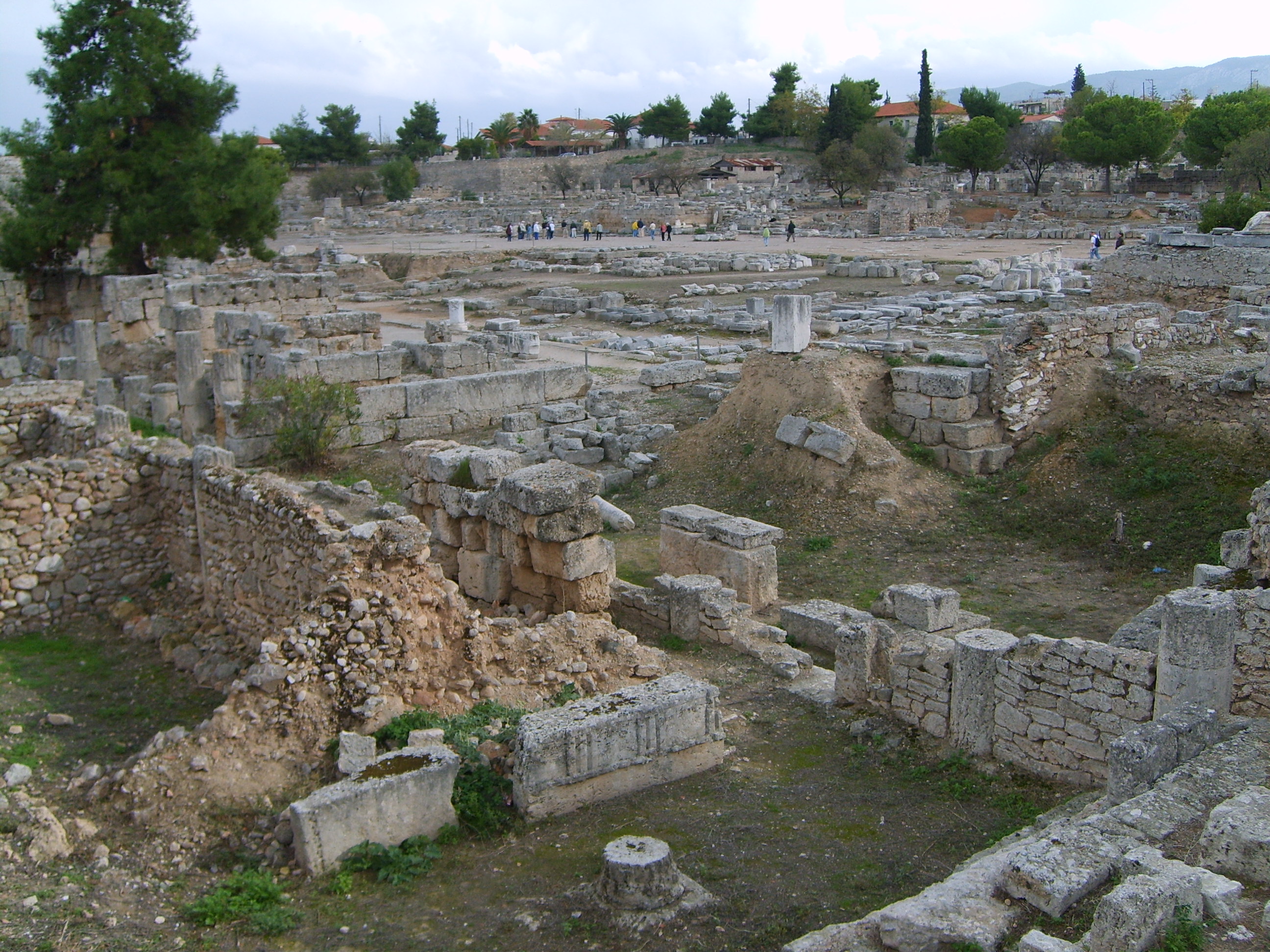
Over in my sidebar, you will find the recording made of the quartet who performed the song, “Corinthian Creed,” which I wrote to summarize the teaching of 1 Corinthians 15 on Paul’s defense of, teaching about and exhortations in light of the resurrection of Christ and our future resurrection at his Second Coming. Just find the black box on the lower right side of this page and select the file at the top of the list called “Corinthian Creed” and you’ll be able to hear our performance.
For a further introduction, read what I wrote about it back on September 30, 2006. Above, you may enjoy a view scanning across the ruins of Ancient Corinth which I shot on my Holy Land Tour in November of 2007, of which, more pictures are available for viewing in my Flikr photo box which is also in the sidebar to the right.
Jesus’ “Lost Years” Found In the New Testament

In my post last Sunday morning, I blogged about Lee Strobel’s book defending “the Real Jesus.” With this topic fresh in my mind, as well as the Sunday School lesson which I’d prepared for that morning, when class began, during our conversation with the children before the lesson, one of them asked out of the blue where Jesus was between the time he was a kid and the time he began his public ministry. I could tell immediately where he was going. Naturally, he followed up by saying his dad had been watching the History Channel and heard that people say Jesus went to India for some time between the ages of 12 and thirty. In the providence of God, my lesson for the day was from Luke 2:39-52, the account of “The Boy Jesus in the Temple,” as the heading over this passage in the English Standard Version describes it.
I’m not terribly familiar with the claims regarding Jesus’ reputed trip to India, spread by those outside the realm of orthodox Christianity. However, having perused the search engine and scanned a few sites (like this one, for example) and Wikipedia articles (like the one on the gnostic Acts of Thomas and the theosophical Aquarian Gospel), I’ve hit upon the apparent basis for the theory that Jesus went to India as a boy. I’d probably already be more clued in about it if I didn’t avoid History Channel programs of this nature and other popular sources of info on the secularized revisionist research on the “historical Jesus.” But I’m getting ahead of myself.
My immediate response to my student was that there are a lot of people who like Jesus, but who don’t believe the Bible. Often, they are people or groups from other religions that associate Jesus with their beliefs in an attempt to lend credibility to them, or for some other reason. In the middle of giving this summary of where stories like that come from, a verse from my lesson came to mind. “Now his parents went to Jerusalem every year at the Feast of the Passover” (Luke 2:41). After I glanced at the passage for a minute, it became clear to me that even though the verse doesn’t say, “Now Jesus and his parents went . . . ” the context indicates that when his parents went to Jerusalem every year, so did Jesus.
It seems I’ve found a piece of New Testament evidence that would indicate that Jesus of Nazareth did not, in fact, ever go to India, or on any fanciful “magical mystery tour” of eastern religions between the ages of 12 and 30, as suggested by the Aquarian Gospel, but was with his parents every year when they went to Jerusalem to celebrate the Feast of Passover.
Outlining “The Love Chapter”
Love needed in my service
If I speak in the tongues of men and of angels, but have not love, I am a noisy gong or a clanging cymbal. And if I have prophetic powers, and understand all mysteries and all knowledge, and if I have all faith, so as to remove mountains, but have not love, I am nothing. If I give away all I have, and if I deliver up my body to be burned, but have not love, I gain nothing.
Affirmations and Denials on Love
Love is patient and kind;
 love does not envy or boast;
it is not arrogant or rude.
It does not insist on its own way;
It is not irritable or resentful;
It does not rejoice at wrongdoing, but rejoices with the truth.
Permanence of Love
Love bears all things, believes all things, hopes all things, endures all things.
Love never ends.
As for prophecies, they will pass away;
As for tongues, they will cease;
As for knowledge, it will pass away.
For we know in part and we prophesy in part, but when the perfect comes, the partial will pass away.
Maturity of Love
When I was a child, I spoke like a child, I thought like a child, I reasoned like a child.
When I became a man, I gave up childish ways.
For now we see in a mirror dimly, but then face to face.
Now I know in part;
Then I shall know fully, even as I have been fully known.
Relative Value of Love
So now faith, hope and love abide, these three; but the greatest of these is love.
New Files Added to My Public Box!
If you’d like a little Audio for Mind and Heart, I’ve just added a song I sang at church a  couple of Sunday mornings ago (you’ll be able to tell I’m not looking for a Dove award!), as well as the sermon preached to me upon my ordination to the office of deacon, just prior to my election to serve in that capacity by Shady Grove Baptist Church. Listen and praise the Lord with me in song and in hearing and heeding his Word preached.
Roman Truths
Before I elaborate on my “Roman Truths,” please allow me to defend myself with the following quote of Martin Luther on the Book of Romans cited by Dr. Tom Browning on page 3 in the introduction to his series of lessons on “The Pinnacle of Christian Doctrine.”
Browning writes that Luther writes:
This epistle is really the chief part of the New Testament, and is truly the purest gospel. It is worthy not only that every Christian should know it word for word, by heart, but also that he should occupy himself with it every day, as the daily bread of the soul. We can never read it or ponder over it too much; for the more we deal with it, the more precious it becomes and the better it tastes (Martin Luther, Lutherʹs works, vol. 35: Word and Sacrament I edited by J. J. Pelikan, H. C. Oswald & H. T. Lehmann (Fortress Press: Philadelphia, 1960; reprinted 1999), 365).
So, in my own defense, last night I was pondering the precious and delicious letter of Paul to the Romans. In my much pondering of this book, I often attempt to come up with an original outline of the book which will the reader or Bible student remember the broad themes of this revolutionary, reforming and reviving book of Romans. I can’t help it if it came out like this!
Roman Truths
1. The Bad News (Romans 1:1–3:20)
2. The Good News (Romans 3:21-8)
3. Good News and the Jews (Romans 9-11)
4. The Good News Wearing Shoes (Romans 12-16)
Somebody help me! I’m losing control of my homiletics!!!


 The Misadventures of Captain Headknowledge