Memoir of the Rev. John Brown, part 8

John Brown’s Self-Interpreting Bible (1859)
Presbyterian Polymath
The pastor of a large congregation has but little time to spare from the duties of his office, compared with one engaged with a less numerous charge. In this respect Mr. Brown found himself in his proper element at Haddington. There, without trenching on the duties of his office, he could devote a very considerable portion of his time to study; and this privilege he improved to the best advantage.
In the summer months his constant rule was to rise between four and five, and during the winter by six. From these early hours, till eight in the evening, excepting the time allotted to bodily refreshment, family worship, or when called away on the duties of office, he continued to prosecute his studies with unremitting application. To a mind so ardent in the acquisition of knowledge, with a judgment so clear, a retentive memory, and exertions so intense, it was by no means surprising that he became greatly superior to most men engaged in discharging the same sacred duties.
In acquiring the knowledge of languages, ancient or modern, he possessed a facility altogether his own. Without an instructor, unless for one month to start him in the Latin, as formerly mentioned, he soon got so far acquainted with that language as to relish its beauties; and, left to his own resources, though frequently but indifferently provided with the proper books, he soon became critically acquainted with the Greek, and especially the Hebrew. Of the living languages, he could read and translate the Arabic, Syriac, Persic, and Ethiopic, the French, Spanish, Italian, Dutch, and German.
With him natural history, civil law, natural and moral philosophy, were particular objects of research; but divinity, and the history of human affairs, sacred or civil, were his favourite studies; and his success in these departments of knowledge are visible in his various works.Among the writers on divinity with whom he was versant, we find that Turretine, Pietet, Mastrecht, and Owen, with Boston, Erskine, and Hervey, were the chief; which shows that he accounted sound divinity and accurate sentiment a far better recommendation of his author, than the flowing fancy, the brilliant style, or the harmonious period.
Though stimulated by a sense of duty, and strongly excited by inclination, to the study of divinity, such was his anxiety to become a universal scholar, that he made himself acquainted with the whole round of the sciences. In his reading, especially important works, he was in the habit of compendizing his author as he went along. In this way he abridged the whole of Blackstone’s Commentaries, the ancient Universal History, and a number of other important works. This, however, is a method concerning which the learned hold different opinions. To lay aside the book, and abridge entirely from memory, and that in the writer’s own language, without regarding the style of the author, will make the substance of the work more his own; which, with other reasons that might be named, seems to render it the more eligible method.
From Demand to Free Gift
Listen to Lutheran Church Missouri Synod minister, Dr. Rod Rosenbladt, talk about what drove Luther’s hammer…
R.C. Sproul on the Current State of the Catholic/Protestant Divide
The contemporary spirit of the Evangelical movement is to lower the historic bar on the differences between Protestantism and Roman Catholicism. Since the 1994 statement Evangelicals and Catholics Together, things have gone from bad to worse. Enter R. C. Sproul, probably the premier Reformed and Protestant apologist of the 20th and early 21st century to stem the tide, and remind us all that not only are the historic distinctions between Protestantism and Roman Catholicism still there, but many more issues have further complicated the matter. Get informed on all the issues so that you may retain the courage to be Protestant (with apologies to David F. Wells)
In recent years, some evangelical Protestant leaders have signed statements pledging themselves to joint social action with Roman Catholics. Others have refused to participate, declaring that, in their view, the statements went too far, touching on the gospel, which remains a point of disagreement between Protestants and Roman Catholics. Many evangelical Christians have found themselves confused by the different directions taken by their leaders.
In Are We Together? A Protestant Analyzes Roman Catholicism, Dr. R.C. Sproul takes his stand for the cardinal doctrines of Protestantism in opposition to the errors of the Roman Catholic Church. Sproul, a passionate defender of the gospel of justification by grace alone through faith alone in Christ alone, cites the historic statements of the Protestant Reformers and the Roman Catholic authorities, then references modern doctrinal statements to show that the Roman Catholic Church has not altered its official positions. In light of this continuing gap, he writes, efforts by some in the evangelical camp to find common ground with Rome on matters at the heart of the gospel are nothing short of untrue to biblical teaching. In Sproul’s estimation, the Reformation remains relevant.
Are We Together? is a clarion call to evangelicals to stand firm for the gospel, the precious good news of salvation as it is set forth in Scripture alone.
HT: Ligonier Store
Creeds and Confessions in the Contemporary Church | Christ the Center Podcast

On this episode, we welcome Rev. Dr. Carl R. Trueman to discuss the important role of creeds and confessions in the church through his book The Creedal Imperative. Dr. Trueman is the Paul Woolley Professor of Historical Theology and Church History at Westminster Theological Seminary and Pastor of Cornerstone Orthodox Presbyterian Church in Ambler, PA. Dr. Trueman brings his critical thought and historic sensitivity to this important plea to many conservative evangelicals.
Participants: Camden Bucey, Carl Trueman, Jared Oliphint
HT: Reformed Forum
Exposing Myths Regarding Slavery and the Crusades

The September 9 episode of the White Horse Inn featured an interview between Michael Horton and Jeffery Burton Russell, author of Exoposing Myths About Christianity: A Guide to Answering 145 Viral Lies and Legends. The following is an edited excerpt from this interview, in which Russell summarizes in layman’s terms common misconceptions about Christianity’s guilt regarding chattel slavery and the Crusades. I hope you find these to be helpful thumbnail sketches:
Horton: The moral questions–that Christianity is intolerant–if you look back at the history of Christianity, very often that criticism is wrapped up in lots of things, like getting hit with tennis balls coming out of that machine; they’re shooting at you so quickly you can’t bat them away.
[They say] Christianity is intolerant. Look at slavery; look at the history of injustice towards women. There’s just so many problems, that Christianity cannot possibly keep its promise to make the world a better place.
Russell: Yeah, let’s just mention a couple of them. Let’s look at slavery, for example. Well, it’s precisely Christians who did away with slavery. People may point out that people had slaves; well, so did everybody else! Slavery was unfortunately a worldwide institution in the ancient world. The whole movement against slavery was started by Christians: by Catholic bishops and Protestant clergy. They were the great leaders of the movement, first to abolish the slave trade, and then to abolish slavery altogether. So, Christianity’s record with regard to slavery is extremely good.
Unfortunately, we know that many of our founding fathers had slaves, but again, it was Christians, not atheists, who moved against the institution.
Then, on the intolerance question: people always raise questions about the Inquisition and the Crusades. The Crusades are somehow seen as a colonialist, Western invasion of indigenous peoples, and view it as a terrible thing. But people seem to be ignorant of the background of the Crusades.
The background of the Crusades is simply that all of the southern Mediterranean lands from Spain to all around North Africa, to as far as what’s now Iraq and Iran–these were Christian territories with Christian populations. The great cities of Alexandria, Jerusalem and Antioch were the centers of Christian bishops, and this is a thoroughly Christian area up until the 600’s. In the 600’s, the Arabs quickly come out of Arabia. By 750 BC, the Muslims defeated the Byzantine Empire and occupied most of the Christian lands. So it’s not as if Christians were attacking these innocent people who had been there for ages and ages.
Christians were fighting a defensive war. The immediate cause of the Crusades lies in the fact that most of the Muslim rulers that previously allowed Christians to go on pilgrimage to Jerusalem, had taken over Jerusalem, and by the 1080’s were forbidding any Christians to go to Jerusalem, and that created a horrible reaction in Europe. So the Crusades were to open up the pilgrimages back to Jerusalem.
So, in a sense, there is no doubt that a lot of the Crusaders behaved very badly. We certainly have plenty of evidence of that. But the motive of the Crusades, and the motive of most of the Crusaders were to open up the pilgrimage to Jerusalem and to take back some territory that the Muslims had taken from them 400 years earlier.
Horton: So in many of these cases, one, it’s just that we don’t understand enough of the historical background; and two, that we sort of anachronistically project our standards of universal human rights on cultures that in any case–whether they were Christian, Muslim, Jewish, whatever—simply had no reference for what we are talking about.
Russell: Yeah. There’s a lot of projection, on the part of historians in the last forty years, of modern values and attitudes back onto the past. It used to be that our aim was to open minds to the various ways of thinking: how did Babylonians think? How did the Chinese think? Christians, Jews and so forth. But now, most teaching of history seems to be very propagandistic. Instead of opening peoples’ minds to various points of view, most historians seem to be imposing a particular ideology on their students and teaching them only one side of things.
Theological & Doxological Meditation #48

Theology in the First Commandment
Q. 48. What are we specially taught by these words before me in the first commandment?
A. These words before me in the first commandment
teach us that God,
who seeth all things,
taketh notice of,
and is much displeased with,
the sin of having any other god (Deuteronomy 30:17-18; Psalm 44:20-21; Ezekiel 8:12) .
Jesus, Priceless Treasure
#656, Trinity Hymnal (© 1990)
Johann Franck, 1655
Tr. By Catherine Winkworth, 1863
JESU, MEINE FREUDE
Johann Crüger, 1649
Jesus, priceless treasure,
Source of purest pleasure,
Truest Friend to me:
Ah, how long in anguish
Shall my spirit languish,
Yearning, Lord, for thee?
Thine I am, O spotless Lamb!
I will suffer naught to hide thee,
Naught I ask beside thee.
In thine arms I rest me;
Foes who would molest me
Cannot reach me here.
Though the earth be shaking,
Ev’ry heart be quaking,
Jesus calms my fear.
Lightnings flash and thunders crash;
Yet, though sin and hell assail me,
Jesus will not fail me.
Satan, I defy thee;
Death, I now decry thee;
Fear, I bid thee cease.
World, thou shalt not harm me
Nor thy threats alarm me while I sing of peace.
God’s great pow’r
Guards ev’ry hour;
Earth and all its depths adore him,
Silent bow before him.
Hence, with earthly treasure!
Thou art all my pleasure,
Jesus, all my choice.
Hence, thou empty glory!
Naught to me thy story,
Told with tempting voice.
Pain or loss or shame or cross
Shall not from my Savior move me,
Since he deigns to love me.
Hence, all fear and sadness!
For the Lord of gladness,
Jesus, enters in.
Those who love the Father,
Though the storms may gather,
Still have peace within.
Yea, whate’er I here must bear,
Thou art still my purest pleasure,
Jesus, priceless treasure.
Dynamics of Church Planting | Christ the Center Podcast

Church planting is one way the Lord expands his kingdom on earth. Christ called his disciples to go forth and make disciples of men, baptizing them in the name of the Father, Son, and Holy Spirit. Faithful discipleship is connected with the local church. That point has been debated in and of itself, but the proper means of church planting has been a much more contentious subject.
In this episode, Andrew Moody and Eric Watkins work through several dynamics of church planting. Rev. Moody serves as Evangelist at San Antonio Reformed Church in San Antonio, Texas, and Rev. Watkins is Pastor of Covenant Presbyterian Church in St. Augustine, Florida. Both Eric and Andrew bring experience to this interesting discussion on planting Reformed churches.
Participants: Andrew Moody, Camden Bucey, Eric Watkins, Jim Cassidy
HT: Reformed Forum
An Example of Scholarly Restraint?
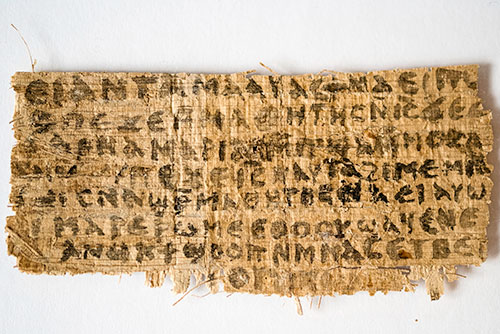
Maybe you’ve seen the news about the Coptic fragment which contains writing which has Jesus referring to “My wife…” It was amusing to see how many people at work today had to ask me, “Hey, Chitty! Did Jesus have a wife?” My answer was that during his first coming, he came to purchase a people whom Scripture calls “The Bride of Christ,” and when he returns, he and his Bride will enjoy the marriage Supper of the Lamb” (Rev. 21:9). So, no, he didn’t marry an
individual during his earthly ministry 2,000 years ago because he is saving himself for his Bride, the church.
There was one curious thing about this fragment making news today: what major Christian holiday is coming up? It’s not Christmas or Easter. Monday did mark Rosh Hashanah for the Jews, but stories like this don’t usually coincide with Jewish holidays.
The timing may be evidence that this fragment is genuine. Don’t get me wrong–I don’t think the apparent assertion of the fragment reflects the truth of the matter. But a serious scholar presented it to a conference of peers, submitting it for peer review, besides the fact that it is not being publicized in conjunction with any major Christian holiday.
Here’s what Michael Heiser, who blogs at PaleoBabble, has to say about it:
Now, to be clear, this discovery isn’t PaleoBabble — at least not yet. Karen King is a good scholar. She teaches on the history of early Christianity (which would include Gnostic sects) at Harvard. I don’t believe for a minute she’s faking anything.
UPDATE: Although it is true that this “Jesus’ Wife” papyrus was not heralded in the sensationalistic way which is usually case with the stories breaking the week of Christmas and Easter, questions are being raised about the propriety of the anonymous owner’s intentions in allowing Harvard scholar Karen King to introduce it to the world as she has. After all, according to the NYT article, Dr. King is interested in giving other scholars a chance to “upend (her) conclusions.” Yahoo News informs us of the discussion in progress
Reformed Forum: Nature and Scripture
I just thought I’d share the video of one of my favorite podcasts, if you’ve got the time.
Reformed Forum is a reformed theology media network, which seeks to serve the church by providing content dedicated to issues in reformed theology. (Link)
The flagship podcast of the Reformed Forum media network is the weekly program, Christ the Center. Hosted by Camden Bucey, a doctoral student at Westminster Theological Seminary in Philadelphia, Pennsylvania, who is often joined by a panel of other students, Christ the Center features interviews of authors and theologians, as well as discussions among the panelists themselves. While accessible and engaging, these guys are not afraid of dealing with the technical and academic aspects of Reformed theology, but I know everyone will find something that will benefit them.
The most recent episode posted at the Reformed Forum YouTube channel deals with the issue of “Nature and Scripture”:
In 1946, the faculty of Westminster Theological Seminary published a symposium on the doctrine of Scipture titled The Infallible Word. Cornelius Van Til’s contribution, an essay titled “Nature and Scripture,” is an important work describing the relationship of general and special revelation. In this episode, Dr. K. Scott Oliphint, Professor of Apologetics and Systematic Theology at Westminster, expounds on this essay and connects it to contemporary issues in philosophy and theological methodology. (Link)
Apartheid and the Dutch Reformed

Q. This question came up as I browsed the web on Liberation Theology this morning. Encyclopedia com mentioned that “Reformed Christianity in South Africa has been one of the ideological pillars of apartheid…” Do you know anything about that history or the position of the Reformed Church on it? My understanding is that the Boers brought the Dutch Reformed Church with them when they colonized South Africa. However, I don’t know how representative of Reformed Theology they were or how it might have been perverted by racism there. Any insights?
Call me lazy, but I will not be answering this very first question to the Genevan Help Line. The reason is not that I lack the ability to Google “South African Apartheid” and “Dutch Reformed Church,” among other key phrases, or even to consult more reputable sources, but I happen to have a friend who is a native of South Africa, and he happens to be Reformed, so I knew his knowledge and experience would prove a valuable resource to consult. In response to D. Kelly, my friend, Lorimer, writes:
Wow! This is a loaded question!
To answer this you must go back to 1652 when the Dutch first came to South Africa and brought the Dutch Reformed practices with them. The misconception is that these were only Dutch people but the truth is that other Europeans came along. The French, Scottish, German, and of course the English also came during this time period.
The French, also known in South Africa as the Huguenots, were the actual initiators of the separation of the Dutch Reformed Church into three main branches of the Reformed Church. One of these churches became the National Church of South Africa, from which would come South Africa’s first President, Paul Kruger. South African currency derived its name, the Kruger Rand, from this important figure.
This church and president wanted to protect the resources of South Africa, so they established moral laws. Fast-forward many years, and many wars; to make the long story short, the Dutch Reformed Church when it arrived in South Africa was different from the way it was when apartheid came into play.
The Boers (which were not all Dutch) used religion as a means of oppressing the blacks and teaching young white kids that God has chosen them as a superior race. So, in a sense, the statement “Reformed Christianity in South Africa has been one of the ideological pillars of apartheid…” is somewhat true in that it depends on which of the three branches it comes from. The “true” Dutch Reformed Church is very much Reformed.
Taking the Bible “Seriously,” Not Literally
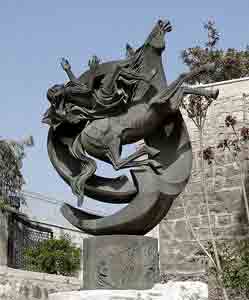
Syrian statue of Saul of Tarsus falling from his horse at the appearance of Jesus
Here’s another example of how people are incapable of absolute objectivity. As you know, I’m currently reading Oxford Church Historian, Diarmaid MacCulloch’s 2009 book, Christianity: The First Three Thousand Years (© 2009, Viking). Fortunately, the author makes no pretense to absolute objectivity. In his telling of the history of Christianity (or, more fashionably, “Christianities”), he explains that at times his own opinion will show through. Boy, does it ever! In some cases, these opinions appear in the form of his own imaginative theory for how something fundamental to Christianity may have developed in a way other than how the Bible explicitly states that it did. What scholar worth his salt is going to take the Bible’s historical claims at face value? Especially those involving supernatural experiences.
In his introduction, MacCulloch calls “modern neurosis” the presupposition that the Bible is authoritative. The “scholarly” approach is to take the Bible “seriously” in a way that disregards the literal interpretation of the Bible.
“The Bible’s authority for Christians lies in the fact they have a special relationship with it that can never be altered, like the relationship of parent and child. This does not deny relationships with other books which may be both deep and long-lasting, and it does not necessarily make the parental relationship easy or pleasant. It is simply of a different kind, and can never be abrogated. Once we see this, much modern neurosis about the authority of the Bible can be laid aside. Maybe the Bible can be taken seriously rather than literally” (MacCulloch, page 8).
In what way might we take the Bible seriously without taking it literally? I suppose the answer is to simply admire and attempt to follow the Bible’s moral teachings, receiving them as wrenched from their presumably mythological context. In other words, orthodox Christians need to become theological liberals. We should bravely affirm that the Bible can be wrong about history, but right about morality and spirituality. In other endeavors, if one is wrong in one area, it undermines his credibility in other areas. If the Bible is historically untenable, then it is spiritually untenable. Why, then, bother with the Bible’s morality, when we can change our morals with the times—which is precisely what theological liberals do with biblical morality. They lay it aside, along with their neurosis about the authority of the Bible. MacCulloch’s own unrepentant homosexuality is a prime example of this fact.
In chapter one, “Greece and Rome (c. 1000 BCE-100 CE),” MacCulloch gives us an example of how he takes the Bible seriously, though not literally. In his description of imperial Rome’s racial inclusivity, and generous granting of citizenship to foreigners of all kinds, he finds the possible origin of the preaching of the Christian gospel among Gentiles. MacCulloch suggests that “pride” in Paul’s own Roman citizenship could have been the real source of his desire to invite Gentiles into the number of God’s chosen people. If we took the Bible seriously, then we, too, could confidently make up our own reasons to explain away the Bible’s historical narratives! MacCulloch leads by example:
Why was Rome’s expansion so remarkably successful? Plenty of other states produced dramatic expansion, but survived for no more than a few generations or a couple of centuries at most. The western part of the Roman state survived for twelve hundred years, and in its eastern form the Roman Empire had a further thousand years of life after that. The answer probably lies in another contrast with Greece: the Romans had very little sense of racial exclusiveness. They gave away Roman citizenship to deserving foreigners—by deserving, they would mean those who had something to offer them in return, if only grateful collaboration. Occasionally whole areas would be granted citizenship. It was even possible for slaves to make the leap from being non-persons to being citizens, simply by a formal ceremony before a magistrate, or by provision in their owners’ wills.32
Where this highly original view of citizenship came from is not clear; it must have evolved during the struggle for power between the patricians and the plebeians after the fall of the kings. In any case, the effect was to give an ever-widening circle of people a vested interest in the survival of Rome. That became clear in one dramatic case in the first century of the Common Era, when a Jewish tent-maker called Paul, from Tarsus, far away from Rome in Asia Minor, could proudly say that he was a Roman citizen, knowing that this status protected him against the local powers threatening him. It might have been his pride in this status of universal citizen which first suggested to Paul that the Jewish prophet who had seized his allegiance in a vision had a message for all people and not just the Jews (MacCulloch, p. 42).
If we only had the scholarly authority to associate things that are historically verifiable–like the extent of Roman citizenship–with fundamental elements of Christianity–like their proclaiming to Gentiles the life, death, resurrection and royal ascension of the Jewish Messiah–then we wouldn’t have to suspend our disbelief enough to take the Bible literally when Paul’s physician-associate, Luke–himself a careful historian (cf. Luke 1:1-3)–records in the sequel to his gospel, The Acts of the Apostles, Paul’s conversion on his way to Damascus, and divine calling to be the apostle to the Gentiles:
[9:1] But Saul, still breathing threats and murder against the disciples of the Lord, went to the high priest [2] and asked him for letters to the synagogues at Damascus, so that if he found any belonging to the Way, men or women, he might bring them bound to Jerusalem. [3] Now as he went on his way, he approached Damascus, and suddenly a light from heaven shone around him. [4] And falling to the ground he heard a voice saying to him, “Saul, Saul, why are you persecuting me?” [5] And he said, “Who are you, Lord?” And he said, “I am Jesus, whom you are persecuting. [6] But rise and enter the city, and you will be told what you are to do.” [7] The men who were traveling with him stood speechless, hearing the voice but seeing no one. [8] Saul rose from the ground, and although his eyes were opened, he saw nothing. So they led him by the hand and brought him into Damascus. [9] And for three days he was without sight, and neither ate nor drank.
[10] Now there was a disciple at Damascus named Ananias. The Lord said to him in a vision, “Ananias.” And he said, “Here I am, Lord.” [11] And the Lord said to him, “Rise and go to the street called Straight, and at the house of Judas look for a man of Tarsus named Saul, for behold, he is praying, [12] and he has seen in a vision a man named Ananias come in and lay his hands on him so that he might regain his sight.” [13] But Ananias answered, “Lord, I have heard from many about this man, how much evil he has done to your saints at Jerusalem. [14] And here he has authority from the chief priests to bind all who call on your name.” [15] But the Lord said to him, “Go, for he is a chosen instrument of mine to carry my name before the Gentiles and kings and the children of Israel. [16] For I will show him how much he must suffer for the sake of my name.” [17] So Ananias departed and entered the house. And laying his hands on him he said, “Brother Saul, the Lord Jesus who appeared to you on the road by which you came has sent me so that you may regain your sight and be filled with the Holy Spirit.” [18] And immediately something like scales fell from his eyes, and he regained his sight. Then he rose and was baptized; [19] and taking food, he was strengthened.
For some days he was with the disciples at Damascus. (See also Acts 22:1-21)
I mean, seriously!
A “Friend” Tells Our Story
 In case I’ve never mentioned it, I love the way Penguin publishes their books! It’s probably just the nostalgia associated with the first Penguin Classic I ever bought as a teenager, Pilgrim’s Progress.
Recently, I was browsing at Barnes and Noble and discovered a recent church history book published by Viking (Published by the Penguin Group). Naturally, I was drawn in. The book is called Christianity: The First Three Thousand Years, by Oxford Professor of Church History, Diarmaid MacCulloch.
Perusing the introduction, it became clear that, while this writer may be a super scholar (he’s got a long list of awards and other honors to his name), he is not a believer, although he used to profess faith. In fact, he was an Anglican deacon, but refused to enter the priesthood due, fortunately, to controversy swirling around homosexual clergy. See his Wikipedia entry linked above for more on this story.
Although intrigued, I was not quite sure if I should spend my money on the book, so I visited that old place where people can check out books temporarily without having to pay for them, unless they are returned late. Remember libraries? Pretty cool places.
Reading the introduction is a roller coaster ride for an orthodox Christian like myself. MacCulloch, as close as he has always lived to Christianity, makes some rather odd observations about the development of Christianity, but he assures the reader he is a “candid friend of Christianity” (p11). Fair enough. The writing is very engaging, and I have a healthy respect for common grace as it relates to the vocation of unbelievers, and I am sure there is much good information I can gain from this book.
My pastor and his family swung by our house this afternoon, and I showed him that I was reading MacCulloch’s Christianity, and wanted to learn what he knew about the writer. He said they used his previous history, Reformation, as a textbook at Westminster Theological Seminary. He also said that the British WTS Church History prof, Carl Trueman, knows MacCulloch and respects his work. My pastor also wants me to let him know what I think after I read it. If any of my readers are familiar with MacCulloch’s work, please share your thoughts and reactions with us in the comments section.
So, with such a hearty endorsement, I suppose I can afford to set aside the other books I’m bogged down in, and focus on this one for a few weeks until I can’t continue. As much as I love books, I’m a slow and easily distracted reader. My “ADD” will kick in at some point, I’ll return the book to the library (on time, hopefully), and then go purchase the paperback edition of both Christianity: The First Three Thousand Years, and Reformation: A History.
Here’s a BBC interview of MacCulloch on his history of Christianity, in case you’re interested in what’s in store for me as I read his book:
Understanding Law & Gospel
 On this episode of the White Horse Inn, Michael Horton addresses the topic, “Understanding Law and Gospel.”
There he goes again… 🙂
The Instrument of Faith

73. Q. How doth faith justify a sinner in the sight of God?
A. Faith justifies a sinner in the sight of God, not because of those other graces which do always accompany it, or of good works that are the fruits of it, nor as if the grace of faith, or any act thereof, were imputed to him for his justification, but only as it is an instrument by which he receiveth and applieth Christ and his righteousness (John 1:12; Philippians 3:9; Galatians 2:16).
Who will become a child of God? The one who is “in Christ.” Who will get “into Christ”? The one who receives Christ by faith, or, according to the original Greek, believing “into” him. John writes, “But to all who did receive him, who believed in (literally, “into”) his name, he gave the right to become children of God” (John 1:12).
Faith which places the sinner “in Christ” is not merely an acknowledgment that there was a historical figure named Jesus of Nazareth who embarked on an itinerant ministry which lead many first century Jews to conclude that he was the Anointed One (“Christ”) proclaimed by the Old Testament prophets. Faith in Christ does begin with such knowledge, even assenting to the truthfulness of such a proposition, but it must also result in a willingness to rest on the righteousness which Christ is proclaimed in the gospel message to have earned by his flawless observance of the law of Moses which has at its heart the moral law of God, confessing that by one’s own observance of God’s law he will not be able to earn for himself the same kind of inherent righteousness. As Paul writes in Galatians 2:16:
“yet we know that a person is not justified by works of the law, but through faith in Jesus Christ. So we also have believed in (again, “into”) Christ Jesus in order to be justified by faith in Christ, and not by works of the law, because by works of the law no one will be justified.”
So being found in Christ depends on having the righteousness of Christ which comes from God, and having the righteousness which comes from God depends on faith. In Philippians 3:9 it is written, “and be found in him, not having a righteousness of my own that comes from the law, but that which comes through faith in Christ, the righteousness from God that depends on faith.” So we see that when faith is imputed as righteousness, faith is not the thing that makes a person inherently righteous, but rather it is simply what the Westminster Divines call in Q&A #73 of the Larger Catechism, “an instrument by which he receiveth and applieth Christ and his righteousness.”


 The Misadventures of Captain Headknowledge
Christian Knowledge | East of Eden
Jonathan Edwards Tee by ReformationShirts.com (click image to see more)
The following episode of the Reformed Forum’s new podcast, East of Eden, was tailor-made for the readers of this blog! East of Eden is a podcast devoted to discussing all things Jonathan Edwards. Not the recent politician with good hair and a bad reputation, but the eighteenth century preacher of the First Great Awakening who became known as the theologian of revival. In this week’s episode, the co-hosts interview a guest to be named below as they discuss Edwards’ sermon on “The Importance and Advantage of a Thorough Knowledge of Divine Truth.” One comment made by Nick Batzig sums up nicely both the sermon and the theme of this blog: “You can have truth in the mind without godliness in the heart, but you can’t have godliness in the heart without truth in the mind.”
Later, I will update this post with a transcript of the context of the preceding quote. In the meantime, listen to the entire episode, “Christian Knowledge,” to be challenged to inform your godliness with a thorough understanding of the truth which accords with godliness (Titus 1:1).
Share this: