Memoir of the Rev. John Brown, part 6

John Brown’s Self-Interpreting Bible (1859)
It’s been a while since I last posted an excerpt from the Memoir of the Reverend John Brown of Haddington as it is found in his Self-Interpreting Bible, but a comment from his great great great Granddaughter spurred me to get back on the job. The following excerpt summarizes Brown’s move …
…From shepherd to salesman to schoolmaster.
Some short time after the spreading of this report, and probably owing to the disagreeable situation in which it had placed him, our shepherd abandoned his crook, and undertook the occupation of a pedlar or itinerant merchant ; a profession, however, in which he made but an indifferent figure. His mercantile excursions were chiefly confined to those parts of the country lying between the Forth and Tay. He seldom took lodging in any family that was not characterized for religion. The first thing he did in his new lodgings, was to turn over their books, and finding one to his mind, the sale of his wares was forgotten, and every mercantile consideration quenched in the more congenial traffic of literary knowledge. His friends and well-wishers frequently hinted the impropriety of neglecting his business; and some of them ventured to apprize him of his danger, and the difficulties into which his carelessness was likely to involve him ; but all their admonitions went for nothing—although he was often obliged to any kind person who would arrange his ill-assorted pack, while he pored for an hour over some book which had fallen into his hand. The acquisition of wealth, unless in so far as it tended to promote the more important acquisition of knowledge, was, in his opinion, a matter about which no wise man would greatly concern himself.
During these perambulations, Charles Stuart the pretender had effectd a landing in the north, and boldly laid claim to his grandfather’s forfeited throne. The partial success attending his opening career, and the alarm it produced, had thrown the country into considerable disorder. The Presbyterians, in general, were loyal ; those of the Secession were universally so. There were many amongst them who had been eye-witnesses of the cold-blooded butcheries, the unqualified tyranny, and ruinous spoliation sanctioned by the last of the Stuarts, and shuddered at the thought of their return. They were inclined, of course, to stand by the king and a Protestant succession, at all hazards; nor was it ever known that one of their body joined the ranks of the pretender. Mr. Brown was imbued with the same political principles ; and observing one day a party of Highlanders approaching him, he had the address to conceal himself till they were gone ; when, pondering on the unsettled state of the country, which he considered unsafe for one of his profession, he came to the resolution of relinquishing his present employment, at least till quieter times. In pursuance of this new scheme he concealed his pack in a peat-stack, and enlisted in a corps of volunteers that had been raised in the neighbourhood in support of government ; with whom he did duty in Blackness, and latterly in the castle of Edinburgh, till the rebellion was extinguished by the decisive battle of Culloden.
On the breaking up of his regiment, he retired to the scenes of his former wanderings, withdrew his deposit from the peat-stack, and recommenced his former employment, which he seems to have followed for at least another year. Tired at last of this uncongenial and wandering life, and wishing to get into a more direct road to his ultimate design, he undertook at the suggestion of several friends the toilsome and troublesome vocation of a teacher. In 1747 he opened a school at Gairney Bridge, a village in the vicinity of Kinross ; which he superintended for two years with remarkable success. His experience, as a self-taught scholar, enabled him with more ease to lead them through those elementary difficulties that stand in the way of the young scholar ; while his patience and conscientious assiduity, which peculiarly qualified him for an instructor of youth, attracted scholars from every quarter. While thus unwearied in carrying them forward in the various branches of education, he laid hold on every proper opportunity to impress their young minds with the importance of practical religion ; particularly on Saturday, before dismissing his school, he made it his constant rule to address them on the duty, the propriety, and urgent necessity of remembering their Creator and Redeemer in the days of their youth ; and the happy result of his pious endeavours may be partly gathered from the astonishing fact, that, though only two years a schoolmaster, eight or nine of his scholars were afterwards ministers of the gospel. His strenuous endeavours to press others forward in the paths of wisdom and usefulness, however, did not retard his own motion, or relax his industry. He has been known to commit to memory fifteen chapters of the book of Genesis in an evening after dismissing his school ; and after all this unparalleled exertion, to allow himself only four hours in bed.
Theology, Ethics and . . . What?
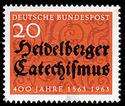
I am currently reading Michael Horton’s Thanksgiving post at Out of the Horse’s Mouth (the White Horse Inn blog), “Joining the Thanksgiving Parade.” In his introduction, he brings up a famous quote–sort of a theological proverb. Here’s Horton’s words:
The Heidelberg Catechism, in fact, is structured in terms of Guilt, Grace, and Gratitude, leading G. C. Berkouwer to conclude, “The essence of theology is grace; the essence of ethics is gratitude.” Or, as we have say around here, duties (imperatives) are always grounded in gospel promise (indicatives). The appropriate response to a gift is thankfulness. (emphasis mine)
In light of this reminder, I simply have a question for students of Reformed theology in general, and the Heidelberg Catechism in particular:
- If grace is the essence of theology, and gratitude is the essence of ethics, then guilt is the essence of what?
Please submit your answers in the comments thread.
May the grace of God in Christ crucified and risen to atone for your guilt inspire much gratitude in you this Thanksgiving!
Metzger on Pagan Parallels with Christianity
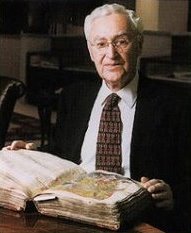
Dr. Bruce M. Metzger, the greatest textual critic of the twentieth century
“The differences between the Christian sacraments of baptism and the Eucharist and corresponding ceremonies in the Mysteries are as profound as their similarities are superficial.”
The quote above was penned by Bruce M. Metzger, in his article, “Considerations of Methodology in the Study of the Mystery Religions and Early Christianity,” published in the January, 1955 edition of the Harvard Theological Journal (p. 13). Metzger’s conclusions from his study of the methodology of scholars who make much of the parallels between Christianity and pagan mystery religions is that the parallels are analogical, rather than genealogical. In other words, the elements of Christianity which parallel paganism were not derived from paganism, but, as above, “their similarities are superficial.”
Read PaleoBabble’s blog post on this article, and then read the article itself.
In short, don’t be sucked in by the claims of “pagan parallels” as an attempt to discredit the historicity, inspiration and authority of the New Testament, or to relativize it, like Rob Bell was…
Was Martin Luther Anti-Semitic?

November 10th was the 528th birthday of Protestant Reformer, Martin Luther. The Lutheran radio show, Issues, Etc., hosted by Todd Wilken, interviewed Uwe Siemon-Netto of the League of Faithful Masks, and author of The Fabricated Luther, about the popular notion that the writings of Martin Luther which were critical of the Jews were in fact part of the source of the twentieth-century Nazi form of anti-Semitism. I will attempt to summarize Siemon-Netto’s explanation and defense of Martin Luther.
Some of Martin Luther’s writings from late in his ministry certainly do not match the political-correctness of modern Western civilization, but they are hardly the source of Nazi sentiment against the Jews. For starters, late in his life, Luther was wracked with physical pain and illness, which took a serious toll on him. Psychologically, people under such severe physical and emotional stress are prone to give expression to ideas which they otherwise would not. Luther’s earlier writings were are more affirming and caring, urging the evangelization of the Jews.
In sixteenth century Germany, it was still a civil crime to commit blasphemy against the Christian God. Thus, the Jews’ denial of Christ was legally categorized as a violation of German blasphemy laws. While today, Western civilization considers blasphemy laws unjustifiable, we must not judge a man anachronistically when he is seen acting consistent with the context of his own generation.
Luther’s statements critical of the Jews had been, right or wrong, suppressed by the Lutheran church due to their recognition that they reflect something other than theologically Lutheran attitude. These writings were recovered and misused by proponents of the Volkisch movement which promoted pre-Christian pagan ethnocentricity and Romantic nationalism, among other influences. Their racist views are projected back onto Luther and unjustly point to him as a primogenitor of their own views when they were actually engaging in public relations to popularize their own peculiar views.
These days, when people find how the Nazis and other German anti-Semites utilized quotes by Martin Luther, it is easy to come away assuming Luther was anti-Semitic in a manner comparable to Nazi Aryanism. Todd Wilken asked Uwe Siemon-Netto to put in a nutshell what he would recommend as a helpful response and defense of Martin Luther in the light of such assumptions. Siemon-Netto explained as follows:
A) The entire Lutheran church rejected Luther’s statements that were critical of Judaism;
B) What Luther wrote against the Jews in his later life was un-Lutheran as compared with his earlier writing on the same subject;
C) Luther was fallible, and made egregious mistakes—an admission made by Martin Luther probably more than anyone else.
Saint Catherine’s Monastery: An Ark in the Wilderness

Father Justin with his cousin (and friend of mine), Bunny Gibson
The following is the lecture delivered on Tuesday night, November 8, 2011 at a symposium on the St. Catherine’s monastery library and the significance of the Sinai manuscripts, hosted by Dr. Daniel B. Wallace and the Center for the Study of New Testament Manuscripts at the Hope Center in Plano, Texas.
The Earliest References
1 The history of a Christian and monastic presence at Sinai begins not in Byzantine times, but extends back into the years of late classical antiquity. One of the earliest narratives to come down to us from that time is Ammonius’s account of the Forty Martyrs of Sinai and Rhaithou. There, we read about monks who had been living in the Sinai deserts ‘for forty years, and for fifty, and for sixty, and for seventy years, who have dwelt in the same place.’ We also read about a monk named Moses, who was admired by all for his zeal and for his grave manner of life. 2 ‘A certain Moses, having adopted the discipline of monasticism from his youth, practised monasticism for seventy-three years in that mountain from which springs of water issued.’ ‘And this saint, from the time that he took the habit of Christ, ate no flesh, but he ate dates only.’ ‘The food of that saint was a few dates, and water only. And he never tasted wine. And his dress was of compressed palm fibre. And he loved silence more than all men.’ From the many miracles that God wrought through him, all the inhabitants of Pharan had come to believe in the Holy Trinity, and received holy Baptism.[1]
I was in Rhaithou in July a few years ago. The temperature registered 118 degrees Fahrenheit. A hot and searing breeze blew from across the Red Sea. It was yet another small insight into the heroism of the monks who lived there in centuries gone by.
3 The historical events described by Ammonius allow us to date his account to the year 373.[2] Thus when he describes elders who have dwelt there as monks for sixty, for seventy, and more years, we understand that there was already an established monasticism at Sinai and Rhaithou at the end of the third and the very beginning of the fourth century, when persecutions were still raging against the Christians. Even then, there dwelt ascetics in the Sinai deserts who were established in virtue, who had attained to the pinnacles of prayer and spiritual graces.
4 Another important early text is the travel account of Egeria, who made a pilgrimage to Jerusalem, after which she continued on to Sinai, around the year 383. She worshipped at the chapel on the peak of Sinai, and at the cave of the Prophet Elias below the peak, after which she descended into the valley, to the Church of the Burning Bush. 5 She writes, ‘there are many cells of holy men and a church on the spot where the bush stands; and this bush is still alive today and gives forth shoots.’[3] The monks celebrated the Liturgy for the pilgrims, and read for them those passages of scripture concerning the events that had taken place at each site. They also presented them with fruits from their gardens.
From the fourth century, Sinai was a place where monks lived in solitude and austerity. But it was also a place of pilgrimage, and these two strands have continued throughout the history of the area, even to our own day.
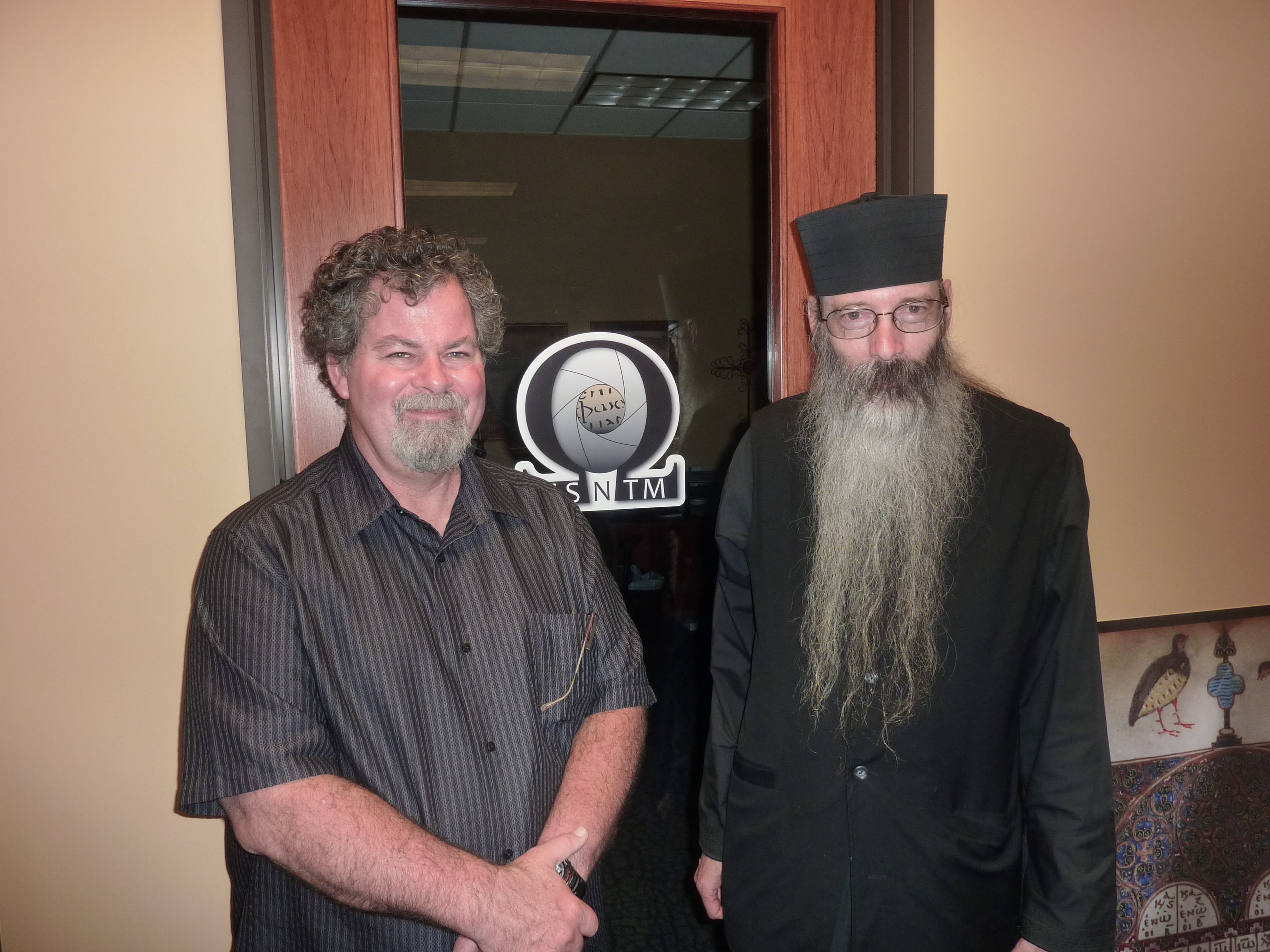
Dr. Daniel B. Wallace with Father Justin
The Sixth Century
6 In the sixth century, the Emperor Justinian ordered the construction of a basilica and high surrounding walls, that have stood ever since. This was done to honour this holy place, and to protect the monks who lived there. The church is remarkably well preserved. Not only are the columns, the capitals, and the walls intact, but the central doors into the nave and the heavy ceiling beams also date from the sixth century. And the focal point of the church is the mosaic of the Transfiguration, one of the most profound works of art from that time. 7 The lintel over the door into the nave bears this inscription,
+ Καὶ ἐλάλησεν κ(ύριο)ς πρὸς Μωυσῆν ἐν τῷ τόπῳ τούτῳ λέγων· ἐγὼ εἰμὶ ὁ θ(εὸ)ς τῶν πατέρων σου, ὁ θ(εὸ)ς Ἀβραὰμ κ(αὶ) ὁ θ(εὸ)ς Ἰσαὰκ καὶ ὁ θ(εὸ)ς Ἰακώβ. + Ἐγὼ εἰμὶ ὁ ὤν +[4]
+ And the Lord spake unto Moses at this place, saying: I am the God of thy fathers, the God of Abraham, and the God of Isaac, and the God of Jacob. + I AM THAT I AM +
8 We can date the completion of the basilica to within a few years, from inscriptions carved on the beams. The seventh beam, counting from the west end, bears an inscription meant to be visible to those entering the nave,
+ Ὑπὲρ μνήμης κ(αὶ) ἀναπαύσεως τῆς γεναμένης ἡμῶν βασιλίδος Θεοδώρας +
+ For the memory and repose of our late Empress Theodora +
The eighth beam bears the inscription,
+ Ὑπὲρ σωτηρίας τοῦ εὐσεβ(εστάτου) ἡμῶν βασιλέως Ἰουστινιανοῦ +
+ For the salvation of our most pious Emperor Justinian +
The inscription on the one beam commemorates the Empress Theodora as having passed away, while the inscription on the other commemorates the Emperor Justinian as still living. We know that the Empress Theodora died in the year 548, while the Emperor Justinian died in 565. These two dates provide the terminus post quem and the terminus ante quem for the completion of the basilica. Is it possible to make the dates even more precise?
9 Procopius, in his work On Buildings, mentions that at the base of the mountain where Moses received the Laws from God, the Emperor built a very strong fortress, with a church dedicated to the Mother of God, to enable the anchorites who dwelt there to pass their lives therein praying and holding services.[5] Many scholars feel that Procopius’ On Buildings was completed in the year 554/5, though others have argued for the date 559/60.[6] Even the latter would allow us to narrow the date for the completion of the basilica to within a span of twelve years.
10 A Greek plaque on the west wall of the monastery refers to the completion of the monastery in the thirtieth year of the reign of the Emperor Justinian, which would be the year 557. Although this particular inscription is not early, it may have been based on earlier records. The date indicated is in keeping with the other dates that we have seen.
11 There is one last inscription to be considered. The mosaic of the Transfiguration of Christ includes this dedicatory inscription,
+ Ἐν ὀνόματι π(ατ)ρ(ὸ)ς κ(αὶ) ὑ(ιο)ῦ κ(αὶ) ἁγίου πν(εύματο)ς· γέγονεν τὸ πᾶν ἔργον τοῦτο ὑπὲρ σωτηρίας τῶν καρποφορησάντ(ων), ἐπὶ Λογγίνου τοῦ ὁσιωτ(άτου) πρεσβ(υτέρου) κ(αὶ) ἡγουμ(ένου) +
+ Σπουδῇ Θεοδώρου πρεσβ(υτέρου) κ(αὶ) δευτ(εραρίου), ἰνδ(ικτιῶνος) δϊ +
+ In the Name of the Father, and of the Son, and of the Holy Spirit. This entire work was executed for the salvation of those who had offered the fruits, by Longinus the most pious presbyter and abbot +
+ The work of Theodore presbyter and deuterarius, indiction fourteen +
This same Abbot Longinus is portrayed in one of the medallions of the mosaic, with a white square placed behind his head as an indication that he was still living at the time. In the years we have been considering, the fourteenth indiction would have fallen during the years 550/1, or 565/6. The latter date is the more probable for the completion of the mosaic.
The entire subsequent history of Saint Catherine’s Monastery may be said to have been written between the ruling lines that we have now traced.
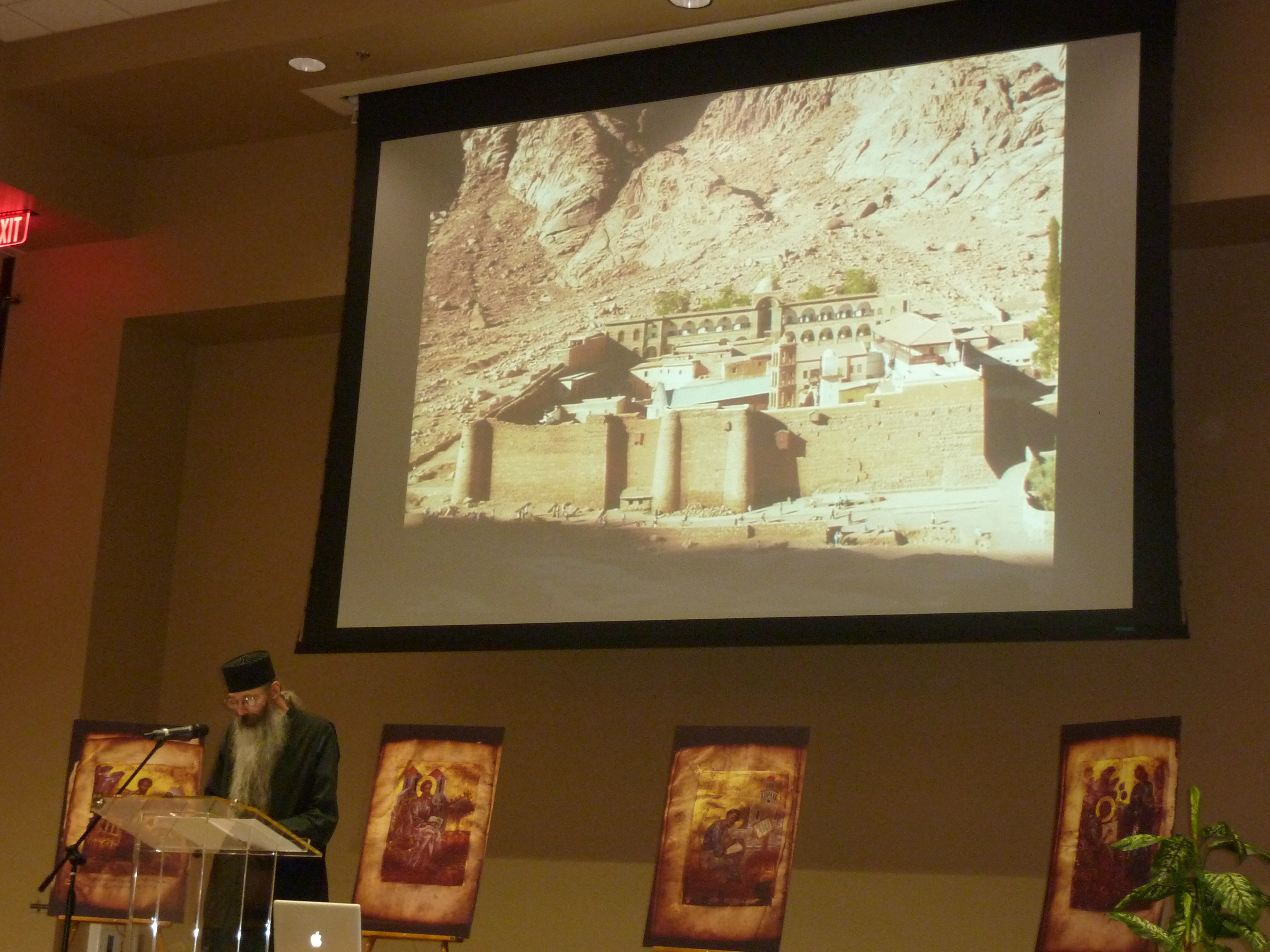
Father Justin speaking about St. Catherine's Monastery
The Sinai Library
12 The Persians sacked Jerusalem in 614, but it was not worth their while to come to this remote site. Its very isolation protected it. Islam came to the area in the year 632. But Moslems also revere Sinai as a sacred mountain, and the monks found a way to live in peace with their new rulers. The monastery continued as it had of old. Ascetics came to this desolate wilderness and reached great spiritual heights. Their writings have been treasured by Christians throughout the world ever since.
13 The most important book to be written at Sinai is called The Ladder of Divine Ascent, in which the author took the ladder that Jacob saw extending from earth to heaven as the motif for the spiritual life. Saint John of the Ladder was abbot of Sinai in the late sixth century. Before being elected abbot, he had lived as an anchorite for forty years, during which he spent his time saying prayers and copying books. This is an indirect witness to the production of manuscripts at Sinai. Precious manuscripts were also brought to the monastery over the years.
The monastery has never been destroyed or abandoned in all its centuries of existence. The climate at Sinai is surprisingly dry and stable, the humidity averaging from twenty to thirty percent. All of this, and the diligent care of the monks, account for the preservation of many manuscripts. The Sinai library is today a remarkable treasure for the antiquity and the significance of its volumes.
14 The library contains 3304 manuscripts, written in eleven languages. These are predominantly Greek, Arabic, Syriac, Georgian, and Slavonic. The manuscripts range in content from copies of the Scriptures, services, and music manuscripts, to sermons, writings of the Fathers, lives of the Saints, and books of inherited spiritual wisdom. The library also includes medical treatises, historical chronicles, and texts in classical Greek, which is the pinnacle of the Greek language.
15 A few of the manuscripts are splendid works of art, with gilded letters and brilliant illuminations, created in Constantinople in the tenth, eleventh, and twelfth centuries, when the City was at its height as the centre of culture and devotion. But no less significant are the humble manuscripts written at Sinai, often on reused parchment, bound between rough boards, the pages stained from long use, a witness to the deprivations and austerity of Sinai, to the generations of monks who have maintained the life of devotion and the cycle of daily services at this holy place.
But perhaps we would come to a greater appreciation of the Sinai library if I could describe four manuscripts in particular, all of which have been recently studied by scholars.
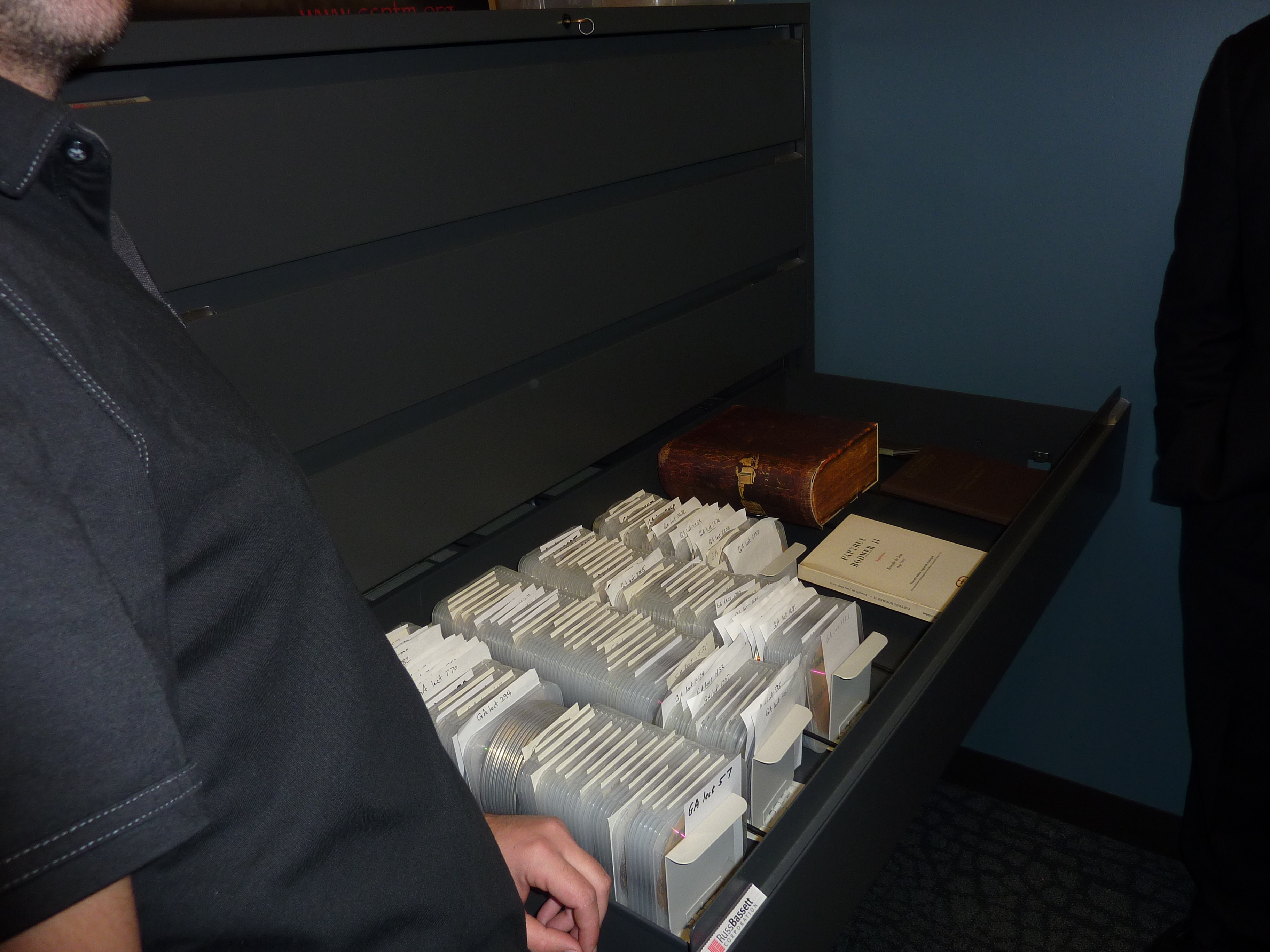
Discs containing some of the manuscripts digitally photographed by CSNTM
Sinai New Finds Christian Palestinian Aramaic 59
16 Aramaic was the language spoken in Palestine at the time of Jesus, and there are a number of Aramaic words and phrases preserved as such in the Greek New Testament.
Καὶ κρατήσας τῆς χειρὸς τοῦ παιδίου, λέγει αὐτῇ· Ταλιθά, κοῦμι· ὅ ἐστι μεθερμηνευόμενον· τὸ κοράσιον, σοὶ λέγω, ἔγειραι.
And he took the damsel by the hand, and said unto her, Talitha cumi; which is, being interpreted, Damsel, I say unto thee, arise. (Mark 5:41)
In Saint Paul’s First Epistle to the Corinthians, he quotes the Aramaic word Maranatha, which means ‘Come, O Lord,’ or, ‘Our Lord is come’ (I Corinthians 16:22), a prayer that must have been familiar to them, and which goes back to the first Aramaic speaking Christians.
A number of manuscripts survive in Christian Palestinian Aramaic, the earliest dating from the sixth century. They are written in a Syriac script, though Syriac and Aramaic are different languages. The texts are mostly copies of the Scriptures, liturgical texts, and lives of the Saints.
Centuries ago, the Sinai manuscripts were kept at a number of different places within the monastery. Some of the oldest were stored in a room in the tower of Saint George, which projects off the north wall of the monastery. In 1734, Archbishop Nikiphoros Marthales created rooms opposite the Archbishop’s quarters for the manuscripts, and asked that they be gathered there from the various areas where they had been stored before. We know now that manuscrips that were already in a ruinous state, as well as loose leaves and fragments, were left behind in this tower room. Some time later, the roof above them collapsed. There they remained until 1975, when one monk was carrying out repairs to the tower, and came across this deposit of manuscripts. They are collectively known as the New Finds.
Among them were a number of manuscripts written in Christian Palestinian Aramaic. A manuscript that dates from the seventh or eighth centuries contains the Sayings of the Desert Fathers, number 59 in the collection. 17 One of the most beautiful is a Lectionary dating from the thirteenth century, manuscript number 41. Professor Alain Desreumaux, from Paris, is a recognised authority on texts written in Aramaic. He visited the monastery during the first week in June of last year, and spent some time studying these manuscripts. He is even now editing and publishing them, thus adding to the number of known texts in Christian Palestinian Aramaic.
Sinai Syriac 52
The writings of Dionysius the Areopagite consist of four treatises and ten letters. The four treatises are The Divine Names, The Mystical Theology, The Celestial Hierarchy, and The Ecclesiastical Hierarchy. Although these works pass under the name of the Athenian who was converted by the Apostle Paul, as mentioned in Acts 17:34, the works are not referred to before the close of the fifth century. Earlier controversies over the reliability of these writings were set aside when they were confirmed by Maximus the Confessor, and quoted by the Lateran Council held in 649. They were translated into Syriac by Sergius of Reshaina, who died in 536. In 827, the Byzantine Emperor Michael II sent gifts to Louis the Pious, among them the works of Dionysius the Areopagite, and Hilduin, the chaplain of the king and later Bishop of Paris, had them translated into Latin. In 858, Scotus Eriugena made a new translation into Latin. From this, they became known and influential in the West. These writings remain of the greatest importance even today in the Orthodox Church.
18 The oldest surviving manuscript in the world of the works of Dionysius the Areopagite is Sinai Syriac 52, a manuscript of the sixth century, that is, the very century in which these works were first translated into Syriac, and the century following their first emergence. The Hungarian scholar Istvan Perczel had edited the works of Dionysius included in this manuscript, working from the microfilm that was made by the Library of Congress in 1950. But there are areas of the manuscript that were damaged or stained, and these were illegible in the microfilm. He came to Sinai for the first time in July of last year, and was able to study the manuscript in some detail. From his reading of the original, and from the high resolution digital images that we were able to take and send him, he hopes to make a new edition of the text.
We know from the enumeration on the first folio of this manuscript that it is missing the first two quires. But an additional six folios from this manuscript turned up in the New Finds, and there are also folios belonging to this manuscript in Paris and Milan. Between all of these, the first two quires are complete, forming the Introduction to the translation made by Sergius of Reshaina.

Yours truly with Father Justin touring the offices of CSNTM
The Codex Sinaiticus
19 The Codex Sinaiticus has been called the world’s oldest Bible. It was written around the year 325, by professional scribes using the finest parchment. It originally consisted of 740 leaves, and contained the whole Bible, from Genesis to Revelation, and in addition, two early Christian writings, the Epistle of Barnabas, and the Shepherd of Hermas. Sadly, due to Constantine Tischendorf, the leaves of this manuscript are now dispersed among four different institutions: the British Library, the library of the University of Leipzig, the State Library of Russa at Saint Petersburg, and Saint Catherine’s Monastery at Sinai. The Sinai leaves were recovered with the New Finds, and consist of twelve entire leaves, and fragments from an additional four.
Although the monastery has always regretted the loss of this manuscript, in 2005 we began a collaboration with the other three institutions, setting aside our differences to accomplish something so important: the conservation of the original leaves, and their publication, both on the internet and in facsimile, together with a complete new transcription of the entire manuscript. In this way, the leaves would be virtually reunited, and made accessible to scholars and students around the world.
20 The conservation of the leaves and fragments at Sinai was carried out in May of 2008, and the following month, scholars came from England to transcribe the texts. They read from the original leaves, sometimes backlighting them to be able to make out faded or damaged letters. But there were times when high resolution digital photographs revealed more of the text, and using these images, they could consult with other scholars about complex passages, especially those passages where there had been multiple corrections. The manuscript and transcription were posted on the internet in July of 2009, and the printed facsimile became available in January of this year.
In July of 2009, we were able to make an important announcement about this manuscript. Three years earlier, conservators completed a survey of the Sinai manuscripts, recording the state of each volume, and taking photographs of the bindings. Nikolas Sarris, a Greek from Patmos, used these photographs to study the tooling of the manuscripts. From the decorative stamps used in the bindings, he was able to reconstruct which manuscripts were bound in the same workshop, and determine whether the bindings were executed elsewhere, or made at Sinai itself.
21 He brought to my attention one of the photographs made during the survey. This was Sinai Greek 2289, and he knew from his research that it was one of a group of eighteen bindings made at the monastery in the first quarter of the eighteenth century. 22 On the inside back board, the paper lining had been partially torn away, revealing a parchment with Greek majuscule script. Was it too much to hope that this was yet another fragment of the Codex Sinaiticus? The more we examined it, the more convinced we became that indeed it was. The text is from the first chapter of the book of Joshua, the eleventh verse, in which Joshua commands the children of Israel, ‘Prepare you victuals; for within three days ye shall pass over this Jordan, to go in to possess the land, which the Lord your God giveth you to possess it.’ In every detail, this fragment seemed to match the Codex. But the monastery has other leaves of the Codex Sinaiticus from this same book, which would have been written by the same scribe. 23 When we juxtaposed the letters from these leaves over the image of the newly revealed fragment, the exact correspondence seemed further confirmation of this identification.
It was universal practice in earlier centuries to use parchment fragments in repairing or binding other texts. But now we are presented with the daunting task of wanting to reveal the whole of this fragment, without the risk of damaging it in the process. Experienced conservators will need to discuss the safest way to recover this leaf. It may be that advanced scanning techniques could reveal more of the text, without attempting to remove the fragment for the time being. We should not rule out the possibility of simply leaving the fragment as it is, waiting for technology to develop. This would be better than to act in haste, and risk damaging or losing the text.
Sinai Arabic New Finds 8
24 In the summer of 2006, Hikmat Kachouh, a scholar from Lebanon, came to Sinai to study the Arabic manuscripts of the Gospels. He was taking a doctorate under the supervision of David Parker, at the University of Birmingham. In the course of his studies, he examined over two hundred manuscripts in twenty-one different institutions. Out of them all, this manuscript, Sinai Arabic New Finds 8, was the one that interested him most. On palaeographic grounds, he dated the manuscript to the second half of the eighth century. He concluded that this manuscript follows an archaic Greek manuscript that differed considerably from the Greek Byzantine text. The Western and Alexandrian readings are very many. He writes, ‘No extant Arabic manuscript can claim more textual value than this version.’[7]
But this manuscript remains extremely important for another reason as well. The oldest manuscripts at Sinai are written on parchment. Even after paper reached the Arab world in the tenth century, parchment remained the preferred writing material. Parchment is made from the skins of calf or sheep, in a process that is highly specialized. As a result, parchment has always been expensive, and often difficult to find. But it can be used to produce a book that is beautiful, and that will last for centuries.
If a text written on parchment is no longer wanted, the writing can be rubbed off, and the valuable parchment used a second time. The original writing remains faintly visible beneath the second text. This is what is known as a palimpsest. Because Sinai was so remote, there are many palimpsests: some one hundred and ten manuscripts contain leaves with an underlying text.
25 Very often, it is this original text that is of the greater interest to scholars. If the original writing was large, and if the second text was written at right angles, it is possible with some patience to make out the underlying text. But more often, this is not the case, and the original writing can remain elusive. In the late nineteenth century, it was customary to apply chemicals to the page, to try to enhance the faded ink. A common reagent was hydrosulfurate of ammonia. There were times when this made it easier to read the original script, but one also risked damaging the page, and ruining it.
Recent advances in digital photography techniques promise to make these texts more legible. Pages are photographed using narrow wavelengths of light, ranging from infrared to ultraviolet, in what is called multi-spectral imaging. Photographs taken at specific wavelengths are often combined, and image processing algorithms are applied, the same techniques used to enhance the faint images of stars and galaxies in outer space. Results are not always certain. Also, it is not only technology that is required to recover the texts. It still requires the sharp eyes and long training of experienced scholars to decipher the resulting image.
26 Leading scientists in the field came to Sinai in September of 2009 and took photographs for a pilot project. The results were encouraging, and they have been promised funding for a five year project to photograph manuscripts in their entirety and make them available to scholars. Even the pilot project revealed important discoveries.
Historians have pointed to surprising parallels between earliest Egyptian monasticism, and earliest Irish monasticism. This can be seen in the architecture and the organization of Irish monasticism. We also know that the Irish retained a knowledge of Greek after it had been lost elsewhere in the West. Seven monks from Egypt are said to be buried at Disert Ulidh in Ireland, and the Bibliothèque Nationale possesses an Irish guide for the use of pilgrims to Scetis in Egypt.[8]
27 At Sinai, we only have one Latin manuscript, a Psalter thought to have been written in Jerusalem in the tenth century. But among the New Finds were manuscript leaves written in Latin, in Merovingian and Visigothic hands. One of the most exciting discoveries was an Arabic manuscript that seems to date from the ninth century, making it very early for an Arabic text. The manuscript is itself made up of a patchwork of smaller pieces of parchment, many of which are palimpsests. It contains both classical and Biblical texts in elegant majuscule Greek. It also contains texts in Latin, and one of these hands has been identified as written in an Insular script. This is a term used to classify a style of writing that began in Ireland in the seventh century, and then spread to England, where it flourished between AD 600-850. This was the age of Aidan and Cuthbert and Bede, the time of an unusual flowering of monasticism in England. Now, for the first time, we have manuscript evidence of direct contact between this world and Sinai. This is evidence that their horizon did not stop at Rome. And, can we say? one of the reasons for this flowering would have been their direct contact with the wellsprings of monasticism in Egypt and Sinai.
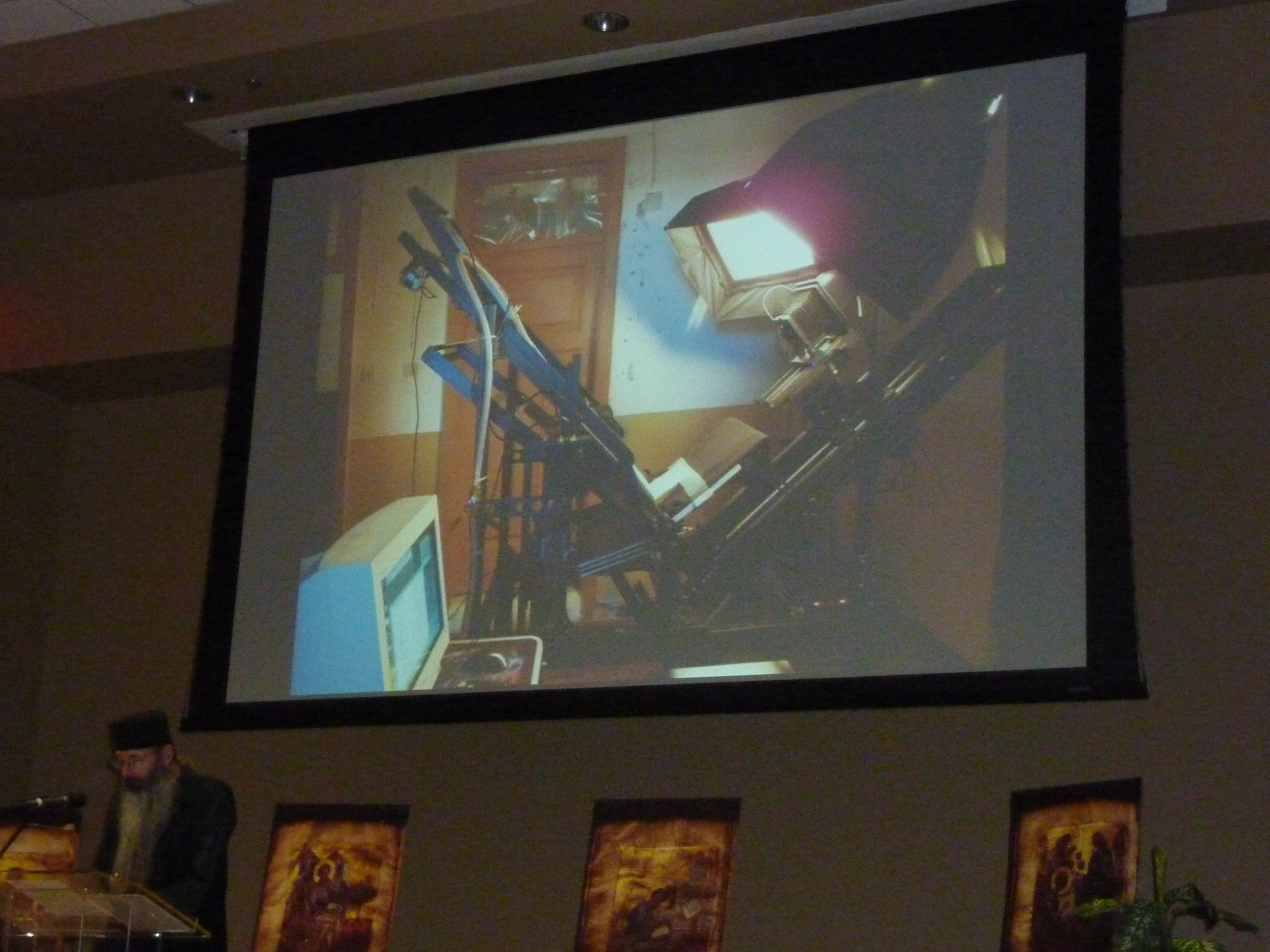
Camera at St. Catherine's Monastery
The New Digital Camera
28 We have looked at four manuscripts that have been studied recently by scholars, as an indication of the continuing importance of the Sinai library. In each case, digital photographs of these manuscripts proved extremely helpful in their study. The photographs we have seen were made with a system that was acquired some years ago. It consists of a large format camera made by Sinar, with a six megapixel digital back. 29 To take photographs, we use a cradle made in London by Alan Buchanan, which was especially designed for the photography of fragile manuscripts. The manuscript never opens more than 90 degrees. It rests open naturally, and the spine is fully supported, for the cradle turns, from first page to last. As pages are photographed, the platen opposite the camera is incrementally recessed, so that the distance between the camera and the manuscript remains the same. This maintains the focus, and ensures that all of the resulting photographs are uniform in size. Using this camera, we have been able to photograph over one hundred of the Sinai manuscripts. This camera still takes excellent photograph, and will continue to be a useful part of our project.
30 But just last week, we completed the installation of a second camera, that will allow us to expand our project. The installation was made by John Stokes, of Stokes Imaging, in Austin, Texas. The new camera has a 48 megapixel Dalsa CCD. In multi-shot mode, it can capture full colour images in resolutions of up to 192 megapixels. Such photographs are 1.25 gigabytes in size. The new system is not only a great advance in the resolution of the images it can capture. It is also much more efficient.
31 John Stokes licensed the way in which the other cradle supports the manuscripts, and then improved it. 32 The platen opposite the camera moves on a track, which ensures that it is always perpendicular to the camera. 33 It is a simple operation to raise the wedge, turn the page, lower the wedge back into place, and 34 place the new page in position to be phhotographed. 35 The platen is always positioned so that it does not exert any pressure on the manuscript. On our first volume, we were able to average over one page per minute. This allows for the careful handling of the manuscript, and for the time it takes the computer to save each image.
When I return to the monastery in November, I will be bringing with me new lighting systems that employ LED units, with the colour spectrum matched to the CCD. This avoids the fatigue of using flash for extended periods of time.
36 The first manuscript we photographed was an Arabic typikon, giving the order of service, that had been requested by a scholar in Germany. The resulting images were straightened and cropped automatically as a part of the image processing, so that all of the resulting photographs are consistent. They were also automatically saved in three different formats: the full archival image in TIFF format, a derivative in full size, but in a compressed JPEG format, and a small thumbnail image that could be mounted on a web site. 37 We also always photograph the binding of each manuscript. 38 At full resolution, scholars can study many of the details of the binding structure.
39 To test the system at its highest resolution, we photographed a rare illumination of King David that is a part of a Syriac translation of the Book of Kings, dating from the seventh century. 40 The resulting image allows one to see the smallest detail. This is useful not only for the study of the illumination. It is also important as a conservation photograph, allowing one at a future date to check the state of the illumination.
We will continue to meet the requests of scholars as they send us requests. But with the expansion of our digital photography program, we also want to embark on a more systematic photography program. We want especially to photograph all of the Arabic and Syriac manuscripts of the library. We are pleased that there has been a resurgence of interest among scholars in these manuscripts. This would also do much to remind Christians in the Middle East of their own rich heritage.
Saint Catherine’s Monastery is a treasury filled with things new and old. Scholars still have much to learn from its library, its numerous icons, vestments, ecclesiastical vessels, its architecture. In all of this, it is a veritable ark in the wilderness.
[1] Agnes Smith Lewis, ‘The Forty Martyrs of the Sinai Desert and the Story of Eulogius, from a Palestinian Syriac and Arabic Palimpsest’, Horae Semiticae no. IX (Cambridge: Cambridge University Press, 1912), pp. 4-5.
See also Christina Müller-Kessler and Michael Sokoloff, ‘The Forty Martyrs of the Sinai Desert, Eulogius the Stone-Cutter, and Anastasia’, A Corpus of Christian Palestinian Aramaic, vol. III (Groningen: Styx Publications, 1996), pp. 21-28.
[2] Heinz Skrobucha, Sinai, translated by Geoffrey Hunt (London: Oxford University Press, 1966), pp. 20-27.
[3] Egegia: Diary of a Pilgrimage, translated by George E Gingras (New York: Newman Press, 1970), p. 55.
[4] The Greek text for this and the following inscriptions are taken from Ihor Ševčenko, ‘The Early Period of the Sinai Monastery in the Light of its Inscriptions’, Dumbarton Oaks Papers, volume 20 (1966), pp. 262‑3.
[5] Procopius, On Buildings, V.viii.5-6 .
[6] Averil Cameron, Procopius and the Sixth Century (Berkeley: University of California Press, 1985), pp. 9-11.
[7] Hikmat Kachouh, The Arabic Versions of the Gospels: The Manuscripts and Their Families (Birmingham: The University of Birmingham, 2008),Vol. 1, p. 376.
[8] H V Morton, Through Lands of the Bible (London: Methuen and Co. Ltd, 1938), pp. 125-6.
The Significance of the Sinai Texts for New Testament Study
The Wednesday session of the Center for the Study of New Testament Manuscripts fundraiser for St. Catherine’s Monastery’s efforts to digitize their collection of ancient manuscripts, second only to the Vatican’s, began with lunch, followed by a lecture by Father Justin, and was finished with a quick tour of CSNTM’s offices at the Hope Center in Plano, Texas. A friend of mine from my last church happens to be a cousin of native Texan Father Justin, so I had the privilege of sharing lunch with both of them. When Father Justin heard that I had posted a review of Tuesday night’s lecture on this blog, he generously offered to send me his more detailed lecture for Wednesday with his invitation to post it in it’s entirety. The following is that lecture, Father Justin’s remarks on “The Significance of the Sinai Texts for New Testament Study.” Photos from the lecture and tour and a few of the Hope Center will be added later in the day.

Cyril Lukaris
Cyril Lukaris
1 The Codex Alexandrinus is one of the oldest manuscripts of the Holy Bible, dating from the fifth century. It is bound in four volumes. The first three contain the Old Testament in the Greek translation known as the Septuagint. The fourth volume contains the New Testament, and the Epistles of I and II Clement. In 1624, Cyril Lucaris, the Greek Orthodox patriarch of Constantinople, presented the four volumes of the Codex Alexandrinus as a gift to England. They reached England in 1627, when they were presented to King Charles I, who placed them in the royal library. This was the first time scholars in Europe had seen such an early copy of the scriptures.
The cry at the Reformation was ad fontes, ‘to the sources’. This meant a study of the New Testament, not in the Latin Vulgate, but in the original Greek. With the recovery of Greek, it became possible to study the Septuagint, and as well, to read the Greek Fathers of the early Church. But a careful study of the Codex Alexandrinus showed variants between this and later manuscripts. It became evident that there was a need, not only to study the New Testament in the original Greek, but to search out the oldest manuscripts, and recover the earliest levels of the text. It was the Codex Alexandrinus that initiated this search to find the oldest manuscripts of the scriptures. From that time, ad fontes, ‘to the sources’, meant, above all, the search for the earliest texts of the New Testament.

Richard Bentley
Richard Bentley
2 Richard Bentley (1662-1742), Master of Trinity College, Cambridge, is regarded as one of the greatest textual critics who has ever lived. In 1721, he published Proposals for Printing a New Edition of the Greek Testament and St. Hierom’s Latin Version, in which he described his approach to the challenge, and he included a critical edition of the last chapter of the Book of Revelation in parallel Greek and Latin, as an example. Jerome had translated the Greek New Testament into Latin in the fourth century. Bentley surmised that, since the Greek and the Latin had diverged at that time, by searching out the oldest manuscripts (this was, above all, the Codex Alexandrinus, which he called ‘the oldest and best now in the world’), and noting where these two coincided, at those points it would be possible to reconstruct the text of the New Testament as it was in the fourth century. He wrote, ‘But, since that time, I have fallen into a course of studies that led me to peruse many of the oldest MSS. of Gr. Test. and of the Latin too of St. Jerom; of which there are several in England a full 1000 years old. The result of which has been, that I find I am able (what some thought impossible) to give an edition of the Gr. Test. exactly as it was in the best examples at the time of the Council of Nice.’[1]
Günther Zuntz has written, ‘It was a stroke of genius to use the agreement of these two witnesses, Origen and the Vulgate, for the recovery of a fourth- or even a third-century text. He was the first to replace the standard text also of the Vulgate by that of its oldest manuscripts; it served him to make up for the scarcity of ancient Eastern manuscripts at his disposal.’[2] In the end, nothing came of his Proposals, due to the enormity of the task, and the antagonism of fellow scholars at his college. Nevertheless, he established procedures, and showed scholars the way forward.

Constantine Von Tischendorf
Constantine Tischendorf
3 In the middle of the nineteenth century, scholars came to Sinai, inspired by this same goal: to locate the oldest manuscripts of the scriptures, in order to recover the earliest levels of the text. Of these scholars, the most famous was Constantine Tischendorf, the first to identify the singular importance of the Codex Sinaiticus. This is a manuscript originally consisting of 740 leaves, containing all of the Old and New Testaments in Greek, as well as the Epistle of Barnabas, and the Shepherd of Hermas, both important late first century texts. The manuscript dates from around the year 325, which would place it within the lifetime of the emperor Constantine. Scholars before Tischendorf had seen the Codex Sinaiticus, but failed to appreciate its importance. He understood at a glance that this was the oldest manuscript of the scriptures he had ever seen, and that every variant reading was of the greatest interest.
In 1844, he managed to take 43 leaves of the codex with him, which he published in Leipzig in 1846, not divulging the source of the manuscript. In 1859, when he was travelling to Sinai under the auspices of the Russian emperor Alexander II, he was shown the rest of the manuscript. He asked that it be sent to Russia where the original could be consulted, so that the publication of the text, undertaken at the expense of the emperor, would be as accurate as possible. The monks of Sinai, out of a genuine concern for the furtherance of Biblical scholarship, gave him the permission he sought, on condition that the manuscript be returned to the monastery upon its publication. To this Constantine Tischendorf agreed in writing, giving the assurances as well of the Russian ambassador to the court of the Sultan.
4 The importance of the Codex Sinaiticus for Biblical scholarship cannot be overestimated. Westcott and Hort had at their disposal the published texts of the Codex Sinaiticus and the Codex Vaticanus as they completed their labour of thirty years that culminated in the publication of the critical edition of the Greek New Testament in 1881. Hort has written, in his lapidary style,
Whatever be the mutual relation of Sinaiticus and Vaticanus, each of them separately, Sinaiticus in the Apocalypse excepted, is found on comparison of its characteristic readings with those of other documentary authorities of approximately determinate date to have a text more ancient by a long interval than that of any other extant Non-Western manuscript containing more than a few verses; to be in fact essentially a text of the second or early third century. This fact, which is independent of coincidences of Sinaiticus Vaticanus, so that it would remain true of Sinaiticus if Vaticanus were unknown, and of Vaticanus if Sinaiticus were unknown, suggests the most natural explanation of their coincidences. They are due, that is, to the extreme and as it were primordial antiquity of the common original from which the ancestries of the two manuscripts have diverged, the date of which cannot be later than the early part of the second century, and may well be yet earlier.[3]
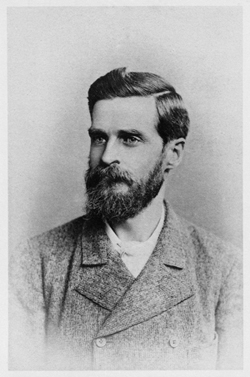
Rendel Harris
Rendel Harris
5 Rendel Harris travelled to Sinai in 1889. At the time a Fellow of Clare College, Cambridge, he was later to become director of studies at Woodbrooke College near Birmingham, and curator of manuscripts at the John Rylands Library in Manchester. He spent seventeen days at the monastery. In a Syriac manuscript, he identified the unique surviving copy of the Apology of Aristides. In 1890, he published Biblical Fragments from Mount Sinai, listing the texts of sixteen fragments of the scriptures that he had been able to study. In the Introduction to the book he wrote,
6 There is much to discourage anyone who proposes to make a journey to Mount Sinai in the interests of Biblical Criticism; the successes as well as the failures of previous visitors have great deterrent force; the latter [those who have failed], because they intimate that there is no useful work to do; the former [those who have succeeded], because they suggest that all the useful work has been done already; and it is surprising how powerfully both of these considerations work in the case in question. . . . For example, Coxe in his report to Her Majesty’s Government on the state of the Libraries in the Levant, expressly states that he avoided Sinai because it had been recently visited by Tischendorf; I believe I am right in stating that at the time when he came to this resolution (in January, 1857), the Sinaitic Codex was still lying in its time-honoured retreat, where in fact it would be to-day if the ordinary conventions concerning the rights of property had been scrupulously regarded.[4]
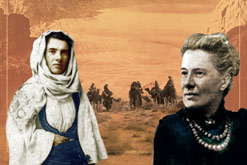
The "Sisters of Sinai": Agnes Smith Lewis and Margaret Dunlop Gibson.
The Twins
7 It was Rendel Harris who encouraged Agnes Smith Lewis and her twin sister Margaret Dunlop Gibson to visit Sinai in 1893, since he knew that there yet remained Syriac and Arabic manuscripts that he had not had time to read. On that visit, Agnes Smith Lewis identified the importance of Sinai Syriac 30, known as the Codex Syriacus. This manuscript is a palimpsest: the original writing was erased, and the valuable parchment used a second time, in the year 778, to write the Lives of the Saints. The original text may date from the fifth century. It is one of only two manuscripts in the world to preserve the Old Syriac translation of the Gospels, made from the Greek towards the end of the second century. We know that the texts of the New Testament were written in the first century. Today, we have manuscripts of the scriptures that date from the third century. What happened in the second century to account for what we see emerging in the third? That is the critical question in New Testament studies, and any manuscript that can illuminate the state of the text in the second century is of the greatest importance.
8 Agnes Smith Lewis and her twin sister Margaret Dunlop Gibson photographed the manuscript in its entirety. From these photographs, other Syriac scholars from Cambridge were persuaded to join them the following year. The first was Robert Lubbock Bensly, Fellow of Gonville and Caius College, Cambridge, lecturer in Hebrew and Syriac, and Lord Almoner’s Professor of Arabic. The second was Francis Crawford Burkitt, a former student of Bensly, who in 1905 was to be appointed Norris Professor of Divinity. Rendel Harris also joined them. The texts of this manuscript were published in Cambridge in several editions over the next few years.
In 1895, Burkitt read a paper at a Church Congress in which he said,
This version is certainly older than the Peshitta, which is not earlier than the fourth century; probably older than the Syriac Diatessaron, which is not earlier than 170 AD. Of this version of the Gospels only one other manuscript is known to survive besides our palimpsest, namely, the Codex in the British Museum used by Cureton; from this, however, more than half the contents are wanting, and its text has certainly undergone revision from the Greek. In the Sinai palimpsest considerably more than three-fourths of the whole of the Gospels is legible, and its text shows no clear signs of revision from later Greek manuscripts.[5]
9 These are a very few of the Sinai manuscripts of the scriptures that have been of the greatest importance to Biblical studies. With the work of such eminent scholars over the course of many years, we may well ask, what remains for us to do? If Rendel Harris could write in 1890 about the discouraging effect of both the successes and failures of previous visitors to Sinai, how much moreso would that be the case today? Are we to be only gleaners in a field that has been already harvested? In fact, just a few years ago, yet another scholar made an important discovery.

Hikmat Kachouh
Hikmat Kachouh
10 Hikmat Kachouh is a Lebanese, who came to Sinai in the summer of 2006. He was working on a doctoral dissertation under the direction of David Parker, at the University of Birmingham, in England. His subject was the text of the Gospels in Arabic, excluding lectionaries. In the course of his studies, he had read over two hundred manuscripts of the Gospels in twenty-one different institutions. He came to Sinai for ten days. During that time, he was able to review sixty manuscripts. He was looking for test passages that would allow him to identify the characteristics of each manuscript. From his careful study of so many other manuscripts, he could quickly tell which had been translated from the Greek, and which from Syriac, and as well, the nature of the text from which the translation had been made. Most of the manuscripts at Sinai represented texts that he had already encountered, but seven of them were texts that he had never seen before. He set them aside as essential to his research. And then he had to return to England.
11 I was able to photograph these texts at high resolution, and send him the digital images. Two of these, in particular, became his favourite manuscripts: these are Sinai Arabic New Finds 8 and 28, which originally formed one manuscript, written on parchment, and containing 143 folios. It dates from the second half of the eighth century or the early ninth century, making it one of the oldest surviving Arabic manuscripts of the Gospels. In his dissertation he wrote, ‘The examination of the Gospel of Luke shows that this manuscript follows an archaic Greek manuscript which differs considerably from the Greek Byzantine text. The Western and Alexandrian readings are very many and will be presented in a separate monograph. No extant Arabic manuscript can claim more textual value than this version.’[6] He has drawn attention to the importance of Arabic manuscripts of the scriptures. In a further study of this manuscript, published in Novum Testamentum, he writes, ‘The Arabic Gospel manuscripts have much to contribute to the history of the transmission of the text, as well as enhancing our knowledge of the biblical tradition’.[7] I might add that Hikmat Kachouh has recently been appointed dean of the Arab Baptist Theological Seminary in Beirut.

A sample camera from the Stokes Imaging website
Today
Such discoveries show the continuing importance of the Sinai manuscripts. What are we doing today to make them more accessible?
12 Some years ago, we began a program to photograph the Sinai manuscripts with a Sinar camera, made in Switzerland, that has a six megapixel CCD. The camera is mounted on a special cradle designed by Alan Buchannan in London, for the safe handling of fragile manuscripts. The camera takes excellent photographs, and will continue to be an important part of our project.
13 The day before I left Sinai to come to the States, we completed the installation of a new digital camera and cradle, made by Stokes Imaging, in Austin, Texas. The new camera has a 48 megapixel CCD. But in addition to the increase in resolution, the new system is much more efficient. The focus and many other functions of the camera and cradle are automated. The processing software straightens and crops the resulting images and saves them in three different formats, all of which had to be completed by the operator with the earlier system. We are very happy to announce this addition to our digital photography program.
14 Another important development is the project for the photography of the Sinai palimpsests. Because Sinai was so isolated, there are many manuscripts where the original writing was rubbed out, and the valuable parchment used a second time. We have over 110 manuscripts with palimpsest text. Already, we can see traces of both scriptural and classical texts in the occasional words that are visible in the margins of these manuscripts. The possibility of recovering these texts is a very exciting prospect.
How can the Sinai manuscripts continue to help us in our study of the scriptures?
As we continue to photograph the Sinai manuscripts and make them available to scholars, it is certain that important discoveries are yet to be made, in our goal to recover the earliest text of the scriptures. But there are other ways as well in which we still have much to learn from the Sinai manuscripts.
15 Scholars are coming increasingly to appreciate the importance of manuscripts of the scriptures with commentary in the margins. Commentaries show us how these texts were understood. One example is a tenth century Sinai manuscript containing the books of Genesis, Exodus, and Leviticus, with marginal commentary drawn from twenty-four different writers, beginning with Philo and Josephus in the first century, and extending to Severus of Antioch in the sixth. The writings of some early authors only survive in such commentaries. The manuscript contains, as well, variant readings from Aquila, Theodotion, and Symmachus, who each made translations of the Hebrew Old Testament into Greek as alternatives to the Septuagint.
16 There has been a living community at Sinai since the late third and early fourth centuries, an astonishing record of continuity. This gives an added dimension to each of the manuscripts: they are still in their original context. Sinai has over fifty copies of the Psalter written in Greek majuscule script, a script that predates the tenth century. Manuscripts such as these may add little to our knowledge of the text, but they can help us understand the place of the scriptures in Christian worship.
17 We face a certain paradox in our own days. In the early seventeenth century, scholars who had studied the Codex Alexandrinus made it their goal to search out the oldest manuscripts of the scriptures, in an effort to recover the earliest levels of the text. We now have manuscripts of the New Testament dating from the third century, and even from the second century, of which Westcott and Hort could only have dreamed. In addition, we have recovered a multitude of texts written on papyrus, from sites such as Oxyrhynchus, and these have contributed much to our understanding of Greek as it was used in late classical antiquity. All of these resources have allowed us to make ever more informed judgements about the text of the New Testament.
And yet, in our own times, Christians are being challenged in the very foundations of their beliefs. In early Christian times, we are told, there were many Gospels, and many Christianities. The process by which the traditional scriptures and faith emerged as normative was quite arbitrary, the result of power plays that could as easily have turned out differently then, could as easily turn out differently for us today. What are we to answer?
18 For those who know their Church history, these issues will sound familiar. These are the very issues faced by Irenaeus in the latter second century. He had to justify the unique place of the four Gospels. He also had to vindicate what he called the canon of faith, the rule of truth. He illustrated this by describing a mosaic in which an artist has used brilliantly coloured pieces of stone and glass to make the portrait of a king. Another person takes this mosaic, and rearranges the pieces to make the portrait of a fox. He can claim that the pieces are identical. He has not added or taken away one stone. But the arrangement is not the same. The pieces are not in their original order.
19 It is the same with the scriptures. Christ is anticipated in the Old Testament in types and figures. In the fulness of time, he came into the world as a recapitulation of the continual presence and activity of the Word. The New Testament is an epitome making clear what had previously been obscure. The canon of faith is this Christocentric reading of scripture, seeing the whole of scripture in the light of Christ and as speaking of Christ, the Old Testament invisibly in types and enigmas, the New Testament visibly in a clear epitome.
This approach to the scriptures was stated most succinctly by the holy apostle Paul in his first epistle to the Corinthians, ‘For I delivered unto you first of all that which I also received, how that Christ died for our sins according to the scriptures; and that he was buried, and that he rose again the third day according to the scriptures’ (I Corinthians 15:3-4). This was the faith announced by the prophets, taught by the Lord, delivered by the apostles. Those who have come to know this overarching pattern will be able to discern the authentic portrait.
20 The cry of the Reformation was ad fontes, ‘to the sources’, a return to the sources of our Christian faith. This must still mean, above all, the most careful study of the text of the holy scriptures, and in this, the Sinai manuscripts have been of the greatest importance. We are certain they will continue to be so, as these manuscripts are photographed and made accessible to scholars. But the age-old continuity of which Sinai remains the very emblem reminds us of the wider scope of this admonition, ad fontes, ‘to the sources’. Those for whom this can include the defence of the faith written by such early writers as Irenaeus, will be in a better position to meet the challenges we face today as Christians. In this, as well, we have much to learn from the Sinai manuscripts.
[1] Richard Bentley, Sermons Preached at Boyle’s Lecture; Remarks upon a Discourse of Free-Thinking; Proposals for an Edition of the Greet Testament; Etc. Etc., edited with notes by the Rev. Alexander Dyce (London: Francis Macpherson, 1838), p. 477.
[2] Günther Zuntz, The Text of the Epistles: A Disquisition upon the Corpus Paulinum (London: Oxford University Press, 1953), p. 7.
[3] Brooke Foss Westcott and Fenton John Anthony Hort, The New Testament in the Original Greek, Introduction and Appendix (Cambridge: Macmillan and Co., 1881), pp. 222-223.
[4] J. Rendel Harris, Biblical Fragments from Mount Sinai (London: C. J. Clay and Sons, 1890), pp. iii-iv.
[5] Francis Crawford Burkitt, ‘The Sinai Palimpsest and the Greek Text of the Gospels’, Mrs. R. L. Bensly, Our Journey to Sinai: A Visit to the Convent of St. Catarina (London: The Religious Tract Society, 1896), pp. 175-6.
[6] Hikmat Kachouh, The Arabic Versions of the Gospels: The Manuscripts and Their Families, (Birmingham: The University of Birmingham, 2008), vol. 1, p. 376.
[7] Hikmat Hachouh, ‘Sinai Arabic New Finds Parchment 8 and 28: Its Contribution to Textual Criticism of the Gospel of Luke’, Novum Testamentum 50 (2008), p. 29.
Twenty-first Century Preservation of Ancient New Testament Manuscripts
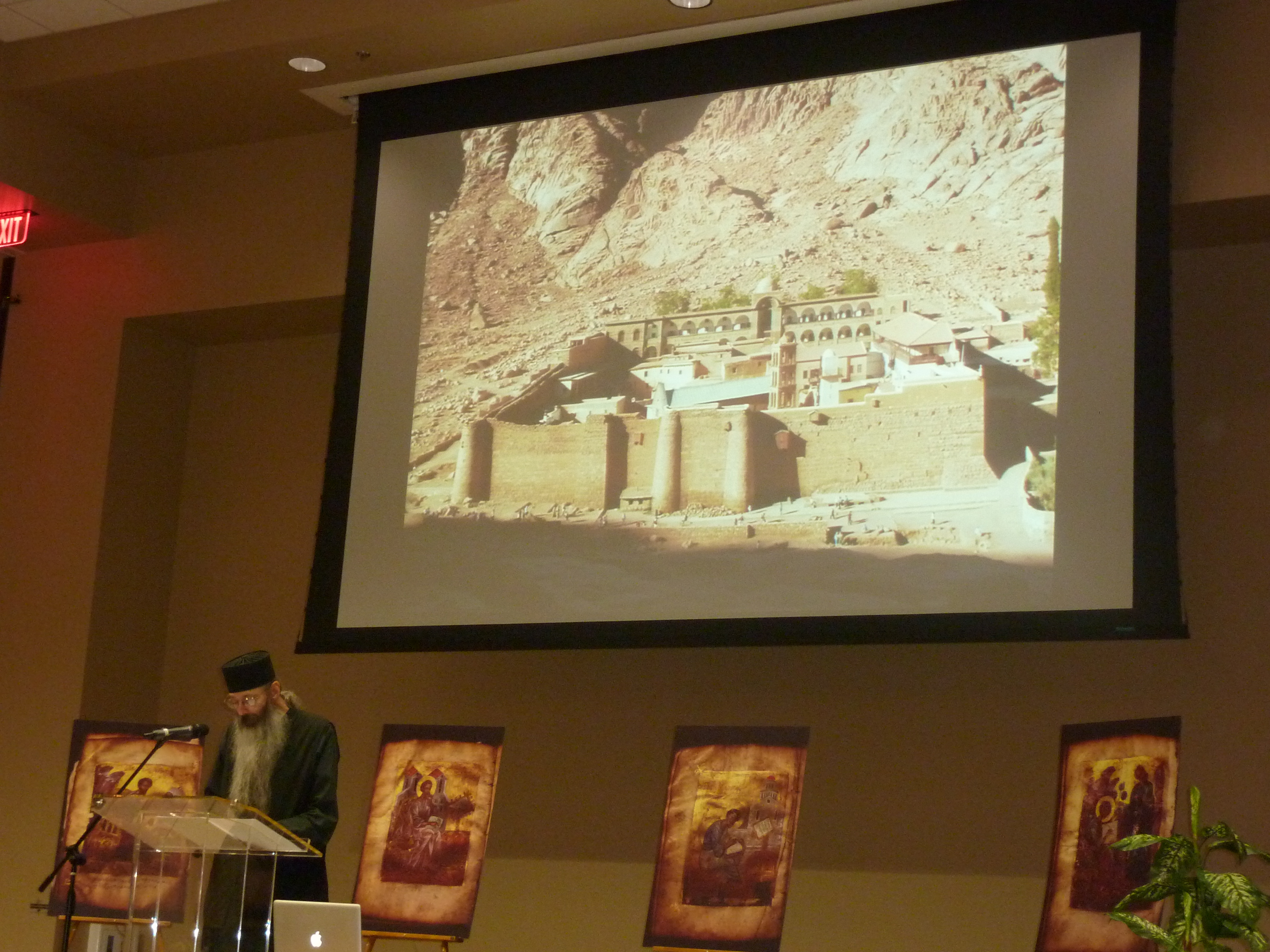
Father Justin Introducing Saint Catherine's Monastery
In the sixth century, the Byzantine Emperor Justinian commanded the building of a Greek Orthodox monastery on Mount Sinai, at what is considered the very location where Yahweh first appeared to Moses in the burning bush, just under the site of his later appearance to the gathered nation of Israel to whom he delivered the Ten Commandments. For this reason, it is easy to see how important Mount Sinai remains as a testimony to God’s revelation of himself through his Word, not only spoken and written by his own finger in the Decalogue, but today, as it is preserved in over 1,200 complete manuscripts and thousands of fragments.
For 1,700 years, the Holy Monastery of Saint Catherine at Mount Sinai has provided a home to these important sources of information regarding the transmission of the New Testament text. In the nineteenth century, the efforts of Constantine Von Tischendorf made the great Codex Sinaiticus accessible to the world of textual criticism and Biblical scholarship.
For decades, Bible scholars worked with ancient New Testament manuscripts often by use of black and white images on micro film, which has its limits in conveying their contents. “In 1975, when a treasure trove of more than 1200 manuscripts was discovered in a hidden store room, St. Catherine’s became the second largest institute in possession of ancient manuscripts, just behind the Vatican” (“A Texan at Mt. Sinai: Meet Father Justin,” CSNTM November 2011 Newsletter). Today, digital photography is increasing accessibility and deepening our understanding of these ancient records. This cutting edge work is being conducted by the work of St. Catherine monastic, Father Justin, the first non-Greek admitted into the fellowship of the ancient monastery. Born Russell Hicks, a native of El Paso, Texas, Father Justin became interested in Saint Catherine’s monastery and the monastic life as a student at the University of Texas at Austin when he read “Island of Faith in the Sinai Wilderness,” an article on the monastery published in the January, 1964 edition of National Geographic Magazine.
In 1978, Hicks was privileged to visit the monastery for two days. “He would end up spending twenty years at a monastery in Brookline, Massachusetts, before coming to St. Catherine’s Monastery. When Father Justin applied to the monastery, Archbishop Damianos broke a long-standing tradition and allowed him to make his home there; he was the first non-Greek to live at the oldest continuously inhabited monastery in the world, built in the sixth century by Emperor Justinian” (CSNTM Newsletter, 11/2011).
There are currently about 25 Greek Orthodox monks living in St. Catherine’s monastery. Father Justin explained that the number had previously been as low as 7 back in 1955, but renewed enthusiasm for monasticism increased their number thanks to the influence of a few charismatic elders in the intervening years.
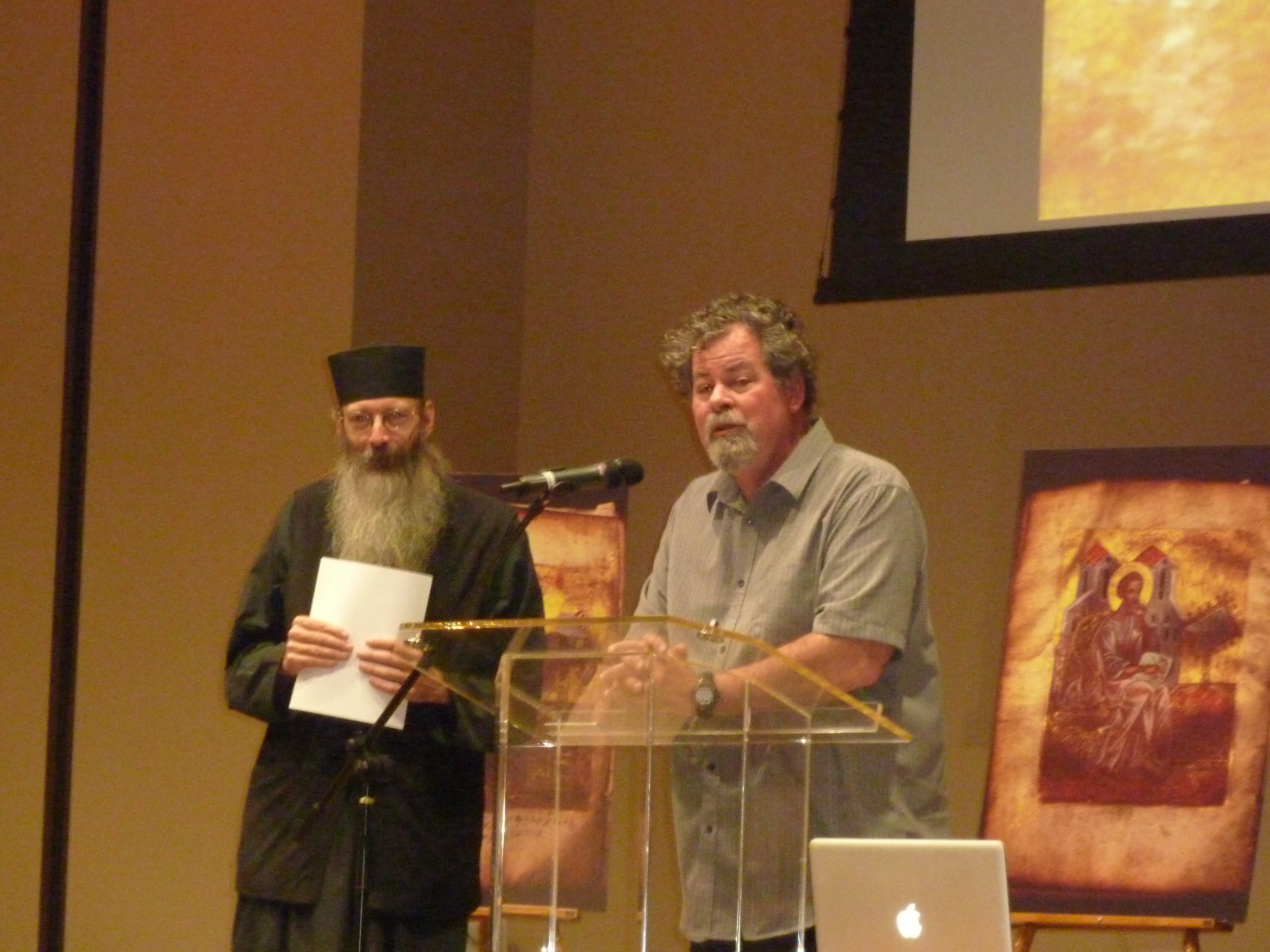
Dr. Daniel Wallace (right) with Father Justin (left)
Father Justin is currently touring America, speaking on the monastery library he now oversees as well as the significance of all of the Sinai manuscripts to textual criticism, raising funds for the expensive work of digitally preserving the images of these ancient documents. Tuesday and Wednesday, November 8-9, 2011, Father Justin was hosted by Dr. Daniel B. Wallace of the Center for the Study of New Testament Manuscripts at the Hope Center in Dallas, the site of this informative symposium.
Tuesday night, Father Justin spoke on “The Mission and Work of the St. Catherine’s Library,” introducing his audience to four sample manuscripts, describing their age, contents and condition, and describing the process of their digital preservation. He went into so much detail that I regret to report that I was unable to take many usable notes. I often found his soft-spoken delivery from lips rendered unreadable behind his long, gray beard difficult to hear. But there was one interesting detail I managed to retain: many of the manuscript images in Father Justin’s PowerPoint presentation often featured small portions of red text among a page of text in black ink. Justin explained that these red portions are called rubrics, using a red ink derived from the carmine of beetles. Rubrics in liturgical texts usually provided directions for priests, distinguishing it from the black text featuring responsive texts intended to be read by the congregation. Because of the older method of reproducing such manuscripts by means of black and white micro film, scholars sometimes found it necessary to travel to the location of the manuscripts themselves to view them in person in order to distinguish rubrics from responsive readings.
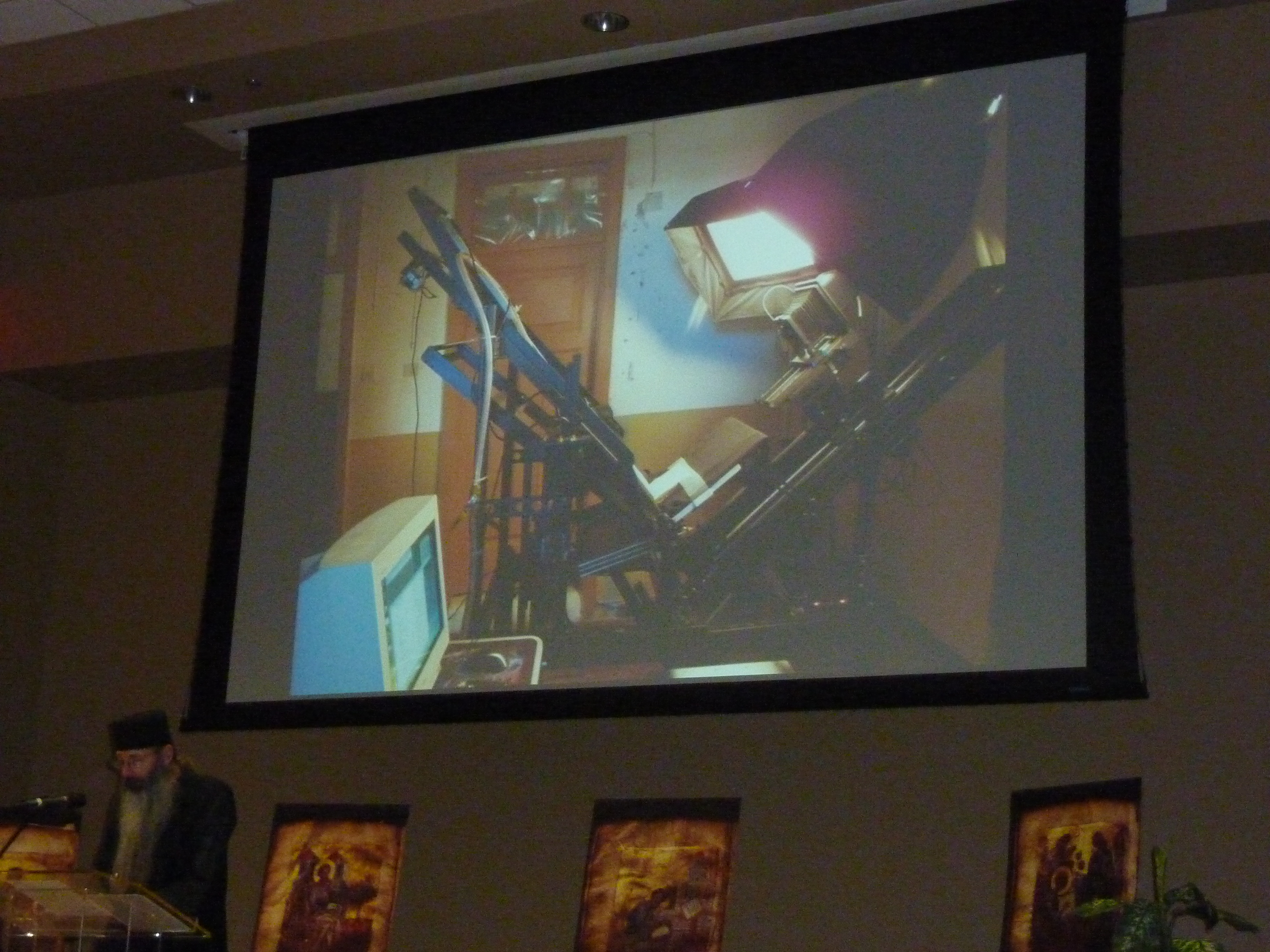
The Sinai manuscripts are digitally imaged by this camera.
We were also treated to a couple of interesting shots of Father Justin’s digital camera. In order to protect the fragile binding of ancient manuscripts, they are cradled so that the codex may be held open at no more than a 90 degree angle. These cameras utilize the same technology as that which sharpens fuzzy images of celestial bodies and other sights in outer space.
In the question and answer period following his presentation, Father Justin also spoke on the dire need of better cataloging of their many manuscripts. He pointed out that the Vatican’s library of manuscripts is so much better cataloged because nuns study library science and apply this knowledge to their unique collection. This is a practice that has yet to be undertaken among the monks at Saint Catherine’s monastery. His partial chronology of efforts to catalog the Sinai manuscripts begins in 1728 when the archbishop at the time gathered the manuscripts housed in various locations in the monastery, but the variety was so diverse that his efforts were unsuccessful. In the mid-nineteenth century, more cataloging took place, but these efforts were little more than lists which did not elaborate to any extent on the contents or condition of the texts. In 1911, a complete catalog was compiled, but the quality of the information remained rudimentary compared to the Vatican library’s work. This shows us how much work remains in the processing of all the data available in the multitude of witnesses providentially preserving the transmission of the text of the New Testament.
I’m looking forward to tomorrow’s presentation on “The Significance of the Sinai Texts for New Testament Study.” Lord willing, a comparable review of it will follow.
News Flash: Mormonism is not Christianity
Evang elicalism is so desparate to be liked by the world, they will seemingly latch onto anything or anyone of any notoriety whatsoever with whom (or which) they find some sort of commonality. Especially if it involves movies or television. A few years ago, evangelical Protestants proclaimed Roman Catholic Mel Gibson’s movie version of a mystic nun’s vision of The Passion of the Christ as the greatest evangelistic tool since Billy Graham. Nowadays, they are opening wide their church doors and their pulpits and plexiglass lecterns to the Mormon with a compelling “testimony” of deliverance from alcoholism who found near-Oprah-like success on FOXNews Channel as one of the leaders of the Tea Party Movement, Glenn Beck.
With the purchase of the old campus of Gateway Church in Southlake, Texas, I’m sad to admit that Glenn Beck is now a neighbor of mine. One of the down sides of this is that Beck will be, and indeed, has already been, welcomed into the evangelical churches of my community to blur the lines between biblical Protestant Christianity and the false religion of Mormonism. A recent episode of the Lutheran radio show, Issues, Etc., features the recording of Glenn Beck’s recent “sermon” delivered at High Point Church in Arlington, Texas where he not only confuses the Kingdom of God and the kingdom of man by speaking on America’s need to stand by the nation of Israel in their ongoing conflicts in the Middle East (a position with which I generally agree), but he confuses the Kingdom of God with the kingdom of Satan as a local evangelical church applauds a Mormon as he “testifies” that “the Lord Jesus Christ is [his] Savior and Redeemer.”
I’m glad I turned off Glenn Beck long before he ever started preaching American civil religion to his politically conservative viewers. What 60 years ago was called New Evangelicalism, fundamentalists of various denominations who sought the lowest common denominator for a semblence of “unity,” has become the New Liberalism, as they allow members of non-Christian religions to preach in their ostensibly “Christian” megachurch pulpits to seek the lowest common denominator with heresy.
Pray for repentance and Reformation for any and all churches that call themselves Christian. While you’re at it, read Arlington, Texas-based Watchman Fellowship’s “Fast Facts on Mormonism,” and do not attend if Glenn Beck appears at your church some Sunday morning in the not-to0-distant future.
Sermon Notes: A Tale of Two Sons (Matthew 21:23-32)

The following sermon was preached on October 30, 2011 by Rev. Joe Troutman at Mid-Cities Presbyterian Church in Bedford, Texas. Listen to the sermon at this link, or subscribe to the podcast.
In fulfillment of the old Testament Scriptures, Jesus Christ came to bring salvation to every sinner who repents and believes in him.
A Question of Authority (Matthew 21:23) And when he entered the temple, the chief priests and the elders of the people came up to him as he was teaching, and said, “By what authority are you doing these things, and who gave you this authority?”
- The beginning of a long series of exchanges between Jesus and the Temple leaders which culminates in the seven woes pronounced upon their hypocrisy in Matthew 23.
- The leaders should have known Jesus’ authority was from heaven.
A Question in Response (Matthew 21:24-27) Jesus answered them, “I also will ask you one question, and if you tell me the answer, then I also will tell you by what authority I do these things. The baptism of John, from where did it come? From heaven or from man?” And they discussed it among themselves, saying, “If we say, ‘From heaven,’ he will say to us, ‘Why then did you not believe him?’ But if we say, ‘From man,’ we are afraid of the crowd, for they all hold that John was a prophet.” So they answered Jesus, “We do not know.” And he said to them, “Neither will I tell you by what authority I do these things.
- Jesus demonstrates his authority by asking a question of the chief priests.
- Jesus’ question makes them weigh the politics of their answer. They want to admit John’s authority from heaven, but knew doing so would be to regard Jesus as something more than just a rabble rouser.
- The leaders lie when they claim to not know the source of John’s authority, and Jesus, knowing this, refuses to answer them.
The Answer (Matthew 21:28-32) “What do you think? A man had two sons. And he went to the first and said, ‘Son, go and work in the vineyard today.’ And he answered, ‘I will not,’ but afterward he changed his mind and went. And he went to the other son and said the same. And he answered, ‘I go, sir,’ but did not go. Which of the two did the will of his father?” They said, “The first.” Jesus said to them, “Truly, I say to you, the tax collectors and the prostitutes go into the kingdom of God before you. For John came to you in the way of righteousness, and you did not believe him, but the tax collectors and the prostitutes believed him. And even when you saw it, you did not afterward change your minds and believe him.
- Jesus’ parable illustrates the chief priests’ weakness and inability which comes from unbelief.
- Neither the first nor the second son were honorable in their response to the command of their father.
- The tax collectors and prostetutes represent the first son of the parable.
- The chief priests and elders represent the second son who professes faith and obedience yet fails in both regards. They should have known
- Christian churches are full of unbelieving, unrepentant sinners who profess faith but do not demonstrate this faith in their walk.
- It is often asked how can we hold accountable to God those who never hear about Jesus? But this parable, and Jesus’ encounter with the chief priests and elders of Israel show us that knowing about Jesus is no guarantee of faith and repentance.
- Without God working in your heart, you will not be able to believe but God is working, using his Word, calling each of us, believer and unbeliever, to repentance and faith.
- Christ suffered the consequences of the sins of the first son in the parable, and likewise those of sinners today who come to Christ in faith. Repent of your sins and trust Christ today, and you will be forgiven of your sins, and you will have done the will of your Father in heaven.
Theological & Doxological Meditations #48

Theology in the First Commandment
Q. What are we specially taught by these words, before me, in the first commandment?
A. These words, before me, in the first commandment, teach us, that God, who seeth all things, taketh notice of, and is much displeased with, the sin of having any other God (Deuteronomy 30:17-18; Psalm 44:20-21; Ezekiel 8:12)
Now Blessed Be the Lord Our God
Scottish Psalter, 1650 Mod.
McKEE C.M.
Spiritual
Arr. By Harry T. Burleigh, 1939
Now blessed be the Lord our God,
The God of Israel,
For he alone does wondrous works
In glory that excel.
And blessed be his glorious name
To all eternity;
The whole earth let his glory fill.
Amen, so let it be.
His wide dominion shall extend
From sea to utmost sea,
And unto earth’s remotest bounds
His peaceful rule shall be.
Yea, all the kings shall bow to him,
His rule all nations hail;
He will regard the poor man’s cry
When other helpers fail.
Union with Christ and Justification
Happy Reformation Day! October 31, 2011 marks the 494th anniversary of the legendary event considered the spark that ignited the Protestant Reformation when Augustinian monk, Martin Luther, nailed the Disputation on the Power and Efficacy of Indulgences(commonly known as the 95 Theses) to the door of the castle church in Wittenberg, Germany in 1517. In the years that followed, Luther lead the movement to reform the church’s understanding of what the Bible teaches about the doctrine of justification by God’s grace alone, received through faith alone, in Christ alone, according to Scripture alone, to the glory of God alone. The Lutheran tradition would build on Luther’s work on justification, and they placed it at the center and starting point of all of the benefits of the redemption purchased
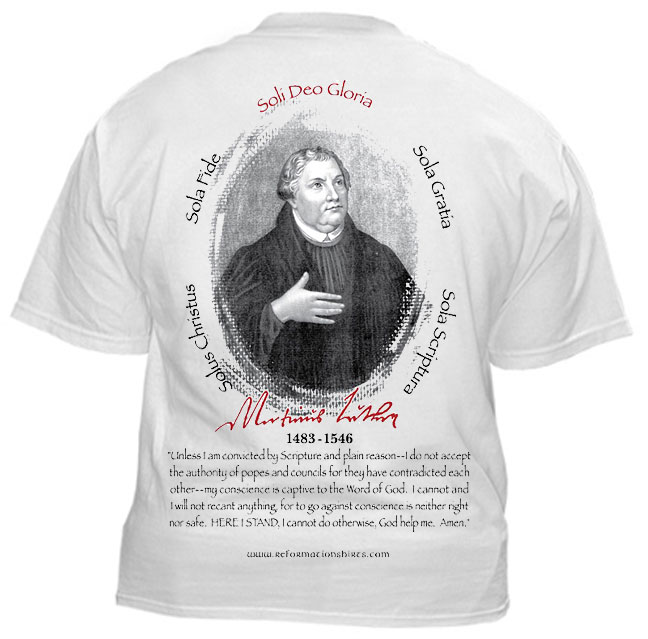
Purchase your Martin Luther T-Shirt from ReformationShirts.com
by Christ for his people. But biblical reformation of soteriology didn’t end with Luther and the Lutherans. The Reformed movement also grew alongside of the Lutheran movement, and while both were co-belligerents against the Roman doctrines of justification and the other benefits of redemption in Christ, they differed on the most biblical way to systematize these truths.
Friday on the Reformed Forum’s podcast, Christ the Center, Camden Bucey, Jim Cassidy and Jeff Waddington interviewed Dr. Lane Tipton, the new Charles Khrae Professor of Biblical and Systematic Theology at Westminster Theological Seminary in Philadelphia, Pennsylvania. Dr. Tipton was allowed two hours to spell out the differences between the Lutheran and Reformed approaches to justification and many current issues related to this essential aspect of Protestant theology, such as whether Dr. Michael Horton’s academic work on the subject is moving Reformed theology toward a more Lutheran, and therefore,according to Dr. Tipton, semi-Pelagian doctrine of justification. Listen to the podcast at this link.
I was introduced to Reformed theology by Michael Horton’s materials and the Lord used his parachurch ministries Christian United for Reformation (CURE) and the Alliance of Confessing Evangelicals (ACE) and the White Horse Inn radio show to gradually bring me around to embrace it. I will certainly be looking forward to a future Christ the Center program in which Dr. Horton responds to Dr. Tipton’s characterization of his work on justification and the other benefits of redemption in Christ. More public dialogue on this ought to take place, IMHO. At this point, Dr. Tipton’s case sounds convincing and more in line with the Reformed confessions and catechisms, as opposed to Dr. Horton’s efforts to, as I once heard him state on the air, build a kind of ecumenism between Reformed, Lutheran and Anglican traditions. I can see how some synthesis may be taking place in that effort. But what do I know?
Reformata, Semper Reformanda!
My Favorite Sport!

Rangers Ballpark in Arlington, home of the Texas Rangers
I’m one of those especially unfortunate fellows who grew up with a love-hate relationship with sports. I played several sports on several little league teams as a child, and played plenty of sports in the streets of my neighborhood. My lack of skill then is probably the chief reason I do not follow sports today, although I do tend to catch the Super Bowl, mostly for the commercials. My new membership in a Reformed church and their biblical and confessional (we view these two adjectives as synonymous) emphasis on delighting in the Lord on the Lord’s Day may have implications for the Super Bowl in the future. All I can say is, thanks be to God for digital video recording.
In light of my lack of interest in sports, I am fond of informing folks that “my sports are politics and religion,” which probably tells people I can relate even less to them, when they may already see me as a socially challenged individual who doesn’t follow sports. It is for this reason that you may not be surprised by my interest in the following lecture series that was held at Christ Reformed Church (URCNA) in Washington, D.C., called “Christianity & Politics,” which is yet another venue for the Westminster Seminary California faculty and alumni, among others, to focus our attention on their attempt at recovering the Reformed notion of the Two Kingdoms approach to the relationship between “Christ and Culture.” A timely offering in this year of presidential politics.
Here’s their introduction to the series, speaker bios and links to the lectures:
Why We Confuse Church & State
Separation of church and state?
Whatever you may think of the contemporary application of our first amendment freedom of religion, Christianity and politics are ever confused in our national consciousness. Preachers seek influence in the political sphere; politicians manipulate and calculate the faithful in their constituencies.
What are the faithful to do? How should we understand our callings as citizens, both on earth below and in heaven above?
Christianity & Politics presents a range of speakers approaching this topic from a range of perspectives while discussing topics as diverse as the mission of the church, the place of evangelicals in American political culture, natural law, and the spirituality of the church.…
Lectures [were] sponsored by Christ Reformed Church, and [took] place in our place of worship, historic Grace Reformed Church, home of President Theodore Roosevelt….
Speakers
MICHAEL HORTON is the J. Gresham Machen Professor of Systematic Theology and Apologetics at Westminster Seminary California, Host of the White Horse Inn radio program and Editor-in-Chief of Modern Reformation magazine. He is a minister in the United Reformed Church.
MICHAEL GERSON is an opinion writer for the Washington Post and former head speech writer and senior policy advisor to President George W. Bush.
DARRYL HART is Assistant Professor of History at Hillsdale College, author of numerous books, and blogs on religion and public life at oldlife.org.
TERRY EASTLAND is the Publisher of The Weekly Standard and an elder at Fourth Presbyterian Church in Bethesda, Maryland.
BRIAN LEE is the pastor of Christ Reformed Church in Washington, DC (United Reformed Church). He is a Guest Faculty at Reformed Theological Seminary and formerly worked on Capitol Hill, the National Endowment for the Humanities, and the Department of Defense.
DAVID VAN DRUNEN is the Robert B. Strimple Professor of Systematic Theology and Christian Ethics at Westminster Seminary California. He is a minister in the Orthodox Presbyterian Church and holds a Law Degree from Northwestern University School of Law.
DAVID COFFIN is the Senior Pastor at New Hope Presbyterian Church in Fairfax, Virginia.
Audio
Michael Horton
The Great Commission (Sermon on Matthew 28)
The Great Commission and Social Justice — (Q&A Session)
Michael Gerson, Darryl Hart, Terry Eastland
The Future of Evangelical Politics (roundtable discussion)
Brian Lee
The Primacy of “Church” in “Church & State” (Sermon on Romans 12)
“Govern Well?” or “Be Governed”? — (Q&A Session)
David VanDrunen
Natural Law and Christian Politics — (Q&A Session)
David Coffin
The Biblical Doctrine of the Spirituality of the Church (Sermon on John 18)
The Historical Doctrine of the Spirituality of the Church — (Q&A Session)
Activism or Confessionalism?

Ever watched Adult Swim’s Moral Orel? It’s like a spoof of Davey and Goliath, and serves as a platform for heavy-handed satire of the moralistic idiosyncrasies of some Christians. Most Christians would find it distasteful to watch, although it probably reflects more truth than our kind are willing to admit—when it isn’t’ caricaturing moralistic Christianity.
Upon watching a few clips of this show and seeing just how much they make it look like an edgy version of Davey and Goliath, I was reminded that this show isn’t only a satire of politically Right-wing Christians, but can step on the toes of liberal Christians as well. The fact is that Davey and Goliath was a production of the Evangelical Lutheran Church in America, a theologically liberal denomination of Lutherans despite the presence of the word “Evangelical” in their name. But it is also true that a generation or more of conservative fundamentalists and evangelicals were raised loving Davey and Goliath and being conditioned to liberal forms of moralism. This must be a small reason why moral and social do-good-ism is an example of common ground shared by today’s conservative culture warriors and liberal progressives. The development of the contemporary political spectrum among Western Christians has a long and storied past, involving the influence of eschatology, pietism and revivalism among other things. These influences raise a question, the answer to which we may find instructive.
“On which is it better for the Christian church to focus her efforts:
civic moral activism, or her own doctrine and practice?”
I submit the following:
- Organized religious efforts toward civic moral activism are derived from a fundamentally utopian vision of eschatology and therefore society, and generally tends to minimize doctrine and practice.
- Organized religious efforts to maintain the purity of each denomination’s own doctrine and practice are drawn from a fundamentally realistic vision of eschatology and therefore society, and generally tends to minimize organized religious civic moral activism.
What’s eschatology got to do with it?
- An Augustinian interpretation of the millennium shared in its broadly among Roman Catholic, Lutheran and Reformed branches of Christendom
- The Roman Catholic version promoted medieval Constantinianism (church over state).
- Lutheran and Reformed reformed amillennialism, tended to focus on doctrine and practice (confessionalism), but had little opportunity to engage in organized religious civic moral activism as we know it today.
- Post-Reformation Protestant Europe replaced Constantinism with ecclesiastical establishmentarianism (state over church); Confessional Protestants complied, affirmed the state’s role in defending the church from heresy, and theoretically denied the state’s right to affect church’s doctrine.
- Twentieth/Twenty-first century Reformed Amillennialism of three varieties (at least): Kuyperian, Two-Kingdom and Theonomic (aka, “Dominionist”)
- An “over-realized” (or utopian) form of amillennial eschatology
- Tended to engage in organized religious civic moral activism
- Held by theologically liberal progressives as well as fundamentalists in the early 20th century.
- Twentieth/twenty-first century Reformed Postmillenialists of two varieties (at least): Kuyperian and Theonomic.
Premillennialism
- Anabaptist eschatology (Anabaptism a non-Roman Catholic version of medieval monastic mysticism)
- Tended to retreat from society and thus avoided both organized religious and individual civic moral activism.
- Adopted by fundamentalist Protestants during the bulk of the 20th century in reaction against theologically liberal Postmillennialists.
Two religious trends add complexity to the preceding eschatological and social tendencies: Pietism and Revivalism:
- Lutheran deviation
- Focused on personal piety, neglected doctrine and practice
- An essentially Wesleyan trend adapted by Calvinists (Reformed); partly inspired by Pietism.
- Focused on individual conversion and piety and promoted organized religious civic moral activism.
Conclusion
- It is better for the church to focus on maintaining the purity of her own doctrine, piety and practice, and to leave civic activism (moral or otherwise) to the individual.
- Thus, I find that an Amillennial, Confessional Protestantism that is relatively uninfluenced by pietism and revivalism is the ideal approach for the Christian church.
The preceeding is my attempt to organize the many things I’ve been learning over the years regarding the development of modern American Protestant confessionalism, liberalism, fundamentalism and evangelicalism. This being merely a blog post, and not an academic essay, those of you who are more informed on these issues are invited to critique my bullet points for the sake of accuracy. Those readers for whom the above raises questions or critical comments, these are especially welcome. You sharpen my iron, I’ll sharpen yours!


 The Misadventures of Captain Headknowledge
Sermon Notes: “Invited to the Supper” (Matthew 22:1-14)
The following sermon was preached by Rev. Joe Troutman at Mid-Cities Presbyterian Church in Bedford, Texas. Listen online or subscribe to the podcast.
God calls all to repent and believe and many refuse, but others believe and are welcome to the feast.
The parable of the wedding feast is the third parable of judgment spoken by Jesus on the week leading to his crucifixion. While the first two primarily targeted the Pharisees, Saducees and Jewish priesthood, this parable applies to all in the nation of Israel who do not follow Christ in faith, but are guilty of rebellion against God.
God will judge everyone who refuses to repent and believe, but will show mercy by bringing to himself repentant believers who had not previously been associated with his covenant people.
Rejection of the Call (Matthew 22:1-7) And again Jesus spoke to them in parables, saying, “The kingdom of heaven may be compared to a king who gave a wedding feast for his son, and sent his servants to call those who were invited to the wedding feast, but they would not come. Again he sent other servants, saying, ‘Tell those who are invited, “See, I have prepared my dinner, my oxen and my fat calves have been slaughtered, and everything is ready. Come to the wedding feast.”’ But they paid no attention and went off, one to his farm, another to his business, while the rest seized his servants, treated them shamefully, and killed them. The king was angry, and he sent his troops and destroyed those murderers and burned their city.
Invitation to All (Matthew 22:8-10) Then he said to his servants, ‘The wedding feast is ready, but those invited were not worthy. Go therefore to the main roads and invite to the wedding feast as many as you find.’ And those servants went out into the roads and gathered all whom they found, both bad and good. So the wedding hall was filled with guests.
Responsibiltiy (11-14) “But when the king came in to look at the guests, he saw there a man who had no wedding garment. And he said to him, ‘Friend, how did you get in here without a wedding garment?’ And he was speechless. Then the king said to the attendants, ‘Bind him hand and foot and cast him into the outer darkness. In that place there will be weeping and gnashing of teeth.’ For many are called, but few are chosen.”
Share this: