Discovery of Biblical Manuscripts Goes On
 The Yahoo! News site is featuring an article on the recent reunion of two portions of an ancient Hebrew scroll containing “The Song of the Sea,” otherwise known as Exodus 15:9-10. You can read all about it here. If you’re curious about what sorts of New Testament manuscript discoveries are ongoing, read this post and/or check out the website for the Center for the Study of New Testament Manuscripts.
The “Vile Pollution” of the Worship of God
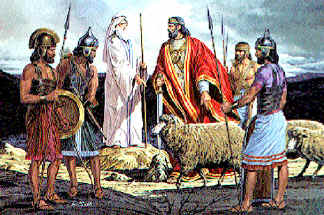
"What then is this bleating of the sheep in my ears...?" 1 Samuel 15:14
Need I point out that the following does not only apply to the sixteenth century Roman Catholic Church?
“Having observed that the Word of God is the test which discriminates between his true worship and that which is false and vitiated, we thence readily infer that the whole form of divine worship in general use in the present day is nothing but mere corruption. For men pay no regard to what God has commanded, or to what he approves, in order that they may serve him in a becoming manner, but assume to themselves a licence of devising modes of worship, and afterwards obtruding them upon him as a substitute for obedience. If in what I say I seem to exaggerate, let an examination be made of all the acts by which the generality suppose that they worship God. I dare scarcely except a tenth part as not the random offspring of their own brain. What more would we? God rejects, condemns, abominates all fictitious worship, and employs his Word as a bridle to keep us in unqualified obedience. When shaking off this yoke, we wander after our own fictions, and offer to him a worship, the work of human rashness, how much soever it may delight ourselves, in his sight it is vain trifling, nay, vileness and pollution. The advocates of human traditions paint them in fair and gaudy colours; and Paul certainly admits that they carry with them a show of wisdom (Colossians 2:23); but as God values obedience more than all sacrifices (1 Samuel 15:22), it ought to be sufficient for the rejection of any mode of worship, that it is not sanctioned by the command of God.” (emphasis added)
John Calvin, in his tract, “The Necessity of Reforming the Church” (cited from page 132 of Selected Works of John Calvin: Tracts and Letters, edited by Henry Beveridge and Jules Bonnet; Volume 1: Tracts, Part 1)
The Risk of Setting “Heart” Ahead of “Head”
 The following is a third generation post. I have nothing to add, but wish I had the credentials to actually write about such topics on my own without directing you elsewhere. But truth and quality sometimes dictate that I not attempt to take matters into my own hands.
The topic at hand is one that is utterly compatible with the theme of my blog: the sometimes false dichotomy between the head and the heart in matters related to Christian faith and life, and the havoc such dichotomies can wreak on the life of the church itself. Believe it or not, even in spiritual matters, some things are better left to the professionals.
Sean Michael Lucas, Presbyterian pastor in Hattiesberg, Mississippi, and former Church History professor at Covenant Theological Seminary in St. Louis, Missouri, has commented on an article written for the Nine Marks Ministries website, by Greg Wills, another Church History professor at Southern Baptist Theological Seminary in Louisville, Kentucky. Hence the three generations. The topic is how our current generation of the American evangelical church is in danger of degenerating into a new liberalism.
Wills gives us the narrative and diagnosis, and Lucas shows us how Wills’ proposals exemplify the risks of pitting the heart against the head. Some of it can be admittedly heady reading (especially regarding some of Lucas’ appeals to philosophy), but, as you read keep in mind that Merriam-Webster has a helpful website, as well as Wikipedia. These are usually all I ever need to keep up with what the experts with all the complicated terminology are trying to tell me, and I recommend their services to you. You will not regret the effort. But don’t worry, the gist is plain as day, even if you don’t want to tangle with the details.
I suppose it would be best to send you first to Lucas’ blog, to allow him to introduce you to the topic the same way I was. His post is called, “A New Liberalism?” and it links you to Wills’ article, “What Lessons Can We Learn From the History of Liberalism?”
Read and heed!


 The Misadventures of Captain Headknowledge
A Question of Chicken and Egg from John’s First Epistle
First John 5:1 reads “Everyone who believes that Jesus is the Christ has been born of God, and everyone who loves the Father loves whoever has been born of him.” Most contemporary fundamentalist and evangelical Christians miss the implication of the apostle John’s wording “has been born of God” as it relates to those who believe. Does this text imply that those who believe were first born of God? Does it therefore imply that regeneration precedes faith? Or must we deny this implication based on our preconceived notion that regeneration is not possible until after we make the right decision to choose to believe?
Reformed Baptist apologist, Dr. James White, has posted a short video explaining this passage in the light of the apostle John’s repeated use of the language “everyone who _____ has been born of God.” He explains that all agree that in the case of two other texts from the same epistle, 1 John 2:29 and 4:7, the apostle’s clear implication is that the action of the believer is the result, and therefore logically follows, the fact of his having been born of God. In these two passages, the actions are “practicing righteousness” (2:29), and “loving” (4:7). In other words, it’s easy to accept the idea that “everyone who practices righteousness has been born of God” at face value, and it is easy to agree that everyone who loves God and his neighbor is one who has been born of God. No one’s tradition teaches the contrary. However, when it comes to the exact same grammatical structure in the first verse of chapter five, we are told by many that we must not make the same inference that being born of God is the prerequisite of saving faith. Dr. White attempts to make the case that this is no more than reading one’s tradition into the text, rather than basing one’s interpretation of the verse on what the text demonstrably means. I agree with him. Watch the following video, and see if you, too, can agree with the apostle John that “everyone who believes that Jesus is the Christ has been born of God.”
Share this: