Theological & Doxological Meditation #42
 The Decalogue’s Sum
Q. What is the sum of the ten commandments?
A. The sum of the ten commandments is, To love the Lord our God with all our heart, with all our soul, with all our strength, and with all our mind; and our neighbor as ourselves (Matthew 22:37-40).
Take Thou Our Minds, Dear Lord
#593, Trinity Hymnal (© 1990)
William Hiram Foulkes, 1918
SURSUM CORDA 10.10.10.10.
George Lomas, 1876
Take thou our minds, dear Lord, we humbly pray; give us the mind of Christ each passing day; teach us to know the truth that sets us free; grant us in all our thoughts to honor thee.
Take thou our hearts, O Christ, they are thine own; come thou within our souls and claim thy throne; help us to shed abroad thy deathless love; use us to make the earth like heav’n above.
Take thou our wills, Most High! Hold thou full sway; have in our inmost souls thy perfect way; guard thou each sacred hour from selfish ease; guide thou our ordered lives as thou dost please.
Take thou our selves, O Lord, mind, heart, and will; through our surrendered souls thy plans fulfill. We yield ourselves to thee—time, talents, all; we hear, and henceforth heed thy sov’reign call.
John Calvin’s Theology: The Rest of the Story
Those who disagree with the Calvinist view of election and reprobation,
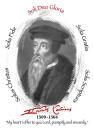
 and object to “Calvinism,” per se, usually seem to not realize just how much more there is to Calvinism than his systematization of the Augustinian (i.e., from the 4th century) doctrine of grace versus the Pelagian notion of free will (which comes complete with its own false gospel of works-righteousness). Baptists in particular, who deny the “doctrines of grace,” don’t realize just how much leftover Calvinism there is in their current theology. Those that do, recognize that they are technically categorized as “moderate Calvinists.” Chief among these is what is nowadays called “eternal security.”
Also, there’s the doctrine of original sin, the Biblical doctrine that Adam’s guilt was imputed to all of his descendants, which sinful condition manifests itself in outward sinful acts. Most Baptists today affirm original sin, and they do so because the Baptists who migrated to America were originally Calvinists. Those “General Baptists,” whom modern anti-Calvinistic Baptists sometimes erroneously look back to as their forefathers in the faith, collectively fell away from the faith, and their theological descendants can be found today among modern Unitarianism.
As a proof for this claim, consider the following words from the Wikipedia entry on the General Baptists, to which I linked above: ” . . . traditionally non-creedal, many General Baptist congregations were becoming increasingly liberal in their doctrine, obliging the more orthodox and the more evangelical among them to reconsider their allegiance during this period of revival (Edward’s, Whitefield’s and Wesley’s 18th century First Great Awakening). Before this re-organisation, the English General Baptists had begun to decline numerically due to several factors linked to non-orthodox ‘Free Christianity’. Early Quaker converts were drawn from the General Baptists, and many other churches moved into Unitarianism. . . “
Those General Baptists denied original sin. For example, John Smyth, (first to pastor a church called “Baptist” shortly before he cast his lot with the Mennonites) wrote in his Confession of Faith in 1609 that, “there is no original sin (lit;, no sin of origin or descent), but all sin is actual and voluntary, viz., a word, a deed, or a design against the law of God; and therefore, infants are without sin.” Modern anti-Calvinistic Baptists generally (no pun intended) affirm original sin, and this is because the Baptists from which you descend were originally Calvinists.
Eternal security and original sin managed to stick around because they weren’t offensive enough to undermine the outward results of mass evangelism, the way the doctrines of grace seem to. We have “revivalism” to thank for that. Read Revival and Revivalism: The Making And Marring of American Evangelicalism, by Iain Murry of Banner of Truth Trust, and you’ll learn how the TULIP got plucked in the wake of the Second Great Awakening as otherwise orthodox Christians began to adopt the methods of arch-Pelagian Charles Finney’s “new measures” in order to maximize the effectiveness of their ginned-up revivals.
But enough introduction. What I wanted to point out was just how pervasive Calvinist theology defines modern Baptist and otherwise Evangelical theology. In my last post, I linked to an essay written by B. B. Warfield entitled “Calvin As A Theologian.” This essay was written to set the record straight about all the common misconceptions that have been fabricated by anti-Calvinists in order to not only disagree with the “five points of Calvinism” (aka, TULIP, the doctrines of grace, etc.) but make those under their spiritual care despise Calvin himself and just about everything he stood for. Read Warfield’s introductory remarks, and then go read the entire article:
I am afraid I shall have to ask you at the outset to disabuse your minds of a very common impression, namely, that Calvin’s chief characteristics as a theologian were on the one hand, audacity—perhaps I might even say effrontery—of speculation; and on the other hand, pitilessness of logical development, cold and heartless scholasticism. We have been told, for example, that he reasons on the attributes of God precisely as he would reason on the properties of a triangle. No misconception could be more gross. The speculative theologian of the Reformation was Zwingli, not Calvin. The scholastic theologian among the early Reformers was Peter Martyr, not Calvin. This was thoroughly understood by their contemporaries.
Among the things that we have inherited from Calvinist theology include the following (as Warfield reports):
-
“In one word, he [Calvin] was distinctly a Biblical theologian, or, let us say it frankly, by way of eminence the Biblical theologian of his age. Whither the Bible took him, thither he went; where scriptural declarations failed him, there he stopped short.”
-
“Calvin marked an epoch in the history of the doctrine of the Trinity, but of all great theologians who have occupied themselves with this soaring topic, none has been more determined than he not to lose himself in the intellectual subtleties to which it invites the inquiring mind; and he marked an epoch i the development of the doctrine precisely because his interest in it was vital (that means “spiritual,” or “devout”) and not merely or mainly speculative.”
-
“The fundamental interest of Calvin as a theologian lay, it is clear, in the region broadly designated soteriological. Perhaps we may go further and add that, within this broad field, his interest was most intense in the application to the sinful soul of the salvation wrought out by Christ, — in a word, in what is technically known as the ordo salutis. . . Its [Calvin’s Institutes]effect, at all events, has been to constitute Calvin pre-eminently the theologian of the Holy Spirit.”
-
“He also marks an epoch in the mode of presenting the work of Christ. The presentation of Christ’s work under the rubrics of the three-fold office of Prophet, Priest and King was introduced by him: and from him it was taken over by the entirety of Christendom, not always, it is true, in his spirit or with his completeness of development, but yet with large advantage.”
-
“In Christian ethics, too, his impulse proved epoch-making, and this great science was for a generation cultivated only by his followers.”
-
“It is probable, however, that Calvin’s greatest contribution to theological science lies in the rich development which he gives–and which he was the first to give–to the doctrine of the work of the Holy Spirit. “
-
Finally, here’s Warfield’s summary of Calvin as a theologian: “It has been common (among academic theologians, not pastors and laity who love to hate Calvin) to say that Calvin’s entire theological work may be summed up in this–that he emancipated the soul from the tyranny of human authority and delivered it from the uncertainties of human intermediation in religious things: that he brought the soul into the immediate presence of God and cast it for its spiritual health upon the free grace of God alone.”
-
And of Calvin’s masterpiece, The Institutes of the Christian Religion, Warfield summarizes: “The Institutes is, accordingly, just a treatise on the work of God the Holy Spirit in making God savingly known to sinful man, and bringing sinful man into holy communion with God.”
Far from being some cold, depressing, rigidly logical and academic murderer (we mustn’t forget Servetus!), Calvin was recognized by his peers and his entire generation as an eminently devout and spiritual biblicist whose development of Protestant theology built on the shoulders of Augustine, Anselm, Hus, Bradwardine, Wycliffe, and Luther and helped make Western Civilization what it became in its historical greatness. All by the grace of God, and for his glory alone!
Reformed Theology Coming to an SBC Church Near You!
On January 11, 2008, the Baptist Press posted a report by Michael Chute, entitled, 
-
“. . . ten percent of Southern Baptist pastors (currently) identify themselves as Calvinists.”
-
“. . . 29 percent of recent SBC seminary graduates espoused Calvinist doctrine.”
-
“. . . a minority of SBC churches are led by Calvinist-leaning pastors, but the number is increasing”
-
“. . . Calvinist-led churches are generally smaller in worship attendance and baptisms than non-Calvinist churches.”
-
“. . . baptism rates between Calvinist and non-Calvinist led churches are virtually identical.”
-
“. . . Calvinistic recent graduates report that they conduct personal evangelism at a slightly higher rate than their non-Calvinistic peers.”
-
A PDF file of the full report is posted here.
Also of interest in the report, Chute quoted Hal Poe, Charles Colson Professor of Faith and Culture at Union University in Jackson, Tennessee, who paints a picture for us of the recent historical trends within the SBC which have led to the current circumstances. “In a broad sense, it’s happening on Christian college campuses too, as Calvinism appeals to young people who are wanting a more intellectual approach to Christianity . . . . Southern Baptists neglected serious Christian education from the early 1960’s, and that’s when all the trouble started. From discipleship training we went to the amorphous youth groups, whose only real good was to keep kids happy until they graduated from high school and graduated from church. Now, you have a generation [of college students] who have come along and want something deeper and they have latched onto Calvinism.”
Poe goes on to site “John Piper, a Reformed Baptist theologian, preacher and author who currently serves as pastor for preaching and vision of Bethlehem Baptist Church in Minneapolis. . . . He’s effective because he’s so passionate. . . He holds huge, stadium-type events that are rip-roaring. There’s nobody else doing anything like this so he becomes [Calvinism’s] expositor. But John Piper’s version of Calvinism is not something John Calvin would espouse, or even that Charles Spurgeon [British reformed Baptist preacher] would espouse.”
It is true that Piper is cut from a different cloth from the great Reformer and the nineteenth-century Puritan “Prince of Preachers.” First of all, it must be noted that Piper is not a Southern Baptist, but a member of the Northern Baptist Convention (Bethlehem Baptist member and Reformed Baptist blogger, Bob Hayton, at Fundamentally Reformed, can correct me on that detail if I’m wrong), where he has been a leader in that denomination’s struggle with the modern heresy known as Open Theism. From my reading of his sermons, Piper may be categorized as a “charismatic Calvinist,” which is more of a doctrinal position than a weekly exhibition of extreme emotionalism in worship, or attempts at exercising the miraculous spiritual gifts of tongues, healing, prophecy, etc., images usually evoked by the term charismatic–though the appeal to emotion seems to be greater in his preaching than in typical Reformed preaching. His experiential emphasis on “desiring God” is in part an application of the answer to the first question in the Westminster Shorter Catechism, which states, “Man’s chief end is to glorify God and enjoy him forever.” But this seems to be little more than a perhaps pietistic reaction against the reputed cold-orthodoxy of many Reformed worship practices.
Another way Calvin would disagree with Piper is in his application of Baptistic principles to Reformed theology, of which, of course, Spurgeon is also guilty. But in this, Piper and Spurgeon are informed by the historic early Baptist confession of faith commonly known as the Second London Baptist Confession of Faith of 1689, which is in large part, a condensing of the Presbyterian Westminster Confession of Faith, with revisions on the statements regarding Baptism. On the other hand, Piper also is embracing the abberant postmodern “emerging” churches–at least the one’s that at least maintain Reformed theology, while seemingly applying seeker-sensitive pragmatic retooling of worship styles to appeal to an “emerging church” demographic. Thus, Piper’s twenty-first century expression of Calvinism does seem to differ from that of Calvin and Spurgeon; however, this Reformed blogger is grateful that such a figure has been able to influence so many Southern Baptists for the doctrines of grace, the biblical emphasis on the sovereignty of God, and his supremacy in all things, including the secular, sacred and even sinful activity of all men.
Joel Osteen: Love Thy Navel
You may or may not notice that I keep updated in my sidebar the
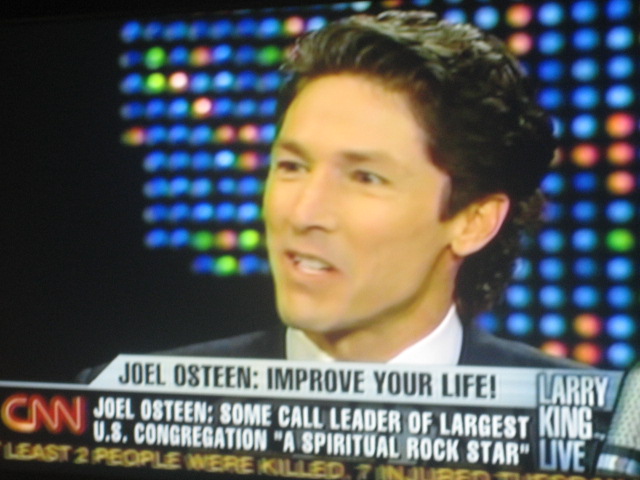


 of the White Horse Inn radio show. This week, I’m not satisfied to just update the sidebar, but I want to impress upon you that you really ought to listen to this week’s program on Joel Osteen, as he is examined as a case study in what Doctors Horton, Riddlebarger, Jones and Rosenblatt call “American Religion.” This is a topic and a problem that affects the way all of us approach our faith and our worship. This timely message needs to be heard and heeded. Don’t miss this week’s episode of the White Horse Inn, for the sake of your soul and the sake of your nation.
Theological & Doxological Meditation #41
Legal Summary
Q. Where is the moral law summarily comprehended?
A. The moral law is summarily comprehended in the ten commandments (Deuteronomy 10:4; Matthew 19:17).
The Ten Commandments
#724, Trinity Hymnal (© 1990)
Versified by Dewey Westra, 1899-1979
Alt. in Psalter Hymnal, 1987
Tune Name: LES COMMANDMENTS DE DIEU 9.8.9.8.
Genevan Psalter, 1547
Arranged by Claude Goudimel, 1564; rev.
My soul, recall with rev’rent wonder
how God amid the fire and smoke
proclaimed his law with thunder
from Sinai’s mountain when he spoke:
“I am the Lord, your God and Sovereign,
who out of bondage set you free,
who saved you from the land of Egypt.
Then serve no other gods but me.
“You shall not bow to graven idols,
for I, a jealous God, your Lord,
shall punish sin in those who hate me,
but love all those who keep my Word.
“The Lord is God; his name is holy.
Do not his holiness profane.
God surely will not hold them guiltless
who take his holy name in vain.
“Remember, keep the Sabbath holy,
the day God sanctified and blessed.
Six days you shall do all your labor,
but on the seventh you shall rest.
“Honor your father and your mother;
obey the Lord your God’s command,
that you may dwell secure and prosper
with length of days upon the land.
“You shall not hate or kill your neighbor.
Do not commit adultery.
You shall not steal from one another
nor testify untruthfully.
“You shall not covet the possessions
your neighbors value as their own;
home, wife or husband, all their treasures
you shall respect as theirs alone.”
Teach us, Lord God, to love your precepts,
the good commandments of your law.
Give us the grace to keep your statutes
with thankfulness and proper awe.
Jesus’ “Lost Years” Found In the New Testament

In my post last Sunday morning, I blogged about Lee Strobel’s book defending “the Real Jesus.” With this topic fresh in my mind, as well as the Sunday School lesson which I’d prepared for that morning, when class began, during our conversation with the children before the lesson, one of them asked out of the blue where Jesus was between the time he was a kid and the time he began his public ministry. I could tell immediately where he was going. Naturally, he followed up by saying his dad had been watching the History Channel and heard that people say Jesus went to India for some time between the ages of 12 and thirty. In the providence of God, my lesson for the day was from Luke 2:39-52, the account of “The Boy Jesus in the Temple,” as the heading over this passage in the English Standard Version describes it.
I’m not terribly familiar with the claims regarding Jesus’ reputed trip to India, spread by those outside the realm of orthodox Christianity. However, having perused the search engine and scanned a few sites (like this one, for example) and Wikipedia articles (like the one on the gnostic Acts of Thomas and the theosophical Aquarian Gospel), I’ve hit upon the apparent basis for the theory that Jesus went to India as a boy. I’d probably already be more clued in about it if I didn’t avoid History Channel programs of this nature and other popular sources of info on the secularized revisionist research on the “historical Jesus.” But I’m getting ahead of myself.
My immediate response to my student was that there are a lot of people who like Jesus, but who don’t believe the Bible. Often, they are people or groups from other religions that associate Jesus with their beliefs in an attempt to lend credibility to them, or for some other reason. In the middle of giving this summary of where stories like that come from, a verse from my lesson came to mind. “Now his parents went to Jerusalem every year at the Feast of the Passover” (Luke 2:41). After I glanced at the passage for a minute, it became clear to me that even though the verse doesn’t say, “Now Jesus and his parents went . . . ” the context indicates that when his parents went to Jerusalem every year, so did Jesus.
It seems I’ve found a piece of New Testament evidence that would indicate that Jesus of Nazareth did not, in fact, ever go to India, or on any fanciful “magical mystery tour” of eastern religions between the ages of 12 and 30, as suggested by the Aquarian Gospel, but was with his parents every year when they went to Jerusalem to celebrate the Feast of Passover.
Evangelical Defense of the Biblical Historical Jesus
 Many Reformed Christians often decry the glut of Evangelical literature on the market. We frequently wring our hands about how much literature available at your local Christian bookstore isn’t worth buying. For example, I have a friend who always says that you can find better Christian books at Barnes & Noble. I know what he means, and I don’t disagree. However, when those of us with high expectations for Christian books spend all of our time talking about the undesirable aspects of the Evangelical literature, we forget that with the bad comes the good.
I, for one, am glad that the Evangelical bookselling market is there to regularly defending the reliability of the Bible on a popular level against the constant onslaught of critical, skeptical, cynical and outright irreverent and disrespectful “search for the historical Jesus.” I added irreverent and disrespectful with Ann Rice’s comments about her opinion of the critical scholarship she’s read over the years in her historical research for her writings. When I find the article I read in which her opinion was cited, I’ll update this post. But I digress. I’m glad the Evangelical Booksellers market is there if only to provide on a popular level a defense of the reliability of the biblical account of Jesus of Nazareth. The Bible makes lots of historical and theological claims about Jesus, and we, as Evangelicals, are obligated to believe the Word of God on these issues. If we are willing to believe the spiritual revelation about Jesus in the Bible, we’d better be prepared to believe the historical revelation about him, too. After all, Jesus told Nicodemus in John chapter three, “If I have told you earthly things and you do not believe, how can you believe if I tell you heavenly things?” (John 3:12) The historical reliability of the Bible (“earthly things”) is part of the basis for the reliability of the theological reliability of the Bible (“heavenly things”).
That’s why, one day, I hope to get around to reading Lee Strobel’s book, The Case for the Real Jesus. You can check out Zondervan’s website with lots of promotional material about it. But right now, I’m having too much fun along the same lines with one of Zondervan’s other great recent releases, The NIV Archeological Study Bible!
Putting Myself In A Box
You may have noticed in the past few days that I’ve been experimenting with a new 
I’ll be featuring things to listen to now and then, like sermons I hear and want to share. Take for example, the one in my box today. It’s by my best friend’s pastor, Dr. Hamp Linehan of First Baptist Church of Richland Hills, Texas. Linehan is one of the greatest preachers in our area. I know you’ll enjoy and benefit from what you hear.


 The Misadventures of Captain Headknowledge