My Favorite Sport!

Rangers Ballpark in Arlington, home of the Texas Rangers
I’m one of those especially unfortunate fellows who grew up with a love-hate relationship with sports. I played several sports on several little league teams as a child, and played plenty of sports in the streets of my neighborhood. My lack of skill then is probably the chief reason I do not follow sports today, although I do tend to catch the Super Bowl, mostly for the commercials. My new membership in a Reformed church and their biblical and confessional (we view these two adjectives as synonymous) emphasis on delighting in the Lord on the Lord’s Day may have implications for the Super Bowl in the future. All I can say is, thanks be to God for digital video recording.
In light of my lack of interest in sports, I am fond of informing folks that “my sports are politics and religion,” which probably tells people I can relate even less to them, when they may already see me as a socially challenged individual who doesn’t follow sports. It is for this reason that you may not be surprised by my interest in the following lecture series that was held at Christ Reformed Church (URCNA) in Washington, D.C., called “Christianity & Politics,” which is yet another venue for the Westminster Seminary California faculty and alumni, among others, to focus our attention on their attempt at recovering the Reformed notion of the Two Kingdoms approach to the relationship between “Christ and Culture.” A timely offering in this year of presidential politics.
Here’s their introduction to the series, speaker bios and links to the lectures:
Why We Confuse Church & State
Separation of church and state?
Whatever you may think of the contemporary application of our first amendment freedom of religion, Christianity and politics are ever confused in our national consciousness. Preachers seek influence in the political sphere; politicians manipulate and calculate the faithful in their constituencies.
What are the faithful to do? How should we understand our callings as citizens, both on earth below and in heaven above?
Christianity & Politics presents a range of speakers approaching this topic from a range of perspectives while discussing topics as diverse as the mission of the church, the place of evangelicals in American political culture, natural law, and the spirituality of the church.…
Lectures [were] sponsored by Christ Reformed Church, and [took] place in our place of worship, historic Grace Reformed Church, home of President Theodore Roosevelt….
Speakers
MICHAEL HORTON is the J. Gresham Machen Professor of Systematic Theology and Apologetics at Westminster Seminary California, Host of the White Horse Inn radio program and Editor-in-Chief of Modern Reformation magazine. He is a minister in the United Reformed Church.
MICHAEL GERSON is an opinion writer for the Washington Post and former head speech writer and senior policy advisor to President George W. Bush.
DARRYL HART is Assistant Professor of History at Hillsdale College, author of numerous books, and blogs on religion and public life at oldlife.org.
TERRY EASTLAND is the Publisher of The Weekly Standard and an elder at Fourth Presbyterian Church in Bethesda, Maryland.
BRIAN LEE is the pastor of Christ Reformed Church in Washington, DC (United Reformed Church). He is a Guest Faculty at Reformed Theological Seminary and formerly worked on Capitol Hill, the National Endowment for the Humanities, and the Department of Defense.
DAVID VAN DRUNEN is the Robert B. Strimple Professor of Systematic Theology and Christian Ethics at Westminster Seminary California. He is a minister in the Orthodox Presbyterian Church and holds a Law Degree from Northwestern University School of Law.
DAVID COFFIN is the Senior Pastor at New Hope Presbyterian Church in Fairfax, Virginia.
Audio
Michael Horton
The Great Commission (Sermon on Matthew 28)
The Great Commission and Social Justice — (Q&A Session)
Michael Gerson, Darryl Hart, Terry Eastland
The Future of Evangelical Politics (roundtable discussion)
Brian Lee
The Primacy of “Church” in “Church & State” (Sermon on Romans 12)
“Govern Well?” or “Be Governed”? — (Q&A Session)
David VanDrunen
Natural Law and Christian Politics — (Q&A Session)
David Coffin
The Biblical Doctrine of the Spirituality of the Church (Sermon on John 18)
The Historical Doctrine of the Spirituality of the Church — (Q&A Session)
Activism or Confessionalism?

Ever watched Adult Swim’s Moral Orel? It’s like a spoof of Davey and Goliath, and serves as a platform for heavy-handed satire of the moralistic idiosyncrasies of some Christians. Most Christians would find it distasteful to watch, although it probably reflects more truth than our kind are willing to admit—when it isn’t’ caricaturing moralistic Christianity.
Upon watching a few clips of this show and seeing just how much they make it look like an edgy version of Davey and Goliath, I was reminded that this show isn’t only a satire of politically Right-wing Christians, but can step on the toes of liberal Christians as well. The fact is that Davey and Goliath was a production of the Evangelical Lutheran Church in America, a theologically liberal denomination of Lutherans despite the presence of the word “Evangelical” in their name. But it is also true that a generation or more of conservative fundamentalists and evangelicals were raised loving Davey and Goliath and being conditioned to liberal forms of moralism. This must be a small reason why moral and social do-good-ism is an example of common ground shared by today’s conservative culture warriors and liberal progressives. The development of the contemporary political spectrum among Western Christians has a long and storied past, involving the influence of eschatology, pietism and revivalism among other things. These influences raise a question, the answer to which we may find instructive.
“On which is it better for the Christian church to focus her efforts:
civic moral activism, or her own doctrine and practice?”
I submit the following:
- Organized religious efforts toward civic moral activism are derived from a fundamentally utopian vision of eschatology and therefore society, and generally tends to minimize doctrine and practice.
- Organized religious efforts to maintain the purity of each denomination’s own doctrine and practice are drawn from a fundamentally realistic vision of eschatology and therefore society, and generally tends to minimize organized religious civic moral activism.
What’s eschatology got to do with it?
- An Augustinian interpretation of the millennium shared in its broadly among Roman Catholic, Lutheran and Reformed branches of Christendom
- The Roman Catholic version promoted medieval Constantinianism (church over state).
- Lutheran and Reformed reformed amillennialism, tended to focus on doctrine and practice (confessionalism), but had little opportunity to engage in organized religious civic moral activism as we know it today.
- Post-Reformation Protestant Europe replaced Constantinism with ecclesiastical establishmentarianism (state over church); Confessional Protestants complied, affirmed the state’s role in defending the church from heresy, and theoretically denied the state’s right to affect church’s doctrine.
- Twentieth/Twenty-first century Reformed Amillennialism of three varieties (at least): Kuyperian, Two-Kingdom and Theonomic (aka, “Dominionist”)
- An “over-realized” (or utopian) form of amillennial eschatology
- Tended to engage in organized religious civic moral activism
- Held by theologically liberal progressives as well as fundamentalists in the early 20th century.
- Twentieth/twenty-first century Reformed Postmillenialists of two varieties (at least): Kuyperian and Theonomic.
Premillennialism
- Anabaptist eschatology (Anabaptism a non-Roman Catholic version of medieval monastic mysticism)
- Tended to retreat from society and thus avoided both organized religious and individual civic moral activism.
- Adopted by fundamentalist Protestants during the bulk of the 20th century in reaction against theologically liberal Postmillennialists.
Two religious trends add complexity to the preceding eschatological and social tendencies: Pietism and Revivalism:
- Lutheran deviation
- Focused on personal piety, neglected doctrine and practice
- An essentially Wesleyan trend adapted by Calvinists (Reformed); partly inspired by Pietism.
- Focused on individual conversion and piety and promoted organized religious civic moral activism.
Conclusion
- It is better for the church to focus on maintaining the purity of her own doctrine, piety and practice, and to leave civic activism (moral or otherwise) to the individual.
- Thus, I find that an Amillennial, Confessional Protestantism that is relatively uninfluenced by pietism and revivalism is the ideal approach for the Christian church.
The preceeding is my attempt to organize the many things I’ve been learning over the years regarding the development of modern American Protestant confessionalism, liberalism, fundamentalism and evangelicalism. This being merely a blog post, and not an academic essay, those of you who are more informed on these issues are invited to critique my bullet points for the sake of accuracy. Those readers for whom the above raises questions or critical comments, these are especially welcome. You sharpen my iron, I’ll sharpen yours!
Sermon Notes: “The Fruit of Faith” (Matthew 21:17-22)
 The following sermon notes summarize “The Fruit of Faith,” preached on Sunday, October 23, 2011 by Rev. Joe Troutman at Mid-Cities Presbyterian Chruch (OPC) in Bedford, Texas (listen online or subscribe to the podcast). My apologies for not posting last week’s sermon on the cleansing of the Temple, on which this sermon builds. I’ll try to post it at a later date. In the meantime, you can listen to that sermon, “The King Comes Home” (Matthew 21:12-17) at this link.
Text of Preparation: John 15:1-17
“I am the true vine, and my Father is the vinedresser. Every branch in me that does not bear fruit he takes away, and every branch that does bear fruit he prunes, that it may bear more fruit. Already you are clean because of the word that I have spoken to you. Abide in me, and I in you. As the branch cannot bear fruit by itself, unless it abides in the vine, neither can you, unless you abide in me. I am the vine; you are the branches. Whoever abides in me and I in him, he it is that bears much fruit, for apart from me you can do nothing. If anyone does not abide in me he is thrown away like a branch and withers; and the branches are gathered, thrown into the fire, and burned. If you abide in me, and my words abide in you, ask whatever you wish, and it will be done for you. By this my Father is glorified, that you bear much fruit and so prove to be my disciples. As the Father has loved me, so have I loved you. Abide in my love. If you keep my commandments, you will abide in my love, just as I have kept my Father’s commandments and abide in his love. These things I have spoken to you, that my joy may be in you, and that your joy may be full.
“This is my commandment, that you love one another as I have loved you. Greater love has no one than this, that someone lay down his life for his friends. You are my friends if you do what I command you. No longer do I call you servants, for the servant does not know what his master is doing; but I have called you friends, for all that I have heard from my Father I have made known to you. You did not choose me, but I chose you and appointed you that you should go and bear fruit and that your fruit should abide, so that whatever you ask the Father in my name, he may give it to you. These things I command you, so that you will love one another.
Introduction
Jewish worship was coming to an end. The Temple gave the appearance of worship as the leaves on the fig tree in today’s text give the appearance of fruitfulness. In their Temple worship, the Jews honored God with their lips, but their heart was far from him. Christ’s cleansing of the Temple in the previous passage was a judgment against their worship, not their commercialism.
Matthew 21:17-22 illustrates the importance of context. In his cursing of the fig tree, Jesus was not being vindictive, but performing a prophetic act against the nation of Israel as a whole: Those who don’t bear fruit will be cursed like the fig tree, but those who believe will bear the good fruit of true worship and righteousness.
In Search of Fruit (Matthew 21:17-19) And leaving them, he went out of the city to Bethany and lodged there. In the morning, as he was returning to the city, he became hungry. And seeing a fig tree by the wayside, he went to it and found nothing on it but only leaves. And he said to it, “May no fruit ever come from you again!” And the fig tree withered at once.
- The glory of God having departed the Temple, Christ returns to Bethany. Matthew and Mark use differing chronologies in their accounts of the cleansing of the Temple and the cursing of the fig tree. But both show the relationship between both events. One cannot be understood apart from the other.
- The fig tree was a symbol of the nation of Israel. “Woe is me! For I have become as when the summer fruit has been gathered, as when the grapes have been gleaned: there is no cluster to eat, no first-ripe fig that my soul desires (Micah 7:1).
- Jesus went to the tree in search of fruit, just as he went to the Temple in search of true worship. Neither provided what he sought.
- Professed faith is unfruitful for those who do not truly abide in Christ by faith (see John 15 above). As John the Baptist warned, the tree that does not bear fruit will be cut down and thrown into the fire. “’Bear fruit in keeping with repentance. And do not presume to say to yourselves, ‘We have Abraham as our father,’ for I tell you, God is able from these stones to raise up children for Abraham. Even now the axe is laid to the root of the trees. Every tree therefore that does not bear good fruit is cut down and thrown into the fire’” (Matthew 3:8-10).
- Thus Christ’s cursing of the fig tree as a prophetic warning was an act of mercy and a call to repentance. May believers never depart into false worship—we must trust the Lord to instruct us in the true worship of God, not our own wisdom.
Faith Yields Fruit (Matthew 21:20-22) When the disciples saw it, they marveled, saying, “How did the fig tree wither at once?” And Jesus answered them, “Truly, I say to you, if you have faith and do not doubt, you will not only do what has been done to the fig tree, but even if you say to this mountain, ‘Be taken up and thrown into the sea,’ it will happen. And whatever you ask in prayer, you will receive, if you have faith.”
- Christ’s reference to the moving of a mountain by faith seems to allude to Zechariah 4:6-9, in which Zerubbabel’s obstacles to rebuilding the Temple after Israel’s return from Babylonian captivity are compared to a mountain being made a plain. “Then he said to me, “This is the word of the LORD to Zerubbabel: Not by might, nor by power, but by my Spirit, says the LORD of hosts. Who are you, O great mountain? Before Zerubbabel you shall become a plain. And he shall bring forward the top stone amid shouts of ‘Grace, grace to it!’” Then the word of the LORD came to me, saying, “The hands of Zerubbabel have laid the foundation of this house; his hands shall also complete it. Then you will know that the LORD of hosts has sent me to you.
- The marveling of the disciples evidenced their lack of faith. Had they the faith of a mustard seed, they would have understood that nothing is impossible for God, be it the withering of a tree, the moving of a mountain or the production of the fruit of true worship and righteousness.
- True worship is impossible “in the flesh,” that is, apart from faith in Christ, but is possible “in Christ,” that is, through saving faith in him. The corporate worship of God is an amazing event: believers stand on holy ground in God’s presence. Unbelievers who presume to worship will prove unfruitful in the worship of God, and they will be judged by Christ as were the fig tree and the Temple.
- The promise in verse 22, “And whatever you ask in prayer, you will receive, if you have faith,” is simply an encouragement to come to God in faith by prayer in acknowledgement of our utter dependence on him. Lack of prayer is the result of self-sufficiency. Christians depend on the outpouring of God’s grace upon them, as a tree is dependent on the rain for life and fruitfulness. Faith in Christ will bear the fruit of the Spirit as described in Galatians 5:22-23, which reads, “But the fruit of the Spirit is love, joy, peace, patience, kindness, goodness, faithfulness, gentleness, self-control; against such things there is no law.”
Resources on Postmodernism
Last week on “Renewing Your Mind with R. C. Sproul,” three lectures on Postmodernism were featured which provide introductions to how this contemporary approach to reality affects philosophy, society and Christianity. These were originally delivered at the 2007 Ligonier Ministries conference called “Contending for the Truth.” You can purchase this conference on DVD, CD or mp3 downloads at this link.
Listen to:
Postmodernism & Philosophy (Dr. Ravi Zacharias)
The Problem of “Head Knowledge”

Image via Wikipedia
One topic I haven’t treated nearly enough lies ironically at the heart of the underlying theme of my blog, which theme is an expression of my experience as a fundamentalist turned confessional Reformed Protestant. The topic is the tension in the fundamentalist and evangelical movements between so-called “head knowledge” and “heart knowledge.” Having been too busy living amidst that tension for the past couple of decades, I haven’t done a great deal of blogging about it since I started this blog.
To be truthful, this blog’s title and theme, “The Misadventures of Captain Headknowledge” is both an indictment and a confession. It’s an indictment for the kind of reason that you may have already read about on my “About Me” page. The confession lies in my honest recognition that I am the sort who has the tendency to, as it is sometimes put, read about the Bible, rather than actually take time to read the Bible.” This is certainly a flaw which stunts my spiritual growth in sanctification and the grace and knowledge of the Lord Jesus Christ. To the extent that my blog is a personal confession, it reminds me to cultivate my own spiritual growth. In the past, I was made to feel that many think this means I must therefore utterly repent of and entirely forsake my tendency to “read about the Bible.” But I disagree, and this is where the indictment part comes in. I regard that attitude to be an overreaction to an otherwise valuable gift of God. A love for reading theology and related Christian literature must not supersede my personal study and application of Scripture, but it needn’t be excluded from my life, either. Old Princeton scholar, Benjamin Breckenridge (B.B.) Warfield has the ultimate quote on this issue, from his book, The Religious Life of Theological Students (P & R Publishing Co.):
Nothing could be more fatal, however, than to set these two things over against one another. Recruiting officers do not dispute whether it is better for soldiers to have a right leg or a left leg: soldiers should have both legs. Sometimes we hear it said that ten minutes on your knees will give you a truer, deeper, more operative knowledge of God than ten hours over your books. “What!” is the appropriate response, “than ten hours over your books, on your knees?” Why should you turn from God when you turn to your books, or feel that you must turn from your books in order to turn to God? If learning and devotion are as antagonistic as that, then the intellectual life is in itself accursed, and there can be no question of a religious life for a student, even of theology. HT: Hot Orthodoxy
Such an imbalanced rejection of academic theology as unnecessary or unhelpful “head knowledge” in favor of so-called “heart knowledge” in its extreme forms often seems little more than an individualistic, experiential mysticism. In his book, What is Faith?, J. Gresham Machen writes on the question of anti-intellectualism and the resultant mysticism against which this blog is in part an indictment:
The depreciation of the intellect, with the exaltation in the place of it of the feelings or of the will, is, we think, a basic fact in modern life, which is rapidly leading to a condition in which men neither know anything nor care anything about the doctrinal content of the Christian religion, and in which there is in general a lamentable intellectual decline. (What is Faith?, p.28)
But if theology be thus abandoned, or if rather (to ease the transition) it be made merely the symbolic expression of religious experience, what is to be put into its place?… Mysticism unquestionably is the natural result of the anti-intellectual tendency which now prevails; for mysticism is the consistent exaltation of experience at the expense of thought. (p.35)
The Son of Man Coming on the Clouds
When I was a child, and a member of a Dispensational Premillennial IFB church, I would often hear my pastor commenting on any given Sunday, “It’s cloudy today—this might just be the day the Lord returns.” At other times, he would conclude the opposite: “I didn’t notice any clouds in the sky, so I guess the Lord may not return today. But this is Texas, and the weather could change at any moment.” The literal presence of clouds in the sky was seen as a necessary condition of Christ’s Second Coming. Why is this? It’s because of the Lord’s words in Matthew 24:30.
Then will appear in heaven the sign of the Son of Man, and then all the tribes of the earth will mourn, and they will see the Son of Man coming on the clouds of heaven with power and great glory.
(Matthew 24:30 ESV)
Was Jesus predicting that on the day of his return, it will literally be cloudy? No, Jesus was alluding to a prophecy by Daniel of the coming of “one like a son of man” who comes “with the clouds of heaven.” What would be the point of predicting whether it would be cloudy on the day of the coming of the Son of Man? Let’s look at Daniel’s prophecy to which Christ alludes (the key phrases will be highlighted):
“I saw in the night visions,
and behold, with the clouds of heaven
there came one like a son of man,
and he came to the Ancient of Days
and was presented before him.
And to him was given dominion
and glory and a kingdom,
that all peoples, nations, and languages
should serve him;
his dominion is an everlasting dominion,
which shall not pass away,
and his kingdom one
that shall not be destroyed.
(Daniel 7:13-14 ESV)
The first thing to notice is the fact that this prophecy contains poetic language. That’s why the ESV editors (and those of most modern English versions) format the prophecy in a poetic style. Ancient Hebrew poetry does not have the same standards for literalism as historical narrative does. It is true that the Gospel of Matthew is a historical narrative, and so it is literally true that Jesus quoted Daniel’s prophecy, but the prophecy Jesus quoted in this historical narrative Gospel account is still a poetic reference.
If the reference to clouds in association with the coming of the Son of Man bears poetic, symbolic meaning, then what might that meaning be? Let’s look at a few other poetic Old Testament passages that similarly associate clouds with the activity of Yahweh.
He lays the beams of his chambers on the waters;
he makes the clouds his chariot;
he rides on the wings of the wind;
(Psalm 104:3)
If we are to take Christ’s reference to coming with clouds literally, then are we also to take Psalm 104’s statement that the LORD makes the clouds his chariot literally? Does an infinite, omnipresent Spirit need to stand on a cloud, hold a set of reins and be transported by means of atmospheric water vapor? Well, has he also literally laid giant wooden beams across a body of water and built chambers in which he might dwell? Does wind literally have wings? Of course it doesn’t. This is nothing but poetic imagery. So, what idea does this imagery of clouds convey? Basically, it conveys the idea of God’s terrifying power and authority. Notice how the Egyptians and their idols react to the image of the LORD riding on a cloud in Isaiah 19:
An oracle concerning Egypt.
Behold, the LORD is riding on a swift cloud
and comes to Egypt;
and the idols of Egypt will tremble at his presence,
and the heart of the Egyptians will melt within them.
(Isaiah 19:1)
With these things in mind, let’s go back and take another look at Matthew 24:30: “Then will appear in heaven the sign of the Son of Man, and then all the tribes of the earth will mourn, and they will see the Son of Man coming on the clouds of heaven with power and great glory (Matthew 24:30).
I hope we can more clearly see now, that the significance of the coming of the Son of Man “on the clouds of heaven” lies in the fact of his terrifying power and great glory whose appearing will make all the tribes of the earth mourn, and at which time will occur the Last Judgment and the ultimate consummation of his Kingdom. This is just one of many examples of the need to genuinely take into account the literary structure of a passage in order to determine its proper interpretation.
The Once and Future King (Matthew 21:1-11)
Sermon Notes from Sunday, October 9, 2011. Delivered by Rev. Joe Troutman at Mid-Cities Presbyterian Church (OPC). Listen online.
Jesus comes into Jerusalem as king, but in a week’s time he will have been crucified and raised from the dead for sinners like you and me.
Westminster Shorter Catechism 26
Q. How doth Christ execute the office of a king?
A. Christ executeth the office of a king, in subduing us to himself, in ruling and defending us (Psalm 110:3; Matthew 28:18-20; John 17:2; Colossians 1:13), and in restraining and conquering all his and our enemies (Psalm 2:6-9; Psalm 110:1-2; Matthew 12:28; 1 Corinthians 15:24-26; Colossians 2:15).
“The Lord Has Need of Them” (Matthew 21:1-5) Now when they drew near to Jerusalem and came to Bethphage, to the Mount of Olives, then Jesus sent two disciples, saying to them, “Go into the village in front of you, and immediately you will find a donkey tied, and a colt with her. Untie them and bring them to me. If anyone says anything to you, you shall say, ‘The Lord needs them,’ and he will send them at once.” This took place to fulfill what was spoken by the prophet, saying, “Say to the daughter of Zion, ‘Behold, your king is coming to you, humble, and mounted on a donkey, on a colt, the foal of a beast of burden.’”
- Jesus demonstrates that he is Israel’s Messiah by fulfilling Isaiah 62:11 and Zechariah 9:9
- Behold, the LORD has proclaimed to the end of the earth: Say to the daughter of Zion, “Behold, your salvation comes; behold, his reward is with him, and his recompense before him.”(Isaiah 62:11 ESV)
- Rejoice greatly, O daughter of Zion! Shout aloud, O daughter of Jerusalem! Behold, your king is coming to you; righteous and having salvation is he, humble and mounted on a donkey, on a colt, the foal of a donkey. (Zechariah 9:9 ESV)
- What was this need? To show us that “[our] salvation comes” (Is. 62:11)
- “By sending for the donkey and colt, Jesus is giving us what we need to believe in him as our Savior.”
- Our need was for a Passover Lamb—we need Someone to die in our place; to wash us clean; to be protected and redeemed from our captivity to sin.
- To those who need God to show that he is real, he has done so by these prophecies of Israel’s Messiah, and their fulfillment hundreds of years later in Jesus of Nazareth.
- God shows us that he is the true God of Israel: the God of Abraham, Isaac and Jacob, and that Jesus is the true King of Israel, who subdues sinners to himself, rules and defends us who believe, and restrains and conquers all his and our enemies.
“Hosanna” (Matthew 21:6-9) The disciples went and did as Jesus had directed them. They brought the donkey and the colt and put on them their cloaks, and he sat on them. Most of the crowd spread their cloaks on the road, and others cut branches from the trees and spread them on the road. And the crowds that went before him and that followed him were shouting, “Hosanna to the Son of David! Blessed is he who comes in the name of the Lord! Hosanna in the highest!”
- Foreshadowed in Jehu’s servants’ response to Jehu’s anointing as King of Israel, and prophecy to defeat the evil king Ahab
- Then in haste every man of them took his garment and put it under him on the bare steps, and they blew the trumpet and proclaimed, “Jehu is king.” (2 Kings 9:13 ESV).
- In crying “Hosanna (Heb. “O Save!” ) to the Son of David!”, the people declare who Jesus is, the rightful King of Israel.
- In crying “Blessed is he who comes in the name of the Lord!” the people sing a portion of the Hallel (Psalms 113-118)—a portion of which is sung after the drinking of “the Cup of Redemption” during the Passover seder (see Psalm 118:26a). Jesus comes to redeem his people from sin, as God redeemed Israel from Egypt.
- Parallels between Israel’s captivity in Egypt and their present occupation by Rome spark strong Jewish nationalism during the Passover season. Rome watches for seditious behavior. The notion of a pretender to the throne of Israel is the very kind of threat for which they watch, and this makes Christ’s entry into Jerusalem especially dangerous. But notice the humility of this King who enters triumphantly, not on a warhorse, but rather on a lowly donkey.
“The King Enters His City” (Matthew 21:10-11) And when he entered Jerusalem, the whole city was stirred up, saying, “Who is this?” And the crowds said, “This is the prophet Jesus, from Nazareth of Galilee.”
- Christ enters Jerusalem but is not recognized by her citizens as their long-awaited King.
-
- The true light, which gives light to everyone, was coming into the world. He was in the world, and the world was made through him, yet the world did not know him. He came to his own, and his own people did not receive him. (John 1:9-11 ESV)
- Foreshadows Christ’s rejection by the people at the end of this Passion Week. Jesus comes to Jerusalem as King, but Jerusalem was not his Kingdom.
- When Jesus walked the earth, his Kingdom was located wherever he went. Jesus wasn’t entering his Kingdom in his Triumphal Entry into Jerusalem, he brought his Kingdom with him. Christ’s Kingdom is “not of this world” (see John 18:36).
- The true light, which gives light to everyone, was coming into the world. He was in the world, and the world was made through him, yet the world did not know him. He came to his own, and his own people did not receive him. (John 1:9-11 ESV)
- Christ does triumphantly enter to conquer, but not to conquer the Romans.
- The Triumphal Entry clearly showed that Jesus was Messiah according to Zechariah 9:9.
- The Triumphal Entry set in motion the events that would lead to his crucifixion.
- The Triumphal Entry threatens Rome, but Christ’s act in the following passage will be a threat to the Jewish priests and other religious leaders.
- Christ did not come to overthrow the Romans and reign in Jerusalem, but to die on a cross for the very people who sent him there: sinners like you and me. He went willingly, but it was yours and my sins which drove him to the cross. He went lovingly to suffer and to die for those who will come to believe. In his crucifixion, the King of Israel will conquer by accomplishing the salvation of his people.
- The King came once riding on the foal of a donkey; he went unrecognized by some, met with indifference by others and still others met him with hostility. He was openly rejected and nailed to a cross.
- But the King will come again riding on the clouds with power and glory (Matthew 24:30). The time of his return remains hidden but he will come to judge as the Ruler of the earth.
- At this time, every knee will bow and every tongue will confess that Jesus Christ is Lord to the glory of God the Father (see Philippians 2:9-11).
- Those who already believe, trust and love Jesus will rejoice at his coming and will kneel again.
- Those who refuse to humbly submit to the Lord in response to his first coming will be humbled and bowed against their wills when he returns to judge.
Everyone who believes in the Lord Jesus Christ will bow his knee willingly, lovingly, obediently and instantly. Repent, believe in him—today—now!—while it’s still called today (see Hebrews 3:13), so that when he comes in glory he will know you as his own and you will rejoice at his coming and not be fearful.
New Site! ReformationShirts.Com
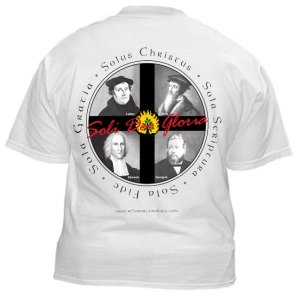
Tip of the iceberg! Other designs include each of these dead theologians alone, Credo, TULIP, simil justus et peccator. Click this image to see more.
The following is from the About Us page at Fort Worth’s Theological Pursuits Bookstore owner David Jacks’ new website, ReformationShirts.Com. Get yours today! I’ve got three of them myself.
About ReformationShirts.com
David Jacks, in 1995 while studying at SWBTS, circulated a shirt bearing the names and likenesses of Martin Luther, John Calvin, Jonathan Edwards and Charles Spurgeon. The shirt was affectionately known as the “Dead Theologians Society t-shirt.” Since that time, the “DTS” shirt has been re-vamped and has now taken the form of the shirt shown on this web site.
Reformation theology has played an important role in the history of Christianity. With the recent resurgence of Reformation theology, many adhering to the Doctrines of Grace search for ways to expose the world to their beliefs. This shirt “with a bunch of dead guys on the back of it” peaks the interest of onlookers and provides an excellent bridge for introducing these “dead guys'” Biblical beliefs.
About the Logo & Its History
The front of the shirt bears a likeness from the symbol of the 16th Century Protestant Reformation – a “burning bush” with the phrase “After Darkness, Light.” The “burning bush” symbol and the phrase were used by the Reformers to represent the light of the Gospel of Grace overcoming the darkness of the Law of Works propagated by the Roman Catholic Church in the centuries leading up to the Reformation.
The back of the shirt bears the names and likenesses of four of the best-known Protestant Reformers spanning a period of 400 years. A German monk named Martin Luther (1483-1546), whose heart was captured by the belief of Sola Fide (Faith Alone for one’s Justification), sparked the Protestant Reformation on October 31, 1517, when he nailed his 95 Theses to the door of the Cathedral in Wittenberg, Germany. Swiss theologian John Calvin (1509-1564) with his emphasis on God’s sovereignty and union with Christ, helped codify the teachings of the Reformation with his first edition of The Institutes of the Christian Religion in 1539. New England Puritan Jonathan Edwards (1703-1758), best known for his sermon “Sinners in the Hands of an Angry God” and his book Freedom of the Will, helped fan the spark of revival in The First Great Awakening and spread flames of salvation concerning the holiness and grace of God in America in the early to mid 18th century. Englishman preacher Charles Spurgeon (1834-1892) spread the Doctrines of Grace in the mid to late 19th century with his passionate and eloquent sermons on the sovereignty and grace of God.
These faithful men best symbolize in the Church’s recent history the beliefs summarized in the five Solas of the Protestant Reformation. These solas are found on the back of the shirt surrounding Luther, Calvin, Edwards and Spurgeon:
Sola Fide ~ Faith Alone
Sola Scriptura ~ Scripture Alone
Sola Gratia ~ Grace Alone
Soli Deo Gloria ~ Glory to God Alone
Solus Christus ~ Christ Alone
May you, too, be inspired and blessed by the truths conveyed on this shirt each time you wear it. And may your whole life be lived in loving obedience. Soli Deo Gloria – TO THE GLORY OF GOD ALONE!
Christology 101 by James White

Tuesday’s The Dividing Line podcast, by Reformed Baptist elder and apologist Dr. James R. White, features a 2 1/2 hour long discussion of the Christological controversies of the first several hundred years of church history. Today, churches by and large are negligent in informing their members on the facts of the church history. This makes the average Christian a viable target for informed unbelievers who are out to smear the truth of God’s infallible Word as it has been defended and preserved in the earthen vessels (2 Corinthians 4:7 KJV) of fallible servants of God and the church. Please take the time to listen to Dr. White’s summary of this important segment of Christian history warts and all, and share this with any believing friend who would benefit from the information that you think might actually listen to it. Click here to listen to “Christology 101”
How to Draw Distinctions

There are a number of especially common and compelling misconceptions about the Bible which are held by the unbelieving world. One of the more popular ones is using nonmoral Old Testament laws against the eternally binding moral laws. For instance, in arguing against the Christian’s appeal to the Old Testament’s prohibition of homosexuality, many will accuse us of inconsistency since we don’t also equally observe the Mosaic Laws against eating unclean animals like shellfish, or meat with blood in it. From my standpoint as one who grew up being instructed that there are distinctions between moral, civil and ceremonial laws, it looks like those not so informed don’t know how to draw simple distinctions. But the apostle Peter once wrote about the fact that uninformed people twist Scripture to their own destruction (2 Peter 3:16), so I guess it’s not uncommon for unbelievers to have such trouble with handling the Word of God correctly (2 Timothy 2:15).
URCNA Associate Pastor, WSC Professor of Systematic Theology and Apologetics, prolific author and host of The White Horse Inn radio show, Dr. Michael Horton has written an informative explanation of this distinction between Old Testament laws. He shows why and how some were typological and thus temporary, associated with the ancient Israelite theocracy until their fulfillment in the redemptive life and ministry of Israel’s Messiah, the Lord Jesus Christ. He also explains that others are eternally and universally binding on all people at all times and in all places as part of God’s way of informing the world of their common need for redemption in the same Messiah of Israel, the Lord Jesus Christ, since the Bible teaches that the wages of sin is death, but the free gift of God is eternal life in Christ Jesus our Lord (Romans 6:23). After his sacrificial death and miraculous resurrection, Christ has ascended to the right hand of God the Father enthroned in heaven to rule over all the nations spiritually, not geo-politically (John 18:36), through the preaching of the Law and the Gospel by calling out a people for his name (Acts 15:14) from every tongue, tribe and nation (Revelation 14:6).
In “Why Can’t I Own Canadians? Rightly Dividing the Word of Truth,” Horton writes (read the rest here):
The commands in the old covenant law (viz., Leviticus and Deuteronomy) are specific to that remarkable geo-political theocracy that foreshadowed the universal kingdom of Christ. The deliverance of Israel in the exodus anticipates a far greater exodus through the waters of death and hell in Christ. The holy wars pale in comparison with the judgment of the nations that Christ will execute at the end of the age. Even if Israel had been faithful to this covenant, Canaan would have only been a type or small-scale model of the extensiveness and intensiveness of God’s reign at the end of the age. Moses could not give God’s people rest in the land of everlasting Sabbath. As the prophets proclaim, this would only come when one greater than Moses would rescue his people and lead them victoriously into the perfect peace, love, and joy that he would win for his co-heirs.
Substantive Wallace Outweighs Populist Ehrman

Wallace/Ehrman Debate Stage
Saturday night, my son, a few friends and I, attended the debate between Dr. Daniel B. Wallace of the Center for the Study of New Testament Manuscripts (CSNTM) and Dr. Bart D. Ehrman, the best-selling rock star of unbelieving New Testament textual criticism at McFarlin Memorial Auditorium on the campus of Southern Methodist University (SMU). It was a very interesting and entertaining debate. Wallace has a much better sense of humor than the seemingly self-important Ehrman.
I’ve only got one observation about the debate. Just judging from the weightiness of each debater’s arguments, Wallace wins. Compared to Wallace’s informative presentation, Ehrman’s was much clearer, because he generally stayed on a much more simplistic level. While it’s easier to follow a simplistic presentation, it’s also easier to distort the truth in one. But you’d expect me to favor Wallace’s presentation. I agree with him on most of his defense of the New Testament.
But I won’t leave you completely without input from the debate. It turns out that the night of the debate was also the release date of Wallace’s latest book, Revisiting the Corruption of the New Testament: Manuscript, Patristic, and Apocryphal Evidence (2011, Kregel). This is a collection of academic essays by Wallace’s interns with an introductory chapter by Wallace which just happens to contain the information in Wallace’s arguments in Saturday night’s debate. I was able to purchase a pre-autographed copy, so I’ll share some of it with you.
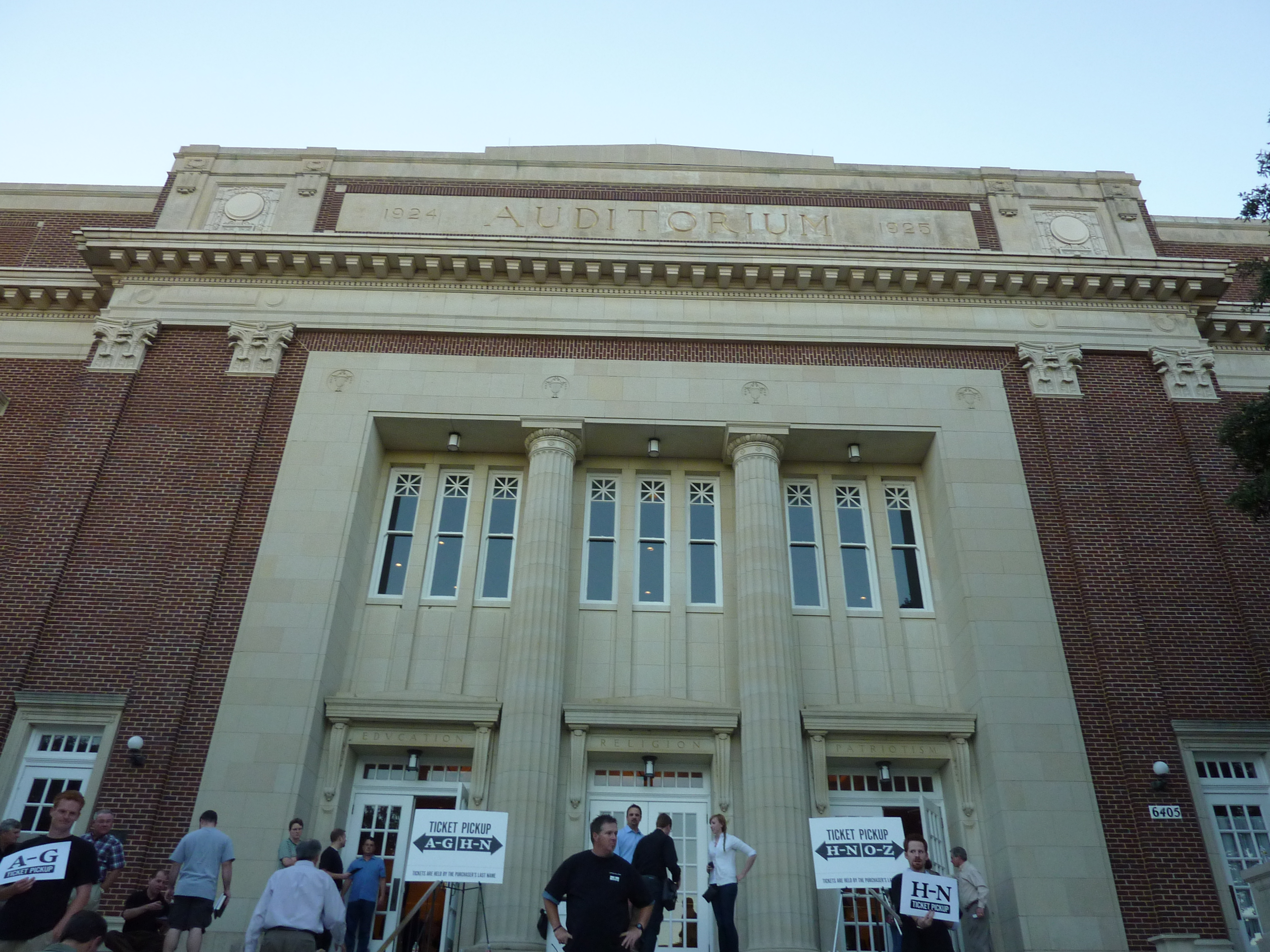
McFarlin Memorial Auditorium
In chapter one, “Lost In Transmission: How Badly Did the Scribes Corrupt the New Testament?” Wallace discusses the number and nature of variant readings, the theological issues involved with the issue of the variants, and the essential reliability of the New Testament manuscripts. You’ll be able to read an excerpt from this chapter at the end of this post.
Chapter two is called “The Least Orthodox Reading is to be Preferred: A New Canon for New Testament Textual Criticism?” by Philip M. Miller. He discusses the historical backdrop of this seeming modern canon of textual criticism, demonstrates Ehrman’s use of this canon, then critiques it, and discusses its value and role.
In chapter three, “The Legacy of a Letter: Sabellianism or Scribal Blunder in John 1.1c?” Matthew P. Morgan presents scribal habits as a “historical lens” on theological development in the early church. He focuses on the roots and rise of Sabellianism, the reactions of the Chruch Fathers to it. Then Morgan analyzes scribal habits in codices Regius and Freerianus, and finishes with a presentation on the grammatical viability of the textual variant in John 1.1c.
Adam G. Messer writes chapter four, “Patristic Theology and Recension in Matthew 24:36: An Evaluation of Ehrman’s Text-Critical Methodology.” According to Messer, those who discern ulterior motives in variants judged to have been purposely made by orthodox scribes, may be assuming too much. “Although any change is a deviation from the original, the difference in a clarification is that it typically better preserves the meaning and buttresses it against heretical counterfesance.”
Tim Ricchuiti has us “Tracking Thomas” in chapter five. In his chapter, Ricchuiti takes “A Text-Critical Look at the Transmission of the Gospel of Thomas.” This chapter provides the “Apocryphal Evidence” in Wallace’s subtitle. Ricchuiti’s “purpose [in this chapter is] (1) to conduct a comparison of the Greek fragments of the Gospel of Thomas to the full Coptic manuscript, (2) to assess the merit of the four manuscripts containing Thomas with respet to their originality, and (3) should the assessment yield fruit, to draw a few conclusions on the scholarly consensus regarding both the character of the Greek fragments versus the Coptic text and the amount of theological alteration present, particularly in Thomas, but more generally in noncanonical works as a whole” (page 226).
Finally, in chapter six, Brian Wright examines several New Testament texts which explicitly call Jesus “theos” or God, attempting to demonstrate that this was not a theological development, as many skeptics claim, but rather began with the first century New Testament writings.
This book looks very satisfying. Pick up a copy for yourself, if you’re inclined to this sort of reading. Now, with all of this in mind, the following is how Dr. Wallace not only introduces his book, but also his argument in the debate. With these words, he gives us sage advice.
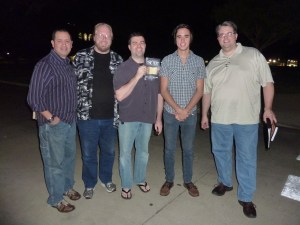
The Debate Spectators (L-R): Victor "I love you, man!" Loredo, Mike Bangs (great last name for a barber, right?), Daniel "Deep Ellum" Garlow (nephew of notorious Dominionist, Jim Garlow, but that's another post), John Brian "J.B." Chitty (lead singer of Denton Drive--click the pic to hear his "Upbeat Thrash Punk"--he says it's positive stuff), and your humble blogger who really needs to stand in back in future group photos.
Two Attitudes to Avoid
To begin with, there are two attitudes that we should try to avoid: absolute certainty and total despair. On the one side are King James Only advocates; they are absolutely certain that the KJV, in every place, exactly represents the original text. To be frank, the quest for certainty often overshadows the quest for truth in conservative theological circles and is a temptation that we need to resist. It is fundamentally the temptation of modernism. To our shame, evangelicals have too often been more concerned to protect our presuppositions than to pursue truth at all costs.
On the other side are a few radical scholars who are so skeptical that no piece of data, no hard fact, is safe in their hands. It all turns to putty because all views are created equal. If everything is equally possible, then no view is more probable than any other view. In Starbucks and on the street, in college classrooms and on the airwaves, you can hear the line “We really don’t know what the NT originally said since we no longer possess the originals and since there could have been tremendous tampering with the text before our existing copies were produced.”
But are any biblical scholars this skeptical? Robert Funk, the head of the Jesus Seminar, seemed to be. In The Five Gospels he said,
Even careful copyists make mistakes, as every proofreader knows. So we will never be able to claim certain knowledge of exactly what the original text of any biblical writing was.
The temporal gap that separates Jesus from the first surviving copies of the gospels—about one hundred and seventy-five years—corresponds to the lapse in time from 1776—the writing of the Declaration of Independence—to 1950. What if the oldest copies of the founding document dated only from 1950?
Funk’s attitude is easy to see: rampant skepticism over recovering the original wording of any part of the NT. This is the temptation of postmodernism. The only certainty is uncertainty itself. It is the one absolute that denies all the others. Concomitant with this is an intellectual pride—pride that one “knows” enough to be skeptical about all positions.
Where does Ehrman stand on this spectrum? I do not know. On the one hand, he has said such things as the following:
If the primary purpose of this discipline is to get back to the original text, we may as well admit either defeat or victory, depending on how one chooses to look at it, because we’re not going to get much closer to the original text than we already are.
… [A]t this stage, our work on the original amounts to little more than tinkering. There’s something about historical scholarship that refuses to concede that a major task has been accomplished, but there it is.
In spite of these remarkable [textual differences, scholars are convinced that we can reconstruct the original words of the New Testament with reasonable (although probably not 100 percent) accuracy.
The first statements were made at the Society of Biblical Literature in an address to text-critical scholars. The last is in a college textbook. All of this sounds as if Ehrman would align himself more with those who are fairly sure about what the wording of the autographic text is.
But here is what Ehrman wrote in his immensely popular book Misquoting Jesus:
Not only do we not have the originals, we don’t have the first copies of the originals. We don’t even have copies of the copies of the originals, or copies of the copies of the copies of the originals. What we have are copies made later—much later….And these copies all differ from one another, in many thousands of places….[T]hese copies differ from one another in so many places that we don’t even known (sic) how many differences there are.
We could go on nearly forever talking about specific places in which the texts of the New Testament came to be changed, either accidentally or intentionally. . . . [T]he examples are not just in the hundreds but in the thousands.
And here is what he wrote in another popular book, Lost Christianities:
The fact that we have thousands of New Testament manuscripts does not in itself mean that we can rest assured that we know what the original text said. If we have very few early copies—in fact, scarcely any—how can we know that the text was not changed significantly before the New Testament began to be reproduced in such large quantities?
The cumulative effect of these latter statements seems to be not only that we have no certainty about the wording of the original but that, even where we are sure of the wording, the core theology is not nearly as “orthodox” as we had thought. According to this line of thinking, the message of whole books has been corrupted in the hands of the scribes; and the church, in later centuries, adopted the doctrine of the winners—those who corrupted the text and conformed it to their own notion of orthodoxy.
So you can see my dilemma. I am not sure what Ehrman believes. Is the task done? Have we essentially recovered the wording of the original text? Or should we be hyperskeptical about the whole enterprise? It seems that Ehrman puts a far more skeptical spin on things when speaking in the public square than he does when speaking to professional colleagues.
These two attitudes—total despair and absolute certainty—are the Scylla and Charybdis that we must steer between.
(Daniel B. Wallace, ed. Revisiting the Corruption of the New Testament: Manuscript, Patristic, and Apocryphal Evidence, ©2011, Kregel. Pages 23-26)
Walking By Faith, Not By Sight (Matthew 20:29-34)

My daughter, Abigail, frequently announces that our pastor at Mid-Cities Presbyterian Church (OPC), Rev. Joe Troutman, is her favorite preacher. Mine, too, Abigail! I think I’ll begin posting links to his sermons so his exposition and application of God’s Word can build you up in your faith, or grant saving faith to those of you who may not already have it. I’ll include my notes of his remarks and sometimes will include a few of my own. Sunday, October 2, 2011, the text was Matthew 20:29-34 and the sermon was entitled, “Walking By Faith, Not By Sight.” (Listen here)
The Son of David, our Lord Jesus Christ, opens the eyes of the blind and sets his people free.
Blind Men Who Could See “And as they went out of Jericho, a great crowd followed him. And behold, there were two blind men sitting by the roadside, and when they heard that Jesus was passing by, they cried out, ’Lord, have mercy on us, Son of David!’” (Matthew 20:29-30 ESV)
- “Lord, have mercy!” This phrase was adapted and sung as Kyrie Eleison in Eastern Orthodox, Roman Catholic, Lutheran and Anglican liturgies, but according to church historian, Philip Schaff, “The Reformed liturgies dropped it altogether” (The New Schaff-Hertzog Encyclopedia of Religious Knowledge, “Liturgics,” page 503).
- Jesus approaches Jerusalem in military procession in anticipation of his triumphal entry. Blind men are bold to call out for him to stop. We are given such boldness by in faith in Christ, to call on God with our requests.
Lord Have Mercy “The crowd rebuked them, telling them to be silent, but they cried out all the more, ‘Lord, have mercy on us, Son of David!’ And stopping, Jesus called them and said, ‘What do you want me to do for you?’ They said to him, ‘Lord, let our eyes be opened’” (Matthew 20:31-33 ESV).
- How persistent are you in your prayers? If God will listen to a couple of blind beggars, he will certainly listen to his children who believe, worship and glorify him. These blind men have literally “walked by faith, not by sight.”
Mercy “And Jesus in pity touched their eyes, and immediately they recovered their sight and followed him” (Matthew 20:34 ESV).
- “Therefore the LORD waits to be gracious to you, and therefore he exalts himself to show mercy to you. For the LORD is a God of justice; blessed are all those who wait for him” (Isaiah 30:18 ESV).
- Healing these blind men was part of Christ’s mission; he was not sidetracked by their bold request.
- Christ’s touching the blind men to heal them was not necessary, but rather a benedictory laying on of hand.
- “[T]he LORD opens the eyes of the blind. The LORD lifts up those who are bowed down; the LORD loves the righteous” (Psalm 146:8 ESV).
- Their calling Christ the Son of David indicates their confession of faith in him as the Messiah who has come to save them. Healing is a sign of the deity of Christ who came so sinners who believe will have eternal life.
- The Lord Jesus Christ, the true King of Israel, does what we cannot: he gives spiritual sight to us who are spiritually blind, that we may see him as the coming Messiah who was born to die for our sins. May your eyes be opened, and may the Lord graciously grant you such saving faith!


 The Misadventures of Captain Headknowledge
Union with Christ and Justification
Happy Reformation Day! October 31, 2011 marks the 494th anniversary of the legendary event considered the spark that ignited the Protestant Reformation when Augustinian monk, Martin Luther, nailed the Disputation on the Power and Efficacy of Indulgences(commonly known as the 95 Theses) to the door of the castle church in Wittenberg, Germany in 1517. In the years that followed, Luther lead the movement to reform the church’s understanding of what the Bible teaches about the doctrine of justification by God’s grace alone, received through faith alone, in Christ alone, according to Scripture alone, to the glory of God alone. The Lutheran tradition would build on Luther’s work on justification, and they placed it at the center and starting point of all of the benefits of the redemption purchased
Purchase your Martin Luther T-Shirt from ReformationShirts.com
by Christ for his people. But biblical reformation of soteriology didn’t end with Luther and the Lutherans. The Reformed movement also grew alongside of the Lutheran movement, and while both were co-belligerents against the Roman doctrines of justification and the other benefits of redemption in Christ, they differed on the most biblical way to systematize these truths.
Friday on the Reformed Forum’s podcast, Christ the Center, Camden Bucey, Jim Cassidy and Jeff Waddington interviewed Dr. Lane Tipton, the new Charles Khrae Professor of Biblical and Systematic Theology at Westminster Theological Seminary in Philadelphia, Pennsylvania. Dr. Tipton was allowed two hours to spell out the differences between the Lutheran and Reformed approaches to justification and many current issues related to this essential aspect of Protestant theology, such as whether Dr. Michael Horton’s academic work on the subject is moving Reformed theology toward a more Lutheran, and therefore,according to Dr. Tipton, semi-Pelagian doctrine of justification. Listen to the podcast at this link.
I was introduced to Reformed theology by Michael Horton’s materials and the Lord used his parachurch ministries Christian United for Reformation (CURE) and the Alliance of Confessing Evangelicals (ACE) and the White Horse Inn radio show to gradually bring me around to embrace it. I will certainly be looking forward to a future Christ the Center program in which Dr. Horton responds to Dr. Tipton’s characterization of his work on justification and the other benefits of redemption in Christ. More public dialogue on this ought to take place, IMHO. At this point, Dr. Tipton’s case sounds convincing and more in line with the Reformed confessions and catechisms, as opposed to Dr. Horton’s efforts to, as I once heard him state on the air, build a kind of ecumenism between Reformed, Lutheran and Anglican traditions. I can see how some synthesis may be taking place in that effort. But what do I know?
Reformata, Semper Reformanda!
Share this: