Confessions of a Restlessly Reforming Evangelical Fundamentalist

Old Life--Home of the Nicotine Theological Journal. Picture by The Sacred Sandwich
Dig my latest comment at Darryl G. Hart’s Old Life Theological Society. His post is titled, “Young, Restless and Lutheran?” He questions whether the broad approach of the Young, Restless and Reformed movement isn’t so broad that it might be more accurate to call it “Young, Restless and Lutheran,” given that, in Hart’s view, it’s less about Reformed theology in general or the five points of Calvinism in particular (no pun intended), and more about having been inspired by a bigger vision of God at the hands of John Piper channeling Jonathan Edwards, and generally begins reminding us all how much less Reformed they are than he and his Truly Reformed OPC brethren are (among whom I eagerly anticipate numbering me and mine). This is my summary, anyway, be it accurate or not.
I found the post and some of the resultant comments engaging enough that I just had to share my own experience at moving from Fundamentalism, through Evangelicalism and into Reformed Confessionalism. Although I write with tongue-in-cheek, the experiences are all very real (and they’re just the tip of the iceberg).
Confessions of a Restlessly Reforming Evangelical Fundamentalist:
Fortunately, I bypassed the whole Piper YRR movement (Piper’s creative and independent streak is waaay too Baptist for my taste) and swallowed the whole TR thing hook, line and sinker…Or so I thought. The further one goes, the more one discovers which exaggerates the differences between what it means to be Evangelical (in modern Western Christianity, that is) and what it means to be Reformed.
First, you fall for the 5 points; then you get over the hump about baptism (my logic was, “if the seventeenth century Baptists agreed with Presbyterians on so much,” as I was then coming to perceive, “then what makes them think Presbyterians are so wrong about baptism?”)…
…then you deal with stuff like exclusive “Acapulco” psalmody, and, for me living in a region where there is no glut of Reformed churches, I take the lazy man’s approach and say this isn’t an issue I have the luxury of standing for, even if I were persuaded of it. And some of their arguments I do find attractively compelling. If it weren’t for those of the advocates of instrumental hymnody.
Now that I’m preparing to join an OPC church, and begin reading all this vast literature about this “splinter group” of a denomination, I feel I’ve come full circle in some ways back to a Presbyterian version of my separatistic IFB background (even the local church planting missions emphasis is reminiscent of the IFB, without the Faith Promise giving campaigns), if you consider some of you more outspoken OPC guys’ position and attitude about TGC and T4G.
Yes, growing up among separatistic fundamentalists, yet consuming my fair share of big tent Evangelical media, it is quite a process in coming to a point where you can confidently call yourself “Reformed” without crossing your fingers behind your back.
This Is No Texas Tall Tale
“J. Frank Norris Week” continues! Last night I joined David R. Stokes, author of The Shooting Salvationist: J. Frank Norris and the Murder Trial that Captivated America at the Fort Worth Sundance Square Barnes & Noble Bookstore, where he spoke for a few minutes before sitting down to sign books. The pictures in this post are from last night’s signing. The text is my semi-formal, though concise, review of the book, which has also been posted at the book’s Amazon.com page. As emotionally dependent as I have become on this book, it was hard for me to step back and write an objective review that is comparable to a professional, or at least experienced, reviewer’s work until I decided to recommend the book in an email to another writer, who shall remain nameless. I gave him the following summary, and decided that this is about as good a review as anyone’s ever going to get out of me. Hope you find it helpful, and feel free to help us spread the word about this story that has been gratefully recovered from historical obscurity.
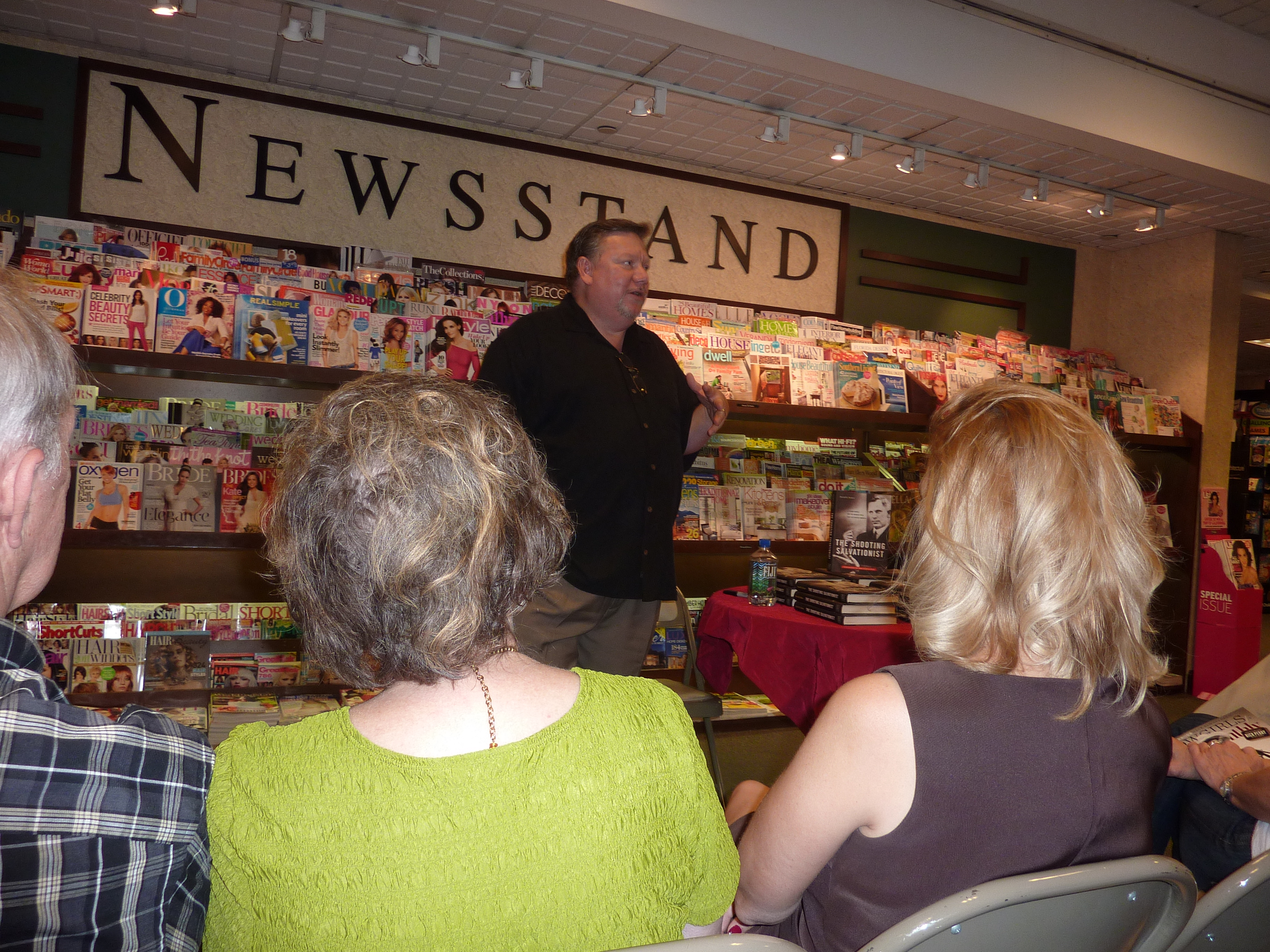
David R. Stokes speaks before his book signing at the Fort Worth Sundance Square Barnes& Noble two blocks from the site of Norris' shooting of Chipps
David R. Stokes is a columnist for Townhall.com. He is also a pastor of a non-denominational church in Fairfax, VA. He studied for the ministry at the same Missouri Bible College from which the late Jerry Falwell got his Bachelors degree before he moved on to bigger and better things. This Bible College, Baptist Bible College, to be precise, has its roots in the ministry of the man who is the subject of the book he is now promoting, The Shooting Salvationist: J. Frank Norris and the Murder Trial That Captivated America (2011 Steerforth Press).
Norris was the pastor of the First Baptist Church of Fort Worth Texas between the years 1909 and 1952 (the year of his death). In the early years of his ministry, he ditched the tame, sane, responsible approach to ministry in which one makes an effort to get along with everyone, for an approach that would generate so much heat it would draw huge crowds to him so he could introduce them to the Light, if you know what I mean. In the process, he was a self-appointed thorn in the side of the underground liquor and gambling interests in Texas, the budding theological liberalism in his alma mater, Baylor, the mayor of Ft. Worth and Star-Telegram founder and all-around entrepreneur Amon G. Carter. This got Norris in hot water with one of the mayor’s friends, another Ft. Worth business leader, Dexter Elliot Chipps, who stormed into Norris’ office one day, threatened to kill him, then walked out. Chipps’ mistake was that he didn’t keep going. He turned for some unknown reason and attempted to reenter the pastor’s office and was met with three or four bullets in the chest. The resulting 1926 murder trial was as big of a media circus as Norris’ hero, William Jennings Bryan’s, recent Skopes Monkey Trial had been, or for those of us in the 21st century, Casey Anthony’s.

Yours truly (left); David R. Stokes (right)
The book is a narrative non-fiction work. It reads somewhat like a novel, but all the dialogue, and much of the narration, even, is directly lifted from his sources which include not only older bios of Norris (pro and con), but much of the most prominent journalistic accounts, legal transcripts and records, as well as personal archives of Norris, Meacham and Carter. The outrageous tactics of Norris in his early ministry make for quite a train wreck, and the history is fascinating, but for folks like myself who grew up in Fort Worth, it gives a lot of new information to an old legend that has lingered in the background of all of our lives, and provides quite a bit of closure as well. I’d like to share with you this fascinating tale that we could only wish were nothing more than a “Texas Tall Tale.”
Politics, Religion and a Gun

David Stokes’ interview with 90.1FM KERA host Krys Boyd on her D/FW local NPR talk show, Think with Krys Boyd, has been uploaded. You can listen to it here.
And so, J. Frank Norris week continues at The Misadventures of Captain Headknowledge! Just wait until tomorrow…
The Shooting Salvationist Author Comes to Ft. Worth

Make that "Wednesday, July 20" at the Sundance Square Barnes & Noble in Ft. Worth
Fairfax, Virginia Baptist Bible Fellowship local church pastor David Stokes grew up as a member of Detroit’s Temple Baptist Church, not twenty years after J. Frank Norris pastored that church at the same time that he pastored First Baptist Church in Fort Worth, Texas. In his day, Norris was known as the “Texas Tornado,” and the “Pistol-Packing Parson.” The memory of J. Frank Norris casts a long shadow for those whose lives were touched by his sensationalistic and controversial ministry. It must be as true for those like Stokes who grew up in the decades following Norris’ death, as it is for us down here in Fort Worth, who boast of relatives with stories of personal connections to the famous fundamentalist firebrand. For example, my own mother grew up playing with Norris’ grandson, George. He was my mother’s best friend’s boyfriend. My great-grandmother hosted the visiting preacher at her house, where lively discussions are said to have ensued between Norris and my great-great grandmother, charming them with the admission that “the only person who could ever change his mind was Mrs. Freeman.” Not only that, J. Frank Norris even performed the wedding ceremony for my son’s great-grandparents on his mother’s side. For better or worse, J. Frank Norris is one of the more colorful cast members in the dramatic history of Fort Worth, Texas. Featuring his battle with the Southern Baptist Convention over Baylor University’s teaching evolution and his own personal war against corruption in local politics as well as the Prohibition-era liquor trade itself, I’ve always said, even as a one-time devoted follower, that the life story of J. Frank Norris would make a great gangster movie!
It looks like the novel on which that movie could be based has just been written by David Stokes. The book is called The Shooting Salvationist: J. Frank Norris and the Murder Trial that Captivated America (©2011 Steerforth Press). The only difference is, Stokes’ story is more of a courtroom drama. But that’s alright with me. At 1pm Central time today, Stokes will be interviewed on the local NPR station, 90.1FM KERA on “Think with Krys Boyd.” (you can sign up for the podcast here if you miss it live). Tomorrow night, from 7:00 to 9:00pm Central time, Stokes will hold a book signing at Barnes and Noble in Fort Worth’s Sundance Square just a few blocks away from the site of FBCFW during Norris’ ministry (see my previous post). On his Facebook page, Stokes reports “apparently there will be some “protesters” on Tuesday night when I speak at the Barnes and Noble in Fort Worth — should be interesting.” You can get familiar with one of those potential protesters at The J. Frank Norris Historical Society, started a year ago by a former associate of Norris’, Roy Emerson Falls.
If you’ve never heard of J. Frank Norris, or if you’ve always known about him–love him or hate him, you’ll be both shocked and in awe of the story of J. Frank Norris and the trial that failed to sentence Norris the electric chair for the death of Dexter Elliott Chipps.
The Shooting Salvationist Released Today!

2011 Steerforth Press--Foreword by Bob Scieffer of CBS News
Join me next Wednesday night, July 20 at the Barnes and Noble in Sundance Square in Fort Worth to meet the author of The Shooting Salvationist, David R. Stokes, get his autograph and/or a pic. I’m planning to post a review of the book just as soon as I finish my Advance Reading Copy. Probably next week.
PS–As an added bonus, you’ll probably also get to meet Rev. Roy E. Falls of The J. Frank Norris Historical Society protesting out front. When Stokes met him last year, he said he was sweet. A good time should be had by all (with the possible exception of Rev. Falls)!
Date: Wednesday, July 20, 2011
Start Time: 6:00 pm End Time: 8:00 pm
(Time Zone: US/Central)
Location: Barnes and Noble – Sundance Square
Category: The Shooting Salvationist Book Tour
Description
Phone: (817) 332-7178
Contact: Debby White
Email: debby@theshootingsalvationist.com
More Info: http://store-locator.barnesandnoble.com/store/2788
Barnes and Noble – Sundance Square
401 Commerce Street
Fort Worth TX 76102
Theological & Doxological Meditation #45

The First Commandment: Worship the Right God
Q. Which is the first commandment?
A. The first commandment is, Thou shalt have no other gods before me (Exodus 20:3; Deuteronomy 5:7).
God Is Known Among His People
(play file 066 in “T&D mp3″ sidebar widget)
#66, Trinity Hymnal (© 1990)
From Psalm 76
The Psalter 1912; alt. 1990, mod.
God is known among his people,
every mouth his praises fill;
From of old he has established
his abode onZion’s hill;
There he broke the sword and arrow,
bade the noise of war be still.
Excellent and glorious are you,
With your trophies from the fray;
You have slain the mighty warriors,
Wrapped in sleep of death are they;
When your anger once is risen,
Who can stand in that dread day?
When from heav’n your sentence sounded,
All the earth in fear was still,
While to save the meek and lowly
God in judgment wrought his will;
e’en the wrath of man shall praise you,
your designs it shall fulfill.
Vow and pay unto Jehovah,
Him your God forever own;
All men, bring your gifts before him,
Worship him, and him alone;
Mighty kings obey and fear him,
Princes bow before his throne.
The Alarm
Sinner, art thou still secure?
Wilt thou still refuse to pray?
Can thy heart or hands endure
In the Lord’s avenging day?
See his mighty arm is bar’d
Awful terrors clothe his brow;
For his judgment stand prepar’d;
Thou must either break or bow.
At his presence nature shakes,
Earth affrighted hastes to flee;
Solid mountains melt, like wax;
What will then become of thee?
Who his coming may abide?
You that glory in your shame,
Will you find a place to hide,
When the world is wrapp’d in flame?
Then the great, the rich, the wise,
Trembling, guilty, all condemned,
Must behold the wrathful eyes
Of the Judge they once blasphem’d.
Where are now their haughty looks?
Oh! Their horror and despair
When they see the open’d books
And the dreadful sentence hear.
Lord prepare us by thy grace;
Soon must we resign our breath
And our souls be called to pass
Through the iron gate of death
Let us now our day improve,
Listen to the gospel voice,
Seek the things that are above,
Scorn the world’s pretended joys.
O! When flesh and heart shall fail,
Let thy love our spirits cheer,
Strengthen’d thus we shall prevail
Over Satan, sin and fear.
Trusting in thy precious Name
May we thus our journey end;
Then our foes shall lose their aim
And the Judge will be our friend.
–from The Evangelical Primer, ninth edition, 1817 by Joseph Emerson


 The Misadventures of Captain Headknowledge
A Case Study in Sin
The following long, tedious post is a small way of demonstrating just how comprehensively God’s law condemns the sin of man. It highlights the depth and breadth of our fallen nature that is bent on violating God’s law in every conceivable manner, and shows just how much we all, believer and unbeliever alike, deserve God’s eternal anger and torment.
The following extensive description of what it means to keep God’s law also shows us just how thoroughly successful the Lord Jesus Christ was in keeping God’s law in every conceivable manner for his elect—those who come to believe.
Finally, it shows the many-faceted way in which we who believe and have been forgiven for such egregious, heinous sin, can express our gratitude for the active obedience of Christ in perfectly keeping God’s law for us, and for his passive obedience in suffering the penalty of divine wrath which such deep, dark, extensive sin deserves.
The church my family has been attending for the past year or more, has recently been going through the Heidelberg Catechism. Last Lord’s Day evening we recited, received instruction on, and discussed Lord’s Day 40, which consists of Question & Answer numbers 105-107, regarding what is required in the sixth commandment, “You shall not murder.”
Last night, the Lord showed me just how easy it is to violate the spirit of God’s command against murder. Several ladies converged on my house to carpool to a ladies meeting. One of those ladies brought her husband with her to stay with me and share a pizza and a movie while they are away. My wife and I used to attend another church with this couple, which church has a distinct reputation for hurting many of its members, and used to be a little more legalistic than it is today. In fact, in some ways, it appears to be changing into the very kind of church it used to stand against. Being a wounded former member of such a church provides many temptations to violate the spirit of God’s command against murder, namely by “dishonoring” and “hating” it in our “thoughts,” “words,” and “gestures” and “deeds,” as we neglect to “lay aside all desire of revenge.”
This kind of sin has become such a habit for me, in particular, that it didn’t dawn on me that this was what we were doing, not even when one of the other members who were in attendance last Sunday evening during the catechism discussion walked in, and I felt compelled to jokingly explain that we were having a little fun at our former church’s expense. It didn’t dawn on me until several hours later. Hence the occasion for the following post.
While it may appear so, this is not an exercise in self-flagellation, but, as I explained above, an amplification of the Heidelberg Catechism’s explanation of what the Bible teaches about what all God requires of us in the sixth commandment. May it open your eyes to the depth of your sin, the extent of Christ’s righteousness and grace, and may it guide you in expressing your loving gratitude for his free gift of righteousness which can only be received by faith in Christ.
Question 105. What does God require in the sixth commandment?
Answer: That neither in thoughts, nor words, nor gestures, much less in deeds, I dishonour, hate, wound, or kill my neighbour, by myself or by another: (Matt. 5:21-22;26:52; Gen. 9:6) but that I lay aside all desire of revenge: (Eph. 4:26; Rom. 12:19; Matt. 5:25; 18:35) also, that I hurt not myself, nor wilfully expose myself to any danger. (Rom. 13:14; Col. 2:23; Matt. 4:7) Wherefore also the magistrate is armed with the sword, to prevent murder. (Gen. 9:6; Ex. 21:14; Matt. 26:52; Rom. 13:4)
Question 106. But this commandment seems only to speak of murder?
Answer: In forbidding murder, God teaches us, that he abhors the causes thereof, such as envy, (Pr. 14:30; Rom. 1:29) hatred, (1 John 2:9,11) anger, (James 1:20; Gal. 5:19-21) and desire of revenge; and that he accounts all these as murder. (1 John 3:15)
Question 107. But is it enough that we do not kill any man in the manner mentioned above?
Answer: No: for when God forbids envy, hatred, and anger, he commands us to love our neighbour as ourselves; (Matt. 7:12; 22:39; Rom. 12:10) to show patience, peace, meekness, mercy, and all kindness, towards him, (Eph. 4:2; Gal. 6:1-2; Matt. 5:5,7,9; Rom. 12:18; Luke 6:36; 1 Peter 3:8; Col. 3:12; Rom. 12:10,15) and prevent his hurt as much as in us lies; (Ex. 23:5) and that we do good, even to our enemies. (Matt. 5:44-45; Rom. 12:20-21)
What does God require in the sixth commandment?
In the sixth commandment, God requires that I not dishonor my neighbor in my thoughts, but that I rather lay aside all desire of revenge;
In the sixth commandment, God requires that I not hate my neighbor in my thoughts, but that I rather lay aside all desire of revenge;
In the sixth commandment, God requires that I not wound my neighbor in my thoughts, but that I rather lay aside all desire of revenge;
In the sixth commandment, God requires that I not murder my neighbor in my thoughts, but that I rather lay aside all desire of revenge;
In the sixth commandment, God requires that I not dishonor my neighbor in my words, but that I rather lay aside all desire of revenge;
In the sixth commandment, God requires that I not hate my neighbor in my words, but that I rather lay aside all desire of revenge;
In the sixth commandment, God requires that I not wound my neighbor in my words, but that I rather lay aside all desire of revenge;
In the sixth commandment, God requires that I not murder my neighbor in my words, but that I rather lay aside all desire of revenge;
In the sixth commandment, God requires that I not dishonor my neighbor in my gestures, but that I rather lay aside all desire of revenge;
In the sixth commandment, God requires that I not hate my neighbor in my gestures, but that I rather lay aside all desire of revenge;
In the sixth commandment, God requires that I not wound my neighbor in my gestures, but that I rather lay aside all desire of revenge;
In the sixth commandment, God requires that I not murder my neighbor in my gestures, but that I rather lay aside all desire of revenge;
In the sixth commandment, God requires that I not dishonor my neighbor in my deeds, but that I rather lay aside all desire of revenge;
In the sixth commandment, God requires that I not hate my neighbor in my deeds, but that I rather lay aside all desire of revenge;
In the sixth commandment, God requires that I not wound my neighbor in my deeds, but that I rather lay aside all desire of revenge;
In the sixth commandment, God requires that I not murder my neighbor in my deeds, but that I rather lay aside all desire of revenge;
In the sixth commandment, God requires that I not be a party to another who would dishonor my neighbor in his thoughts, but that I rather lay aside all desire of revenge;
In the sixth commandment, God requires that I not be a party to another who would hate my neighbor in his thoughts, but that I rather lay aside all desire of revenge;
In the sixth commandment, God requires that I not be a party to another who would wound my neighbor in his thoughts, but that I rather lay aside all desire of revenge;
In the sixth commandment, God requires that I not be a party to another who would murder my neighbor in his thoughts, but that I rather lay aside all desire of revenge;
In the sixth commandment, God requires that I not be a party to another who would dishonor my neighbor in his words, but that I rather lay aside all desire of revenge;
In the sixth commandment, God requires that I not be a party to another who would hate my neighbor in his words, but that I rather lay aside all desire of revenge;
In the sixth commandment, God requires that I not be a party to another who would wound my neighbor in his words, but that I rather lay aside all desire of revenge;
In the sixth commandment, God requires that I not be a party to another who would murder my neighbor in his words, but that I rather lay aside all desire of revenge;
In the sixth commandment, God requires that I not be a party to another who would dishonor my neighbor in his gestures, but that I rather lay aside all desire of revenge;
In the sixth commandment, God requires that I not be a party to another who would hate my neighbor in his gestures, but that I rather lay aside all desire of revenge;
In the sixth commandment, God requires that I not be a party to another who would wound my neighbor in his gestures, but that I rather lay aside all desire of revenge;
In the sixth commandment, God requires that I not be a party to another who would murder my neighbor in his gestures, but that I rather lay aside all desire of revenge;
In the sixth commandment, God requires that I not be a party to another who would dishonor my neighbor in his deeds, but that I rather lay aside all desire of revenge;
In the sixth commandment, God requires that I not be a party to another who would hate my neighbor in his deeds, but that I rather lay aside all desire of revenge;
In the sixth commandment, God requires that I not be a party to another who would wound my neighbor in his deeds, but that I rather lay aside all desire of revenge;
In the sixth commandment, God requires that I not be a party to another who would murder my neighbor in his deeds, but that I rather lay aside all desire of revenge;
In the sixth commandment, God requires that I not hurt myself;
In the sixth commandment, God requires that I not willfully expose myself to any danger;
For this reason, God has granted the right to human government alone to put murderers to death, as the just punishment of murder, and as a deterrent to murder by others.
But this commandment seems only to speak of murder?
In forbidding murder, God teaches us that he abhors envy as the cause of murder, and that he accounts it as murder;
In forbidding murder, God teaches us that he abhors hatred as the cause of murder, and that he accounts it as murder;
In forbidding murder, God teaches us that he abhors anger as the cause of murder, and that he accounts it as murder;
In forbidding murder, God teaches us that he abhors desire of revenge as the cause of murder, and that he accounts it as murder;
But is it enough that we do not kill any man in the manner mentioned above?
No: for when God forbids envy, he commands us to love our neighbor as ourselves;
No: for when God forbids envy, he commands us to to show patience towards our neighbor;
No: for when God forbids envy, he commands us to to show peace towards our neighbor;
No: for when God forbids envy, he commands us to to show meekness towards our neighbor;
No: for when God forbids envy, he commands us to to show mercy towards our neighbor;
No: for when God forbids envy, he commands us to to show all kindness towards our neighbor;
No: for when God forbids envy, he commands us to to prevent his hurt as much as lies in us;
No: for when God forbids envy, he commands us to to do good to our neighbor, even to our enemy;
No: for when God forbids hatred, he commands us to love our neighbor as ourselves;
No: for when God forbids hatred, he commands us to to show patience towards our neighbor;
No: for when God forbids hatred, he commands us to to show peace towards our neighbor;
No: for when God forbids hatred, he commands us to to show meekness towards our neighbor;
No: for when God forbids hatred, he commands us to to show mercy towards our neighbor;
No: for when God forbids hatred, he commands us to to show all kindness towards our neighbor;
No: for when God forbids hatred, he commands us to to prevent his hurt as much as lies in us;
No: for when God forbids hatred, he commands us to to do good to our neighbor, even to our enemy;
No: for when God forbids anger, he commands us to love our neighbor as ourselves;
No: for when God forbids anger, he commands us to to show patience towards our neighbor;
No: for when God forbids anger, he commands us to to show peace towards our neighbor;
No: for when God forbids anger, he commands us to to show meekness towards our neighbor;
No: for when God forbids anger, he commands us to to show mercy towards our neighbor;
No: for when God forbids anger, he commands us to to show all kindness towards our neighbor;
No: for when God forbids anger, he commands us to to prevent his hurt as much as lies in us;
No: for when God forbids anger, he commands us to to do good to our neighbor, even to our enemy.
Share this: