What Do You Listen For?

“In all our preaching, we must never lose sight of the hill called Calvary, where the Son of Man was killed in our place. Regardless of the text or topic at hand, there must be some view of Calvary in every sermon. Your congregation should experience the amazing and comforting sight of the crucified Savior each and every time you preach. They sould anticipate the sight of Calvary in every sermon, and rejoice when it comes into view. And all the more, when the cross is not immediately obvious in the text. ‘Where is the hill?’ they should be asking. ‘Where is that blessed hill on which our precious Savior died?’ We should exalt Christ’s finished work in our sermons so as to comfort the converted and convict the unbeliever.
“Spurgeon’s example should inspire us: ‘I received some years ago orders from my Master to stand at the foot of the cross until he comes. He has not come yet, but I mean to stand there until he does’ (C. H. Spurgeon, “The Old, Old Story,” The Spurgeon Archive, http://www.spurgeon.org/sermons/0446.htm (accessed July 2006)). Let us stand with the Prince of Preachers, gentlemen. As we preach the whole counsel of God, let us keep the cross central–by doing so, we will indeed be watching our doctrine.”
Theological and Doxological Meditation #26

Theological and Doxological Meditation #25

Famous Anabaptist Leaders and Their Distinctives
 Once again, Dr. Jack Arnold introduces our subject, with a more detailed treatment of it by Dr. Thomas Lindsay. These figures may be considered the “top of the food chain” when it comes to the diverse world of Anabaptist doctrine and practice.
Introduction
As a whole, the Anabaptist movement centered around the common people who wanted the simplicity of New Testament Christianity. However, some outstanding, educated men were leaders among the Anabaptists.
Conrad Grebel Grebel was a prominent member of the church in Zurich. He had been led to the evangelical faith by Zwingli, and heartily approved his work of reforma-tion. But he soon became disappointed with Zwingli and Luther because he felt the church was not being reformed along New Testament lines. In January, 1525, a man named Blaurock asked Grebel to baptize him again, although he had been baptized in infancy. Grebel complied. Thereupon, Blaurock rebaptized others. Thus the Anabaptist movement had its beginnings with Conrad Grebel.
Balthasar Hubmaier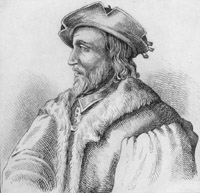 Hubmaier was one of the better educated men of his day, having received his doctorate in theology. He was a priest, and, during his pastorate in Walshut, a great change came over him as he studied the New Testament. He found many things he had been doing were not biblical, and he began to preach reform. Hubmaier’s conscience began to bother him about the Bible’s teachings about baptism, the purity of the church, the new birth, discipleship, and evangelism. Hubmaier rebaptized his entire congregation of 300, and the church renounced all fellowship with Rome. He believed in evangelistic preaching, and went into Moravia where thousands were saved. Hubmaier was probably one of the few Anabaptist leaders who believed in election and predestination. He died a martyr in 1527, and two years later his wife was strangled and thrown in a river.
Jacob Hutter Hutter was a godly man who preached in Austria, Moravia, and Poland until his martyrdom in 1536. He founded a sect called the Hutterites. A group of modern Hutterites in Canada are pictured here.
Menno Simons Simons was a humble man who lived a hard life. A priest of the Roman Catholic Church, he left by his own choice around 1536, believing he could no longer live with his conscience as a Roman Catholic, He felt that neither the Catholics nor the Reformed Church did much for the inner life of a man, that it was all externalism and hypocrisy. He opposed the fanaticism of his day, and could not understand why Christians persecuted one another. He had many struggles over discipleship and holy living, and truly believed that dedicated Christians would receive persecution from the world. Followers of Menno Simon’s teachings came to be called Mennonites, and their work later spread to Russia, the United States and Canada. The Mennonites have always been pacifists, and are earnest, industrious Christians, who have often lived in communal settlements.
The Anabaptist Movement takes shape
This quiet Evangelical movement assumed a more definite form in 1524. Before that date the associations of pious people acted like the Pietists of the seventeenth or the Wesleyans of the eighteenth century. They associated together for mutual edification; they did not obtrusively separate themselves from the corrupt or slothful Church. But in June 1524, delegates representing a very wide circle of “praying assemblies” or Readings met at Waldshut, in the house of Balthasar Hubmaier, bringing their Bibles with them, to consult how to organize their Christian living on the lines laid down in the New Testament. No regular ecclesiastical organisation was formed. The Brethren resolved to separate from the Papal Church; they published a Directory for Christian living, and drew up a statement of principles in which they believed. Amongst other things, they protested against any miraculous efficacy in the Sacraments in general, and held that Baptism is efficacious only when it is received in faith. This led afterwards to the adoption of Baptist views. A second conference was held at Augsburg in 1526, which probably dates the time when adult-baptism became a distinctive belief among all the Brethren. This conference suggested a General Synod which met at Augsburg in 1527 (Aug.), and included among its members, delegates from Munich, Franconia, Ingolstadt, Upper Austria, Styria, and Switzerland. There they drew up a statement of doctrinal truth, which is very simple, and corresponds intimately with what is now taught among the Moravian Brethren. Their Hymnbook does not bear any traces of the errors in doctrine usually attributed to them. Its chief theme is the love of God awakening our love to God and to our fellow-men. Instead of infant baptism they had a ceremony in which the children were consecrated to God. Baptism was regarded as the sign of conversion and of definite resolve to give one’s self up to the worship and service of God. It was administered by sprinkling; the recipient knelt to receive it in the presence of the congregation. The Holy Supper was administered at stated times, and always after one or two days of solemn preparation. Their office-bearers were deacons, elders, masters and teachers, or pastors. They distinguished between pastors who were wandering evangelists and those who were attached to single congregations. The latter, who were ordained by the laying on of hands, alone had the right to dispense the Sacraments. All the deacons, elders, and pastors belonging to communities within a prescribed district, selected from among themselves delegates who formed their ecclesiastical council for the district, and this council elected one of the pastors to act as Bishop or Superintendent. It was the Superintendent who ordained by laying on of hands. The whole of the Brethren were governed ecclesiastically by a series of Synods corresponding to those in the Presbyterian Churches. This organisation enabled the Anabaptists to endure the frightful persecution which they were soon to experience at the hands of the papal and Lutheran State Churches.
Ignorant? No! Fanatics? . . .
The chief leaders were Balthasar Hubmaier and Hans Denck. Hubmaier was a distinguished scholar. He became, at an unusually early age, Professor of theology at Ingolstadt (1512); he was Rector of the famous High School in that city (1515); and Cathedral preacher at Regensburg (Ratisbon) (1516). In 1519, feeling that he could no longer conscientiously occupy such positions, he retired to the little town of Waldshut. Hans Denck was a noted Humanist, a member of the “Erasmus circle” at Basel, and esteemed the most accurate Greek scholar in the learned community. Conrad Grebel, another well-known Anabaptist leader, also belonged to the “Erasmus circle,” and was a member of one of the patrician families of Zurich. Like Hubmaier and Denck, he gave up all to become an evangelist, and spent his life on long preaching tours. These facts are sufficient to refute the common statement that the Anabaptists were ignorant fanatics.
Mystical Denck
Perhaps Denck was the most widely known and highly esteemed. In the summer of 1523 he was appointed Rector of the celebrated Sebaldus School in Nurnberg. In the end of 1524 he was charged with heresy, and along with him Jorg Penz, the artist, the favourite pupil of Albert Durer, and four others. Denck was banished from the city, and his name became well known. This trial and sentence was the occasion of his beginning that life of wandering evangelist which had among other results the conferences in 1526 and 1527, and the organisation above described. Denck had drunk deeply at the well of the fourteenth and fifteenth century Mystics, and his teaching was tinged by many of their ideas. He believed that there was a spark of the divine nature in man, an Inner Word, which urged man to walk in the ways of God, and that man could always keep true to the inward monitor, who was none else than Christ. The accounts given of some of his addresses seem to be echoes of Tauler’s famous sermon on the Bridegroom and the Bride, for he taught that the sufferings of the faithful are to be looked upon as the love-gifts of the Saviour, and are neigher to be mourned nor resisted. We are told in the quaint Chronicle of Sebastian Franck, that the Baptist current swept swiftly through the whole land; many thousands were baptized, and many hearts drawn to them. “For they taught nothing but love, faith, and crucifixion of the flesh, manifesting patience and humility under many sufferings, breaking bread with one another in sign of unity and love, helping one another with true helpfulness, lending, borrowing, giving, learning to have all things in comon, calling each other ‘brother.’ ” (Chronica (Augsburg edition, 1565), f. 164.) He adds that they were accused of many things of which they were innocent, and were treated very tyrannically.
Anabaptist Individualism Defies Classification
The Anabaptists, like the earlier Mystics, displayed a strong individuality; and this makes it impossible to classify their tenets in a body of doctrine which can be held to express the system of intellectual belief which lay at the basis of the whole movement. We have three contemporary accounts which show the divergence of opinion among them–two from hostile and one from a sympathetic historian. Bullinger (Der Wiedertauferen Ursprung, Furgang, Secten, etc. (Zurich, 1560)) attempts a classification of their different divisions, and mentions thirteen distinct sects within the Anabaptist circle; but they manifestly overlap in such a way as to suggest a very large amount of difference which cannot be distinctly tabulated. Sebastian Franck (Chronica (3 pts., Strassburg, 1531)) notes all the varieties of views which Bullinger mentions, but refrains from any classification. “There are,” he says, “more sects and opinions, which I do not know and connot describe, but it appears to me that there are not two to be found who agree with each other on all points.” Kessler (Sabbata (ed. by Egli and Schoch, St. Gall, 1902)), who recounts the story of the Anabaptists of St. Gallen, notes the same great variety of opinions.
Identifying the Leading (though not universal) Ideas
It is quite possible to describe the leading ideas taught by a few noted men and approved of by their immediate circle of followers, and so to arrive with some accuracy at the popularity of certain leading principles among different parties, but it must be remembered that no great leader imposed his opinions on the whole Anabaptist circle, and that the views held at different times by prominent men were not invariably the sentiments which lay at the basis of the whole movement.
Passive Resistance
The doctrine of passive resistance was held by almost all the earlier Anabaptists, but it was taught and practised in such a great variety of ways that a merely general staement gives a misleading idea. All the earlier Anabaptists believed that it was unchristian to return evil for evil, and that they should take the persecutions which came to them without attempting to retaliate. Some, like the young Humanist, Hans Denck, pushed the theory so far that they believed that no real Christian could be either a magistrate or a soldier. A small band of Anabaptists, to whom one of the Counts of Lichtenstein had given shelter at Nikolsburg, told their protector plainly that they utterly disapproved of his threatening the Austrian Commissary with armed resistance if he entered the Nikolsburg territory to seize them. In short, what is called “passive resistance” took any number of forms, from the ordinary Christian maxim to be patient under tribulation, to that inculcated and practised by the modern sect of Dunkhers.
Melchior’s Millennial Madness and Commitment to Christian Charity
The followers of Melchior Hoffman, called “Melciorites,” held apocalyptic or millenarian views, and expected in the near future the return of Christ to reign over His saints; but there is no reason to suppose that this conception was very widely adopted, still less that it can be called a tenet of Anabaptism in general. All the Anabaptists inculcated the duty of charity and the claims of the poor on the richer members of the community; but that is a common Christian precept, and does not necessarily imply communistic theories or practices. All that can be definitely said of the whole Anabaptist circle was that they did kneep very clearly before them the obligations of Christian love. The so-called Communism in Munster will be described later.
Primitive Christianity the Goal . . . was it reached?
When we examine carefully the incidental records of contemporary witnesses observing their Anabaptist neighbours, we reach the general conclusion that their main thought was to reproduce in their own lives what seemed to them to be the beliefs, usages, and social practices of the primitive Christians. Translations of the Bible and of parts of it had been common enough in Germany before Luther’s days. The “common man,” especially the artisan of the towns, knew a great deal about the Bible. It was the one book he read, re-read, and pondered over. Fired with the thoughts created in his mind by its perusal, simple men felt impelled to become itinerant preachers. The “call” came to them, and they responded at once to what they believed to be the divine voice. Witness Hans Ber of Alten-Erlangen, a poor peasant. he rose from his bed one night and suddenly began to put on his clothes. “Whither goest thou?” asked his poor wife. “I know not; God knoweth,” he answered. “What evil have I done thee? Stay and help me to bring up my little children.” “Dear wife,” he answered, “trouble me not with the tings of time. I must away, that I may learn the will of the Lord” (C. A. Cornelius, Geschichte des Munsterischen Aufruhrs (Leipzig, 1855), ii. 49.). Such men wandered about in rude homespun garments, often barefooted, their heads covered with rough felt hats. They craved hospitality in houses, and after supper produced their portions of the Bible, read and expounded, then vanished in the early morning. We are told how Hans Hut came to the house of Franz Strigel at Weier in Franconia, produced his Bible, read and expounded, explained the necessity of adult baptism, convinced Strigel, the house father, and eight others, and baptized them there and then. He wandered forth the same night. None of the baptized saw him again; but the little community remained–a small band of Anabaptists (ibid, ii. 49). (Lindsay, pp. 434-439)
Theological and Doxological Meditations #24
 Christ’s Prophetic Office
Q. How does Christ execute the office of a prophet?
A. Christ executes the office of a prophet,
in revealing to us,
by his word and Spirit,
the will of God for our salvation
(John 1:18; 15:15; 20:31; 1 Peter 1:10-12).
I Heard the Voice of Jesus Say
Horatius Bonar, 1846
#304, Trinity Hymnal (© 1990)
I heard the voice of Jesus say,
“Come unto me and rest;
lay down, O weary one, lay down
your head upon by breast.”
I came to Jesus as I was,
weary and worn and sad;
I found in him a resting place,
and he has made me glad.
I heard the voice of Jesus say,
“Behold, I freely give
the living water; thirsty one,
stoop down and drink, and live.”
I came to Jesus, and I drank
of that life-giving stream;
my thirst was quenched, my soul revived,
and now I live in him.
I heard the voice of Jesus say,
“I am this dark world’s Light;
look unto me, your morn shall rise,
and all your day be bright.”
I looked to Jesus and I found
in him my Star, my Sun;
and in that light of life I’ll walk,
till trav’ling days are done.
On this day in Christian History: November 3, 75…

Introducing the Anabaptists

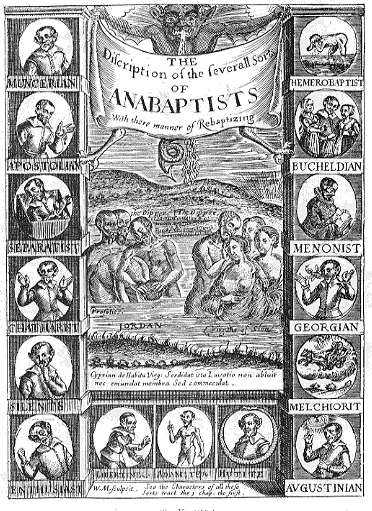
I’ve had a couple of requests (like I’m an expert?) to post some information about the Anabaptists. It’s been a long time coming, but here it is. First, I’ll feature some information from the late Dr. Jack Arnold, President of Equipping Pastors International, and Pastor Emeritus of Covenant Presbyterian Church, Oviedo, FL from his series Reformation Men and Theology, lessons 10 and 11. Then, I’ll supplement Dr. Arnold’s info with that of Dr. Thomas Lindsay, Principal, The United Free Church College, Glasgow, Scotland from a chapter in his book A History of the Reformation, volume II: The Reformation in Switzerland, France, the Netherlands, Scotland and England, The Anabaptist and Socinian Movements and the Counter-Reformation. (1928)
Dr. Arnold writes . . .
The Anabaptists were separatists who rejected infant baptism and believed that the outward, external church should consist only of saved and baptized believers. They would rebaptize those who professed Christ who had previously been baptized as infants. The preposition ana means “again,” thus Anabaptists were those who “baptized again.”
The Anabaptist movement officially began around 1522 in Zurich, Switzerland, when certain men wanted the Reformation to proceed more quickly and to be patterned more along New Testament lines than along those pursued by Ulrich Zwingli. Thus, there was a break between Zwingli and these more radical reformers.
It is very difficult to classify the Anabaptists as a single group, for there was wide diversity among them. Some were fanatics and heretics who brought great shame to the work of the Reformation, but others were not nearly so extreme and fanatical. Some were pantheistic, some extremely mystical, some anti-Trinitarian, some extreme millennialists, while others were quite biblical in most areas of their theology. A good majority of the Anabaptists were spiritual people, dedicated to Christ. They were devoted students of the Bible who felt the Reformers were not purifying the church quickly enough or properly applying the principles taught in the New Testament. The original Anabaptists were called “Brethren” or “The Company of the Committed.”
The Anabaptists were probably the least understood and most persecuted of all the groups of the early Reformation era. The Catholics, Lutherans and Calvinists opposed them violently.
Dr. Lindsay elaborates . . .
MULTI-FACETED NATURE OF THE MOVEMENT
It is neither safer nor easy to make abrupt general statements about the causes or character of great popular movements. The elements which combine to bring them into being and keep them in existence are commonly as innumerable as the hues which blend in the colour of a mountain side. Anabaptism was such a complicated movement that it presents peculiar difficulties. As has been said, it had a distinct relation to two different streams of medieval life, the one social and the other religious–the revolts of peasants and artisans, and the successions of the Brethren.
SOCIAL ASPECT–ONGOING CLASS WARFARE
From the third quarter of the fifteenth century social uprisings had taken place almost every decade, all of them more or less impregnated with crude religious beliefs. They were part of the intellectual and moral atmosphere that the “common man,” whether in town or country district, continuously breathed, and their power over him must not be lost sight of. The Reformation movement quickened and strengthened these influences simply because it set all things in motion. It is not possible, therefore, to draw a rigid line of separation between some sides of the Anabaptist movement and the social revolt; and hence it is that there is at least a grain of truth in the conception that the Anabaptists were the revolutionaries of the times of the Reformation.
RELIGIOUS ASPECT–ANTI-CLERICAL, CHARITABLE, “PLAIN” AND SIMPLE
On the other hand, there are good reasons for asserting that the distinctively religious side of Anabaptism had little to do with the anarchic outbreaks. It comes in direct succession from those communities of pious Christians, who, on the testimony of their enemies, lived quiet God-fearing lives, and believed all the articles in the Apostles’ Creed; but who were strongly anti-clerical. They lived unobtrusively, and rarely appear in history save when the chronicle of some town makes casual mention of their existence, or when an Inquisitor ferreted them out and records their so-called heresies. Their objections to the constitution and ceremonies of the medieval Church were exactly those of the Anabaptists of the sixteenth century; and if we do not find a universal repudiation of infant baptism, there are traces that some did not approve of it. They insisted that the service ought to be in the vulgar tongue; they objected to all the Church festivals; to all blessing of buildings, crosses, and candles; they alleged that Christ did not give His Apostles stoles or chasubles; they scoffed at excommunications, Indulgences, and dispensations; they declared that there was no regenerative efficacy in infant baptism; and they were keenly alive to all the injunctions of Christian charity–it was better, they said, to clothe the poor than to expend money on costly vestments or to adorn the walls of Churches, and they kept up schools and hospitals for lepers. They met in each other’s houses for public worship, which took the form of reading and commenting upon the Holy Scriptures.
MEDIEVAL ORIGINS, DIDACTIC & APOLOGETIC PRACTICES
As we are dependent on very casual sources of information, it is not surprising that we cannot trace their continuous descent down to the period of the Reformation; but we do find in the earlier decades of the sixteenth century notices of the existence of small praying communities, which have all the characteristics of those recorded in the Inquisitors’ reports belonging to the end of the fourteenth or beginning of the fifteenth centuries. They appeared in Basel in 1514, in Switzerland in 1515, in Mainz in 1518, and in Augsburg somewhat earlier. By the year 1524, similar “praying circles” were recorded as existing in France, in the Netherlands, in Italy, in Saxony, in Franconia, at Strassburg, and in Bohemia. They used a common catechism for the instruction of their young people which was printed in French, German, Bohemian, and perhaps Italian. In Germany, the Bible was the German Vulgate (a German translation of the Latin Vulgate, jdc)–a version retained among the Anabaptists long after the publication of Luther’s. They exhibited great zeal in printing and distributing the pious literature of the Friends of God of the fourteenth and fifteenth centuries. Many of them taught Baptist views, though the tenets were not universally accepted, and they were already called Anabaptists or Katabaptists–a term of reproach. Some of their more distinguished leaders were pious Humanists, and thier influence may perhaps be seen in the efforts made by the Brethren to print and distribute the Defensor Pacis of Marsiglio of Padua
(Lindsay, pp. 432-434).


 The Misadventures of Captain Headknowledge